Ἡρακλεία
Jamie Barras
STRONG MAN AS KNIGHT ERRANT. HERCULES AND THE KIDDIES, NORTHAMPTON'S NEW HERO. His Herculean labours over for the night, Mr. Fulton Morrison, the American strong man, stood in the wings chewing a cigar and watching the spectacle "China,” wherein some 50 children, the children of Northampton's very poor, played at being little Chinamen and little Chinawomen. That ended, he went to seek his money. He found the assistant manager pale and distraught. The manager, he said, had cleared the boxes of all the gold and silver, and was nowhere to be found.[1]
Edward “Hercules” Morrison’s finest hour came on a cold January day in 1901. The co-proprietor of the Northampton music hall at which he was appearing ran off with the takings, leaving several of the performers in dire straits. Morrison stepped up and settled the bills of the worst-affected.[2] This was a rare “hero” moment for a man who would have several scrapes with the law. He was motivated to act to help the child performers, he said, by thoughts of his own son back home in London. However, his children would not always be at the forefront of his thoughts. He was, in short, a complicated man.
The name of the newcomer is Edwin Fulton Morrison, and he is known throughout America as the American Hercules. Of Scotch and North American Indian origin, he was born in Washington, February 27, 1875. His mother was the daughter of Sitting Bull, the great American chief, who was killed in the Sioux rising of 1891 by the United States soldiers. The American Hercules was educated at the Harvard University, where he took the degree of MA. At nine years of age he won distinction as an athlete. He was captain for three sessions of the Harvard baseball team, holds the Harvard-Yale football medal for 1887, and numbers of medals and prizes as boxer, wrestler, and is an expert in running and cycling, and was dubbed by the students whilst he was training for the medical profession, the Hercules of the college.[3]
In common with many music hall turns, the story of his origins and early life that Morrison presented to the public was pure guff, a bit of business that was as much a part of his act as his feats of strength. If Morrison’s fiction went further than most, it was because of his true origins and the society in which he lived and in which he tried to make a living. Still, it went very far indeed. Edward Fulton Morrison (1874–1942) was, in all probability, born in Tuscaloosa, Alabama, in 1874, the son of Sarah Morrison, a woman of African American heritage, and an unknown father. It is worth noting that this would have made him 13 in 1887, when he allegedly turned out for Harvard against Yale, and 15 in 1889, when, according to another part of his story, he gave up practising medicine to go on the stage.[4]
Note the date he gave for his birth in the report above: 27 February. This will become important later.
The best evidence we have for his true origins is the will of his brother (or half-brother), Benjamin Franklin Morrison (1869–1930). Benjamin Morrison left the bulk of his estate to his beloved wife, Julia, and daughter, Edith. However, he also left property to his sister, Susie, and the princely sum of $1 to his “brother, Edward Fulton Morrison, whose last known address was London, England”. We can trace Benjamin Franklin Morrison back through public records to Tuscaloosa, Alabama, where his sister, Susie, was still living at the time of his death. The middle name “Franklin” will make repeated appearances in this story.[5]
In official records and in the language of the time, Benjamin Franklin Morrison’s race was recorded as “black” or “coloured”. Although we cannot discount the possibility of a North American Indian element to the Morrison heritage, we can at least be confident that it was not the binary that Edward/Edwin Fulton Morrison presented in his fictionalised biography: he did not have a Scottish father, and his mother was not the daughter of Sitting Bull.[6]
Instead, we see in Edward Fulton Morrison another example from the end of the nineteenth century of a performing artist of African American heritage active in Europe who found it advantageous personally and professionally to present themselves as Native American. This places Morrison in the same company as Carlisle “Chief Kawbawgam” Williams, Maymie “Manitza Losoros” Calloway, and Willis “Mystery” Gauze, all of whom I have already written about in this series.[7]
As I have also written, the motivation for these acts of ethnic switching are clear: it was partly because performers of Native American heritage were in vogue, particularly in Europe, and partly because, in the late nineteenth/early twentieth century, in the entirely spurious racial hierarchy created by people of European heritage, North American Indians, at least as individuals, were deemed worthy of better treatment than people of African heritage. Saying that you were Native American opened doors that we closed to African Americans.[8]
Morrison did not achieve the fame of Gauze or Williams, nor enjoy the career longevity of Calloway; his story is, rather, one of a man of colour getting by in England any way he could. His methods were not always to his credit. But in that, he was only human.
The feats he is announced to perform at the Royal Aquarium embrace breaking chains fixed like bracelets round the upper arms by a sudden extension of his biceps; snapping chains placed round the upper part of his body by extensions of the chest; breaking chains suspended from two rigid uprights by a blow of the fist. All the chains are, previously to use, examined by the visitors present and subjected to various tests. Tears in half with his fingers all coins of the Realm bar only 4s. and 5s. pieces.[9]
Morrison’s act was a commonplace strongman act made interesting by his obvious physical appeal—his photographs show him to have been a handsome and well-groomed man with a physique worthy of the “Hercules” stage name. The English music hall of the 1890s featured two other “American Hercules” (Fred Paulsen and Charles Auguste Samson), as well as an “Anglo-American Hercules” (Monsieur de Saurin), an “African Hercules” (Santiago), and a “Scottish Hercules” (Apollo, aka William Bankier). There was even a seller of books on bodybuilding who used the name “Achillis, the American Hercules”.[10]
All of these performers were following in the footsteps and modifying the billing of the great Eugen Sandow (Friedrich Wilhelm Müller, 1867–1925), the man they called the “Modern Hercules”. Sandow was the father of modern bodybuilding—indeed, he coined the term. Sandow toured the world as a circus and music hall strongman act in the 1890s and 1900s. He was famously bested only once, by Katarina “Katie” Brumbach (1884–1952), the “Female Hercules”, who adopted the stage name “Sandwina” to mark the event. Sandow later developed an exercise regimen that he promoted through his “Institutes of Physical Culture”, the forerunner of modern gyms. In 1897, he published his first book, “Strength and How to Obtain it”; he followed this up in 1904 with “Body-Building”.[11]
It was to Sandow that Morrison directed a challenge to announce his debut as a strongman.
Challenge to Sandow. Sir, —Having crossed the Atlantic with the avowed intention of competing with Mr. Sandow, and receiving replies to my previous challenges, I shall be glad if you will publish the following challenge. 1 am prepared to compete with Mr. Sandow in any feats of strength he may propose, for a stake ranging from £100 to £1,000 a side. The contest to take place where Mr. Sandow chooses. The terms of the contest to be mutually agreed upon. I am so anxious to bring this matter to a head that I would agree to almost anything he may suggest in order that I may effect my desire.—I am, Sir, your obedient servant, Edward Hercules (the American Hercules).[12]
Sandow ignored the challenge—as Morrison almost certainly expected him to; it was the publicity he was after. Morrison issued a similar challenge to “Sampson” (i.e., Samson). There were several strongmen of that name, including the “Charles Auguste Samson” mentioned above. One of these Sampsons/Samsons, who was in Australia at the time of the challenge, claimed that Morrison had been his “servant” for many years. This claim can be taken with a pinch of salt, but it does raise the question of where Morrison received his training.[13]
When he turned up at the offices of the “Sportsman” newspaper in London on 11 October 1898 to issue his challenge, Morrison claimed that he had recently returned from giving exhibitions of strength in Rotterdam. Alas, he had lost all his equipment when the ship he was travelling on caught fire, which is why he could not prove the truth of his account. A year later, when he made his debut at the Royal Aquarium as Edwin Fulton Morrison, he would claim that he had made his professional debut in “Washington” (D.C.) in 1889 and gone on to appear at Circus Flagon, Rotterdam, Circus Lawrence, Amsterdam, and the Cassino, Hague.[14]
As he had just turned 15 in 1889, the Washington, D.C., story seems a stretch; however, the Netherlands story at least sounds plausible were it not for the added detail of the loss of his equipment. This reads very much like the cover story of a man who had yet to debut but was claiming otherwise.
As ever, it is hard to know to what extent Morrison’s fabulous story of his origins and early life was believed, or was expected to be believed, as opposed to being treated simply as part of his act. Descriptions of him from the period made no reference to his purported North American Indian heritage. An early review described him as resembling a larger, “lighter coloured” Bobby Dobbs, referring to an African American welterweight boxer of the period. A later news report described him as a “mulatto”, a standard term of the period for a person of mixed European and African heritage.[15]
What we can be certain of is that Morrison had been in England since at least 1897, because that is when he married Florence Mary Alford (1874–1947), his first, and perhaps, only legal wife. Florence was the daughter of the steward of a Thames steamer. The date given for her birth on her birth certificate was 6 December 1873. As with the date of Morrison’s birth, this will become important later.[16]
Morrison married Florence in Camberwell, London, in the autumn of 1897. In February of the following year, Florence gave birth to a son, Eric Holmes Morrison (1898–1967). The 1901 England Census found the young family living with two of Florence’s sisters in Camberwell. Morrison’s profession is given on the census return as “professional strongman”, and his place of birth as “Washington, America”. Given that his brother Benjamin Franklin Morrison was living in Washington, D.C., we can reasonably assume that this was the last place that Edward Fulton Morrison lived before leaving for England. The story of the rest of his early life and (if he had one) professional career is lost to time.[17]
NATIONAL PALACE OF VARIETIES—The "star" turn at the National Palace of Varieties this week is provided by a splendidly-built athlete known as "The American Hercules," and described as the strongest man on earth. Most strong men lay claim to the mentioned distinction, but we should certainly imagine that the massive American is at least one of the strongest of earth's sons. On Monday evening, he performed some astounding feats of strength, amongst the most remarkable being the breaking of a penny. a shilling, and lastly a sixpence between his fingers.[18]
Following his round of publicity-generating as “Edward Hercules”, Morrison debuted his stage act under the name “Edwin Fulton Morrison, the American Hercules” at the Royal Aquarium in London in late September 1899. After a month-long engagement at the Aquarium, he went on a tour of the halls up and down England. The start of 1901 saw him in Northampton, as we have seen. His usual billing at this time was simply “The American Hercules”, and by 1902, he seems to have abandoned “Edwin” in favour of his real first name, “Edward”.
Although Morrison worked steadily in the first couple of years of the new century, the reality was that the strongman craze was dying, at least as popular entertainment. There is tentative evidence that, as early as January 1902, Morrison was open to alternative employment. Towards the end of that month, he was convicted of assaulting two men. The facts of the case suggest that he was hired to rough them up, as they were father-and-son private enquiry agents, William and Robert Bachelor. Late one night, the Bachelors noticed three men following them as they made their way home. One of the three men attacked the Bachelors as they were crossing Vauxhall Bridge. The Bachelors identified Morrison as their attacker. Morrison claimed that he thought the Bachelors were going to throw him over the side of the bridge. Although Morrison was the worst for drink, the evidence suggests that the two other men he was with had hired him to rough up the Bachelors on behalf of someone who had suffered as a result of one of the Bachelors’ investigations (an errant spouse?).[19]
By the end of 1903, Morrison had started to supplement his stage earnings by going into business, taking over the running of the Tivoli Music Hall in Tottenham. Although this situation appears not to have lasted long, he followed it by taking a leaf out of Sandow’s book and opened “Hercules’ Private School of Physical Culture” in Southampton in March 1904. He may also have returned to America for a time in 1905, if so, to visit his brother in Washington, D.C.[20]
Eventful Cab Ride. Southend "Hercules,” the Lady, and the Visitor. Extraordinary interest attached to a charge of theft preferred against a Southend-on-Sea athlete at the Essex Sessions. The individual in question was Edmund Franklin Morrison, professionally known as “Hercules,” who, in conjunction with a young married woman, named Ethel Gresswell, was charged with stealing a watch, chain, scarfpin, and about £8 in money from the person of William Henry Wiles, at Southend, on November 1.[21]
In 1906, Morrison had another brush with the law. This time, the charge was theft. He was accused, along with a woman named Ethel Gresswell, of robbing a drinking companion of cash and jewelry. The alleged victim was one William Henry Wiles, a factory manager who had used the opportunity presented by his wife visiting relatives to go for a night on the town. During his carousing, he fell into company with Morrison. Morrison then introduced him to Ethel Gresswell, who started to cosy up to Wiles. The three got on famously together. And the next thing that Wiles remembered was waking up the next morning with a hangover and without his watch, chain, scarf pin, and £8 in cash. He went to the police.[22]
Morrison turned up at the police station shortly afterwards with the watch and chain and claimed that Wiles had handed them to him for safekeeping, and he had been looking for Wiles ever since to return them. He claimed not to know Gresswell, but when Gresswell was arrested at her lodgings, she was found to possess a number of photographs of Morrison. The police were of the judgment—and this seems the most probable explanation—that Morrison and Gresswell had schemed to rob Wiles, expecting that he would be too afraid of his wife finding out about his dalliance with Gresswell to go to the police. When Morrison discovered he had been wrong about that, he went to the police himself and handed in the purloined property. The cash and scarf pin were never recovered.
At his trial, Morrison held up well under examination. He was evidently an articulate and intelligent man. The judge, meanwhile, had little sympathy for Wiles, the man separated from his belongings while betraying his marriage vows. He threw out the charges.
One thing of note about this case was that Morrison was charged under the name “Edmund Franklin Morrison”—it will be remembered that Franklin was his brother’s middle name. This would tend to support Morrison’s story that he returned home for a visit the year before. He would style himself as Edmund Franklin Morrison for the next few years.
Sometime around 1908, the Morrisons settled in Hastings, in Sussex. Morrison—now billed as the “Indian Hercules”— embarked on a long engagement performing his strongman act at the Hastings Hippodrome, which ran from October 1908 until at least May of the following year. “Mr and Mrs (Hercules) Morrison” were among the people who gave birthday presents to the Hippodrome’s manager, Vivian Fisher, in January 1909.[23]
The 1911 England Census found Morrison—still using the name “Edmund Franklin Morrison” living in Hastings with his son, Eric. Morrison, “professional athlete”, born in “Washington, USA”, is described on his return as a “widower”. This is curious as Florence Morrison was alive and well and living in Camberwell on Census night. She was staying with friends, Harry and Lizzie Sage. Although listed as a “visitor”, if we jump ahead to the 1921 Census, we see that she was still at the same address and still living with Lizzie Sage (Harry Sage had died in the interim). We can safely assume from this that she and Morrison had separated. Later events would show, however, that they had not divorced.[24]
Mr. J. B. Melville, who appeared for Mr. Morrison, said that the plaintiff had made a big reputation for himself as a strong man, and was one of the strongest men in the world. He used to perform on the music-hall stage, and when that fashion went out of vogue, he acted as an expert physical culturist. He ran a physical culture school at Catford and had discovered a cure for minor ailments.[25]
In the 1910s, Morrison, now heading towards 40, settled into his role as “Professor of Physical Culture” and “Swedish Drill Instructor”. In 1914, he opened another School of Physical Culture at Sportsbank Hall, Catford. There, he promoted wrestling matches. He also turned medical quack, claiming to have discovered a cure for rheumatism. The school would last only a year, but Morrison would keep up the quackery. He would also find himself back in court, but this time as a plaintiff in a libel action. The defendant was Morrison’s bookie. Unhappy with Morrison’s reluctance to settle his account, he took to sending letters to Morrison’s associates, accusing Morrison of being dishonest. Morrison won the case but was awarded only a farthing’s damages.[26]
The 1921 England Census found Morrison in Bexley, Kent, 45 years old and back to using his real name. He was now describing himself as a specialist in “rheumatoid arthritis & neuritis (massage)”. Eric, by this time 23 years old and working as a fitter and joiner for Vickers, was still living with him. The other members of the household were a servant, Alice Timson, 56, and “May Morrison”, 48, born in Scotland and described on the return as Morrison’s wife.[27]
There is no record of a second marriage for Edward Fulton Morrison in England, Wales, or Scotland. As we will see, Morrison was likely still legally married to Florence. That Eric was living with his father rather than his mother is interesting. It speaks, if nothing else, of Morrison’s love for his children and his qualities as a father. Eric would marry a few years later and set up home with his new wife. Not long after this, Morrison would split from May and begin a new relationship with a woman over 30 years his junior. Alas, that relationship would end in tragedy.
Denny was born on November 23, 1930, in Bristol, England. His birthplace: the Llandoger Trow, a circa 1664 inn and public house by the harbour. Denny's father was the publican at the time, and the family had quarters there.[28]
Dennis Mervyn Morrison (1930–2018) was born in Bristol in November 1930, the son of Edward Fulton Morrison, by then 55 years old, and 21-year-old Daisy Muriel Hewer (1909–1935), the daughter of a local farm worker. Two years after giving birth to Dennis, Daisy gave birth to a daughter, Esther M., and a year after that, to a second son, Benjamin Franklin Morrison—named after his paternal uncle, who had passed away the year Dennis was born. Tragically, Daisy would die while expecting another child just two years later, aged 26.[29]
The Llandoger Trow, the pub where the family lived, and Morrison served as publican, still exists. It is a much-storied establishment, reputedly where Robert Louis Stevenson met Alexander Selkirk, the inspiration for Robinson Crusoe; the pub was reputedly also the model for the Admiral Benbow public house in Treasure Island.[30] How Morrison came to be its publican is a mystery. He had, up until this juncture, spent his whole time in England living in the South-East of England. Indeed, the family would move back to London shortly before Daisy’s early death.
The years immediately following the death of Daisy Hewer were difficult ones for her three children. Morrison absented himself from the scene, and the children were taken into care. In later life, Dennis Morrison, the only one of the three children to have any memory of the events, would characterise this as his father being too overcome with grief to cope. As Morrison “subsequently retrieved the children”, and, by Dennis’s account, was a doting father, we should perhaps take this account at face value.[31] However, there is counter-evidence that must be considered. And this concerns Florence, Morrison’s first, and probably only legal wife.
The 1939 England Register found Florence Morrison living at 40 Grove Vale, SE22, Camberwell/East Dulwich. Her household consisted of herself and one other person, her husband, “Fulton T. Morrison”. If the names and Camberwell location were not already evidence enough, we can confirm that this was Edward Fulton Morrison and his first wife, Florence, by their dates of birth given in the register: 27 February 1874 and 7 December 1873. This matches the information we have for Morrison and Florence (the date of birth for Florence differs from that on her birth certificate by a day, but this is not uncommon for births late at night).[32]
“Fulton T. Morrison” is described in the register as a “retailer”. A search of post office directories shows that a “Fulton Thompson Morrison” ran a confectionery shop at 40 Grove Vale, Camberwell, from 1939 until at least 1941. Morrison and Florence were living above the shop.[33]
After his young partner died, Morrison disappeared from the lives of the children they’d had together, changed his name, reunited with his wife, and opened a sweet shop.
According to Dennis Morrison, he and his siblings were only in care “for a short time” before his father “subsequently retrieved” them. But Daisy Hewer died in 1935, and Morrison was living with Florence and separated from his children as late as 1939. Bearing in mind that we are talking about the recollections of someone who was a small child and suffering from trauma at the time of the events described, it seems possible that the time of separation was longer than Dennis remembered. It is also possible that Morrison re-entered his children’s lives after only a short separation, but only for visits; it would only be later that he would have them live with him again. Where Florence was in all this, we do not know. Dennis makes no mention of her in his later account, but this would not be a surprise even if she were present. It is hard to believe that Morrison ran a sweet shop and raised three children, all under 10 years of age, alone. It is also worth noting that Dennis Morrison said that the reunited family lived in Wimbledon, which is quite some distance from Camberwell.
Alas, like Morrison’s origins and early life, the truth is lost to history. All we are left with is Dennis Morrison’s assertion that his father was a man who doted on his children.
Edward Fulton Morrison, the American Hercules, died in Surrey on 3 November 1942, aged 68.
At the Royal Aquarium, by a sudden expansion of the muscles of the upper arm, he breaks chains with apparent ease, whilst with a blow of his fist, he breaks powerful chains suspended from rigid uprights. His fingers are also extremely powerful, and they enable him to break sixpences, pennies, and halfpennies. He toys with weights of 112lb., and raises dumb-balls of over 300lb. In a recumbent position, he supports a weight of 672lb. In his final feat, he supports heavy weights on his chest, including 16 ladies.[34]
His most sensational turn, supporting on his chest a tableau — "Ceres' Wheel" — which includes sixteen women, was not given yesterday, the apparatus being incomplete, but it will from this afternoon form part of his regular programme at each of his two daily performances.[35]
Edward Fulton Morrison faked his backstory and oversold his achievements and abilities. However, in that, he was only doing what it took for anyone, not just a man of colour, to get ahead in the world of the music hall. When the strongman craze faded, he turned to other means to make a living, not all of them legal. In his private life, he strayed far from his first wife, only to return when tragedy overtook him; not a glorious track record. Against this, he was evidently a loving father and, more broadly, held family in high regard. He was, in short, a complicated man.
Jamie Barras, July 2026.
Back to Staged Identities
Notes
[1] ‘Strongman as Knight Errant’, Bradford Daily Argus, 9 January 1901.
[2] ‘Vindication of Hercules’, Worcestershire Chronicle, 9 February 1901.
[3] ‘An American Hercules at the Royal Aquarium’, Sporting Life, 29 September 1899.
[4] Note 3 above.
[5] Benjamin Franklin Morrison’s will: Benjamin F. Morrison, District of Columbia, U.S., Wills and Probate Records, 1737–1952, ancestry.co.uk, Ancestry.com Inc. (Operations), accessed 1 July 2026.
[6] Benjamin Franklin Morrison’s race is recorded on his death certificate and in his census returns. Benjamin F. Morrison, death date 8 October 1930, Washington, District of Columbia, U.S., Death Certificates, 1874–1931; entry for Benjamin Morrison, Julia O. Morrison, and Edith B. Morrison, Washington, D.C., 1920 US Federal Census; ancestry.co.uk, Ancestry.com Inc. (Operations), accessed 1 July 2026. Edward Fulton Morrison’s photographs show a man of colour, but it is impossible to identify his full heritage from them. See, for example, ‘The American Hercules’, Music Hall and Theatre Review, 18 January 1901.
[7]https://www.ishilearn.com/staged-identities-song-of-hiawatha, https://www.ishilearn.com/staged-identities-una-baza-de-oros, https://www.ishilearn.com/staged-identities-mystery-gauze, accessed 1 July 2026.
[8] Berger, Bethany, "Red: Racism and the American Indian" (2009). Faculty Articles and Papers. 265. https://opencommons.uconn.edu/law_papers/265, accessed 18 June 2026.
[9] Note 3 above.
[10] Fred Paulsen: ‘Royal Aquarium’, St James's Gazette, 21 March 1890. Charles Auguste Samson: ‘The Charge Against Samson’, Belfast News-Letter, 25 February 1892. De Saurin: ‘Gossip About the Play, Glasgow Evening Post, 13 February 1893. Santiago: ‘Music and the Drama: Glasgow’, Airdrie & Coatbridge Advertiser, 27 February 1892. Apollo/William Bankier: ‘Apollo, the Scottish Hercules’, Southport Visiter, 28 July 1894; ‘Yamato v Irslinger’, Boxing World and Mirror of Life, 15 February 1908. Achillis: ‘Advertisements & Notices’, Illustrated Police News, 6 November 1897.
[11] ‘Eugen Sandow Dead’, Dundee Courier, 15 October 1925. ‘Strength and How to Obtain It’ by Eugen Sandow ; with anatomical chart, illustrating the exercises for physical development; illustrated with several full page portraits of the author. Source: Wellcome Collection, accessed 1 July 2026. We might suppose that “Achillis” (Note 9 above, final reference) was either selling Sandow’s book or a plagiarised version of it. Katie Brumbach: Tessa Hulls, ‘The Great Sandwina: Circus Strongwoman and Restauranteur, https://www.atlasobscura.com/articles/the-great-sandwina, accessed 3 July 2026.
[12] ‘Challenge to Sandow’, St James Gazette, 23 February 1899.
[13] Original challenge, Harvard story, and Sampson’s response: ‘A Challenge to Strongmen’, The Referee (Sydney, NSW), 16 November 1898. Edward Hercules, lineal descendant of Sitting Bull: ‘Weight Lifting’, Sporting Life, 8 April 1899.
[14] Note 3 above.
[15] Note 3 above; ‘Bobby Dobbs’, Boxing World and Mirror of Life, 4 December 1901; ‘“The American Hercules”’, Echo (London), 29 January 1902.
[16] Marriage to Florence Alford and birth of Eric Holmes Morrison; similarly, years of death of Florence M Morrison and Eric H Morrison: search of Births, Marriages, and Deaths, https://www.freebmd.org.uk/search, accessed 1 July 2026. Florence Maria Alford’s date of birth: her birth certificate, registered at Greenwich on 14 January 1874, digital copy obtained from the General Register Office, July 2026.
[17] Entry for Edward Morrison, Florence Morrison, and Eric Morrison, Camberwell district, 1901 England Census, ancestry.co.uk, Ancestry.com Inc. (Operations), accessed 1 July 2026.
[18] ‘National Palace of Varieties’, Croydon Times, 22 December 1900.
[19] ‘In the Police Courts: The Embankment at Night’, Daily News (London), 30 January 1902.
[20] ‘The Tivoli, Tottenham’, Tottenham and Edmonton Weekly Herald, 25 December 1903. Hercules School of Physical Culture: ‘Boxing at Southampton’, Boxing World and Mirror of Life, 27 July 1904. America trip: ‘Ted F. Morrison’, Boxing World and Mirror of Life, 5 July 1905.
[21] ‘Eventful Cab Ride’, Illustrated Police Budget, 8 December 1906.
[22] Note 19 above.
[23] ‘Public Notices: Hippodrome, Hastings’, Hastings & St. Leonards Advertiser, 1 October 1908; ‘Wrestling at the Hippodrome’, Hastings & St. Leonards Advertiser, 5 November 1908; ‘Hastings’, Music Hall and Theatre Review, 20 May 1909; ‘Presentation to Mr. Fisher’, Hastings and St Leonards Observer, 16 January 1909. Fisher died just a few weeks later: ‘Death of H. Vivian Fisher’, The Era, 13 February 1909.
[24] Entry for Eric Holmes Morrison, Hastings district, 1911 England Census; entries for Henry Charles Sage, Elizabeth Sage, and Florence Morrison, Camberwell district, 1911 England Census; entries for Elizabeth Sage and Florence Morrison, Camberwell district, 1921 England Census, ancestry.co.uk, Ancestry.com Inc. (Operations), accessed 1 July 2026.
[25] ‘Catford Man’s Libel Action’, Lewisham Borough News, 11 December 1914.
[26] Note 23 above; ‘Sportsbank Hall’, Sporting Life, 29 July 1914; ‘Hercules’ School of Physical Culture’, Sydenham, Forest Hill & Penge Gazette, 16 July 1915.
[27] Entry for Edward Fulton Morrison, May Morrison, and Eric Holmes Morrison, Bexley district, 1921 England Census, ancestry.co.uk, Ancestry.com Inc. (Operations), accessed 1 July 2026.
[28] Dennis Mervyn Morrison, obituary, Newmarket, Ontario, March 2018, Dennis Mervyn Morrison Obituary | Roadhouse & Rose Funeral Home | 1930 - 2018, accessed 2 July 2026. Edward Fulton Morrison at Ye Llandoger Trow: ‘Possession of a Revolver, But No License’, Western Daily Press, 2 December 1932.
[29] The births of the Morrison–Hewer children and Daisy’s own birth and death can be followed by searches of Births, Marriages, and Deaths, https://www.freebmd.org.uk/cgi/search.pl, accessed 2 July 2026.
[30]https://www.atlasobscura.com/places/llandoger-trow, accessed 2 July 2026.
[31] Note 26 above.
[32] Entry for Fulton T. Morrison and Florence M. Morrison, Camberwell district, 1939 England and Wales Register, ancestry.co.uk, Ancestry.com Inc. (Operations), accessed 1 July 2026. Morrison’s date of birth (day and month): Note 3 above. Florence Alford Morrison’s date of birth: Note 15 above, final reference.
[33] Entry for Fulton Thompson Morrison, London, England, Electoral Registers, 1832-1972, London, England, City Directories, 1736-1943, ancestry.co.uk, Ancestry.com Inc. (Operations), accessed 1 July 2026.
[34] ‘Royal Aquarium’, Morning Advertiser, 30 September 1899.
[35] ‘Westminster Aquarium’, Morning Post, 29 September 1899.
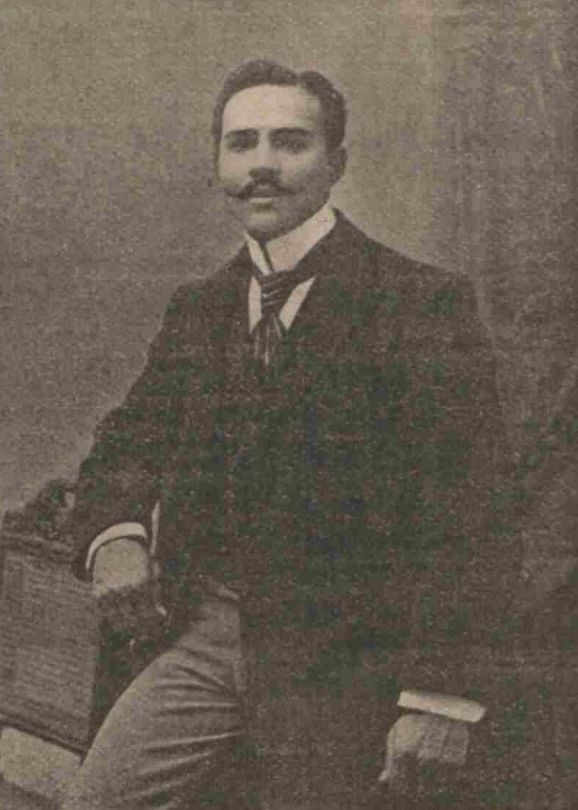
Edward Fulton Morrison. Music Hall and Theatre Review, 18 January 1901. Image created by the British Library Board. No known copyright holder.
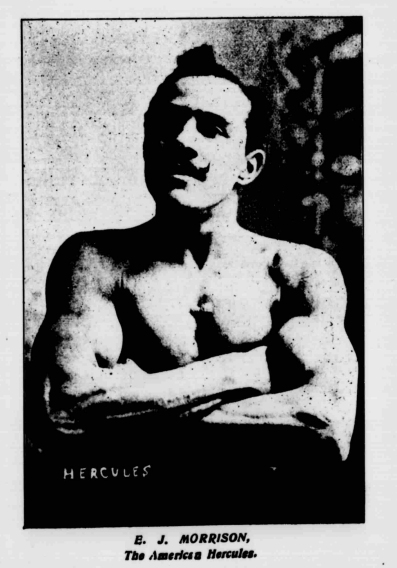
Edward Fulton Morrison, the American Hercules. Boxing World and Mirror of Life, 5 July 1905. Image created by the British Library Board. No known copyright holder.
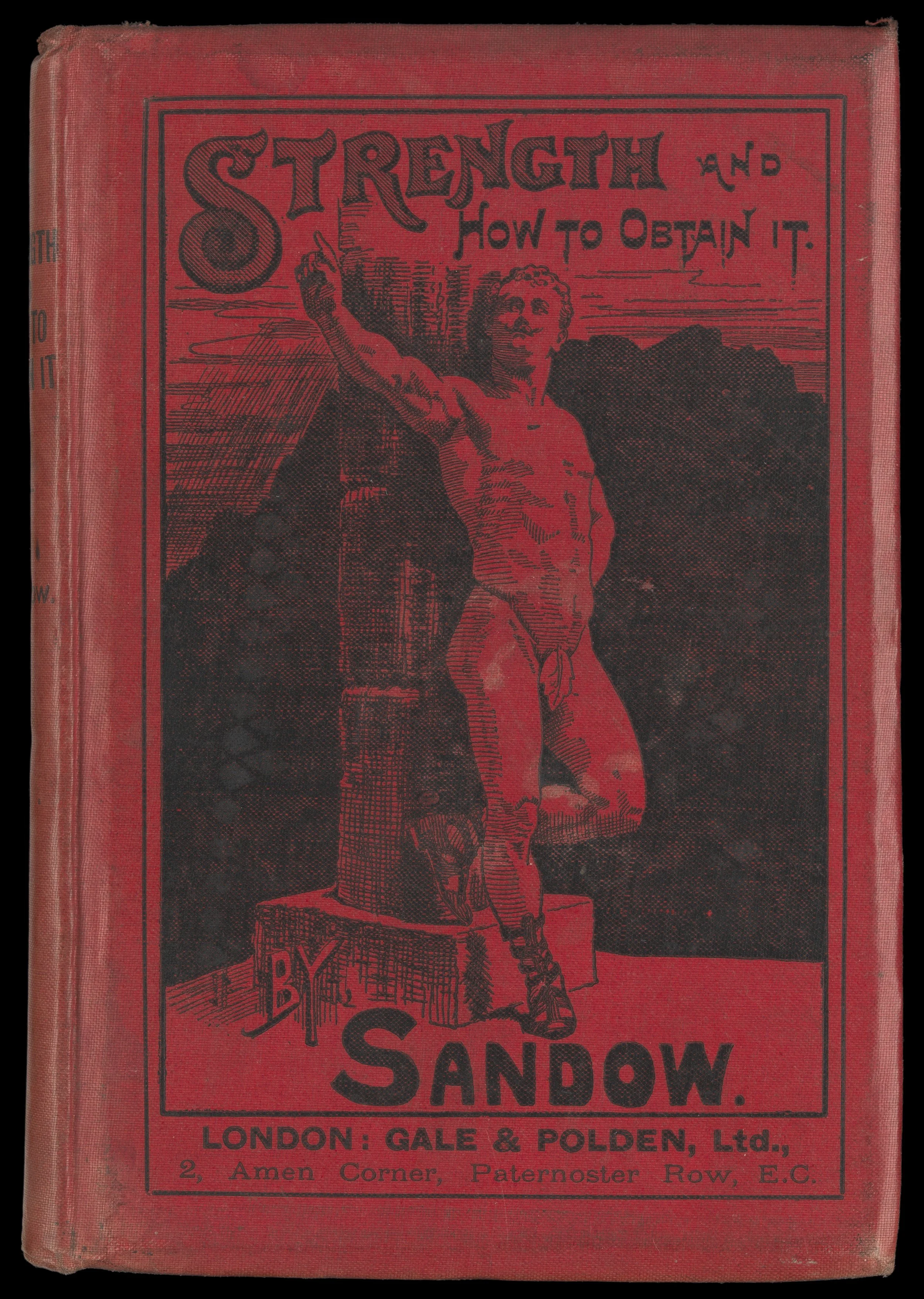
Strength and How to Obtain it, Eugene Sandow. Image created by the Wellcome Collection, L0070610. Public domain .
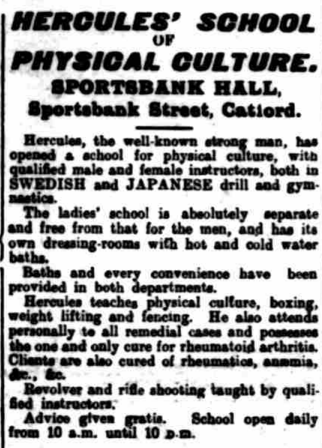
Hercules' School of Physical Culture. Sydenham, Forest Hill & Penge Gazette, 27 November 1914. Image created by the British Library Board. No known copyright holder.
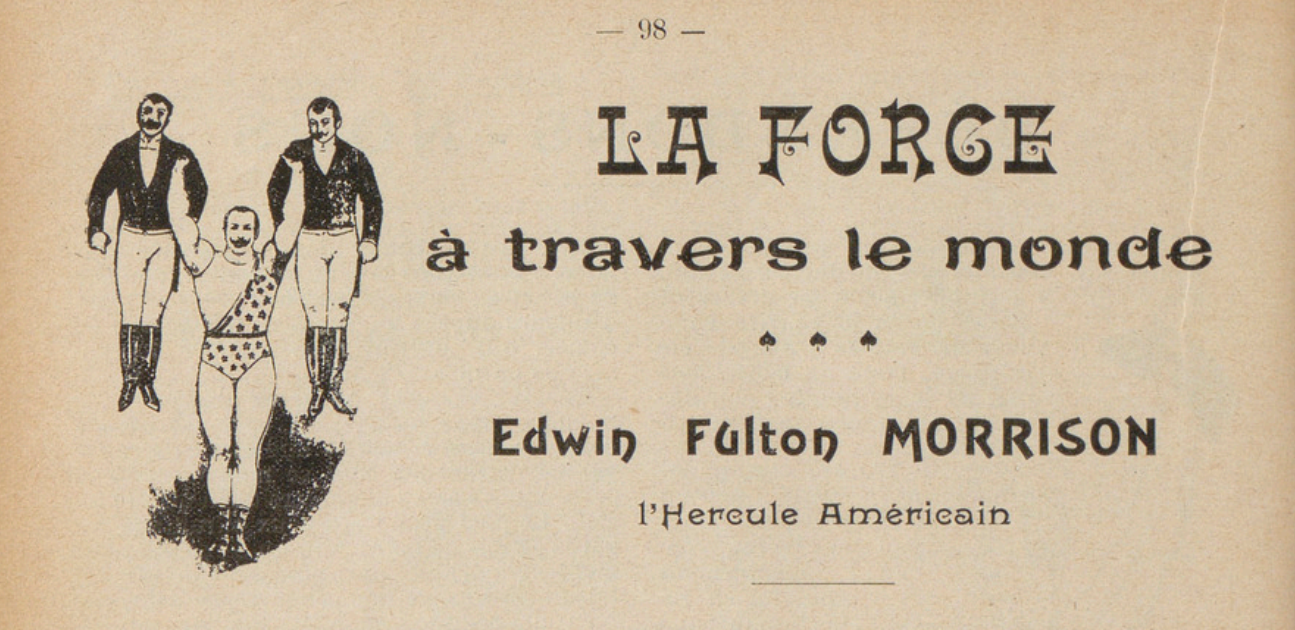
l'Hercule Americain. La Santé par les Sports, 1 February 1912. Image created by the Bibliothèque nationale de France, accessed via Gallica. Public domain.
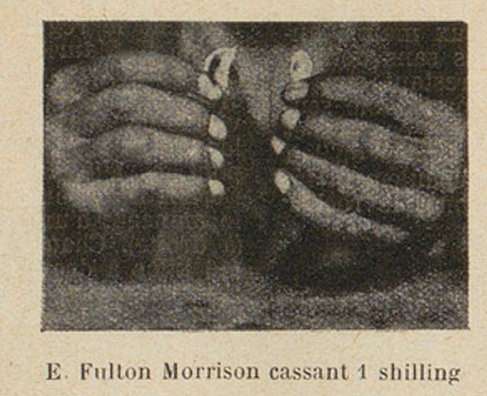
E. Fulton Morrison cassant 1 shilling. La Santé par les Sports, 1 February 1912. Image created by the Bibliothèque nationale de France, accessed via Gallica. Public domain.
École de Culture Physique Desbonnet. La Santé par les Sports, 1 February 1912. Image created by the Bibliothèque nationale de France, accessed via Gallica. Public domain.
42 centimetres pour le biceps de Vigneron. La Santé par les Sports, 1 February 1912. Image created by the Bibliothèque nationale de France, accessed via Gallica. Public domain.
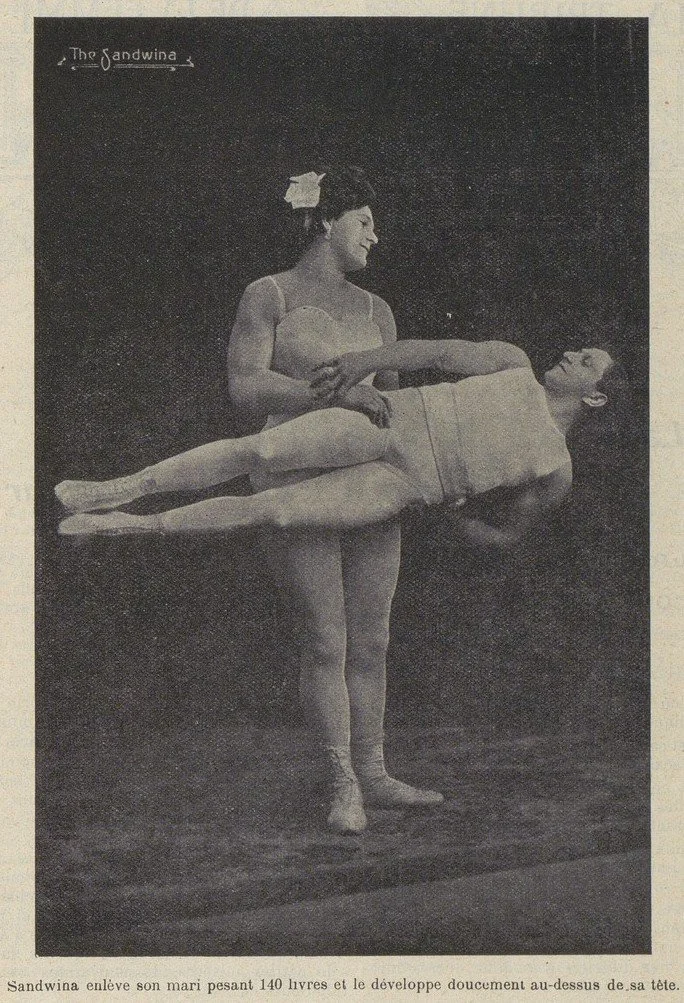
Sandwina enlève son mari pesant 140 livres. La Santé par les Sports, 15 July 1911. Image created by the Bibliothèque nationale de France, accessed via Gallica. Public domain.