Beyond the Saints and Greys.
Jamie Barras.
With the brightest of prospects, the new Liverpool Baseball Club (American Code) was launched last Saturday at its beautifully situated ground attached to Woolton Hall Hydro. The occasion was made a festive one, and took the form of a garden party. About 250 ladies and gentlemen, many of whom hold prominent positions in the city, assembled on the spacious verdant lawn, where they were entertained to a selection of music by the Liverpool North-End Silver Prize Band and the Columbia Pierrots, and to refreshments.[1]
The baseball game that took place in Liverpool on Saturday, 16 July 1910, was remarkable for several reasons. One was that it was played under the American code—Liverpool was the birthplace and heartland of baseball under the competing English code; games under the American code were extremely rare in the city before the 1930s. Another was that at least three of the players belonged to Liverpool’s Hispanic community: the Panamanian consul, Juan Navarro, his deputy, Juan Bautista Chevalier, and an “F. Jimenez”.[2]
However, the aspect of this game that I want to focus on here is the participation of another group of Liverpool residents who would go on to have a considerable impact on the American baseball scene in England: Mormon missionaries.
President Cannon, in reply to Mr. Young, said that baseball had always been interesting to him because he could see it from the missionary standpoint. When he was over here in about 1910 he heard that some of the members of the British Mission had played at a fourth of July celebration in some secluded spot, far from the public gaze. He had thought that the mission was going to the dogs; but when he came over again and saw that the British people were interested in riding, and such games as football, cricket, tennis, and golf, he realised that baseball would be a great aid to Missionary work in this country.[3]
We can positively identify only one of the players in the 16 July 1910 game as a Mormon missionary, Daniel Ray Shurtliff (1885–1961).[4] However, Shurtliff was certainly not the only Mormon in Liverpool: from the arrival of the first Mormon missionaries in England in 1837 until the move to London in 1933, Liverpool was the headquarters of the Mormon Mission in England, and, indeed, all of Europe. There may well have been Mormon missionaries among the players in the 16 July 1910 game that we cannot identify.[5]
Over two decades later, the then head of the British Mission, Joseph. J. Cannon (1877–1945)[6]would recall 1910 as being the year he first heard of baseball being played by members of the mission. More than this, D. Ray Shurtliff’s involvement in the 16 July 1910 baseball game in Liverpool is, to the best of my knowledge, the first recorded instance of a Mormon missionary playing any sport alongside non-Mormons while on mission. This game took place a full year before the participation of a Mormon missionary in the Tokyo-American Baseball Club, which was previously believed to be the first instance of Mormon missionaries being involved in sport.[7]
Sport would form a cornerstone of Mormon proselytising from the early twentieth century onwards. In Britain, this would ultimately be to the Church’s detriment, thanks to the “baseball baptism” scandal of the early 1960s.[8] However, I will not be covering the post-war period here. Nor will I be discussing the LDS’s use of that other “American import”, basketball, in its pre-war missionary work. Readers interested in those topics are directed to the work of Richard Kimball, Jessie Embry, and John Brambaugh.[9]
My focus will instead be on the Mormon use of American baseball in Britain between 1911 and 1939. Even within that narrow topic, I will largely ignore the two most obvious examples of this, the Rochdale Greys and Catford Saints, two teams formed of Mormon missionaries that participated with varying success in the top tier of Britain’s mid-to-late 1930s American baseball leagues. Their stories have already been told by the likes of Josh Chetwynd, Brian Belton, and Harvey Sahker, and I cannot improve on those accounts.[10] My interest is in telling the story of the lesser teams and local initiatives—the grassroots of the game and Mormon involvement in it in Britain.
Bowling [sic] said he had been playing at baseball on the green, and in walking to Shipley Glen began aimlessly throwing stones, one of which went through the lamp.[11]
After the 1910 game in Liverpool, the next time that Mormons playing baseball made the British newspapers was a year later, and in unfortunate circumstances. On Friday, 2 June 1911, Mormon missionary Clarence Evan Bohling (1889–1966) appeared in Otley Police Court in Leeds, Yorkshire, charged with “wilful damage of a gas lamp” in Baildon, Bradford. Bohling had been on his way back from a game of baseball on Baildon Green when the offence happened. He apologised and was fined 1 shilling plus damages.[12]
The game on Baildon Green, which took place on 2 May 1911, appears to have involved only Bohling and his fellow missionaries and points to the young men of the British Mission playing baseball recreationally in this period. For further evidence of this, we can turn to the British Mission’s own newspaper, the Millennial Star.[13]
Pleasant Outing.—On Easter Monday, the saints of the Belfast branch, with their friends, went out to the Belmont Glens on a scenic excursion. Everybody had an excellent time. The elders played baseball part of the time while the saints and others of the elders played games. All took lunches and we had an excellent time together.[14]
CONVENTION OF ELDERS OF THE BRITISH MISSION[…]Only the missionaries will attend the convention; but a hearty invitation is extended to all our readers to attend the concert to be given at the “Deseret”, London, Wednesday evening, and also the baseball game Thursday morning.[15]
This was in keeping with the sport’s popularity among young American men in general and within church communities in particular. By 1911, the Church of the Latter-Day Saints (LDS), in common with faith-based organisations like the Young Men’s Christian Association (YMCA), had adopted the ideals of the “muscular Christianity” movement, holding that playing sports built not only physical fitness but also moral strength. For the LDS, there was also a recognition that offering sports programmes helped keep young people born into the church in the church. (For more on the Mormon equivalent of the YMCA and YWCA, see below.)
It was, of course, just a small step from there to realising that sports programmes could also attract converts among the young. However, all the evidence points to no concerted attempt to initiate such programmes being made until the 1930s. Even then, according to the research of Embry and Brambaugh, it seems that this was the result not of instructions from the LDS leadership but individual mission leaders taking the initiative to begin such programmes. These pioneers then communicated their success to fellow mission leaders who copied their approach.[16]
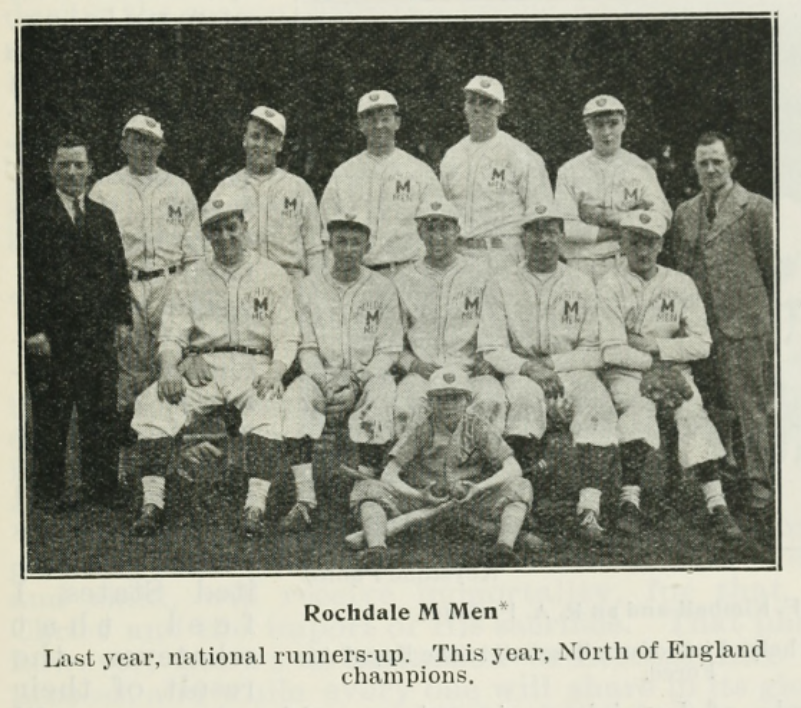
Why did it take so long? The principal reason, certainly in the case of the British Mission, seems to be that such efforts, once they began, fell largely on the shoulders of the young men and women of the Mormon Mutual Improvement Associations (YMMIA for young men, YLMIA, and later YWMIA, for young women); it was not until 1931 that the British Mission could boast enough converts to organise its own MIA branches and put their members to work. Members of the YMMIA, known as “M Men” (Mutual Men), and YLMIA/YWMIA, known as “Gleaners”, would play a key role in forming a bridge between Mormon elders and British youth from the 1930s onwards. As we will see, although the Mormon baseball and softball teams of the 1930s were led by missionaries, the bulk of their players were M Men.[17]
SPORTING MORMONS. TWENTY-FIVE MISSIONARIES IN A BASEBALL MATCH. ‘“Sunday Express’ Correspondent. NOTTINGHAM, Saturday. A baseball match, Nottingham v. Sheffield, was played on a private enclosure here to-day by twenty-five Mormon missionaries. Nottingham won by 27 to 6. The Mormons’ attempts to obtain girl recruits have aroused much resentment in Nottingham, and they had great difficulty in securing a playing pitch. The corporation could not or would not supply their needs, and sports clubs were indifferent.[18]
Although the LDS as yet lacked the warm bodies to launch outreach programmes, recreational baseball continued as a social activity throughout the 1910s and 1920s. By the late 1920s, this had grown to include internal competitions organised between the different regional centres. The 1927 baseball game in Nottingham featured Nottingham missionaries taking on their colleagues from Sheffield. It served as a precursor to a “National Ball-game Championship” played as part of the mission’s Fourth of July celebrations in Sheffield in 1930. The competing teams comprised missionaries from Hull, Sheffield, Nottingham, and Leeds. In a series of games played at the town’s Graves Park, Hull beat Nottingham 13–12, and Leeds eventually triumphed over Sheffield 1–0 following an initial 15–15 draw. Hull then beat Leeds 18–14 to take the cup. Photographs taken at the time show that the missionaries played in their street clothes, including, in some cases, ties—as neatly turned out as always.[19]
One outcome of these 4 July 1930 games, which attracted a good number of spectators, was that Mormon missionaries were invited to teach baseball to the pupils of De La Salle College, a catholic boys' school in Sheffield. This is both a remarkable example of inter-faith tolerance and, to the best of my knowledge, the earliest recorded instance of members of the LDS British Mission teaching baseball to non-church members.[20]
The 1930 championship was such a success that it was repeated the following Fourth of July at Manchester; this time featuring teams from Sheffield, Leeds, Manchester, and Liverpool. In the Manchester–Leeds game, Leeds triumphed 6–3.[21]
The members of the Birmingham, Sheffield, Manchester, Liverpool, Leeds, Hull, and Nottingham gathered again on 4 July 1932 in Nottingham, and again baseball played a part in the festivities. Alas, we do not have any press reports, and the Millennial Star restricted itself to simply reporting the event.[22]
The lack of reporting of the 1932 meeting in the wider British press speaks to editors no longer regarding happenings between Mormons as newsworthy. This speaks of normalisation, of people in England becoming used to having Mormons in their midst. This may have emboldened the Mormon leadership to raise its public profile, as within a year, the British Mission would be putting itself forward as an active partner in a fresh attempt at popularising American baseball in Britain.
AMERICAN BASEBALL FOR LIVERPOOL The National Association Baseball League, which is to control the interests of American baseball in Liverpool and district, held a successful meeting in Liverpool last night. The rules and points of play were explained, and it was stated that arrangements were well in hand for next season. There is a strong assembly of clubs who have agreed to play under 100 per cent American rules.[23]
One of the speakers who explained the “rules and points of play” of American baseball at the inaugural meeting of what would eventually be called the National Baseball Association (NBA) held at a Liverpool restaurant in November 1933 was Elder William Hutchison Houston (1872–1938) of the Mormon Liverpool Mission. Also present was another Liverpool missionary, Harvey Franklin Freestone (1907–1973). The two men were there at the invitation of the other speaker, Canadian Harry Holland (1909–1972).[24]
Holland was born in Cheshire but raised in Ontario. In September 1933, he returned to England, and a month later, he spotted the two Mormon missionaries playing catch in Liverpool’s Botanic Gardens and approached them. Holland had played youth baseball in Toronto, and he suggested forming a team to play a game against the crew of an American ship berthed in the port—something that had long been a feature of the American baseball scene in London. However, before that game could be organised, Holland read about the upcoming NBA meeting and contacted the organisers. This led to Holland and Elder Houston being invited to speak at the meeting.[25]
The meeting was hosted by John Moores (1896–1993), the Liverpool businessman behind this latest attempt to popularise American baseball in England. Moores had been a patron of the English version of the sport, which, as stated at the start of this article, had originated in Liverpool and was still much played there in the summer. Moores had switched to supporting the American game following a visit to the US in August 1933. He spent the early autumn of that year trying to persuade the English Baseball associations to make the same switch. Failing in that attempt, he decided late in the year to go it alone and start his own National Baseball Association to promote the American game.[26]
Alas, Elders Houston and Freestone were reassigned shortly after the Liverpool meeting, and nothing came of that attempt to involve the LDS in the Moores effort. However, Harry Holland did get involved. He helped launch the first NBA league the following summer, taking charge of training umpires and helping to found a team, the Avalons, named after his youth league side back in Toronto. Holland settled in Liverpool, married, and would remain involved in American baseball in England until at least 1953, when he was appointed secretary of the British Baseball Association and Commissioner of British Baseball. He died in 1972.[27]
A year after its Liverpool leagues, the NBA launched its first leagues in London, the East London and West London amateur leagues. Holland was put in charge of promotion. This is what led him to the LDS British Mission’s new headquarters in London (relocated from Liverpool in 1933). He took with him a proposal: the West London league was looking for an eighth team, and based on his interactions with Elders Houston and Firestone back in 1933, he thought the LDS might be interested. The NBA would provide all the uniforms and equipment the Mormon team needed.
It is here that Mission President Joseph J. Cannon re-enters the story. He had become head of the British Mission shortly after its move to London. He saw the potential in what Holland was offering both as a tool for the LDS’s missionary work and a way to gain some positive press. A meeting with Leonard David “L.D.” Wood (1898–1971), the American-born head of the NBA in London, was arranged. President Cannon attended, along with two other missionaries, one of whom was Wendell J. Ashton (1912–1995), editor of the Millennial Star. Ashton would go on to be the player–manager of the Mormon team, which would be named the Latter Day Saints. Meanwhile, President Cannon was elected to the Executive Committee of the West London League.[28]
The Latter Day Saints would be formed of missionaries—American LDS officials. Meanwhile, a second Mormon team was formed to play in the NBA’s North of England League (covering Lancashire and Yorkshire). The players in this team, known within the Church as the “Rochdale M Men”, would become known to the British public at large as the Rochdale Greys (and sometimes, perhaps incorrectly, as the “Greyhounds”). An early version of the uniform included the “M Men” name on the left breast. The players were, as the name suggests, members of the YMMIA, not missionaries.[29] The British press, of course, did not make this distinction in its reporting. It also has to be acknowledged that, after a poor start to the season, the team was bolstered by the recruitment of missionaries with baseball experience, with the result we will see below.
As we will also see, at least three more M Men teams, Bradford, Hull, and Birmingham, would join the effort within the next two years. However, to return to the Latter Day Saints missionary team of 1935, the NBA presented the team with uniforms with its name in gold lettering on the left breast, and photographs of the team wearing this uniform were taken. However, curiously, although no attempt was made to disguise the team’s origins, by July 1935, just over one month into the season, it was being referred to in the British press not as the “Latter Day Saints” but as “New London”.[30]
[…]there is another match at the Shepherd’s Bush Stadium that should attract a big crowd. . . .It is between New London and Streatham, and on the result hangs the destination of the London Cup. . . .New London is composed of young Mormon missionaries from Utah who are at present in this country, and undoubtedly they are the best club in the isles.[31]
I have been unable to find any explanation for this change in name. It seems clear that someone objected to the team having the same name as the Church itself, but whether this was someone inside the Church or outside it, I cannot say. That there was sensitivity to the presence of Mormon teams in the leagues is clear—there were, for example, a number of objections to the Rochdale Greys’ habit of forming prayer circles in the centre field at crunch moments in their games. It may be that the NBA realised that having “Latter Day Saints” on the game schedules would attract protestors to games, and the Church, keen to use baseball to “break down the barriers of prejudice” that had existed ever since its arrival in Britain, compromised on the name to stay in the game.[32]
It was as “North London” that the LDS missionaries faced off against their Northern colleagues, the Rochdale Greys, in the 1935 NBA National Amateur Baseball Championship final on Tuesday, 4 September 1935. The game was dominated by the pitching of Elder Blaine Bybee (1913–1990) for New London, who was on course for a shut-out game until the Greys scored in the final inning; the missionaries triumphed 7–1. Back in the States, Bybee had played for Ogden in the semi-pro Utah State Baseball League.[33]
Rochdale would claim its own national championship in 1938. By then, the LDS missionary team, which went through a further name change to the Catford Saints for the 1936 season, had been wound up. Rochdale benefited from the incorporation of the best of the Saints players into its ranks, chief among them, the Saints’ star pitcher Elder Stanley Bruce Hanks (1915–1989). Readers are directed to the work of Harvey Sahker, Josh Chetwynd, and Brian Belton for the full story of these two teams and the leagues in which they played. One element of their story worthy of note here is the presence in the 1939 Rochdale Grey roster of missionaries Lee Lamont Frodsham (1917–1999) and John William “Jack” Palmer (1917–1997). The previous season, Frodsham and Palmer both played for the Sheffield Dons, a rare instance of Mormon missionaries playing for a non-Mormon team, albeit one that had a good number of Mormon players that year.[34]
As the Rochdale and Catford teams were the most high-profile of the Mormon baseball teams, they provided the Church with its best press, something that it was keen to draw to the attention of its members. The most favourable press found its way into the Millennial Star, quoted to show the Church’s members the dividend that its investment in the game was paying: “Baseball fans know them as fine players and sportsmen, but how many know they are religious teachers?[…]They have worked and played themselves right into the hearts of the people.”[35]
M MEN SOFTBALL Successful attempts at introducing Softball as an M Men activity are being reported daily. Efforts should be made during the summer to establish it fully.[36]
That the activities of the Latter Day Saints/New London and Rochdale Greys were just the most visible elements of a wider strategy to use baseball to gain converts is made plain by the call in the Millennial Star, issued in May 1935, for MIA branches to incorporate softball into their outreach activities. By the time that this call went out, missionaries in Leicester and Birmingham had already started organising M Men exhibition games.
Baseball— Minus Risks. Mormons' Effort To Introduce Game In Leicester Parks APPEAL BY YOUNG "ELDERS"—AN effort is being made to introduce into Leicester a variation of America's national game--Baseball. It is known as "Soft Ball" and differs from the more exciting type of the American game in that expensive equipment is not required and there are not the same hazards.[37]
These efforts spread to Hull, where the “M.M. Reds” took on the “M.M. Blues” in a series of exhibition games in the city’s East Park, and six missionaries, five American and one Canadian, were on hand to teach local youths the game—and sign them up to the YMMIA. By the end of the summer, softball was also a feature of M Men activities in Newcastle and Plymouth. Wendell J. Ashton, editor of the Millennial Star and player–manager of the LDS missionary team, spelled out how the sport could be used in proselytising in an article published in April 1935.[38]
The Mutual Improvement Association of the British mission is planning for softball (baseball played with a ball which does not require the use of gloves and other paraphernalia) competition in every district this spring and summer. There is an opportunity of inviting onlookers to join in the game and after that in the other M.I.A. activities.[39]
By the following summer, 200 M Men were actively playing the game, and it had advanced to the point that the Mission was able to hold a national softball championship in London on Saturday, 15 August 1936. Champion teams of four districts, Northampton, Oldham, Bristol, and Southwest London, faced each other. In the morning, at Catford Stadium—the new home of the LDS missionary team, now known as the “Catford Saints”—Northampton defeated Southwest London, 13–5, and Bristol defeated Oldham, 20–1. In the final, played on Wandsworth Common the same afternoon, Northampton triumphed over Bristol, 7–6.[40]
This event is doubly noteworthy, as the Northampton team was captained by Brigham Spencer Young Jr (1913–2004), great-great-grandson of the LDS leader of the same name. Young had arrived in England in late 1935 to begin a two-year mission. In this, he was following family tradition, as the first Brigham Young had served in the British Mission way back in 1840. Following his triumph as captain of the Northampton M Men softball team, known as the “M Sluggers” in 1936, Young was recruited into the Catford Saints to play hardball in the 1937 season of the London Major Baseball League. He left the UK at the end of his mission in March 1938.[41]
There does not appear to have been a repeat of this softball contest at a national level in future years—the silver cup presented to Brigham Young V and his Northampton team became the Birmingham district MIA championship trophy; however, softball would remain an important outreach activity for the MIA and British Mission from this point forward. As already discussed, this was not always to the Mission’s credit.[42]
AMATEUR BASEBALL. Leeds League Ready to Start[…]Two clubs from Bradford have been admitted to the League, Thornbury and Bradford “M Men”, and at the moment there are six teams attached to the competition, although it is expected to add two more in the next few days.[43]
By the start of the 1936 season, the NBA was operating two tiers: a top, “professional” tier and a lower “amateur” tier. Although it should be noted that the “professional” leagues were professional only in that players were paid, the skill level of the players in these leagues was that of players in senior amateur leagues in North America. Indeed, the pick of the players in the “professional” English leagues were men who had played senior amateur baseball in the States or Canada. In the 1936 season, the top tier comprised the Yorkshire League, the North of England League, and the London Major League. The two flagship Mormon teams, the Rochdale Greys and the newly rechristened Catford Saints, played in the North of England League and the London Major League, respectively. Both teams, by this time, were formed largely of missionaries. In contrast, the new “Bradford M Men” team, which joined the lower-tier Leeds Amateur League in its inaugural season, was, as its name suggests, an MIA team, albeit one bolstered by the presence of missionaries.
The M Men proved dominant, racking up a ten-game winning streak and topping the league, only to then lose in the Yorkshire Amateur Cup final, 11–9, to the league runners-up, fellow Bradford team, the Thornbury Trojans. The final was marked by bad weather, making pitching difficult, and most of the runs came from runners, aided by the poor light and lashing rain, stealing bases.[44]
For the 1937 season, the Bradford M Men would transfer to the new Bradford and District Amateur League, where they would remain until the suspension of play at the outbreak of the Second World War. The Trojans, later renamed Tyersal Tigers, would remain their bête noire, knocking them out of the 1937 and 1938 Yorkshire Cup competitions.[45]
Hull "M" Men v. Thornbury Trojans BASEBALL A great amateur baseball attraction —the Yorkshire Challenge Cup final will bring Hull "M" Men and Thornbury Trojans into opposition at Craven Park; on Monday night. Hull "M" Men are champions of the Hull Amateur League, while Thornbury Trojans, present holders of the Yorkshire Cup, are the present leaders of the Leeds Amateur League, and will play off the final of the National Amateur Challenge Cup Competition at Greenfield Stadium on August 28.[46]
The 1937 season was to prove the high-water mark for this latest attempt to popularise American baseball in England. That season, the NBA ran three top-tier leagues and innumerable amateur leagues, albeit concentrated in its three centres, Lancashire, Yorkshire, and London. It was also the season that LDS participation in the sport reached its pre-war peak, with the returning Rochdale Greys, Catford Saints, and Bradford M Men being joined by two new M Men teams, Hull and Birmingham. The new teams played in the lower-tier Hull Amateur and Birmingham Amateur leagues, respectively.
We have a team list of the members of the Hull M Men club for the 1937 season. Based on the different titles of the players (“elder”, “brother”, or no title), we can tell that it was largely formed of ordinary rank and file M Men, not missionaries or MIA officers: Walter Williamson, Reginald Williams, Don Dixon, Douglas Collingwood, Fred Wood, Ken Marshall, Gearyle James, Cherry Burton, Bill Wilson, and Bill Dixon. Brothers George Walker and Walter Yull. Elders Joseph S. Wood, Bryant H. Croft, Charles W. Hails, and Daniel Garn Heaton.[47]
The story of the Hull M Men mirrored that of their Bradford counterparts: they dominated locally, but could not overcome Thornbury/Tyersal to capture the top prize. In both cases, bolstered by the presence of American missionaries who had grown up playing the game, the M Men teams were big fish in small ponds. The Birmingham M Men team, however, found itself up against an even bigger fish.
A keen conflict was expected from the meeting of Durex, Birmingham and National amateur champions, and M-Men, the newly-formed club of whom much is expected Durex gained an overwhelming victory by 45 runs to 11 over the Mormons at Bickenhill-lane, Marston Green.[48]
The Durex Abrasives team was the creation of Birmingham-based American businessman Donald Kelso, who was also the founder of the 1930s Birmingham baseball scene. Kelso had built Durex into a team that was amateur in name only, populating it with North American players who drew a salary from the Durex company to keep their amateur status. It was centred on Canadian Sid Bissett, one of the best pitchers in England, and one of only two amateur players to receive a call-up for the 1938 England team that took on and bested America in a five-game test series in 1938.[49]
It would be tempting to feel sorry for the Birmingham M Men in having to go up against a team of effectively ringers. However, nationally, the Mormons themselves were not above skewing the odds in their favour. The president of the European Mission, Apostle Joseph Francis Merrill (1868–1952), who was based in London, exploited the fact that all Europe-bound missionaries had to pass through his office to snag any decent baseball players and re-assign them to the British Mission. This was how missionary Christian John Draayer (1916–1987), who was supposed to be on his way to Denmark, came to pitch for the Catford Saints.[50]
The other major difference between the Birmingham baseball scene and the Hull and Bradford scenes in which the other M Men teams played was that there was no top-tier league in the Birmingham district. The Birmingham leagues were part of the NBA but not created by it. American baseball in Birmingham remained resolutely amateur, played mainly by works teams like Durex. One consequence of this was that, unlike the Yorkshire amateur leagues, the Birmingham amateur leagues did not have to compete with a local top-tier league for press coverage. As a result, we have far more information about the Birmingham M Men team than we do the Bradford and Hull M Men teams.
I will end this piece with pen sketches of the Birmingham M Men published in a Birmingham newspaper and almost certainly written by the secretary of the local MIA branch, Idaho native Victor Blaine Hart (1915–1996).[51] Before that, I want to consider the legacy of the LDS’s British mission’s involvement in American baseball in Britain before the Second World War.
For the Church, its involvement in American baseball in Britain was a win until it wasn’t. It helped to bolster the Church’s shaky reputation and raise its public profile in a way that showed it in the most positive light (“fine players and sportsmen”). It was also a boon to recruitment, not least via the MIA softball programmes. Alas, postwar, the Church let its success go to its head, replacing an opportunity to join the church through participation in its sports programme with a requirement to do so, to its cost.
For American baseball in Britain, the LDS’s involvement provided it with a pool of good-but-not-great players just when it needed them, as the NBA was growing the game. Nothing kills a nascent sports scene quicker than one-sided victories; fans are bored by them, and vanquished teams lose the will to continue the sport. The Mormon teams were good enough to show spectators how exciting American baseball could be, but never so dominant that other teams couldn’t beat them, not even at the amateur level. They didn’t crush their opponents; they raised their game.
The tragedy of the NBA was that, from 1936 onwards, the top tier of its leagues was dominated by imported batteries with senior amateur or even minor professional league experience who laid waste to teams populated with rookie players. With results a forgone conclusion and runs few and far between, spectators stopped turning up to games, and bottom-of-the-table teams folded.[52]
There is an alternate timeline where the NBA waited another season before introducing a top “professional” tier; another season in which English teams could have honed their skills against good-but-not great Mormon teams, and the MIA could have coached English converts in its M Men teams who could then have gone on to bolster non-Church teams. Would these teams have been able to beat teams centred on North American senior amateur or minor league batteries? Not often, not at first, but often enough to have kept the game alive long enough for them to have done so.
The return to peace in 1945 would see the restart of American baseball in its former centres, Liverpool, Yorkshire, and London and the Southeast, but only at an amateur level. New Mormon teams would play their part in helping to regenerate the scene. But that is a story for another author to tell.
Jamie Barras, April 2026.
Back to Diamond Lives
The Birmingham M Men
Warner Murphy, who played for Public Theatre in U.S.A., will be in charge of the catching department, while Glen H. Grimmett, a Utah Branch Aggie athlete, has arrived just in time to pitch for them. Other elders who have shown great promise with their pitching are Paul V. Strebel, former L.D.S. Business College "star," and Jack Brailsford, Thermopolis Baseball Club expert, who will be appearing at third base. Farell K. Walker, who previously was a member of the Southerland Utah team, is practically certain to be stationed at first base. The position of second base has yet to be filled. There are two players in the running in Paul D. Backman and "Bob" Costello. Karl Foster, ex-High School "star" and cowboy, will be at short stop. The outer field will be held down by George Walker, Blaine Parkinson ("slugging farmer") and V. Blaine Hart, secretary of the M-Men Club, who has played for the Idaho Falls Club. Idaho is an expression of the Shoshonee Indian (ee-dah-how), which means "Look, the sun is coming down the mountains." Idaho Falls is a city on the Snake River, 123 miles south-west of the Western entrance to the famous Yellowstone Park.[53]
Notes
[1] ‘Baseball and Rounders’, Liverpool Echo, 23 July 1910.
[2] I go into the identity of the players in the 16 July 1910 game in more detail here: https://www.ishilearn.com/diamond-lives-a-kind-of-bumblepuppy, accessed 17 April 2026.
[3] ‘Baseball in England’, Sydenham, Forest Hill & Penge Gazette, 10 September 1937.
[4] Shurtliff: https://www.familysearch.org/en/tree/person/details/KWCH-C7D, accessed 14 April 2026.
[5] Ronald G. Watt and Kenneth W. Godfrey, “‘Old 42’: The British and European Mission Headquarters in Liverpool, England, 1855–1904,” Mormon Historical Studies 10, no. 1 (2009): 87–99.
[6]https://historic-liverpool.co.uk/sites/woolton-hall, accessed 16 April 2026. https://www.golfsmissinglinks.co.uk/index.php/england/north-west/lancashireaiom/483-lancs-woolton-hall-golf-club-liverpool, accessed 16 April 2026.
[7] Richard Ian Kimball, "Sports in Zion: Mormon Recreation, 1890-1940" (Urbana: University of Illinois Press, 2003), 100–101, cited in: Jessie L. Embry and John H. Brambaugh, "Preaching through Playing: Sports and Recreation in Missionary Work, 1911-64", Journal of Mormon History (2009), 35, 4, 53–84.
[8] See Note 7 above, final reference. This involved British children being offered opportunities to learn American sports by Mormon missionaries, but only if they were willing to convert to Mormonism. This “quantity over quality” approach was predictably both ineffective—retention levels were low—and a public relations disaster—it enraged parents, whose consent was not sought. The approach was abandoned in the mid-sixties, but the repercussions continued to be felt long afterwards, even outside Britain, with some missions abandoning sports altogether. For a contemporary account of the alarm that “baseball baptisms” caused among British parents, see: ‘Misunderstandings about New ‘Baseball Club’’, Barnoldswick & Earby Times, 16 February 1962.
[9] Note 7 above.
[10] Harvey Sahker, ‘The Blokes of Summer’, (Free Lance Writing Associates, Inc., 2011); Josh Chetwynd and Brian A Belton, ‘British Baseball and the West Ham Club’ (London: McFarland and Company, 2007).
[11] ‘Threw Stone at Lamp’, Leeds Mercury, 3 June 1911.
[12] Bohling: https://www.familysearch.org/en/tree/person/details/KWCZ-6ND, accessed 24 April 2026.
[13] The first game of American baseball played in Bradford was played by the Spalding tourists back in 1889; it had to be abandoned due to poor weather: ‘The American Baseball Players at Bradford’, Sporting Chronicle, 21 March 1889.
[14] ‘From the Mission Field’, Millennial Star, 20 April 1911. This and other issues of the Millennial Star can be accessed via archive.org: https://archive.org/details/millennialstar, accessed 26 April 2026.
[15] ‘Convention of Elders of the British Mission’, Millennial Star, 14 August 1913.
[16] Note 7 above, final reference.
[17] C. Terry, ‘History of LDS Youth Programs’, https://juvenileinstructor.org/history-of-lds-youth-programs/, accessed 26 April 2026. Rise of the MIA in England: ‘Mutual Improvement Association: An Opportunity!’, Millennial Star, 21 January 1931.
[18] ‘Sporting Mormons’, Sunday Express, 5 June 1927.
[19] ‘Hit by Colleague with Bat’, Sheffield Daily Telegraph, 5 July 1930. ‘Say You Guys, This is One He-Man’s Game’, Sheffield Independent, 5 July 1930.
[20] ‘The Missionary Speaks: Physical Fitness’, Millennial Star, 31 July 1930.
[21] ‘Mormon Baseball Title Series Thrills Many’, Manchester Evening News, 4 July 1931. This is the only game for which I have been able to find a report.
[22] ‘From the Mission Field’, Millennial Star, 4 August 1932.
[23] ‘American Baseball For Liverpool’, Liverpool Daily Post, 8 November 1933.
[24] Houston: https://www.familysearch.org/en/tree/person/details/K2WK-FN9. Freestone: https://www.familysearch.org/en/tree/person/details/KWC5-27X, accessed 25 April 2026.
[25] This is the version of events given here: Wendell J. Ashton, ‘Baseball and Mormons in England’, Improvement Era, v38 n10, October 1935, 598–600; 644–649.
[26] I cover these events here: https://www.ishilearn.com/diamond-lives-versions, accessed 25 April 2026. For an academic treatment, see: Daniel Bloyce, ‘John Moores and the ‘Professional’ Baseball Leagues in 1930s England’, Sport in History, 2007, 27:1, 64–87.
[27] ‘Avalon’s Big Baseball Capture’, Liverpool Evening Express, 16 May 1934; ‘Baseball Filip’, Liverpool Echo, 18 June 1953; ‘Baseball as in America’, Liverpool Echo, 2 May 1953. Harry Holland can be found in the 1939 England Register, living in Liverpool, married to Irene, and working as an “athletic coach”; ancestry.co.uk, Ancestry.com Inc. (Operations), accessed 27 April 2026. His year of death: search of Births, Marriages, and Deaths, cross-referenced with the date of birth given in his 1939 Register entry (10 December 1909): https://www.freebmd.org.uk/search, accessed 27 April 2026.
[28] Ashton: https://www.familysearch.org/en/tree/person/details/KWCG-V4Y, accessed 26 April 2026. Ashton’s account of the origins of Mormon involvement in the 1930s English leagues is one of the best records of the origins of the leagues themselves. See Note 25 above. Leonard Wood: https://www.findagrave.com/memorial/133117458/leonard-david-wood, https://www.gracesguide.co.uk/Leonard_D._Wood, accessed 26 April 2026.
[29] The Greys are referred to as the “Rochdale M Men” here: ‘From the Mission Field: Rochdale’, Millennial Star, 19 September 1935. And as the “Rochdale M Men (or Greys)” here: ‘More than Players!’, Millennial Star, 17 September 1936. There is a photograph of the Rochdale team with “M Men” written on their uniforms in the 15 October 1936 issue of the Millennial Star.
[30] ‘Baseball: Streatham Set the Pace’, Streatham News, 5 July 1935.
[31] ‘Mormon Baseball Stars’, Daily Express, 7 September 1935.
[32] ‘Baseball Held Up For Prayer’, Belfast Telegraph, 18 May 1939. The quote is from Ashton, Note 25 above.
[33] ‘Baseball Cup Final’, Rochdale Observer, 4 September 1935. Bybee: https://www.familysearch.org/en/tree/person/details/KWZV-4LV, accessed 26 April 2026. Bybee playing for Ogden: Ashton, Note 25 above.
[34] Hanks: https://www.familysearch.org/en/tree/person/details/KWCF-ZZC, accessed 26 April 2026. The best account of the Rochdale Greys’ 1938 championship win is given here: Josh Chetwynd, ‘Ross Kendrick’, ed. Joe Grey, ‘Nine Aces and a Joker’ (Ross-on-Wye: Fineleaf Books, 2012), 27–36. Ross Kendrick was the pitcher for the losing team in the 1938 final. For the story of the LDS missionary team after it changed its name to the Catford Saints, see Chetwynd and Belton, Note 10 above, second reference. Frodsham: https://www.familysearch.org/en/tree/person/details/KWCH-9V4, accessed 3 May 2026. Pitching for Sheffield: ‘Baseball: ‘Sheffield Dons Visit to Halifax’, Sheffield Independent, 13 May 1938. Palmer: https://www.familysearch.org/en/tree/person/details/KWCN-ZZ8, accessed 3 May 2026. We can identify this Palmer as the “Jack Palmer” who played for Sheffield and Rochdale from the record of his return to the US in 1939 on the same ship as Lee Frodsham, cross-referenced with the date of birth (14 July 1917): "New York, New York Passenger and Crew Lists, 1909, 1925-1958", FamilySearch (https://www.familysearch.org/ark:/61903/1:1:24LF-LLK : Sat Apr 12 17:59:00 UTC 2025), Entry for Lee Frodsham, 1939; "New York, New York Passenger and Crew Lists, 1909, 1925-1958", FamilySearch (https://www.familysearch.org/ark:/61903/1:1:24LF-LPG : Sat Apr 12 17:37:57 UTC 2025), Entry for John Palmer, 1939. Palmer pitching for Sheffield, 1938: ‘Baseball: Dons Visit Bradford’, Sheffield Independent, 15 July 1938. Frodsham and Palmer in Rochdale Greys, 1939: ‘Baseball’, Rochdale Observer, 10 June 1939.
[35] See Note 29 above, second reference. The quote is from the Daily Mirror, 2 September 1935.
[36] ‘M Men Softball’, Millennial Star, 23 May 1935.
[37] ‘Baseball—Minus Risks’, Leicester Evening Mail, 2 May 1935.
[38] ‘Baseball Comes to Hull’, Hull Daily Mail, 27 July 1935; ‘Mormons’ Bid at Plymouth’, Western Morning News, 12 August 1935. Birmingham: ‘From the Mission Field: Birmingham’, Millennial Star, 9 May 1935. Newcastle: ‘From the Mission Field: Newcastle’, Millennial Star, 4 July 1935.
[39] ‘A New Aid to Proselyting’, Millennial Star, 11 April 1935.
[40] ‘From the Mission Field: Another Climax’, Millennial Star, 13 August 1936; ‘From the Mission Field: General’, Millennial Star, 27 August 1936; ‘Baseball Champions of Britain’, Northampton Mercury, 21 August 1936.
[41] Young: https://www.familysearch.org/en/tree/person/details/KWC1-C5B, accessed 26 April 2026. First Brigham Young in Britain: Note 6 above. Arrival of Brigham Spencer Young Jr in Britain: ‘Brigham Young No. 5 “Explains” The Mormons’, Daily Express, 31 October 1935. In Catford Saints: see Note 3 above. Departure: ‘Brigham Young Goes Home’, South London Observer, 18 March 1938.
[42] Fate of the trophy: Birmingham District M.I.A. Convention at Kidderminster’, Millennial Star, 19 June 1941.
[43] ‘Amateur Baseball’, Yorkshire Evening Post,21 March 1936.
[44] ‘From the Mission Field: Leeds’, Millennial Star, 27 July 1936; ‘Yorks. Baseball Cup’, Bradford Observer, 8 September 1936.
[45] ‘Bradford Baseball’, Yorkshire Post and Leeds Intelligencer, 26 January 1937; ‘To-Day’s Baseball’, Bradford Observer, 3 June 1939; ‘Brilliant Fielding at the Shay’, Halifax Evening Courier, 1 July 1938.
[46] ‘Baseball’, Hull Daily Mail,21 August 1937.
[47] ‘From the Mission Field: Hull’, Millennial Star, 2 December 1937.
[48] ‘Easy for Durex’, Evening Dispatch (Birmingham),3 May 1937.
[49] I tell the story of the Durex team and Sid Bissett here: https://www.ishilearn.com/diamond-lives-health-friendship-and-baseball-part-iv, https://www.ishilearn.com/sid-bissett, accessed 26 April 2026.
[50] This information comes from Wendell Ashton and is cited by Embry and Brambaugh, Note 7 above, second reference. Saints team member Frank Ellis remembers the story another way, giving Ashton the credit: Sahker, Note 10 above, first reference, page 48. Merrill: https://www.familysearch.org/en/tree/person/details/KWCV-NFR, accessed 26 April 2026. Draayer: https://www.familysearch.org/en/tree/person/details/KWCJ-3VF, accessed 26 April 2026. Draayer playing for the Saints: ‘Kennel Boys Make Baseball Debut’, Daily Express, 1 May 1936.
[51] Hart: https://www.familysearch.org/en/tree/person/details/KWZ4-YF2, accessed 26 April 2026.
[52] This is the analysis of Bloyce, see Note 27 above, second reference.
[53] New Baseball Team’s Bid for Honours’, Birmingham Daily Gazette,23 April 1937.
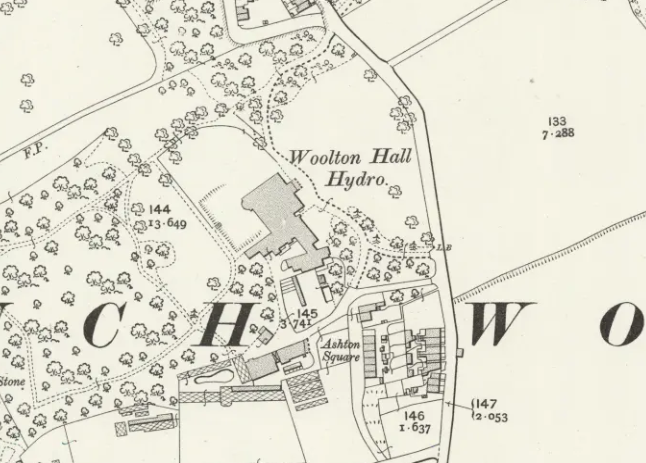
Woolton Hall Hydro, just outside Liverpool; site of the 16 July 1910 game that included Mormon missionary D. Ray Shurtliff. Ordnance survey map accessed at Library of Scotland.
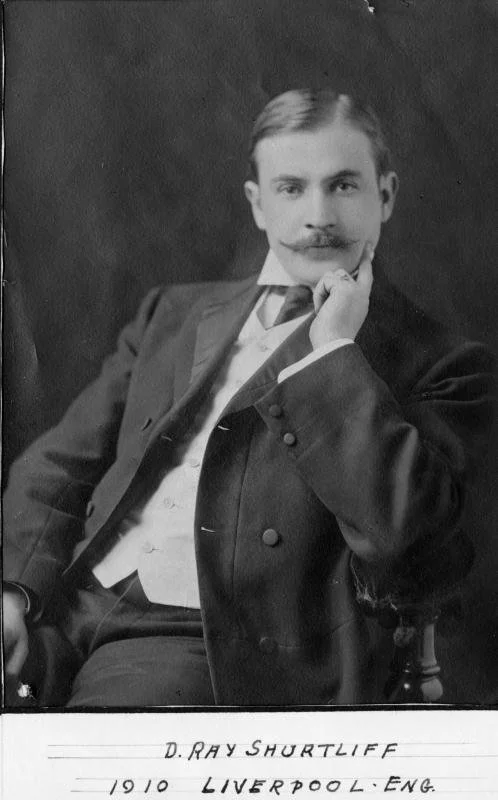
Mormon Missionary D. Ray Shurtliff. Image uploaded to FamilySearch.
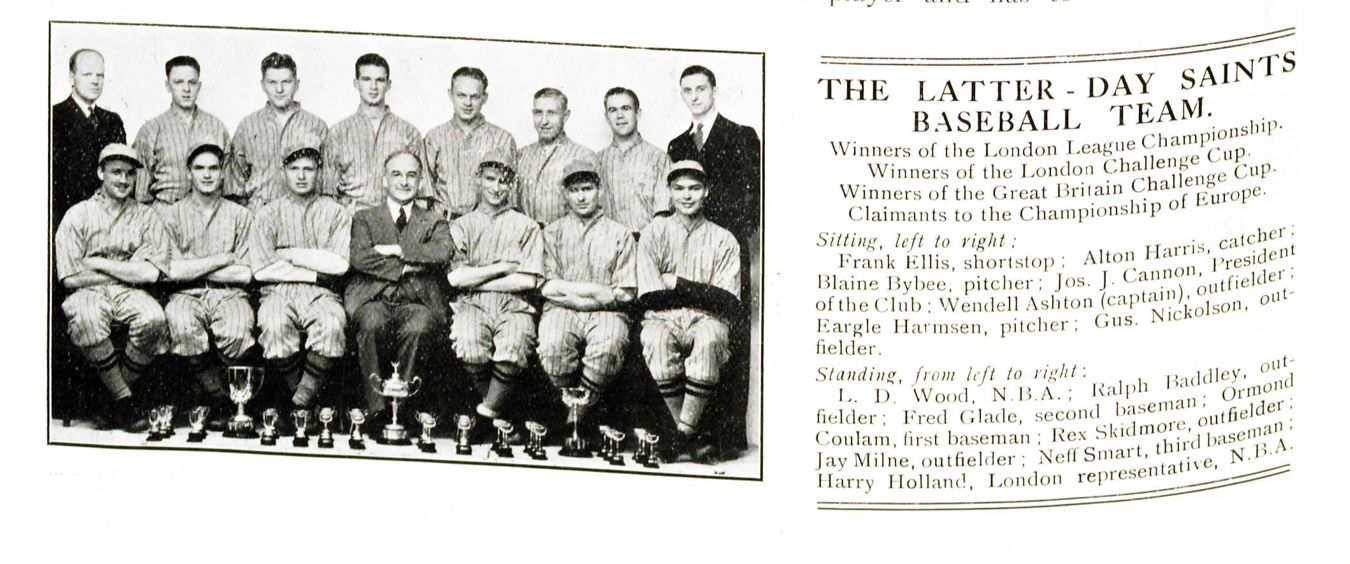
The Latter-Day Saints/New London Baseball Team, 1935, posing with their trophies. The Sports Trader, October 1935, 18-19. British Library. Author's own scan.
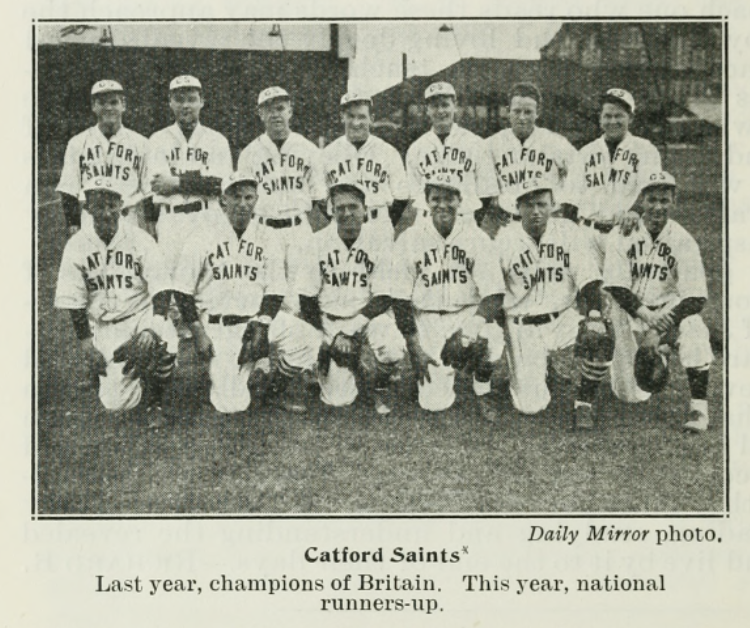
The Catford Saints, Mormon Missionary team, 1936. Image from Millennial Star newsletter, 15 October 1936. Accessed from archive.org. Public domain.
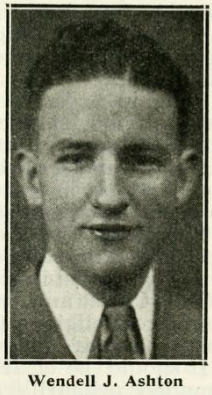
Wendell J. Ashton, player-manager of the Catford Saints. Image from Millennial Star newsletter. Accessed from archive.org. Public domain.
The Rochdale M Men aka the Rochdale Greys, 1936. Image from Millennial Star newsletter, 15 October 1936. Accessed from archive.org. Public domain.
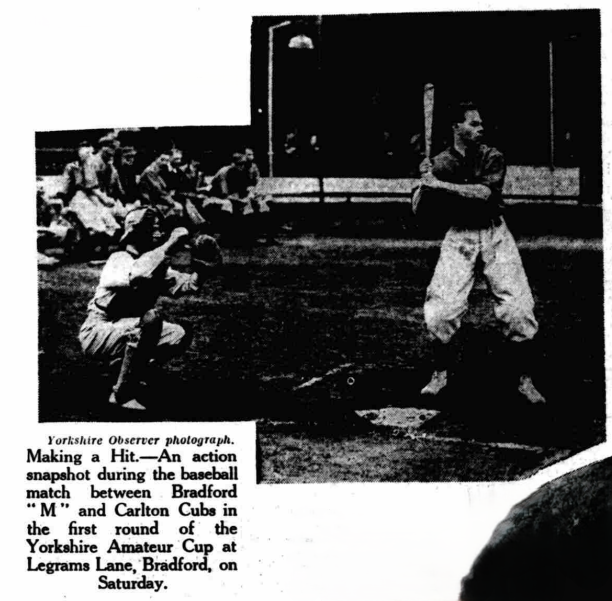
A Bradford M Men player at bat. Bradford Observer, 8 June 1936. Image created by British Library Board. No known copyright holder.
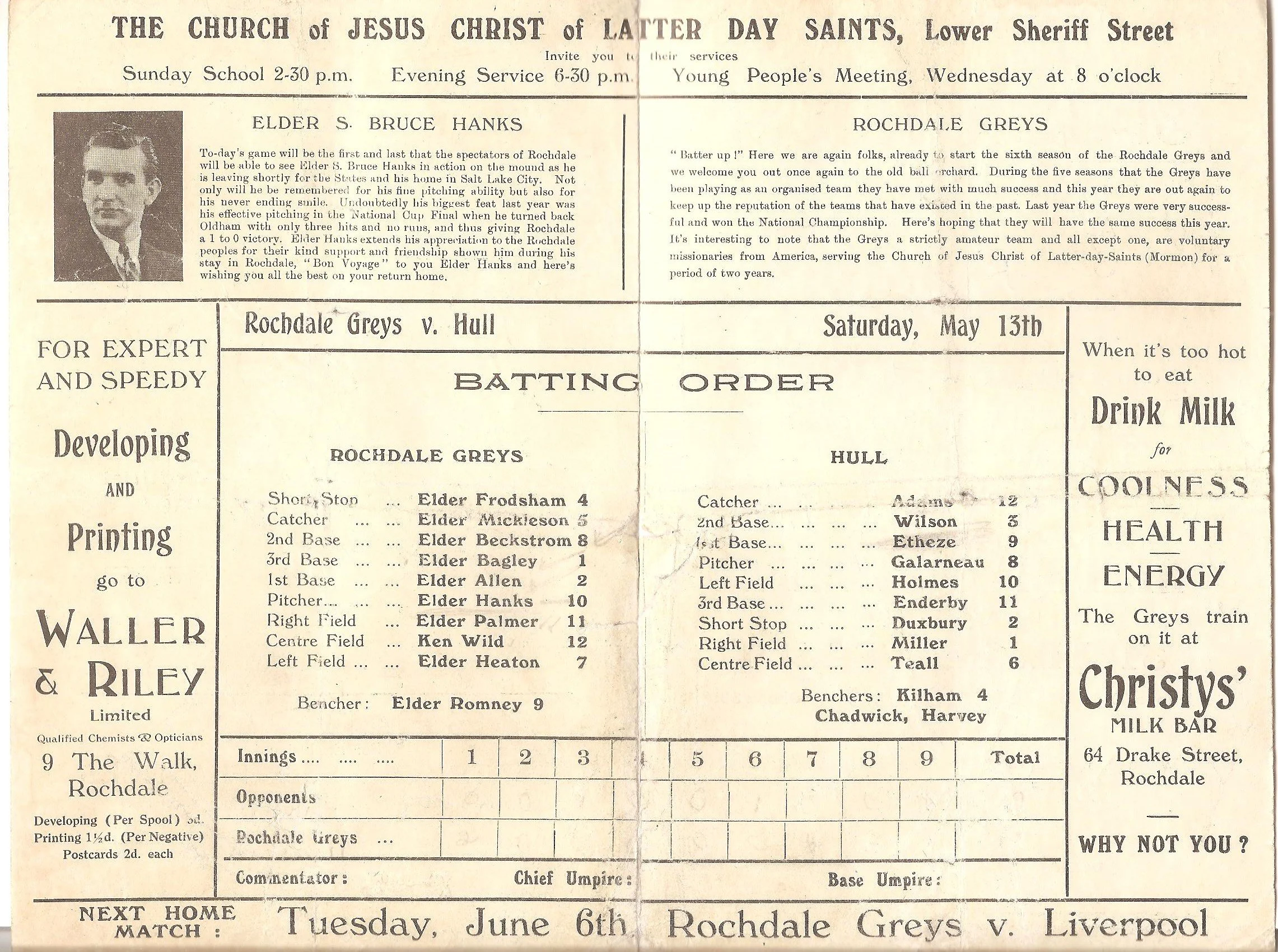
Advertisement for the LDS, Rochdale Greys baseball programme. Image courtesy of Project COBB.
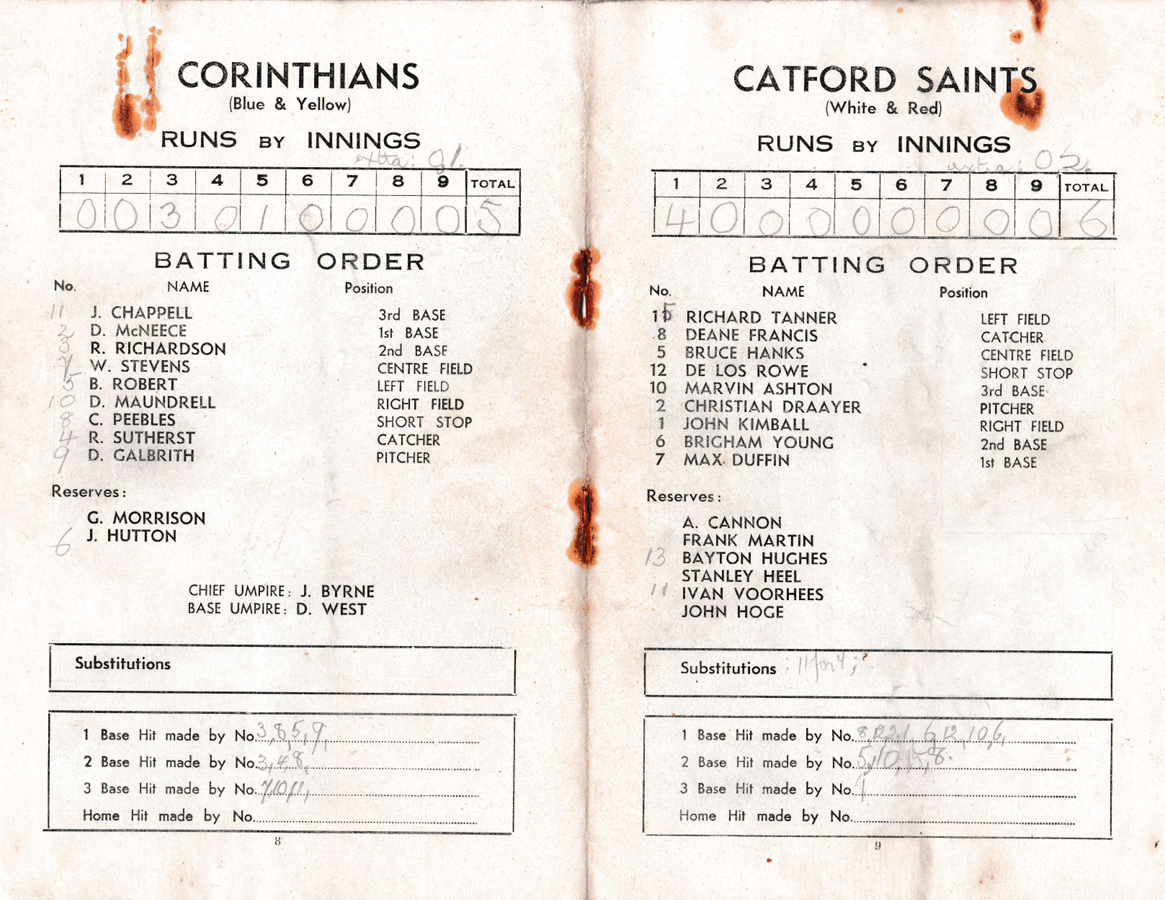
Catford Saints team list for the 1937 season, including Christian Draayer and Brigham Young V. Baseball programme, author's own collection.
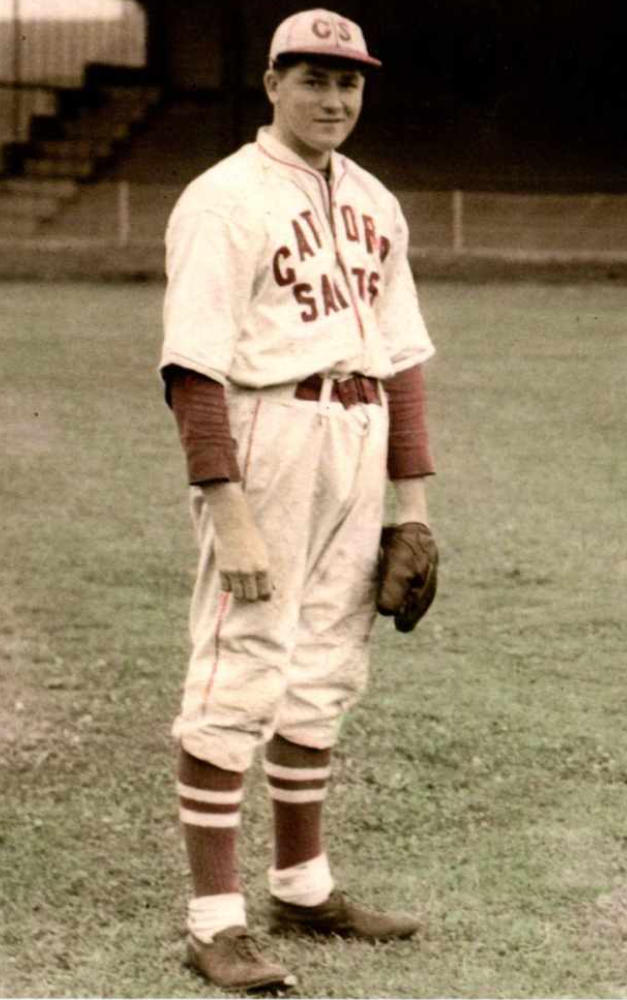
Bruce Hanks, Catford Saints pitcher. Image uploaded to FamilySearch.
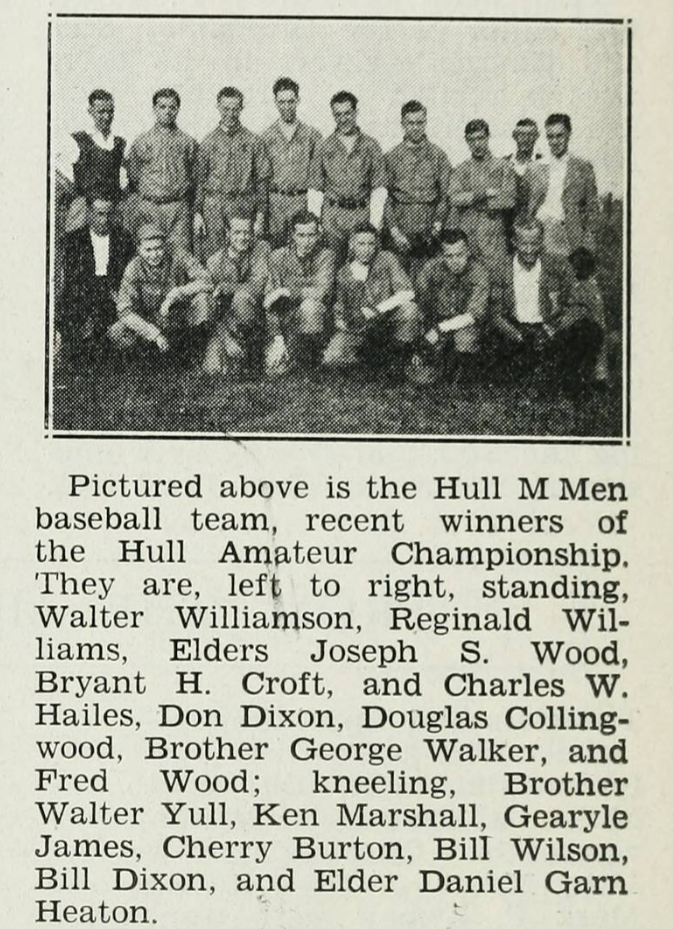
The Hull M Men. Image from Millennial Star newsletter, 2 December 1937. Accessed from archive.org. Public domain.
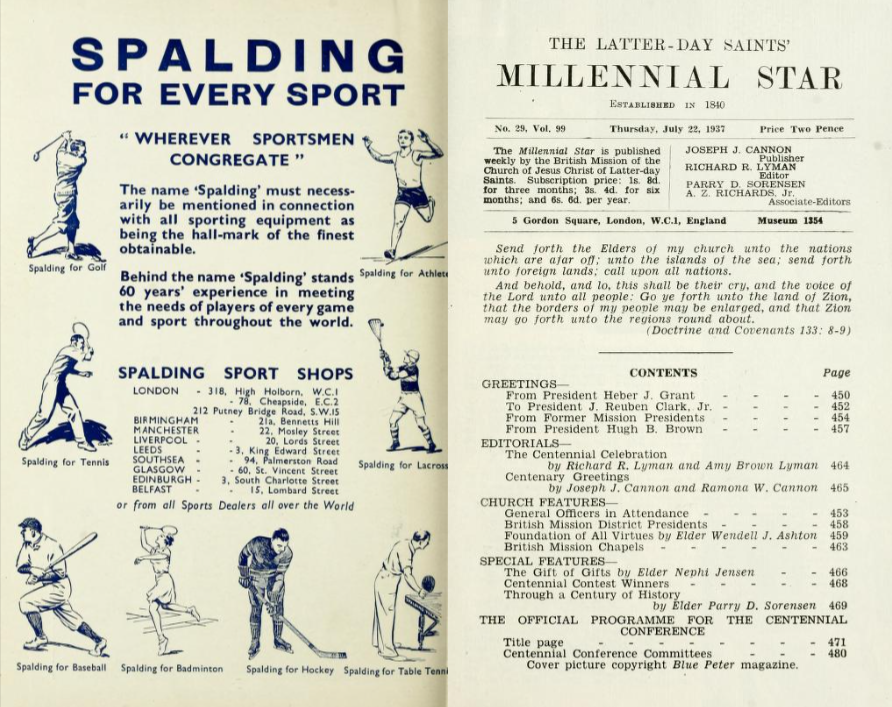
A Spalding Sports Equipment ad in a 1937 issue of the Millennial Star. Image from Millennial Star newsletter, 22 July 1937. Accessed from archive.org. Public domain.