A Stchurt Game for Nacky Yobs.
Jamie Barras.
As District Scoutmaster, many years ago, I felt the need for a quick team game[…]Football is too hot for summer and boys of twelve cannot play with boys of seventeen. Cricket ground is too rough[…]Rounders much better, but Tennis ball not hard enough. In 1909 I got a Spalding guide for 1908, read it at Easter, made a bat, made a ball, gave a test under the rules—great success from the start.[1]
STCHURT.—Verb and noun. V., to stchurt = to travel fast. N., good stuff.[2]
Frederick John “Fred” Lewis (1879–1960) was an original. Born and bred in Chipping Norton, in North Oxfordshire, he was a builder by trade, an educator by inclination, and a communicator by nature. He was the local scoutmaster, Punch and Judy man, film projectionist, undertaker, and heating system installer. Famously opinionated, he had his idea of how and why things should be done and would not be moved from that position, even when it was to his detriment. He was exactly the type of personality needed to persuade a 3000-strong community in rural Oxfordshire that they should make American baseball their summer game.[3]
Once it had matured, the Chipping Norton baseball scene benefited from being within motoring distance of Oxford, allowing local teams to raise their game by playing against Rhodes Scholars. From the mid-1920s onwards, it also participated in efforts to popularise American baseball in other parts of the country. It was active in the Anglo-American London scene from 1924 until around 1930. A few years later, it joined in Liverpool businessman John Moores’ attempts to popularise the sport nationally.[4]
For all this, it has traditionally been viewed as a purely English affair, something that would seem to be a given for a scene that developed around a village in rural North Oxfordshire. However, with this piece, I want to show that from 1915 onwards, thanks to a local philanthropist, the Chipping Norton scene benefited from the presence in the district of men who had learned the game in Canada. This Canada connection, which dated back to 1895, might even have contributed indirectly to the scene’s origins. Rather than being splendid in its isolation, the Chipping Norton baseball scene had strong links to the game’s second home. How it made use of that connection is, however, harder to divine.
TURNING SLUM BOYS INTO GENTLEMEN. LUXURY AS A MEANS OF REFINEMENT. An interesting experiment in philanthropy is being made by Mr. C. E. B Young, a barrister, of Dalesford, in Oxfordshire.[...]If the boy decides that he would like to go to Canada, his fare is paid, and he is given work on farms which Mr. Young owns. If a lad prefers to stop in England, he is taught how to be a farmer, bricklayer, blacksmith, carpenter, clerk, tailor, agricultural labourer, or even a photographer, and in due time work is found for him.[5]
Charles Edward Baring Young (1850–1928) believed that, given the right start in life, any boy could become the best of men. To that end, in 1885, he founded the Kingham Hill School (aka Kingham Hill Homes) in rural Oxfordshire. Kingham Hill had its own farm and workshops as well as classrooms and dormitories (the “homes”) for 300 boys. It took in orphans and boys from families in straitened circumstances and taught them a trade and how to read and write and live a Christian life. Ten years after the school’s founding, Young bought Havelock Farm in Woodstock, Ontario; this became the base for what would be the school’s signature project: providing boys with the means to start a new life in Canada.[6]
One of the boys who went on that journey was George Pike.
G.R.C. Pike, the Cheltenham cricketer, has shown us little this season of his hitting powers learned in American baseball, and which two seasons ago enabled him to build up several good scores by powerful driving all along the carpet, but against Astwood Bank on Wednesday he gave a glimpse of his old form in making his 63 not out. He hit a beautiful 6 and nine 4’s, five of them in succession.[7]
George Richard Charles Pike (1892–1985) was born in Weston-Super-Mare, Somerset, in March 1892, the son of accountant Alexander Pike and his second wife, Sarah Pike née Dance. Pike Sr died when George was just 8 years old, leaving Sarah Pike to raise five children alone. By 1901, just a year after Alexander Pike’s death, the Pike children had been dispersed among the larger Pike family, with only George and his little sister Minnie still in Sarah’s care. By 1911, Sarah would be living apart from all five of her children, working as a live-in nurse. George Pike’s story was, in short, typical of that of boys admitted to Kingham Hill School.[8]
George Pike arrived at Kingham Hill in July 1901, just over a year after his father died. He was 9 years old. Except for his war service, he would spend the next 20 years in the Kingham Hill system as pupil and teacher. A 1910 newspaper report shows him playing cricket for the school in the local league, and in the 1911 England Census, he was recorded as being a teacher at the school. Former pupils staying on to teach was a feature of life at Kingham Hill. In the same 1911 Census, for example, we find Cyril Viner, Ernest Bond, and Edward Burton all also recorded as teachers at the school, even though they were 17, 15, and 14 years old, respectively. It must be remembered that the school provided training in farming and other trades; it needed instructors familiar with its teaching methods, regardless of age.[9]
In February 1913, aged 21, Pike emigrated to Canada, travelling to Kingham Hill’s farm, Havelock, at Woodstock, Ontario. He sailed with several other Hillites, including John Frederick “Jack” Herring (1893–1985), whom we will encounter again shortly.[10]
Under the Kingham Hill system, in return for having their passage to Canada paid for them, the Hillites worked on the farm at Havelock farm for a year. This also gave them time to acclimatise to their new home and find other placements. In 1931, old boy William Adams provided the Kingham Hill Magazine with the following account of his own Havelock experience, which can stand as representative of the experiences of many. Adams, like Pike, had entered Kingham Hill after losing his father at a young age. He was a pupil at the school from 1891 to 1897. Then, after a short time working as a page boy in Charles Baring Young’s Oxfordshire seat, Daylesford House, Adams moved to London and found work as a page for a Harley Street doctor. Four years later, he decided to emigrate to Canada and approached his old benefactor, who made the arrangements.[11]
Previous to sailing for Canada we went to London. We went to the outfitters—nothing was forgotten, even preserved meats for the long train journey after we landed in Canada. We arrived in Canada, July 10th, 1903. I stayed the first year at Havelock Farm, where the late H.G. Benfield was in charge. For a few years, I worked for different farmers by yearly contracts. In 1907, I was married.[12]
George Pike seems to have left the farm and the Woodstock area as soon as his year was up. At least, the outbreak of the First World War in August 1914 found him in Quebec. Like many of the Kingham Hill old boys, Pike was quick to volunteer to fight, enlisting at Valcartier, Quebec, on 31 August 1914. He became a signaller in the 1st Battalion of the 1st Division of the Canadian Expeditionary Force (CEF). By the summer of 1915, he was serving on the front line in France.[13]
Somewhere along the way, he learned how to play baseball and played enough of the game to be described as an “ex-baseball player” in later life. He could have learned it in Chipping Norton, but I think not (see argument below for why); he possibly learned it at Havelock Farm, where we know baseball was played (albeit from a game in 1926—again, see below); he almost certainly played it in the CEF in France, whether he learned it there or back in Ontario.[14]
Many other Hillites resident in Canada also answered the call. Jack Herring, the Hillite who had arrived in Canada with George Pike in 1913, enlisted alongside Ray Moulden (1893–1975) and Harry Juniper (1892–1969) on 22 October 1914. All three were assigned to the 18th Battalion of the CEF. They, too, would be serving in France by the summer of 1915. On the Kingham Hill Roll of Honour, over a quarter of the names are of men who fell fighting in Canadian units. A Kingham Hill old boy even wrote a book on Canada’s contribution to victory, having served as a war correspondent for the Ministry for Overseas Military Forces of Canada.[15]
CANADIAN BASEBALL. Another Canadian baseball match was played at the Folkestone Cricket Ground on Saturday afternoon, between the 2nd Divisional Supply Column and the 18th Battalion Infantry. The game was watched by a good crowd of spectators, and each successful stroke met with enthusiastic applause from the many Canadians present. The 18th Battalion won by 12 runs to 9, but the 2nd Divisional Supply Column played a splendid game, and were well on the way to equalizing the score at the conclusion, having scored well in the latter part of the play.[16]
It is impossible to overstate the impact that the arrival of the CEF in the European theatre had on the fortunes of American baseball in Britain (and, indeed, France). Andrew Taylor, at his Folkestone Baseball Chronicle Facebook page, and in his research papers, has done much to detail this phenomenon. Historian and author Stephen Dame has also made important contributions to this field.[17]
The unit that Herring, Moulden, and Juniper joined, the 18th Battalion, was famous, even infamous, for its love of the sport,[18] but it was hardly alone in that. The number of games played by Canadian units in their base areas in Kent numbered in the hundreds. There were Military and Hospital Leagues, knock-out competitions, and games against a team formed of players who had participated in the most recent attempt to popularise the sport in England, the 1906–1913 London leagues. The man who led that latter team was former league administrator John Gibson Lee, the leading light in attempts to bring American baseball, Canadian-style, to the war-weary British public. Lee was the secretary of the Military Bases and Hospitals Baseball League.[19]
CHIPPING NORTON. Pioneer Troop Boy Scouts’ Camp. —The Chipping Norton and Bloxham Boy Scouts have been camping out at Fairford[...]On Friday, the officers arranged a display, having been asked to do so by the local supporters. The Scouts marched from the Market Square to the rally-ground, where an exhibition game of baseball was first played, the game proving very popular. Then followed fire drill, ambulance, tent pitching, relay races, wrestling, and boxing.[20]
Meanwhile, in Chipping Norton, Fred Lewis’ attempts to popularise the game had continued apace. Between 1909 and 1914, Lewis taught the game at Boy Scout camps. By 1914, older boys and local Girl Guides were also playing the game. In 1917, the first organised challenge competition was held with Boy Scout teams competing. The winning team was awarded a silver cup that was the gift of John Gibson Lee—the secretary of the Military Bases and Hospitals Baseball League we met above. This cup would continue to be awarded to the best team in the district for the next 40+ years. Today, it sits in the Chipping Norton Local History Museum. The summer of 1918 saw games featuring “soldiers, land girls, and other teams”. One of the girls’ teams called itself the “Black Socks”.[21]
As many of the men from the area were in uniform, we cannot tell for certain who was meant by games featuring “soldiers”, other than these were likely men on leave or convalescing. We do know, however, that Hillites who had joined the CEF were among the men in uniform who returned to the area.
NEWS OF THE HILL. The most important events are the visits from our “Old Boys” from the “Front” and “Training Quarters”. We were pleased to see such a large number among whom were George Brooks, Percy Floyd, Harold Gerard, Arthur Humphrey, Lieut. Fred James, Sgt. Alfred Jarvis, Robert Jolly, Ray Moulden, Cpl. George Pike, Tom Pitt, Jack Shepperd, Fred. Spriggs, William Stiles, George Stubbings, Charles Thomas, George Trinder, Sgt. Cyril Viner, Reg. Viner, Fred. White and Jim Flynn.[22]
Of course, this was far from the first time that there had been contact between the Hillites who had moved to Canada and their old school. Charles Baring Young, himself, periodically travelled to Canada to visit Havelock Farm and its residents. One of those trips was in 1909, the year that Fred Lewis hit on baseball as the solution to the problem of what sport his Boy Scouts should play in the summer. Kingham Hill had its own Boy Scout Troop, and we know that Charles Baring Young hosted Boy Scout rallies at Kingham Hill, which Fred Lewis attended as District Scoutmaster. Did Fred Lewis quiz Baring Young on his return from his 1909 trip about what summer sport Canadian boys played?[23]
More than this, we can be sure that there was two-way communication in the form of letters from the time of the first party leaving for Canada in 1895 onwards. Many of those, of course, would be to pupils and teachers of Kingham Hill. However, their contents would have found their way into the larger Chipping Norton community, not least through the participation of pupils and staff in local sports leagues. As we have seen, the school had a cricket team that took part in the local league—George Pike was one of its players; what would be more natural than an old boy in Canada telling a fellow Kingham Hill cricketer that the summer game there was baseball, and this news reaching other teams in the league?
To this can be added Hillites from Chipping Norton itself, who we know remained in contact with their families after they emigrated. The school cast a wide net in finding its pupils, and this included the local area. Ray Moulden, the Hillite who, alongside Jack Herring and Harry Juniper, enlisted on 22 October 1914 and was assigned to the 18th Battalion of the CEF, was a Chipping Norton boy. He was one of the men in uniform who found his way back to Kingham Hill from the Front. John Gilkes (1895–1975) was another. He was from Great Rollright, a village just north of Chipping Norton. A Havelock boy, he enlisted in October 1915 at Woodstock, Ontario, and was assigned to the 71st Battalion of the CEF. Gilkes is of particular interest to us here as he took part in a baseball game at a reunion of old boys at Havelock Farm in 1926. This is a rare example of evidence that baseball was a feature of life at the Farm, albeit from 8 years after the end of the First World War.[24]
All of which is to show that Chipping Norton sporting men like Fred Lewis had every reason to know what sports Canadian men and boys played in the summer. And from 1915 onwards, some of those Canadian men were finding their way [back] to Chipping Norton.
Boy Scouts’ Rally. The annual rally in connection with the Chipping Norton and District Boy Scouts’ Association was held in the grounds of Over Norton House on Thursday Evening[…]The Scouts attending included troops from Chipping Norton, Kingham Hill, and Churchill, and there were also representatives from Foxholes and Chadlington.[25]
This, of course, raises the question: Did any Hillites play baseball in Chipping Norton before they emigrated? There is evidence that leans towards the answer being “no”. By Fred Lewis’s own account, he took baseball equipment “to every scout camp up to the outbreak of [the] 1914 war”. However, while Kingham Hill had a scout troop in this period, Charles Baring Young would not allow it to go away to camp. Rallies that lasted a day, yes, camps that took them away from the school on a Sunday, no. In what appears to be a rare area of disagreement between Baring Young and Fred Lewis, Baring Young was concerned over a lack of observance of the Lord’s Day by Boy Scouts at camp. Fred Lewis’s position was that the boys attended church on a Sunday and could not be expected to do more.[26]
This would support the idea that, unique to the Boy Scouts in the Chipping Hill area, the Kingham Hill boys were not exposed to Fred Lewis’s baseball evangelism. We know that Kingham Hill old boys played baseball. This evidence points to them only learning the game after they moved to Canada, which is ironic given that they went to school in one of the few places in England where they could have learned the game as children.
We have been very pleased to see the following “old boys” on the Hill, many of whom, now demobilised, returning to the old place before settling down to their work in civil life again[…]we have been very pleased to welcome back to the Hill F.G. Goddard, C. Viner, J. Beeson, W. Briers, G. Pike, F. Luxton, P. Floyd[…].[27]
Dear Sir, —It is with interest that I read your correspondent’s remarks on Baseball in last week’s issue. It is possible that there are in Banbury quite a number of ex-Servicemen who played this excellent game "over there.” This being the case I should be pleased to lend to the hon. Secretary of any sports club in Banbury a complete set of equipment for say a month, so that a team could be raised to meet us[…][28]
In 1920, the Chipping Norton Baseball Club was formed. The club accepted both men and women playing members, and mixed games were a feature of at least its first season—something that attracted the attention of even the national press. This was a function of its origins in the local scouting movement, which included women “cubmasters”, and associated organisations such as the Girl Guides. Local teams also had their first games against teams from outside the area, playing two games against American Rhodes Scholars attending Oxford University. There would be further games against Rhodes Scholars in future years.[29]
A comparison of rosters for the club’s senior team and those of Boy Scout teams of earlier years shows that the former’s players were men who had learned the game under Lewis’s tutelage, men like its star pitcher Horace Warmington (1902–1978), who had been a Patrol Leader in the Chipping Norton Boy Scout troop during the war. The scene also included ex-servicemen like Cyril Arthur Viner (1896–1965), who had served in the Ox. And Bucks. Light Infantry. (This Cyril Viner should not be confused with the Cyril Viner who attended Kingham Hill; the latter’s middle name was Leslie.)[30]
Meanwhile, the Hillites who had returned to the area, several of whom took up or took up again roles at the school, George Pike among them, returned to playing cricket in the summer, in line with the school’s devotion to that bat-and-ball game.[31]
We know from Fred Lewis’s correspondence that he knew that there were ex-servicemen in the area who had played baseball in France (“over there”), and we know that he wanted to recruit them to the cause. We also know that there was at least one game in Chipping Norton in 1920 between a team led by Fred Lewis and another of demobbed servicemen.[32] However, I know of no evidence that any Hillites joined the Chipping Norton Baseball Club. This does not mean that none did, of course; there is still much research to be done there. However, it is worth examining the possibility that this was the case.
It could be that no Hillites were interested in swapping cricket for baseball now that they were back in the home of the former game. However, it is also possible that Fred Lewis thought better of letting loose experienced players on his relative rookies. Exactly that situation had proved the downfall of at least two early attempts to popularise baseball in England and would also be blamed for the failure of a further attempt in the 1930s.[33]
Arguably, then, the best place for the Hillites who had learned the game in Canada or the CEF was on the sidelines, giving encouragement when needed but also providing critical voices if it looked like local players were backsliding for want of challenging opposition. As I write this, I am reminded of two pseudonymous baseball correspondents, “Pitcher”, who provided insightful, if arch, commentary on the London baseball scene of 1906–1913, and “Homer”, who provided the same service to the London baseball scene of 1935–1939. Both wrote for newspapers in the Leyton/West Ham area of East London. They may even have been the same man. Regardless, they were both almost certainly men who had learned the game in North America. Their [self-appointed] mission was to work from the sidelines to steer English leagues in the “right” direction.[34]
There is much more research needed to divine what use, if any, Fred Lewis made of the ex-CEF men. But we shouldn’t be too surprised if he kept them at arm’s length but near enough to benefit from their insightful, if arch, commentary.
Cheered by a crowd of about 700 people. many of whom were Americans, the village team of Chipping Norton, the district that gave the United States its national sport, won the British baseball championship at Stamford Bridge ground. Fulham. S.W., yesterday afternoon.[35]
By 1924, the Chipping Norton scene had been integrated into the re-emerging London baseball scene. This was controlled by former US and Canadian servicemen who had remained in England following the end of the war, many of them finding work in London’s nightclub scene. Although this collaboration would bring Chipping Norton its greatest triumph as a baseball club, its back-to-back “British” championships in 1926 and 1927, the relationship would sour soon afterwards. It is easy to see why: it is hard to imagine Fred Lewis seeing eye-to-eye on many things with men who made their living in the boozy, sex-soaked world of 1920s Soho. It can’t have helped that, around this time, Fred Lewis started promoting the myth that Abner Doubleday, the man who at the time was incorrectly credited with inventing baseball, was from Oxfordshire.[36]
In 1933, Liverpool businessman John Moores launched a new effort to popularise American baseball in England. Chipping Norton joined in those efforts, participating in the new National Baseball Association (NBA)’s challenge cup competitions and acting as an ambassador for the sport in areas that the NBA found hard to reach, principally the South West of England. However, once again, the relationship soured over Fred Lewis’s disapproval of the NBA’s approach, which played up the glamour of the sport, not its value as a means of improving the minds and bodies of young people.[37]
The Chipping Norton baseball scene continued to be involved in the amateur game locally and nationally until the death of Fred Lewis in 1960. A few months earlier, the baseball club had lost its clubhouse and all its equipment in a fire, for which it had no insurance coverage. These two blows marked the effective end of baseball in Chipping Norton.[38]
Charles Baring Young died in 1928, but the Kingham Hill School’s Canada programme continued until 1946. The school still exists to this day, but as an independent, fee-paying boarding school.[39]
In 1920, George Pike married fellow teacher Lillian Alma Morris Wiggall. The pair moved to Cheltenham later that same year, Pike accepting an offer to go into the bicycle manufacturing business with William Martin, the husband of one of Lillian’s sisters. Active in the Cheltenham cricket scene throughout the 1920s and 1930s, Pike would later take up golf. In the 1930s, it was not unusual for people to motor from Cheltenham to Chipping Norton to watch baseball there—was George Pike among them? Similarly, in 1934, a group of American schoolboys on a tour of Europe stayed at Cheltenham College for a few days and played a game of baseball while they were there—did George Pike witness it? Perhaps. We know that he at least returned to Kingham Hill from time to time, where he could reminisce about his days on diamonds in France. He died in Cheltenham in September 1985.[40]
The president [of the Banbury Rotary Club] said that, following the report in the Press on the presentation to the Club of a baseball bat, he had had a letter from Mr. Fred Lewis, of Chipping Norton, enclosing a pamphlet which showed the part played in the beginnings of baseball by Oxfordshire, notably at Chipping Norton and Woodstock.[41]
Fred Lewis had some strange ideas about the origins of baseball and some strong views about its place in public life. He was, at the same time, an intensely practical man, as any builder would be. He knew how to make full use of the tools available to him. He had on his doorstep an institution with ties to baseball’s second home, and, from 1915 onwards, men residing in the area, albeit sometimes temporarily, who had learned to play the game there. They may have been too hot a prospect to be allowed to participate fully in the local scene, but that didn’t mean use could not be made of them. It would have been against Fred Lewis’s character not to have at least tried to do so.
Whether he succeeded or not, their very presence showed that Chipping Norton was not, as is popularly believed, splendid in its isolation; it was deeply connected to the wider world of baseball.
Jamie Barras, May 2026.
Back to Diamond Lives
Notes
[1] Fred Lewis, ‘Chipping Norton Baseball’, Baseball In Britain Monthly, Issue 3, July 1950. Available to download here: https://projectcobb.org.uk/materials.html, accessed 26 May 2026.
[2] G.R.C. Pike, ‘“English” Words and Their Meanings’, Kingham Hill Magazine, March 1920. Available to download here: https://www.kinghamhill.org.uk/alumni/archive, accessed 26 May 2026.
[3] Fred Lewis was inducted into the British Baseball Hall of Fame in 2010: https://www.projectcobb.org.uk/bbhof/index.html, accessed 26 May 2026. Bill Williams gives the best account of baseball in Chipping Norton: Bill Williams, ‘Were They the Champions?’, https://www.playingpasts.co.uk/articles/team-sports/were-they-the-champions-the-fascinating-story-of-chipping-norton-baseball-club/, accessed 26 May 2026. A 2008 story in the Oxford Mail incorporates more biographical details on Fred Lewis: ‘Batting for Britain’, https://www.oxfordmail.co.uk/news/2025640.batting-britain/, accessed 26 May 2026.
[4] See Williams, Note 3 above, second reference. Also: ‘Baseball: Chipping Norton v. The American Legion’, Oxfordshire Weekly News, 13 August 1924; ‘Baseball in Birmingham’, Birmingham Daily Gazette, 24 January 1935.
[5] ‘Turning Slum Boys into Gentlemen’, Daily Express, 29 October 1907.
[6] Charles Young: ‘Mr. C.E.B. Young’, Cheltenham Chronicle, 29 September 1928. Kingham Hill School: https://www.kinghamhill.org.uk/about/school-history, accessed 27 May 2026. “Towards the Perfect Man” taken from the Latin Vulgate Bible, Ephesians 4:13: donec occurramus omnes in unitatem fidei et Agnitionis Filii Dei in virum perfectum in mensuram aetatis plenitudinis Christi. Havelock Farm: https://homechildrencanada.weebly.com/8203havelock-farm-woodstock.html, accessed 27 May 2026.
[7] ‘Sporting Gossip’, Gloucestershire Echo, 5 August 1926.
[8] Years of birth and death: entry for George Richard C. Pike, Gloucester, Births, Marriages, and Deaths: https://www.freebmd.org.uk/cgi/search.pl, accessed 24 May 2026; cross-referenced with marriage banns for George Richard Charles Pike, Oxfordshire, England, Church of England Marriages and Banns, 1754-1930, ancestry.co.uk, Ancestry.com Inc. (Operations), accessed 24 May 2026. Alexander James Pike: https://www.familysearch.org/en/tree/person/details/9J28-PDR, Sarah Maria Ann Dance: https://www.familysearch.org/en/tree/person/details/G439-K33, accessed 27 May 2026. Entry for Sarah Pike, George Pike, and Minnie Pike, Weston-Super-Mare district, 1901 England Census, ancestry.co.uk, Ancestry.com Inc. (Operations), accessed 26 May 2026. At least one of Sarah’s children was brought up by his half-brother, Alexander Pike’s son by his first wife: entry for William Pike, Roath district, 1901 Wales Census. Sarah separated from her children: entry for Sarah Maria Ann Pike, Weston-Super-Mare, 1911 England Census, ancestry.co.uk, Ancestry.com Inc. (Operations), accessed 27 May 2026.
[9] I gratefully acknowledge the assistance of Kingham Hill School for access to George Pike’s records. Pike playing cricket for Kingham Hill in 1910: ‘Cricket’, Oxfordshire Weekly News, 22 June 1910. Entries for George Richard Pike, Cyril Viner, Ernest Bond, and Edward Burton, Kingham district, 1911 England Census, ancestry.co.uk, Ancestry.com Inc. (Operations), accessed 26 May 2026.
[10] Jack Herring: https://18thbattalioncef.blog/soldiers-found-from-other-sources/herring-john-f-service-no-53119/, accessed 27 May 2026.
[11] William Adams, ‘Forty Years’, Kingham Hill Magazine, October 1931; available to download here: https://www.kinghamhill.org.uk/alumni/archive, accessed 27 May 2026.
[12] See Adams, Note 11 above.
[13] George Richard Charles Pike’s CEF service records can be found at the Government of Canada’s Personnel Records of the First World War archive: https://www.canada.ca/en/library-archives/collection/research-help/military-history/first-world-war/fww-personnel.html, accessed 27 May 2026.
[14] ‘Cricket: Cheltenham Wednesday v. Stow-on-the-Wold’, Cheltenham Chronicle, 19 August 1922.
[15] See respective service papers, Note 13 above. Also, Note 10 above, and: https://18thbattalioncef.blog/soldiers-found-from-other-sources/moulden-raymond-service-no-53144/, https://18thbattalioncef.blog/soldiers-found-from-other-sources/juniper-william-henry-service-no-53131/, accessed 27 May 2026. “Over a quarter”: I base this on the Roll of Honour published in the Kingham Hill Magazine, December 1918; available to download here: https://www.kinghamhill.org.uk/alumni/archive, accessed 28 May 2026. A quick calculation shows 17 of the 59 names being recorded as belonging to Canadian units. Fred James, Canada’s Triumph, (London: Charles and Son, 1918); available to download here: https://archive.org/details/canadastriumphfr00jameuoft/page/n3/mode/2up, accessed 28 May 2026.
[16] ‘Canadian Baseball’, Folkestone, Hythe, Sandgate & Cheriton Herald, 22 May 1915. See also: https://18thbattalioncef.blog/2018/02/09/21595/, accessed 27 May 2026.
[17] Andrew Taylor: https://www.facebook.com/FolkestoneBaseball#, accessed 3 October 2025; “Did Canada Save British Baseball?”, Journal of Canadian Baseball, 2022, 1 (1), https://ojs.uwindsor.ca/index.php/jcb/article/view/7699, accessed 27 May 2026. https://doi.org/10.22329/jcb.v1i1.7699. Stephen Dame: Stephen Dame, ‘Batted Balls and Bayonets: Baseball and the Canadian Expeditionary Force, 1914–1918’, https://sabr.org/journal/article/batted-balls-and-bayonets-baseball-and-the-canadian-expeditionary-force-1914-1918/.
[18]https://18thbattalioncef.blog/2018/09/24/the-deliquency-of-an-entire-battalion/#more-26325, accessed 27 May 2026.
[19] See Taylor, Note 16 above, second reference.
[20] ‘Chipping Norton’, Banbury Guardian, 17 August 1916.
[21] Account taken largely from the following: ‘Baseball at Chipping Norton’, Evesham Standard & West Midland Observer, 25 August 1923. For a photograph of the cup, see Williams, Note 2 above, second reference. “Black Socks”: ‘Baseball Matches at Chipping Norton’, Oxfordshire Weekly News, 24 July 1918. Lee presenting the cup: ‘Chipping Norton District Boy Scouts’, Oxfordshire Weekly News, 17 April 1918. It is worth noting here that Fred Lewis claimed to have seen his first real game of American baseball in London in 1913. This would have been a game in the British Baseball League run by the National Baseball Association. John Gibson Lee was also secretary of that league, and it seems possible that Lewis made his acquaintance, or at least became aware of him, then, and 4 years later, wrote to him asking for support, which Lee provided in the form of a cup.
[22] ‘News from the Hill’, Kingham Hill Magazine, December 1916; available to download here: https://www.kinghamhill.org.uk/alumni/archive, accessed 27 May 2026. This was the first issue of the school magazine, started to provide a means for boys at the school to send “a message to the trenches from those at home—a message of sympathy and good cheer, a message telling them what is taking place on Kingham Hill, and lastly, a message giving information about their comrades on active service” (editorial by Charles E.B. Young).
[23] See Adams, Note 11 above. Baring Young hosting scouts: ‘Boys Scouts’ Competitions’, Oxfordshire Weekly News, 2 February 1916.
[24] John Gilkes: https://www.familysearch.org/en/tree/person/details/L13R-FZX; service papers: see Note 13 above. Gilkes playing baseball at the reunion: Arthur F. Wheatley, ‘A Canadian Reunion’, Kingham Hill Magazine, September 1926; available to download here: https://www.kinghamhill.org.uk/alumni/archive, accessed 27 May 2026.
[25] ‘Boy Scouts’ Rally’, Oxford Chronicle and Reading Gazette, 10 July 1914.
[26] ‘Chipping Norton & District Boy Scout Association’, Oxfordshire Weekly News, 18 November 1914. Quote from Fred Lewis: Note 1 above.
[27] ‘Chronicle of Events’, Kingham Hill Magazine, September 1919; available to download here: https://www.kinghamhill.org.uk/alumni/archive, accessed 27 May 2026.
[28] ‘Baseball’, Banbury Advertiser, 12 January 1922. Quoting a letter from Fred Lewis.
[29] New club, 1920: ‘Baseball Club for Chipping Norton’, Oxfordshire Weekly News, 14 April 1920. Mixed games: ‘Baseball at Chipping Norton’, Oxford Journal, 13 October 1920; ‘Mixed Baseball in England’, Daily Mirror, 18 September 1920. Rhodes Scholars games: ‘Baseball: Exhibition Game by University Players’, Oxfordshire Weekly News, 9 June 1920.
[30] Compare the rosters here: ‘Baseball Match: Chipping Norton v. University Players’, Oxford Journal, 8 June 1921; and here: ‘District Scout Camp’, Oxfordshire Weekly News, 14 August 1918. Horace Warmington: https://www.familysearch.org/en/tree/person/details/GZJD-GJZ, accessed 28 May 2026. Cyril Arthur Viner: https://www.familysearch.org/en/tree/person/details/LT8H-RG1. Just to confuse matters, there was also a Cyril Leslie Viner, a Hillite who returned to the Chipping Norton area after the war: https://www.familysearch.org/en/tree/person/details/G9VF-ZPL, accessed 28 May 2026. However, we can point to “C.A. Viner” organising a baseball game in 1920: ‘Baseball’, Oxfordshire Weekly News, 30 July 1924.
[31] See, for example, ‘Chronicle of Events’, Kingham Hill Magazine, June 1919; available to download here: https://www.kinghamhill.org.uk/alumni/archive, accessed 27 May 2026. Also: ‘Chadlington: Cricket.—Chadlington v. Kingham Hill’, Oxfordshire Weekly News, 9 July 1919.
[32] Note 28 above and ‘Baseball at Chipping Norton’, Oxford Journal, 9 June 1920.
[33] The presence of experienced American players in local leagues was cited as the reason for the failure of both the first professional baseball league in Britain in 1890 and the London leagues of 1906–1913. See: Joe Grey, ‘What About the Villa?’ (Fineleaf Editions, 2010) and Daniel Bloyce, ‘A Very Peculiar Practice: The London Baseball League, 1906-1911.’ NINE: A Journal of Baseball History and Culture, 2006, 14, 118–128. It would also be the downfall of the 1930s leagues: see Bloyce, Note 35 below, first reference.
[34] A game report by “Pitcher”: ‘Baseball’, Leytonstone Express and Independent, 16 May 1908. A game report by “Homer”: ‘West Ham Win First Match’, West Ham & South Essex Mail, 8 May 1936. Andrew Taylor of the Folkestone Baseball Chronicle and I agree that “Pitcher” was probably the Leyton pitcher, William Jarman, an Englishman who learned his baseball in Cleveland, Ohio, or someone acting as Jarman’s mouthpiece. Andrew thinks that “Homer” may have been Jarman, too, as Jarman was still alive in the 1930s, lived in West Ham, and was involved with the West Ham Invicta baseball club in the late 1930s.
[35] ‘Baseball’, Oxfordshire Weekly News, 18 August 1926; quoting the Evening News (London).
[36] I tell the story of the London baseball scene of the Roaring Twenties here: https://www.ishilearn.com/diamond-lives-art, accessed 28 May 2026. The “London Americans” playing in Chipping Norton, 1924: ‘Baseball: London American Team’, Oxfordshire Weekly News, 27 August 1924. Chipping Norton and the disputed “national” championships: Williams, Note 3 above, second reference. The falling out: there is a remarkable film of Fred Lewis in 1934 speaking to American newsreel reporters about baseball in England, in which he has nothing good to say about his former associates in London. Meanwhile, in 1930, Variety published an article on the London scene in which the writer called the Chipping Norton team “the world’s lousiest”, clearly repeating something said by one of the London crowd (probably Charlie Muirhead, the Canadian ex-serviceman who ran the scene): Variety article: ‘7th Inning Stretch for Tea at Am. Baseball Games in London’, Variety, 30 July 1930. Fox Movietone newsreel outtakes: Fox Movietone News Story 23-173, filmed 25 September 1934, available to view at: https://digital.tcl.sc.edu/digital/collection/MVTN/id/637, accessed 20 October 2025.
[37] The story of the Moores Leagues: Daniel Bloyce, ‘John Moores and the ‘Professional’ Baseball Leagues in 1930s England’, Sport in History, 27:1 (2007), 64-87: https://doi.org/10.1080/17460260701231067. Chipping Norton as baseball ambassadors in Swindon: ‘Novelty for Swindon’, North Wilts Herald, 10 June 1938. Lewis’s disenchantment: Fred Lewis, Note 1 above.
[38] ‘Baseball Chippy Dies at Banbury’, Banbury Guardian, 24 November 1960; ‘Baseball Club Insurances to be Investigated’, Banbury Guardian, 24 March 1960.
[39]https://www.kinghamhill.org.uk/welcome-to-kingham-hill-school, accessed 28 May 2026.
[40] See entry for George Pike and Lilian Wiggall, Births, Marriages, and Deaths: https://www.freebmd.org.uk/search, accessed 28 May 2026; entry for George Richard Charles Pike and Lillian Alma Morris Pike in return for William Martin, Cheltenham district, 1921 England Census, ancestry.co.uk, Ancestry.com Inc. (Operations), accessed 26 May 2026. ‘Death of Mr W. Martin, Local Cycle Firm Partner’, Gloucestershire Echo, 28 December 1949. Golf: ‘Golf: Fourball Foursomes’, Gloucestershire Echo, 16 May 1934. Cricket: ‘Cricket: Teams for Tomorrow’s Matches’, Gloucestershire Echo, 24 August 1926. North Gloucestershire baseball fans: ‘Gloucester Day By Day’, Gloucester Citizen, 26 August 1935. American schoolboys at Cheltenham College: ‘U.S.A. Schoolboys,’ Gloucestershire Echo, 12 July 1934. Pike returning to Kingham Hill: ‘Chronicle of Events’, Kingham Hill Magazine, March 1922; available to download here: https://www.kinghamhill.org.uk/alumni/archive, accessed 27 May 2026
[41] ‘How Banking Began’, Banbury Advertiser, 26 October 1949.
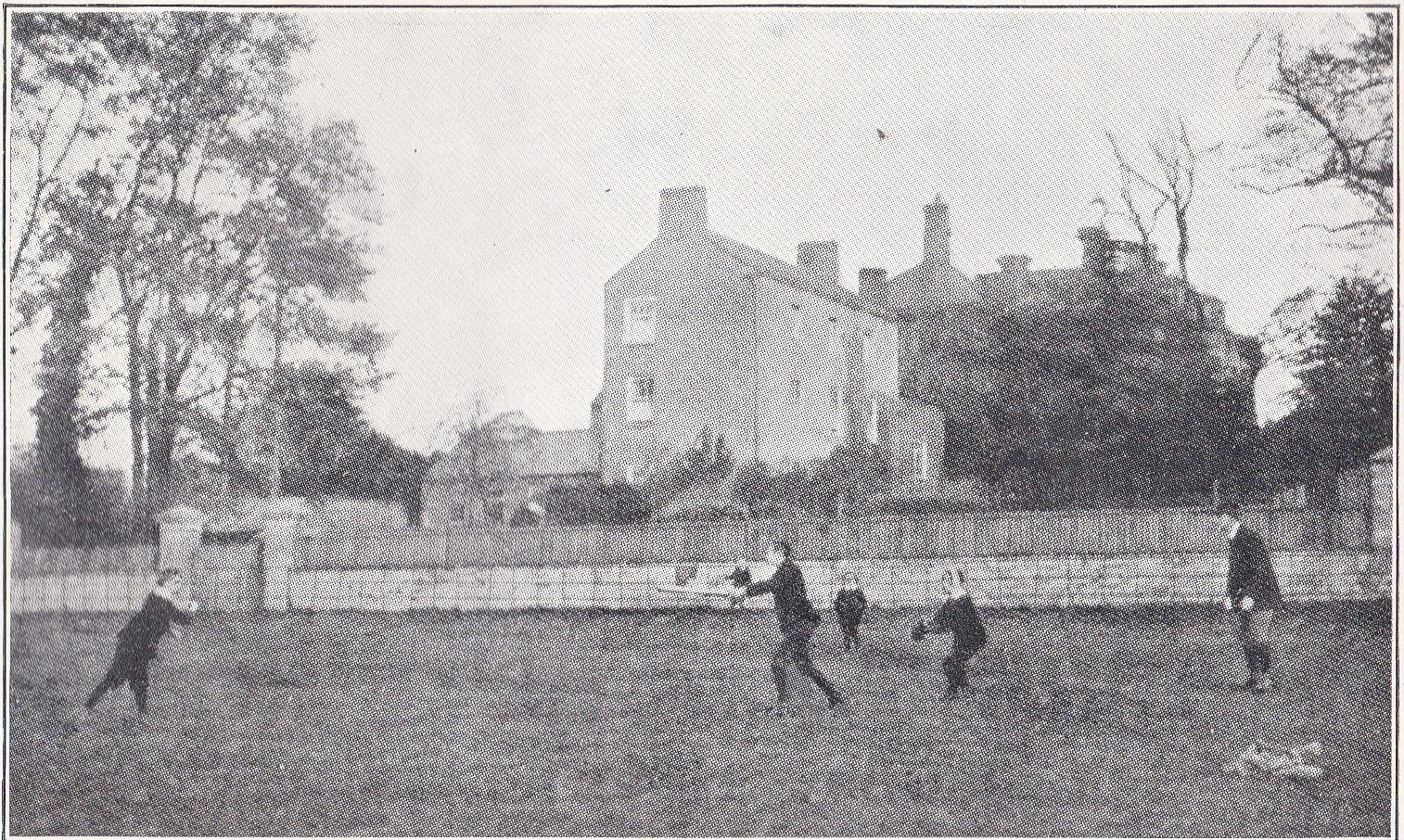
Schoolboys playing baseball at Chipping Norton, 1913. Frontispiece, L.D. Wood, "Baseball for Boys and Beginners", (Liverpool: National Baseball Association, 1939). Author's own collection.
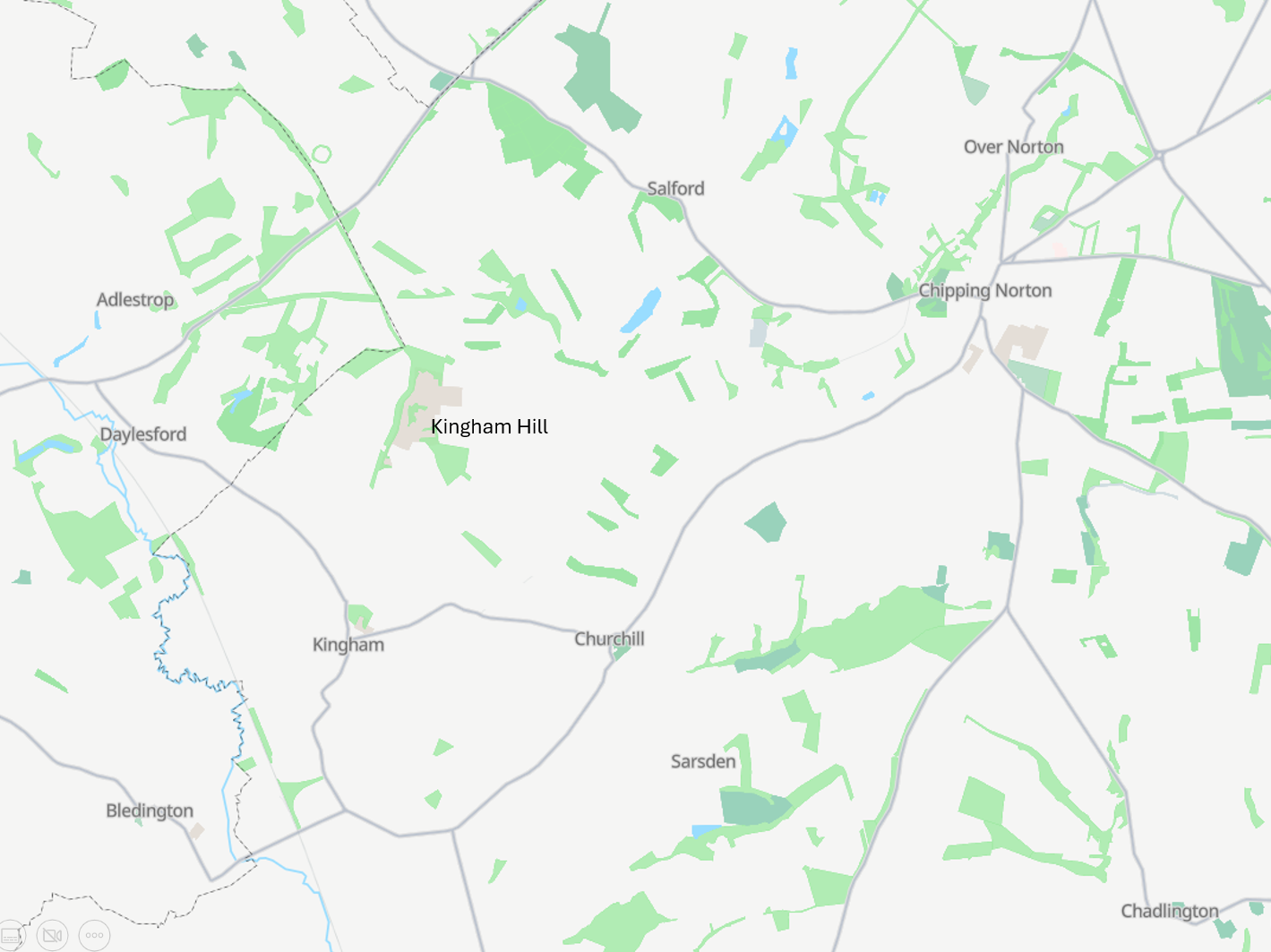
Chipping Norton and District, North Oxfordshire, including Kingham Hill.
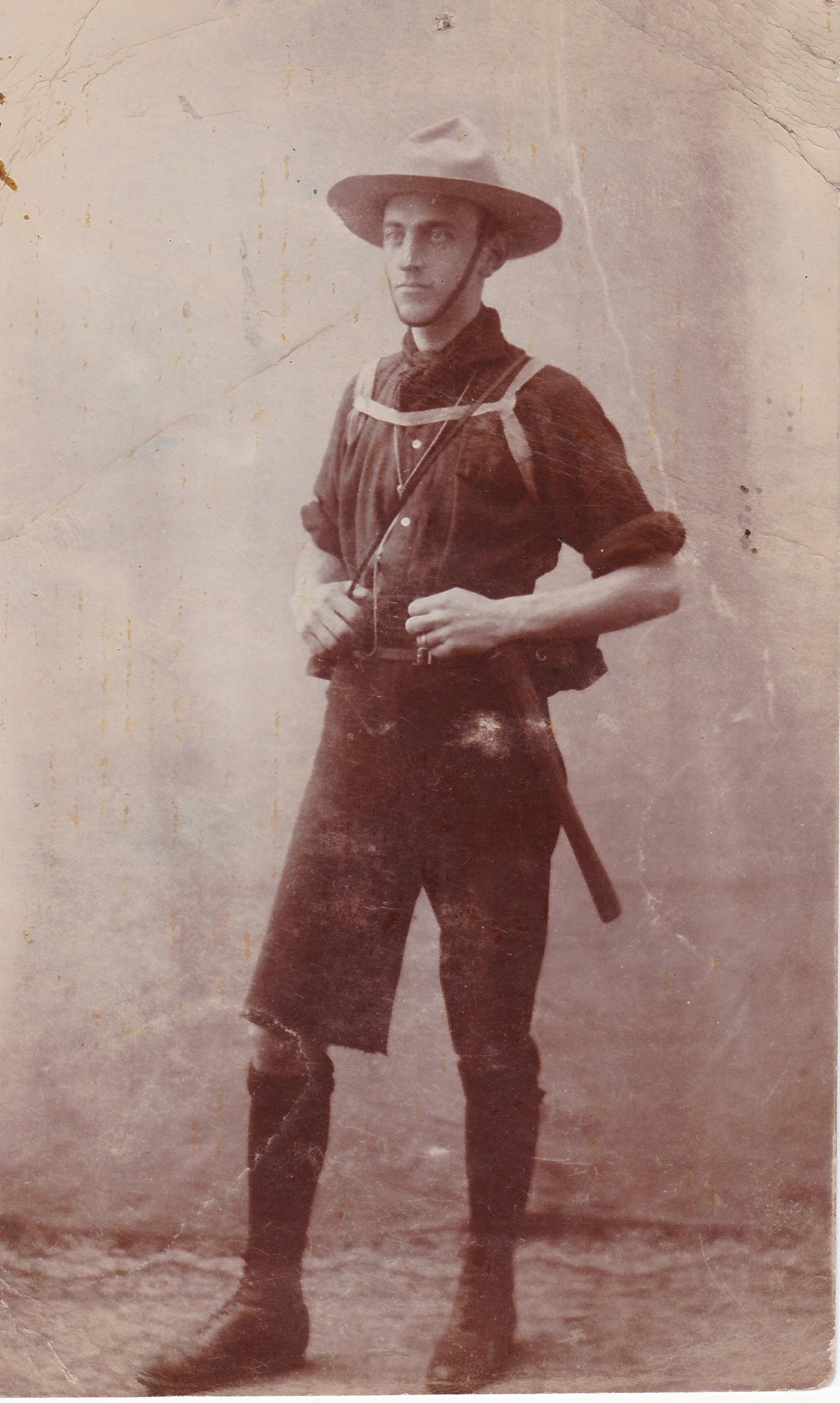
Fred Lewis in his Pioneer Scouts uniform, circa 1907. Real photo postcard by Frank Packer. Author's own collection.
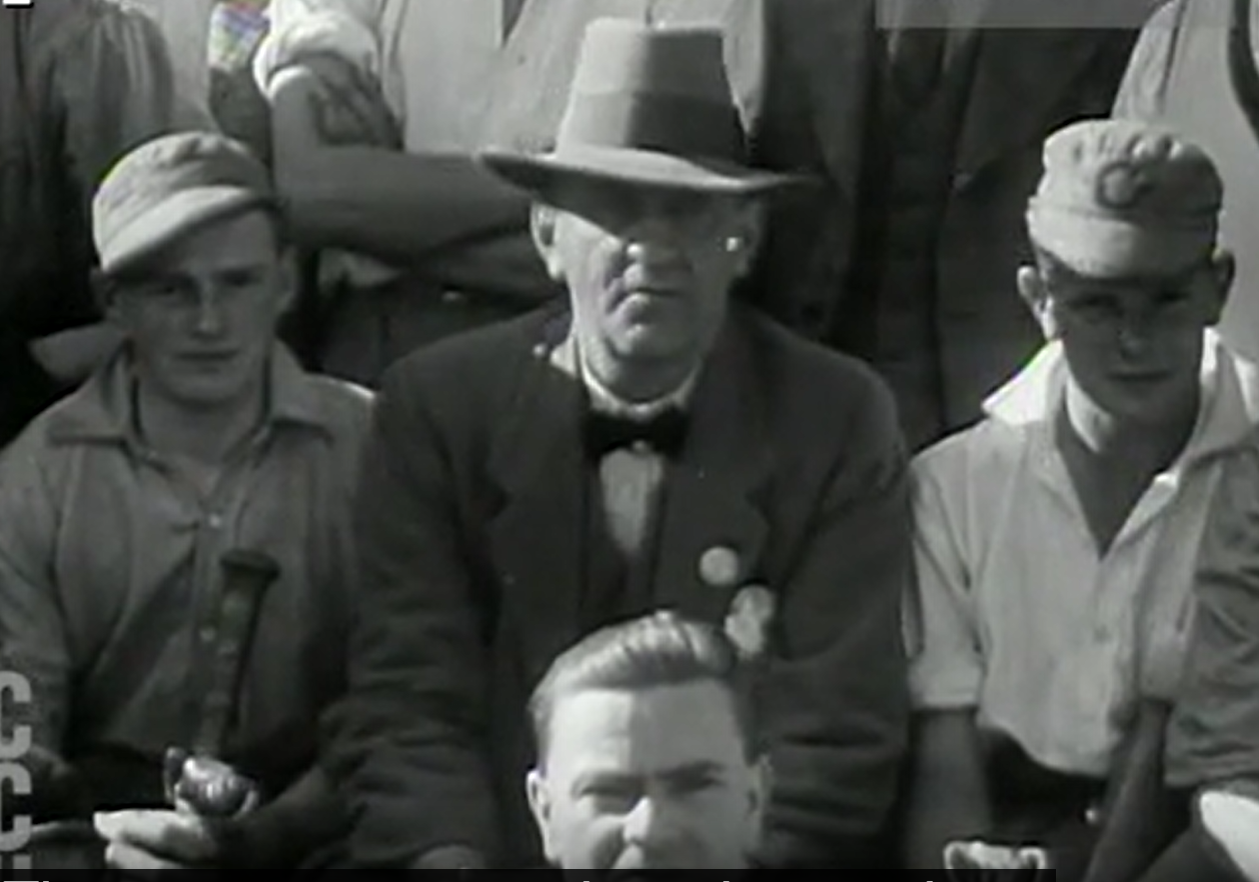
Fred Lewis in 1934 with some of his Chipping Norton baseball players. Still from Movietone News outtakes, https://digital.tcl.sc.edu/digital/collection/MVTN/id/637
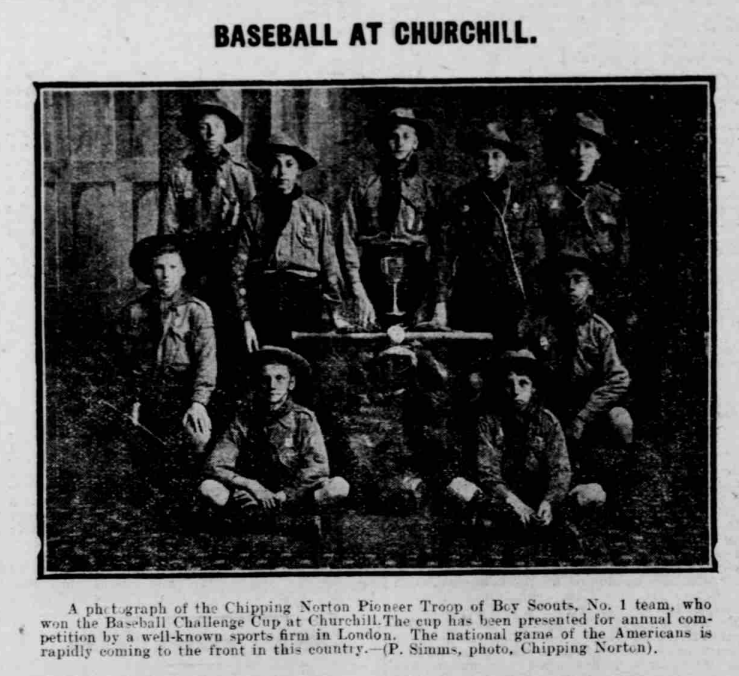
Boy Scout baseball team, first winners of the Chipping Norton Baseball Cup. Oxford Journal, 19 June 1918. Image created by British Library Board. Public domain.
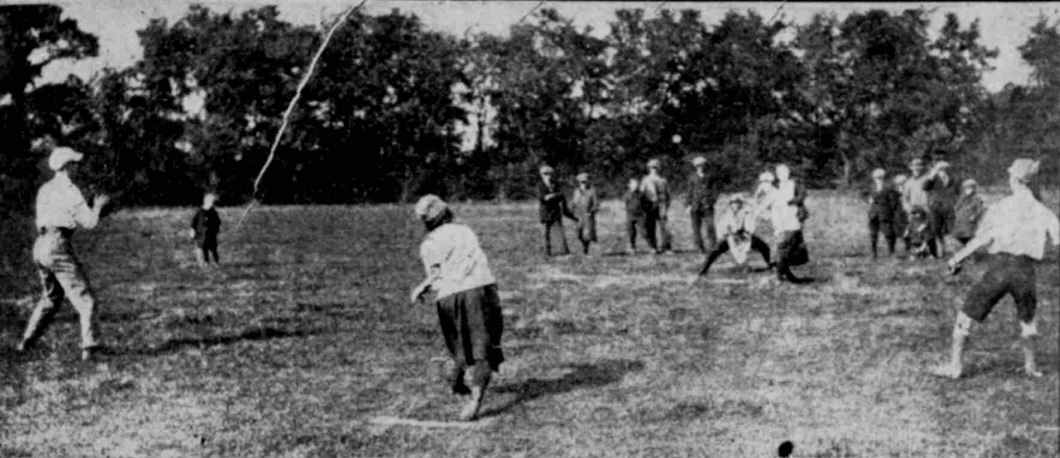
Mixed baseball, Chipping Norton. Oxford Journal, 13 October 1922. Image created by British Library Board. Public domain.
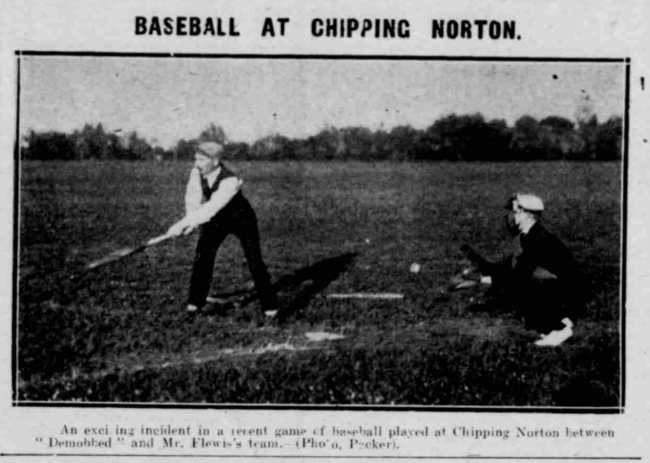
Baseball at Chipping Norton, Fred Lewis Nine versus Demobbed Nine. Oxford Journal, 9 June 1920. Image created by British Library Board. Public domain.
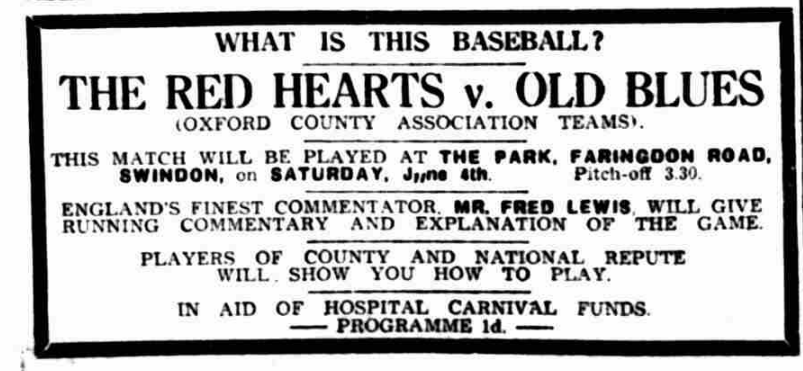
Chipping Norton teams on baseball missionary work in the South West of England. North Wiltshire Herald, 3 June 1938. Image created by British Library Board. Public domain.
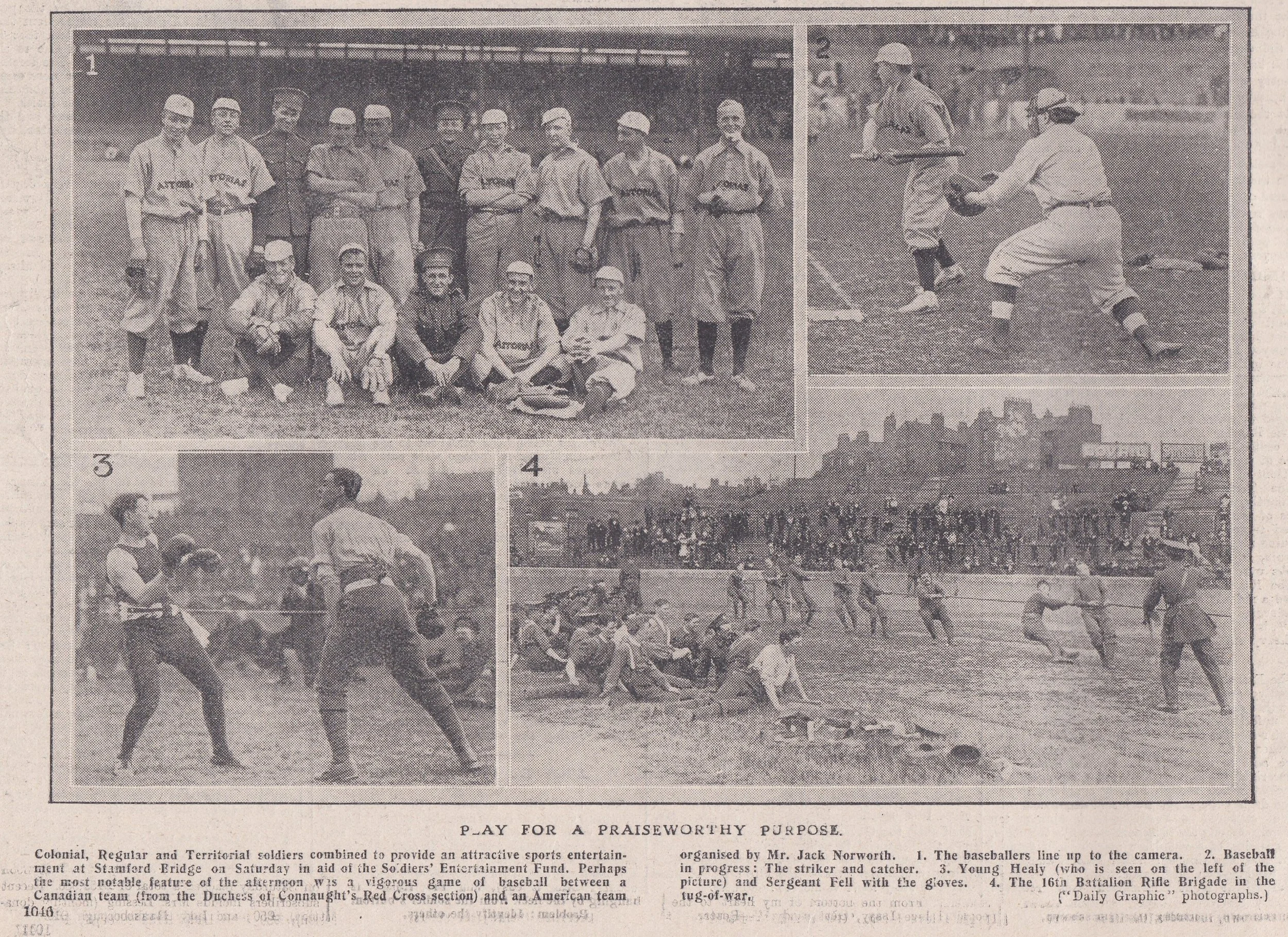
Wartime sports, including Canadian Expeditionary Force (CEF) baseball hospital league team, Astoria (later Taplow). Daily Graphic, 7 June 1915. Author's own collection.