
The Mad Man and the Natural
Jamie Barras
The morning of Saturday, 17 August 1895, was a tense one for Derby industrialist Frances Ley. At the start of the year, he had crowned his seven-year love affair with American baseball by becoming the first British-born president of the National Baseball Association of Great Britain (NBA). Now, Derby, the team that Ley had founded, funded, and nurtured through good times and bad, was playing for the NBA’s greatest prize, the English Amateur Baseball Championship trophy at the stadium that Ley had built as a temple to the game.[1]
And yet, Derby’s victory was far from a sure thing. Their opposition, the London-based Fuller’s team, named after American confectioner William B. Fuller, the team’s sponsor, was built around the most lethal battery in England: catcher Charles Carey, an African American stage performer with unsurpassed physicality born of his training as a dancer and acrobat, and baby-faced Howard Ruggles, a 20-year-old American ad man, rated, even by the partisan Derby press, as the finest pitcher in England.[2]
Just one month before the big game, to counter the threat that the Ruggles–Carey battery represented, Ley had taken a calculated risk: he had brought a new pitcher into his Derby team. His name was William Hogan, and people called him the best native-born pitcher in England, a natural; but, he had been out of the game for three long years, and with just one month to rediscover his form in a team that included the player that Ley had unceremoniously booted out of the pitcher’s box to make way for him,[3] it was by no means certain that he would be able to deliver the goods.
Frances Ley had every reason to feel tense.
Mr Fuller, the American confectioner, is an enthusiastic baseballer and has encouraged the formation of a club among his people. There are now, indeed, many baseball clubs in London and the provinces. The headquarters of the game in London may be located in the picturesque park near Telford-avenue, Brixton, that is now mainly devoted to baseball. There is a spacious pavilion, a tea-room that is, in fact, a branch of Mr Fuller's well-known establishment, and a refreshment saloon under the care of Mr Reed Pinaud.[4]
The London and Midlands baseball scenes were a study in contrasts. Ley’s Derby had started out as a company team formed of employees from his Vulcan Foundry works. The 1890 national professional baseball league that it joined—England’s first—was a joint venture between American baseballers and British Association footballers, an attempt to establish American baseball as a summer complement to the winter game of Association Football. Many of its players, including, as we will see, William Hogan, were professional footballers drawn to the new sport as a means to keep fit (and keep getting paid to play) during the close season. The professional league did not last, for reasons we will discuss below, but the amateur game lived on, drawing from the same well of players and supporters. The Midlands scene was, in short, like its Association Football big brother, a blue-collar affair.
The London scene could not have been more different. As the presence of Carey, the African American stage performer, and Ruggles, the American ad man, in a team sponsored by an American confectioner, suggests, it was formed largely of North American expatriates, which, in the period, meant mostly entertainers and businessmen. It was largely the brainchild of Canadian-born comedian R.G. Knowles, and the 1896 book that Knowles wrote with co-author, songwriter Richard Morton, introducing baseball to the British public, remains our best guide to the origins of the scene and the 1894 and 1895 baseball seasons in London.[5]
Knowles had been a founder member of the Thespians baseball team back in 1892, an independent outfit formed of entertainers, as the name suggests. Knowles had led the Thespians to back-to-back English championship wins in 1893 and 1894. Eighteen Ninety-Four was also the year that he helped found the London Baseball Association (LBA) to run the game in London. The LBA operated a senior and a junior league, both of which drew heavily on commercial sponsorship to cover costs, something that was reflected in the names of the teams: alongside the Thespians, there were St Jacob’s Oil, Remington Typewriter’s, the Post Office, etc. For the 1895 season, the returning teams were joined by two new teams, both of which were thought of as potential league winners: Dewar’s, a team sponsored by Thomas Dewar, the Scotch Whisky distiller and new president of the LBA, and, as we have seen, Fuller’s, sponsored by confectioner William B. Fuller. The London baseballers had every reason to believe that they would be bringing home the English cup at the end of the season again.[6]
Thus, it was of immense satisfaction to the Derby club that when it travelled down to London to open its 1895 season, it trounced both Fuller’s and Remington Typewriter’s.
Derby took an excellent team, probably the best at their command, and throughout both games hardly gave away a chance. On the first day, the feature of the game was the excellent pitching of Mellors, who appears to be in the best of form.[7]
‘Mellors’ was James Hallam Mellors (1865–1909), a Leicestershire native and employee at Ley’s Vulcan Foundry in Derby who had been with the team since its inception.[8] He was—until the arrival of William Hogan—Derby’s lead pitcher for the 1895 season. Indeed, he had been Derby’s lead pitcher ever since the departure at the end of the 1890 season of John Peter Reidenbach (1865-1939), the American pitcher that Ley had, controversially, brought over from Cleveland, Ohio, to teach his employees baseball and pitch for his factory team.[9]
To the satisfaction of the Derby press, who made much of the fact that the home team was largely ‘English’ while the visiting team was ‘All Americans’, Derby repeated its success against Fuller’s on home ground a few weeks later. In a game characterised by poor fielding and weak pitching on both sides, leading to a final 44–32 score in Derby’s favour, the principal consolation for the London side was the strong performance by Carey both in front of and behind the plate.[10] However, it was clear that it was lacking in the pitching department.
So, it was with some relief that, in early June, salvation arrived in the form of Howard Palmer Ruggles.
At Telford Avenue the Fullers and Dewars met in a national cup game. Each team put forth every effort and after one of the most exciting games seen in London the Dewars won by 4 runs. Achew, Le Free, and Le Martine did great work for the winners, both at the bat and in the field, and for the losers Ruggles, Ashby, and Albertus were very much in the game.[11]
Howard Palmer Ruggles (1875–1959) was born in St Louis, Missouri, the son of railway ticket agent Oliver Ruggles and Rebecca Ruggles née Scobee. In 1891, Oliver Ruggles moved his family to Chicago, and there, Howard attended Lake View High School. At Lake View, Howard and his little brother Ennis both turned out for the baseball team, Howard serving as catcher. He also played on the school football team.[12] It might be expected that he would go on to college, but he had ambitions to make it in the rapidly advancing world of magazine publishing—1893, Howard’s second year at Lake View, was the year that Samuel McClure revolutionised the industry by selling each issue of his McClure’s Magazine for just 15 cents, relying on advertisements to cover costs and generate profits. This model turned publishing on its head and made the search for advertisers arguably the most important part of the publishing process.[13]
It was against this backdrop that Howard decided to skip college and start what would become a lifelong career in the furiously paced world of magazine advertising, going to work for the Werner Publishing Company of Chicago. His first assignment? Secondment to the company’s London office. This was the summer of 1895. He was 20 years old.[14]
The Fullers won principally through the magnificent work of Ruggles, first as catcher and afterwards going into the box. Not one clean steal was made off him as catcher, and when he took on the other end he struck out nine men and allowed but four hits and two runs in four innings, Carey, with one exception, gave perfect support.[15]
When Ruggles signed on to play for Fuller’s in early June 1895, it was in the same position he had played at Lake View: catcher. However, within a couple of weeks, it was obvious that he was, instead, the ace hurler that the team had been looking for. Once Ruggles partnered with Carey as catcher, the Fuller’s battery was near-unstoppable. Something that Derby discovered to its cost in early July.
Ruggles had another outing at Telford-avenue Thursday afternoon. He struck out 18 of the Midlanders, made a single, a double, three-bagger, and home run.[16]
Having bested Fuller’s twice in the early season, this was a rude awakening. A hint of peevishness began to enter the Derby press’s coverage of games at which the Derby faced Ruggles in the box.
On the Wednesday and Thursday, the games were entirely in favour of Derby, who won easily, but after playing these two hard games and getting prettily well knocked about they were set to meet absolutely the strongest team that could be selected, including Ruggles, the well-known pitcher. It was anything but sportsmanlike to arrange such a match for the third game, and it was hardly surprising to see the Derby team go down. In a fair encounter it is open to serious question whether any team the Metropolitans could select could take a rise out of the Midlanders.[17]
After a further defeat against Fuller’s at Derby, the local press even went so far as to say that Ruggles was the only reason that the Derby team now struggled against Fuller’s.
On the Fuller's side the team as whole played a fairly good game, but had it not been for the pitching and catching of Ruggles, to whom they trusted to carry them through, their chances of success would have been very slight indeed. With a full team, we think Derby has very little to fear from Fuller's.[18]
They did at least allow that Ruggles was the best player that any London team had to that date sent north. Ley was not blind to the threat. Indeed, the game just described, played on 17 July 1895, was the game in which William Hogan, not yet occupying the pitcher’s box, made his Derby debut.
In the matter of pitchers the Villa cannot, however, claim any indulgence, for they have three men who can occupy the box, against Hogan, for the North End. The North End thrower has certainly proved himself a marvel, for he not only keeps close to his box work, but fields all balls which come his way to perfection, and, in addition, bats considerably above the average.[19]
William Hogan (1871–1911) was an army brat. He was born in Aldershot camp in March 1871, the son of Irishman Cornelius Hogan, a sergeant in the 101st Regiment of Foot (Royal Bengal Fusiliers), and Bridget Hogan née Rafter. Cornelius and Bridget had met and married in India, where Bridget was born (Hogan was born in Tipperary, Ireland). The Rafters went back at least two more generations in India. Alas, a dearth of online records makes this intriguing aspect of Hogan’s heritage, for the moment, a closed book.[20]
As its name suggests, the Royal Bengal Fusiliers was itself a regiment raised in India. It had started life as the Bengal European Regiment of the East India Company, being transferred into the British Army and designated the 101st Regiment of Foot (Royal Bengal Fusiliers) in 1862. In 1868, the regiment was sent to England to retrain. It remained there until 1874, when it took up garrison duty on Malta and then Cyprus. Its next deployment was an important one for our story, as, in 1879, it was transferred to Nova Scotia, where it remained for the next two years. While in Canada, it was merged with another former East India Company regiment, the 104th Regiment of Foot (Bengal Fusiliers), to form the Royal Munster Fusiliers.[21]
Even if the above deployments were not a matter of record, we might discern them from the places of birth of the Hogan family children: William, born in Aldershot in 1871, Agnes, born on Malta in 1875, Cornelius Jr, born on Malta in 1879, and Charlotte, born in Nova Scotia in 1880. Jumping ahead in the timeline: Cornelius Jr would grow up to join his father’s old regiment, renamed the Royal Munster Fusiliers, before becoming a professional footballer, like his big brother.[22]
William Hogan would have been eight or nine years old when his father’s regiment, with the Hogan family in tow, deployed to Nova Scotia in 1879. The British military presence in Nova Scotia centred on Halifax. Although it would not be until 1888 that Halifax would have its first organised baseball league, the Halifax Baseball Club was formed as far back as 1868, with informal teams and games active in the port city even further back.[23] The Hogans spent over a year in Nova Scotia, providing plenty of opportunities for an impressionable young boy with an athletic turn of mind to see his first baseball game.
On the renamed Royal Munster Fusiliers' return to England, Cornelius Hogan Snr retired from the British Army and settled his family in Salford, Manchester. However, like many former soldiers, he found life outside the Army even tougher than life inside it. By 1890, he had signed up a second time, joining the 47th (Lancashire) Regiment, and moving, with his family once more in tow, to the regiment’s base, the Fulwood Barracks in Preston.[24]
Fulwood Barracks remains a British Army establishment to this day; from its gates, it is just a 10-minute walk to Deepdale Stadium, since 1878, the home of Preston North End Football Club, and from where, in May 1890, the newly established Preston North End Baseball Club put out a call for players.
On Saturday, Mr. M.P. Betts, the secretary of the Great Britain League, in company with Mr. Hart, of Chicago, and Mr. [Maskrey], of Pennsylvania, paid a visit to Preston, and Mr. [Maskrey], who is an experienced ball player of the Western League, was left behind for the purpose of instructing the North End players, and anyone else who wishes to learn the game. During yesterday morning, Mr [Maskrey] was busily engaged in marking out a ground and getting the bats, balls, and bases ready.[25]
Leech Maskrey (1854–1922) was one of a number of instructors brought over from the States by the National Baseball League of Great Britain. Although most of the instructors were minor league or varsity players, Maskrey was—briefly—a major leaguer, playing for the Louisville Eclipse and Cincinnati Red Stockings for several seasons in the 1880s.[26] He would serve as Preston North End Baseball Club’s player–manager for its season in the professional British National League.
The origins of the National League, its establishment, progress, and ultimate demise after only a single season have been told by others, most notably Joe Grey in What About the Villa?, and I will not dwell long on the story here. For our purposes, it is enough to know that the league was formed of four teams, all from the Midlands, three of them associated with Association Football clubs, Preston North End, Stoke, and Aston Villa, and the fourth, Francis Ley’s Derby factory team. As stated above, it was intended as a close-season complement to the Association Football leagues and designed to attract the same players and fans. It failed, ultimately because it had external financing (from the Spalding Brothers Sporting Goods Company) for only a single season and could not support itself from gate receipts alone. However, along the way, it almost fell apart over the controversy of Francis Ley employing an experienced American battery in his Derby team—pitcher John Reidenbach and catcher Sim Bullas—that lay waste to all before it. The other teams protested, Ley promised not to employ Reidenbach as a pitcher going forward, and then reneged on that promise as soon as Derby started losing without Reidenbach in the pitcher’s box. When it was politely suggested to Ley that this was not the behaviour of an English gentleman, Ley withdrew his Derby team from the league in a state of high dudgeon. With the withdrawal of Derby, Preston, after a close-fought battle with rivals Aston Villa, ended the season top of the table, only to have a victory taken from them and fall to second after a league meeting judged that Stoke had failed to put up a fight in one of its games against Preston. The league handed the season win and the first English National Professional Baseball Championship to Aston Villa.[27]
The controversial end to the season aside, the success of the Preston team during the season was largely due to two factors: Maskrey’s intelligent leadership and the pitching of William Hogan.
[…]the staying powers of Hogan as a pitcher have surprised everyone.[28]
Hogan, it must be remembered, was all of 19 years old in 1890—a year younger than Ruggles would be when he would join Fuller’s in June 1895. An undoubted natural talent, Hogan also had the advantage of that early exposure to the game, even if only as a spectator, and, from a physiological perspective, of being an experienced cricketeer on top of an Association Football player.[29] We do not know his height, but he was 11 stone in weight, and his brother, Cornelius, was nearly six feet tall. Taken together, these suggest that William Hogan was also of above-average height. Although the theory that taller pitchers have advantages compared to shorter pitchers is disputed, not least statistically,[30] having a larger body frame would have allowed Hogan to carry more muscles, and, as these muscles were developed and tempered by a youth spent playing cricket, he was in a position to put these extra muscles to good use.
With regards to Association Football: the 1889/1890 season was also the season that Hogan started his football career, playing for a small Southport-based club, Churchtown.[31]
Mentored by Leech Maskrey, Hogan had arguably had the largest impact of any native-born player in the 1890 National League. However, like the other instructors funded by Spalding, Maskrey returned to the States when the funding dried up and the League folded. Only time would tell if Hogan could sustain the form he had shown under Maskrey’s tutelage.
[...]the phrase, With battery,” has been much discussed, and various guesses have been made at it; [...]the best we have heard of was heard at Deepdale, and was as follows:- first spectator: "Does tha know who battery is?” Second spectator: "No, I don’t. (After a pause) Oh, I hev it. It’s Hogan. Tha knows he comes fro th’ Barracks, en that’s why he's battery.”[32]
In the summer of 1891, baseball made the short journey from Deepdale to Fulwood Barracks, with the formation of the Fulwood Baseball Club in early June. Hogan pitched for, effectively, his home team, the Fulwoods, against his Preston teammates at Deepdale in the inaugural game of the 1891 season at the start of June. Three weeks later, the Fulwoods had secured a ground just outside the back entrance to the Barracks; this they christened with a game of married men versus single men from the barracks, Hogan playing for the single men, who won the game 24–4. Later that summer, Hogan put together a scratch cricket team from amongst his Preston teammates and took on a barracks team formed of men from the North Yorks Regiment. With Hogan bowling, the hesitant baseballers were one run behind after the first innings, but trounced the soldiers in the second innings, winning the match.[33]
Hogan was also in the pitcher’s box for Preston’s game against the touring Edinburgh University team, which was largely formed of North Americans studying medicine at the university and was captained by Nova Scotian Thomas Benjamin Moore.[34] The previous year, Moore had been instrumental in introducing baseball to the North East of England, alongside fellow Nova Scotian Harry Sheffield (who tragically died in April 1891 of TB, aged just 23). The North East baseball scene would produce a number of strong clubs, prime among them Middlesbrough (1892 National Champions), Stockton (1894 runners-up), and Wallsend (1896 National Champions).[35] Preston trounced the collegians, although the game had to be abandoned after only five innings due to rain.
However, the real business of the 1891 baseball season in the Midlands, now that the National League was no more, was the renewal of the rivalry between Preston and Derby, with the latter now without the services of their American battery, Reidenbach and Bullas, who had returned to the US as soon as the 1890 season was over. Ley’s team felt their absence. With Hogan in the pitcher’s box, Preston was now dominant.
What a pity it is that baseball has been allowed to collapse, as, judging by the enthusiasm evinced the numerous spectators at Deepdale on Friday and Saturday, the game would have become more popular even than last season, At any North End are not to blame, for as soon as the manager is conspicuous by his absence, then they are able to arrange four matches with Derby. The result of the first two, which came off as above stated, showed beyond a doubt that the North Enders are the best local nine in Britain[...]whilst in Hogan, the Prestonians have a pitcher of considerable merit, no doubt, the best English pitcher we have.[36]
It is worth taking a moment to consider that reference to Hogan being the best ‘English’ pitcher in the game in England. Although no doubt the writer simply meant native-born as opposed to North American, not specifically ‘English’, it does invite the question: how did Hogan view himself? I think he, and the people around him, would have described him as an Irishman. It was true that he had never lived in Ireland—we cannot even be sure that he had ever visited the country—and, at the time that the above report was written (August 1891), he had spent more years in England (13) than anywhere else; however, against this, he was the son of Irish parents and Catholic in a Protestant country. It is likely that, wherever the Hogan family were in the world, and they had seen a good proportion of it, as Irish Catholics in the British Army, it was to others of the same origin and faith to whom they felt the closest kinship. It is also telling in this regard that, when in 1881, the Royal Bengal Fusiliers merged with the Bengal Fusiliers, the new name of the combined regiments was the Royal Munster Fusiliers, itself indicative of the Irish origins of many of its soldiers.
BASEBALL: THE FIRST MATCH BETWEEN ENGLISHMEN AND AMERICANS. NORTH END v. NEW YORK AMATEURS Saturday witnessed the first game at baseball between Americans and devotees of ’ball of any other country, and thus to the Preston North End team belongs the honour of having played what may be looked upon as the first international baseball match.[37]
Arguably, the most significant game that Preston played in 1892 was their opener against a scratch ‘England’ team formed of Derby and Stoke players. With Hogan pitching, and the assistance of two of the Edinburgh University team they had played against the previous season, Preston beat the Derby and Stoke men 30–25. They also continued their run of wins against Derby, beating Ley’s much diminished in stature team 55–39 in June—the number of runs scored by both teams a measure of the lack of true competition that Derby at this moment in its history represented.[38]
However, the most-anticipated and highly attended games were undoubtedly the two games that Preston played in August against ‘the New York Amateurs’. Alas, these were to be the last games that the club played. It is sad to have to report that these games were anything but a fitting send-off. The Amateurs were a shady outfit scraped together by a shady man, former major league player and manager, Al Lawson. Their 1892 tour of Britain came to a crashing halt when they ran out of money, and Lawson abandoned the team to return to the States.[39] Their second game at Deepdale descended into farce when the New York team’s 16-stone first baseman, Harvey, lost his grip on his rain-soaked bat, which spun off and hit one of his teammates.[40] The crowd laughed. Preston North End Baseball Club passed into history.
Given the combination of falling attendances spurred by a lack of strong local opposition—as the Derby game showed—and the death in October 1892 of its strongest supporter, its president and Preston North End Football Club chairman, John Woods, its demise was not unexpected. Its departure from the scene left Derby, where Frances Ley continued to support the game, the Midlands' only baseball heartland. For the next few years, it would be to North East England and London that Britain’s baseballers looked for signs of a future for the game.[41]
For Hogan, the next few years would be devoted to his Association Football career. He had found a berth in a Blackpool team, the Fleetwood Rangers, where he would remain until the close of the 1894/1895 season. In May 1895, it was announced that he had transferred to Leicester Fosse F.C. Two months later, Francis Ley came calling.
BASEBALL: ENGLISH CUP COMPETITION. The members of the Derby Baseball Club have arrived in Newcastle and last night stayed at the Douglass Hotel, having journeyed North to try conclusions with the Wallsend Club in the semi-final of the English Cup Competition, the Parade Ground at Walker having been selected as neutral territory.[42]
Hogan had his first start as a pitcher for Derby in its semi-final match against Wallsend in the second week of August 1895. Somewhat bizarrely, the umpire for the game was Al Lawson, the man behind the New York Amateurs, the last team that Hogan had pitched against back in 1892. Lawson was back in England with another shady outfit, the ‘Boston Amateurs’, supposedly a team formed of Ivy League men, but nothing of the sort.[43] Plus ça change…
In a close-fought, scrappy game on a ground in badly need of landscaping, Derby eventually triumphed 20–17. Meanwhile, in the other semi-final, Fuller’s were supposed to meet South Cleveland team Stockton on ‘neutral ground’ in Middlesbrough; however, in strange circumstances, Stockton refused to play at Middlesbrough, home to its great rival in the South Cleveland league, giving the result to Fuller’s by default. Instead, Stockton faced a consolidated London team—featuring Carey and other Fuller’s players, but not Ruggles—in a friendly game at its home ground the day it was supposed to play Fuller’s in Middlesbrough. There is no accounting for regional rivalries.[44]
The stage was now set for the much-heralded Derby–Fuller’s clash for the 1895 English National Championship.
The final tie for the English Baseball Cup was played on the Baseball Ground on Saturday afternoon, in magnificent weather, and in the presence of quite 2,000 spectators. Both teams put their strongest available nine in the field, and in view of the keen struggles which have been the order of the day on the occasion of the previous meetings of the two teams the utmost interest was evinced in the encounter.[45]
The 1895 English National Championship final opened with Charles Carey, Fuller’s African American catcher at the plate, and Hogan and Berresford in the pitcher’s box and behind the plate, respectively, for Derby.[46] Carey launched Hogan’s second pitch skyward to be caught by James Mellors, the Derby pitcher that Hogan had replaced, at shortstop. The next Fuller’s player, Riley, was dismissed in much the same fashion to a catch by Derby’s first baseman, Nottingham Forest footballer Steve Bloomer. However, Howard Ruggles, who was up next, made it to the bases due to a fielding error and was brought home by Turner, thanks to a rare fielding error by Derby captain Dennis Allsopp. More nervous fielding by Derby saw Fuller’s put on two more runs before being dismissed.
Ruggles entered the pitching box for Fuller’s. Bloomer stepped up to the plate. And struck out. Hogan came forward and went the same way as Bloomer. Allsopp stepped up, and Ruggles sent him back down again. After one inning, it was 0–3 to Fuller’s, and Derby’s batters had yet to make contact with the ball.
In Fuller’s second time at bat, Ruggles brought both Carey and Riley home with a three-base hit, but was run out at third base, ending the inning. Berresford brought Booth home for Derby, Derby’s first two hits of the game, but was run out himself, and Ruggles got down to work again; the inning ended with no further score. In the third inning, Hogan finally came alive, and Fuller’s were unable to add to their tally, while Derby clawed a run back. 2–5. By the end of the fourth inning, the score stood at 3–6. The fifth inning was marked by more fielding errors by Derby and more lethal hurling by Ruggles: Fuller’s put on another three runs, while Derby failed to score, Hogan making it all the way to third base only to then have to watch as both Bloomer and Allsopp failed to make it to first base, and Murphy fell to a catch. The score now stood at 3–9 in the London team’s favour.
If the score concerned Hogan as he stepped into the pitcher’s box to start the sixth inning, he didn’t show it. He shut the Londoners out. Ruggles replaced him in the pitcher’s box. And faltered. Berresford, Middleton, and Robinson got under three poor strikes from the young pitcher and made it all the way around. 6–9. The Derby faithful dared to hope.
Hogan held Fuller’s to a single run in the seventh inning. He had not only rediscovered his old form but his old resilience, too, pitching as consistently in the seventh inning as the third. The same could not be said for Ruggles. Seven Derby players made it to the bases in their seventh inning, five of them making it all the way around. 11–10. Derby was now in front for the first time in the game, and the faithful were cheering and applauding every play.
The eighth inning was a disaster for Fuller’s. Adding just two to their tally, they then had to watch as Derby batters made free with a visibly weakening Ruggles’ strikes, racking up nine more runs, including a home run for Booth. 20–12
In response to this, a shaken Fuller’s could make only 4 runs in their final time at bat. Victory was Derby’s by 4 runs and an inning. 20–16. In a speech following the end of the game, Francis Ley called this the happiest moment of his life.[47]
The victory was the biggest knockdown blow the London clubs have ever experienced, for, supported by the great American pitcher, the game was looked upon by them as nothing short of a certainty for Fuller's. They now, however, have learnt a useful lesson, and another year will probably rely on themselves instead of going across the Atlantic for their star performer.[48i]
From many points of view, this was a matter of congratulations, as the Midlanders are essentially an English team, and their capture of the bays from a purely American nine must give an impetus to the sport, and serves to show beginners what can be accomplished by pluck and perseverance.[48ii]
Seen very much as the triumph of native talent against Yankee experience, the victory of Derby in the 1895 English National Championship overturned two years of victories by a team formed largely of North American players (the Thespians) over teams formed largely of British players (Darlington and Stockton). It was to prove a watershed: London team Remington’s would play for the trophy the following year, but lose to Wallsend. There would be only two further Championships before the end of the century, both of which would feature teams largely formed of British players, and both of which would be won by Derby—albeit, in the case of the 1897 final, with the assistance of John Reidenbach, their American pitcher from the 1890 National League returned for one last season of baseball in England.[49]
However, as the account above makes clear, this was actually more a case of the triumph of Hogan’s experience over Ruggle’s raw talent. To this must be added the fact that Hogan was an athlete, a professional footballer, and a cricketer; while Ruggles, for all his talent, was a 20-year-old white-collar worker. Francis Ley had made a smart call in bringing Hogan ‘out of retirement’ to join his Derby team, but more than Hogan’s talent, what Ley had needed in the end was the resilience Hogan had demonstrated in his first season in baseball back in 1890. If he was a natural, it was because he was built that way.
Mr. Ruggles was employed in the London office of the Werner company several years ago, and while in England he pitched three games against the crack Derby team. This team was famous for its hitting ability, but Mr. Ruggles’ work was so effective that the American team for which he officiated in the box won two out of the three games.[50]
Howard Ruggles’ secondment to the Werner Company’s London office ended in October 1895, and he returned to America to take up a post at the company’s head office in his hometown of Chicago. He continued to play amateur baseball, turning out for the Oak Park (outdoor summer baseball) and Rockford (indoor winter baseball) teams. He also continued to prove equally adept at catching as well as pitching, and was in demand for one as much as the other.[51] At some point in 1896, he was joined in the Werner Company by his younger brother, Ennis, who had also continued his amateur baseball career after graduating from Lake View High. When the Werner Company moved its operations to Akron, Ohio, the Ruggles brothers went with it.
The 1896 summer baseball season saw Howard and Ennis Ruggles both turn out for the Akron independent amateur team. Both Ruggles brothers were in the Akron team both times it faced a Kent amateur team that also included two brothers in its roster: Leech and Frank Maskrey—the Leech Maskrey who had been the player–manager of the Preston North End baseball team in the 1890 National League; William Hogan’s mentor.[52] Retired from professional sport, Leech still played for the love of the game. Did he and Ruggles get together after the games to discuss their mutual acquaintance back in England?
(It is also worth remembering that John Reidenbach and Sim Bullas were residents of Cleveland, Ohio—did the three old 1890ers meet up to reminisce?)
The next few years were ones of change for Howard Ruggles, beginning with the bankruptcy of the Werner Company. He found a job as the western ad rep for Cosmopolitan Magazine, meaning a life on the road. In October 1899, he married a girl from back in Missouri, Georgiana Ketcham, which should have marked an upswing in his fortunes. However, almost immediately, tragedy struck: following their wedding, the happy couple embarked on a honeymoon in England; just one month later, Georgiana came down with typhoid fever. She died in London on 18 November 1899, aged just 22. England was a place of bitter memories for Howard Ruggles.[53]
A widower at 24, Ruggles returned home to Chicago. There, he found waiting for him not only his own family, but Georgiana’s family, the Ketchams, too.[54] They had moved to Chicago to be near their daughter and new son-in-law. Shared grief and close proximity can have a strange effect on people: just over two years after the death of his first wife, Georgiana, Howard Ruggles married Cornelia, Georgiana’s younger sister. The couple would go on to have two children together.[55]
In 1907, Ennis Ruggles, Howard’s younger brother and fellow baseballer, died, aged just 30.[56]
By 1915, aged 42, Howard Ruggles was living with his young family in New York, the head of his own ad agency. His great contribution to the field of magazine advertising was the idea of selling full-colour ads across a bundle of magazines, rather than one by one. His clients included Cosmopolitan, Outlook, Scribner’s, Century, World’s Work, and Everybody. He was still playing baseball; in 1919, he founded a ‘New York Advertising Giants’ baseball team, which took on the ‘Chicago Advertising White Sox’ for charity.[57]
Howard Ruggles died in Bloomfield, New Jersey, on 22 January 1959, aged 84.[58]
Last Saturday, the public were admitted to the practice of the players, and it was admitted on all hands that they shaped exceedingly well, and with most of the new men likely to prove cracks, it is expected that Fosse will be one of the most deadly combinations in the Second Division. Among the recruits are Trainer, the Welsh International, centre-forward; Hogan, a baseball pitcher (Fleetwood)[..].[59]
One week after his triumph in the pitcher’s box for Derby, William Hogan was back in training for the 1895/1896 football season. He had done the job that Ley had hired him to do. Thus, Hogan was spared the indignity of having to take the field against Al Lawson’s ersatz ‘Boston Amateurs’, who, to the fury of Francis Ley and the Derby crowd, finessed the first of two games that they played against Derby by, once they were ahead, slowing the pace of the game until bad light stopped play.[60]
The 1895 English National Championship final appears to have marked the end of Hogan’s baseball career, or, rather, lured back to the game by Francis Ley (or Francis Ley’s chequebook), once that job was done, he made no further comebacks. After a single season at Fosse F.C., he transferred to Grimsby Town and then on to Lincoln City, only to be released back to Grimsby after a deal to allow the latter to call him back whenever they needed him raised the ire of the Lincoln City board. The 1897/1898 season found him playing for Nelson F.C., in that club’s last season in the league. Nelson released Hogan in March 1898, after which he had a tryout for Wigan. However, he appears to have been released from Wigan after playing only a single game, which was against his former club Nelson.[61]
The end of the 1897/1898 season marked the end of William Hogan’s football career. He passed the baton to his younger brother, Cornelius Jr, who was signed by Aston Villa in January 1898 and would go on to have a seven-year career in the professional leagues. For his part, William Hogan returned to Preston and began work as a foreman at the Preston Electric Car Works.[62]
The 1901 England Census found William Hogan in Preston, working at the Car Works. His parents had, by this time, retired to Ireland, taking their youngest daughter, Charlotte, with them; however, most of the other Hogan children remained in the Preston area. Following the end of his own football career, Cornelius Jr joined them there. Alas, he died of TB just four years later, in 1909, aged just 30.[63]
William Hogan outlived his younger brother by fewer than two years, dying of kidney disease in January 1911. He was 39 years old. He never married.[64]
That Ruggles is a very fine pitcher, there can be little or no doubt, but there is nothing about him to strike terror in the mind of a batsman[...]At the same time, the general body of the Fuller's rendered Ruggles very inadequate support, although Carey caught a good game. On the Derby side[...]Hogan pitched consistently well all through the game, and Berresford, in the mask, was reliable, cool, and on the game faultless.[65]
Ultimately, Derby’s victory in the 1895 English National Championship final was Francis Ley’s. He had stood by his team through good times and bad to bring them to their peak in the 1895 season, and when Fuller’s recruited Ruggles and began to sweep all before it, including Derby, he went out and found his own ace hurler in William Hogan, though it meant casting aside the loyal James Mellors in the process.
However, this is not to diminish the roles played by the two pitchers in the final result. Poor Howard Ruggles, the 20-year-old American ad man, buckled under the weight of the responsibility of carrying Fuller’s on his young shoulders. Meanwhile, William Hogan, the 24-year-old natural, despite having been out of the game for three years, rediscovered his old form and resilience just when it mattered.
Jamie Barras, December 2025.
Back to Diamond Lives
Notes
[1] Francis Ley and American baseball: Joe Grey, ‘What About the Villa?’ (Ross-on-Wye: Fineleaf Publications, 2010), 37–43; the book is available to download here: https://www.projectcobb.org.uk/ebooks/WatV.pdf, accessed 15 December 2025. Ley, president of the NBA: ‘London Baseball Association’, Manchester Courier, 26 February 1895. 1895 National Cup Final preview: ‘English National Baseball Cup’, Derby Daily Telegraph, 17 August 1895.
[2] I tell the story of Carey here: https://www.ishilearn.com/diamond-lives-behind-the-mask and here: https://www.ishilearn.com/staged-identities-messrs-broom-and-carey, accessed 15 December 2025; best pitcher in England. Ruggles is described as the ‘finest pitcher in England’ here: ‘Baseball’, Derby Mercury, 21 August 1895. The same report describes the Derby team as formed of ‘local men’.
[3] The games described here predate the introduction of the pitcher’s mound to baseball. It also has to be said that few English diamonds before the 1930s had pitcher’s mounds, as they were laid out on playing surfaces shared with other sports (principally football—Association and Rugby).
[4] ‘Benevolent Baseball’, The Era, 17 August 1895.
[5] R.G. Knowles and Richard Morton, ‘Baseball’ (London: George Routledge and Sons, 1896). Free to download from archive.org: https://archive.org/download/baseball_202409/Baseball.pdf, accessed 9 January 2025.
[6] See Note 5 above.
[7] ‘Baseball: Derby v. Fuller’s and Remington’s’, Derby and Chesterfield Reporter, 17 May 1895.
[8] James Mellors is described as a native of Kegworth (Leicestershire) here: ‘National Baseball League of Great Britain’, Lancashire Evening Post, 19 June 1890. From this, it is possible to identify him as the James Hallam Mellors employed as an Iron Moulder in Derby in the 1891 and 1901 England Censuses, ancestry.co.uk, Ancestry.com Inc. (Operations), accessed 16 December 2025. For his year of death: search for James Hallam Mellors, Births, Marriages, and Deaths, https://www.freebmd.org.uk/cgi/search.pl, accessed 16 December 2025.
[9] For John Reidenbach and the controversy his presence in the league caused, see: Joe Grey, ‘Nine Aces and a Joker: John Reidenbach’ (Ross-on-Wye: Fineleaf Books, 2012), 5–16. Available to download here: https://www.projectcobb.org.uk/ebooks/NAaaJ.pdf, accessed 16 December 2025.
[10] ‘All Americans’: notice of the upcoming game, Derby Daily Telegraph, 22 May 1895. Match report: ‘Baseball: Derby v. Fuller’s’, Derby Daily Telegraph, 27 May 1895. As an aside, in the latter report, Carey is described as ‘a “coloured” player of exceptional strength’, the clue that led to him being identified as African American music hall performer Charles Carey, see Note 2 above.
[11] ‘Baseball: Fullers v. Derby’, Derby Daily Telegraph, 5 July 1895.
[12] This information is assembled from various places, principally: 1) the entries for Howard Ruggles in the 1880 and 1900 US Federal Censuses for St Louis, Missouri, and Chicago, Illinois, respectively, ancestry.co.uk, Ancestry.com Inc. (Operations), accessed 16 December 2025; and 2) photographs of the Lake View High School Baseball Team, 1892 and 1893, and Football Team, 1893, available to view online at the Chicago Public Library Digital Collections: https://cdm16818.contentdm.oclc.org/digital/collection/ahs/id/366, https://cdm16818.contentdm.oclc.org/digital/collection/ahs/id/366/rec/1, https://cdm16818.contentdm.oclc.org/digital/collection/ahs/id/373/rec/3, accessed 16 December 2025. Howard and Ennis Ruggles are named in the supporting information.
[13] https://nic.pressbooks.pub/massmediainafreesociety/chapter/5-2-history-of-magazine-publishing/, accessed 16 December 2025.
[14] ‘Baseball’, Akron Beacon Journal, 23 April 1897. This report, from a period when Ruggles was working at the Werner Company’s Akron, Ohio, office, is also direct evidence that Howard Palmer Ruggles and Ruggles, the Fuller’s pitcher are one and the same. Annoyingly, in the report, his name is rendered as ‘H.G. Ruggles’; however, we can confirm this is Howard Palmer Ruggles, as this error was corrected in later reports, and his brother Oliver Ennis (O.E.) Ruggles was in Akron with him: ‘Beat Kent’, Akron Beacon Journal, 10 May 1897.
[15] ‘Baseball’, London Daily Chronicle, 5 July 1895.
[16] ‘Baseball: Fullers v. Derby’, Derby Daily Telegraph, 5 July 1895.
[17] ‘Notes on On-Door Sports, Derby Daily Telegraph, 10 July 1895.
[18] ‘Baseball: Fullers v. Derby’, Derby Daily Telegraph, 15 July 1895.
[19] ‘The Baseball Championship: North End V. Aston Villa’, Lancashire Evening Post, 19 August 1890.
[20] Information gleaned from the following: 1) birth and death certificates for William Hogan, 1871, Aldershot (Farnham Registration District), and 1911, Preston, digital copies obtained from the General Register Office, December 2025; 2) Marriage registration for Cornelius Hogan and Bridget Rafter, 1868, India, Select Marriages, 1792–1948; 3) Birth registration for Bridget Rafter, 1852, India, Select Births and Baptisms, 1786–1948; 4) Birth registration for Catherine Rafter, 1827, India, Select Births and Baptisms, 1786–1948; ancestry.co.uk, Ancestry.com Inc. (Operations), accessed 15 December 2025.
[21] https://www.nam.ac.uk/explore/101st-regiment-foot-royal-bengal-fusiliers, accessed 16 December 2025.
[22] The places and years of birth of the Hogan children are based on census returns: return for Cornelius Hogan, Broughton, Salford, 1881 England Census, ancestry.co.uk, Ancestry.com Inc. (Operations), accessed 15 December 2025. Cornelius Hogan, the younger, in the Munster Fusiliers, recruited into Aston Villa FC: ‘Football Notes’, Luton Times and Advertiser, 28 January 1898. His career: English National Football Archive, https://www.enfa.co.uk/, accessed 16 December 2025.
[23] Colin D. Howell, “First Innings: Baseball, Cricket, and the Bourgeois Ideal of Healthful Sport.” In Northern Sandlots: A Social History of Maritime Baseball, 13–36. University of Toronto Press, 1995. http://www.jstor.org/stable/10.3138/j.ctt2tv5ng.6.
[24] Cornelius Hogan is described as a ‘pensioner’, and the family living at a house in Broughton in their 1881 England Census return; by 1891, they are living in barracks at Fulwood, Preston, and Cornelius is described as a sergeant in the Lancashire Regiment. Lancashire Infantry Museum, Fulwood Barracks: https://www.lancashireinfantrymuseum.org.uk/fulwood-barracks, accessed 16 December 2025.
[25] ‘Baseball in Preston’, Preston Guardian, 3 May 1890.
[26] https://sabr.org/bioproj/person/leech-maskrey/, accessed 16 December 2025.
[27] See Note 1 above, first reference.
[28] ‘We Hear and See’, Lancashire Evening Post, 23 August 1890.
[29] Hogan as cricketer: ‘Sports and Pastimes’, Preston Herald, 8 August 1891; ‘The Fosse F.C.’, Leicester Chronicle, 25 May 1895.
[30] Hogan’s weight: see Note 29 above, final reference. Cornelius Hogan Jr, height: see Note 22 above, second reference. Glenn P. Greenberg, ‘Does a Pitcher’s Height Matter?’, https://sabr.org/journal/article/does-a-pitchers-height-matter/, accessed 17 December 2025.
[31] William Hogan’s football career: English National Football Archive, https://www.enfa.co.uk/, accessed 16 December 2025.
[32] ‘We Hear and See—Baseball’, Lancashire Evening Post, 13 June 1891.
[33] Hogan playing for Fulwood at baseball: ‘Baseball’, Preston Herald, 3 June 1891; ‘The Fulwood Baseball Club’, Preston Herald, 20 June 1891. At cricket: see Note 29 above, first reference.
[34] ‘Sports and Pastimes’, Preston Herald, 15 August 1891.
[35] I tell the story of Moore, Sheffield, and the North East baseball scene here: https://www.ishilearn.com/diamond-lives-iron-and-ash, accessed 17 December 2025.
[36] ‘We Hear and See—Baseball’, Lancashire Evening Post, 13 June 1891.
[37] ‘Baseball’, Lancashire Evening Post, 15 August 1892.
[38] England game: ‘Baseball’, Lancashire Evening Post, 16 May 1892. Derby game: ‘Baseball’, Derby Mercury, 15 June 1892.
[39] Jerry Kuntz, ‘The Rogue Who Tried to Reform Baseball’, https://sabr.org/journal/article/george-h-lawson-the-rogue-who-tried-to-reform-baseball/, accessed 17 December 2025.
[40] ‘Sporting Intelligence’, Preston Herald, 17 August 1892.
[41] ‘Death of Mr. John Woods’, Cricket and Football Field, 8 October 1892.
[42] ‘Baseball’, Lancashire Evening Post, 15 August 1892.
[43] See Note 39 above.
[44] Derby–Wallsend game: ‘Baseball’, Derby Daily Telegraph, 12 August 1895. Fuller’s–Stockton affair: ‘Baseball, Bright and Busy’, Music Hall and Theatre Review, 16 August 1895.
[45] ‘Baseball’, Derby and Chesterfield Reporter, 23 August 1895.
[46] The following account from the game is drawn from Note 45 above.
[47] See Note 45 above, and ‘Baseball’ Long Eaton Advertiser, 24 August 1895.
[48] i. ‘Notes on Out-Door Sports’, Derby Daily Telegraph, 21 August 1895. ii Knowles and Morton, 51-52, Note 5 above.
[49] https://www.projectcobb.org.uk/national_champions.html#1890-99, accessed 17 December 2025.
[50] See Note 14, first reference.
[51] Entry for H.P. Ruggles, passenger lists, RMS Campania, departed Liverpool, arriving New York, 17 October 1895, New York, U.S., Arriving Passenger and Crew Lists (including Castle Garden and Ellis Island), 1820-1957, ancestry.co.uk, Ancestry.com Inc. (Operations), accessed 15 December 2025. ‘Indoor Baseball’, Inter-Ocean (Chicago, IL), 21 March 1896; ‘Oak Park Baseball Team Ready for Season’, Chicago Tribune, 25 April 1895;
[52] Howard and Ennis Ruggles in Akron for Werners and in the Akron team: see Note 14 above, first reference. Leech and Frank Maskrey in the Kent baseball team: ‘Kent Here Saturday’, Akron Beacon Journal, 5 May 1896; Akron featuring the Ruggles brothers versus Kent featuring the Maskrey brothers: ‘Beat Kent’, Akron Beacon Journal, 10 May 1896; ‘Once More’, Akron Beacon Journal, 19 July 1896.
[53] Western ad rep for Cosmopolitan: ‘Personal and Social’, Akron Beacon Journal, 17 January 1901. Marriage to Georgiana Ketchum: entry for Howard P. Ruggles and Georgiana E. Ketcham, 3 October 1899, Missouri, U.S., Jackson County Marriage Records, 1840-1985, ancestry.co.uk, Ancestry.com Inc. (Operations), accessed 15 December 2025. Death of Georgiana: ‘On Her Wedding Trip’, Kansas City Journal, 19 November 1899.
[54] Entry for Howard P. Ruggles, Chicago district, 1900 US Federal Census, ancestry.co.uk, Ancestry.com Inc. (Operations), accessed 15 December 2025. More than simply living in the same city, the Ketchams were living next door to the Ruggles.
[55] Marriage to Cornelia Ketchum: entry for Howard P. Ruggles and Cornelia Ketcham, 17 June 1902, Cook County, Illinois, U.S., Marriages Index, 1871-1920, ancestry.co.uk, Ancestry.com Inc. (Operations), accessed 15 December 2025; ‘People in Society’, Kansas City Journal, 13 May 1902. Two children: Entry for Howard P. Ruggles, Westchester District, 1915, New York State Census, ancestry.co.uk, Ancestry.com Inc. (Operations), accessed 15 December 2025.
[56] https://www.findagrave.com/memorial/202638041/oliver-ennis-ruggles, accessed 18 December 2025.
[57] In New York: see Note 55 above, final reference. Advertising career: ‘Howard P. Ruggles Joins Columbia’, Broadcast Advertising, August 1930. New York Advertising Giants: ‘New York and Chicago Advertising Teams Play for Charity’, Editor and Publisher, 21 August 1919.
[58] Entry for Howard P. Ruggles, New Jersey, U.S., Death Index, 1848-1878, 1901-2017, ancestry.co.uk, Ancestry.com Inc. (Operations), accessed 15 December 2025.
[59] ‘Football at Leicester’, Morning Leader, 29 August 1895.
[60] ‘Baseball: Derby v. Americans’, Derby Mercury, 28 August 1895.
[61] See Note 31 above, and: ‘The Association Game’, Sporting Chronicle, 16 January 1897; ‘Sports and Pastimes’, Lincolnshire Chronicle, 22 January 1897; ‘Round the Ropes’, Nelson Chronicle, Colne Observer and Clitheroe Division News, 18 March 1898.
[62] See Note 22 above, second and third references.
[63] Entry for William Hogan, Preston district, 1901 England Census; entry for Cornelius, Bridget, and Charlotte Hogan, Queenstown Rural No. 2, 1901 Ireland Census, ancestry.co.uk, Ancestry.com Inc. (Operations), accessed 15 December 2025. Death certificate for Cornelius Hogan, Preston district, digital copy obtained from the General Register Office, December 2025.
[64] See Note 20 above, first reference. Hogan’s brother-in-law, Arthur Leggett, husband of his sister Agnes, registered the death.
[65] See Note 48 above.
The 1895 Derby and Fuller's teams, with other teams in the London Baseball Association, London, August 1895. Carey, the Fuller's African American catcher is front row, left. Howard Ruggles, the Fuller's pitcher, is two places to Carey's left (our right). William Hogan, the Derby pitcher, is five places to Carey's left. Windsor Magazine, November 1895. Author's own collection. The identification of Hogan is based on the known photograph of him here: https://leicestershirefootballarchive.com/1895-96-season-summary/, accessed 19 December 2025.

Howard Ruggles, aged 18, detail from 1893 Lake View High School Baseball Team photo, Chicago Public Library, https://cdm16818.contentdm.oclc.org/digital/collection/ahs/id/199/rec/2. Copyright undetermined.

1893 Lake View High School Baseball Team photo, Chicago Public Library, https://cdm16818.contentdm.oclc.org/digital/collection/ahs/id/199/rec/2. Copyright undetermined. Howard Ruggles is sitting second from the left, middle row. His younger brother, Ennis, is sitting front row, right.
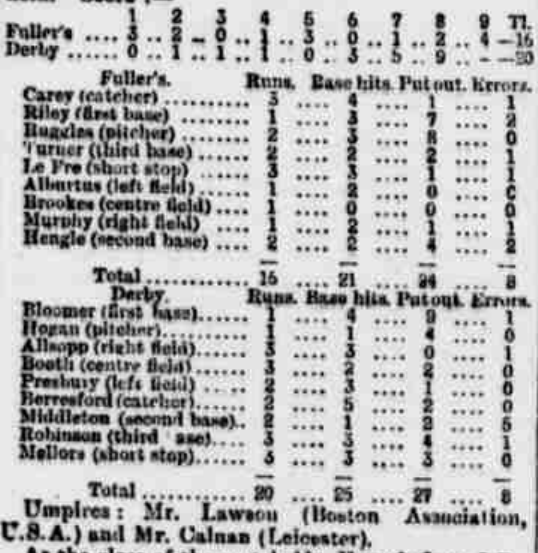
Stats from the 1895 English National Baseball Championship final, Derby and Chesterfield Reporter, 23 August 1895. Image created by British Library Board. No known copyright holder.
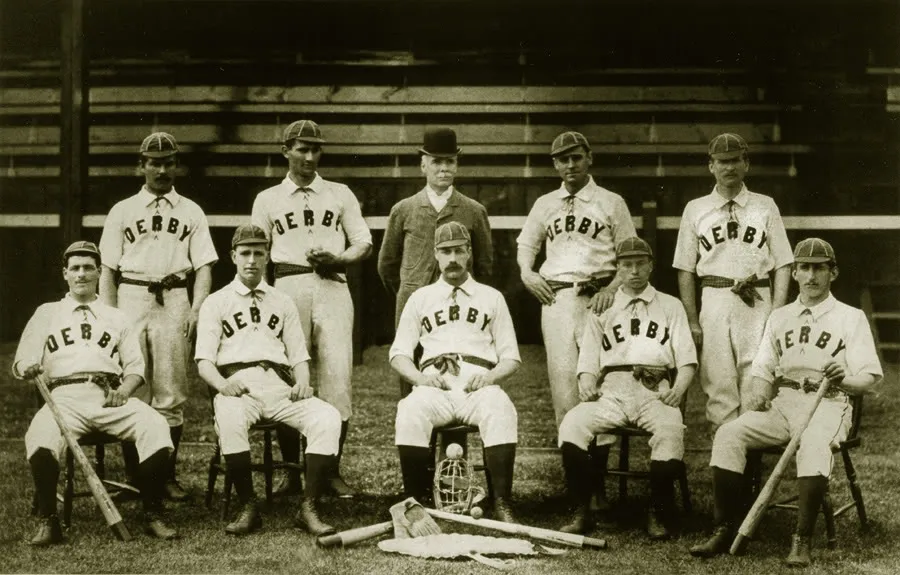
The 1890 Derby Baseball Team with Francis Ley, back row, centre. Copyright unknown.