Orders and Enquiries.
Jamie Barras.
The steadily-growing popularity for baseball in this country made its mark in the orders for equipment at a Horbury firm of sporting goods manufacturers. " At the present time," I was told. "There are about 200 baseball clubs in this country. By the orders and Inquiries we have received here for equipment for the game it has definitely come to stay. It appears that it will attract many 'Soccer' fans as an exciting summer game, and it is unlikely that it will decrease the popularity of cricket. We feel there will be a great demand for baseball equipment, and have put down extra plant and called in extra workpeople to cope with the demand."[1]
In this survey article, I present a chronological list of British manufacturers that engaged with attempts to introduce baseball in this country. I will—with one possible exception—only cover companies that manufactured, not imported, uniforms and/or equipment; that is my measure of “engagement”. I will also include a subsection on baseball-based tabletop games—board and electronic—as a second axis of engagement.
My sources are primarily advertisements from newspapers, baseball-related publications (magazines and game programmes), and trade journals (The Sports Trader). The article will be accompanied by reproductions of as many of those advertisements as access rights allow.
Most of the companies surveyed sold baseball equipment for only a brief period, their sales trajectories following a familiar arc, namely, introduction—early growth—stall—decline, the lifecycle of a product rejected by consumers. In this, they mirrored the attempts to introduce the game into England from which they sought to profit. Baseball in England suffered from a poor product–market fit.[2]
Rounders or Base-Ball
In the Park, the following amusements have been provided—Archery, Cricket, Croquet, Quoits, Football, High Jumping, Merry-go-round, Gymnasium, Swings, See-saw, Rounders or Base-ball, Skittles, Aunt Sally, &c[3]
Before American baseball, there was also the old English game of baseball, which was originally a base-running ball game, without a bat, the ball being struck with the flat of the hand. By the middle of the nineteenth century, it existed in versions played both without and with a bat. When it was played with a bat, in some parts of the country, it was known as rounders.[4] There would have been an untold number of manufacturers of outdoor games sets that included rounders bats, balls, and posts, alongside quoits rings and posts, croquet mallets, hoops, etc. Since the 1860s, there has also been a competitive sport derived from rounders, once known as English Baseball but known today as Welsh Baseball. However, my focus here will be on equipment manufactured in England for the American game.
Having laid out my exclusion rules, I will start the survey by breaking them.
S. Rose & Co.
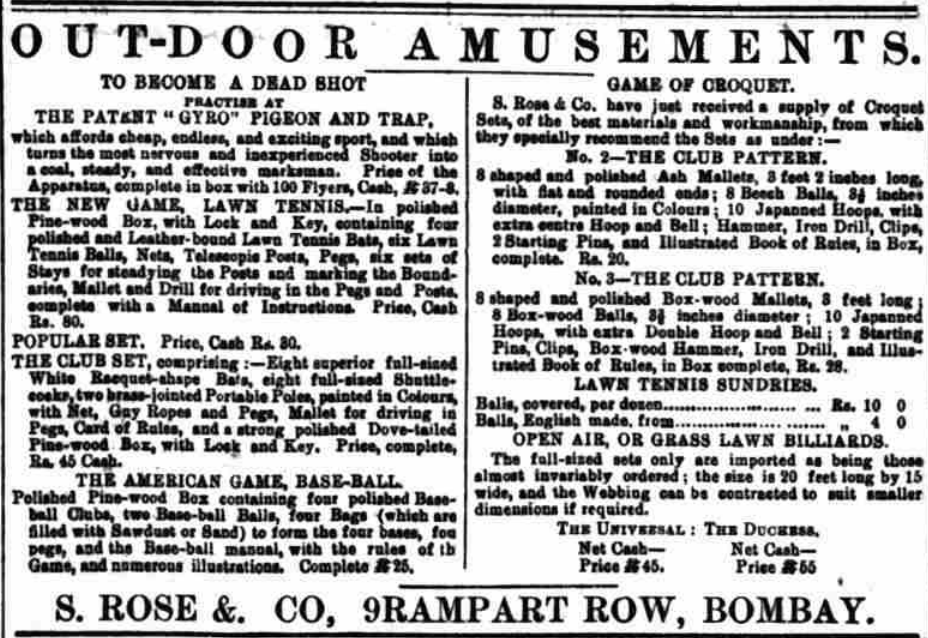
THE AMERICAN GAME, BASE-BALL. Polished Pine-wood Box containing four polished Base-ball Clubs, two Base-ball Balls, four Bags (which are filled with Sawdust or Sand) to form the four bases, four Pegs, and the Base-ball manual, with the rules of the game, and numerous illustrations. Complete Rs 25.[5]
I begin my survey of English manufacturers of baseball equipment with an importer based in India. The S. Rose & Co. business, located in what was then called Bombay, now Mumbai, operated from 1872 until 1947. From 1874, for a period of nearly a decade, it sold a baseball set retailing for Rs 25 (for comparison, the company sold a croquet set for Rs 28). S. Rose & Co. would later become famous as an importer of musical instruments, particularly pianos. Their baseball sets were certainly imported, and probably imported directly from America. However, there is a chance they were imported via England and an outside chance they were made there. This is because 1874 was a significant year for American baseball in England.[6]
In the summer of 1874, the Harry Wright baseball tourists visited England. The tour was not a success; British sports fans and players were curious but bemused, and on the whole, preferred cricket.[7] It is easy to imagine that an English company might bet that a baseball boom would result from the tour and import or perhaps even make baseball sets in anticipation of this. When no boom materialised, their only hope of recouping their investment would have been to sell the kits on. If this were the case, we can guess the name of the company to which the sets were sold.
S. Rose & Co. acquired most of its products via its “London Agency” based at 3 Chapel Place, Poultry, London. This was the business address of S. Harraden & Co. Samuel Harraden (1822–1897) was a Cambridge-born businessman who started his professional career as an organist in Calcutta. There, he met and married Rosalie Linstedt, the daughter of a Swedish businessman and his Kashmiri wife. One of Samuel and Rosalie Harraden’s children was the novelist and suffragette Beatrice Harraden.[8]
Harraden operated an import business in Calcutta, specialising in musical instruments. After the bulk of the family moved to England, this was run by one of his sons, Edwin Harraden. There is circumstantial evidence that suggests that “S. Rose & Co.” was a Bombay-based subsidiary of S. Harraden & Co. First, there is the fact that S. Harraden & Co. was S. Rose & Co.’s “London Agency”. Then, there is the fact that many of the products licensed by one company were also licensed by the other, with a strong focus on musical instruments. Next, and related to this, Samuel Harraden famously provided a very early demonstration of the Edison phonograph in Bombay/Mumbai at the S. Rose & Co, showrooms. S. Rose & Co. would subsequently be one of the major importers of phonographs into India. Then, there is the name “S. Rose”, which seems to be a combination of Samuel and Rosalie Harraden’s given names. Finally, S. Rose’s telegram address was “Rosebud, Bombay”: “Rosebud” was the name of the young female protagonist of one of Beatrice Harraden’s novels and may have been the nickname of her mother or little sister, who was also called Rosalie. As S. Harraden & Co. and S. Rose & Co. were based on opposite sides of the Indian subcontinent, they were not in competition with each other.[9]
Alas, we will likely never know. S. Rose & Co. was wound up following Indian independence in 1947, while S. Harraden & Co. ceased trading with the death of its founder in 1897.
George G. Bussey & Co.
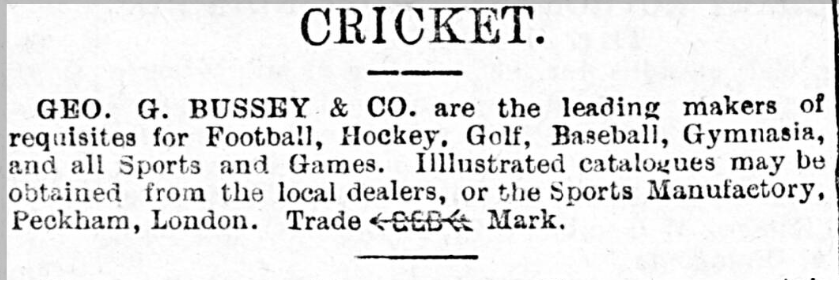
GEO. G. BUSSEY & CO. are the leading makers of requisites for Football, Hockey, Golf, Baseball, Gymnasia, and all Sports and Games. Illustrated catalogues may be obtained from local dealers, or the Sports Manufactory, Peckham, London. Trade GGB Mark.[10]
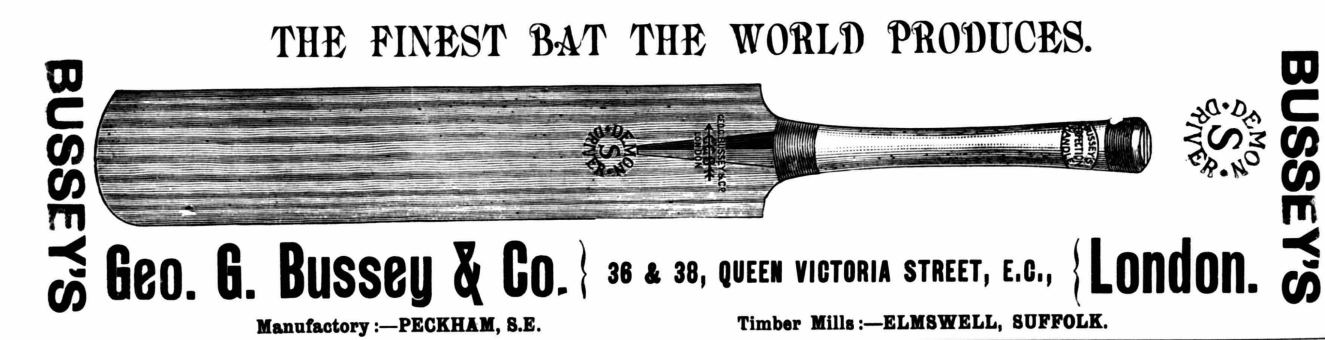
The next company on our survey is the first general sports goods manufacturer on the list. The Peckham-based Geo. G. Bussey & Co. was founded by gunsmith George Gibson Bussey (1829–1889) around 1864 in Peckham, London. By 1887, the Bussey gun workshop had been rebuilt as a sporting goods factory, the “Sports Manufactory”. In 1889, George died, and control of the company passed to his son, William Eton Bussey (1858–1942). The company, which would last well into the twentieth century, went on to become world-famous for its cricket bats; W.G. Grace was a customer. The company even owned its own willow plantation and timber mills in Suffolk.[11]
Bussey’s foray into the manufacture of baseball equipment coincided with the introduction of the game to London. In August 1894, when the Bussey company first advertised baseball equipment for sale, the London Baseball Association (LBA) had just launched its first full season with four teams. Bussey’s factory in Peckham was in easy reach of the LBA’s ground at Hyde Farm in Balham. The following season, the LBA was at its zenith; it ran two divisions in 1895 and added a second venue, the Crystal Palace at Sydenham. However, after this, it fell into a rapid decline. Bussey stopped advertising baseball equipment for sale in August 1895. It is likely it would have started advertising equipment again at the start of the following season had there been any life left in the scene.[12]
The Bussey company had experience of working with hardwoods from its range of practice and technique cricket bats. Some of these bats had narrow profiles and had a heft much like baseball bats, albeit with very different cross-sections. Surviving examples of these practice and technique bats give some flavour of what the Bussey baseball bats must have looked like.[13]
A.G. Spalding & Bros.
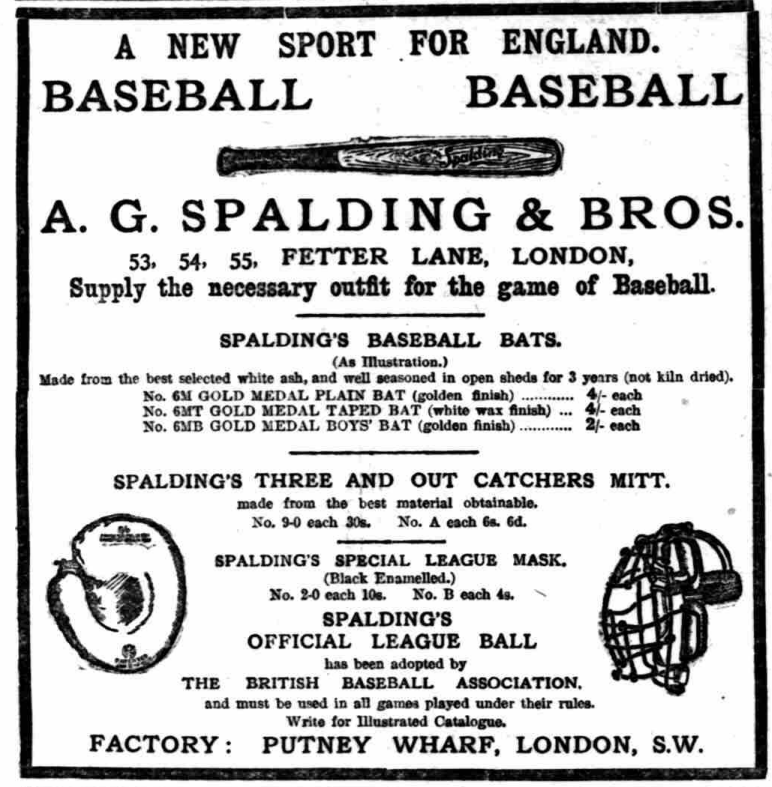
A NEW SPORT FOR ENGLAND. BASEBALL. A.G. SPALDING & BROS, 53, 54, 55 FETTER LANE, LONDON Supply the necessary outfit for the game of Baseball[…]SPALDING BASEBALL BATS (As Illustration) Made from the best selected white ash, and well seasoned for 3 years in open sheds (not kiln dried)[…]SPALDING’S OFFICIAL LEAGUE BALL has been adopted by THE BRITISH BASEBALL ASSOCIATION and must be used in all games played under their rules.[14]
A.G. Spalding & Bros. was, of course, the famous American sporting goods manufacturer led by baseball player, manager, and team owner, Albert Spalding. One might suppose, then, that the baseball equipment that it sold out of its stores in London and other places in England was imported. However, in 1902, Spalding started manufacturing in England at its Fetter Lane premises in London. In 1906, it opened a much larger factory at Putney Wharf, South-West London, which remained in operation for the next half century; there, it manufactured sporting goods for the English market, most obviously footballs, cricket bats, golf clubs, and tennis rackets. This makes it possible that at least some of the baseball equipment it offered in association with the British Baseball Association (BBA) was made in England. The BBA began operating leagues in London the same year that Spalding opened its new Putney Wharf factory. In a Spalding ad from that year, the company described itself as the supplier of “official league” footballs to clubs including “Woolwich Arsenal, Fulham, Tottenham Hotspur, Queens Park Rangers, London Caledonians, Norwich City, and Queens Park (Glasgow)”. The first three clubs on that list had baseball teams in the inaugural season of the BBA.[15]
Another Spalding ad from 1906, publicising the company’s relationship with the BBA, offers us a rare glimpse at the price of baseball goods in Britain in this period, with bats selling for 4 shillings and gloves for anything from 6 shillings to 30 shillings. By way of comparison, in 1900, a leading sporting goods manufacturer was selling cricket bats for from 7 shillings to 17 shillings. There were 20 shillings in the pound, and £1 in 1906 is around £155 in modern money (2026).[16]
Frank Sugg, Ltd., H.H.B. Sugg Ltd.
FOOTBALL KING 10s. The Best Ball Every Way, Wear, Shape, Play. FOOTBALL. HOCKEY. GOLF. BOXING. SCOUTING. SKATING. BASEBALL. SWIMMING. RUNNING. EXERCISES. PUNCH BALLS ROLLER SKATING. FRANK SUGG LTD.[17]
Unquestionably, the British company with the longest association with baseball is the Frank Sugg company and its spin-off H.H.B. Sugg Limited.Frank Sugg (1862–1933) was a Lancashire cricket player and Derby and Everton footballer. He was also the pitcher for a Liverpool team that took on the Spalding tourists at baseball in Liverpool in March 1889 (he was playing for Everton FC at the time).[18]
In 1894, Frank and his brother and fellow cricketer, Walter Sugg (1860–1933), opened a sporting goods store in Liverpool. By 1904, this had grown into Frank Sugg Limited, which had branches throughout Lancashire and Yorkshire. The company was advertising baseball equipment for sale by no later than 1909. Alfred John Bailey (1870–1943), who would serve as chairman of the Liverpool-based English Baseball Association (EBA) throughout the 1920s and 1930s, was the company secretary.[19]
And there is the rub: the EBA was the organisation in charge of baseball under the English code, not the American game. Liverpool was one of its heartlands. The Frank Sugg company sponsored cup competitions under the English code in both Liverpool and its other heartland, South Wales.[20] Its original “baseball” range was for the English game, which uses a different bat and ball to the American game. The bat has a flat striking surface, while the ball, although of similar dimensions to the junior US baseball (just under 9 inches circumference, around 4.4 ounces weight), lacks the rubber cushioning of the latter, with older designs consisting of a cork centre wrapped in yarn with a leather figure-of-eight stitched outer (modern designs use either cork or rubber cores). However, Sugg is of interest to us here because he retained his interest in the American code. For example, in 1918, he sponsored a knock-out competition between US and Canadian military teams in Liverpool.[21]
More than this, he transmitted that interest in American baseball to his nephew, Walter’s son, Hubert Henry Bell Sugg (1884–1978). In 1914, H.H.B. Sugg took over several branches of Frank Sugg Limited and renamed them H.H.B. Sugg Limited. Then, in 1933, Liverpool businessman John Moores launched a new attempt to popularise the American game in England under the auspices of a new National Baseball Association (NBA). By 1936, the H.H.B. Sugg stores were advertising baseball equipment for sale.[22]
SUGG’S HAVE EVERYTHING FOR ALL SPORTS INCLUDING BASEBALL.[23]
This equipment was unambiguously for the American game, as the company ran ads in programmes for NBA games. The company would continue to feature baseball in its advertisements up until the summer of 1938. By this time, the wheels had come off John Moores’ efforts to popularise the American game.[24]
The H.H.B. Sugg company was far from the only sporting goods manufacturer to board the Moores bandwagon. This is not a surprise, as the Moores effort was the largest and best-financed attempt to popularise the American game in England that the country had yet seen.
Jack Sharp Limited.
BASEBALL CUP FINAL. At Bootle Stadium, yesterday, the American baseball final for the Jack Sharp Cup attracted a large number of spectators.[25]
Jack Sharp (1878–1938) was in many ways the twin of Frank Sugg, although even more prominent, at least, in Liverpool. He won international caps in both cricket and football and had a long career as a footballer for Everton FC, eventually becoming a director of the club. He opened his eponymous sports outfitters in Liverpool city centre in 1903 and went out to provide kit for both Everton FC and Liverpool FC, as well as many other local teams. As with Frank Sugg, as a Liverpool-based outfitter, Sharp’s earliest and longest-lasting foray into selling baseball equipment was for the English game—examples of bats the company made for the English game survive. However, again, as with Frank Sugg, the Sharp company sponsored cup competitions for the American game. In Jack Sharp’s case, this was in association with fellow Liverpool businessman John Moores’ attempts to popularise the sport in the 1930s. Jack Sharp died in 1938, but his business survived until the 1980s.[26]
William Sykes Limited.
The steadily-growing popularity for baseball in this country made its mark in the orders for equipment at a Horbury firm of sporting goods manufacturers. " At the present time," I was told. "There are about 200 baseball clubs in this country. By the orders and Inquiries we have received here for equipment for the game it has definitely come to stay. It appears that it will attract many 'Soccer' fans as an exciting summer game, and it is unlikely that it will decrease the popularity of cricket. We feel there will be a great demand for baseball equipment, and have put down extra plant and called in extra workpeople to cope with the demand."[27]
The quote with which I opened this piece, from February 1936, comes from an interview with an exhibitor at the British Industries Fair at Olympia. The “Horbury firm” is readily identifiable as William Sykes Limited. Their factory near Wakefield was the largest sporting goods factory in England. The firm had a long association with the famous English sporting brand, Slazenger, and was absorbed into the Slazenger business in 1942. It produced cricket equipment under its own “Sykes” brand, including a bat endorsed by the great Don Bradman, and footballs under the “zig-zag” brand. After exhibiting at Olympia in February 1936, by no later than November of that year, Sykes had begun advertising baseball equipment for sale. Alas, as with H.H.B. Suggs, it would enjoy only brief success given the NBA’s woes from 1937 onwards.[28]
It is worth noting here that the 1936 British Industries Fair was not the first time that British manufacturers exhibited baseball-related products at the event. There was also baseball equipment on display at the 1929 fair.
German buyers at the British Industries Fair found much to admire in the sports section, the exhibits in which show that this country not only excels in equipment for all games that originated in Britain, but also for games, such as ice hockey and baseball, which are rarely played here[...][29]
Alas, the names of the companies concerned were not reported. Evidently, the equipment was made for export.
The Sports Trader Debate.
But, Mr. Sports Trader—you who read this—do you realise the greatest handicap which has had to be overcome in the growth of baseball in England? Lack of equipment and facilities for obtaining equipment. What is going to be done about it? In the manufacture of baseball goods, the English manufacturer is faced with competition from America, goods that are so perfect that the high price is forgotten by those who buy them, and competition from Japan, where baseball in the national sport, goods that are remarkably fine quality for the low price. All these goods are upon a market that is practically undisputed by the home dealer. It is possible to buy English baseball equipment, but, quite candidly, such samples as have come my way would not bear comparison with the American article and have not even the advantage of price as an asset.[30]
In the October 1935 issue of the trade journal The Sports Trader, writer J.S. Sluter slated British attempts to manufacture baseball goods in competition with imports. This provoked an angry response from British manufacturers, published in the following issue. This, in turn, led to two British manufacturers of baseball goods placing advertisements in issues of The Sports Trader the following year.[31]
Joseph Hadfield, Barratt & Co., Charles Webber & Co.
The coming boom BASEBALL. SHIRTS & PANTS CUT AND MADE TO OFFICIAL REQUIREMENTS. Baseball is rapidly becoming a favourite National Summer game. Take a large share of business from the inevitable demand for equipment, with our Baseball uniforms[...]JOSEPH HADFIELD, BARRATT & Co. Ltd. Altrincham St., Manchester.[32]
On the way! Make the game pay by stocking up with these English Ash BASEBALL BATS. Appointed the Official Bat for 1936 BY The National Baseball Association[…]CHARLES WEBBER & CO., BONHAY, EXETER.[33]
Joseph Hadfield (1864–1932) started his clothing business in Manchester at the end of the nineteenth century. Sometime after 1929, that business became Joseph Hadfield, Barratt & Co., an athletic and industrial clothing manufacturer. Hadfield, Barratt is an outlier on this list, as a manufacturer of uniforms, not bats and balls. At the 1936 British Industries Fair, a company sold “baseball outfits” for 20 London-based teams. Was this Hadfield?[34]
Baseball outfits are also in demand and one firm has had an order to equip 20 newly-formed junior baseball teams in London, which are being backed by a wealthy American. The value of this order is in the region of £800, approximately £40 being necessary to equip a baseball team of nine players.[35]
Meanwhile, I have found no evidence that any bat was the “official bat” of the NBA in any year; nor can I find any evidence of sales of a Charles Webber baseball bat. Although Webber was advertising itself as the retailer of the official NBA bat as early as April 1935, these advertisements appear to be a case of wishing and hoping, again. Charles Webber & Co. was a sporting goods manufacturer founded by Charles Wingyett Webber (1856–1934), the third generation of Webbers to operate a wood-turning business in Exeter. By 1936, the business was being run by his sons. I have been unable to determine if there is any connection between this Webber and the Webber brand of baseball used in English/Welsh Baseball and latterly manufactured by John Jaques of London, the famous toymakers.[36]
Albert Ward Ltd.
OFFICIAL OUTFITTERS TO BOLTON SCARLETS BASEBALL CLUB. Albert Ward, Ltd., Bolton’s Sports Depot. 53 Bradshawgate.[37]
Former Lancashire and England cricketer Albert Ward (1866–1939) started his eponymous sporting goods business in Bolton in 1895. However, by the time that the firm began supplying baseball equipment to the Bolton Scarlets in 1936, it was under new ownership. Alas, this is all I have been able to discover to date. The Bolton Scarlets folded at the end of the 1938 season. We can reasonably assume that the Alfred Ward company’s interest in baseball ended at the same time.[38]
Pricing.
WHERE YOU GET THE BEST FOR LESS. ATTENTION ALL SPORTSMEN & SPORTS CLUBS, CHESSMANS OFFER THE ENTIRE STOCK OF Messrs. H.J. DAVIS & CO. SPORTS DEALERS, HIGH STREET, BROMPTON, CHATHAM.[39]
Before moving on from the 1930s, I want to look briefly at pricing. In early 1937, a Kent-based company called Chesmans offered for sale the inventory of collapsed London sports dealer H.J. Davis and Co. The stock included imported baseball equipment, and prices were given. This can be taken to represent the upper end of what baseball equipment cost in England in the period. The items listed were a [catcher’s] mask—no maker’s name—original price 18/6 (18 shillings and sixpence); an “Arlett stick”, probably a Spalding Buzz Arlett signature bat, original price 10/6; a “Frish stick”, probably a Hillerich & Bradsby Frankie Frisch signature bat, original price 10/6; an “ace glove”, probably a Spalding Ace fielder’s glove, original price 8/6; and what is described as a “Tuf Ide Club”, original price 17/6. “Tuf-ide” was a leather substitute; what was meant by “tuf ide club”, I do not know. There were 20 shillings in a pound, and £1 in 1937 is around £85 in modern money. A comparison with prices from 1906 (see A.G. Spalding & Bros., above) shows that, corrected for buying power, bats were around 20% more expensive in 1937 compared to 1906, a rate of increase way below the rate of inflation.[40]
A. Baily & Co.
Messrs. A. Baily and Co. Ltd., are exhibiting at this year's British Industries Fair at Olympia, London, and displayed on their stall is an assortment of sports gear, including the latest line in baseball equipment.[41]
I don’t intend to cover post-1945 in much depth, not least because, for the past 80 years, most baseball equipment in England has been imported. There is a strong and natural preference for equipment from North America by people who play the game. As ever, this comes with the caveat that I am talking about American baseball, not the homegrown variety—I will touch briefly on the latter at the end of this piece.
A. Baily and Co. was a Glastonbury-based sporting goods manufacturer and clothing company that started life as a tannery and leather goods company. It was famous for its boxing gloves, which were the preferred glove for championship fights in England for much of the twentieth century. However, it also produced rackets for various sports (tennis, badminton, etc.), before this part of its business was sold off to John Snow & Co. A. Baily was started by Albert William Shore Baily (1840–1912), and was latterly run by his son, Albert Jr. It displayed baseball equipment at the 1951 British Industries Fair. It is possible this was for export. However, it may also have been aimed at American military servicemen based in Britain—as was the case with the next manufacturer on this list.[42]
Jabez Cliff & Co.
Footballs are turned out in large quantities every year at the Walsall firm of Jabez Cliff and Company Limited, both for professional clubs and for schools[...]Other articles manufactured by the firm for use in England include balls for the American games of baseball and softball. They are made mainly for personnel serving with American armed forces in England.[43]
Jabez Cliff & Co. was another tannery and leather-goods maker turned sporting goods manufacturer. It was started in Walsall by Jabez Cliff at the end of the eighteenth century. However, it was Cliff’s grandson, Sir Jabez Cliff Tibbits (1884–1974), who, in the 1920s, turned it into a large-scale concern. Its Globe brand footballs featured in FA Cup Finals. In the 1950s, it turned that expertise to the production of balls for baseball, softball, and rounders in the familiar figure-of-eight stitched pattern. The company went bust in 2014.[44]
Hunts County.
HUNTS COUNTY BASEBALL. The ball consists of a cork centre wrapped in yarn and covered with white natural leather, or a synthetic composite leather.[45]
Bringing things right up to date (2026), Hunts County is a Huntingdon-based sporting goods manufacturer famous for its cricket bats. Its history dates to 1904 via the original County Cricket Bats company of Little Paxton, Cambridge. Hunts County was started “in a shed” in Huntingdon in 1983 by Tony Cook, Bob Cook, and other former employees of County when the latter closed.[46]
Including Hunts County on this list is another rule breaker, as the company makes equipment for what is now known as Welsh Baseball, not American Baseball. This comprises the flat-striking-surfaced bats and 8.5-inch circumference, 4.4 oz balls used in that game (cf., >9-inch, >5-ounce MLB balls). The balls also eschew the rubber cushioning associated with modern MLB balls, harkening back to the yarn-only binding around the cork centre of earlier designs that Welsh baseball inherited from rounders and English Baseball.[47]
However, as it would be a small step from there to making equipment for the American game, I find Hunts Country worthy of inclusion, particularly as they are the only English manufacturer that I know of that makes sporting equipment with “baseball” in the name. More than this, they have the skill and engineering setup to make equipment for American baseball if there was a demand for it.
Bishop/Wilkinson Sports and Leisure (Aresson/Wilks).
Elevate your game with the Aresson Super Match Rounders Ball—designed specifically for competitive match play. Crafted with precision, these balls feature a robust cork centre encased in premium leather, ensuring exceptional durability and performance on the field. With a circumference of 18.2 cm and a weight of 70 g, they're engineered to meet the stringent standards of Rounders England, making them a must-have for serious players.[48]
Wilks Big Hitter Softball Bat. Top-quality English Ash bat. Non-slip rubber grip. Maxi size: 86 cm long, 6 cm barrel, approx 0.70 kg. Mini size: 75 cm long, 5 cm barrel, approx 0.57 kg.[49]
Elevate your game with the Wilks Force Soft Softball, meticulously crafted to enhance your practice sessions. Its genuine leather outer and soft cork core combine to offer an exceptional grip, ensuring effortless throws and catches.[50]
The case with sports wholesaler Bishop Sports and Leisure, which trades as Wilkinson Sports and Leisure, is somewhat similar to that of Hunts County: Its in-house brand “Wilks” makes equipment for softball, not baseball, but this does include bats and balls manufactured in the UK. Wilkinson is also the sole distributor of rounders equipment made by Aresson Sports Limited. These are two companies with the skillset and equipment to turn to making equipment for American baseball if there was a demand for it.[51]
Tabletop Games.
WELCOME TO WORLD SERIES BASEBALL, Congratulations! You’re in the middle of the World Series Baseball competition and the momentum is on your side. But everyone’s out to beat you, especially the hard-hitting computer team. So if you want to win the Series read this official program. With the right combination of pitching and “STEAL” strategy you may even become a World Star player! Have fun.[52]
Baseball is a sport of pitch-based, closed-loop cause and effect. This mechanic lends itself to turn-based gameplay, and tabletop games based on baseball have existed almost as long as the sport itself. Historically, the most popular of these were those that combined real player performance statistics with the throw of a die to simulate on-field gameplay based on statistical probability tempered by uncertainty. Tabletop games for children, especially younger children, employed similar mechanics but replaced real player statistics with generic player scores determined or weighted by a throw of a die. Early baseball computer games reproduced the board-game experience on-screen. However, as computer processing power grew, statistical probability and/or randomness was replaced by physics-based mechanics.[53]
Given the global nature of the toy industry, it is not surprising that export-minded British manufacturers produced baseball-themed tabletop games. However, identifying these games is correspondingly difficult. We are left with games created and manufactured in this country and sold here as such. Much more research is needed here.
World Series Baseball for ZX Spectrum 48k and Commodore 16 (Imagine Software Ltd).
Get a feel for pitching, hitting, running, throwing, fielding and catching. The shadow of the ball will help you judge where the ball is headed. World Series Baseball is easy to pick up but tough to master, especially against the computer team.[54]
Imagine Software sprang into being in the heady days of the first boom in computer gaming. This was the early 1980s and fortunes were being made by people not much older than teenagers. Alas, many of them had the management skills to match. Imagine launched big, spending eye-watering sums, for the time, on marketing and packaging. Their early games were hits, but revenue could never keep up with expenditure in a work environment where indecision driven by in-fighting inflated budgets. The company went bust just over a year after it was created. The final games under the Imagine name were actually released by Ocean, the company that bought Imagine’s intellectual property.[55]
World Series Baseball was one of those final games. It was created for the Sinclair ZX Spectrum 48k by Ian Morrison and David J. Anderson in 1984 and finally released in 1985. The game could be played by one or two players, a novelty in itself. In one-player mode, the player played against the computer. Players used up/down/left/right/“fire” keys to determine how a ball was pitched, struck, or thrown, depending on whether they had control of the pitcher, batter, or a fielder at that moment. Runners could also steal bases. Although this might suggest a physics-based mechanic, look-up tables actually determined the result. This was possible as there were only so many combinations of pitch angle and speed, bat angle and speed, etc., that the player could input, and it was a restriction decided by the limited processing power of early personal computers and gaming consoles.[56]
The game originally retailed for just under £7. Videos of gameplay can be found on YouTube.[57]
Strikeout (Triotoys/Playtwice Ltd).
Pitch a fast ball or a curve ball. Score a home run. In Strikeout all the drama and excitement of Major League Baseball is simulated in a game of strategy and skill.[58]
“Strikout” was the brainchild of Terry Miller, a young Nottinghamshire-based game designer and founder of the Playtwice board game company. It was a game for two players. Each turn would begin with each player choosing, without showing the other player, a card that determined what pitch they would pitch (pitcher) or what pitch they would defend against (batter). The outcome was then determined by how closely these combinations matched (pitcher chooses to throw curveball, batter chooses to defend against curveball, perfect match, advantage to the batter; pitcher chooses curveball, batter chooses to defend against a screwball, perfect mismatch, advantage to the pitcher). A throw of a die could swing the decision the other way. The actions of fielders and runners were determined in a similar fashion. This mechanic was effectively rock–paper–scissors with a die roll modifier.[59]
The game was released in 1986 and retailed for £19.95 direct from the manufacturer including postage and packaging.
Jamie Barras, July 2026
Back to Diamond Lives
Notes
[1] “Orders for the West Riding”, Bradford Observer,28 February 1936, 9.
[2] Geoffrey A. Moore, Crossing the Chasm: Marketing and Selling High‑Tech Products to Mainstream Customers (New York: Harper Business, 1991).
[3] “Grand Rural Fete at Winkton House”, Christchurch Times, 25 June 1864, 1.
[4] David Block, Pastime Lost: The Humble, Original and Now Completely Forgotten Game of English Baseball (Lincoln: University of Nebraska Press, 2019).
[5] “Advertisement for S. Rose & Co.”, Indian Statesman,25 December 1874, 1.
[6] I first saw the S. Rose & Co. ad here: Bill Staples Jr., “A History of Baseball in India, 1874–1947,” Bill Staples Blog, August 2023, https://billstaples.blogspot.com/2023/08/a-history-of-baseball-in-india-1874-1947.html?m=1, accessed July 23, 2026.
[7] John Bauer, “Summer 1874: New Game in the Old Country: U.S. Teams Tour England,” SABR Games Project, https://sabr.org/gamesproj/game/summer-1874-new-game-in-the-old-country-u-s-teams-tour-england/, accessed July 23, 2026.
[8] S. Rose “London Agency” at 3 Chapel Place: Advertisement for S. Rose and Co., Times of India. S. Harraden & Co. at 3 Chapel Place: “Shippers”, Bookseller, 2 June 1871, 18. The Harradens: Molly McClain, “A British Health Seeker in Southern California: Beatrice Harraden (1864–1936),” Journal of San Diego History 67, no. 1 (2021): 26–28.
[9] S. Rose and S. Harraden companies were both agents for the same pneumatic ice machine: Advertisement, Home News for India, China and the Colonies, 14 September 1877, 36. Samuel Harraden at the S. Rose & Co. showrooms demonstrating phonograph: “The Phonograph”, Times of India, 6 December 1878, 1. S. Rose & Co. and phonographs: G. N. Joshi, “A Concise History of the Phonograph Industry in India,” Popular Music 7, no. 2 (1988): 147–56, http://www.jstor.org/stable/853533.
[10] “Cricket.”, St Helen’s Examiner,18 August 1894, 6.
[11] Robert Hewison, Passport to Peckham (New Cross, London: Goldsmiths Press, 2022), 22; “Geo. G. Bussey and Co., Limited”, The Referee, 24 June 1906, 12. Biographical information on George Gibson Bussey and William E. Bussey, death registrations, 1889 and 1942, respectively, Births, Marriages, and Deaths, https://www.freebmd.org.uk/cgi/search.pl, accessed 23 July 2026. https://www.gracesguide.co.uk/George_G._Bussey_and_Co, accessed 23 July 2026.
[12] “How Baseball is Played”, The Sketch, 3 October 1894, 13; “Bustling Baseball Bristling”, Music Hall and Theatre Review, 6 September 1895, 13.
[13]https://sportantiques.co.uk/cricket-1/bats/antique-narrow-profile-technique-cricket-bat-by-bussey-co-1, accessed 23 July 2026.
[14] Advertisement for A.G. Spalding & Bros., Sporting Life, 19 May 1906, 2.
[15] “Situations Vacant”, London Daily Chronicle,1 March 1902, 10; “American Workmen’s Demands”, Edinburgh Evening Dispatch, 2 July 1903, 2; advertisement for A.G. Spalding & Bros, South London Press, 20 August 1904, 6. Daniel Bloyce, “A Very Peculiar Practice: The London Baseball League, 1906–1911,” NINE: A Journal of Baseball History and Culture 14, no. 2 (2006): 118–28, https://dx.doi.org/10.1353/nin.2006.0001. Advertisement for A.G. Spalding & Bros., Tatler, 22 August 1906, 269.
[16] Note 14 above; Cricket bats: Advertisement for Frank Sugg Ltd, Cricket, 10 May 1900, 6.
[17] Advertisement for Frank Sugg, Ltd., Sheffield Evening Telegraph, 4 September 1909, 7.
[18] “Bee’s Notes on Sports: The Passing of Frank Sugg”, Liverpool Echo, 30 May 1933, 10. Frank Sugg joins Everton F.C.: “Football” Bolton Daily Chronicle, 5 October 1888, 4. Pitching for Liverpool against Spalding tourists: ‘The American Baseball Teams at Liverpool’, Sporting Life, 25 March 1889, 4. Sugg Challenge Competition, English baseball, Liverpool: ‘Baseball Budget’, Liverpool Echo, 31 July 1909. South Wales: ‘Baseball’, Western Mail, 2 October 1924.
[19] Walter Sugg: “Death of Walter Sugg”, Nottingham Evening Post, 22 May 1933, 7. A.J. Bailey: “A Notable Figure”, Liverpool Echo, 30 March 1943, 3. Chairman, English Baseball Union: ‘Will This Come True’, Athletic News, 27 June 1927, 16. Walter Sugg and Bailey on board of Frank Sugg Limited: https://www.gracesguide.co.uk/1908_Stock_Exchange_Year-Book:_Miscellaneous_Companies:_F, accessed 12 April 2026.
[20] Sugg Challenge Competition, English baseball, Liverpool: “Baseball Budget”, Liverpool Echo, 31 July 1909, 10. South Wales: “Baseball”, Western Mail, 2 October 1924, 4.
[21] Ball for English baseball from 1890 onwards: James Manders Walker, “Modern Rounders,” in Rounders, Quoits, Bowls, Skittles and Curling (London: George Bell and Sons, 1892), 7–17. Sugg-sponsored cup competition under the American baseball code in Liverpool in 1918: “Baseball Tournament at Goodison Park”, Liverpool Echo, 25 July 1918, 3.
[22] Years of birth and death, Hubert Henry Bell Sugg: death registration, 1978, Births, Marriages, and Deaths, https://www.freebmd.org.uk/cgi/search.pl, accessed 24 July 2026. HHB Sugg takes over Frank Sugg stores: “Messrs. H.H.B. Sugg, Ltd”, Sheffield Daily Telegraph, 1 January 1931, 4.
[23] Advertisement for Sugg’s, Star Green ’un, 13 June 1936, 7. The ad does not explicitly say H.H.B. Sugg Limited; however, the store address, Angel Street, Sheffield, is the H.H.B. Sugg store address: “Satisfactions, etc.”, Sheffield Independent, 1 June 1932, 10.
[24] See, for example, advertisement, programme, Sheffield Dons versus York City Maroons, June 1937, https://projectcobb.org.uk/materials.html, accessed 24 July 2026. Advertisement for H.H.B. Suggs Limited, Driffield Times, 23 April 1938, 4.
[25] “Baseball Cup Final”, Liverpool Daily Post, 7 September 1934, 14.
[26] Jess Molyneux, "Famous Liverpool sports shop was 'the' place [to] go for decades", Liverpool Echo, 15 December 2022, https://www.liverpoolecho.co.uk/news/nostalgia/famous-liverpool-sports-shop-the-25756032, accessed 28 July 2026. “Death of Jack Sharp”, Evening News (London), 28 January 1938, 16.
[27] Note 1 above.
[28] “Yorks. Sports Goods Factory”, Bradford Observer, 5 September 1945, 3; “Motoring, not television is sport’s competitor”, Daily News (London), 29 August 1960, 2; “Don Bradman’s Bats”, Sheffield Independent, 30 May 1931, 9; Stephen Wilson, “William Sykes–Slazenger,” Horbury History, accessed 24 July 2026, https://www.horburyhistory.org/William-Sykes-Slazenger/; advertisement for Sykes, Horbury, Yorks, Shields Daily Gazette, 25 November 1936, 6.
[29] “British Industries Fair”, The Scotsman, 19 February 1929, 8. https://www.gracesguide.co.uk/British_Industries_Fair, accessed 26 July 2026.
[30] J. Sluter, “Baseball”, The Sports Trader, October 1935, 18–19.
[31] “Baseball Equipment”, The Sports Trader, November 1935, 12–13.
[32] Advertisement, The Sports Trader, February 1936, 103.
[33] Note 32 above.
[34] Years of birth and death for Joseph Hadfield: details of will, Joseph Hadfield, Yorkshire Post and Leeds Intelligencer, 10 February 1932, 2. Joseph Hadfield & Co.: “Machinists, &c., Wanted”, Manchester Evening News, 18 July 1929, 9.
[35] “Orders from Many Countries”, Belfast Telegraph, 25 February 1936, 6.
[36] “Obituary: Mr C.W. Webber”, Western Morning News, 27 November 1934, 4. ““New Balls” Call as Baseballers Run into Crisis”, South Wales Echo, 8 August 1989, 7. Advertisement, The Sports Trader, April 1935, 8.
[37] Advertisement for Albert Ward Ltd, baseball game programme, Oldham Greyhounds versus Greenfield, 21 May 1938. Author’s own collection.
[38] “Obituary: Albert Ward”, Yorkshire Post and Leeds Intelligencer, 7 January 1939, 14. https://www.theboltonnews.co.uk/news/6134465.from-the-ben-files/, accessed 26 July 2026.
[39] Advertisement for Chesmans, Kentish Independent, 22 January 1937, 17.
[40]https://sports.ha.com/itm/baseball-collectibles/bats/1920-s-russell-buzz-arlett-game-used-bat/a/7051-81424.s, https://www.christies.com/lot/lot-frankie-frisch-professional-model-bat-6021467/, https://vintagesportsantiques.com/1920s-Spalding-Ace-Black-Fielders-Glove,
[41] “At the B.I.F.”, Central Somerset Gazette, 11 May 1951, 5.
[42] “The Boxing Gloves that Come from Glastonbury”, Wells Journal, 16 October 1970, 9; “Somerset Alderman’s Estate”, Somerset Guardian and Radstock Observer, 3 January 1913, 3.
[43] “Sports Goods Produced in Walsall”, Walsall Observer, 27 January 1956, 6.
[44] Simon Penfold, Memory Lane, "A sad farewell to two centuries of expertise which helped build town", Walsall Chronicle, 26 June 2014, 16.
[45]https://www.maceysports.co.uk/products/hunts-county-baseball, accessed 25 July 2026.
[46] “Company Bowled Over By Success”, Cambridge Daily News, 9 September 1983, 24–25.
[47]https://www.maceysports.co.uk/products/wbu-county-baseball-bat?variant=39638110666833, accessed 25 July 2026.
[48]https://www.newitts.com/aresson-super-match-rounders-ball, accessed 25 July 2026.
[49]https://www.martinberrillsports.com/products/wilks-big-hitter-softball-bat, accessed 25 July 2026.
[50]https://www.newitts.com/wilks-force-soft-softball, accessed 25 July 2026.
[51]https://www.wilkinsonsport.co.uk/, accessed 25 July 2026.
[52] Back-cover matter, World Series Baseball computer game (Liverpool: Imagine Software Ltd (UK), 1984).
[53]https://baseballgames.dreamhosters.com/BbHistory.htm, accessed 26 July 2026. Bill Lange, “Early Computer Baseball,” Old School Gamer Magazine, October 2018, 14, https://www.oldschoolgamermagazine.com/early-computer-baseball-by-bill-lange/. Accessed 26 July 2026.
[54] Note 52 above.
[55] “The Bubble Bursts,” CRASH Online, August 1984, https://www.crashonline.org.uk/07/news.htm. Accessed 25 July 2026.
[56]https://spectrumcomputing.co.uk/entry/5746/ZX-Spectrum/World_Series_Baseball, accessed 25 July 2026.
[57] Note 56 above.
[58] Copy, advertisement for Strikout, First Base Magazine, Winter 1987.
[59] “Spycatcher is the Game”, Nottingham Evening Post, 15 December 1987, 11; https://boardgamegeek.com/boardgame/109120/strikeout, accessed 26 July 2026.
The American Game, Base-Ball, Times Of India, 9 September 1880. Image created by the British Library Board. No known copyright holder.
Geo. G. Bussey & Co., St Helen's Examiner, 18 August 1894. Image created by the British Library Board. No known copyright holder.
Geo. G. Bussey & Co., Cricket, 17 July 1902. Image created by the British Library Board. No known copyright holder.
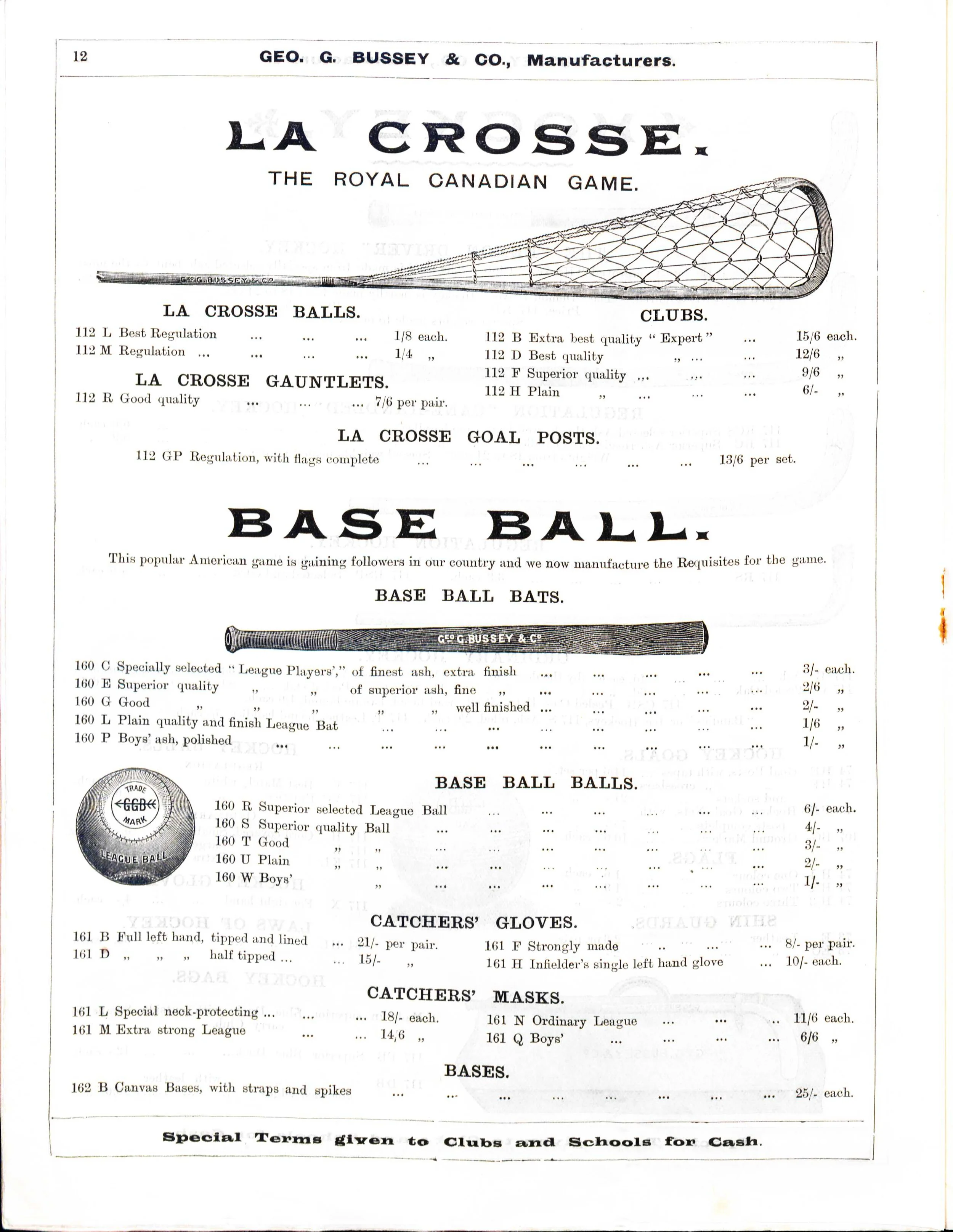
Geo. G. Bussey 1894/95 Winter Sports Catalogue. British Library. Author's scan.
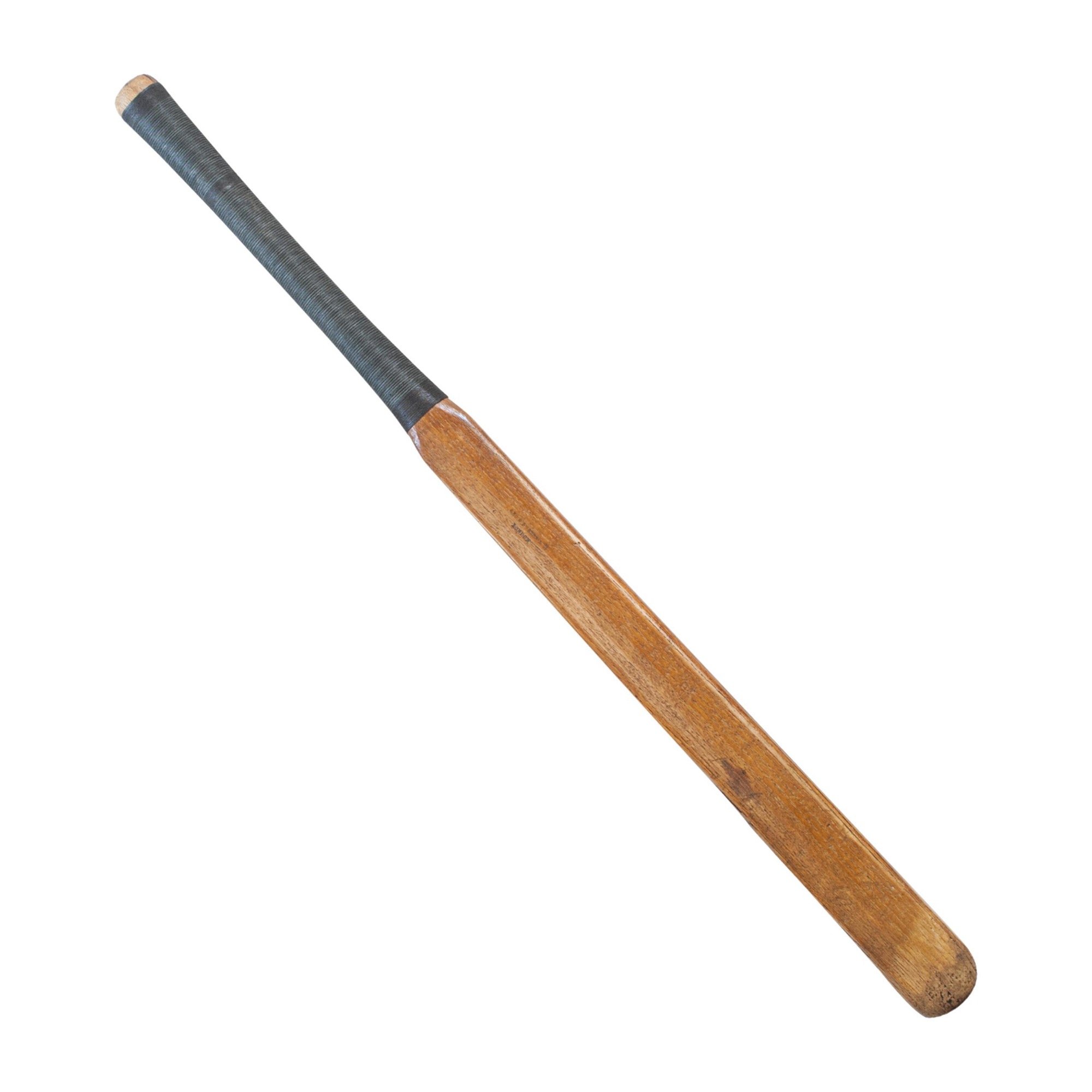
Bussey hardwood narrow profile technique cricket bat. Sports Antiques. Copyright undetermined.
A.G. Spalding & Bros., Sporting Life, 19 May 1906. Image created by the British Library Board. No known copyright holder.
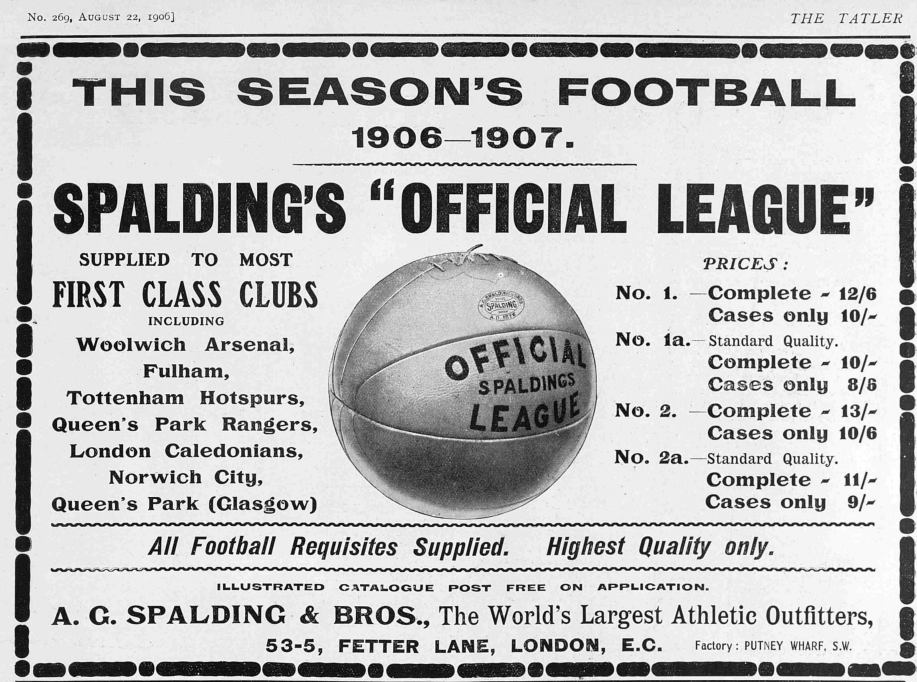
A.G. Spalding & Bros, Tatler, 22 August 1906. Image created by the British Library Board. No known copyright holder.
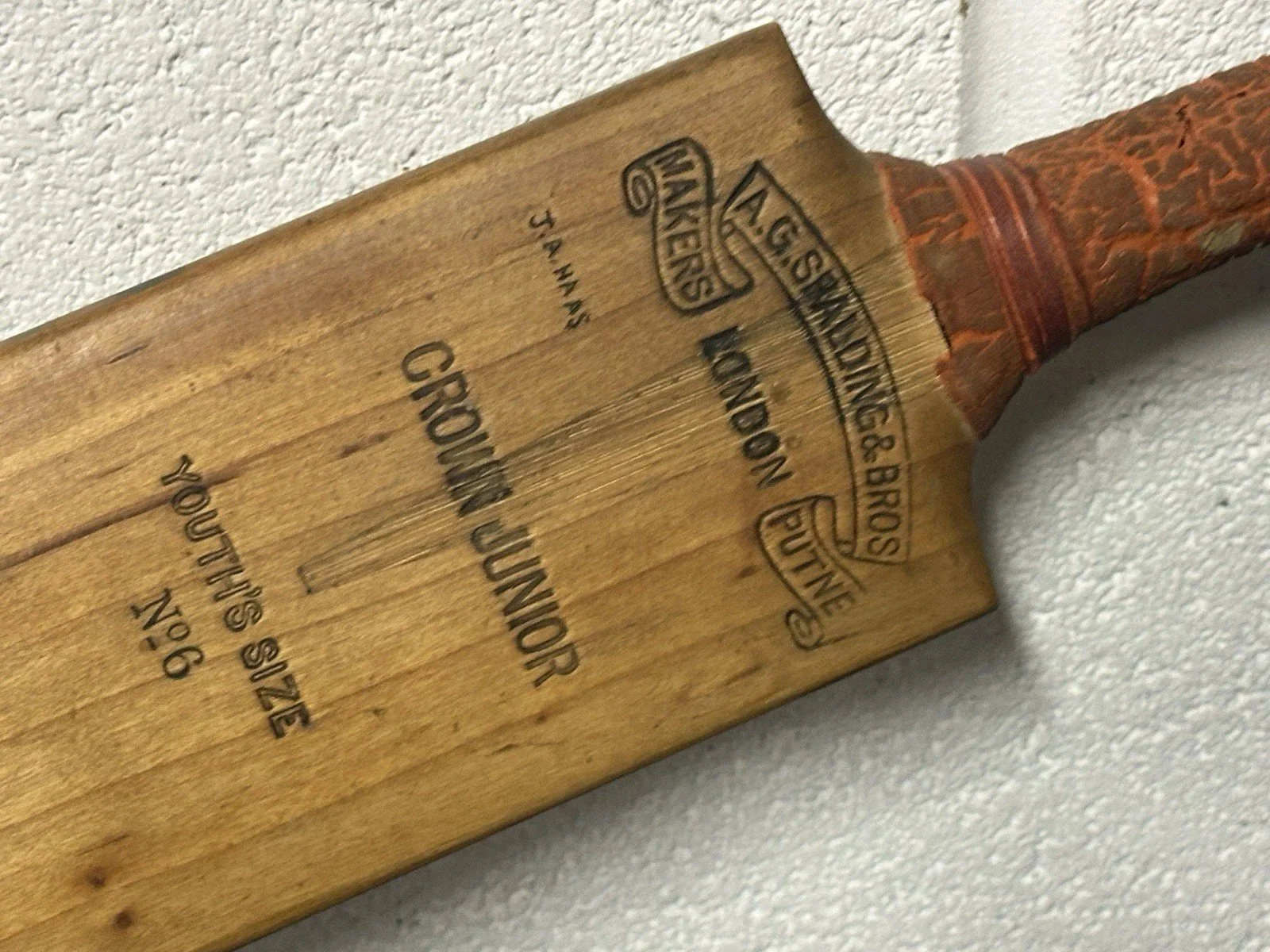
A.G. Spalding & Bros. cricket bat, made at the Putney Wharf works. eBay. Copyright undetermined.
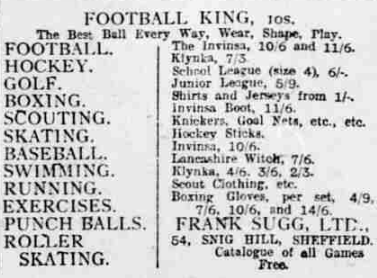
Frank Sugg Ltd. Sheffield Evening Telegraph, 4 September 1909. Image created by the British Library Board. No known copyright holder.
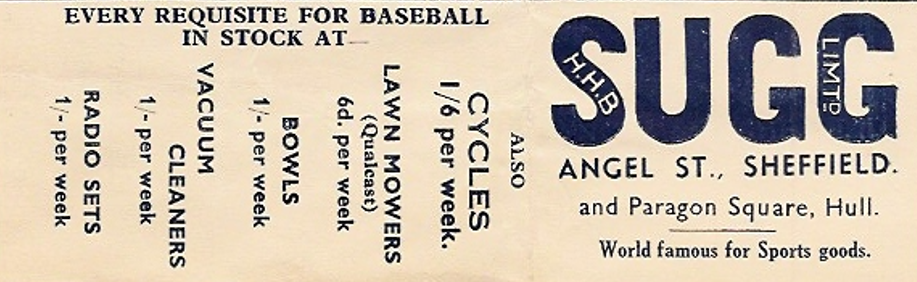
H.H.B Sugg Ltd, baseball game programme, Sheffield Dons v York City Maroons, June 1937. Image created by Project COBB. Public domain.
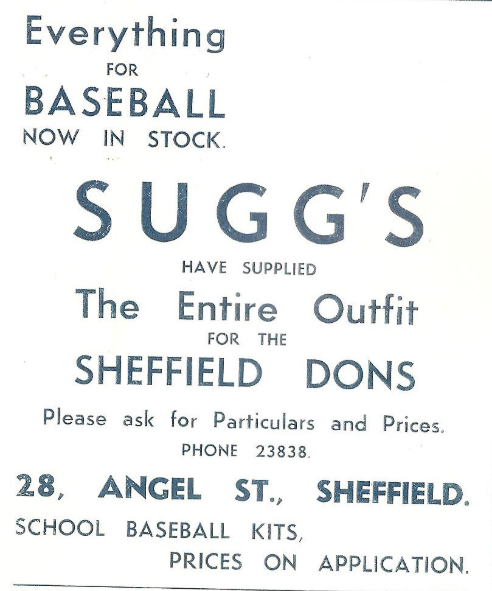
H.H.B. Sugg Ltd, baseball game programme, Sheffield Dons v Wakefield Cubs, 30 July 1936. Image created by Project COBB. Public domain.
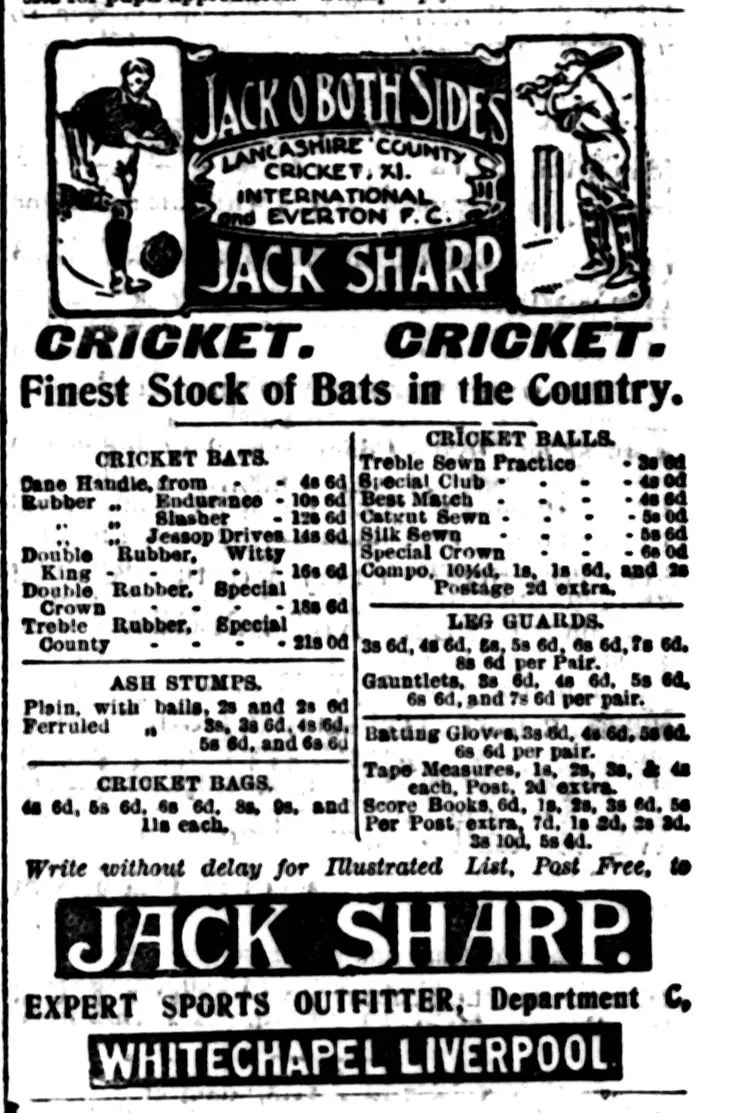
Jack Sharp. Wigan Advertiser, 28 April 1906. Image created by the British Library Board. No known copyright holder.
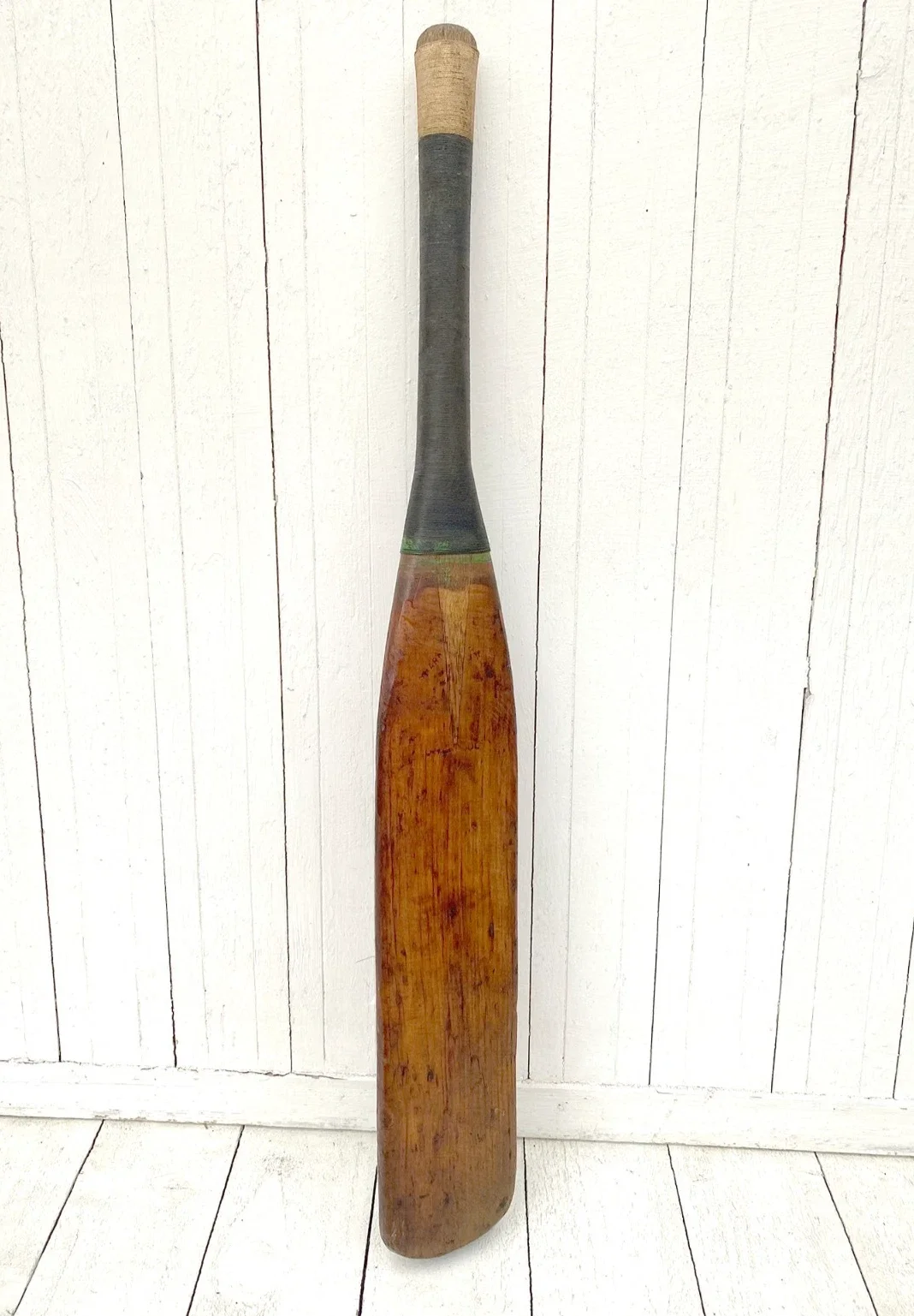
A Jack Sharp bat for English baseball. eBay listing. Copyright undetermined.
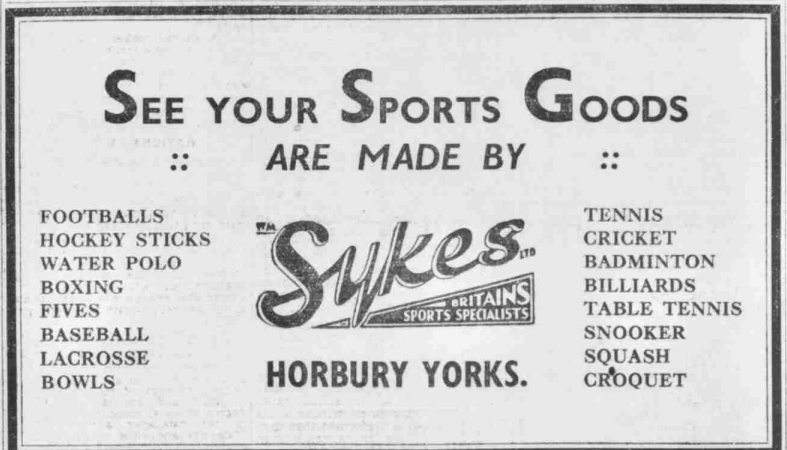
William Sykes Ltd. Sheffield Daily Telegraph, 25 November 1936. Image created by the British Library Board. No known copyright holder.
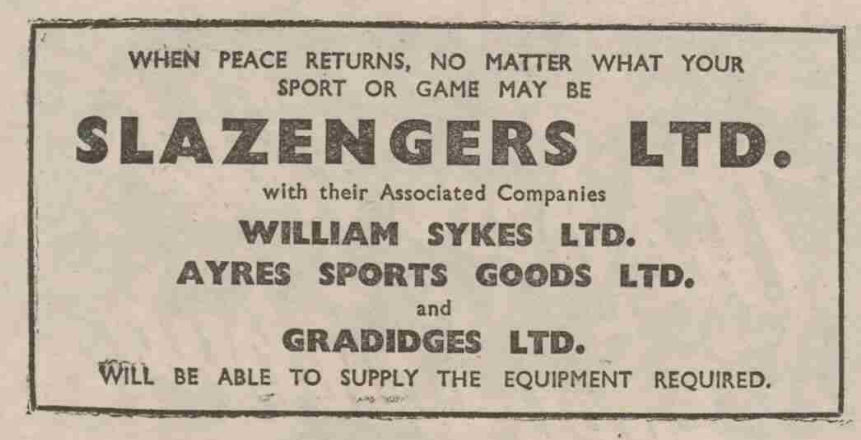
William Sykes Ltd. Civil and Military Gazette (Lahore), 25 March 1944. Image created by the British Library Board. No known copyright holder.
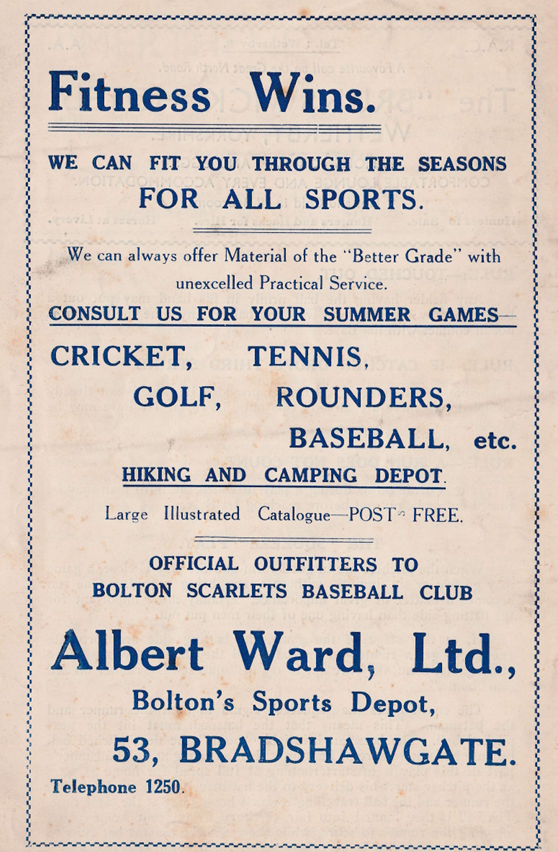
Albert Ward Ltd. baseball game programme, Oldham Greyhounds v Greenfield, 21 May 1938. Author's own copy. Public domain.
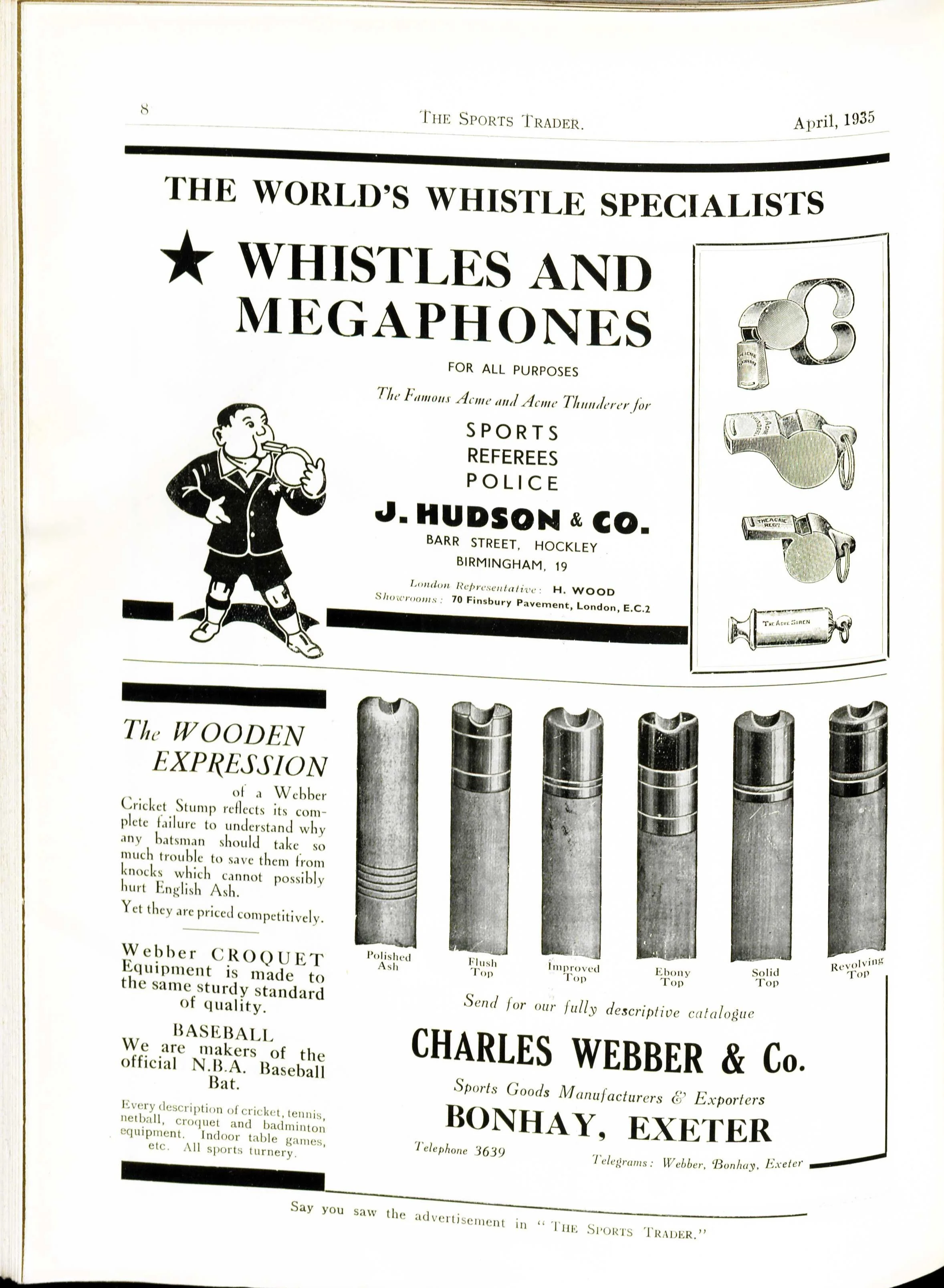
Charles Webbers & Co, The Sports Trader, April 1935. British Library. Author's own scan.
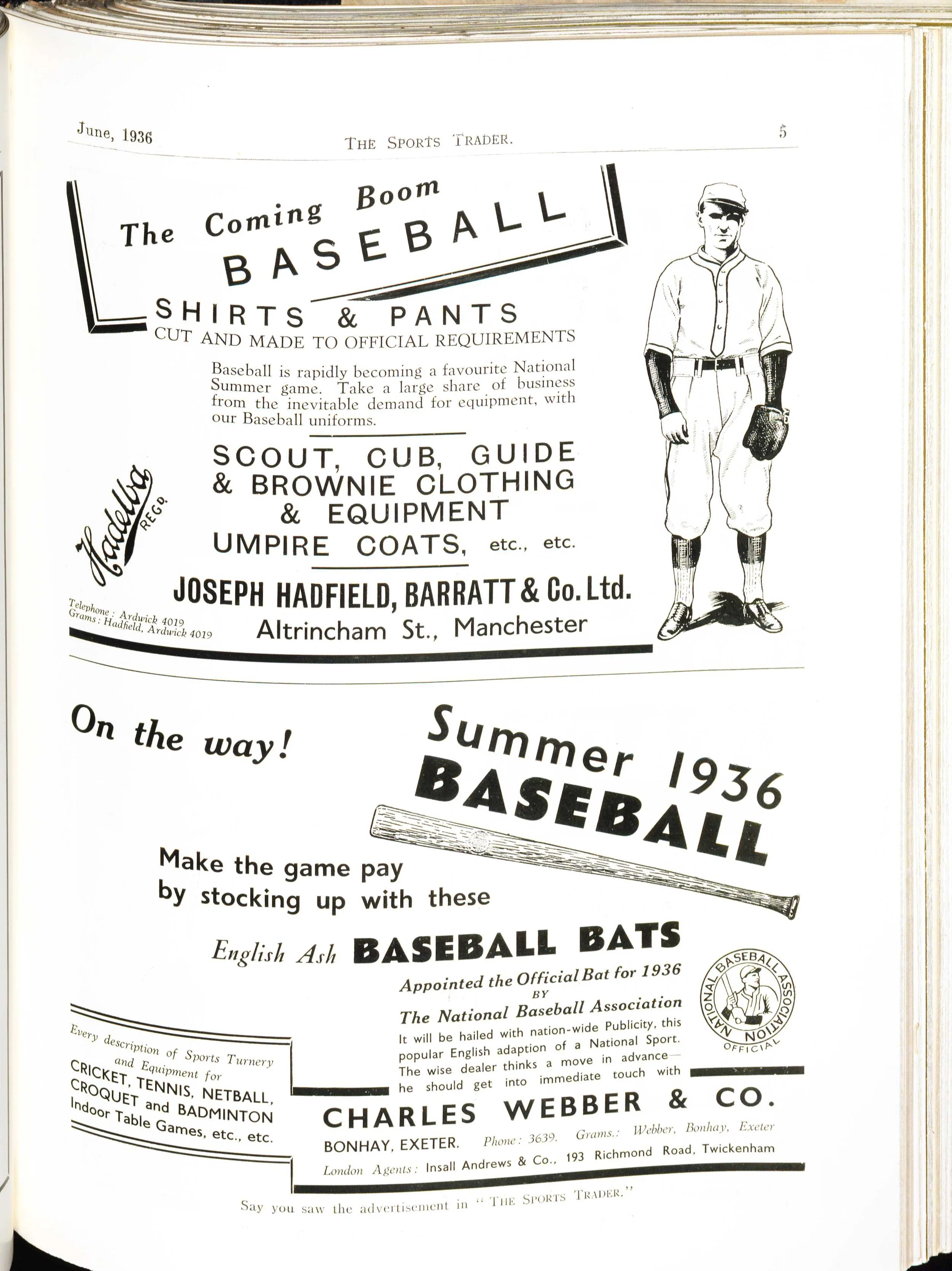
Joseph, Hadfield, Barratt & Co, and Charles Webbers & Co, The Sports Trader, June 1936. British Library. Author's own scan.
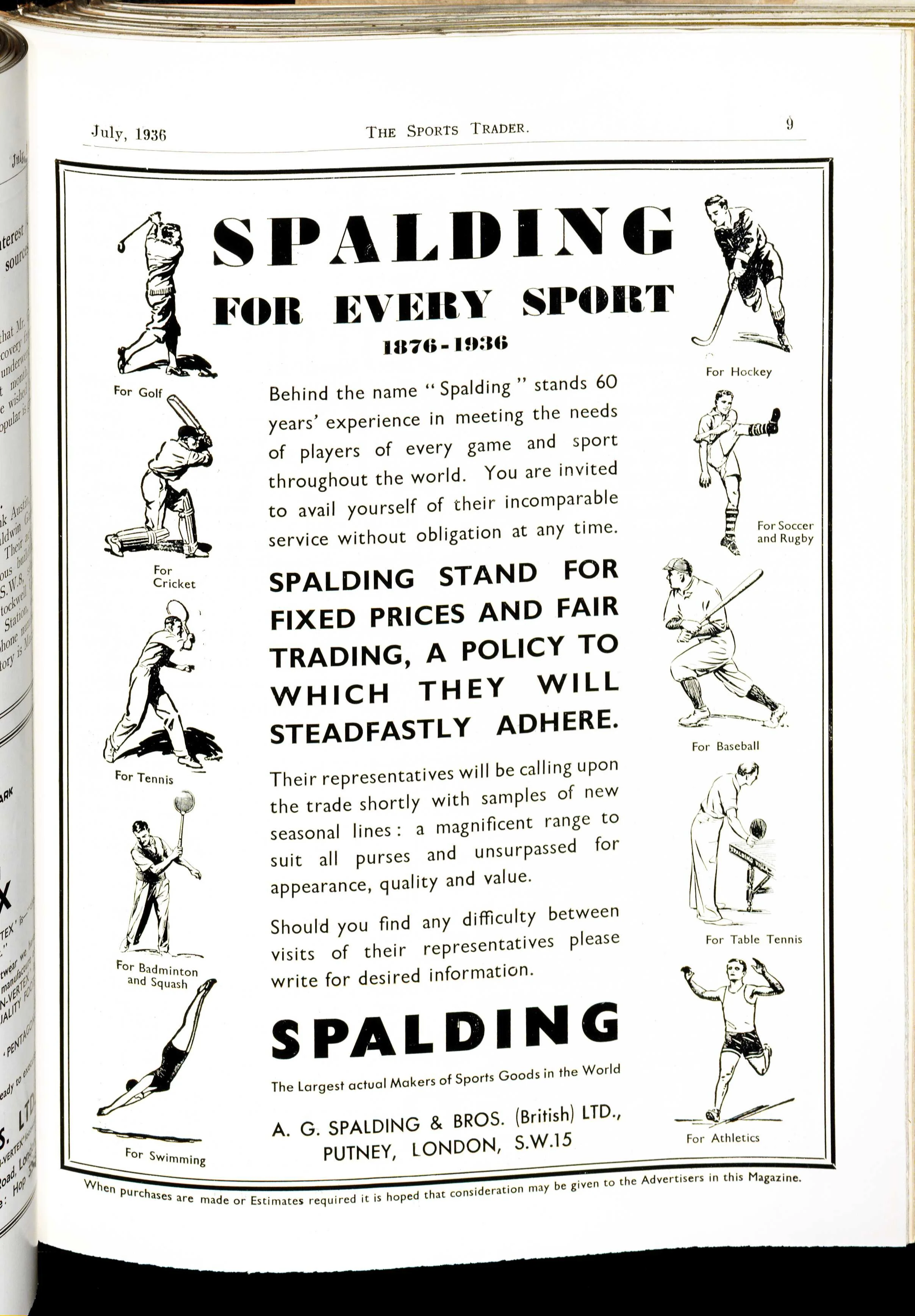
Spalding Company, The Sports Trader, July 1936. British Library. Author's own scan.
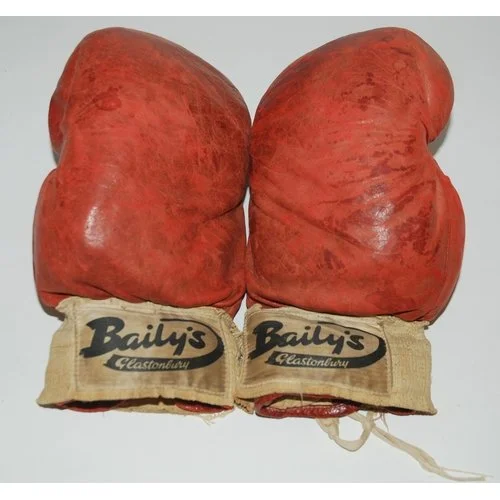
A. Baily & Co. boxing gloves. Copyright undetermined.
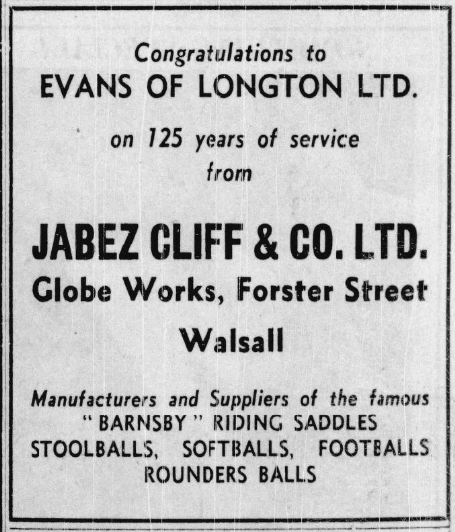
Jabez Cliff & Co. Staffordshire Sentinel, 14 April 1965. Image created by the British Library Board. No known copyright holder.
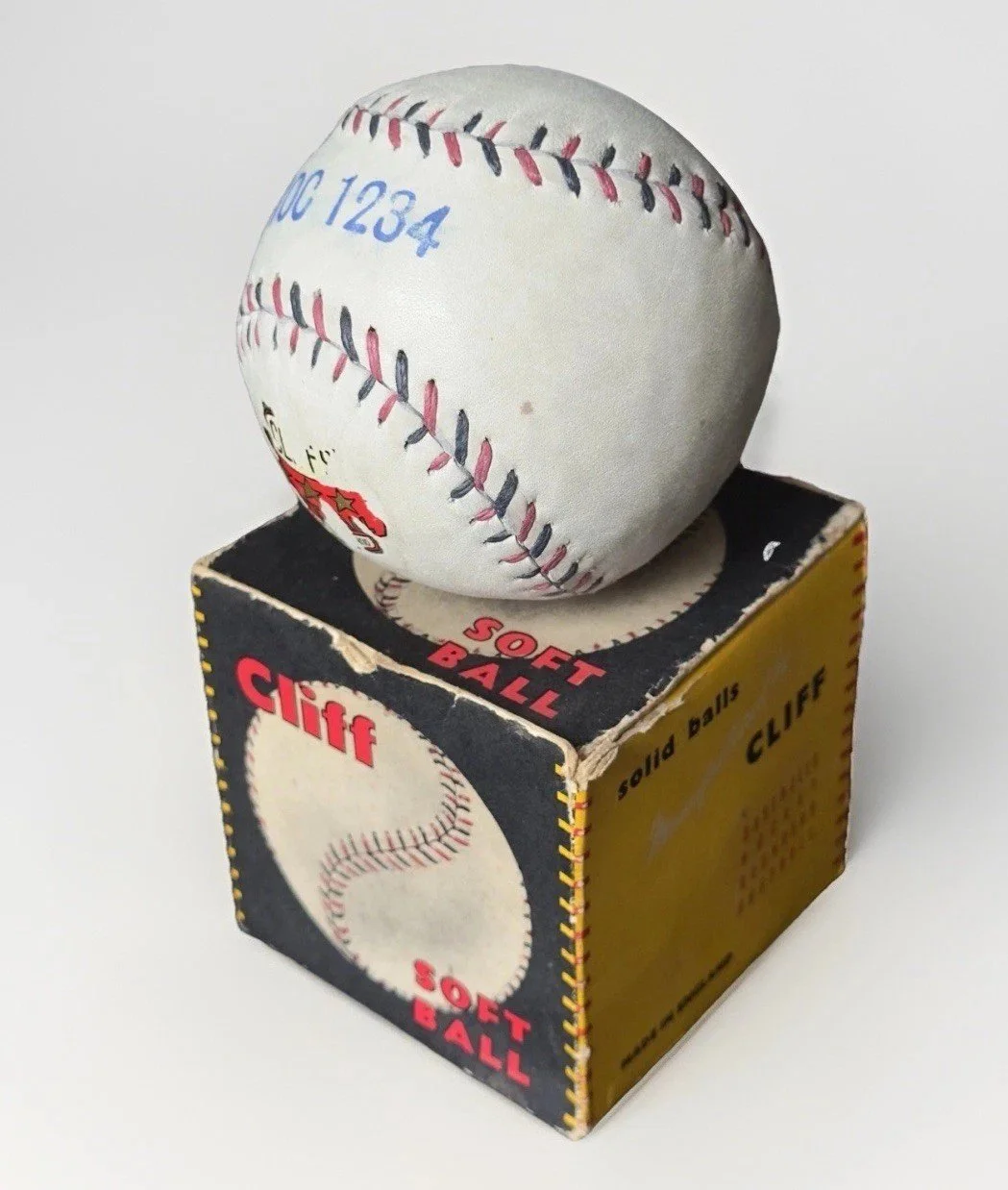
Jabez Cliff softball. Author's own collection.
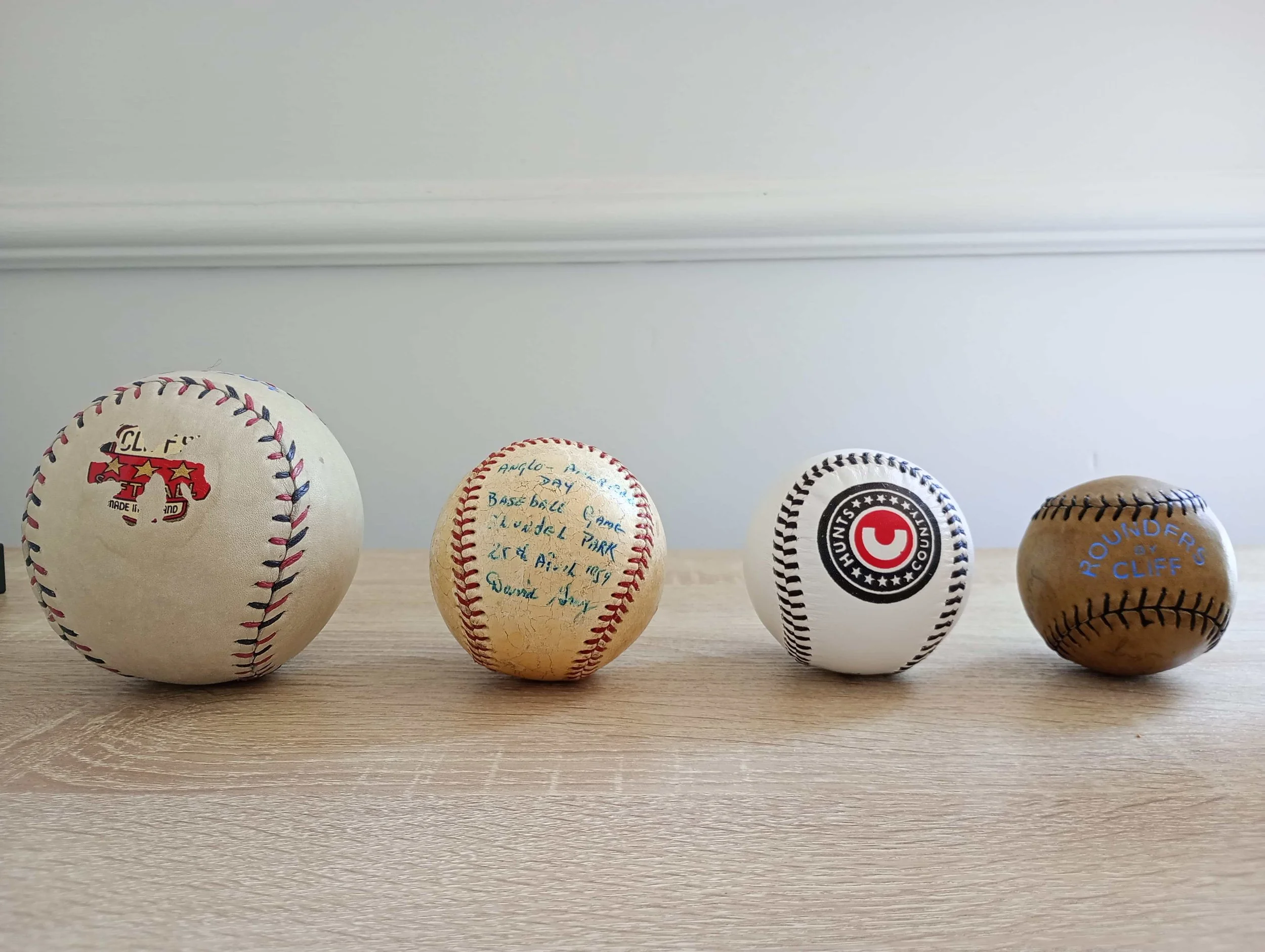
Jabez Cliff softball, national league baseball, Hunts County ball for Welsh Baseball, and Jabez Cliff rounders ball. Author's own collection.
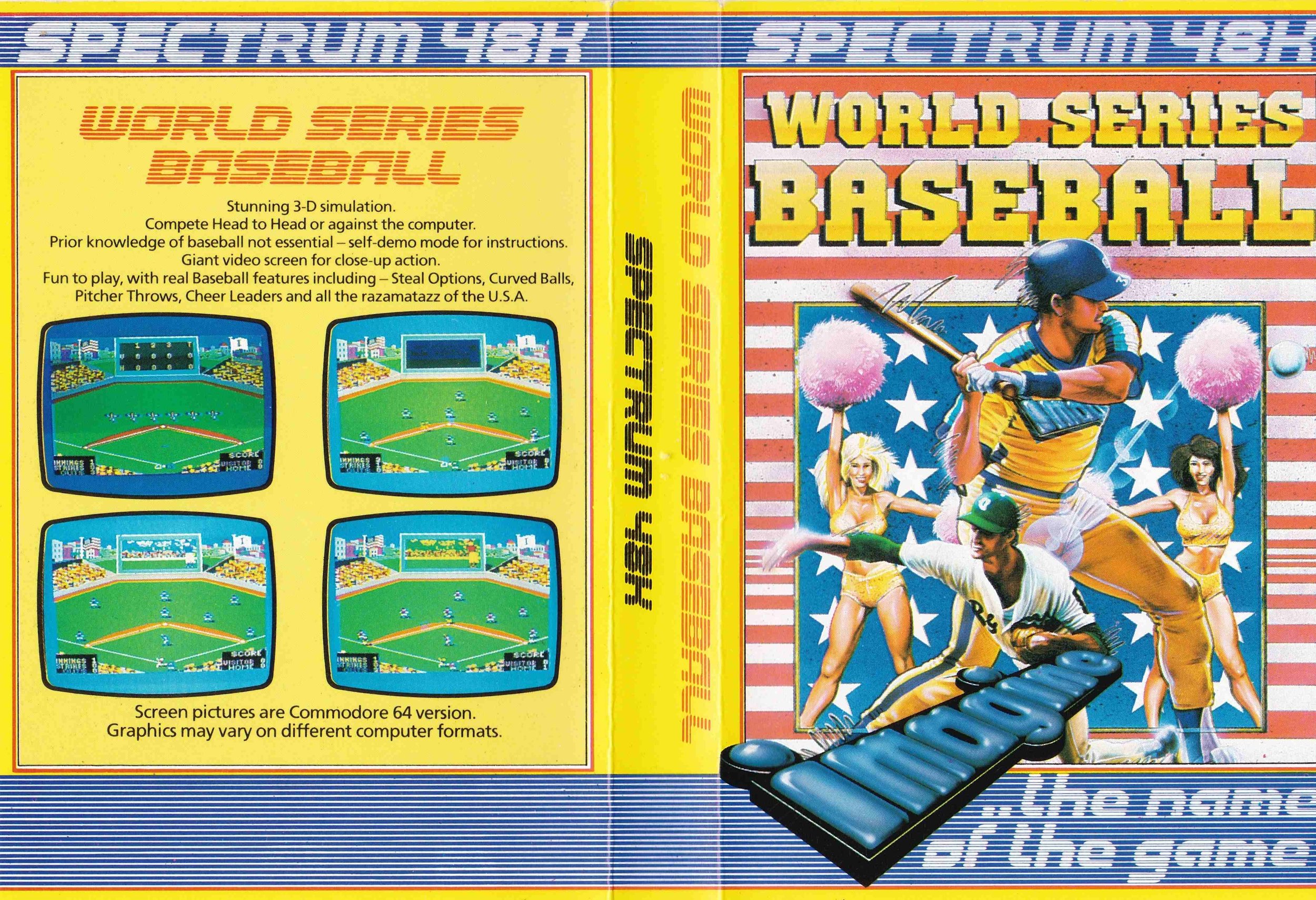
World Series Baseball for ZX Spectrum, 1985. Author's own collection
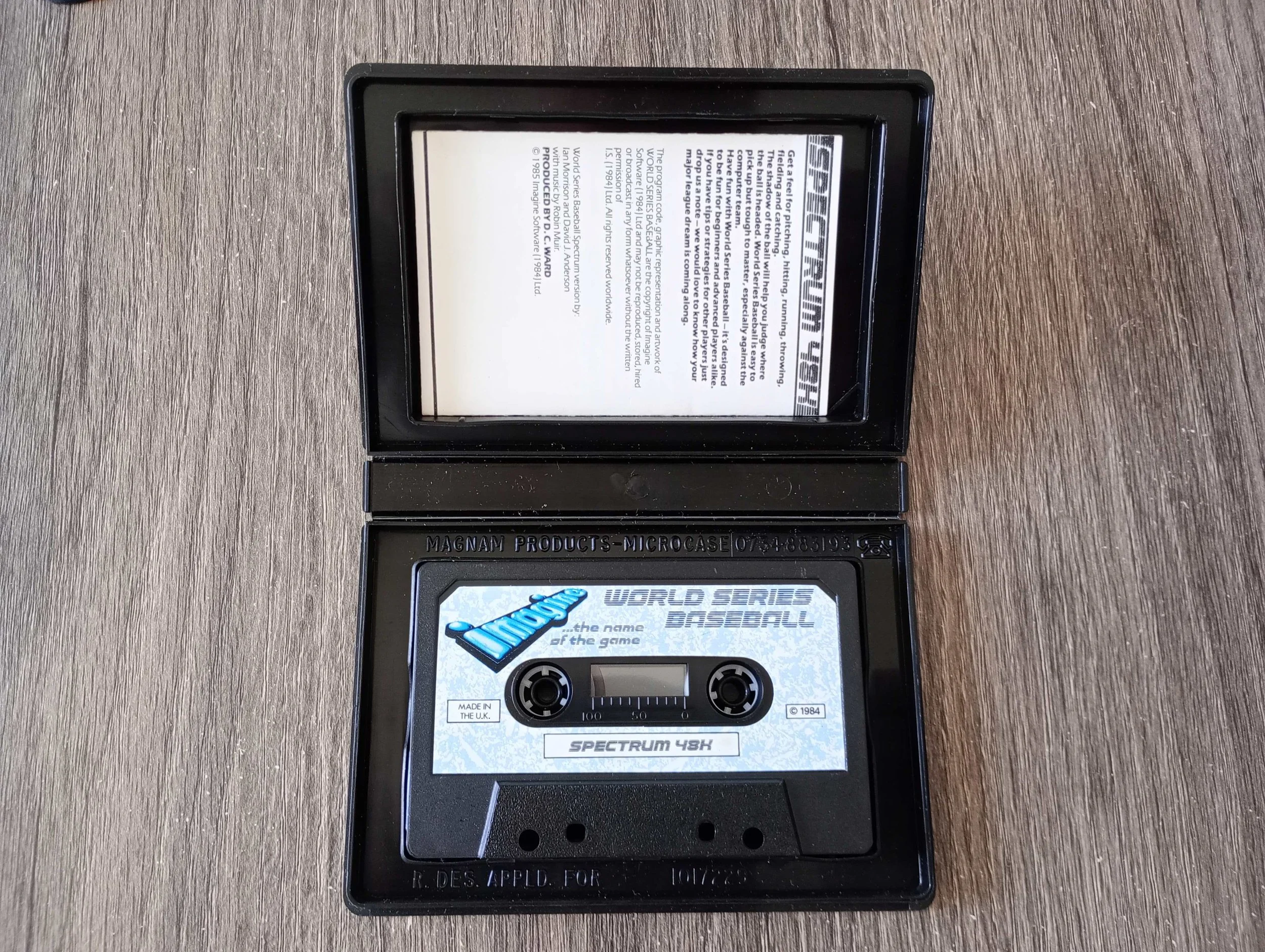
World Series Baseball for ZX Spectrum, 1985. Author's own collection
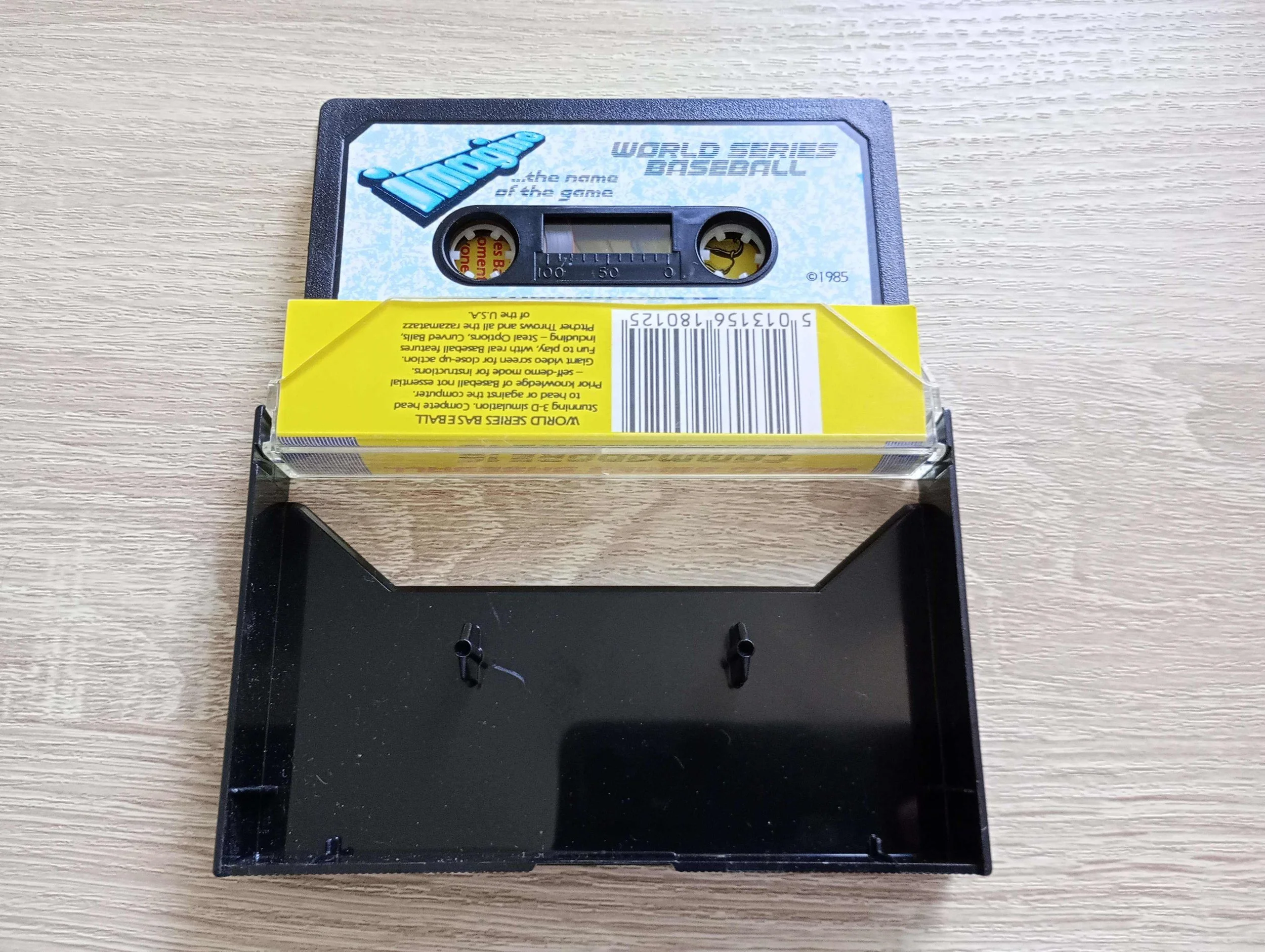
World Series Baseball for Commodore 16, 1985. Author's own collection
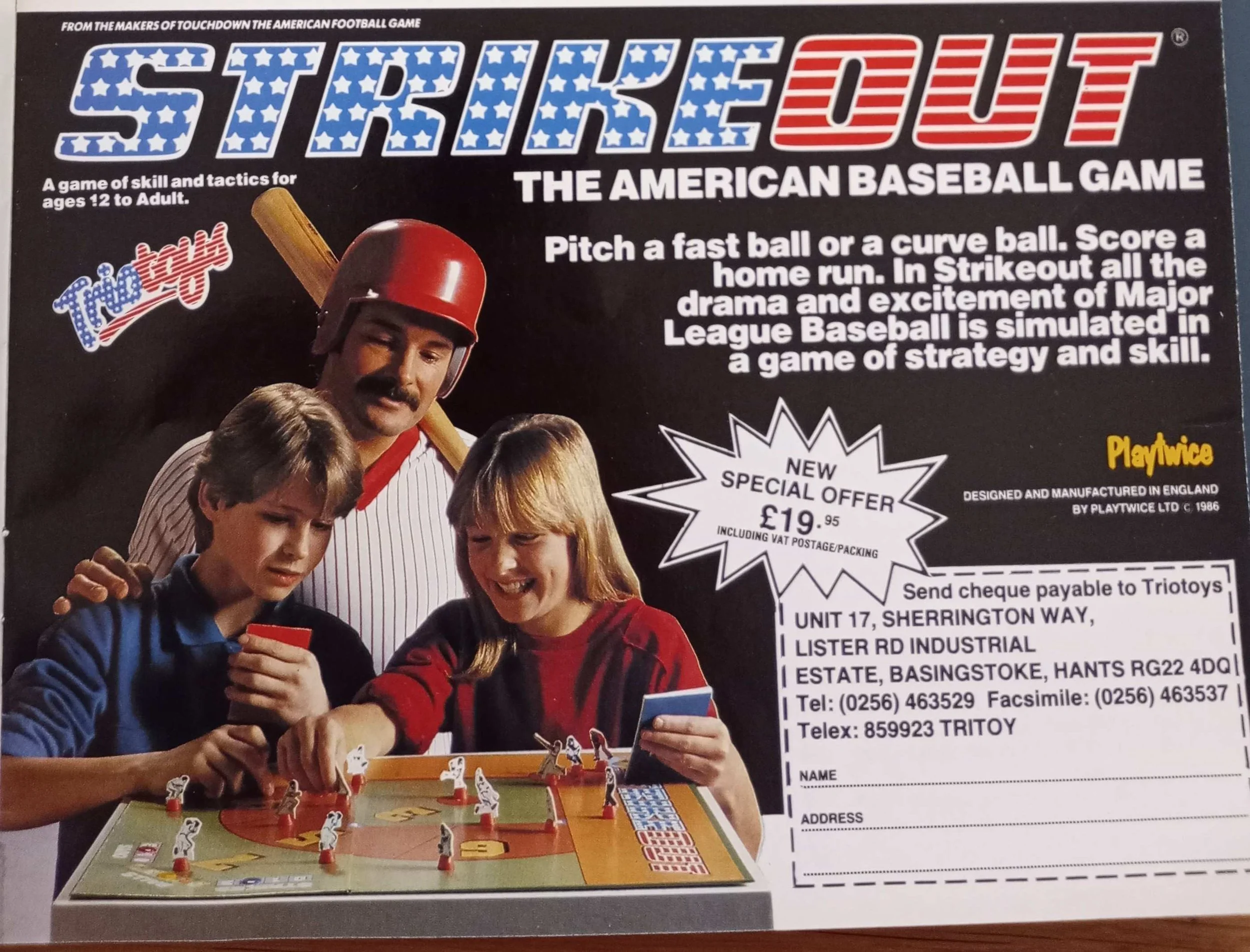
Strikeout board game, First Base Magazine, Winter 1987. British Library. Author's own photograph.