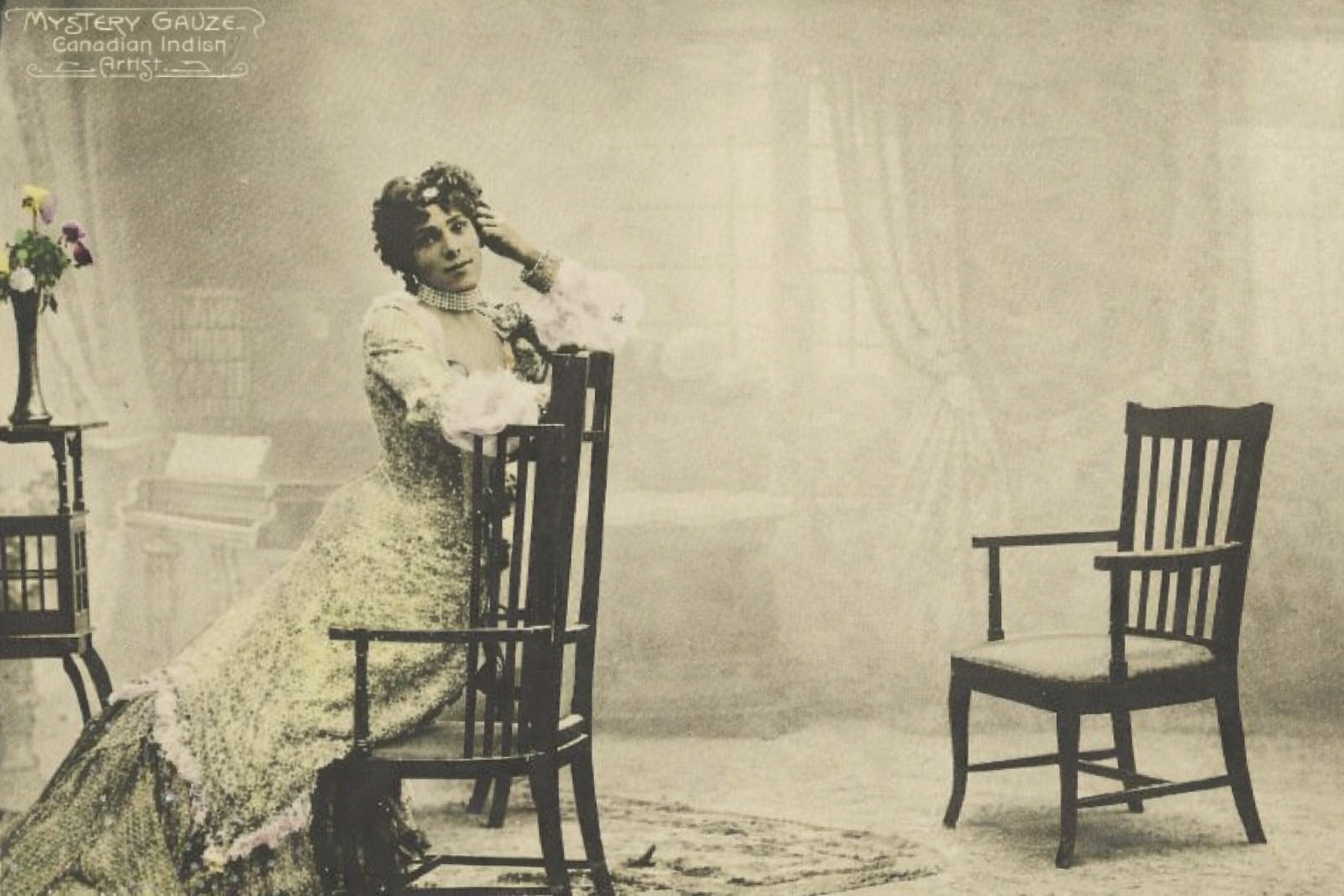
Mystery Gauze
Jamie Barras
Mystery Gauze was the appropriate name of the artiste who essayed the difficult task of female impersonation; and it should be said to his credit that on his first appearance, so excellent was the impersonation that large numbers in the audience were unable to believe that they were looking upon and listening to a man. In the next item, however, when in the middle of the apparently fine female voice, there was interjected a piece of the deepest bass, there was a positive roar from the audience, which was renewed in a milder form when the stylish headgear of the elegant lady was swept off to reveal the unmistakable masculine head beneath.[1]
In the course of his long life, Willis Gauze (1861–1939) picked up and discarded many identities. He was African American by birth, Black Canadian by adoption, and North American Indian by self-identification. Or North American Indian by birth, Black Canadian by adoption, and African American by self-identification. The story changed. He was the foremost Black female impersonator of the blackface minstrel era, a prima donna per antonomasia. He may also have been the foremost North American Indian female impersonator of that era. So much remains uncertain. His story is one of performance and “passing”, on and off stage. I present it here in all its mystery.
Mystery Gauze, a Canadian, goes through an interesting performance, in the course of which he contributes some curious Indian feats.[2]
Gauze’s true origins and heritage are lost to time. Contemporary records, some created only with information from Gauze himself, many of them conflicting, present us with two working hypotheses. I have listed the records that contribute to these two hypotheses in the Appendix.
Hypothesis one: Willis Gauze—we do not know if that was his real name—was born in Wisconsin or Michigan in 1861 to a sister of Lucy Priscilla Smith (1859–1927), a woman of African American heritage from Milwaukee. In 1878, Lucy Smith married William Taylor Hulett (1856–1944) in Detroit. Hulett was born and raised just across the Detroit River, in Essex, Ontario; however, his parents, Taylor and Esther Hulett, were an African American couple from Tennessee. Taylor and Esther Hulett moved (escaped?) to Canada in the early 1850s and settled in Pike Creek, Ontario. After her marriage to William Taylor Hulett, Lucy Smith Hulett moved to Ontario with him. For reasons that are not clear, her nephew, the man we know as Willis Gauze, then 17 years old, went with her. It seems likely that Lucy had been raising him, suggesting that both of his parents were out of the picture by this time. In later years, Gauze would refer to William Taylor Hulett as his uncle. He would stay with his aunt and uncle on his infrequent returns to Essex County.[3]
Gauze would also, in later years, claim to be of “Huron” (Wyandot/Wendat) heritage. It is possible that his absent father was of Wendat heritage. However, it also seems possible that, for professional reasons, he adopted a Wendat heritage. The Pike Creek area, where his Uncle Taylor grew up, was home to elements of the Wendat Nation.
Hypothesis two: The man we know as Willis Gauze was born to unknown parents, one of whom was of African American heritage, the other Wendat heritage, in Pike Creek, Ontario, in 1861. For unknown reasons, rather than his own parents raising him, he was raised by the Huletts. However, he was absent from the Hulett home for long periods from the age of 12 onwards, travelling across the Detroit River to Detroit and on to New York. When the man he regarded as his uncle, Taylor Hulett’s son, William Taylor Hulett, married Lucy Priscilla Smith in Detroit in 1878, Willis Gauze, who was in the city at the time, returned to Windsor with them and lived with them for the next few years. He would continue to alternate trips to the US with periods staying with his “uncle” and “aunt” for the next 40 years.
William Taylor Hulett was a farmer-turned-teamster. Whatever the origins and heritage of Willis Gauze, a life of manual labour in rural Canada was not for him. The bright lights of Detroit, just across the Detroit River, called to him. It was there that he would have seen his first female impersonator in a blackface minstrel show.
[…]the evening closes with opera bouffe, Mr. Leon, reputed to be the first female impersonator of the present day, and possessing also an alto voice of extraordinary power and compass, taking the prima donna parts. The illusion is said to be complete.[4]
Blackface minstrel troupes began in the 1840s in the form of white performers presenting a caricature of African American life in the rural South in a “plantation festival” of song and dance. Minstrel performances evolved from there in a three-act show, with a “plantation festival” as the first act, the olio, a more or less regular variety programme, albeit one in which most of the performers were in blackface makeup, as the second act, and an “Ethiopian opera”, a performance with characters and a plot as well as song and dance, usually with a plantation setting, as the final act.[5]
Female impersonation was a feature of blackface minstrelsy from its earliest days. Initially, this was in the form of the “wench” character, a crude caricature of a young African American woman who tempted and frustrated the musicians and dancers of the “plantation festival” line. However, it was with the creation of the olio variety programme of the expanded minstrel performance that female impersonation, not only in minstrel troupes but also in America, came of age with the introduction of the prima donna.[6]
The prima donna, aka the “male soprano”, left behind the clowning and racist stereotyping of the “wench” character in favour of emphasising European ideas of femininity in the form of the soprano of the Grand Opera or concert hall. The prima donna aimed to “pass” as female, maintaining the illusion until the final reveal. We can draw a direct line from the prima donna of the blackface minstrel shows to the strand of modern American female impersonation that emphasises being convincing in the role. This stands in contrast to the tradition of drag and the English pantomime dame, which confronts the audience with what is recognisably a man in a dress.[7]
The premier white prima donna of the blackface minstrel era was Francis Leon (Francis Patrick Glassey, 1844–1922). With his professional partner, Edwin Kelly, Leon is credited with moving the blackface minstrel show away from its purely rural, plantation roots towards a more European-centric entertainment, albeit one that still relied heavily on negative stereotypes of people of colour for its “humour”.[8]
The Kelly and Leon combination played Detroit in September 1877. Willis Gauze may well have been in the city then and seen Leon perform. If he did, he would have seen the other star of the combination, Thomas Dilward, aka “Japanese Tommy” (1817–1887). Dilward was a man of small stature of African American heritage, and possibly also of North American Indian heritage. He was one of the first performers of colour to appear in a blackface minstrel troupe, back in the 1840s. Although known mainly for his trouser roles, he also worked as a female impersonator of the prima donna type. After appearing in Detroit in 1877 with Kelly and Leon, he returned to the city as a solo act in 1882.[9]
However, when looking for early inspirations for the performer that Willis Gauze would become, we need to examine two acts that appeared in Detroit in 1878. These were Callender’s Georgia Minstrels and the Hyer Sisters Combination. Both acts featured performers who would have a lasting impact on Willis Gauze’s career. The first was Billy Kersands (1842–1915), the great Billy Kersands, the premier Black performer of blackface minstrelsy of the nineteenth century. At the height of his career, Gauze would work with Kersands for a decade. The second was the leading Black prima donna female impersonator of the 1870s, William Elmer Lyle (?–?).[10]
LYLE, the female impersonator, was quite a success, being the only member of the company whom the audience would like to have seen more.[11]
William Elmer Lyle, burlesque prima donna, for years a member of Callender’s Georgias, is with this troupe.[12]
Callender’s Georgia Minstrels was one of several troupes from the second half of the nineteenth century that used the “Georgia Minstrels” name to identify themselves as featuring African American and Black Canadian, not white, performers of blackface minstrelsy. Georgia Minstrel troupes, which generally, but not always, had white managers, promoted the same negative stereotypes of people of colour as white minstrel troupes, as this is what paid the bills. However, they were as popular with Black audiences as with white, as Black audiences could recognise that they were watching caricatures, but still see enough that was true to laugh along with the performer, not at the performer.[13]
All Georgia Minstrel troupes owed their origins to the original “Georgia Slave Troupe Minstrels” of 1865. White promoters of Georgia Minstrel troupes were notoriously bad at paying their artists, and many Black performers of blackface minstrelsy, Billy Kersands and Willie E. Lyle among them, moved from one troupe to another and back again in search of better pay.[14]
Charles Callender—one of the worst of the bunch of the white promoters—acquired his Georgia Minstrel troupe in 1872 when he bought out the interest of a business partner of African American promoter and performer Charles B. Hicks (1840–1902). Hicks was of the view that he had been squeezed out by Callender and his fellow white managers, who had conspired to persuade bookers from hiring a troupe led by a man of colour. Callender used the money he saved by underpaying, and sometimes, not paying at all, his performers to greatly increase the size of the troupe. One of his new hires was Wille E. Lyle, who first appeared in reports of Callender’s Georgia Minstrel performances in the summer of 1874.[15]
Lyle would remain with Callender for the next five years. He made a lasting impact on the story of Black performers of blackface minstrelsy one year after he joined Callender’s, when he helped to compile a songbook of material performed by Callender’s troupe. The songbook, published by Robert De Witt, recorded not only the composers of the songs but also which members of the troupe performed the songs. In doing so, it gave us a unique insight into the performance styles of Black performers of blackface minstrelsy. In Willie E. Lyle’s case, this was an insight into the prima donna as realised by Black performers.[16]
DASHING FEMALE SWELL. Music by J.E. Stewart. Sung by W.E. Lyle. 1 am a gay and dashing belle/as you are well aware/I love to dress and cut a swell/with me none can compare/I’m always cheerful, light and gay/my heart is never sad/I strive to cast dull care away/to keep my spirits glad.[17]
I’LL MEET YOU IN THE PARK. Sung by WILLIE E. LYLE. I’ve a note from dear Augustus, ‘tis replete with love for me/He invites me out next Sunday, oh what pleasure it will be/To Central Park he intended to go, to ramble around and observe the show/That day I’m sure, many joys will bring, just listen to his words I’ll sing.[18]
As can be seen, there is no suggestion that the prima donna is anything other than “she” appears: a young woman of fashion, chaste, but enjoying life. Lyle is shown in caricature on the cover of the De Witt Songbook, wearing a formal gown and carrying a fan, the image of respectability. After five years with Callender, Lyle was briefly with both the Hyer Sisters Combination and Sprague’s Georgia Minstrels; then, in March 1880, it was announced that he was returning to Callender. However, after this, he disappears from view.[19]
It seems reasonable to identify Willie E. Lyle as the template for the performer that Willis Gauze became, as postcards of Gauze at the height of his fame show.[20] This connection is even there in Gauze’s early billing.
THE ORIGINAL AND ONLY SERVITUDE AND FREEDOM OR THE Underground Railroad Slave Combination Company[…]NOTE OUR ARRAY OF TALENT[…]Mr. WILLIE GAUZE, the greatest of all impersonators.[21]
The earliest mention of Willis Gauze as a performer that I have found is his billing as “Willie Gauze”, female impersonator, in the “Servitude and Freedom” company in a performance in Jackson, Michigan, in September 1885. That his first recorded performance was in Michigan is understandable, given what we know of his connections to Detroit and Essex County. Indeed, the “Servitude and Freedom” company owed its origins to Detroit-based musician and music teacher Edward M. Rector (?–?). Rector had first performed a version of “Servitude and Freedom” in Chicago back in 1878. He then toured with Foss’s Georgia Minstrels before setting himself up as “Prof. E.M. Rector”, guitar teacher, in Detroit in 1881. He also became the musical director of the “Detroit Colored Musical Society No. 3”, organising at least one concert performance in the city. That concert featured as its star vocalist MadameMarie Selika (Mary Price Holloway Williams, 1850–1937), one of the leading female African American vocalists of the late nineteenth century.[22]
Alas, the “Servitude and Freedom” company did not thrive; Rector left Jackson without paying the company’s bills, and the irate boarding-house keeper seized the company’s baggage, stranding the performers in the city. Rector would have a further run-in with the law in 1896 when he set up a fake chapter of the Knights of Pythias and then ran off with the subscriptions.[23]
Undaunted by the failure of the Servitude and Freedom company, Gauze, still billed as Willie Gauze, signed on to Callender’s Georgia Minstrels—the troupe that had starred Willie E. Lyle back in the 1870s. He did not stay in the troupe long, however—performers rarely did. Instead, by October 1888, he had entered into the professional partnership that would make his name.[24]
The great Colored Comedians, Tom McIntosh and Wm. Gauze, are without a doubt the “Greatest on earth”. Mr. Gauze is the only colored female impersonator on the Stage, his voice and singing are phenomenal.[25]
Tom McIntosh (1840–1904) was second only to Billy Kersands in terms of fame and earnings as a Black performer of blackface minstrelsy. It is a measure of the quality and appeal of Willis Gauze’s performance that the great McIntosh teamed up with him. They toured as “McIntosh and Gauze” from late 1888 until the summer of 1889, playing music halls and dime museums. Latterly, they joined one of the few Georgia minstrel troupes owned and operated by African Americans, the McCabe and Young Georgia Minstrels. McIntosh would remain with the troupe and become its chief draw; however, Gauze, perhaps chafing at the change in their professional relationship, was lured away by another troupe and the promise of his own star billing after only a few weeks.[26]
With this rise in his billing came a new stage name. For the next decade, he would be a member of Richards and Pringle’s Georgia Minstrels and be known as the Great Gauze.[27]
One of the most wonderful contraltos and female impersonators of the stage is the great Gauze, now with the Famous Georgia Minstrels. His wardrobe is from Worth’s and is superb.[28]
[…]the great Gauze, female impersonator, was thought to be a real woman until at the conclusion of his third encore he pulled off his wig and thanked the audience in a voice that no woman could imitate.[29]
Having performed with Tom McIntosh, Gauze now shared the stage with McIntosh’s only peer, Billy Kersands. These two partnerships placed him at the front rank of Black performers of blackface minstrelsy. His act had by this time reached full maturity as a classic prima donna turn, built on “passing” for female until the final reveal. The 10 years he spent with the Richards and Pringle combination took him from age 28 to 38, a period when his voice would be at its full power and compass. We can also suppose that this was the time when his earning power was at its greatest. He would not have been earning as much as Kersands was—Kersands was arguably the highest-earning person of colour in America in the last quarter of the nineteenth century[30]—but it would still have been far in excess of the average wage for the time, and immeasurably more than he would have earned if he had stayed on the farm back in Essex County.
Gauze’s time with the Richard and Pringle minstrels came to an end in the summer of 1899. Ten years was a long time to tour the same act to the same cities year in year out. He needed new audiences.
He found them on the other side of the world.
The M’Adoo Company of Georgia Minstrels and Alabama Cake-walkers presented their second change of bill to a good audience at the Theatre Royal last night[…]Mr. Willis Gauze, the female impersonator, was twice recalled for his songs, rendered in the clear falsetto voice which proves so deceptive.[31]
In the autumn of 1899, Willis Gauze was recruited by Orpheus M. McAdoo (1858–1900) to join a tour of Australia. McAdoo was himself a singer of some talent. He got his start performing in a troupe of “Jubilee Singers”. This was the name given to African American choral ensembles that sang a cappella and often, but not always, included what we now recognise as Gospel songs alongside vocal pieces from the European classical tradition. McAdoo went on to form a troupe of Jubilee Singers that included his wife, Mattie, and his brother, Eugene. The McAdoo Jubilee Singers toured extensively in the 1890s, finding success in England, South Africa, Australia, and New Zealand. However, by 1898, McAdoo recognised that he needed to change up the act. He returned to the United States to recruit performers for a minstrel-style vaudeville outfit that he eventually named the McAdoo Georgia Minstrels and Alabama Cake-walkers.[32]
One feature of the McAdoo company’s repertoire that would have been new to Gauze was its performance of a “Tom Show”. This was the name given to dramatisations of Harriet Beecher Stowe’s anti-slavery novel “Uncle Tom’s Cabin” that included a blackface minstrel “plantation festival interlude” as added entertainment. Tom Shows were hugely popular throughout the English-speaking world in the last quarter of the nineteenth century, their appeal waning only when ragtime came along and made the banjo-led plantation music style seem old-fashioned. Gauze took one of the leading roles in the McAdoo Tom Show, that of Eliza Harris, the escaping enslaved woman who carries off the famous escape across the ice floes.[33]
The Tom Show production was one of the last that Orpheus McAdoo oversaw. He died in Sydney in July 1900. His wife, Mattie, and their young son returned to the US, but the McAdoo company, including Willis Gauze, and back under its McAdoo Jubilee Singers name, continued to tour Australia and New Zealand for the next year. One noteworthy change in Gauze’s billing in this period was that he was now billed as “Canadian”. This was undoubtedly a move made to appeal to fellow colonials; it foreshadowed future developments.[34]
MAIDENHEAD. EMPIRE THEATRE—Proprietor, Mr A. Ball.—This theatre was open for three nights commencing 11th inst. with a variety show, of which one of the leading features was the marvellous acrobatic display of the Leopold Family. A distinct novelty was the turn of Willis Gauze, the coloured female impersonator.[35]
By December 1902, Willis Gauze had found his way to England. He signed a contract to tour the Barrasford Halls, as they were known—a step down from the top-rank Moss and Stoll Empire venues—under the billing “Willis Gauze”. He was now a solo act. As in Australia, he made much of the patriotic appeal to Britishers of his Canadian roots, billing himself as a “Canadian male soprano”. His act was his old prima donna act presented to yet another set of new audiences.[36]
However, he still had one last card to play as a female impersonator, one last ace up his sleeve.
Mystery Gauze is a Canadian Indian artist of considerable merit.[37]
Gauze debuted his new act as a “Canadian Indian artist” in April 1904; by October of that year, he had refined it to read “the only Indian female impersonator in the world”. He had found the unique selling point that would sustain his career as a prima donna.[38]
I have written elsewhere about African American performing artists of the late nineteenth/early twentieth century who found it advantageous to present themselves to European audiences as Native American, not African American.[39]
However, unlike Mayme Calloway and Craig Williams, Willis Gauze may—may—have had a genuine claim to that identity. His decision to make it the basis of his act was unquestionably motivated by the same commercial realities that motivated Calloway and Williams to fake their origins; however, in his case, it may have been rather an instance of emphasising one aspect of his real heritage—North American Indian—over the other—African American or Black Canadian.
In favour of the latter interpretation is the fact that Gauze continued to self-identify as a North American Indian for much of the rest of his life. Against the idea that this was Gauze emphasising an aspect of his true heritage, is the explanation of his origins provided by his relatives.
Why, if he had no claim to the identity, would he continue to self-identify as a North American Indian for decades? It may well be that he found that it worked to his advantage off-stage as well as on. In the early twentieth century, in the entirely spurious racial hierarchy created by people of European heritage, North American Indians, at least as individuals, received better treatment than people of African heritage.[40] That may have been the lesson that performing as a North American Indian on stage taught Willis Gauze.
Alas, we are unlikely to discover the truth.
TO THE ANTIPODES. We had a card from Willias Gauze, who spent 20 years in Europe up to 10 years ago, and who left Chicago some months ago with the Rusco and Hockwald Minstrels. The card was mailed last week at San Francisco and vouchsafed the info that when it reached me Gauze would be “way out on the Pacific” on his way to New Zealand. We will hear more about that later, as Gauze always did believe in using postage stamps.[41]
Gauze remained in Europe until the summer of 1915, billed as the “Mystery Gauze, Canadian-Indian soprano and baritone”.[42]
On his return to the US, he returned to an old engagement and an old stage name, rejoining Richards and Pringle’s Georgia Minstrels and performing once more as the “Great Gauze”. As the call was one to nostalgia, gone, for now, was the Indian billing. However, this engagement lasted only a few months. He was now in his late fifties, well past his prime as a prima donna, with its implicit reliance on “passing” for female. When he next returned to the stage, it would be in a tuxedo. With one exception, one last hurrah as a female impersonator, he would spend the rest of his career in “trouser” roles.[43]
In 1920, and now over 60, he joined William C. Buchner’s Dixie Jubilee Concert Company, which performed what we would recognise today as Gospel music. In the company’s publicity, he was billed as an “Indian baritone”.[44]
The Buchner company toured Canada and the American West throughout the 1920s. From 1924 to 1926, it also toured New Zealand and Australia, marking Gauze’s first return to those two countries in over 10 years.[45]
Just before the Antipodean trip, Gauze spent a season touring with a Georgia Minstrels troupe. This also marked a brief return to female impersonation. It is easy to imagine that Gauze may have had mixed emotions about returning to the prima donna character. He was now 64 years old; it would have been a very different face that looked back at him in the mirror from that of 40 years earlier when he first played the part.[46]
After the Buchner company’s return to the States in June 1926, Gauze toured briefly with two of the other male singers of the troupe as a trio and then signed with another Jubilee Singer troupe. His last stage performance was in Muncie, Indiana, in July 1928. He died in Chicago on 9 February 1939, aged 78.[47]
One of the most wonderful contraltos and female impersonators of the stage is the great Gauze, now with the Famous Georgia Minstrels. His wardrobe is from Worth’s and is superb.[48]
Willis Gauze was the foremost Black female impersonator of the blackface minstrel era. He may also have been the foremost North American Indian female impersonator of that era. He dedicated much of his professional career to “passing”. The extent to which that was true of his life off stage, too, we will likely never know.
Jamie Barras, June 2026.
Back to Staged Identities
Appendix: Documents Supporting Theories on Origins and Heritage of Willis Gauze
1. “Gauze, Wm”, “actor”, “32”, residing at 97 Parent Avenue, Windsor, Ontario, 1894–1895 Tax Assessment for Windsor, Ontario. Canada, Ontario, Tax Assessment Rolls, 1827-1922. Familysearch.org.
2. Entry for Willis Gauze “actor” in the household of William Hulett and [Lucy] Priscilla Hulett, 429 Mercer Street, Windsor, Ontario, 1921 Census of Canada. Lucy is described as American and having entered Canada in 1878. The same is true of Willis Gauze. The return also records the birthplace of William Hulett’s parents as the USA, while he was born (in 1856) in Ontario. The “racial or tribal origin” of all members of the family and Willis Gauze is recorded as “negro”. It is worth noting that this information would have been provided by William or Lucy Hulett. Familysearch.org.
3. Marriage registration of Wm T. Hulett and Priscilla Smith, 5 September 1878, Detroit, Michigan. Michigan, U.S., Marriage Records, 1867–1952, Ancestry.com Inc. (Operations).
4. Entry for Taylor and Esther “Hewlett” and family, Maidstone, Ontario, 1871 Census of Canada. Children’s birthplaces given as Canada, parents as United States, “origin” as “African”. Eldest child, John, born in 1851, just 10 years before Willis Gauze’s birth. Familysearch.org.
5. Death Certificate for William Taylor Hulett, Windsor, Ontario, died 7 April 1944. Place of birth of both parents given as Tennessee. Ontario, Canada, Deaths and Deaths Overseas, 1869–1953, Ancestry.com Inc. (Operations).
6. Willis Gauze, actor, 50, 10 August 1915, Entry into Canada from Detroit. Place of birth given as “Tecumseh, Ont.” “Race” is recorded as “Afr[ican] Bl[ac]k”. Contact in Canada: Uncle, William T. Hulett, 39 Mercer Street, Windsor, Ont. Soundex Index to Canadian Border Entries through the St. Albans, Vermont, District, 1895-1924. Familysearch.org
7. Willis Gauze, concert singer, 64, 9 March 1926, Entry into US from Canada, Port of Detroit. Place of birth given as “Pike Creek, Ont.” “Race” is recorded as “Indian (Huron)”. Contact in Canada: Uncle, William T. Hulett, 429 Mercer Street, Windsor, Ont. Ever been in US before? Yes. 1872–1878 & 1875(1885?)–1888. In New York and Detroit. We know from newspaper reports that Gauze was in the US from at least 1885 until 1899, although this included trips back to Canada. Soundex Index to Canadian Border Entries through the St. Albans, Vermont, District, 1895-1924. Familysearch.org
8. Willis Gauze, professional singer, 64, 13 March 1926, Entry into US from Canada, Port of Detroit. Place of birth given as “Pike Creek, Ont.” “Race” is recorded as “African”. Contact in Canada: Uncle, William Hulett, Windsor, Ont. Ever been in US before? Yes. 9/1873–6/1876 in Detroit, Mich. Soundex Index to Canadian Border Entries through the St. Albans, Vermont, District, 1895-1924. Familysearch.org
9. Entry for Willis Gauze, 64, concert signer, passenger lists for SS Waunganui, sailing from Wellington, New Zealand, 18 August 1925, arriving San Francisco. “Race or origin” “North American Indian”, place of birth, “Canada, Pike Creek”. California, U.S., Arriving Passenger and Crew Lists, 1882-1959, Ancestry.com (Inc.) Operations.
10. Entry for Willis Gauze, 67, Chicago, 1930 US Federal Census. Place of birth of Gauze and both his parents entered as “Canada, Ontario”. Familysearch.org.
Notes
[1] ‘Transfield’s Hippodrome’, Sheerness Guardian and East Kent Advertiser, 16 July 1904.
[2] ‘The Tivoli’, Morning Mail (Dublin), 28 June 1904.
[3] Sources and explanations in Appendix.
[4] ‘The Theatres’, Sydney Morning Herald, 2 February 1878.
[5] Robert E McDowell, “Bones and the Man Toward a History of Bones Playing. Journal of American Culture”, 1982, 5: 38-43. https://doi.org/10.1111/j.1542-734X.1982.0501_38.x.
[6] Information on Blackface minstrelsy and female impersonation:
1. Robert C. Toll, ‘Blacking Up: The Minstrel Show in Nineteenth-century America’ (New York: Oxford University Press, 1974), 139–145; at https://archive.org/details/blackingupminstr00toll, accessed 17 June 2025;
2. Bean, Annemarie. (2018). Transgressing the Gender Divide: The Female Impersonator in Nineteenth-Century Blackface Minstrelsy from INSIDE THE MINSTREL MASK (Hanover: Wesleyan University Press, 1996);
3. Ken Padgett, Minstrel Show Female Impersonators, https://black-face.com/minstrel-female-impersonators.htm, accessed 16 June 2026;
4. Kevin Clarke, The Story of Julian Eltinge: America’s Greatest Female Impersonator, http://operetta-research-center.org/story-julian-eltinge-americas-greatest-female-impersonator/, accessed 16 June 2026.
[7] Bean, Note 5 above, second reference.
[8] Toll, Note 5 above, first reference.
[9] ‘Detroit Opera House’, Detroit Free Press, 2 September 1877; ‘Amusements’, Detroit Free Press, 30 April 1882. Dilward in early troupes: Mel Watkins, On the real side: laughing, lying, and signifying-- : the underground tradition of African-American humor that transformed American culture, from slavery to Richard Pryor (New York: Simon & Schuster, 1994), page 108. Dilward images at the University of Utah, J. Willard Marriott Digital Library, in a dress: https://collections.lib.utah.edu/ark:/87278/s66hkqwq; in a suit: https://collections.lib.utah.edu/ark:/87278/s6ec5p75, public domain.
[10] Kersands in Detroit with the Hyer Sisters: ‘Amusements: Detroit Opera House’, Detroit Free Press, 26 April 1878. Lyle in Detroit with Callender’s Minstrels: ‘Amusements: Whitney’s’, Detroit Free Press, 16 August 1878. Lyle would later join Kersands in the Hyer Sisters combination: ‘Coming—The Hyer Sisters’, Leavenworth Press, 27 November 1878. Kersands: Watkins, page 113, Note 8 above, third reference; Toll, page 254, Note 5 above, first reference. Anna and Emma Hyers were pioneering female African American singers and troupe managers: Kevin Vaughn, Hyers Sisters’ legacy unearthed, https://www.stlamerican.com/entertainment/living-it/hyers-sisters-legacy-unearthed/, accessed 18 June 2026.
[11] ‘Amusements: Callender’s Georgia Minstrels’, Wisconsin State Journal, 7 December 1877.
[12] ‘Sprague’s Georgia Minstrels’, Lancaster Daily Intelligencer, 19 November 1879.
[13] Toll, Note 5 above, 256–262.
[14] History of the Georgia Minstrels: Eileen Southern, ‘The Georgia Minstrels: The Early Years’, Inter-American Music Review, 2019, 10, 157–167. https://iamr.uchile.cl/index.php/IAMR/article/view/53523, accessed 17 June 2026.
[15] Southern, Note 13 above. ‘Review of Amusements: The Academy of Music’, Chicago Tribune, 14 June 1874.
[16] De Witt, R. M, Willie E Lyle, Alex A Luca, Frederic Maccabe, Georgia Minstrels, and Harris Collection of American Poetry and Plays. Songsters. 1875. Willie E. Lyle’s Great Georgia Minstrels Song Book. New York: R.M. De Witt. Brown University Library.
[17] De Witt Songbook, Note 15 above, page 19.
[18] De Witt Songbook, Note 15 above, page 28.
[19] Note 9 above, third reference; Note 11 above; ‘Amusement Notes’, Lancaster Daily Intelligencer, 1 March 1880.
[20] Mystery Gauze, University of Utah, J. Willard Marriott Digital Library, https://collections.lib.utah.edu/ark:/87278/s6rt9p5a, public domain.
[21] ‘Amusements: Hibbard Opera House’, Jackson Citizen Patriot (Jackson, Mich.), 11 September 1885.
[22] ‘Dramatic: The Coliseum’, Daily Inter-Ocean (Chicago, IL), 7 May 1878; ‘The Georgia Minstrels’, Saint Paul Globe (Saint Paul, MN), 29 December 1879; ‘Amusements: Music Hall’, Detroit Free Press, 21 December 1881. Madame Selika: Thea Tjepkema, ‘Madame Marie Selika: Cincinnati’s Internationally Renowned Black Diva in Music Hall’, https://friendsofmusichall.org/2026/03/23/madame-marie-selika-cincinnati-internationally-renowned-black-diva-in-music-hall/, accessed 18 June 2026.
[23] ‘Central City Brevities’, Jackson Citizen Patriot (Jackson, Mich.), 14 September 1885; ‘E.M. Rector’, Detroit Free Press, 26 May 1896.
[24] ‘The Theaters: Callender’s Georgia Minstrels’, Democrat and Chronicle (Rochester, NY), 19 October 1886.
[25] ‘Stage Whispers’, Cromwell’s Kansas Mirror, 5 May 1889.
[26] Tom McIntosh: Sylvester Russell, ‘Tribute to Tom M’Intosh’, The Freeman (Indianapolis, IN), 9 April 1904. McIntosh and Gauze: ‘Amusements: Austin’s Nickelodeon’, Boston Globe, 21 October 1888. With McCabe and Young: ‘Amusements: Union Hall’, Belvidere Standard, 21 August 1889.
[27] ‘The Georgia Minstrels’, Bourbon News (Paris, KT), 23 August 1889.
[28] ‘Avenue Theater’, Times-Picayune (New Orleans, LA), 6 October 1889.
[29] ‘Amusements: Richards & Pringle’s Minstrels’, Tacoma Daily Ledger (Tacoma, WA), 9 May 1898.
[30] Toll discusses African American minstrel earnings; Toll, Note 5 above, first reference, 223–225.
[31] ‘Amusements: Richards & Pringle’s Minstrels’, Tacoma Daily Ledger (Tacoma, WA), 9 May 1898.
[32] Orpheus McAdoo: Lynn Abbott and Doug Seroff, Out of Sight: The Rise of African American Popular Music, 1889-1895 (Jackson: University Press of Mississippi, 2002), 119-140; quoted here: https://beinecke.library.yale.edu/article/orpheus-m-and-mattie-allen-mcadoo-papers, accessed 18 June 2026.
[33] Tom Shows: David Pilgrim, ‘The Tom Caricature’, https://jimcrowmuseum.ferris.edu/tom/homepage.htm, accessed 18 June 2026. ‘M’Adoo’s Negro Dramatic Company: Uncle Tom’s Cabin’, Daily Record (Rockhampton, Qld.), 20 March 1900.
[34] Note 31 above; McAdoo Jubilee Singers, Gauze billed as Canadian: ‘The Jubilee Singers’, Bendigo Advertiser (Bendigo, Vic), 23 December 1901.
[35] ‘Provincial Theatricals: Maidenhead’, The Era, 20 December 1902.
[36] Gauze on the Barrasford tour: ‘The Thomas Barrasford Tour’, Music Hall and Theatre Review, 3 July 1903. The Barrasford Halls: https://web.archive.org/web/20060506124332/http://pages.britishlibrary.net/mikepymm/barrasfo.htm, accessed 18 June 2026. “Canadian male soprano”: ‘Royal Hippodrome, Liverpool’, St. Helens Newspaper & Advertiser, 31 July 1903.
[37] ‘Amusements: People’s Palace’, Bristol Magpie, 21 April 1904.
[38] Note 36 above; ‘Gilbert’s Circus at Exeter’, Western Times, 17 October 1904. It appears that, at least initially, with this new billing, Gauze also tried to inject some “Indian” elements into his act; they did not go down well: “A Canadian, Mystery Gauze, performs some curious Indian feats, which are not quite intelligible”, ‘Tivoli Theatre of Varieties’, Evening Irish Times, 28 June 1904.
[39]https://www.ishilearn.com/staged-identities-una-baza-de-oros, https://www.ishilearn.com/staged-identities-song-of-hiawatha, accessed 18 June 2026.
[40] Berger, Bethany, "Red: Racism and the American Indian" (2009). Faculty Articles and Papers. 265. https://opencommons.uconn.edu/law_papers/265, accessed 18 June 2026.
[41] ‘To The Antipodes’, Chicago Defender, 18 October 1924.
[42] ‘Shipcote Hall, Gateshead’, Newcastle Daily Chronicle, 20 April 1915. Return to North America: see Appendix, Note 6.
[43] ‘Trio of Tip Top Shows at the Opera House This Week’, Morning Echo (Bakersfield, CA), 2 December 1915.
[44] ‘A Note or Two’, Chicago Defender, 24 January 1920; advert, W.C. Buchner’s Original Dixie Jubilee Concert Co., Altamont Journal (Altimont, KS), 16 February 1922.
[45] Note 40 above; ‘Willis Gauze Writes’, Chicago Defender, 2 September 1922; ‘Australia Enjoys Spirituals’, Afro-American (Baltimore, MD), 21 March 1925.
[46] Tim Owsley, ‘Georgia Minstrels’, Chicago Defender, 30 August 1924.
[47] ‘Heading East’, New Pittsburgh Courier, 2 June 1926; ‘Jubilee Singers Are Well Received at Chataqua’, Star Press (Muncie, IN), 12 July 1928; ‘Mr Willis Gauze’, Chicago Defender, 25 March 1939.
[48] See Note 28 above.
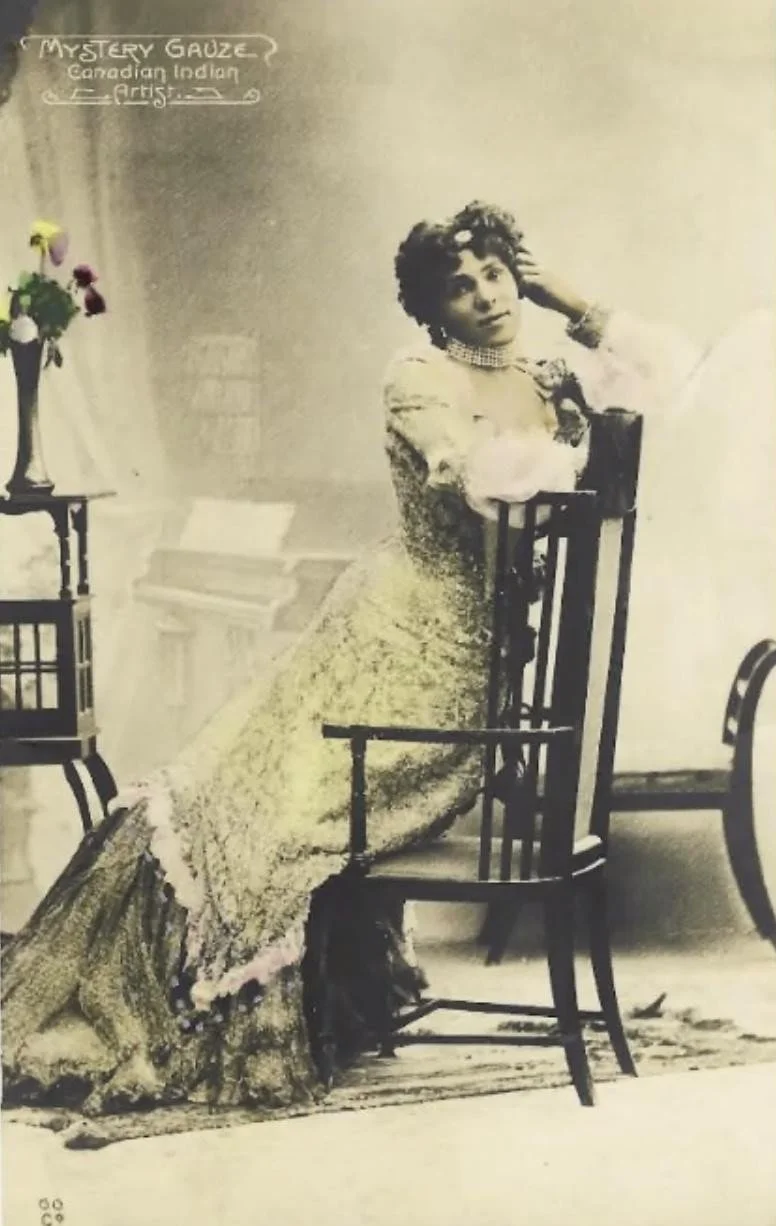
Willis Gauze. University of Utah, J. Willard Marriott Digital Library, https://collections.lib.utah.edu/ark:/87278/s6rt9p5a. Public domain.
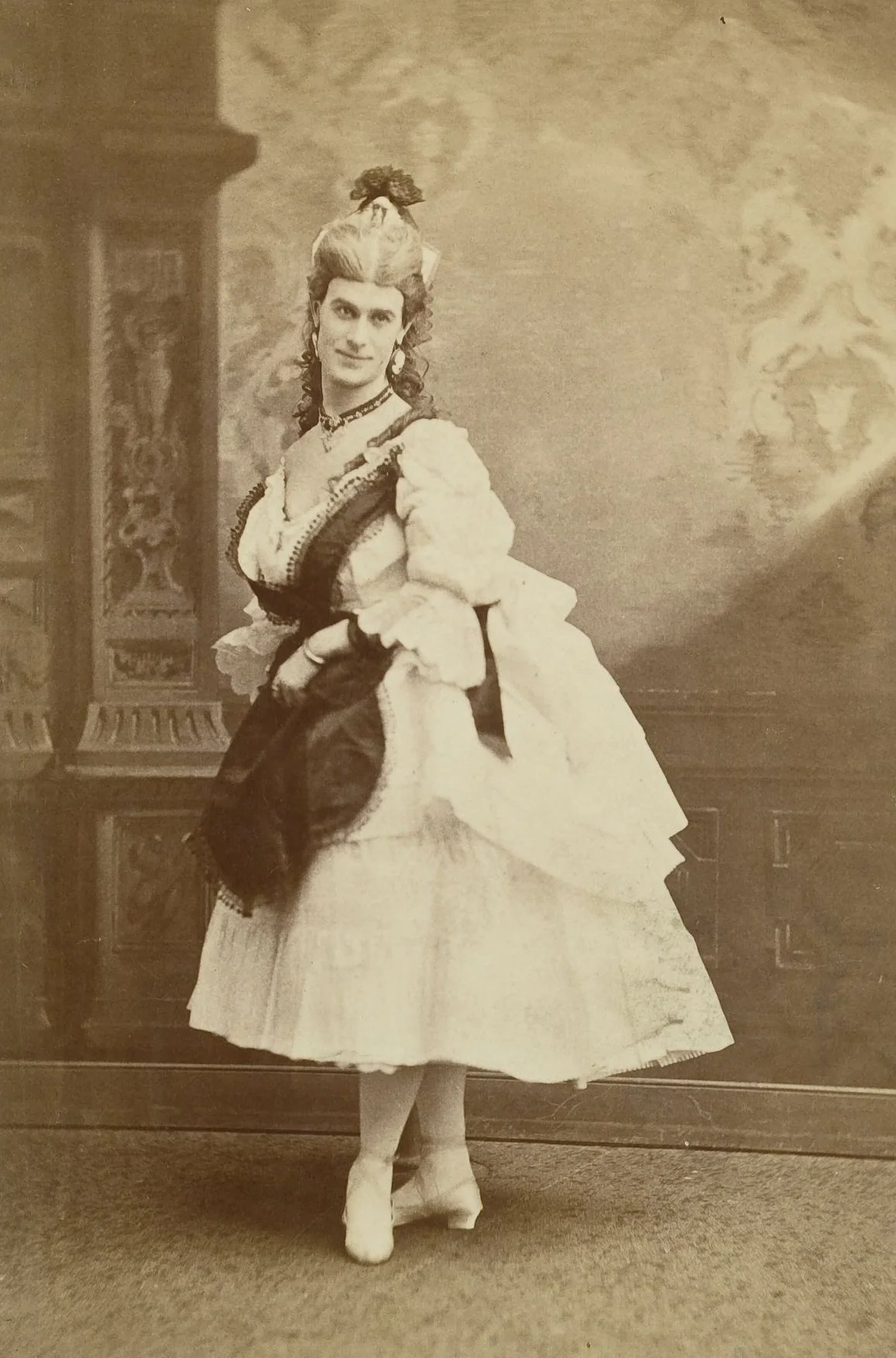
Francis Leon as prima donna. Harvard Theatre Collection-Francis_Leon_TCS_1.640_-_cropped. Public domain.
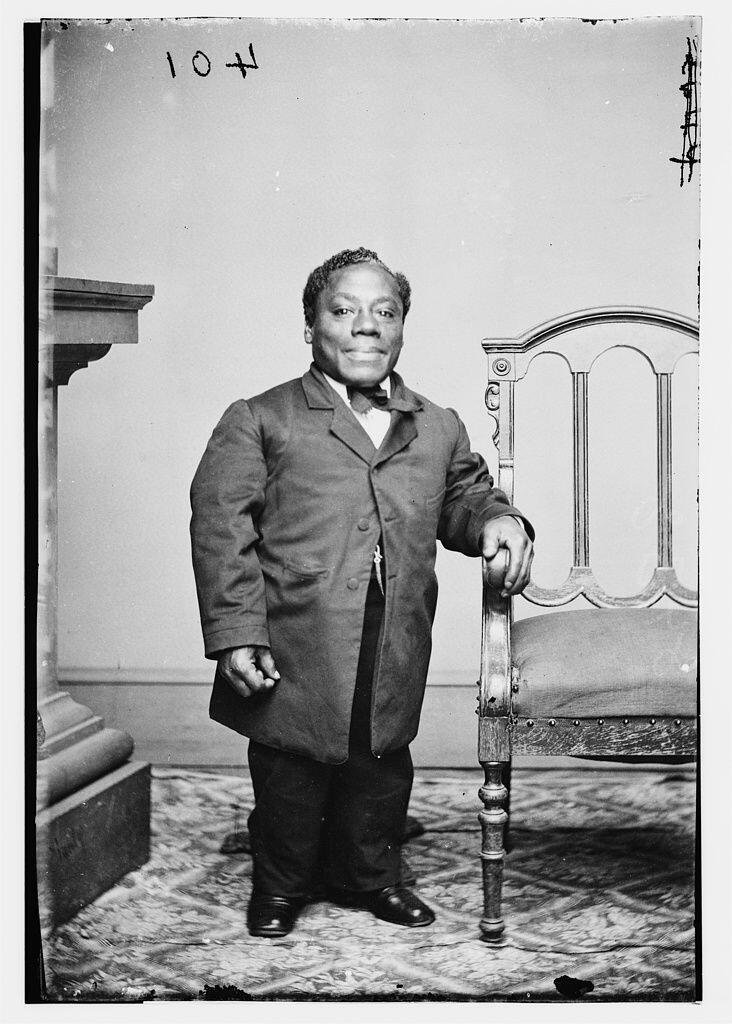
Thomas Dilward, "Japanese Tommy", University of Utah, J. Willard Marriott Digital Library, https://collections.lib.utah.edu/ark:/87278/s6ec5p75. Public domain.
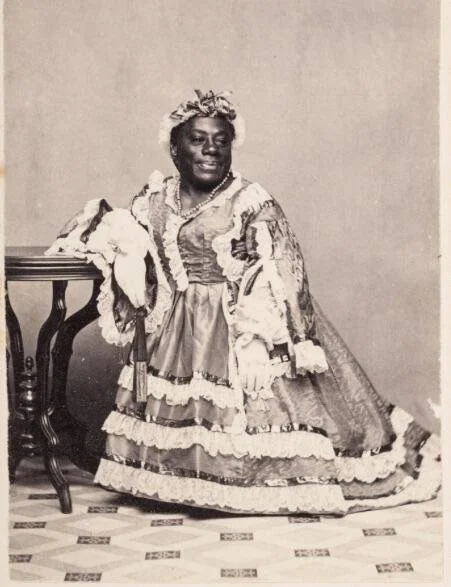
Thomas Dilward as prima donna, University of Utah, J. Willard Marriott Digital Library, https://collections.lib.utah.edu/ark:/87278/s66hkqwq. Public domain.
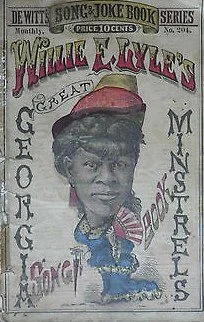
WIllie E. Lyle. Copyright underdermined.
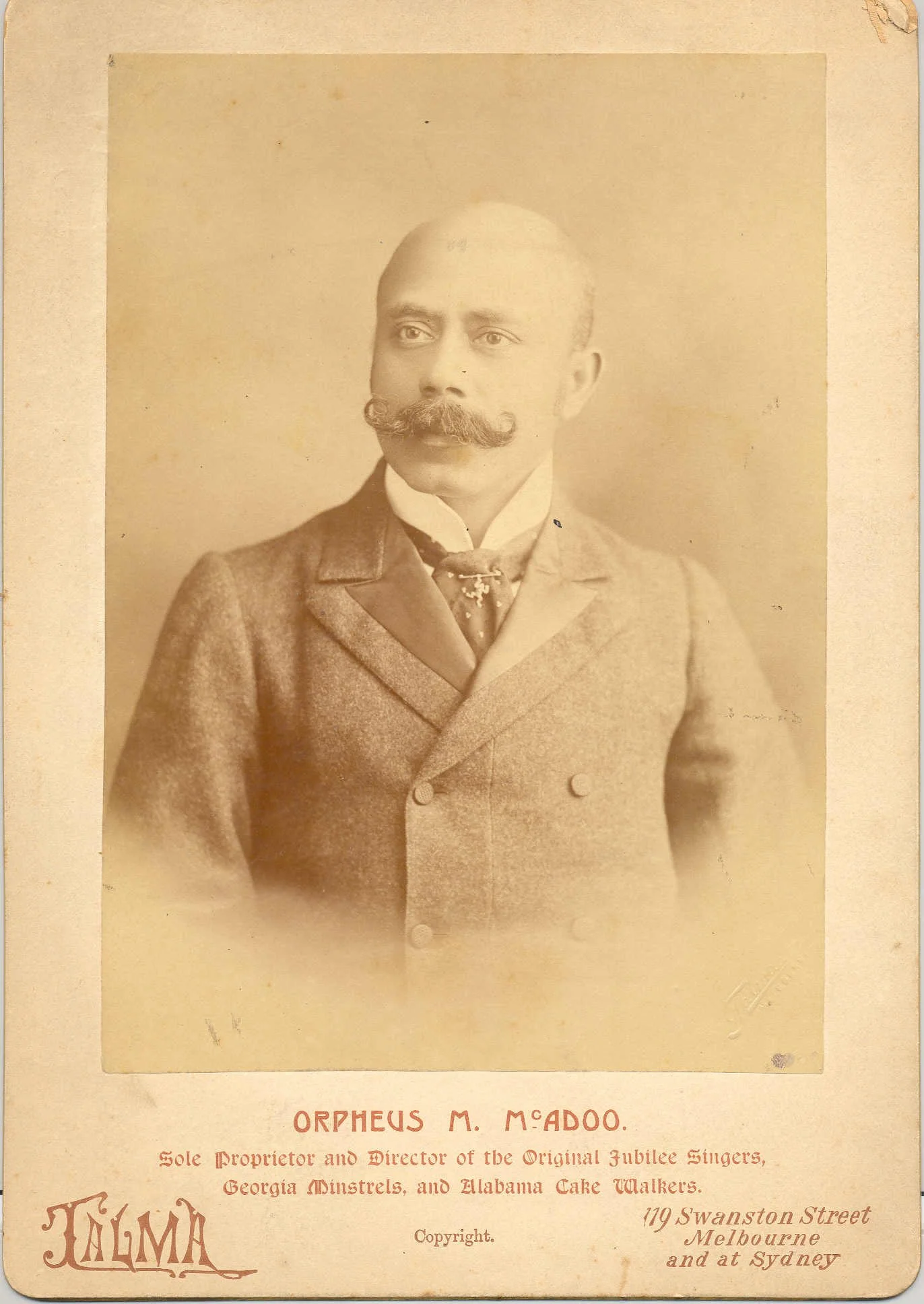
Orpheus M. McAdoo. Beinecke Library, Yale University, https://beinecke.library.yale.edu/article/orpheus-m-and-mattie-allen-mcadoo-papers. Public domain.
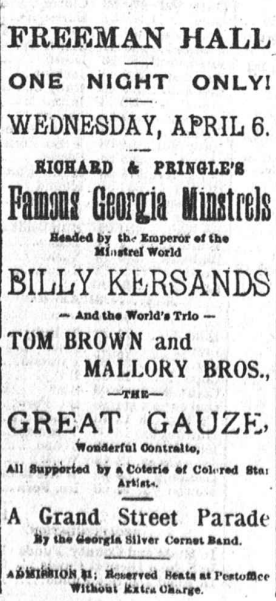
The Great Gauze in Richards and Pringles Georgia Minstrels with Billy Kersands. Daily Independent (Elko, Nebraska), 4 April 1892. Image created by the Library of Congress. Public domain.
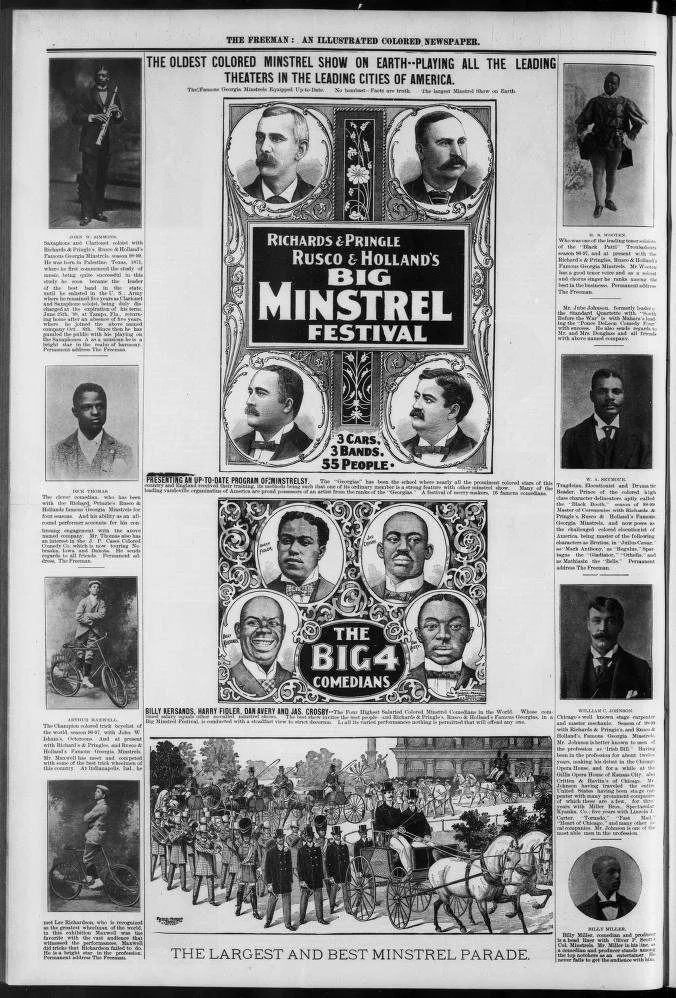
Richards and Pringles Georgia Minstrels with Billy Kersands. The Freeman (Indianapolis, IN), 24 December 1898. Image created by the Library of Congress. Public domain.
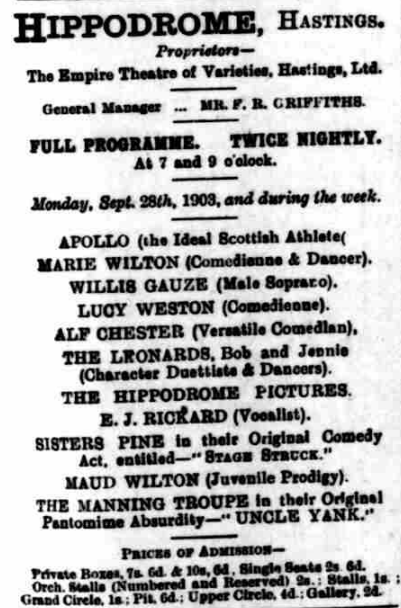
Willis Gauze in England. Bexhill-on-Sea Chronicle, 26 September 1903. Image created by the British Library Board. No known copyright.
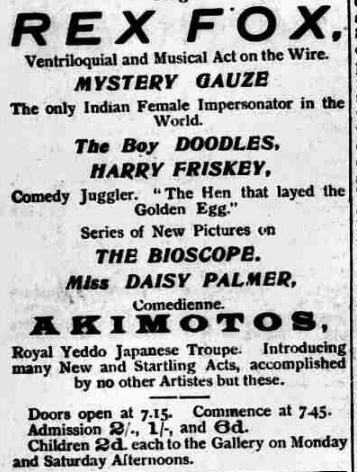
Mystery Gauze. Yarmouth Independent, 14 April 1906. Image created by the British Library Board. No known copyright.
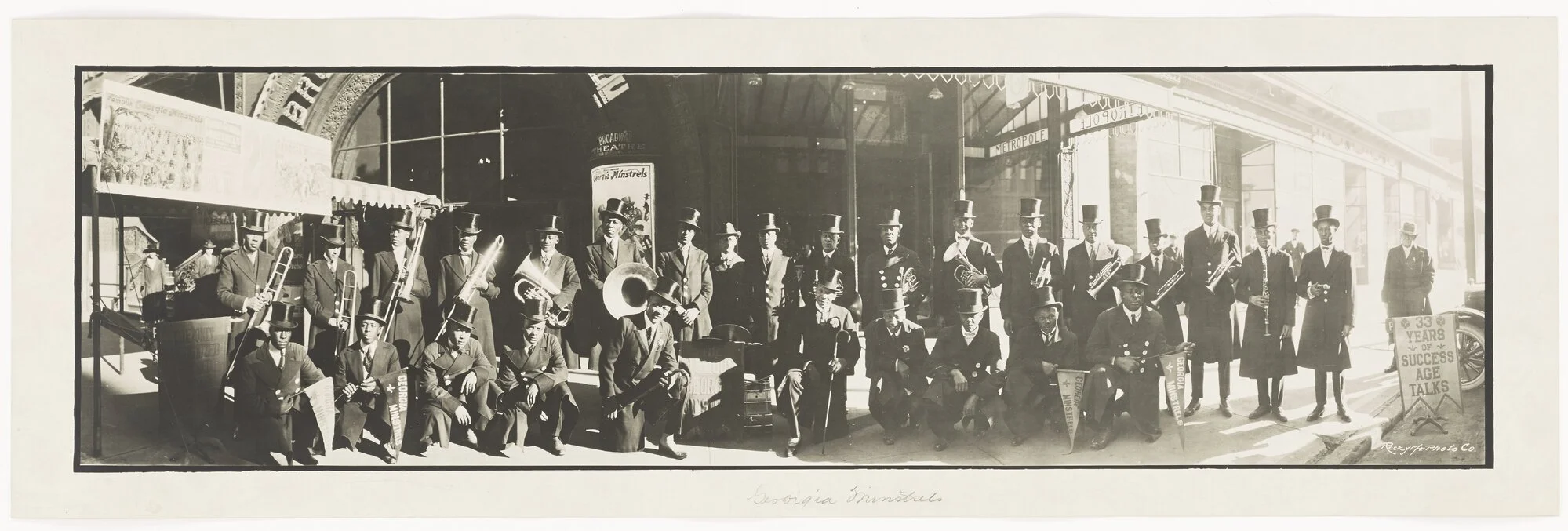
Georgia Minstrels circa 1920. Denver Public Library, https://digital.denverlibrary.org/nodes/view/1130111. Public domain.