Un Cuore Nero
Jamie Barras
Content warning for quotes from period sources that use language we recognise as slurs today
After this piece was first uploaded, I became aware of the following, earlier, article on the life of David Nero written by Prof. Melton McLaurin of the University of North Carolina Wilmington: M. McLaurin, "Divine Convictions: The Tale of an African American Trickster in Victorian Britain,” Gateway Heritage, Quarterly Magazine of the Missouri Historical Society, 15 (Winter, 1994-95), 4-17. I have not been able to track down a copy of the article; nevertheless, I want to acknowledge it here and thank historian and author Jeffrey Green for bringing it to my attention. Jeffrey Green’s own account of the life and career of David Nero is contained in his book “Black Americans in Victorian Britain” (Barnsley: Pen and Sword Books Ltd, 2018).
David Victor Adolphus Nero, aka Gustavus Arthur N. Rodfrass, aka Gustavus Victor Adolphus Rodmann-Fraser, aka Prince Umbetiqua Sanghanghamo (1846(?)–1898) was a Casanova, charlatan, and conman. Although in England he managed and performed with gospel choirs and variety troupes, his real stage was the classroom, pulpit, and drawing room. His chief interest to us here is how closely elements of his story mirror those of another of our subjects, John Ojijatekha Brant-Sero (1867–1914).[1] Like Brant-Sero, Nero exploited the Victorian fascination with the stereotype of the “noble savage” to set himself up as a spokesman for his people and separate well-meaning liberals, mostly women, from their money. Although his crimes were those of an individual, not a people, as he was a man of colour, a racist press made much of his brushes with the law. He claimed to represent his people; only in the eyes of bigots was this true.
I have the honour to forward, in accordance with verbal instructions given me on the 3rd inst. By the Inspector-General of Police, all the reliable particulars I have been able to gather regarding the life whilst in this colony of David Nero, who is now undergoing six months’ imprisonment in England for obtaining money under false pretenses.[2]
Although there is not much that is certain about the life of David Nero, other than the date of his death (13 June 1898), it seems likely that he was born David Augustus Nero in around 1846 in Friendship, British Guiana (modern Guyana), the son of former slaves. Nothing is known about his education, but he evidently received one, and he was by all accounts an intelligent man. By 1871, he was working as a teacher at a school in his hometown and must have been a man of some standing in his community. However, that year, he was convicted of stealing a pepper pot. He was also unsuccessfully prosecuted for forging a bill of goods. Following the collapse of this latter case, he left the colony for North America, as far as we can tell, never to return.[3]
Nero next surfaced in Windsor, Ontario, in 1878, again working as a schoolteacher. That year, he married twice within the space of two months, first to Lucinda Stone in Cleveland, Ohio, and again, five weeks later, to Rosema Cram or Crane in Detroit, Michigan. He would later claim that Lucinda died, but in truth, he abandoned her a day after their wedding, making off with all her worldly goods (a gold watch and some cash); in 1882, critics of Nero tracked her down to Nebraska. The fate of Rosema is unknown; however, Nero likely married and immediately abandoned her in much the same way he had married and immediately abandoned Lucinda.[4]
In late 1878, Nero moved to St Louis, Missouri, where he secured an appointment as a school principal. There is no suggestion that he had a wife with him at this time. Instead, the first time the good people of St Louis knew of a wife was when he returned to the city in February 1879 with Mary Eliza Brodie and her two daughters from her first marriage in tow, having married in Chicago.[5]
It is from Nero’s time in St Louis that we have our first description of him, provided by a newspaper intent on trying to explain his appeal to women.
He is over six feet in height, and is muscular and splendidly proportioned, with graceful bearing, features far above the average in looks and an excellent conceit, which gives him rather a haughty air. His skin is as black as pigment could make it. He has a thorough education and when he applied for a position here in June, 1878, he stood the principal’s examination with credit.[6]
The Nero family’s time together in St Louis was to prove brief. In a sign of things to come, evidence was unearthed that Nero had both stolen funds from his school and made unwanted advances to female students. Although a school board investigation exonerated Nero, the feelings of the parents of the school were so strongly against him that he was moved to a new school. Within a year, there were fresh charges of misappropriating school funds. This was the finish.[7]
The Nero family moved to Kansas City, where Nero again found work as a school principal. He also became active in a local Methodist church. This was to prove his undoing. The local African American Methodist community had, since the Civil War, been divided on political lines; Nero aligned himself with the “Southern” faction, which brought him into conflict with the firebrand leader of the “Northern” faction, a former Cleveland politician by the name of Paul Gaston, who claimed French and African ancestry. Following a brawl at a church meeting that was supposed to bring an end to the conflict, Nero, working through a local newspaper, attacked Gaston by publicising the latter’s many run-ins with the law in Cleveland and earlier in Canada. Gaston fought back.[8]
A SCHOOL SCANDAL. SHOCKING IMMORALITY CHARGED UPON PROF. NERO. Leading Colored Citizens Accuse Him of the Grossest Licentiousness—Numerous Amours and Liaisons Alleged Against Him.[9]
The charges against Nero embraced inappropriate advances to his female pupils, as in St Louis, affairs with female teachers, and, most shockingly, an accusation of an improper relationship with Victoria, the eldest daughter of his wife, Mary Brodie, from her first marriage, which culminated in an illegal abortion. To these were added the accusations of bigamy in regard to his marriages to Mary Brodie and Lucinda Stone (there was no mention of Rosema Cram/Crane).
It is worth noting here that, like Gaston, Nero also had a connection to Cleveland, in that this was where he met, married, and abandoned his first wife, Lucinda Stone, in January 1878. It is also worth noting that before moving to Cleveland, Gaston, like Nero, lived in Ontario, albeit in Guelph, not Windsor. At least one Cleveland newspaper alluded to the two men both having been active in Cleveland—they had much the same reputation in the city. Allied to this, shortly before the Kansas City charges were filed, there was a claim that Nero had sustained injuries as a result of an altercation with a friend, described as an “ex-Canadian”, over an unpaid debt. This evidence raises the possibility that the relationship between the two men dated to well before their clash in Kansas City in 1882.[10]
Although Nero was able to fend off the worst of the charges, which were at best impossible to substantiate and at worst simply hearsay, he was unable to counter the charges of bigamy, given that Lucinda had been found alive, or escape the suspicion over the disappearance of bonds owned by the school of which he was principal. He resigned from his position and disappeared. However, Kansas City had not seen the last of him.[11]
PROFESSOR NERO WILL RETURN. It will be remembered that about three weeks ago, Professor D.V.A. Nero of this city, left quite suddenly for parts unknown, in consequence of proceedings against him for bigamy, instituted in the criminal court of Jackson county. The indictment was the final act of a series of charges against Nero, and so strong did the proof appear that he had either to flee or be locked up. Upon authority it can now be stated that Professor Nero will return to Kansas City in a few days and ask to have his trial on the charge of bigamy, now pending against him.[12]
The African American community of Kansas City was so riven with faction that people actively engaged in trying to get Nero reinstated despite all the charges against him, simply to put one over on their political opponents. While this played out at various school board meetings, Nero started a newspaper to put over his side of the argument. More significantly, he became a prime mover in an attempt to unite African American voters behind an independent, all-African American ticket in local elections, a block of voters that could also be delivered to any white politician prepared to back Nero’s reinstatement. In this, he worked alongside his recent antagonist, the former Cleveland politician Paul Gaston—further evidence that the two men were sometimes partners, sometimes enemies, and very much cut from the same cloth.[13]
Nero also, somewhat incredibly, sued Lucinda Stone for divorce on the grounds of adultery because when his critics had tracked her down to Nebraska, they had found her living with another man. This action, whatever its merit, was enough to free Nero of the charge of intentional bigamy and set the stage for the next twist in his life and career.[14]
PROFESSOR NERO’S VINDICATION. A special meeting of the board of education was held yesterday morning, President Yeager in the chair and all the members being present. Prof. D.V.A. Nero, who was formerly principal of the Lincoln School, was reinstated, being elected principal of the Sumner. The election of Prof. Nero to the position was unanimous and was a flattering vindication of a teacher who was pronounced one of the best coloured instructors ever employed in the public schools by several members of the board yesterday.[15]
Nero had played a masterly game. By establishing himself as a politician with 5000 black voters at his command, he went from pariah to darling of the Republican movement in the city. Once he was free of the charge of bigamy, all obstacles to his reinstatement were removed. All he had to do was not get into any further trouble, and his future in Kansas City would be assured. Alas, staying out of trouble was something that Nero was pathologically incapable of doing.
BLOODSHED AVERTED. Word was received at 3 o’clock yesterday afternoon at the Central police station, that a duel was to occur at 4 p.m. between Professor D.V.A. Nero, principal of the Lincoln School, and John W. Howard, a carpenter, residing at 918 Campbell Street.[16]
In the summer of 1885, Nero embarked on a trip to Europe that took in Scotland, England, France, and Germany—the visits to the latter two countries facilitated by the fact that Nero was fluent in both French and German as well as English. While there, he gave lectures on the subject of “The American Negro”. He also fabricated his credentials and history to separate members of his audience from their money. I will delve into that aspect of the trip below. While in England, he made the acquaintance of a white woman named Minnie Harper (her race was to prove significant). When he returned to Kansas City, Minnie Harper came with him. What Nero’s wife, Mary, made of all this is not clear; she had, by this time, become a schoolteacher herself and worked alongside her husband at the Sumner School.[17]
At some point, Minnie Harper struck up a friendship with a local man called John Howard. This may have been after she discovered that Nero was in correspondence with other women he had met in England. Howard, a white man, took offence at Nero continuing to visit Minnie Harper after he had made her acquaintance and challenged him to a duel. Although the police intervened before any violence could be done, the story was splashed across the Kansas City newspapers.[18]
This was the final straw for the Kansas City Board of Education. Local politicians had been prepared to turn a blind eye to Nero’s behaviour as long as his alleged indiscretions concerned only women of colour, but once it was alleged that he, a man of colour, had pursued a white woman, not even his political power-broking could save him. He was dismissed from his position for a second and final time in November 1885.[19]
ANNUAL SUPPER TO THE POOR.—The annual supper given to about 1800 poor people, from funds raised by public subscription, took place in the City Hall last night. The Rev. Dr Wallace presided, and among other gentlemen on the platform were the Rev. Dr Boyd, the Rev. Principal Nero[...].[20]
Nero fled the city in the company not of his wife, Mary, but of Minnie Harper.[21] It was to Britain the pair returned, specifically to the location of Nero’s warmest reception on his summer tour, Glasgow, Scotland. It seems certain that Nero had always planned to return to Europe, perhaps with the plan he eventually carried out in mind; however, he almost certainly did not intend that this would be a permanent move. His situation in Kansas City before the Harper affair was too much to his advantage, and the opportunities for graft associated with his position as a school principal and political boss were too great.
Mary Nero remained in Kansas City with her children. Although there is evidence that she and Nero remained in contact for at least the next year, he was effectively out of her life. She continued working as a schoolteacher in Kansas City for the next 25 years. She died in the city in 1912 and kept her married name to the end.[22]
Once back in Glasgow, Nero, with his “wife” Minnie Harper, set about re-establishing himself in the city. During his first visit back in the summer, he had presented himself as the Reverend Nero, touring Europe to collect funds for “Sumner College” in Kansas City, a college for African American students of which he was the principal. He had also presented a partially reimagined biography. He was, he said, born in West Africa. While still a boy, he was captured by slave traders and transported to the island of Martinique, where he was sold into slavery. However, a short time later, a French missionary “took a fancy to him” and “purchased him from his master”. The missionary educated him alongside his own children. When, after a few years, the missionary died, his widow took Nero to Canada. There, Nero set about learning English before embarking on a career as a divinity student and teacher.[23]
This was a story carefully crafted for maximum appeal to the prejudices and pretensions of a liberal white audience, a tale of suffering, slavery, rescue by a white saviour, and an elevation in status through education and dedicating oneself to the service of God. Its message, which is one his audiences wanted to hear, was that people of colour could better their lives, but only through the benevolence of white people.
In the course of just three sermons, “Rev. Principal Nero” raised £25, £11, and £24 in collections; sums that cumulatively amounted to 9 months' wages for the average manual labourer. And this was but a small fraction of what he was taking in in the form of private donations.[24]
What is remarkable is how quickly the scheme fell apart. Having presented himself as a humble preacher and college principal trying to raise funds for his cash-strapped college back in America, he then proceeded to live the high life. More particularly, his “wife”, Minnie, spent money freely on outfits not in keeping with Glasgow society’s idea of what a minister’s wife would wear. Within two months of Nero’s return to Glasgow, people suspicious of his veracity started making enquiries in Kansas City through friends in New York. It was quickly established that there was no such institution as “Sumner College”, and Nero was, in fact, a disgraced school principal. He was arrested. A search of his rooms turned up £101 in cash and receipts for money transfers to the United States of a further £103. The police estimated that he had raised somewhere in the region of £400 from the people of Glasgow. To the glee of the press, numerous letters from female admirers were also found in his rooms.[25]
“PRINCIPAL” NERO AT COATBRIDGE.—This notorious negro, who was announced to give a lecture and elocutionary readings in the Temperance Hall on Saturday night, arrived, an hour earlier than expected, and walked to the hall, followed by a large crowd.[26]
Nero was granted bail. Having decided that his best course of action was to brazen his way through, something that had worked for him in the past, he gave a newspaper interview in which he claimed it was all just a misunderstanding—he was raising money for a college that had yet to be built, hence the confusion, etc. He also continued to give lectures, albeit now to audiences either hostile to him or simply curious to see the “notorious negro” in the flesh. The tactic worked: in mid-May, it was announced that all charges would be dropped due to the difficulty of securing evidence from America.[27]
True to form, Nero now fought back against his detractors, issuing writs against the Glasgow Mail and the proprietor of a waxworks exhibition who had created an unflattering effigy of him. Both cases collapsed when Nero left Scotland unexpectedly to return to America (and Mary?). He appears to have separated from Minnie Harper at this time.[28]
His return to America was brief; by October, he was back in England, using a different name, but up to the same old tricks. This time, he had pushed his luck too far.
"PRINCIPAL NERO" AGAIN. At Rochdale Police Court yesterday, Gustavus Adolphus Rodman Fraser, alias Principal Nero and Rev. Romasses Fraser, was again brought before the magistrates, charged with obtaining money by false pretences from Rev. Robert Veitch, minister, Providence Chapel, on the 18th ult. Mr Worth said the prisoner said he was a slave, and led persons to believe that it was his first visit to England. He would prove that the prisoner was two years ago in Kansas, teaching a school there, and obtained quite a notoriety.[29]
By a remarkable coincidence, while staying in Oldham, Lancashire, delivering lectures and fleecing people under his new assumed identity of the Rev. Rodman-Fraser (originally of the “Mandingo Country”, West Africa, then a slave in Cuba, before escaping to North America), Nero ran into a man who had known him back in Kansas City. When the man soon afterwards attended his local church and heard Nero introduced from the pulpit as the Rev. Rodman-Fraser, he approached the minister after the service and revealed Nero’s real name and history. Nero was arrested, tried, and, this time, finally, convicted. He was sentenced to six months’ hard labour. The courts had had enough of his tricks.[30]
Coloured Jubilee Singers.—A somewhat peculiar but highly meritorious concert was given in the Public Rooms on Thursday evening by the Missouri Jubilee Singers, whose reduced strength now consists of two ladies and three gentlemen—Mr. G. A. N. Rodmann-Fraser being at the head.[31]
Upon his release, Nero reinvented himself once more, this time as the manager of the “Missouri Colored Jubilee Singers”. The term “Jubilee Singers” was the name given in the late nineteenth century to African American a cappella choirs—and their imitators—who specialised in singing what were known at the time as “slave songs”, “plantation songs”, or “negro spirituals” and what we know today as gospel music. The Fisk Jubilee Singers of Fisk University, Alabama, was the first such choir to make a name for itself, touring England in the early 1870s. In the following decades, many more African American choirs travelled to the UK as performers in “Tom Shows”, dramatisations of Harriet Beecher Stowe’s anti-slavery novel Uncle Tom’s Cabin that included musical interludes that, perversely, presented a rose-tinted view of life on a plantation in the Antebellum South.[32]
Although the identities of the members of the “Missouri Colored Jubilee Singers” are unknown, it is likely that they were performers in a Tom Show that had folded, leaving them stranded somewhere in England, where, to their misfortune, Nero found them. They would not long have to suffer his attention, however, as, as soon as his name began to appear in the press in association with the Jubilee Singers, his past history was brought to the attention of the previously unsuspecting people of the Midlands. Outed, Nero disappeared back into the shadows.[33]
"SACUL'S CONTRACT. At the Birmingham Police-court, on Wednesday, an application was made to Mr Colmore by Emmie Lucas, a vocalist, to take out a summons against Gustavus Arthur N. Rodfrass, alias Rodman Frazer, for the purpose of recovering wages due under a contract. Detective-sergeant Stevenson handed to Mr Colmore a form of contract, signed by Miss Lucas in her professional name of "Sacul" and G. A. N. Rodfrass. The terms of this contract, which was not stamped, were to the effect that Miss Sacul was engaged to perform with the Anglo-African Choir as soprano vocalist for three months from June 25th.[34]
Having learned at least one lesson over the Jubilee Singers’ affair, when Nero re-emerged anew in the summer of 1888, it was under a new name, Gustavus Arthur N. Rodfrass. He was now acting as the manager of the “Anglo-African Choir”, a combination comprised of both white and black singers who performed a repertoire of European classical choral works. The Anglo-African Choir performed a number of engagements across the summer of 1888, albeit with little success. At some point, Nero, unhappy with the ticket receipts, hit upon the idea of charging aspiring singers for an introduction to the choir and then simply leaving for another district before it came time to honour the agreement. Even more disturbingly, he married one of the choir’s members, a “Miss Hunter”, only for his new wife to die under unknown circumstances a very short time afterwards.[35]
While touring, Nero presented himself as an “unattached” student of Oxford University who was organising entertainments to raise funds to continue his studies in advance of becoming a missionary in Sierra Leone. He had, in fact, tried to become a student at Oxford earlier in the year, but failed. Using the Oxford ruse, he obtained 10 shillings from a Rev. H.E. Griffith, vicar of a church in Glasbury, Powys, Wales. This, he claimed, was to be in advance of the Anglo-African Choir performing in the neighbourhood. When no such performance materialised, Griffith became suspicious and made enquiries. This led to Nero being arrested yet again. Once his true identity was exposed, his conviction was inevitable. This time, despite the only charge being the obtaining of 10 shillings under false pretences, the sentence was nine months' hard labour.[36]
This extraordinarily hard sentence for the offence committed reflected that this was Nero’s third set of charges and second conviction in the space of 2 years. The courts had clearly identified him as a career criminal. One might also suspect racism behind the severity of the sentence, but it is hard to imagine that someone with Nero’s track record, whatever the colour of his skin, would have got away with much less of a punishment. What is extraordinary about this case is that the offence was committed at all. Later evidence, discussed below, would show that Nero had money aplenty. There was no need for him to trick 10 shillings out of anyone. He was simply pathologically incapable of resisting the urge to separate well-meaning people from their money. This spoke of either a lack of impulse control or, perhaps more likely, a supreme arrogance.
ANNESLEY. A NOVEL ENTERTAINMENT:- Professor Victor A. Browning, a native of Mandingo Land, gave a very interesting entertainment in the National Schools on Monday night. He gave a very racy account of Mandingo Land, West Africa, the African Mode of Life, Native Villages, Agricultural and Commercial Resources, Religion, Marriages, the King and his Advisers, Mandingo War, the Attack of the Arabs, Midnight Capture of the Blacks, the March to the Sea, Slave Mothers and Fathers, Sale of the Slaves, Labour on the Plantation, Escape of his Parents, their Capture, Insurrection among the Slaves, Martial Law, Freedom at Last, Birth and Infancy of Professor Browning, Childhood, Schooldays, Manhood, Voyage to England, &c.[37]
Shortly after his release from prison for the second time, Nero embarked on the career that would be his only visible (emphasis on the word “visible”) source of income for the rest of his life: lecturing to an unsuspecting British public about the entirely fictional African country of “Mandingo Land” and his equally fictional life as a slave. To this performance, he appended entirely unrelated musical entertainment, initially performed by himself, and later by hired female and, occasionally, male vocalists. In the early stages of this career, he masqueraded as “Professor Victor A. Browning”. However, he discarded this persona relatively quickly for one designed to appeal to his audience's desire for the exotic. He, at the same time, fulfilled a long-held ambition.
LECTURE ON MANDINGO-LAND BY A NATIVE. On Thursday evening, in spite of the inclement weather, a large audience assembled in St Giles Hall, Hinckley, to hear Mr. Umbequita Sanghamo deliver his popular lecture on his native land—Mandingo Land. The lecturer is an undergraduate of one of the English universities[…].[38]
The final chapter in the life and career of David Nero properly opened with his final marriage, to Jane Ann “Jennie” Morris, the daughter of a Nottinghamshire baker, in Nottingham in April 1891. Although not certain, it is likely that Jennie was the “Miss Ada Morris” who worked for a time as one of the female vocalists in Nero’s troupe. In the parish marriage register, Nero gave his name as Gustavus Victor Adolphus Rodmann-Fraser and his age as 27. He was in reality around 45; his new bride was 22. Nero described himself as a “student” in the register; in his return for the 1891 England Census, completed just a few days later, which found Nero and Jennie boarding in Leeds, he described himself specifically as a “theological student”.[39] This was an extension of the story he told people back in 1888. The remarkable thing about it was that, within a year of his marriage to Jennie, this became a reality.
It was likely that, as the 1888 case showed, Nero had been trying to gain admission to an English university for a number of years before he was finally accepted at the University of Durham in April 1892.[40] We can only speculate as to his motives. Unquestionably, his frauds would be harder to detect if he became, in reality, what he claimed to be, a church minister, with a degree as proof. In the event, despite completing six terms of study, Nero never took the final exam, leaving the university without a degree in March 1895.[41]
In one key respect, leaving without sitting his final exams put him back to square one—for example, within two years, he would be caught out falsely claiming to have a degree from Durham; the same old story. However, it is possible that he left because he felt that his time at Durham had already opened enough doors for him.
Nero, in the guise of “Prince Umbetiqua Sanghangsamo”, and with Jennie, a servant, and various hired vocalists in tow, spent much of 1891–1897 touring England, performing his programme of lectures and unrelated musical entertainment. Inevitably, this tour from time to time included skipping town without paying for the troupe’s board and lodgings. From the spring of 1892 until the spring of 1895, he made use of his status as an undergraduate at Durham University to support his bona fides, which is to say, to help put over his act. After March 1895, he started claiming to have obtained a BA in Divinity at Durham University and to be currently studying for a degree in Medicine at King’s College London. He also told people that he planned to return to Mandingo Land to establish a hospital there, which sounds like and probably was a ruse to dupe more people out of their money. However, it has to be acknowledged that there were no allegations to this effect.[42]
Nero’s inability to simply pay his bills would once more bring his lies to light. In December 1896, while the troupe was in Devon, Nero was accosted on a platform of Torquay train station by a lodging-house keeper incensed that Nero was leaving town without settling the bill for his servant’s room and board. In fact, Nero’s claims to have graduated from Durham University had been exposed as a lie as early as September; however, this was little reported at the time. The Torquay incident made a much bigger splash, as did its sequel, in which the servant in question took Nero to court over unpaid wages and an accusation of assault. Nero was brought to court in his Rodmann-Fraser identity, and the lies he had told about his education were brought up once more.[43]
Although the incident occasioned the troupe’s exit from the Torquay area, it does not appear to have otherwise impacted Nero’s activities—he, Jennie, and the troupe continued touring for another year. This was likely because the publicity did not, for once, result in the discovery of cases of Nero separating local worthies from their money (lying about one’s education and not paying lodging-house keepers was evidently only to be expected of itinerant entertainers). Could it be that Nero was finally content with his lot?
It was more likely that he was feeling his age.
David Nero died at St Mary’s Hospital, Paddington, on 13 June 1898. The cause of death was recorded as phthisis (TB), heart dilation, and bronchitis. His age was given as 38; he was in reality 52. For a man known to be a magnificent physical specimen, wasting away from tuberculosis could not have been an easy burden to bear. No doubt his many victims would think that he deserved his fate.[44]
Nero left his widow, Jane/Jennie, nearly £500 in his will, a not inconsiderable sum for the time (nearly 5 years’ wages for the average labourer).[45] This both demonstrates that he had little need to trick people out of their money following his “big score” in Glasgow in 1885 and 1886, and that, unlike most conmen, he did not run through his ill-gotten gains as quickly as he acquired them. So what motivated him to defraud people?
John Ojijatekha Brant-Sero, whose life and career mirrored that of Nero in many ways, was a man driven by demons conjured up by his acute awareness of the distance between his vision of himself—an intellectual, a man of letters, and a sage—and the reality, that, in order to make a living, he had to play the part of the “stage Indian”, a caricature created by white authors. There is no sense of an equivalent self-loathing with Nero. Yes, once in Britain, he lived a fake life shaped to fit the prejudices and pretensions of the people he targeted for fraud: a man of colour who had suffered at the hands of other men of colour before being rescued by a white man. However, his frauds began long before he came to Britain, and his first victims were the people of his hometown of Friendship, British Guiana, and members of the African American communities of St Louis and Kansas City.
Nero accumulated wealth through theft and fraud, but greed seems also not to have been the motive; the mere fact that he left a will shows that he was prepared to let the money go. Instead, the monies he made seem to have been his way of keeping score. He was a man who undoubtedly viewed himself as superior to the people who fell for his frauds. His desire to commit fraud and go on committing it appears to have been simply his way of proving this to himself.
Jamie Barras, February 2026, revised April 2026.
Back to Staged Identities
Notes
[1]https://www.ishilearn.com/onthefrontier, accessed 10 February 2026.
[2] ‘Something More About “Nero”’, Rochdale Observer, 23 February 1887.
[3] See Note 2 above.
[4] That Nero was working as a teacher in Windsor, Ontario, can be confirmed from tax records: "Canada, Ontario, Tax Assessment Rolls, 1827-1922", FamilySearch (https://www.family search.org/ark:/619 03/1:1:66ZT-5R59), Entry for David Nero, 1878. Marriages: 1) David V.A. Nero to Lucinda Stone, 2 January 1878, Cuyahoga County, Ohio, U.S., Marriage Records and Indexes, 1810–1973. 2) David Victor A. Nero to Rosema Cram/Crane, 12 February 1878, Michigan, U.S., Marriage Records, 1867–1952.
[5] David Nero is St Louis: ‘A Black Lothario’, St Louis Post-Dispatch, 3 February 1886. David, Mary, and Mary’s daughters, Victoria and Cora, appear in the 1880 US Federal Census, living on Spruce Street in St Louis, ancestry.co.uk, Ancestry.com Inc. (Operations), accessed 10 February 2026. Marriage: David Victor Adolphus Nero to Mary Eliza Brodie, Illinois, U.S., Marriage Index, 1860–1920. Account of Nero’s critics tracking down Lucinda: ‘Nero’s Case’, Kansas City Journal, 15 March 1882.
[6] ‘Something More About “Nero”’, Rochdale Observer, 23 February 1887.
[7] See Note 6 above.
[8] Paul Gaston was himself something of a rogue, with charges of arson, burglary, and attempted murder in his past: ‘In A New Role’, Cleveland Leader, 24 May 1880.
[9] ‘Something More About “Nero”’, Rochdale Observer, 23 February 1887.
[10] See Note 4 above, second reference, and Note 8 above, final reference. Gaston and Nero associated with each other in a Cleveland newspaper report: ‘Kansas City May Keep Them’, Plain Dealer (Cleveland, OH), 20 December 1881.
[11] ‘The Nero Charges’, Kansas City Star, 8 February 1882; ‘Nero Resigns’, Kansas City Journal, 18 March 1882.
[12] ‘Professor Nero Will Return’, Kansas City Times, 16 April 1882.
[13] ‘The Lincoln School’, Kansas City Journal, 25 May 1882; ‘The Kansas City Enterprise…’, Kansas City Times, 7 August 1882; ‘County Colored Convention’, Kansas City Times, 6 September 1882.
[14] ‘Legal’, Kansas City Star, 5 July 1882. ‘The Courts—Nero Acquitted’, Kansas City Journal, 6 September 1882.
[15] ‘Professor Nero’s Vindication’, Kansas City Times, 2 January 1883.
[16] ‘Bloodshed Averted’, Kansas City Journal, 19 October 1885.
[17] ‘Professor Nero’s Vacation’, Kansas City Journal, 7 June 1885; Note 16 above; Note 5 above, first reference. Mary Nero working alongside her husband: ‘The Teachers’, Kansas City Star, 2 June 1883.
[18] See Note 17 above.
[19] ‘Why Nero was Dismissed’, Kansas City Journal, 14 November 1885.
[20] ‘The New York Sun…’, Kansas City Times, 3 March 1886.
[21] ‘Nero Redivivus’, Kansas City Journal, 2 December 1886. Minnie Harper is identified as “Ellen Harper” in this piece.
[22] Letters from Mary to Nero were found amongst his papers when he was arrested in Oldham in November 1886: ‘Nero and the Lancashire Witches’, Newry Reporter, 6 January 1887. Still a teacher after 25 years: ‘Teachers for School Year’, Kansas City Journal, 4 September 1911. Death: https://www.findagrave.com/memorial/104904475/mary-e-nero, accessed 11 February 2026.
[23] See Note 21 above.
[24] ‘Remarkable Imposition by a Negro Preacher’, Forfar Herald, 5 February 1886.
[25] See Note 24 above.
[26] ‘Principal Nero at Coatbridge’, Aberdeen Press and Journal, 6 April 1886.
[27] Interview: ‘Statement by Principal Nero’, Dundee Evening Telegraph, 4 March 1886. Lectures, hostile crowds: see Note 26 above. Charges dropped: ‘The Charge Against “Principal” Nero’, Fifeshire Advertiser, 15 May 1886.
[28] ‘Principal Nero in Wax’, Evening Gazette (Aberdeen), 11 June 1886; ‘Principal Nero and the Glasgow Mail’, Dundee Evening Telegraph, 9 June 1886; “The Last of Principal Nero’, Aberdeen Evening Express, 22 July 1886.
[29] ‘“Principal Nero” Again’, Edinburgh Evening News, 26 November 1886.
[30] ‘The Frauds of “Principal Nero”’, Wigan Examiner, 17 November 1886; ‘A Fraudulent Negro Preacher’, Sutton Journal, 16 December 1886.
[31] ‘Coloured Jubilee Singers’, Cannock Advertiser, 13 August 1887.
[32] I tell the story of the Fisk Singers and Tom Shows here: https://www.ishilearn.com/staged-identities-cuckoos-and-nightingales, accessed 11 February 2026.
[33] ‘The Alleged Church Bigotry at Walsall’, Cannock Advertiser, 10 September 1887.
[34] ‘Sacul’s Contract’, Era, 4 August 1888.
[35] Notices and Advertisements, Nuneaton Observer, 29 June 1888; ‘Concert’, Wellington Journal, 28 July 1888. The death of Miss Hunter: ‘David Augustus Nero’, Workington Star, 3 November 1888.
[36] ‘Principal Nero Imprisoned for Fraud’, Workington Free Press and Solway Pilot, 10 November 1888.
[37] ‘Annesley. A Novel Entertainment’, Mansfield Reporter, 26 December 1890.
[38] ‘Lecture on Mandingo Land by a Native’, Hinckley Times, 26 January 1895.
[39] Entry for Gustavus Victor Adolphus Rodmann Fraser, 2 April 1891, Nottinghamshire, England, Church of England, Marriages and Banns, 1754–1937; return for Gustavus V.A.R. Fraser, Jennie A.R. Fraser, Leeds, 1891 England Census; ancestry.co.uk, Ancestry.com Inc. (Operations), accessed 10 February 2026. “Miss Ada Morris”: ‘Public Notices’, Brighouse Echo, 31 July 1891; ‘Victoria Hall, Glossop’, North Derbyshire & North Cheshire Advertiser, 30 September 1892.
[40] ‘Durham University’, Northern Echo, 26 April 1892. Nero, as Rodmann Fraser, was accepted as a “probationer in arts”.
[41] ‘The Black Prince at Torquay’, Tiverton Gazette & West Devon Herald, 1 December 1896.
[42] See Note 39 above, third and fourth references, and: ‘Lecture by the Son of a Slave’, Birmingham Gazette, 6 March 1895; ‘Lecture on Africa’, Wells Journal, 27 August 1896; ‘Lecture’, East Kent Times and Mail, 17 November 1897. Skipping town: ‘London, or rather Central Africa...’, New York Herald, 15 March 1896.
[43] Identity exposed: ‘A Contradiction’, Wells Journal, 20 September 1896; assault at Torquay: see Note 40 above; cases brought by servant: ‘A “Black Prince” and his Servant’, Tiverton Gazette & West Devon Herald, 22 December 1896.
[44] Death Certificate for Victor Adolphus Rodman Fraser, 13 June 1898, Paddington district, digital copy obtained from the General Register Office, February 2026. The cause of death is recorded as “phthisis, dilation of the heart, and bronchitis”.
[45] Probate, 26 August 1898, will of Victor Adolphus Rodman Fraser, England and Wales, National Probate Calendar (Index of Wills and Administrations), 1858–1955, ancestry.co.uk, Ancestry.com Inc. (Operations), accessed 10 February 2026.
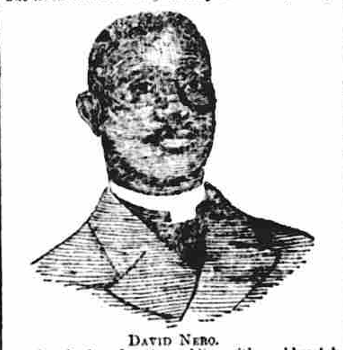
David Nero. People's Journal, 22 February 1886. Image created by the British Library Board. No known copyright holder.
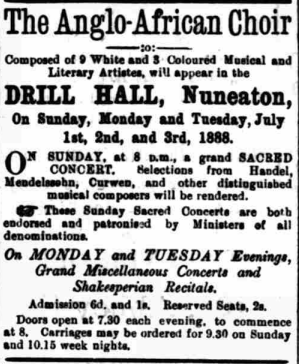
The Anglo-African Choir. Nuneaton Observer, 29 June 1888. Image created by the British Library Board. No known copyright holder.
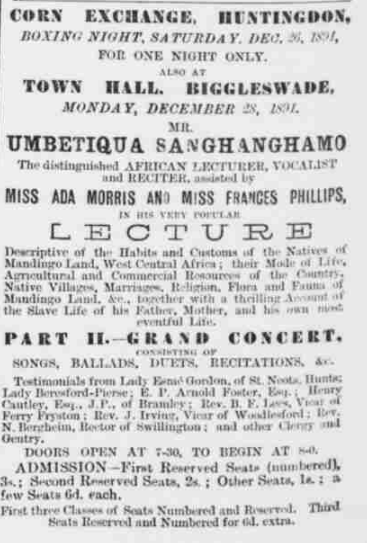
Umbetiqua Sanghanghamo and Miss Ada Morris. Hunts County News, 19 December 1891.
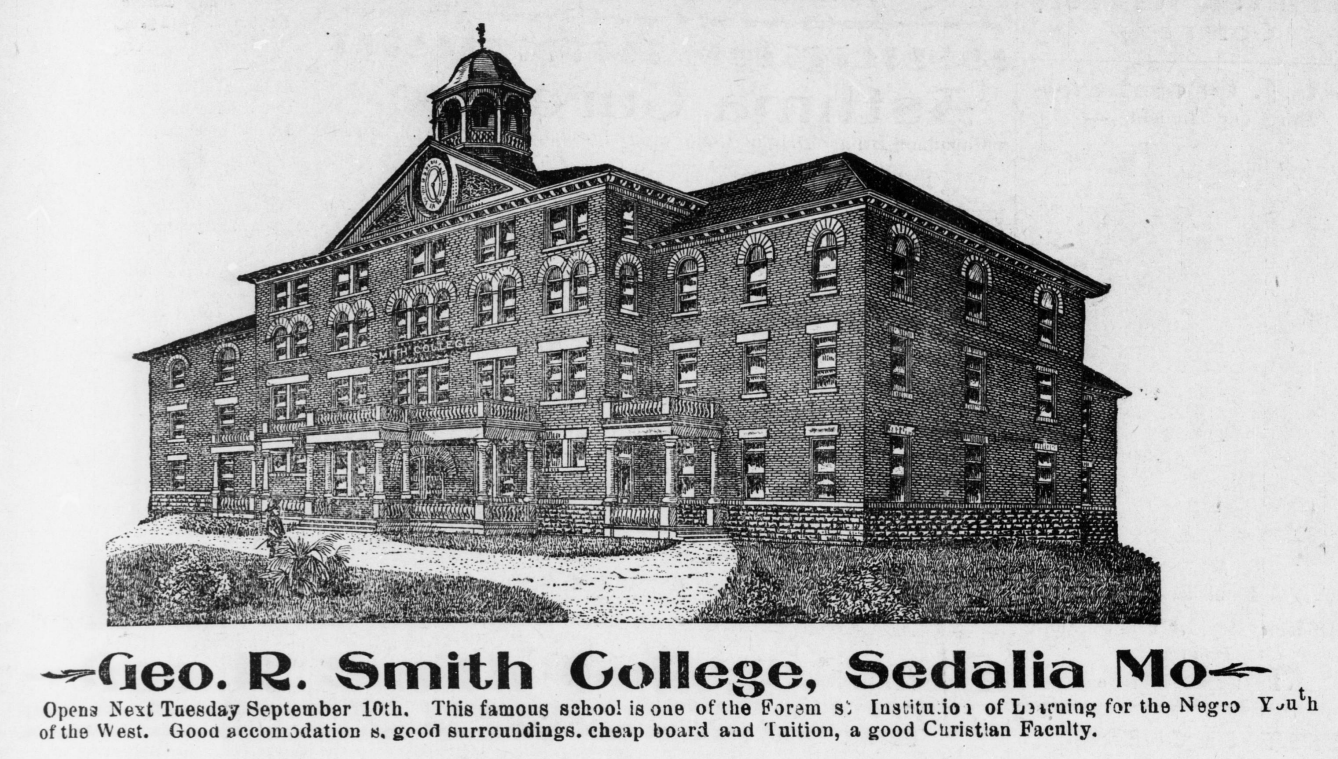
Sedalia Times, 7 September 1901. Image created by the Library of Congress. Public domain.