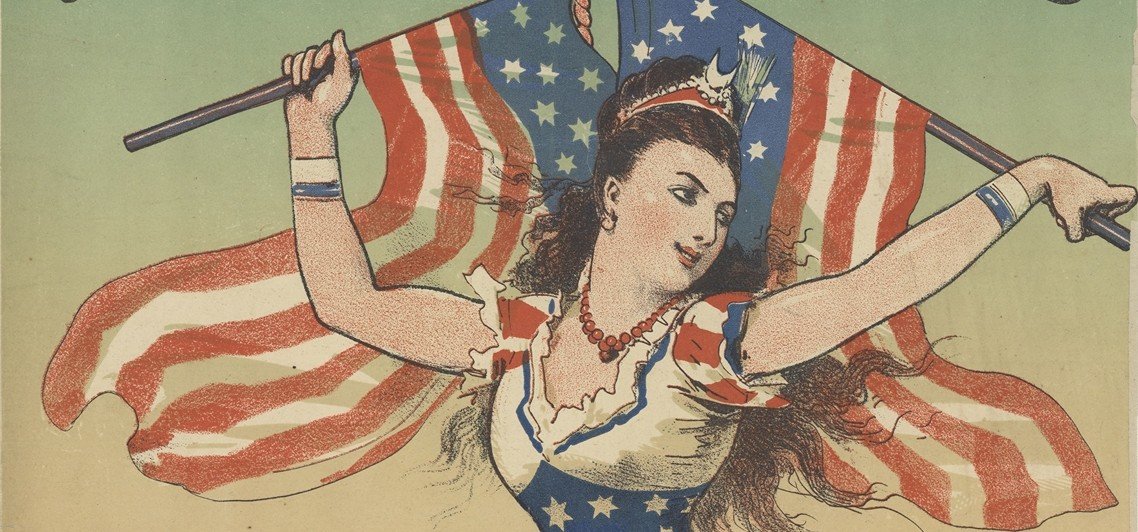
Dare.
Jamie Barras.
TO THE EDITOR OF THE STANDARD SIR,— A sensational performance that certainly ought to be prohibited is announced for repetition on Saturday at the Crystal Palace. "Leona Dare's" balloon ascent is a deliberate courting of a hideous catastrophe, and it is astonishing to find it permitted at Sydenham. Some say the daring woman who hangs on to a balloon by her teeth is really sustained by invisible wires. If so, no matter. De Groof, the "Flying Man," had confidence in his apparatus, and so have all these daring athletes; but for all that, some day their contrivances fail them, and then the public is shocked by a fatal "accident." I am, Sir, your obedient servant,[1]
Leona Dare, the Pride of America, the Rage of Paris, the Wonder of Madrid, the Surprise of London,[2] did not need invisible wires to pull off her “iron jaw” act, just training, discipline, and a large measure of courage. Dare saved the artifice for her biography, spinning tales of her origins, early life, and career that were every bit as astonishing as her performances. In her day, she was a sensation. Now, she is known primarily for the posters of her painted by Jules Chéret. In this piece, I hope to restore her to three dimensions.
In the year 1863, somewhere south of Mason and Dixon’s line, a Union soldier by the name of Stewart was killed in battle. Mr. Stewart left a family consisting of a wife, a little daughter aged eight years and two younger brothers[…][3]
Leona Dare was born Susan Adeline Stuart/Stewart (1854–1922) in the Southern United States. The exact location is not definitely known. Her former husband believed that it was Alabama. Dare herself would, in the final decade of her life, claim it was Louisiana, and that her father was a Confederate soldier and her mother a woman of Mexican or Spanish heritage born at the Alamo. At other times, Dare claimed to have been born in Georgia, Tennessee, Mississippi, and even California. Her billing dubbed her the “Queen of the Antilles” and played up a Cuban/Spanish connection.[4]
There is convincing circumstantial evidence that Mississippi was Dare’s place of birth. Her two younger brothers, Meredith Leonard “Charlie” Stuart (1858–1945) and John J. Stuart (1861–?),were both born there. Dare would spend her final days living with Meredith’s daughter, named Leona Dare Stuart, in her honour, in Spokane, Washington. We can also be fairly confident that her father’s name was Andrew Jackson Stuart (?–1863). Her mother’s name is less certain. In 1871, when she married, Dare gave her mother’s name as “Nancy Myrs”; later, she would say her name was Anna Meiza.[5]
The 1870 US Federal Census records Dare’s brother Meredith Stuart living on the Conlee farm in Washington County, Illinois. Little brother, John, was one county over, living on the Breeze farm in Jefferson County. In the Breeze census return, John Stuart is described as Breeze’s adopted son. This supports Dare’s story that, in 1863, following the death of her father in the Civil War, her mother took the children north to Indiana and then on to Kinmundy, Marion County, Illinois. There, she left them in the care of neighbours while she returned to the South to recover some of the family’s property. She never returned. Dare would later receive a letter saying she had remarried, to a man called William R. Gentry. She would spend the rest of her life looking for her.[6]
The neighbours turned the children over to the local authorities. Although new families could be found for her two brothers in the locale (Marion County abuts both Jefferson and Washington Counties), no one in this rural part of the state had any use for a girl. Dare was dispatched 60 miles north to Mattoon, Coles County. There, she was taken in by Jesse Adams, the town constable, and his wife. Mary. The Adams had four sons; the addition of a daughter would have been a boon to Mary in an age when women and girls took on all domestic duties.[7]
These records of two brothers named Stewart/Stuart/Steward, both born in Mississippi, living separately, but in adjacent counties, in Illinois in 1870, are the only independent sources for the stories Dare told about her early life. They are also almost the only evidence to support Dare’s contention that her real name was Susan Adaline Stuart. As we will see shortly, the subject of Dare’s real name would remain an issue for decades to come.
She always had a great desire to find her mother; so one day, in 1868, without informing her foster parents of her intentions, she departed in search of her. Adaline went to Kinmundy, and, failing to find her, she went to St Louis. There, an opportunity presented itself, and she joined Warner’s circus and learned to be a trapeze performer under the now known and celebrated name of Leona Dare.[8]
By the time of the 1870 US Federal Census, Dare had left the care of the Adams. According to one later account, she went in search of her mother, whom she believed was living in St Louis. On arriving there, she found no trace of her mother but was instead presented with an opportunity to join the circus of Joseph E. “Joel” Warner (1831–1914). In another account, Warner discovered her while she was still living in Mattoon.[9]
Although Dare would work for Warner in 1872, there are several challenges to claims that she joined his circus any earlier. The first is that, although Warner was a booking agent for other circus owners in the late 1860s, he did not begin to operate his own circus until 1870, two years after Dare is said to have left the Adams’ care. A second is that Dare did not adopt the “Leona Dare” stage name until 1871, by which time, she had spent at least two years performing under the name “Mademoiselle Zoe”. The third is that her former husband later stated that she made her debut in 1869 at the Theatre Comique in New Orleans under the name “Zoe”, and it was there that she learned the trapeze. He was in a position to know this, as he was her instructor. His name was Thomas Smith Hall (1847–1926).[10]
Thomas Smith “Tommy” Hall was the New York-born son of sailor John Hall and his wife Anna Hall, née Robertson. A clown, pantomimist, and gymnast, Tommy would spend most of her career performing as one half of the “Brothers Dare” alongside one of his four brothers, Stewart Holland Hall (1853–1902). Stewart Hall/Dare was known as the “one-legged gymnast”, having lost a leg in a train collision. A third Hall brother, George Alexander Hall (1858–1933), would also go into show business, starting as an assistant to his two older brothers and later branching out on his own as a strongman and gymnast.[11]
Somewhat bizarrely, at one time or another, all three of the Hall brothers who went into show business would be identified in the press or in public records as the husband of Leona Dare. However, the marriage record of Thomas S. Hall and Adeline Stuart in New York on 1 July 1871, confirms that Tommy was her partner. To complicate matters, Dare’s death certificate names “George Hall” as her husband.[12]
Before going on to detail the involvement of Leona Dare with the Hall brothers—unarguably the most important of her performing career—it is worth taking a moment to examine one aspect of Dare’s early career arising from her use of the stage name “Mademoiselle Zoe”: the oft-repeated story that her real name was Bridget McCarthy.
Leona, as plain Bridget McCarhy, made her first appearance on the world’s stage in Mobile, where she grew to womanhood without any incident of especial moment happening to bring her before the public. Like many others, beautiful in form and feature, Bridget fell by the wayside, and in the course of her nomadic life, in 1866, drifted to New Orleans.[13]
In 1878, various newspapers published what purported to be a list of the real names of famous actors and actresses. In that list, Leona Dare’s real name was recorded as Bridget McCarthy. This list would continue to be published until at least 1885, despite reports specifically refuting it and giving Dare’s real name as Adaline Stuart, which appeared soon after the list first began to circulate.[14]
The author of the Bridget-McCarthy story was James Flynn, one-time co-proprietor of the Olympic Theatre in New Orleans. Flynn claimed to have discovered “Bridget” in the audience of the Olympic. Recognising her appeal, he worked with his partner, E.E. Duffy, to turn plain old Bridget McCarthy into Mademoiselle Zoe, trapeze artist. It was while she was under their tutelage at the Olympic, Flynn said, that she met Tommy Hall.[15]
As we have already seen, thanks to the census entries for her brothers, Meredith and John, supported by Leona’s well-documented time spent living with Meredith’s daughter towards the end of her life, we can state with some certainty that Dare’s real name was Stuart. This supports her contention that her full name was Susan Adeline Stuart. The date given in the Flynn story—1866—is also far too early for this “Bridget McCarthy” to have been Leona Dare. And Tommy Hall claimed that the pair met at the Theatre Comique in New Orleans, not the Olympic. Furthermore, while it is interesting that Flynn said that “Bridget’s” place of birth was Mobile, as Tommy Hall believed that Leona was born in Alabama, Flynn’s statement that Bridget grew to adulthood in Mobile again contradicts known facts about Dare.
It seems probable that Flynn, looking back from 1880 at events from more than a decade before, had Leona/Zoe confused with another protégé. A “Mademoiselle Zoe”, trapeze artist, was reported to have died in a fall in 1872 in Galveston, Texas. By this time, as we will see, Adeline Stuart had dropped the Zoe stage name for Leona Dare. Was this “Mademoiselle Zoe” the real Bridget McCarthy? Both Tommy Hall and Leona Dare would make repeated attempts to correct the record; lazy journalism kept the falsehood in circulation.[16]
He never knew that his mind was affected because his wife would not live with him. He tried to shoot himself, and had a wound which lasted some time.[17]
When Tommy Hall and Adeline Stuart met in New Orleans in 1869, he was 22, and she was 15. That a man and a girl who had a tutor–student relationship should, within two years, marry would be looked upon with alarm today. It was, of course, all too common in the past. The pair married in New York in July 1871. Shortly afterward, Dare, who had been performing as “Mademoiselle Zoe”, re-debuted under her new stage name “Leona Dare”.[18]
All three of the Hall brothers involved in show business would, in time, also adopt the “Dare” stage name. This suggests strongly that the idea for Adaline to transform herself from Mademoiselle Zoe to Leona Dare was at least in part Tommy Hall’s. We know that Hall was Dare’s teacher in acrobatics and that he designed the specialised apparatus she used in her act. There is also strong evidence that Tommy Hall regarded “Leona Dare” as his creation and, after he married her, his possession. He certainly developed a romantic obsession with her, as is evident from his suicide attempt when she finally broke free from him, and the fact that, once he recovered, he crossed an ocean to try to get her back.
In contrast, whatever romantic feelings Dare had for Tommy Hall did not last long after the wedding. That the pair stayed together for four years as man and wife is a testimony to how much Dare felt that her career owed to Hall’s skills as a technician and performer. That she eventually left him, regardless, speaks volumes as to how constricting she found the relationship, both romantically and professionally.
At this stage in her career, Dare was a solo performer; Hall’s role was that of a manager and technician. In time, they would develop a double-trapeze act, performing together on the same horizontal bar. Hall would also serve as Dare’s partner in the “iron jaw” act that made her famous. However, Hall would only join Dare in the spotlight once he had perfected that act. The pair would perform it for the first time for Joel Warner in Indianapolis in July 1872.
“HOW WAS THAT FOR HIGH?” A Man and a Woman Perform the Double Trapeze Half a Mile High[…]Warner has actually persuaded a young and beautiful Spanish girl, named Leona Dare, who does marvellous feats upon the trapeze in the circus, to make balloon ascensions. The trip was made on Thursday morning at a point of about nine miles southeast of our city. The balloon was duly inflated, and at a quarter to eight was cut loose, and the fine-formed Leona, in circus clothes, dangling downward from the trapeze bar, holding in her teeth a strap which encircled the waist of Tommy Hall, her companion for her first voyage in the air, left terra firma.[19]
This July 1872 stunt was the debut of Dare’s “iron jaw” act in its most spectacular and dangerous form. Key to the act was an apparatus designed by Tommy Hall, a mouthpiece consisting of a metal hook that could rotate freely in a mount that terminated in two prongs overlaid with a rubber mouthpiece molded to match Dare’s bite (see gallery below). The basic act existed in two forms. In one, Dare was suspended by this hook from a trapeze, supported only by the strength of her bite. In the other, Dare would hang upside down from the trapeze supporting her partner, again, only by the strength of her bite.[20]
Both acts required tremendous courage and stamina from Dare. The second had the added dimension of the psychological weight of knowing she was responsible for the life of another human being. Her partner, of course, placed their life in her hands.
Reports of the first balloon ascent claimed that while Dare was “perfectly cool”, Tommy Hall “visibly weakened” as the moment of the ascent approached. Once the balloon was launched, the act commenced with Dare spinning Tommy Hall around as she held on to him with only the grip of her teeth. Then, as the balloon continued to ascend, Hall arrested his gyrations. Using Dare’s body as a “ladder”, he climbed up and joined Dare on the trapeze. The pair then performed their “regular” double-trapeze act, albeit several hundred feet in the air. When the pair returned to the ground, Dare was giddy with triumph, famously laughing and exclaiming to Warner, “How was that for high?” Hall, meanwhile, was “silent and sober”.[21]
It is not clear from descriptions of Dare’s iron jaw act how long her partner spent held aloft only by the grip of her teeth. It was probably of the order of seconds rather than minutes, but, of course, to observers caught up in the spectacle, it would have appeared to be much longer.
As the above quote shows, stories of Dare having a Spanish connection also date from the time with Warner. Although it was the more exotic the better when it came to the backstories of circus performers, this does seem to reflect Dare’s belief that her mother was of Spanish or Mexican ancestry. As Dare was eight years old when her mother abandoned her and her brothers, it is possible that she retained some memory of stories of her life that her mother told her. However, it is equally possible that Dare had created a narrative to fit her memories of how her mother looked and spoke.
The challenge, as ever, is with the facts that we do have, that none of the Stuart children have names of Spanish origin (Susan Adaline, Meredith Leonard, John J.), and that in 1871, Dare gave her mother’s name as “Nancy Myrs”. That Dare’s mother had a dark complexion, we might suppose from photographs of Dare herself, and that she spoke with an accent, we can infer from Dare’s belief that she was of Spanish or Mexican heritage. However, this could also suggest an origin elsewhere in Europe. The surname “Myrs/Meyers” coupled with an accent suggests a possible Germanic/Jewish origin, for example. Alas, we lack any definite information.
The agreement under which plaintiff’s wife was engaged at the Oxford was put in. It was dated July 2 1878. By it Leona Dare agreed to engage, and the defendant to accept her, as a performer at the Oxford. She was to be paid £70 a week.[22]
By the mid-1870s, Leona Dare was earning as much in a week as the average working man was earning in a year. With Dare’s earnings, she and Tommy Hall bought a house on the upmarket Lexington Avenue in New York. The pair toured relentlessly in this period. They remained with Warner in 1873, but by 1874 had branched out on their own. In 1875, they joined Nick Roberts’ Pantomime Troupe in his touring performance of “Jack and Jill”. Dare was now billed as the “Empress of the Air”, and the act was a family affair, with Stewart Hall, billed as “Stewart Dare”, Leona’s “brother” and “pupil”, performing a comedic gymnastic double act with Tommy Hall, assisted by little brother George Hall. George also likely worked as Dare’s assistant and partner. This engagement would later lead to a rumour that, when Dare’s marriage to Tommy Hall ended, she eloped with George.[23]
Although the elopement rumour was untrue, the Hall–Dare marriage was over in all but name by 1875. Hall was unquestionably still in love with Dare—obsessively so—but Dare had long since ceased to have romantic feelings towards him. She was also increasingly resentful of how Hall handled the couple’s finances. She would later claim that Hall was the one who deserted her, taking $50,000 of her money with him. This was untrue but reflected Dare’s sense that her earnings were ending up in Hall’s pocket. Arguably, she was supporting not only her husband but also his brothers: Stewart and George Hall may have had their own act and earnings, but they owed their place on the bill to Dare.[24]
Dare finally left Hall in early 1876. However, a distraught Hall persuaded her to return to him by promising to grant her a divorce if they couldn’t make the marriage work a second time. He reneged on that promise. Dare sold the house on Lexington Avenue and gave Hall half the money, thinking she could buy her way free of him. She could not. She appears not to have understood the depth of Hall’s romantic obsession with her. But then, she was still only 21. Finally, feeling no other option was open to her, Dare fled overseas, taking the all-important iron jaw apparatus with her. When Hall realised she was gone, he shot himself.[25]
Hall survived his suicide attempt and left the US in pursuit of Dare. He found her performing in Paris and again attempted a reconciliation. Dare rebuffed him a third time. In need of funds and not familiar with French, Hall retreated to England to plot his next move. He started by wiring his brother, Stewart, in the US to come to England. By February 1877, the pair were performing at the Oxford Music Hall in London. Tommy Hall impressed upon the Oxford’s proprietor, John Henry Jennings, what a great attraction his wife would be if Jennings were to book her. Intrigued, Jennings made enquiries and discovered that Leona was everything that Hall said she was; however, she would refuse to come to England as long as her estranged husband was there. Hall swore to Jennings that he loved his wife too much to interfere with her career. The two men struck a deal: Jennings agreed to re-engage the Brothers Dare at a future date in return for Tommy Hall agreeing not to attempt to approach Leona Dare while she was at the Oxford.[26]
All those who see Leona Dare will envy her her teeth, and must marvel at the strength of her jaw. She was applauded at the beginning; she was greeted with cheers of encouragement as she proceeded, and at the end, something like a tempest of enthusiasm raged, and brought the lady to the front some half-dozen times.[27]
Leona Dare’s debut at the Oxford in October 1878 was yet another sensation. She performed both versions of her iron-jaw act, suspending herself from a trapeze and supporting a male assistant, as well as a solo trapeze act and a swinging trapeze act. Reviews did sound one ominous note, however, a foreshadowing of future events.
The only objection we shall raise in the matter of this performance shall take the form of a suggestion to the effect that a net spread beneath Leona-Dare while with her teeth she turned the male acrobat into a spinning top would preclude all danger, and would in no way detract from the merit or attractiveness of the performance[…][28]
Of course, Tommy Hall did not stick to the agreement to stay away—his sole purpose in promoting his wife to Jennings was to get her to England so he could renew his pursuit of her. As part of this, he petitioned for restitution of conjugal rights, an attempt to have the English courts order Dare to return to him. Dare fled England before the action came to court. Her flight was so precipitous that she left her performing apparatus behind at the Oxford. Dare seized his chance and took out a second action against Jennings, claiming ownership of the apparatus.[29]
Hall’s true intent was to force Dare to return to England. In that, he failed. The resulting case, which came to court in June 1879, provides us with a wealth of detail on the Hall–Dare relationship, albeit largely, but not exclusively, from Hall’s side. Dare’s version came in the form of a deposition read out in court, laying bare her resentment at Hall’s controlling ways and exasperation at his refusal to let her go. She claimed that the iron jaw apparatus was hers both by common sense—she was the one who used it—and by purchase—the half-share of the Lexington Avenue house that she had handed Hall had also been in payment for the apparatus. Unfortunately for Dare, the judge saw things differently. Displaying an attitude towards women all too typical of the times, he accepted Hall’s argument that everything Dare owned, including the iron jaw apparatus, belonged to her husband. He ruled in Hall’s favour.
Leona Dare was now without the apparatus she had been using for nearly a decade. She was forced to continue her act with new and unfamiliar equipment and set-ups. A less-than-ideal arrangement.
At the Circus in [Hamburg], Leona Dare, the bold trapeze performer, has met with a serious accident, by which she will probably for a long time, if not altogether, be incapacitated from again appearing in her tour de force, all her teeth being injured.[30]
While performing at the Renz Circus in Hamburg in June 1880, Dare mistimed a move and was struck in the face by her trapeze, knocking out all her front teeth. She returned to Vienna, the circus’s winter home, to convalesce. This injury, which promised to put an end to her iron-jaw performances, was to prove life-changing in another way. In Vienna, she made the acquaintance of a young banker named Ernst Grunebaum. Grunebaum had become enamoured of Dare from afar, having seen her perform. He showered her with attention, incurring the ire of his disapproving parents. Although still only 25, Dare was several years Grunebaum’s senior. It is likely that, under other circumstances, she would have been flattered by the young man’s attention but otherwise unmoved. However, she had, in the space of six months, experienced two shattering losses. She succumbed to Grunebaum’s suggestion that, in the face of his parents' disapproval, the pair elope. They fled Vienna, making first for England and then on to America, where, it was hoped, Dare would be able to receive the treatment she needed to restore her bite.
One time last June there came to Chicago a gentleman and lady calling themselves Mr. and Mrs. Ernest Theodore Grunebaum, residing at No. 7 Volkesgarten strasse, Vienna, when at home, and who had, it appeared, come to America to spend the honeymoon[…]Judge, then, the mortification that will be felt when it is ascertained that these people were not married at all—at least, not legally married. And here is the most interesting part of the story. The gentleman is, as his card indicates, “Ernest Theodore Grunebaum, of No. 7 Volkesgarten strasse, Vienna”, the son of wealthy and honoured parents in the Austrian Capital. The lady is none other than Leona Dare.[31]
Leona and her young beau travelled to Illinois, where Leona renewed her relationship with her foster father, Jesse Adams, and tracked down her two brothers, Meredith and John. She wished to share some of her recent good fortune with them. In John’s case, this meant sending him to college. Meredith, who was making his way as a farmer, was so affected by the support he received that he named his first child Ernest Theodore in Grunebaum’s honour. In time, he would also name a daughter after Leona.[32]
From rural Illinois, Dare and Grunebaum travelled to Chicago for the dental treatment Leona required. They also entered Chicago high society. In a move that seems to indicate that Dare had decided to give up her performing career, the couple concealed from their new acquaintances the truth of their relationship and Dare’s real identity. This was to blow up in their faces when, in November 1880, for some inexplicable reason, they decided to not only hold their much-delayed wedding in the city but also to invite their new acquaintances, all of whom were under the impression the couple was already married.[33]
With Dare’s true identity exposed, the fact that she was still married to Tommy Hall was also revealed. Dare claimed that she had not had any contact with Hall since leaving him in 1876 and had heard that he was dead. This, of course, was not true; she had provided a deposition for the court case over the ownership of her performing equipment as recently as November 1879. However, as Hall was in England—something Dare knew very well—Dare was finally able to obtain a divorce from him in his absence. She and Grunebaum married. Good times seemed to lie ahead.
It was not to be.
The celebrated “Leona Dare” and her husband, Ernest Grunebaum, have become insolvent and are being mercilessly pursued by creditors. The family jewelry, valued at $2,700, has been secured at Geneva Lake, Wisconsin, by the sheriff to satisfy their debts.[34]
Dare’s new life depended completely on her new husband’s family restoring him to his inheritance. Dare and Grunebaum tried to negotiate a reconciliation by telegram and letter from America, but failed. With no other recourse, and with their American creditors nipping at their heels, they returned to Europe and Vienna to renew their pleas in person. The trip was a disaster. Grunebaum’s family not only refused to see him and his bride, they also arranged to have him drafted into the Austrian army.[35] Dare was suddenly alone and penniless. She did the only thing she could: she went back to performing.
Leona Dare, the daring young acrobat, has been engaged at Renz’s Circus, where her numerous admirers and friends are as enthusiastic as ever in their praise of her wonderful strength and agility.[36]
After a period working at the Renz Circus in early 1882, Dare moved to Paris and the Hippodrome. A witness to her act there made an observation that was to prove all too prescient.
One of the sensations to which [Franconi] treats his rich clients is Leona Dare hanging on by her teeth to a rope. As she has a fine figure, she excited the greatest interest among the fast men of the clubs. A phenomenon of this kind is like a prize-fighter obliged to lead a regular life. If her nerves and muscles got out of order, she would either be killed in a fall or have to give up exhibiting.[37]
Modern research has highlighted the degree to which the precarious existence of circus artists—a lack of job security, an itinerant existence, a physically demanding career with a constant risk of career-ending injury or death—exerts an emotional and psychological toll. Circus artists experience unusual levels of stress[38] and experience as many physical injuries as professional athletes.[39] Yet, they are expected to smile through the pain.[40]
In the summer of 1880, Leona Dare received an injury that rendered it nearly impossible for her to continue her iron-jaw act, even with corrective surgery. In recognition of this, she retired from performing on her marriage to Ernst Grunebaum. The forced end to that marriage forced her to return to performing. Public demand then forced her to return to her iron jaw act. We cannot know how much physical pain she had to endure every time she performed the act, nor what psychological toll this took. We can guess that it was an accident waiting to happen. It finally did in November 1884.
Lately, at the Princess’s Theatre, Valencia, Spain, Leona Dare, the American acrobat, was suspended from the roof of the theatre by her feet, and held in her teeth the ropes of a trapeze-bar on which a male acrobat, known as M. George, was performing. During the act, Miss Dare was seized with a nervous fit and dropped the trapeze. M. George and the apparatus dropped, whirling to the floor. The audience was horror-stricken. Everyone rushed for the doors, and a panic ensued, in which many people were crushed and otherwise injured. Miss Dare clung to the roof, screaming hysterically. She was rescued with difficulty after the excitement had somewhat subsided and is now confined to her bed from exhaustion following the shock. M. George has since, by cable, been reported dead, and Miss Dare in a precarious condition.[41]
This tragedy was the origin of the rumour that Dare had eloped with George Hall in 1876: an American promoter, seeing the name “George”, put two and two together and came up with five. To this was attached a further, reprehensible suggestion that Dare had deliberately dropped “George Hall” in a fit of jealousy.[42]
As Tommy Hall pointed out in a subsequent letter to the press, George Hall was alive and well and performing in Germany. He would later make his home in London and become a stalwart of the local baseball scene under his stage name George Hall Dare. Tommy Hall, meanwhile, had remarried by the time of Dare’s accident. He now regarded Dare simply as a “friend” and declared that she did not have a jealous bone in her body. The accident, he wrote, was just that, an accident.[43]
Dare’s recuperation was a long one; it would be another 18 months before she returned to performing. Although this would involve taking up her iron-jaw act once more—it is what the public demanded—this time, and forever more, the only life she would be risking would be her own.
At the Parc Leopold last week, Leona Dare actually performed the bold and difficult feat of holding on by her teeth to a sling suspended from the car of a balloon as it rose in the air. The element of danger was as far as possible excluded, by formal order of the burgomaster that the performer should be securely attached to the car by a safety cord but it was evident to spectators that the feat of holding on by the teeth was in no way diminished by this wise precaution.[44]
Dare’s new balloon act, a variation on her old turn for Joel Warner, was performed in association with Swiss aeronaut Eduard Spelterini (1852–1931).[45] The pair toured the act—performed with or without a safety line according to the dictates of municipal officials—across Europe for the next four years. In 1888, they brought it to England, where it caused equal amounts of wonder and outrage. In October 1890, while performing the act in Paris, Dare suffered a further injury. As the balloon began to ascend, the wind carried it away. Realising the danger, Dare let go, falling 20 feet to the ground and breaking her leg.[46]
If this new injury was not the actual end of Dare’s performing career, it was the beginning of the end. By the mid-1890s, she had retired. She was 40. She devoted the rest of her life to reconnecting with her brother, Meredith Stuart, and his family, and continuing her quest to reunite with her mother. (It is not known what happened to John, her other brother.) It seems likely that she spent much of her accumulated earnings in this fruitless quest, as she spent the last years of her life living with her niece and namesake, Leona Dare Musser née Stuart (1892–1925).[47]
Leona Dare, the Pride of America, the Rage of Paris, the Wonder of Madrid, the Surprise of London, died in Spokane, Washington, in May 1922. She was 67 years old.
WOMEN AS GYMNASTS[...]The professional gymnasts find their most famous prototypes in Leona Dare, the "Flying Queen," who went into training when a mere child, and was celebrated for more than twenty years for performing feats that no other women and few men would dare attempt[...][48]
Leona Dare rose to the very top of a very tough profession by the true grit born of a childhood ripped apart by war and loss. She suffered blow after blow during her 20-year career, but always picked herself up, dusted herself off, and started all over again. Tommy Hall, in his obsession, thought that “Leona Dare” was his creation. He was wrong. Her life was one of reinvention, sometimes accompanied by tales of pure invention, but in the latter, she was simply laying claim to her own narrative; telling her story, her way. She was her own creation.
Jamie Barras, May 2026.
Back to Staged Identities
Notes
[1] ‘Leona Dare’, London Evening Standard, 1 June 1888. Vincent de Groof was a Belgian inventor killed in 1874 when his experimental ornithopter-come-glider-come-parachute crashed shortly after it was released from the balloon that was carrying it aloft: ‘Death of M. de Groof, the Flying Man’, Illustrated Police News, 18 July 1874.
[2] Dare’s billing: ‘Notices and Advertisements: The Oxford’, Echo (London), 13 January 1879.
[3] ‘Leona Dare’s History’, Buffalo News, 27 November 1880. Quoting a report in the Chicago Times.
[4] Former husband (Thomas Hall—see below)’s account of Dare’s origins: ‘Leona Dare’, New York Herald, 12 February 1885. Dare’s later account: ‘Leona Dare Still Searches for Mother’, Charlotte News, 12 March 1912. California and Mississippi: these are the places of birth given by Dare on her 1876 and 1889 US Passport applications, respectively: U.S., Passport Applications, 1795-1925, ancestry.co.uk, Ancestry.com Inc. (Operations), accessed 11 May 2026. Georgia is recorded as her place of birth on her death certificate, filled out using information provided by her niece: "Washington, Death Certificates, 1907-1960", FamilySearch (https://www.familysearch.org/ark:/61903/1:1:N3GN-B6F), Entry for Leona Dare and Andrew J. Stewart, 23 May 1922. Cumberland Gap, Tennessee: ‘Leona Dare’, Indiana State Sentinel, 12 March 1884. Billing as “Queen of the Antilles”: ‘Leona-Dare at the Oxford’, The Era, 6 October 1878.
[5] Meredith Stuart is recorded as “Meredith Steward” in the entry for Smith Conlee, Washington County, Illinois, in the 1870 US Federal Census; we can be sure it is “our” Meredith Stuart, as his place of birth is given as Mississippi. John J. Stuart is recorded under that name in the entry for John Breeze, Jefferson County, Illinois, in the 1870 US Federal Census. Mississippi is recorded as his place of birth, and he is described as Breeze’s adopted son. Leona Dare’s 1871 marriage under the name Adaline Stewart records her father’s name as Andrew J. Stewart and her mother’s name as “Nancy Myrs”: "New York, New York City Marriage Records, 1829-1938", FamilySearch (https://www.familysearch.org/ark:/61903/1:1:Q2CN-N3NY), Entry for Thomas S Hall and Adaline Stuart, 1 July 1871. On her death certificate, using information provided by her niece, her father’s name is again recorded as Andrew J. Stewart, but her mother’s name is recorded as “Anna Meiza”: see note 4 above, final reference.
[6] Letter claiming second marriage to William R. Gentry: ‘In Search of Mother’, The leader (Brookhaven, Miss.), 19 October 1898.
[7] Dare returned to Illinois in 1880, reconnected with Jesse Adams, and tracked down her two brothers, one of whom had prospered, one of whom had not: ‘Neighbouring Counties’, Twice a Week Sun (Greenville, IL), 3 December 1880.
[8] See Note 3 above.
[9] Joseph E. Warner: https://www.hmdb.org/m.asp?m=214745, accessed 11 May 2026. The St Louis version: see Note 3 above. The Mattoon version: ‘Leona Dare’, Chicago Tribune, 17 November 1880.
[10] Dare working for Warner in 1872: ‘How Was that for High?’, Charleston daily news (Charleston, SC), 2 July 1872, quoting the Indianapolis Sentinel. Hall’s account of the origins of his relationship with Leona Dare: Note 4 above, first reference, and the following: ‘The Lovely Leona’, St Louis Globe Democrat, 17 June 1869; ‘Tribulations of an Acrobat’, Reynolds’ Newspaper, 1 June 1879.
[11] Thomas Hall: https://www.familysearch.org/en/tree/person/details/P4CB-PLN; George Hall: https://www.familysearch.org/en/tree/person/details/P4C1-D1F; Stewart Hall: https://www.familysearch.org/en/tree/person/details/9C1D-MP5, accessed 11 May 2026. Stewart Dare, one-legged gymnast, train collision: ‘Notices and Advertisements: Nick Roberts’ Pantomime Troupe’, Kentucky Gazette, 2 October 1875. Brothers Dare: See Note 4 above, first reference. Stewart Hall and his wife Adelaide contracted yellow fever and died while on a trip to Brazil in 1902:
[12] See Note 5 above, third reference.
[13] ‘A Countess’, Houston Post, 10 December 1880.
[14] List first publication, for example: ‘People with Double Names’, Times-Union (Rochester, NY), 27 February 1878. 1885: ‘Stage Names’, Pacific Bee (Sacramento, CA), 2 January 1885. Story refuted: New York Mercury, 16 March 1878.
[15] See Note 13 above.
[16] “Mademoiselle Zoe” killed: item in the Austin American-Statesman, 13 February 1872. Correcting the record: See Note 4 above, first reference; Note 8 above, second reference;
[17] See Note 4 above, final reference.
[18] The “Leona Dare” stage name first makes its appearance in September 1871, in a billing in the Sunday Mercury (New York), 24 September 1871, describing the opening of the act in New Haven on 18 September.
[19] See Note 10 above, first reference.
[20] A later version of Dare’s mouthpiece now resides in the Northwest Museum of Arts and Culture, Spokane, Washington: https://collectionsportal.northwestmuseum.org/simple-search?q=leona+dare, accessed 12 May 2026; see also photograph in the gallery at the end of this article. The gallery also contains illustrations of both versions of the act.
[21] See Note 10 above, first reference.
[22] See Note 10 above, third reference.
[23] Lexington Avenue house: see Note 9 above, third reference. With Roberts: see Note 10 above, third reference. Refuting the elopement rumour: Note 4 above, first reference and second-to-last reference.
[24] The breakdown of the relationship is detailed in the court proceedings Hall took out against an employer of Dare’s in 1879 in an attempt to recover the apparatus he had made for her: Note 9 above, last two references. $50,000 stolen: Note 3 above, first reference.
[25] Note 10 above, last two references.
[26] Note 10 above, last two references.
[27] Note 4 above, final reference.
[28] ‘Leona-Dare at the Oxford’, The Era, 6 October 1878.
[29] Petition, Thomas Smith Hall versus Susan Adeline Hall, 9 December 1878, England & Wales, Civil Divorce Records, 1858-1918, ancestry.co.uk, Ancestry.com Inc. (Operations), accessed 12 May 2026.
[30] ‘Amusements on the Continent’, The Era, 27 June 1880.
[31] ‘Romance of the Flying Trapeze’, New York Mercury, 27 November 1880.
[32] Return to Illinois: Note 7 above. The naming of two of Meredith Stuart’s children: https://www.familysearch.org/en/tree/person/details/GSFW-F1X, accessed 13 May 2026.
[33] See Note 3 and Note 31 above for accounts of this episode.
[34] ‘Leona Dare’, New York Times, 31 January 1881, quoting the Chicago Times.
[35] Note 4 above, second-to-last reference.
[36] ‘Notes from Berlin’, Globe, 15 February 1882.
[37] ‘France’, Weekly Dispatch (London), 7 May 1882.
[38] Fleur E.C.A. van Rens, Brody Heritage, Mental health of circus artists: Psychological resilience, circus factors, and demographics predict depression, anxiety, stress, and flourishing, Psychology of Sport and Exercise, 53, 2021,101850, https://doi.org/10.1016/j.psychsport.2020.101850.
[39] Faltus J, Richard V. Considerations for the Medical Management of the Circus Performance Artist and Acrobat. IJSPT. 2022;17(2):307-316. doi:10.26603/001c.31645.
[40] Alexandra Ross, Jamie Shapiro, Under the big top: An exploratory analysis of psychological factors influencing circus performers, Performance Enhancement & Health, 5 (3), 2017, 115–121, https://doi.org/10.1016/j.peh.2017.03.001.
[41] ‘Amusements’, Weekly Times & Echo (London), 14 December 1884.
[42] ‘Did Leona Dare Drop George Hall?’, New York Herald, 24 November 1884.
[43] Tommy Hall’s letter: Note 4 above, first reference. George Hall and baseball in London: R.G. Knowles and Richard Morton, ‘Baseball’, (London: George Routledge & Sons, 1896), 75–76.
[44] ‘Brussels Dramatic Gossip’, Era, 17 July 1886.
[45] Spelterini: Hannes Mangold, ‘Switzerland from Above’, https://blog.nationalmuseum.ch/en/2019/05/switzerland-from-above/, accessed 13 May 2026.
[46] Paris injury: news item, St Louse Post-Dispatch, 12 October 1890.
[47] The information about Dare’s retirement comes from an otherwise highly romanticised 1900 account of her life: ‘Search for Her Mother’, Freeland Tribune (Freeland, Pa.), 29 March 1900. The source was Dare herself. Leona Dare Stuart: https://www.familysearch.org/en/tree/person/details/GDMW-GNC, accessed 13 May 2026. The younger Leona, tragically, died of a uterine tumour within a few years of the death of her aunt.
[48] ‘Brussels Dramatic Gossip’, Era, 17 July 1886.
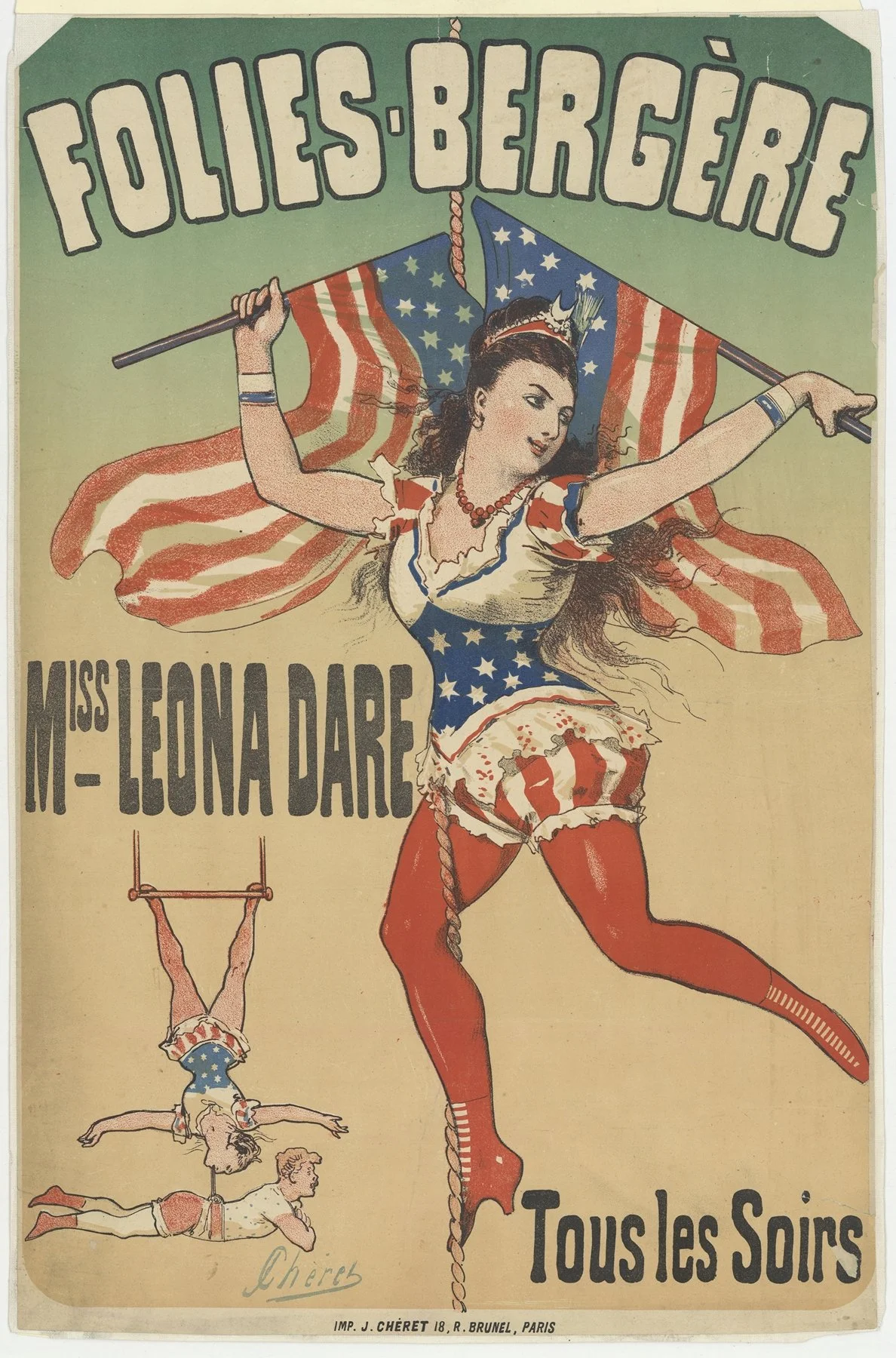
Miss Leona Dare, poster by Jules Chéret. Public domain. Digital Collection of the French National Library. https://gallica.bnf.fr/accueil/fr/html/accueil-fr
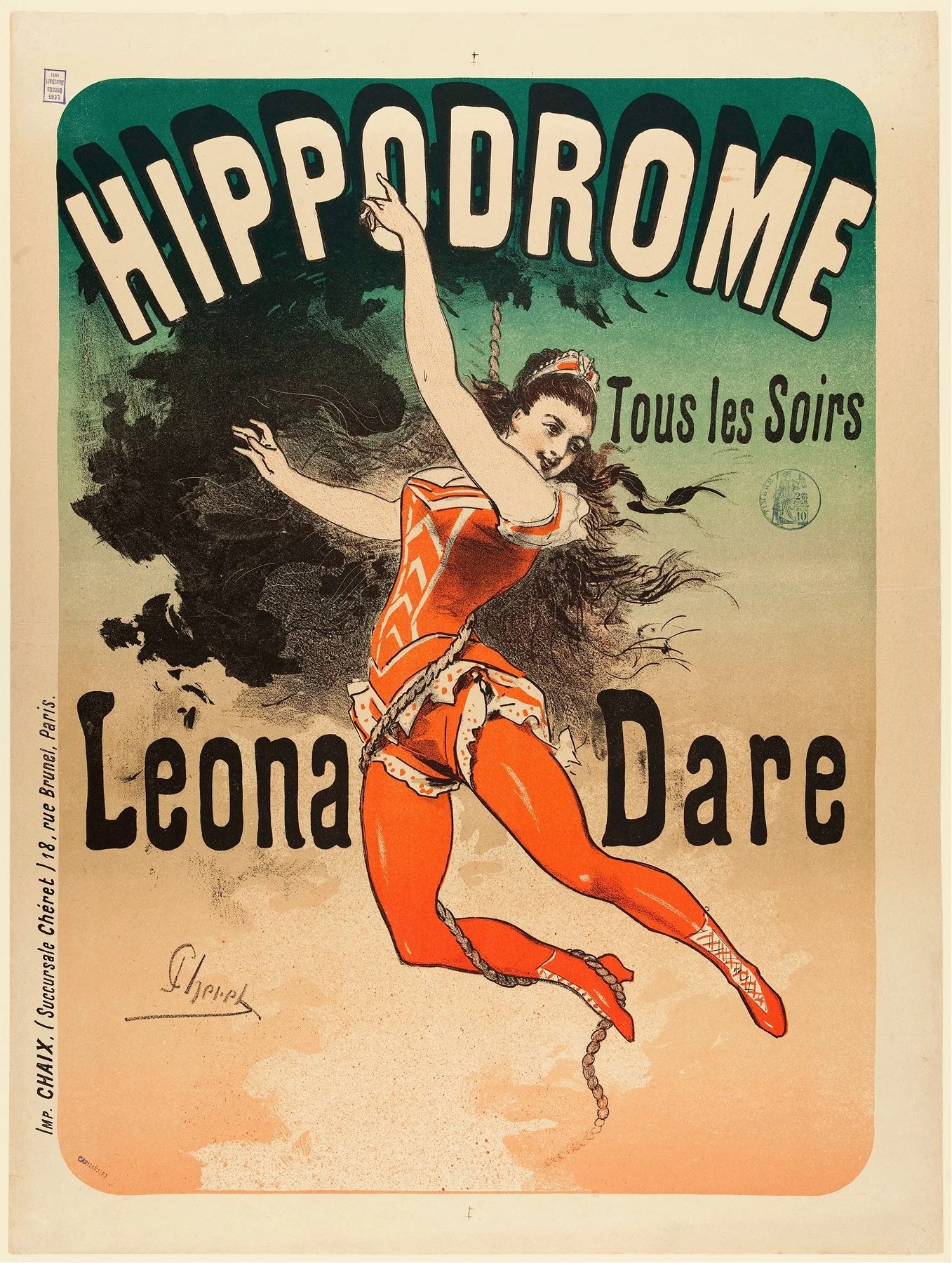
Miss Leona Dare, poster by Jules Chéret. Public domain. Digital Collection of the French National Library. https://gallica.bnf.fr/accueil/fr/html/accueil-fr
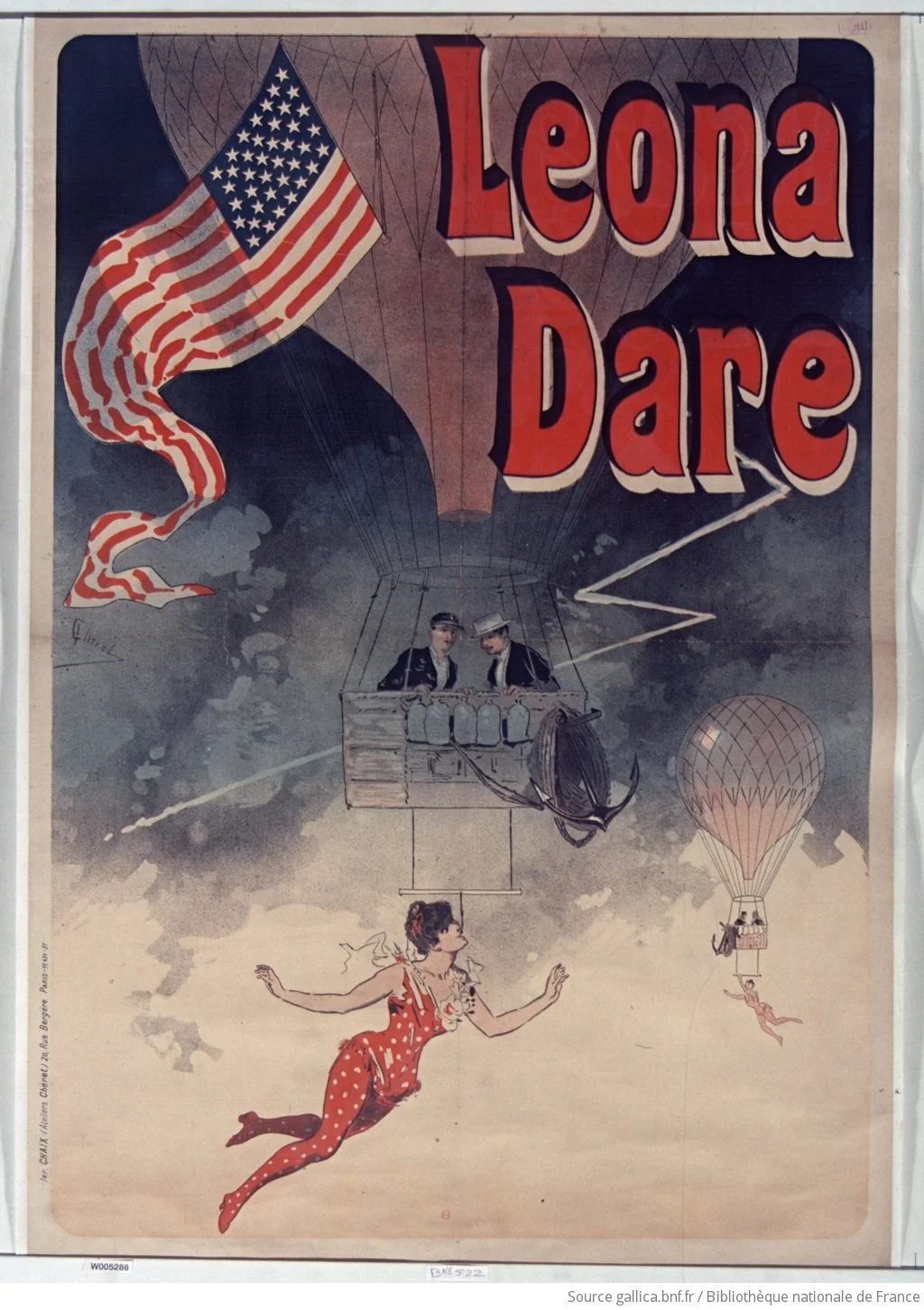
Miss Leona Dare, poster by Jules Chéret. Public domain. Digital Collection of the French National Library. https://gallica.bnf.fr/accueil/fr/html/accueil-fr
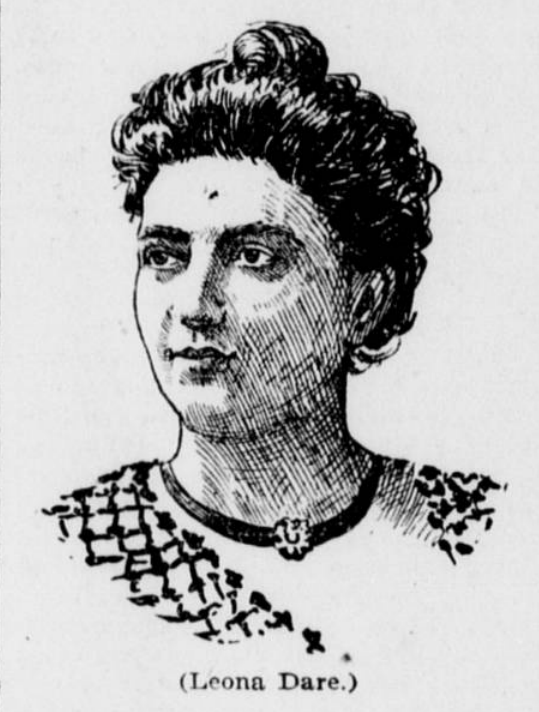
Leona Dare, Freeland Tribune, 29 March 1900. Image created by Library of Congress. Public domain.
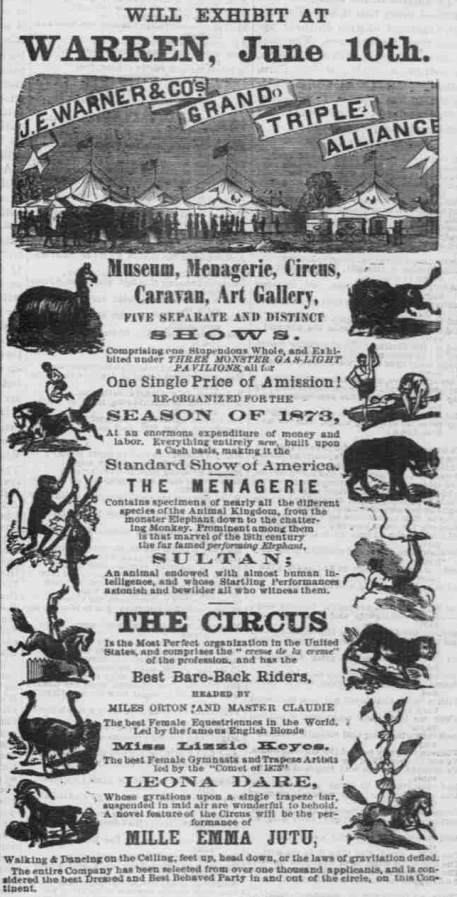
Leona Dare on the bill of Joel Warner's Circus. Western Reserve Chronicle, 4 June 1873. Image created by Library of Congress. Public domain.
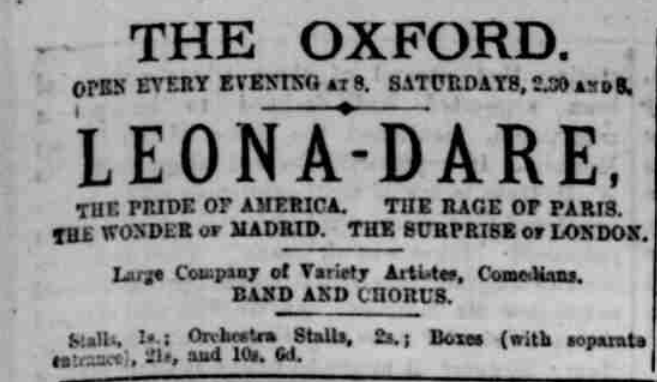
Leona Dare, the pride of America, the rage of Paris, the wonder of Madrid, and the surprise of London. Echo (London), 13 January 1879. Image created by the British Library Board. No known copyright holder.
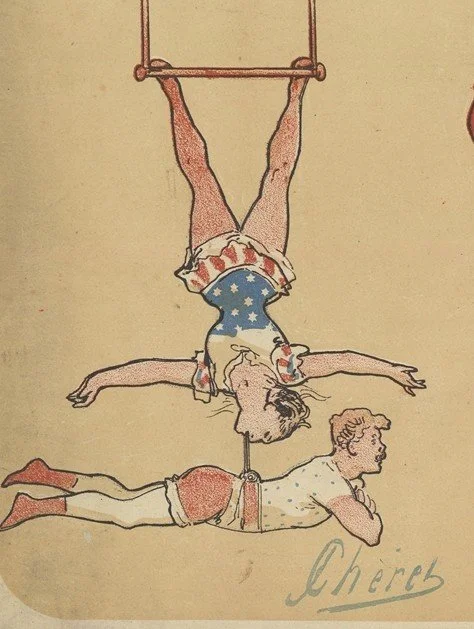
One version of Leona Dare's iron-jaw act, detail, poster by Jules Chéret. Public domain. Digital Collection of the French National Library. https://gallica.bnf.fr/accueil/fr/html/accueil-fr
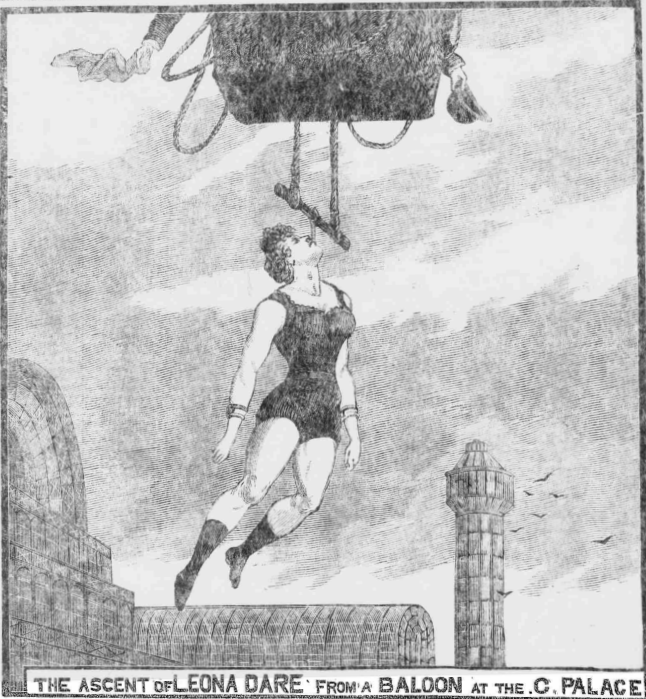
The Ascent of Leona Dare, Illustration Police News, 16 June 1888. Image created by the British Library Board. No known copyright holder.
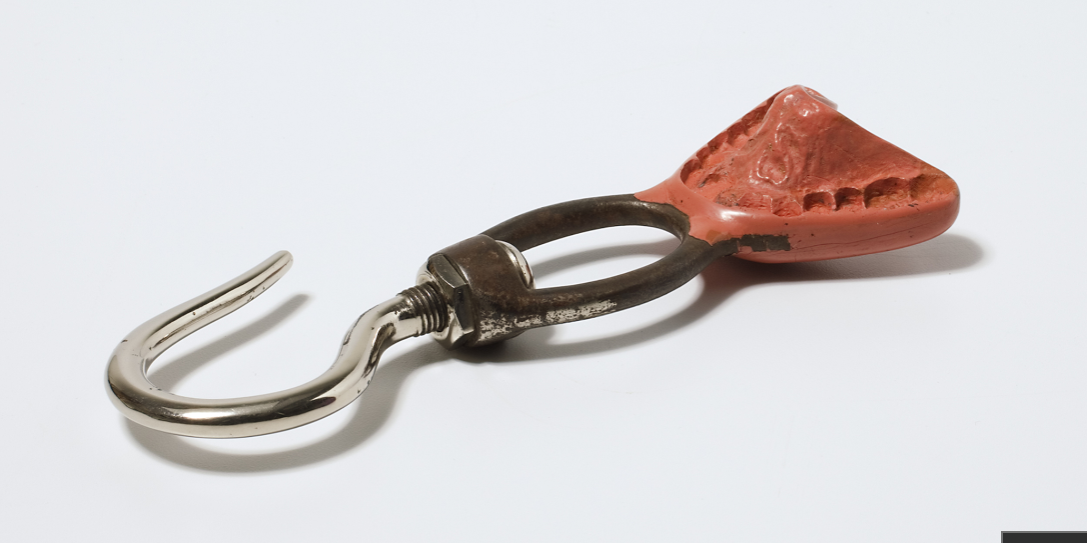
Leona Dare's iron-jaw act mouthpiece. Northwest Museum of Arts and Culture, Spokane, Washington. Used with permission.