Foreign to this Country.
Jamie Barras.
BASEBALL AT PLYMOUTH. EXHIBITION GAME BY AMERICAN CADETS. Followers of sport in the West are not entirely ignorant of the American national game of baseball. Many recall with interest the exhibition given at Mount Wise in 1910 by the officers of the U.S.N. Training Squadron. In consequence, the crowd which assembled at Millbay Park on Saturday to witness an exhibition game between teams picked from the cadets from the U.S.S. Ranger were able to follow and appreciate the display. Because we never hear anything of baseball in the West of England many people jump at the conclusion that it is quite foreign to this country. That is a great mistake.[1]
In a companion to this piece, I told the story of how Cheltenham cricketer George Richard Charles Pike (1892–1985) learned his baseball thanks to the efforts of a Christian philanthropist, but due to the complicated history of the game in England, we cannot say for certain where it happened—England, Canada, or France.[2]
In this piece, I want to look at why a Cheltenham newspaper reporter felt the need to add “American” in front of “baseball” when describing the origin of Pike’s hitting powers.[3] It is the story of baseball in the West Country, a history defined by the scarcity of major population centres in the region and its location on the fault line between two competing codes. Against this backdrop, it should come as no surprise that there are parallels with the introduction of baseball to the American West. Although in the case of England’s “Wild West”, it was distance, not resistance, that kept it at bay.
The Old Game of Rounders.—A few young men of our city are about to revive the now almost forgotten game of rounders, by forming themselves into a club, to be named "The City of Bristol Rounder Club," and all necessary arrangements are being made, with a view to its immediate starting.[4]
To the best of our current knowledge, the first attempt in England to turn a base-running bat-and-ball game into an organised sport began in August 1864 in Bristol, South Gloucestershire, with the founding of the “City of Bristol Rounder Club”. This attempt to turn the children’s game of rounders into a sport for adults was both informed by and a reaction against the American game, taking inspiration from the successful development of baseball as a rival to cricket, but rejecting the American innovations of a foul line and three-out/all-out, which partisan English observers regarded as spoiling the flow of the game.[5]
It is no coincidence that the first attempts to turn rounders into an organised sport were centred on Bristol, Cardiff, and Liverpool, as all three were port cities with deep connections to North America. Bristol and Liverpool were hubs of the transatlantic trade, and ships, having unloaded their cargoes in those two ports, would travel on to Cardiff to load coal or iron for the return trip.[6]
Nor is the timing likely to be a coincidence: in 1863, the year before the City of Bristol Rounder Club was formed, a print showing Union prisoners playing baseball at the Salisbury Confederate Prison became a surprise best-seller all over Europe.[7] Although intended by its promoters as propaganda for the Confederate cause, painting a rosy picture of life in a Confederate prison, the print also served as an advertisement for baseball, which had seen an explosive growth in popularity due to the Civil War. The good people of Bristol, Cardiff, and Liverpool would have been among the first to know of this development.
Ultimately, due largely to differences in population density, it was the much larger scene in Liverpool that went on to form the first Rounders Association and codify a set of rules for the sport. Gloucestershire and Cardiff rounders clubs followed Liverpool’s lead, adopting the new National Rounders Association (NRA) rules in 1887 and 1889, respectively.[8] I have included a history of rounders in Gloucestershire after it adopted the NRA rules as an Appendix. My focus here is on what happened next.
Since the challenge was originally given the National Rounders Association has changed its name to “The English Baseball Association”, although still playing the old game of rounders. I am glad to state, however, that the matches referred to will be played according to the genuine or regular baseball rules.[9]
In April 1892, the NRA changed its name to the English Baseball Association (EBA). It did so to escape the associations of rounders with the children’s game that spawned it, something it viewed as stifling its growth. The Gloucestershire section of the EBA was its smallest. This was again a function of the region’s lack of population density. In 1890, two years before it changed its name, the GRA boasted only 200 members. In contrast, as early as 1885, the Liverpool section of the NRA had 80 clubs in its senior division alone (approaching 1000 playing members).[10]
Still, and critically, these 200 men represented most of the men in Gloucestershire interested in playing a base-running bat-and-ball game. As in Liverpool and South Wales, this meant that the American game was effectively locked out of the county: that “need” was already met. It was only in regions of England where the need for a summer sport for the working man was not met by the English game that the American game gained a foothold, principally in the industrialised Midlands and North East of England. (There was also an American baseball scene in London by the mid-1890s, but it was an outlier, being largely an expatriate scene sustained by American and Canadian entertainers and businessmen.)[11]
Meanwhile, in Somerset and Devon, rounders clubs formed in the 1870s continued to play the game under its old name into the late 1890s. Too far from any centre of the sport, and too dispersed geographically to gain anything by forming or joining an association, they evolved into as much social as sporting clubs, and were often directly associated with public houses, such as the teams associated with the Crown and Anchor Inn, Crediton Inn, and Old St Paul’s Ale House in the Exeter area of Devon. They also danced to their own tune in terms of the code by which they played, as is evident from the rounders club of Minehead, Somerset, which, as late as 1895, played a version of the game that scored “rounders” separate from “runs”. A scorecard from May 1895 shows a game of two innings, but with very few players scoring either rounders or runs; this suggests a hybrid of English and American baseball, with only complete circuits of the bases/posts being scored as runs, and a complete circuit in one attempt scored as a “rounder”, features of American baseball, but every player having a turn at bat, a feature unique to English baseball.[12]
For American baseball clubs to gain any sort of footing in such barren ground was a distant dream. In March 1889, the Spalding baseball tourists came to Bristol to play a game of baseball in the birthplace of cricketing great W.G. Grace. The great man himself watched the game and took a few deliveries from one of the tourists’ pitchers afterwards. However, a great number of the spectators left before the game was over; their curiosity satisfied, but their interest not piqued. As if to confirm this conclusion, a year later, the athletics club of Devon coastal resort Torquay presented its members with a proposal to start a baseball team. The effort was greeted with such overwhelming indifference that it was quickly adjudged a “ludicrous failure”.[13]
It would take God and a World War to turn American baseball’s fortunes in the West Country around.
Later in the day tea was provided at the adjacent Sundar Schools, followed by recreation in a field in Martin’s Lane, where a Maypole dance, a baseball match arranged by members of the Bristol Y.M.C.A., and selections by the band were features of the entertainments provided.[14]
The role of the YMCA in sporting culture in the UK has been well-documented. The presence of Americans and Canadians on missionary service in the UK made basketball and American baseball natural fits for its sporting outreach programmes. In districts like Cardiff, where English baseball dominated, the YMCA even ran teams in the local leagues under that code.[15]
In 1907 and 1908, the Bristol YMCA, under its secretary, local man Edgar Baker Hallett (1883–1968), put on several displays of American baseball at events organised by the local temperance movement. (The evidence that this was “American” and not “English” baseball is that the sport was described as “Canadian baseball” in the press.)[16]
Hallett was reassigned to the Plymouth YMCA in March 1912. He was a water polo player, and, in Plymouth, he helped create a league that included teams from the Royal Navy Docks at Devonport. It is no surprise, then, to see him organising an exhibition of baseball by the cadets of the visiting US Navy Training Ship Ranger at Devonport in July 1912.[17]
BASEBALL EXHIBITION GAME AT PLYMOUTH. An interesting exhibition game of baseball has been arranged by the secretary of the Y.M.C.A. (Mr. E. B. Hallett) between two teams from the United States training ship Ranger. The match will take place at Millbay Park this morning at 10.30 and some good exponents of the game will be taking part.[18]
The game, between Senior and Junior cadets, was won by the Juniors, 5–3.[19] One newspaper report on the game alluded to an earlier game that had taken place in June 1910, a few miles away, within the grounds of the naval base itself, between midshipmen of the battleships Indiana and Iowa of the visiting US Naval Academy Practice Squadron.[20]
BASEBALL MATCH AT MOUNT WISE. Instead of the customary cricket match at Mount Wise, the pitch yesterday was occupied by two American teams in a game of baseball. The sides, which were composed of midshipmen, were drawn, one from the United States battleship Indiana, the other from the Iowa.[…]Yesterday’s match resulted in a win for the Iowa by 4 to 2, the scorers of the Iowa being Midshipmen Erwin, Ridgely, M’Chung, and Osborne, and for the Indiana Midshipmen Nielson and Hall.[21]
These two games were a harbinger of things to come. For much of the next three decades, most American baseball games in the West Country would involve faith-based organisations and the armed forces of the USA and Canada, separately or in combination. This is no surprise: as the West Country lacked any major industries, missionaries and military men were the only experienced players who found their way there.
This latter observation leads to another. As early as 1888, North Devon and Somersetshire were being described as England’s “Wild West”, with all the rugged appeal of the American original. If we treat the 1889 visit by the Spalding tourists to Bristol as a one-off, then the introduction of American baseball to the West Country followed a similar trajectory as that of its introduction to the American West, particularly the American Southwest; it was carried there by missionaries and military men and used to win hearts and minds in advance of the arrival of settlers.[22]
Y.M.C.A. and the Recreation for the Troops. The Y.M.C.A., with commendable enterprise, has devoted practically its whole organising force to the task of providing recreation and meeting the moral and spiritual needs of the troops, so many of whom are in camps and unaccustomed quarters at this time[…]Mr. E. B. Hallett (general secretary Plymouth Y.M.C.A.) and Mr. A. Rayner Smith (general secretary Devonport Y.M.C.A.) have organised large bands of workers who are distributing […] magazines and arranging sing-songs.[23]
At the outbreak of the First World War, the YMCA rose to the challenge of providing home comforts to servicemen in camps and billets. Sporting equipment was in high demand. With autumn already here and winter approaching, for British Army units, this meant footballs, and lots of them. However, the Canadian troops, who began to arrive in increasing numbers from October 1914 onwards, had other needs.
‘WITH THE CANADIANS ON SALISBURY PLAIN. Mr. A. N. Cole, of Cheltenham (‘“Famous’’ as he is not inappropriately called by his friends), sends us the following interesting letter for publication:—Y.M.C.A. Tent, Pond Farm Camp, Salisbury Plain, Nov. 3, 1914. have come home for a brief visit, but return to Canadian camp almost at once. [...]If any readers have spare footballs (Rugby or Association) or baseball sets— these are much sought after.[24]
As I have said elsewhere, it is impossible to overestimate the impact that the arrival of the Canadian Expeditionary Force (CEF) in Britain on its way to France had on the fortunes of American baseball in Britain. CEF soldiers and medical personnel would play hundreds of games in the force’s base areas in Kent by the war’s end. The YMCA would play a leading role in arranging tournaments in the big Canadian base areas in the area around Shorncliffe and Folkestone.[25]
My focus here is on games that took place in front of a crowd (civilian and military), as representing the visible presence of American baseball in the West Country (if a tree falls…). However, of course, untold numbers of games were played by soldiers in camps away from public gaze. If far fewer of even these games were played in the West Country, it was because far fewer CEF units made it that far west.
Wherever Canadians were to be found in the West Country, games were got up, even among Canadians in British Army service.
A baseball match, between teams representing the 48th Canadian Regiment and the 3/6th Battalion of the Gloucestershire Regiment played at Malvern yesterday in the presence of a large crowd. The game ended 3–1 in favour of the Gloucesters. It is hoped to play a return match at Cheltenham shortly.[26]
ARRIVAL OF THE 3/4th AND THE 3/6TH. The 3/4th and 3/6th Gloucesters who are to be billeted amongst the householders of the east and north districts of Cheltenham for the present arrived in the town Saturday from Malvern[..]We hear that in the 3/6th are a number of Canadians, who have organised a powerful baseball team, who may entertain a regimental crack team in the town during the autumn.[27]
Of course, this was particularly true on Dominion Day. On 1 July 1916, a game was played at Bath between a local Canadian Depot unit and one stationed on Salisbury Plain, with victory to the latter by 10 runs to 6. The Bath contingent gained their revenge in the return game at Salisbury on 2 August 1916, beating the home team by 7 runs to 6. These were likely to be the first games of American baseball played in either city. Both games were in aid of the French Red Cross.[28]
One of the leading lights in American baseball in Britain in the First World War was one of the men who had done so much to try to popularise the game in the country before the war, John Gibson Lee (1886–1918). Lee was born in France to British parents, but spent his formative years in the US. It is hard to know at this remove whether he saw himself as British or American. He had been first a player and later an administrator in the London-based 1906–1909 British Baseball Association and its successor organisation, the National Baseball Association. The latter ran out of steam in 1912. However, Lee, in the months immediately before the outbreak of the First World War, became involved in an attempt to revive American baseball in London. Frustrated in his efforts by the outbreak of war, he turned his attention to organising exhibition games for charity between Canadian teams and a team of players from the old London leagues that he called the “London Americans”. By 1916, these exhibition games had grown into a full-blown league featuring the London Americans and teams from CEF base areas and hospitals in the London Area (the “Military Base and Hospital League”).[29]
In 1917, Lee took his London Americans and a team of Canadians all-stars on a tour of Britain and Ireland in aid of war charities, playing a series of games promoted as “America vs Canada”. On 4 October 1917, the tour reached Bournemouth, giving the seaside town its first experience of the American game.
Baseball at Bournemouth. Huge Crowd Witnesses First Match. An ideal day, an ideal game, and, from a financial point of view, an ideal crowd. So it may be said that success attended everything in connection with the important baseball match played between American and Canadian teams on behalf of the Mayor of Bournemouth's War Funds at Meyrick Park on Saturday.[30]
The day was a gala affair, with an aircraft fly past, speeches galore, and an auction of the two teams’ bats and the game ball in the evening—with Sir Thomas Lipton of tea fame scooping up the bulk of the prizes. Lee’s London Americans won the game 4–1.[31]
In one important respect, this game stands apart from the other games played in the region during the war, as Lee’s goal with the tour, as with the league back in London, was to leverage the presence of Canadian baseball players in England, and English crowds' fascination with them, to try to jumpstart the game in Britain once more. In this, he was taking advantage of another circumstance unique to the war years: the suspension of top-class cricket for the duration. For the first, and only, time in its life in England, baseball did not have competition from another bat-and-ball summer sport.
Whether Lee’s scheme had a hope of succeeding anywhere in England is debatable—cricket was still played recreationally, and between teams and players local to the people watching the matches, a big element of fan culture in British sport; it almost certainly had no hope of succeeding in the West Country, for the reasons I have already outlined. Still, Lee battled on: the next stop on the tour was Ireland, for games in Dublin and Belfast.[32]
Lee’s Bournemouth game was to have a sequel 15 years later. After Lee’s early death in November 1918, the London Americans continued under new management, going through several personnel changes before becoming the flagship team of the Anglo-American Baseball Association (AABA). The AABA ran the game in London from the mid-1920s to the early 1930s. It was created by ex-servicemen who had played in the Anglo-American Baseball League in London in 1918–1919 and then stayed in England after the war.[33]
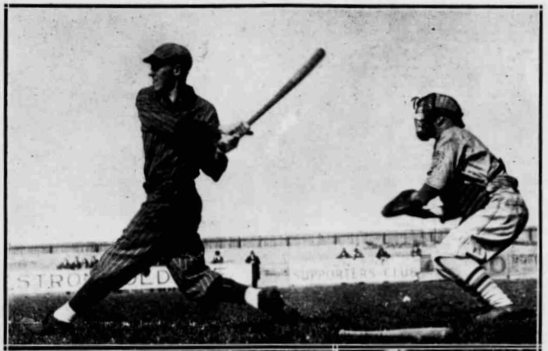
In 1932, the AABA brought the London Americans back to Bournemouth for a game dubbed the “USA” versus the “British Empire”. The latter won by 9 runs to 4. Typical of the AABA, the teams were a hotchpot of entertainers, boxers, ice hockey players, and Rhodes Scholars. The head of the AABA, Canadian Charlie Muirhead, was sincere in his desire to see American baseball become popular in the UK, but he had to work with what he had available; as a result, alas, particularly in its later years, the AABA was more burlesque than baseball.[34]
For the benefit of the visiting people the officers at Stover Camp have arranged an exhibition game of baseball, America's national game, between their team and a picked team from the Canadian Red Cross Hospital, Bushy Park, near London.[35]
On 2 July 1917, another game of some significance was played in Newton Abbott, Devon. This was between one of the teams from John Gibson Lee’s Military Bases and Hospitals League, Bushy Park, visiting from London, and a team from a local detachment of the Canadian Forestry Corps (CFC). There were CFC units stationed throughout England and Scotland, tasked with harvesting timber for use at the Front. They played a lot of baseball. In 1918, Lee’s Bases and Hospital League would be superseded in the London area by two new leagues, one run directly by the Canadian Military Athletics Association and another, the “Anglo-American Baseball League”. The latter was a private commercial venture, an attempt to launch an overseas professional baseball circuit in Europe at a time when it was believed the war could go on for years. Ultimately, only Canadian and American military teams in the London area got involved. One of those teams was a CFC team from a unit based at Sunningdale, Berkshire. Its starting pitcher was Black Canadian Charles Kelly.[36]
BASEBALL EXHIBITION EXETER. U.S.A. WILKES ' v. CANADIANS. The first baseball match in Exeter was played at the County Athletic Ground, on Saturday, between teams representing the U.S.A. battleship Wilkes and the Canadian R.N.V.R., and ended in a win for the Americans by ten to seven.[37]
Nineteen Eighteen marked the high-water mark for American baseball in the West Country in the early part of the twentieth century. It would not be until the return of the American Military in the next World War that the number of games played in the region would reach the same level. In July, American baseball returned to Salisbury, with a game between the 154th Aero Squadron (Lopcombe Corner) and 155th Aero Squadron (Lake Down). Lake Down emerged the victors, 6–3. That same month, US Navy teams played a 4 July game at Dartmouth, Plymouth. There would be at least one more Navy game at Dartmouth, later in the year. American units also played a 4 July game in Bath, in a day that included a tour of the sites and lunch at the Grand Pump Rooms for visiting American troops.[38]
In Cheltenham, the American YMCA organised a 4 July game between teams from US Army Aviation units based in the Cotswolds and Wiltshire. The game was played on the grounds of Cheltenham College and was such a success that the Cotswold team took on a US Army Aviation unit from Bristol a few days later at the city’s athletics ground. The Cotswold team won both games, the latter 7–5.[39]
In June, the first of what would prove to be several exhibition games played in the Bournemouth area in the summer of 1918 took place between teams from US Army units in camp at Worgret and Beaulieu, with Beaulieu winning 9–8. In late September, in a game organised with the help of the American YMCA, teams from US Army units stationed at Wareham and Salisbury, the “Tank Corps” and the “Aviators”, respectively, played an exhibition game at a Children’s Sports Meeting, with the Aviators handing the Tankers an 11–0 drubbing. A few weeks later, two Tank Corps teams from Wareham played a game just down the road at Poole.[40]
Military baseball in the Bournemouth area would continue into 1919, with games between Canadian units in May of that year at Wool and Bournemouth. The Wool game was between two Canadian Tank Corps teams calling themselves “University of Toronto” and “University of Manitoba”, most of the players being “ex-Varsity men”. Manitoba won 8–5.[41]
These games in the summer of 1919 really marked the end of the dominance of military games in the West Country. This is not to say there were no more games between military teams in the region after 1919, of course. We might cite, for example, games between teams of US Navy cadets in Paignton and Torquay during a 1924 visit by the US Naval Academy Practice Squadron, and between sailors from the destroyers Toucey and Breck on Portland and Tracy and Borie at Weymouth, in May and August 1927, respectively. Sailors from the Toucey and Breck also played cricket and baseball against Royal Navy officers during their visit. However, with the return of peace, the pendulum would now swing back in favour of games organised by faith-based organisations.[42]
A display by the Devonport troop of land and sea scouts, under the direction of Mr. W. Best, assisted by Mr. F.W. Moreton, Assistant District Commissioner, Sea Scouts, was followed by a sports display by Devonport Y.M.C.A. Athletic Club. This included a baseball match between picked sides. The sports were watched by a large attendance.[43]
BASEBALL American Coaches For Y.M.C.A. Section. The American game of baseball is slowly being developed in this country, and to-day a number of teams exist in England, and in Wales there is quite a strong league. Recently a section has been started by the Cheltenham Y.M.C.A., who have two American coaches, C. A. Beckstrom and L. C. Larsen, who are co-operating with the Y.M.C.A. teaching their friends in Cheltenham the game.[44]
The YMCA emerged from the First World War a much bigger, more professional, and more centralised organisation than when it entered it. Reinvigorated, it set about regaining the ground it had lost to similar faith-based organisations in the years leading up to the start of the war. It saw sports, particularly American sports, as a means to that end.[45]
The challenge when judging just how much American baseball the YMCA played in the West Country is in trying to divine which code is meant when reports mention “baseball” without any qualifier. It is easy enough when, as in the second quote above, a reference is made to American coaches being employed to teach the game, but what about the first, where only “baseball” is mentioned?
The reason we need to consider this carefully is that, by the 1920s, baseball under the English code was trying to make a comeback in the region. The 1920s and 1930s were a golden age for baseball under the English code in its two heartlands, Liverpool and South Wales, with five-figure crowds turning out for the England–Wales Baseball Internationals, which, by the 1920s, had become an annual event. Spurred on by this success, teams from South Wales began playing exhibition games across the West Country to judge interest in forming local leagues. On 4 August 1928, Wales lost to England in the annual baseball international under the English code in a match played at Liverpool. A few days later, the defeated Wales team took on a representative team from the Welsh leagues in a match at Weston-Super-Mare. Bad weather led to the game being abandoned with the team from the Welsh leagues in a commanding position. In July 1930, teams representing Cardiff East and Cardiff West played an exhibition match at Barnstaple, Devon, with the West team winning by two runs.[46]
Meanwhile, in Gloucestershire, although games under the English code had not been played at a senior level since the end of the nineteenth century, school and junior sporting organisations continued to play under English rules. In May 1927, the Gloucester Scouts took on the Templars. The Scouts scored 17 and 34 in their two innings, the Templars 36 and 43 in theirs. As early as 1922, there was a girls' schools league in Cheltenham, the Cheltenham Schools’ Association Baseball. It ran for at least three years.[47]
So, to read that Bath YMCA Boys’ Centre held a summer camp at Weymouth in August 1928, where “baseball” was played alongside cricket and football, is to be left wondering, which baseball?[48]
My instinct is to say, the deeper one gets into the West Country—the further one gets from South Wales as the car drives—the more likely it is to have been American baseball. So, I am inclined to believe the game played at Devonport in the quote above was American baseball; meanwhile, Taunton YMCA’s claim that its baseball club was the “champion of West England” makes it likely that it played English baseball.[49]
MORMONS' BID AT PLYMOUTH Establishment of Sunday-School. PROGRESS AMONG THE YOUNG. ENCOURAGED by their success in Plymouth, the Mormons are shortly to make overtures for the establishment of a branch in Cornwall—probably at Penzance[...]One of the features which will obtain in Plymouth shortly is "soft-ball," a kind of baseball, practice at which has already been indulged by the young men followers at the Central park, stated Mr. Ashley.[50]
By the mid-1930s, the YMCA was not the only faith-based organisation using the lure of American sports to appeal to potential converts in the West Country. The British Mission of the Church of Jesus Christ of Latter-day Saints, better known as the Mormon Church, added softball to its sports programme (which already included basketball) in 1935. I have written about the role that the Mormon Church played in attempts to popularise American baseball in Britain elsewhere. The British Mission’s sports programmes were run by members of the Mormon equivalent of the YMCA, the Young Men’s Mutual Improvement Association (YMMIA), whose members were known as “M Men” (Mutual Men). In the summer of 1936, the YMMIA held a national softball championship in London. Alongside eventual winners Northampton, there was an M Men team from Bristol.[51]
The “C.A. Beckstrom” and “L.C. Larsen” described in the quote above as American coaches for Cheltenham YMCA’s baseball section were Mormon missionaries, Clarence Archibald “Arch” Beckstrom (1919–1990) and Louis Clair Larsen (1917—2004). That same year, 1938, two more Mormon missionaries assisted in the Cheltenham YMCA’s baseball programme, Van Wilson Green (1917–1978) and Harold Lee Allen (1917–2009).[52]
Although this might at first glance suggest a remarkable example of YMCA and Mormon Church collaboration, the reality is a little different. Arch Beckstrom and Harold Allen weren’t just Mormon missionaries; they were also players in the Rochdale Greys baseball team.[53] Their collaboration with the YMCA marked the next, and final phase of attempts to introduce American baseball into the West Country: the arrival of “settlers”.
Baseball on the County Ground This Evening BASEBALL is to be played on the Gloucestershire County Cricket Ground, Ashley Down, Bristol, at six o'clock this evening. This game is being staged under the auspices of the London Major Baseball League and the star players of the National Baseball Association will be seen in action.[54]
In 1933, Liverpool businessman John Moores revived the National Baseball Association as the first step in his plan to launch professional American baseball leagues across England. The story of the Moores Leagues, which lasted from 1933 until the outbreak of the Second World War, has been told in many places. In 1934, Moores threw his considerable financial resources behind going national. By 1935, there were professional leagues in Lancashire (Moores was based in Liverpool) and Yorkshire, and amateur leagues in those counties and in London. By 1936, a professional league had started in London, too. The Mormon Church ran two [amateur] teams in the professional leagues, a natural extension of its M Men softball programme, the Catford Saints in London and the Rochdale Greys in Yorkshire.[55]
Nineteen Thirty-Six was also the year that the NBA made its first tentative moves into the West Country, with an exhibition game in Bristol by players from its London professional league. Symbolically, the game was played on the Gloucestershire County Cricket ground, where, in 1889, the Spalding baseball tourists had played the first known game of American baseball in the West Country.
The NBA’s aim was nothing less than colonising the West Country the same way it had Yorkshire, Lancashire, and London, but it should come as no surprise that the West Country proved a much tougher nut to crack. Nothing came of that 1936 effort. The NBA tried again in 1937, this time sending to Bourton, Gloucestershire, two amateur teams from just over the border in Oxfordshire, Chadlington and the Chipping Norton Doughboys. The announcer for the game was the redoubtable Fred Lewis, founder of the Oxfordshire baseball scene. But there was still nothing doing.[56]
Then, like the US Cavalry, the RAF came riding in to save the day.
BASEBALL AT WESTON Canadians who, a few months ago, came in for widespread publicity by crossing the Atlantic in a body to join the Royal Air Force, have brought their national game, baseball, with them. Two teams of players, mostly hailing from the Dominion, met for a game at Weston-super-Mare last night. One set of nine came from St. Athan’s Station, and their opponents represented Locking Station.[57]
In the summer of 1939, the NBA stepped into the “lion’s den”, starting an American baseball league in Cardiff, heartland of the English code. (Baseball under the English code had become so synonymous with South Wales by 1939 that many people had started referring to it as “Welsh Baseball”.) This bold endeavour was made possible only by the RAF’s adoption of baseball as a recreational activity: two of the seven teams in the league were RAF teams. But more than this, the RAF teams were willing to act as ambassadors for the sport. Prime among them was the team from the RAF Technical Training School at St Athan, South Wales, which played games across South Wales to promote the league.[58]
Although the results of the Cardiff experiment were mixed—the league attracted a decent amount of interest, but at one of the exhibition games elsewhere in Wales, 75% of the crowd left before the end of the game—the NBA felt confident enough to bootstrap a league in the West Country on the back of it. Following the same blueprint, it held a series of exhibition games between the RAF St Athan team and teams from RAF units in the West Country that had sizeable Canadian contingents.[59]
However, it knew that it needed civilian teams to round out any league. To that end, it copied another of its successful schemes and created a baseball team using the players from a local ice hockey team. Enter the Bristol Bombers.
The arrangements are now complete for the big baseball match to be played on the Bristol Aeroplane Co.’s ground, at Filton, on Wednesday next, commencing at 7 p.m., when the Bristol Bombers ice hockey team will meet the R.AF. (Weston-super-Mare). The sponsors are the National Baseball Association (South Wales Area), and the officials of this organisation intend to put Bristol on the map as far as baseball is concerned.[60]
The Bristol Bombers were a new team created for the 1938/39 English ice hockey season by the manager of the Bristol Coliseum Ice Rink, G.W. McCarthy. In common with most teams in the professional game, all its players were Canadian. Many of them worked for the Bristol Aeroplane Company in the close season.[61]
Ice Hockey had experienced an explosion in popularity in Britain following Great Britain’s unexpected gold medal in the sport at the 1936 Berlin Olympics. The ice rink owners who backed British ice hockey had deep pockets and recruited large numbers of Canadian players to expand their leagues. This move coincided with John Moores’ NBA greatly increasing the number of its own leagues. Not one to look a gift horse in the mouth, the NBA snapped up the Canadian ice hockey players as they arrived, offering them a chance to increase their earnings in the close season by playing baseball, something the players were used to doing back in Canada.[62]
We have a roster for the Bristol Bombers nine.
Bristol Bombers.—First base, Taylor; catcher, Tennian; second base, Chowen; pitcher, Hamilton; short stop, Cornish; third base, McPherson; right field, Plummer; centre field, Munro; left field, McLeod.[63]
The battery was Donald Walter “Don” Hamilton (1914–1997) of Manitoba, pitcher, and John Francis “Jack” Tennian (1920–1942) of Saskatchewan, catcher. Tennian joined the RAF at the outbreak of the Second World War. Tragically, he was killed in a flying accident in September 1942, aged just 23.[64]
The Bristol Bombers have the distinction of being the first professional baseball team in the West Country. Alas, they were also the last.
The NBA’s dream of adding a Bristol league to complement its Cardiff league was dashed by the outbreak of the Second World War. In fact, by 1939, the wheels had already come off John Moores’ attempt to popularise American baseball in Britain. The decision to fuel the burgeoning scene’s expansion by mass-recruiting North American players had proved disastrous. Although this unquestionably raised the standard of play compared to games between teams of rookie British players, it turned off fans. The whole reason that the English version of baseball existed was that British sports fans liked their bat-and-ball games to flow smoothly and have frequent run-scoring. The more North Americans in a baseball game, the shorter the innings and the lower the scores. North American fans celebrated shutouts; British fans left before the game ended. In the face of this downturn, the NBA could not survive the disruption to organised sport that the outbreak of war brought.[65]
The Bristol Bombers played their last game at Weston-Super-Mare on 2 September 1939, a return match against the RAF (Weston-Super-Mare) team. Its players then dispersed into the RAF, war industries, or went back to Canada. A local newspaper captured a photograph of the two teams at the end of the game, smiling, side by side, walking confidently into the future.[66]
BOURNEMOUTH CUBS.—Now entering their second season, are finding the absence of a Baseball League in their area the big drawback. They are afraid of waning interest through lack of games, and therefore would like to contact any Southern Counties Club who like a day in Sunny Bournemouth. What about it, some of you live-wire secretaries? Here is an excellent opportunity to organise an excursion that will strengthen the team spirit of your club. Oh, yes—we know there is expense involved, but why not start taking small payments weekly from your members for a future date? The Cubs offer return fixtures wherever possible. Secretary: Victor Beach, 25, Shaftesbury Road, Bournemouth, Hants.[67]
The Second World War would bring American baseball back to the West Country in a big way. As with other regions of England, this sparked interest in the game in a new generation of English sports fans. However, the problem was the old one: the West Country was too far from the centre of the gravity of the game in England to sustain a scene of its own, and the expense of travelling to games against teams elsewhere was too great. The Bournemouth Cubs survived only 3 years.[68]
The story of American baseball in England has been described as one of “prolonged cultural resistance”; in England’s “Wild West”, it was distance, not resistance, that kept it away.[69]
Jamie Barras, June 2026.
Back to Diamond Lives
Postscript: Although there was briefly a South West Baseball League in the region in the 1990s, it wouldn’t be until the second decade of the twenty-first century that American baseball would establish something akin to a permanent presence in the region. In 2012, a new South West Baseball League was created, which, in 2016, became the South West and Wales Baseball League (SWWBL). As of 2026, the SWWBL operates two divisions in three districts.[70]
Appendix: Rounders in Gloucestershire
Nailsea: Rounders Club. The following match was played at Nailsea on Saturday last, and after a very exciting game ended in favour of the B.R.R.C. [Bedminster Rangers’ Rounders Club].[71]
By the early 1870s, rounders as a sport had grown beyond its Bristol roots and was being played across South Gloucestershire, Somerset, and even into Devon. However, there appears to have been no attempt to establish a governing body or codify the rules—developments that would be necessary if the sport were to continue growing. Nor does there seem to have been any attempt to move the game on from its origins. A spectator viewing a game of organised rounders in the Bristol area in the 1870s would have seen something near-identical to the children’s game they knew, except in the keeping of score. A small, soft ball was still used, as was a short, one-handed bat. Similarly, teams comprised six or eight players, which meant the bases/posts were not covered. The latter was not deemed necessary, as the main way of putting runners out, as with the children’s game, was hitting them with a thrown ball.[72]
One reason for this lack of greater organisation was that the region was too sparsely populated to develop a large integrated scene. This was a function of its largely rural character outside of the major population centres of Bristol and Gloucester. This stood in major contrast to the situation with the other centres of rounders in this period, the industrialised regions of Liverpool/Lancashire and South Wales. By 1871, Lancashire was second only to London in population density.[73]
It is no surprise then that it was the Liverpool rounders scene that produced the sport’s first governing body, the Liverpool Rounders Association, which, on the adoption of a codified set of rules in 1883, transformed into the National Rounders Association (NRA). It is also no surprise that the rules of baseball were a direct inspiration.[74] They were there ready to be drawn upon; but more than this, the Liverpool rounders enthusiasts had been able to see the American game for themselves when the Harry Wright baseball tourists played in the city in 1874. Their version of rounders drew directly from that experience.[75]
ROUNDERS. A handsome bronze challenge shield has been obtained for the working men of Gloucester, and will be competed for on Wednesday next, in the Park, under the rules of the National Rounders' Association, between the Wagon Works Rounders' Club and the Atlas Rounders' Club.[76]
The first games played in Gloucestershire under the NRA (Liverpool) rules were played in July 1887 by two works teams. By the following season, the Gloucestershire Rounders Association (GRA) had been formed under the presidency of Gloucester corn merchant and Liberal MP, Thomas Robinson (1827–1897). The organising secretary was cabinet maker Frederick Mansfield (1839–1915), another Liberal. The GRA’s clubs were a mix of works teams and teams associated with religious institutions; these included two teams from the Gloucester Wagon Works (Smith’s Shop and Turners and Fitters) and a team from the Fielding and Platt Company’s Atlas Works, alongside the Ryecroft Wesleyans, Gloucester Rangers, Beaufort Rovers, Harlequins, and X.L.C.R. (Excelsior). This placed the development firmly in line with ideas current at the time about the importance of physical recreation for working men and women—a happy worker was a productive worker. In 1886, the National Physical Recreation Society recognised the value of rounders as a sport for the working man by donating a shield to be competed for by rounders clubs across Britain.[77]
THE AMERICAN BASE BALL PLAYERS IN BRISTOL. RECEPTION AND EXHIBITION GAME. The American base ball players yesterday visited Bristol, received a hearty reception from many of the local sportsmen, played an interesting exhibition game at the new County Cricket Ground, gave a few of the chief members of the Gloucestershire team a chance to bat against their peculiar delivery, and returned to London by the evening train.[78]
The year after the Gloucester Rounders Association was formed, baseball came to the county. This was in the form of the Spalding tourists, who, by this time, were coming to the end of their world tour. The Bristol game was the tourists’ first game in England outside London. Bristol was likely chosen because it was the home of W.G. Grace, who had been born in the city in 1848 and played for the Gloucestershire county team. The great man was present at the civic reception for the tourists and received a toast from Albert Spalding. He was also one of the county cricketers who faced a few balls after the game. A good number of the spectators left before the game was over, their curiosity satisfied but their interest not piqued. This was to prove a recurring theme of the tour, which was not judged a success.[79]
The tourists ended the English leg of their tour with three games in Liverpool: an exhibition game of baseball followed by games of rounders and baseball against a Liverpool team drawn from the city’s rounders clubs. Each side likely hoped to demonstrate the superiority of its game; in the event, it was honours even, with the Liverpool rounders players winning the rounders match and the American baseball players winning the baseball game. This left both sides unsatisfied. However, the experience had a lasting effect on rounders as a sport, as it led directly to the adoption of new rules that replaced the small, soft rounders ball with a junior baseball, and allowed the batter to grip the bat one- or two-handed at his discretion. The adoption of the hard baseball also saw an end to putting a batter out by hitting him with a thrown ball, for obvious reasons.[80]
Thus, rounders came even closer to baseball in its rules. There were even those who saw the two sports merging in the not-too-distant future. Instead, they were to become ever more bitter rivals. Something that was prompted by the National Rounders Association’s decision in April 1892 to rebrand itself.[81]
Since the challenge was originally given the National Rounders Association has changed its name to “The English Baseball Association”, although still playing the old game of rounders. I am glad to state, however, that the matches referred to will be played according to the genuine or regular baseball rules.[82]
The decision by the NRA to change the name of its sport to “baseball” enraged the men who, in the wake of the Spalding tour, were attempting to introduce American baseball into England. In fact, the American baseball boosters had only themselves to blame: the main reason the NRA changed the name of its sport was the association of the name “rounders” in the public consciousness with the children’s game that had spawned it, something the American game’s boosters had exploited. Newton Crane, the American lawyer and newspaperman in charge of promoting baseball in Britain, in his 1891 book on baseball intended for a British audience, wrote that “It has been urged against baseball that it is simply an improved form of rounders. It undoubtedly owes its origin to rounders, but it bears less resemblance to that game than modern cricket does to the ancient sport of the village green, where an inverted milking stool and wooden balls were the rude implements of play.”[83]
The Gloucestershire Rounders Association followed the national body in changing its name to the English Baseball Association (EBA) in May 1892. That same month, the South Wales Rounders Association rebranded itself, somewhat awkwardly, the South Wales English Baseball Association (quickly shortened to the more sensible South Wales Baseball Association).[84]
(One thing worth noting about this latter affair is that it makes plain that the game’s originators intended that their game be known as “English Baseball”, not simply “Baseball”—the “English Baseball Association” was the organising body of English Baseball, not the organising body of Baseball in England. However, this intent would soon be lost, with subsequent generations of players simply calling their game “baseball”, using the qualifier “English” only when contrasting it with the American game.)
Notes
[1] ‘Baseball Match at Plymouth’, Western Daily Mercury, 22 July 1912.
[2] Years of birth and death: entry for George Richard C. Pike, Gloucester, Births, Marriages, and Deaths: https://www.freebmd.org.uk/cgi/search.pl, accessed 24 May 2026; cross-referenced with marriage bann for George Richard Charles Pike, Oxfordshire, England, Church of England Marriages and Banns, 1754-1930, ancestry.co.uk, Ancestry.com Inc. (Operations), accessed 24 May 2026. Companion piece: https://www.ishilearn.com/diamond-lives-a-stchurt-game-for-nacky-yobs, accessed 28 May 2026.
[3] ‘Sporting Gossip’, Gloucestershire Echo, 5 August 1926.
[4] ‘The Old Game of Rounders’, Western Daily Press, 3 August 1864.
[5] ‘The American Game of Baseball’, Evening Star, reproduced in the Lancaster Gazette, 29 August 1874.
[6] Martin J. Daunton, Coal Metropolis, Cardiff 1871–1914 (Leicester: Leicester University Press, 1977), 39–42.
[7] Debbie Shaefer-Jacobs, Civil War baseball, National Museum of American History, https://americanhistory.si.edu/explore/stories/civil-war-baseball, accessed 25 May 2026.
[8]https://www.ishilearn.com/diamond-lives-intolerance, accessed 25 May 2026.
[9] Newton Crane, President of the National Baseball Association, letter to the Liverpool Mercury, 23 June 1892.
[10] GRA 200 members: ‘Gloucestershire Rounders Association’, Gloucester Citizen, 17 October 1890. Size of Liverpool game: ‘Rounders’, North British Daily Mail, 31 March 1885.
[11] Not that this stopped the American baseball boosters from trying, unsuccessfully, to replace the English game with the American one in Liverpool and South Wales. See Note 7 above. For an account of the Midlands baseball scene in the 1890s, see Joe Grey, ‘What About the Villa?’ (Fineleaf Editions, 2010). For the North East baseball scene, see https://www.ishilearn.com/diamond-lives-iron-and-ash, accessed 26 May 2026. For the London scene, see R.G. Knowles and Richard Morton, ‘Baseball’, (London: George Routledge & Sons, 1896).
[12] Devon rounders clubs: ‘Rounders at Exeter’, Exeter Flying Post, 1 April 1899. Minehead game: ‘Rounders Club’, West Somerset Free Press, 27 April 1895.
[13] Baseball tourists in Bristol: ‘The American Base Ball Players in Bristol’, Western Daily Press, 16 March 1889. Torquay proposal and result: ‘Baseball’, Torquay Times and South Devon Advertiser, 21 March 1890; ‘Notes in the West’, Western Morning News, 7 April 1890. It should be acknowledged that baseball under the English code fared no better, with a 1907 attempt by a Devon football club to introduce the game attracting little interest: ‘The Teignmouth Football Club’, Teignmouth Post and Gazette, 5 April 1907.
[14] ‘About Bristol’, Bristol Times and Mirror, 24 May 1907.
[15] Hugh McLeod, ‘The YMCA and the Rise of Modern Sport’, https://ymcaheritage.com/wp-content/uploads/2020/04/The-Rise-of-Modern-Sport-YMCA-Oral-Histories-and-Stories-v.2.pdf, accessed 16 July 2025. YMCA teams in the Cardiff English Baseball leagues: ‘Baseball’, South Wales Daily News, 22 May 1911.
[16] Hallett: https://www.findagrave.com/memorial/186378383/edgar-baker-hallett. Early efforts in Bristol: Note 27 above and the following: “Canadian baseball”: ‘Hanham’, Western Daily Press, 29 July 1907; ‘Temperance Demonstration at Hanham’, Western Daily Press, 11 June 1908.
[17] Hallett transfer from Bristol to Plymouth YMCA: ‘New Y.M.C.A. Secretary’, Western Daily Mercury, 30 April 1912. Water polo league: “Three Towns Water Polo League’, Western Daily Mercury, 20 May 1912.
[18] ‘Baseball Exhibition Game at Plymouth’, Western Daily Mercury, 20 July 1912.
[19] See Note 1 above.
[20] 'Battleship for the Middies; Three Assigned to Them for Next Summer's Cruise', New York Times, 27 November 1909.
[21] ‘Baseball Match at Mount Wise’, Western Morning News, 30 June 1910.
[22] “Wild West” of England: ‘Stag Hunting on Exmoor’, Illustrated London News, 25 August 1888. This connection is discussed in detail in the following: French, Henry. 2024. “‘The Wild West of England’: Enclosure, Stag-Hunting, and the Creation of New Popular Perceptions of Exmoor in the Nineteenth Century.” Cultural and Social History 21 (4): 507–34. doi:10.1080/14780038.2024.2359502. Baseball and the American West: Jude Butler, More than a Sport, https://sabr.org/journal/article/more-than-a-sport-early-developments-of-baseball-in-lawrence-kansas/; Jeffrey P. Beck, American Indian Barnstorming Teams, https://sabr.org/journal/article/american-indian-barnstorming-teams/, accessed 30 May 2026.
[23] ‘Y.M.C.A and the Recreation for the Troops’, Western Times, 3 September 1914.
[24] ‘With the Canadians on Salisbury Plain’, Gloucestershire Echo, 6 November 1914.
[25] See Note 2 above, final reference, and the following: Andrew Taylor, “Did Canada Save British Baseball?”, Journal of Canadian Baseball, 2022, 1 (1), https://ojs.uwindsor.ca/index.php/jcb/article/view/7699, accessed 27 May 2026.
[26] ‘Sporting Gossip’, Gloucestershire Echo, 23 October 1915.
[27] ‘Local War News’, Gloucestershire Echo, 30 October 1915.
[28] ‘Canadian Baseball in England’, Salisbury and Winchester Journal, 8 July 1916; ‘Baseball Match’, Salisbury Times, 4 August 1916.
[29] See Taylor, Note 25 above, second reference. Lee died in what is popularly known as the 1918 Spanish Flu Epidemic: ‘Deaths’, Middlesex County Times, 23 November 1918.
[30] ‘Baseball at Bournemouth’, Bournemouth Graphic, 5 October 1917.
[31] See Note 30 above.
[32] Dublin: ‘Baseball: Interesting Game in Dublin’, Evening Herald (Dublin), 27 October 1917; Belfast: ‘Baseball Match in Belfast’, Northern Whig, 1 November 1917. The Belfast game featured a late-game substitution, with African-American Jazz musician Louis Mitchell stepping in to replace the injured London Americans pitcher Stanley. Mitchell would go on to run his own baseball team in Paris: Berliner, Brett A. "Syncopated Hits: The Clef Club Negro Baseball Team in Jazz-Age Paris." NINE: A Journal of Baseball History and Culture 19, no. 2 (2011): 44-52. https://dx.doi.org/10.1353/nin.2011.0009.
[33] The AABA: https://www.ishilearn.com/diamond-lives-art, accessed June 2026. See also: ‘Baseball: Attempt to Popularise Game in This Country’, West London Observer, 8 May 1925.
[34] ‘Baseball—and Bud’, Bournemouth Times and Directory, 20 May 1932.
[35] ‘Dominion Day’, Western Times, 2 July 1917.
[36] Taylor, Note 25 above, second reference; Dame, Stephen. 2022. “Coloured Diamonds: Integrated Baseball in the Canadian Expeditionary Force 1914-1918”. Journal of Canadian Baseball 1 (1). https://doi.org/10.22329/jcb.v1i1.7696.
[37] ‘Dominion Day’, Western Times, 2 July 1917.
[38] ‘Baseball Match’, Salisbury and Winchester Journal, 27 July 1918; ‘Glorious Fourth’, Western Morning News, 5 July 1918; ‘West of England News’, Western Morning News, 19 November 1918; ‘Spa Towns: Bath’, Morning Post, 4 July 1918.
[39] ‘Two American Teams…’, Gloucestershire Echo, 15 July 1918; ‘Voluntary War Work in Gloucestershire’, Gloucestershire Echo, 18 March 1919.
[40] ‘Baseball Match’, Swanage and Wareham Guardian, 6 July 1918; ‘Children’s Sports Meeting’, Bournemouth Guardian, 5 October 1918; ‘RFA Prisoners of War’, Swanage and Wareham Guardian, 12 October 1918.
[41] ‘Successful Fete and Gymkhana at Wool’, Western Gazette, 16 May 1919; ‘Local and District News’, Western Gazette, 23 May 1919.
[42] ‘Torquay Invaded’, Western Morning News, 21 June 1924; ‘American Naval Visitors’, Western Morning News, 17 May 1927; ‘Baseball at Castletown’, Southern Times and Dorset County Herald, 21 May 1927; ‘Baseball at Lodmoor’, Southern Times and Dorset County Herald, 27 August 1927.
[43] ‘Carnival Days at Devonport’, Western Morning News, 6 September 1928.
[44] ‘Baseball: American Coaches for Y.M.C.A. Section’, Gloucestershire Echo, 28 May 1938.
[45] John Weier, ‘The YMCA At War’, https://www.vahs.org.uk/2013/04/feature-4/, accessed 31 May 2026.
[46] ‘Baseball: England Beat Wales At Liverpool’, Western Mail, 6 August 1928; ‘Baseball at Weston’, Western Daily Press, 9 August 1928; ‘Baseball’, North Devon Herald, 31 July 1930.
[47] ‘Baseball’, Gloucestershire Citizen, 31 May 1927; ‘Baseball’, Gloucestershire Echo, 18 July 1922; ‘Cheltenham Schools’ Association Baseball League’, Gloucestershire Echo, 11 October 1924.
[48] ‘Y.M.C.A. Boys’ Centre’, Bath Chronicle and Weekly Gazette, 20 August 1927.
[49] ‘Taunton Y.M.C.A’, Taunton Courier and Western Advertiser, 20 November 1929.
[50] ‘Mormons’ Bid at Plymouth’, Western Morning News, 12 August 1935.
[51] ‘M Men Softball’, Millennial Star, 23 May 1935; https://www.ishilearn.com/diamond-lives-beyond-the-saints-and-greys, accessed 31 May 2026; ‘From the Mission Field: Another Climax’, Millennial Star, 13 August 1936. The Millennial Star was the newsletter of the British Mission of the Mormon Church. Issues can be read at archive.org: https://archive.org/search?query=subject%3A%22Millennial+Star%22, accessed 31 May 2026.
[52] Clarence Beckstrom: https://www.familysearch.org/en/tree/person/sources/KWC6-BRD; Louis Larsen: https://www.findagrave.com/memorial/111639398/louis-clair-larsen; Van Wilson Green: https://www.familysearch.org/en/tree/person/details/KWCV-561; Harold Allen: https://www.familysearch.org/en/tree/person/details/KWZZ-FFF, accessed 31 May 2026. Allen and Green: ‘Baseball Match’, Gloucestershire Echo, 1 September 1938.
[53] Beckstrom and Allen in Rochdale Greys; see, for example, ‘Baseball’, Rochdale Observer, 13 August 1938; ‘Baseball’, Rochdale Observer, 7 June 1939; ‘Baseball’, Rochdale Observer, 15 July 1939.
[54] ‘Baseball on the County Ground This Evening’, Western Daily Press, 19 August 1936.
[55] The best short version of the story of the Moores leagues is: Daniel Bloyce, ‘John Moores and the ‘Professional’ Baseball Leagues in 1930s England’, Sport in History, 27:1 (2007), 64-87: https://doi.org/10.1080/17460260701231067.
[56] ‘Baseball at Bourton’, Gloucestershire Echo, 9 July 1937.
[57] ‘Baseball at Weston’, Bristol Evening Post, 20 July 1939.
[58] I tell the story of the Cardiff American Baseball League and RAF baseball here: https://www.ishilearn.com/diamond-lives-health-friendship-and-baseball-part-iii, accessed 31 May 2026. See also: ‘Cardiff American League’, Western Mail, 22 May 1939; ‘Somerton Park Novelty’, South Wales Argus, 13 May 1939; ‘American Baseball at Mountain Ash: Some Candid Comments’, Merthyr Express, 3 June 1939. “Lion’s Den” is the description applied to South Wales by Alfred Grogan, secretary of the Yorkshire County [American] Baseball Association in the association’s June 1939 monthly newsletter (author’s personal collection).
[59] ‘Baseball for Bristol’, Bristol Evening Post, 18 August 1939; ‘Baseball Match Tomorrow’, Bristol Evening Post, 22 August 1939.
[60] ‘Baseball Match at Fitton Next Week’, Bristol Evening Post, 19 August 1939.
[61] ‘The Bristol Bombers’, Fife Free Press, 11 February 1939; ‘Ice Hockey at the Coliseum’, Bristol Evening Post, 12 January 1939; ‘To-night’s Ice Hockey at the Coliseum’, Bristol Evening Post, 6 January 1939. ‘Straight Off the Ice’, Dundee Evening Telegraph, 7 February 1939. The best information I have found about the Bristol Bombers is a Reddit post from the grandson of one of the players: https://www.reddit.com/r/hockey/comments/1nswkhq/my_grandad_played_hockey_in_the_uk_between/, accessed 31 May 2026.
[62] I tell that story here: https://www.ishilearn.com/diamond-lives-slugger, accessed 31 May 2026.
[63] ‘American-Style “Battle Cries” as Bristol Samples Baseball’, Bristol Evening Post, 24 August 1939.
[64] Don Hamilton: https://www.familysearch.org/en/tree/person/details/G5X9-F2N, accessed 1 June 2026, cross-referenced with the entry for Donald W. Hamilton, Bristol district, 1939 England Register, ancestry.co.uk, Ancestry.com Inc. (Operations), accessed 1 June 2026. Jack Tennian: ‘Killed’, Leader-Post (Regina, Saskatchewan), 26 September 1942; https://www.familysearch.org/en/tree/person/details/LRY2-8W3, accessed 1 June 2026.
[65] See Bloyce, Note 55 above.
[66] ‘Baseball at Weston’, Bristol Evening Post, 30 August 1939; photograph, caption ‘Combined teams of RAF (Weston) and Bristol Bombers, who gave Weston a taste of baseball last weekend’, Weston-super-Mare Gazette, 9 September 1939.
[67] ‘News from the Diamonds’, Baseball (In Britain) Monthly, Issue 1, May 1950. Available to read here: https://projectcobb.org.uk/materials.html, accessed 1 June 2026.
[68] I base this on the last press mention of the Cubs: ‘Sunday Baseball’, Daily Express, 1 September 1951.
[69] Bloyce, Daniel & MURPHY, PATRICK. (2008). Baseball in England: A Case of Prolonged Cultural Resistance. Journal of Historical Sociology. 21. 120 - 142. 10.1111/j.1467-6443.2008.00332.x.
[70] 1990s South West Baseball League: ‘Baseball’, Western Evening Herald, 29 May 1991. SWWBL: https://www.facebook.com/SouthWestandWalesBaseballLeague/, accessed 1 June 2026.
[71] ‘Nailsea: Rounders Club’, Bristol Mercury, 31 May 1873.
[72] See Note 9 above for a scorecard showing teams with six players and runners “thrown out”. In the earliest records of the game in Bristol, runners put out by being hit with a thrown ball were recorded as “struck out”—something lost in translation? See scorecard here for an example: ‘Rounders’, Western Daily Press, 24 August 1867.
[73]https://www.populationspast.org/resources/rsd/pop_dens_1871.pdf, accessed 25 May 2026.
[74] “…these laws being mainly founded on a very popular American game called Base Ball”: W.H. Hivey, Hon. Sec. Rounders’ Association, letter to the Manchester Courier, 6 June 1883.
[75] See Note 4 above.
[76] ‘Rounders’, Gloucestershire Chronicle, 23 July 1887.
[77] ‘Gloucestershire Rounders Association’, Gloucester Citizen, 30 May 1888. In an earlier report, the name under consideration was ‘Gloucester Rounders Association’, Gloucester Citizen, 2 May 1888. National Physical Recreation Society shield: ‘The Naval and Military Tournament’, Liverpool Daily Post, 19 December 1887. The report records the presentation in May of the previous year, the shield to the National Rounders Association. Thomas Robinson: https://www.familysearch.org/en/tree/person/details/GZKX-DYC; Frederick Mansfield: https://www.familysearch.org/en/tree/person/details/GXYK-Y1N, accessed 25 May 2026. Year of death for Mansfield, from search of Births, Marriages, and Deaths for Gloucester: https://www.freebmd.org.uk/cgi/search.pl, accessed 25 May 2026.
[78] ‘The American Base Ball Players in Bristol’, Western Daily Press, 16 March 1889.
[79]https://chicagology.com/baseball/1888worldtour/, accessed 25 May 2026. The tour is described in detail in: Harry Clay Palmer, James Austin Fynes, J. Austin Fynes, Francis C. Richter, William Ingraham Harris, ‘Athletic sports in America, England and Australia’, (Philadelphia, Boston: Hubbard Brothers, 1889), 151—460.
[80] Liverpool Games: ‘The American Baseball Teams at Liverpool’, Sporting Life, 25 March 1889. New Rounders rules: James Manders Walker, ‘Modern Rounders’, in ‘Rounders, Quoits, Bowls, Skittles And Curling’. (London: George Bell and Sons, 1892), pages 7–17.
[81] NRA name change: ‘English Baseball’, Liverpool Mercury, 25 April 1892.
[82] Newton Crane, President of the National Baseball Association, letter to the Liverpool Mercury, 23 June 1892.
[83] Newton Crane, ‘Baseball’ (London, UK: George Bell & Sons, 1891), page 2.
[84] Gloucestershire name change: ‘Gloucester Baseball’, Gloucester Citizen, 30 May 1892; South Wales: ‘Rounders’, South Wales Echo, 25 May 1892.
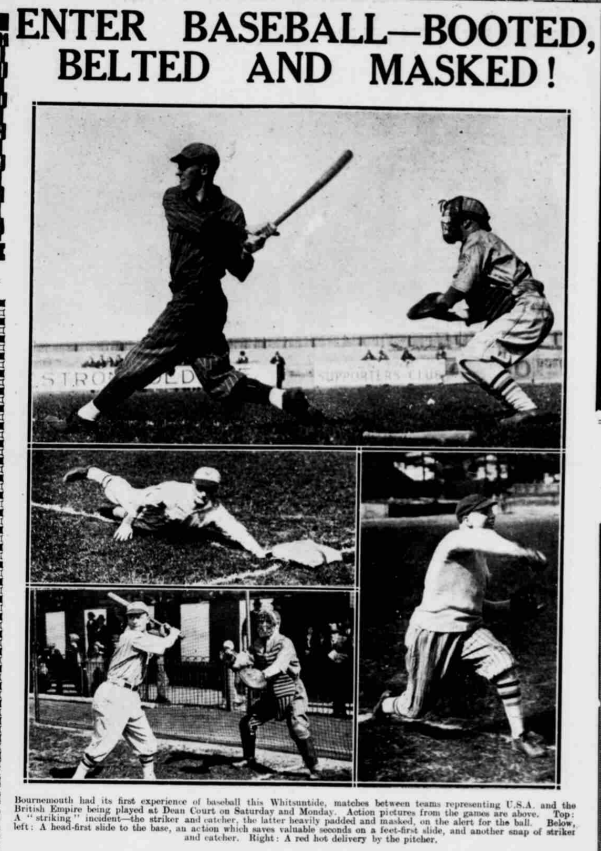
London Americans, 1932 vintage. Bournemouth Times and Directory, 20 May 1932. Image created by the British Library Board. No known copyright holder.
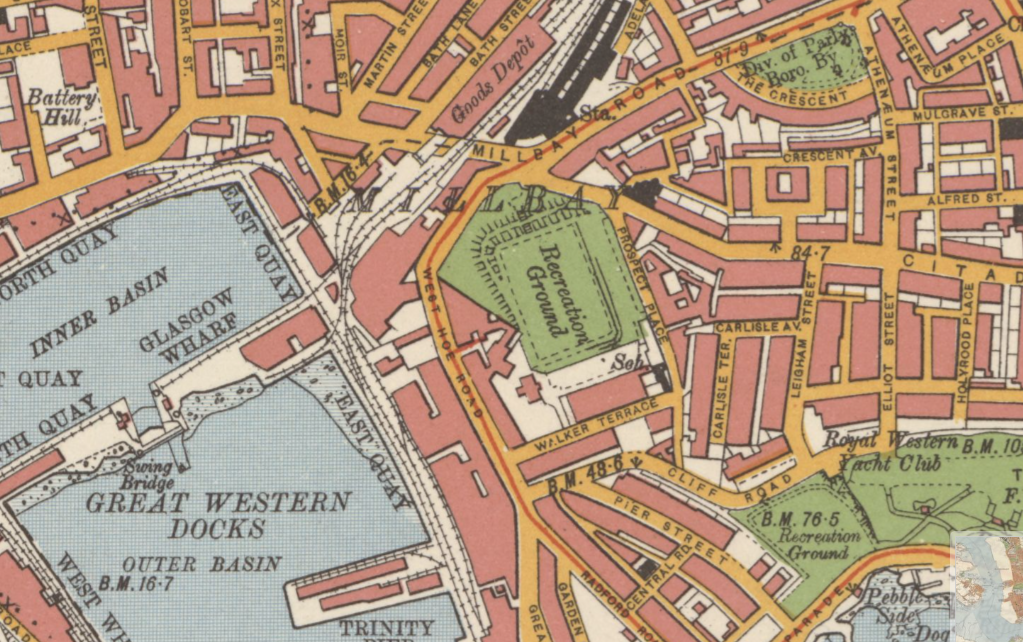
Recreation ground, Millbay, Plymouth. Ordnance Survey, 1920. Courtesy of the National Library of Scotland: https://maps.nls.uk/os/
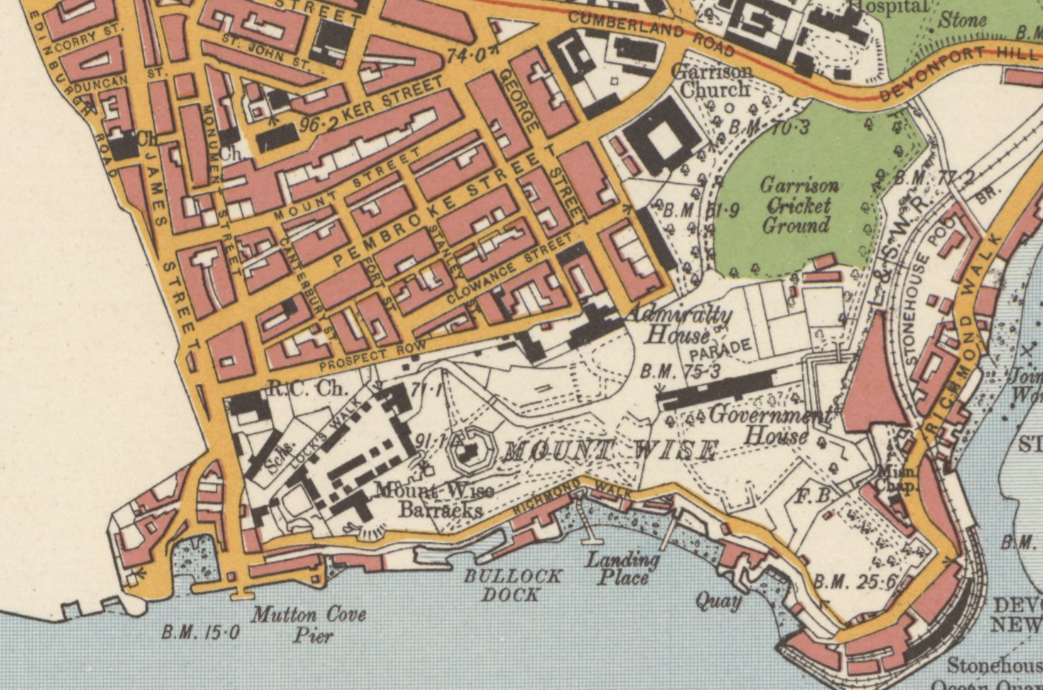
Cricket ground, Devonport, Plymouth. Ordnance Survey, 1920. Courtesy of the National Library of Scotland: https://maps.nls.uk/os/
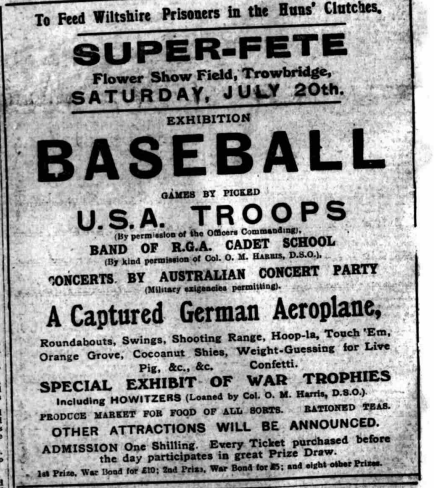
Baseball, Trowbridge, Wiltshire Times, 6 July 1918. Image created by the British Library Board. No known copyright holder.
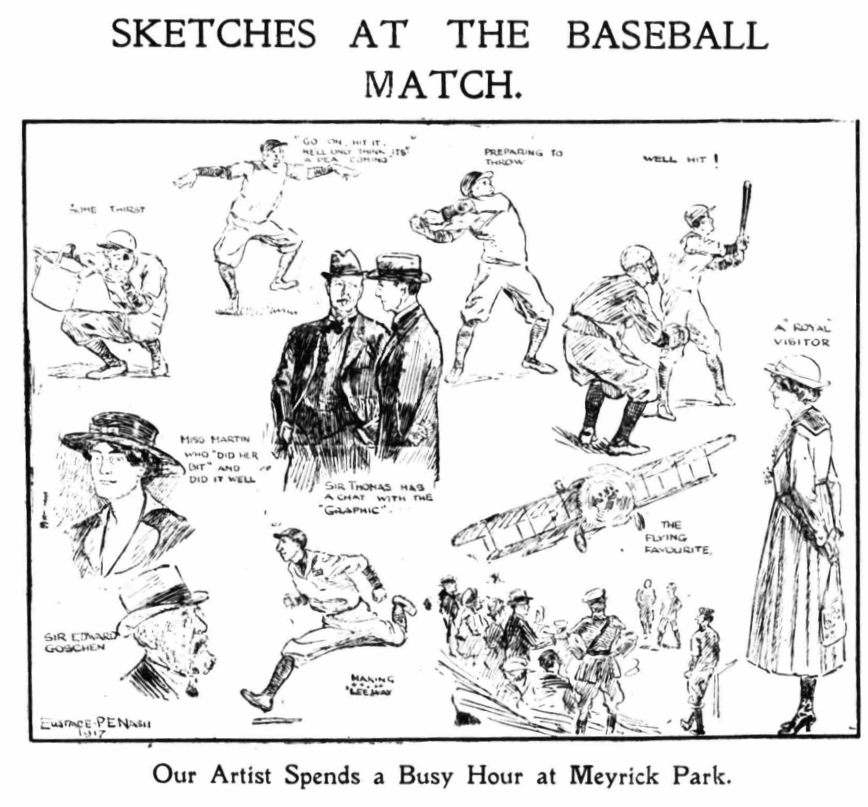
Cartoon, Eustace P.E. Nash, Bournemouth Graphic, 5 October 1917. Image created by the British Library Board. No known copyright holder.
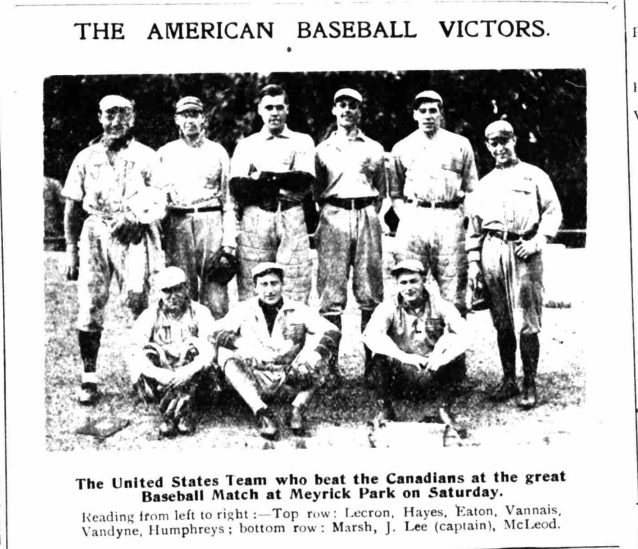
London Americans, 1917 vintage. Bournemouth Graphic, 5 October 1917. Image created by the British Library Board. No known copyright holder.
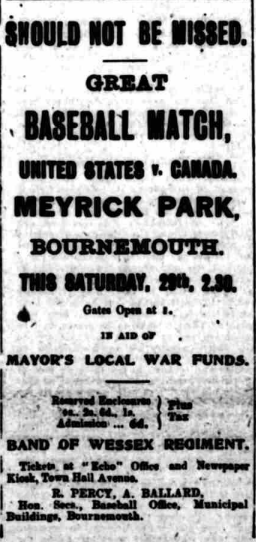
London Americans, 1917 vintage. Bournemouth Graphic, 29 September 1917. Image created by the British Library Board. No known copyright holder.
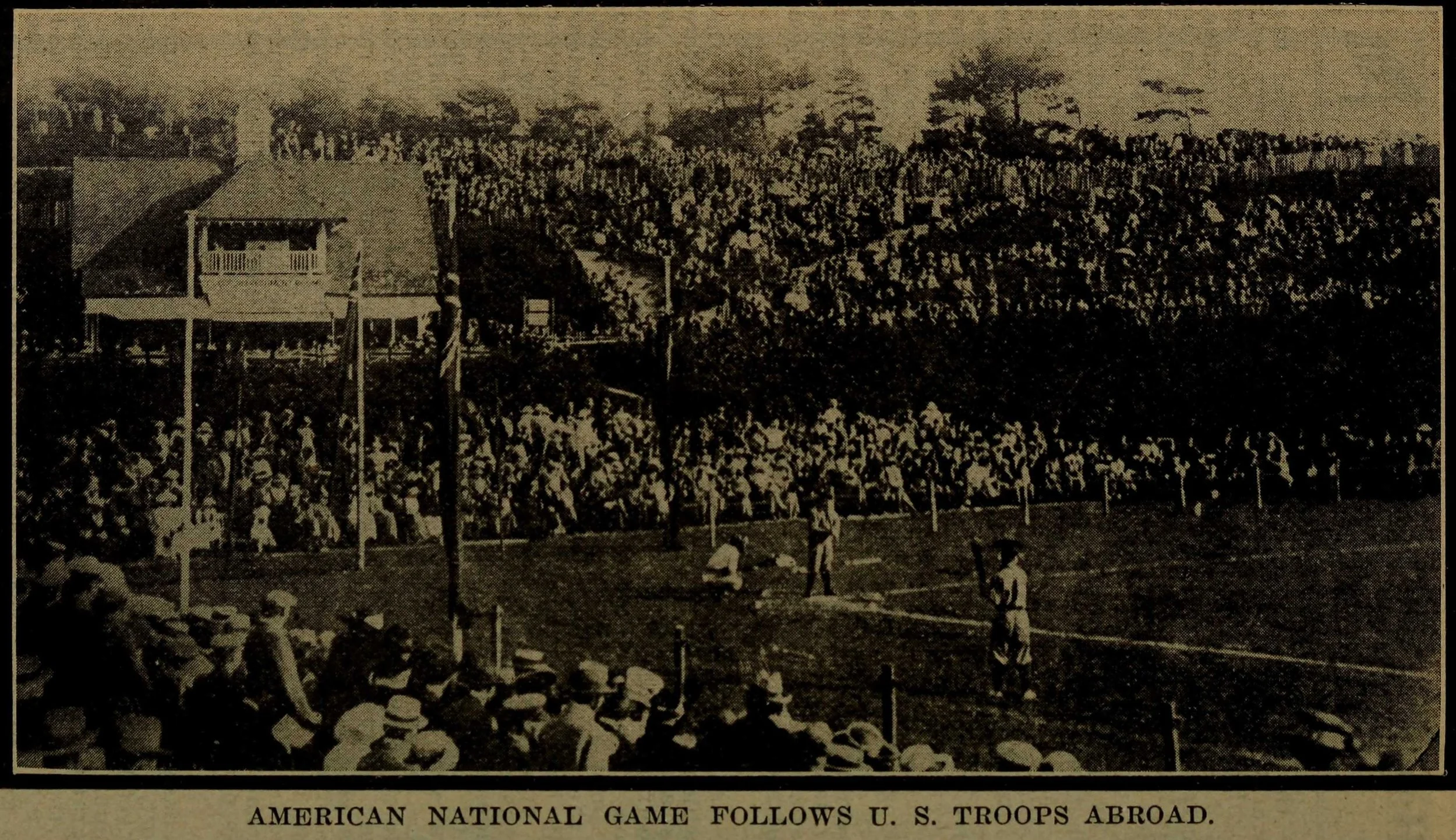
London Americans, 1917 vintage, Bournemouth, Meyrick Park golf links, October 1917. The Reach official American League base ball guide 1918-1919. Image created by the Smithsonian. Public domain.
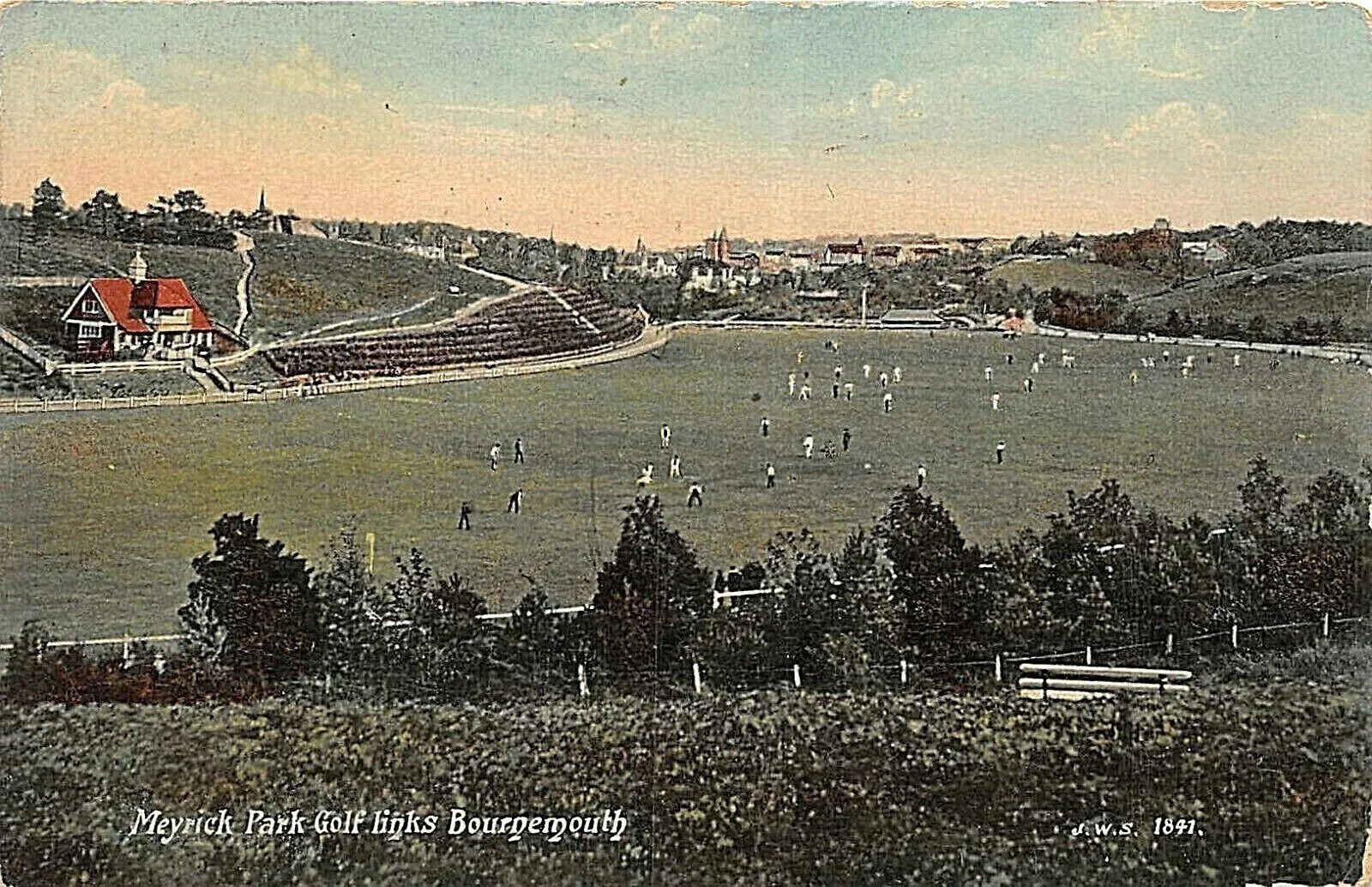
Bournemouth, Meyrick Park golf links. Postcard. Author's own collection.
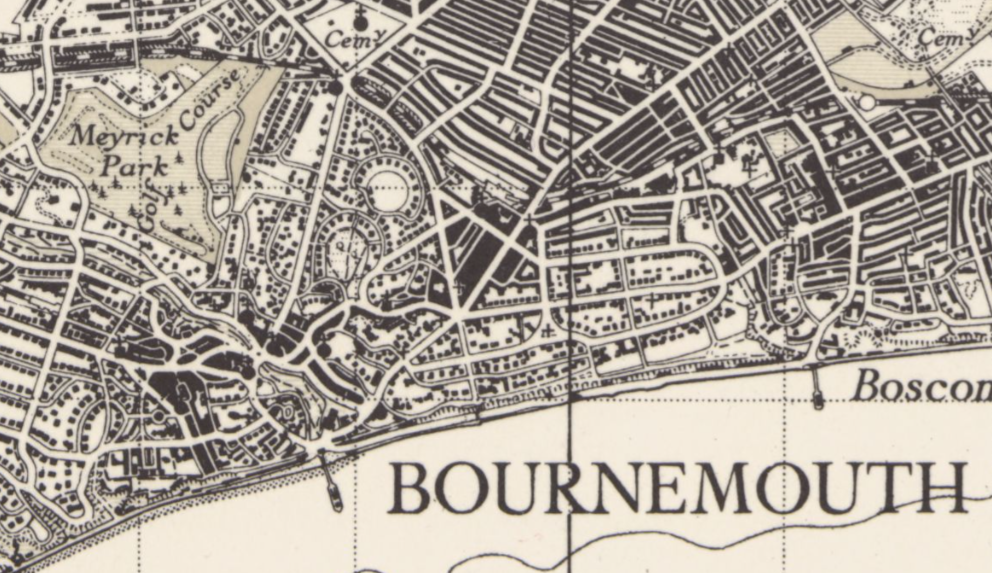
Meyrick Park, Bournemouth. Ordnance Survey, 1930. Courtesy of the National Library of Scotland: https://maps.nls.uk/os/
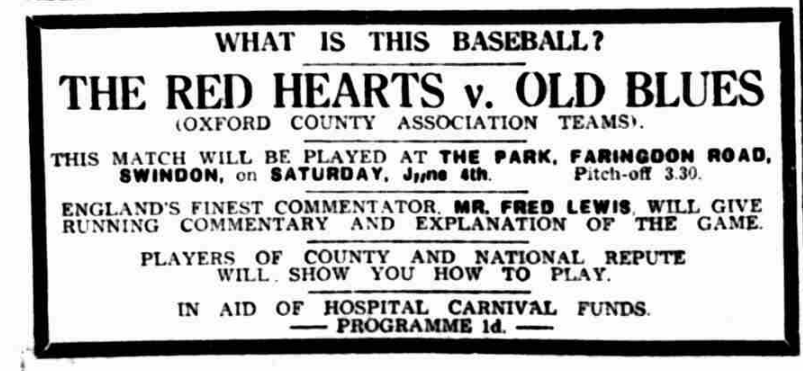
Fred Lewis and the Chipping Norton teams in Wiltshire. North Wiltshire Herald, 3 June 1938. Image created by the British Library Board. No known copyright holder.
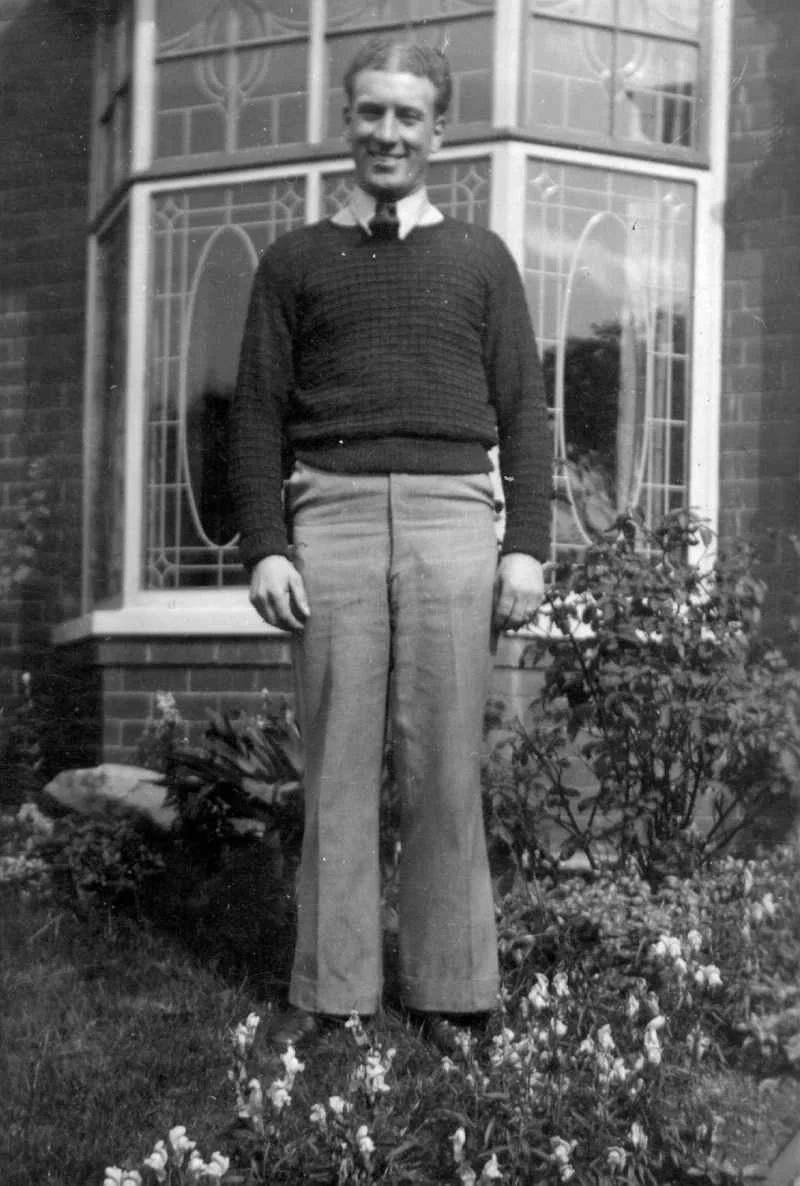
Mormon missionary and baseball player, Arch Beckstrom, in England, 1938. Uploaded to FamilySearch. Copyright undetermined.
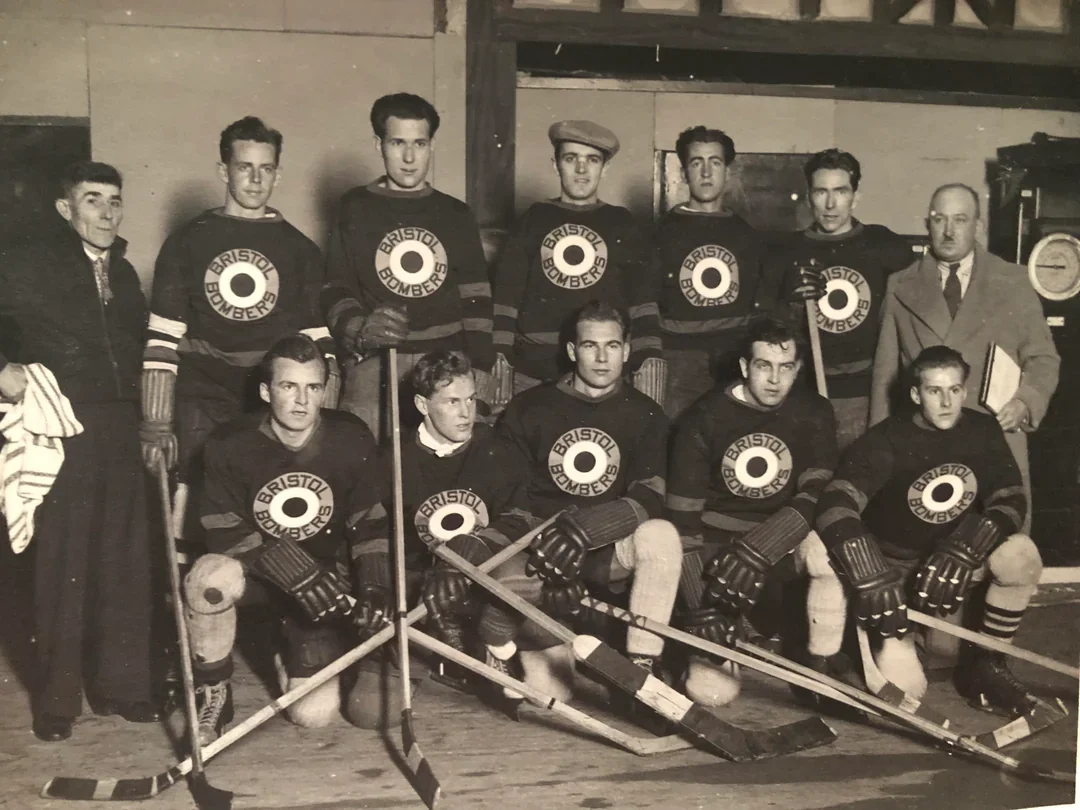
The Bristol Bombers Ice Hockey team, 1938-1939. Uploaded to Reddit. Copyright undetermined.
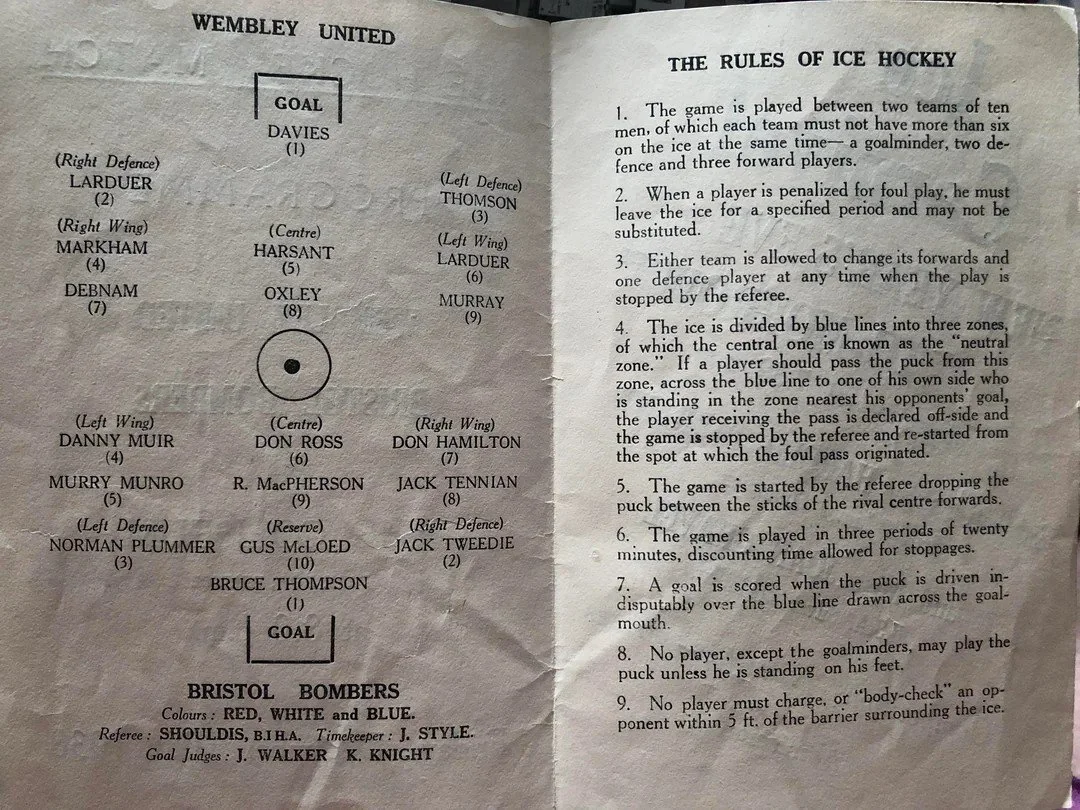
The Bristol Bombers Ice Hockey team, 1938-1939. Uploaded to Reddit. Copyright undetermined.
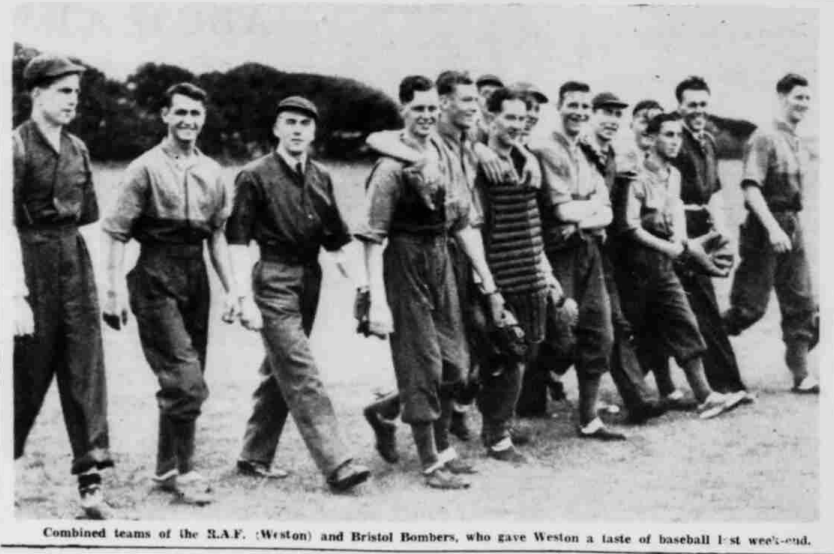
The Bristol Bombers and RAF (Weston-Super-Mare) baseball teams. Weston-Super-Mare Gazette, 9 September 1939. Image created by the British Library Board. No known copyright holder.
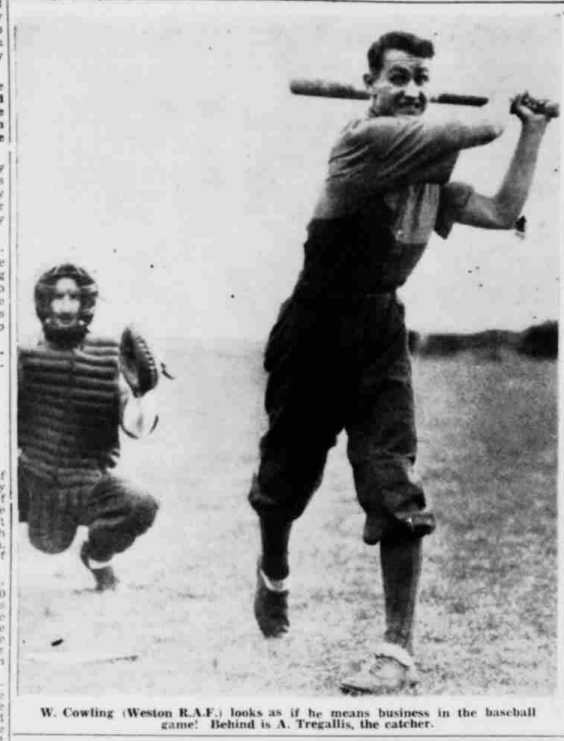
Weston-Super-Mare Gazette, 9 September 1939. Image created by the British Library Board. No known copyright holder.