Lost and Found
Jamie Barras
By 1921, although still only in her mid-twenties, Elre Campbell (1897–1949) had already buried one husband and divorced another. A single mother, she sewed hats in the family’s cramped Detroit apartment to survive. One day, one of her children joked that the hat she was sewing looked more like a lampshade. This was Elre’s Eureka moment. Thanks to the rapidly expanding automobile industry, Detroit was growing at an astounding rate—its population would increase by 58% by the decade’s end—driving demand for home furnishings. Out of this realisation was born the Campbell Lamp and Shade Company, which, in its earliest days, consisted of Elre and her children working together in their living room on the company’s signature handmade products, Elre designing and sewing, and the children putting together the frames. From this would grow a business that, with one or two bumps along the way, including two more failed marriages for Elre, would last over 70 years and provide employment for four generations of Campbells. In 1946, Elre would even join the interior design department of the Ford Motor Company. It was no wonder one of her daughters called her an “all-‘round genius”.[1]
This was a remarkable turnaround for a woman whose early adulthood had been derailed by the lies told by the people she had grown up thinking were her parents, a pair of itinerant vaudeville performers called Erle and Ollie Salambo. The real story, for so long lost between the many layers of lies and only half-remembered truths that the Salambos told, would only come to light after Elre’s death. I tell it here to celebrate the life of a woman who found a way to live with not knowing.
An application was made on Saturday to Mr. Fenwick at Marlborough Street Police Court for a license to permit Elre Cecilia Salambo, a little American girl aged seven and a half years, to perform at St. George's Hall. Mr. Salambo, who brought the child to the Court, stated that she would always be accompanied by him or her mother, and would only appear for a few minutes on the stage[…]The police offered no objection, and the required license was granted.[2]
By the time that Erle Salambo applied to a London court to allow the girl he introduced as his daughter to perform on stage, he was more than a decade into a vaudeville career that had begun in the USA in 1890.[3] For much of that career, he would claim that his real name was Earl John Livingstone and that he was born in Los Angeles but spent his early years in Australia. Later in life, after he switched careers to banking and bond dealing, he would instead claim that his name was Dessaux and that he was the descendant of French aristocrats. None of this was true; in reality, he was born Erle Sigismund Dessau (1869–1923), the son of a German Jewish druggist, in Morgan, Illinois, where he spent his early childhood.[4]
Erle would acknowledge his Jewish faith only when it profited him to do so. His childhood came to an early end with the death of his father when Erle was just 12. His mother moved the family to California, where Erle found work as a carpenter. In 1888, he met and married Danish-born immigrant Elana Cecelia Friis (1874–1947) in San Bernardino. The marriage got off to a rocky start; within a year, the Dessaus were being chased over unpaid mortgage payments. However, by the time the court summons was issued, they had already fled the state and changed their identities, reinventing themselves as Erle and Ollie Salambo, vaudevillians.[5]
REYER’s NEW OPERA. “Salambo” Given a Successful Presentation at Brussels […]TO-night has been a great night for Brussels and a great night for the musical world. A new five-act opera, composed by one of the foremost living French maestros and inspired by a masterpiece of French literature, had its first hearing at the Theatre de la Monnaie before one of the most brilliant audiences that sat in judgement.[6]
“Ollie” was short for “Olivette” and, like “Salambo”, was the name of a now-forgotten opera that was making headlines in Philadelphia in the same year that the Salambos began to perform. The couple made their debut in that city in August 1890 at the Chestnut Avenue Opera House in a production mounted by famous showman Imre Kiralfy.[7]
Erle Salambo’s training as a carpenter undoubtedly stood him in good stead in creating the effects for the Salambos act, which combined fire eating with electrical wizardry. No doubt his father had also taught him something about mixing chemicals—Dessau Sr may even have entertained his children with homemade pyrotechnics. Salambo was surprisingly open with the press about how he and Ollie worked their act. In common with traditional fire-eating acts, the Salambos used gasoline-soaked swabs that they secreted in their mouths as fuel. However, rather than using a naked flame to ignite the gasoline, they made use of electrical discharges. These were generated by bringing close together wires secreted in their costumes that were connected to the terminals of a generator off-stage—a positive wire for Erle, a negative one for Ollie. It beggars belief that the worst injuries they ever admitted to suffering were singed fingertips.[8]
The Salambos would spend the next five years touring the US. They soon added to their act a mind-reading turn for Ollie called Mlle Olivette. In that turn’s early days, much was made of Ollie’s Danish origins, to give the act an air of exoticism; however, in time, the pair would switch to claiming that Ollie was born in California, to maximise the act’s patriotic appeal.[9]
In an event that was to change both their career and their lives, in December 1895, the Salambos began a short-lived partnership with one of the great characters of American vaudeville, Merton Clive Cook (1868–1931). A genuine original, Cook, who performed under the name Clivette, was a juggler, acrobat, sleight-of-hand artist, and magician who, in the 1900s, turned to painting, becoming one of the leading members of the American realist school before embracing expressionism and eventually abstract art. “Salambo and Clivette”, which included “Mme Clivette”, almost certainly Cook’s, at this time, future wife, Catherine Chamberlain, lasted only two weeks as a combination, but those 14 days marked the high point of the Salambos performing career in terms of relevance. They were also to have a profound effect on the rest of the Salambos' careers and lives, as, when Merton Clivette partnered with the Salambos, he had just returned from an eight-month engagement at the Empire Theatre in London. The stories he had to tell of the reception he had received there convinced Erle Salambo that this was where the Salambos had to head next. They completed their last contracted engagement in the US at the end of March 1896. By the middle of the next month, they were on their way to England.[10]
THE SALAMBOS. Salambo and Ollivette. Electrical Dynomatic Wonders. The Human Arc Lights. Nature’s Laws set at Defiance. The act is undescribable. Apply for particulars and lithos to Nathan and Somers, 10, Henrietta Street.[11]
Erle and Ollie Salambo arrived in England in April 1896 on board the SS Germanic, travelling on a US passport that Erle had taken out under the name “Erle S. Salamboo” for himself and his wife.[12] They had no child with them, and Erle Salambo’s passport application had also made no mention of a child. (It is worth noting here that the passenger list for the Germanic did include children, including one as young as 1 ½ years old—i.e., it was not that the presence of infants was not recorded in the passenger list). This is worth noting, as the Salambos would later claim in print and in official documents that Elre was born in Brooklyn in December 1894 or 1895, i.e., that she was their natural daughter.
The Salambos debuted at the Royal Holborn in London two weeks after their arrival in the UK. Billed as “Salambo and Olivette, Electrical Dynomatic Wonders”, they were well received. British audiences were amazed and somewhat bewildered by the Salambos’ unique combination of electric light show and fire eating. They topped bills up and down the country.[13]
The Salambos’ 1896 debut was the start of a six-year-reign as a top draw at English halls. In February 1897, the entertainment weekly, The Sketch, devoted a full page to an interview with the pair conducted at their temporary digs in Kennington. The interview was accompanied by a picture of them in their Mephistopheles-inspired stage outfits—another nod to opera. Despite the interview taking place at the Salambos' digs, the piece made no mention of the Salambos having a child, although it has to be acknowledged that this could be explained by prevailing negative attitudes towards working mothers favouring silence on the subject.[14]
However, just a month after The Sketch interview was published, Erle Salambo was making headlines of a very different kind.
A FULHAM ACTRESS’S BABY. AN INTERESTING CASE. Mr. Lane, QC., had before him a very interesting case at the West London Police Court on Wednesday, when a young woman named Ethel Agnes O’Shea, residing with her mother at Walham Grove, appeared as complainant against a married man named Earl John Livingstone (better known as “Salambo, the Fire King”) an actor at present employed at Liverpool, who, she alleged, was the father of her child, born in July, 1896.[15]
Ethel Agnes O’Shea had been a member of a revue called “The Spider and the Fly” at the same time as the Salambos back in the US. In her testimony in court, she stated that Erle Salambo had been “very good” to her during the tour and on at least one occasion had visited her in her hotel room; a visit that nine months later resulted in the birth of a baby boy. By this time, Ethel had returned to England. She soon discovered that the Salambos were also in the country. She went to where the Salambos were playing and showed Erle Salambo what she described to him as his new baby son. She claimed that Salambo had acknowledged the child and offered to pay a stipend, giving her an address at which he could be reached, but then reneged as soon as she had departed. Letters to the address she had given him went unanswered. She felt compelled to issue a summons. On cross-examination, Salambo’s lawyer chose not to challenge Ethel’s account of her dealings with Salambo and instead got her to acknowledge that there was a man in the “Spider and Fly” company who had the same surname as that which Ethel had given the baby, “Kramer”. Ethel claimed that this was a mere coincidence—the child was named after a good friend of her mother—but witnesses called by Salambo’s lawyer testified that Ethel had told them that Kramer of the “Spider and Fly” company was the boy’s father. The summons was dismissed. Salambo walked away from the case with his reputation tarnished but free from any further obligations towards Ethel and her child.[16]
This case, although it had a “favourable” outcome for Salambo, is potentially of some importance to our story, of which more later. If nothing else, it established that Erle Salambo was a philanderer.
In late 1900, the Salambos embarked on a short tour of Germany and Austria, returning to the UK in February 1901.[17] In order to go on this tour, Erle Salambo had to renew his US passport, something he did at the US Embassy in London in September 1900. His passport application, made in the name Erle S. Livingston, is the first official record anywhere of the existence of Elre, who appears as “Cecelia Elre”, with a birth date of 26 December 1897, and place of birth of Wolverhampton in the British Midlands.
At first glance, the story this document tells us is that Ollie Salambo became pregnant while the Salambos were touring and gave birth in Wolverhampton on Boxing Day, 1897. However, we know that this cannot be true, as the Salambos were appearing in pantomime in Edinburgh all through December 1897 and January 1898—Ollie could not have been 275 miles away in Wolverhampton giving birth.[18] For this reason, we can properly describe this document as the foundation document of the Elre Campbell story, as it is the first place we find the version of the origins of Elre that Elre herself came to know, or at least believe: she was born in England to someone other than Ollie Salambo. Whether Erle Salambo intended this declaration in his passport application to be a notification of the fact that he and Ollie had adopted a child is unclear. His subsequent attempts to obscure Elre’s origins suggest that, if he did, he soon came to regret his candour, as his 1901 England Census return made clear.
The 1901 England Census found all three Salambos, listed as the “Livingstones”, in digs in Nottingham, recorded thus: Erle S. Livingstone, 29, Music Hall Artiste, born in Chicago, USA; Ollie C. Livingstone, 27, Music Hall Artiste, born in Los Angeles, USA; and Elre C. Livingstone, 7, born in Brooklyn, USA. It is hard to see this change in the age and place of birth of Elre as anything other than Erle Salambo now claiming that he and Ollie were Elre’s birth parents.
The increase in claimed age for Elre was necessary to place her birth before the Salambos arrived in the UK in the spring of 1896. However, there was another reason to claim she was older than she really was. To understand why, we need to look more closely at the circumstances surrounding her debut on stage in the autumn of 1901.
An application was made on Saturday to Mr. Fenwick at Marlborough Street Police Court for a license to permit Elre Cecilia Salambo, a little American girl aged seven and a half years, to perform at St. George's Hall.[19]
The passing of the 1889 Prevention of Cruelty to, and Protection of, Children Act made it illegal for children under the age of 10 to perform on stage except under special licence. As these licences were valid only for the jurisdiction covered by the court or school board that issued them, new licences had to be applied for in every new jurisdiction in which the child was intended to perform.[20] Needless to say, it was far easier to gain a licence for a child of 7 or 8 than for one of 3 or 4 (assuming a year of birth of 1897, as in the 1900 passport renewal).
The Salambos billed Elre as a “child historian” and “infant encyclopedia” who had memorised 10,000 facts;[21] her act was a memory act in which members of the audience asked her questions to which she, to their astonishment, given her young age, always had an answer. Of course, she was working to a script, and the “audience members” who asked the questions were plants. The Salambos were already using this system with Ollie’s mind-reading act, which included a segment where she guessed people’s ages to the exact day. Given the description of Elre’s act as presented by the Salambos, not its reality, it is not surprising that the concern of magistrates was that, by requiring a young girl to memorise and recall 10,000 facts, the Salambos were both causing her undue stress and neglecting other aspects of her education. Such concerns could and did lead to courts refusing the Salambos licences to allow Elre to perform.[22] On one occasion, a court was even prepared to go further.
CHILD HISTORIAN. NOVEL SCENE IN EXETER POLICE COURT[…] Answering the Magistrates’ Clerk, the little girl stated that her age was eight and that the present year was 1902, but she could not say in what year she was born. Mr. Varwell remarked that she knew what she was trained to know, and the Magistrates’ Clerk said it did not seem that she was receiving the simplest education.[23]
Elre gave such a poor performance in front of Exeter magistrates in October 1902 that they were not only inclined to refuse the licence but also to remove Elre from her parents’ care and place her in a school so that she could receive the education she so clearly lacked. This understandably distressed the Salambos greatly. It was only after much beseeching and a further examination by a doctor that the magistrates relented and granted the licence on the understanding that it would only be for one week, and after that, Elre would be granted a rest. The Salambos committed to keeping her off the stage until the following Easter, claiming that they were planning a holiday to Europe (this was a lie: they were booked to tour America—although Elre was not scheduled to perform on the tour[24]).
The Exeter magistrates assumed that, like the children of many itinerant performers, Elre had missed out on an education because she and her parents were never in one place long enough for her to receive one. However, there is a simpler explanation: she was younger than her parents claimed in their application for a licence. We have already discussed the 26 December 1897 birth date for Elre that Erle Salambo provided in the first official document in which her name appeared, his 1900 US passport renewal. To this, we can add a photograph of Elre published in The Era in November 1901, shortly after Elre debuted, in which Elre looks like a toddler, not a child of 7 or 8 (see gallery at the end of this article), and a story about Elre that appeared in an American newspaper in 1902 in which her age was given as 5 (see below).[25]
It may seem ludicrous to suggest that a child of 3 or 4 could work an act that required memorising a script, but it must be remembered that this was the age at which Shirley Temple debuted. In truth, as we will see, the real story was likely somewhere between: Elre was both younger than the Salambos claimed and had missed out on an education, not because she had been on the road, but because of the straitened circumstances of her early life. Those same circumstances had left her undersized for her age, which would further obscure the truth of her real birth date.
A 5-YEAR-OLD PRODIGY[…]Erle Cecelia Salambo, the 5-year-old daughter of the Salambos, electrical experts, exhibiting at the Orpheum this week, is a child prodigy. She possesses remarkable ability as a retentive memorizer of statistical and historical information. Although she is not being exhibited in this country, her presence is in great request by managers in every city visited by the Salambos.[26]
In late 1902, not long after the Exeter incident, the Salambos returned to America for a series of engagements that stretched into the spring of 1903. They appear to have remained true to their commitment to the magistrates to keep Elre off the stage; however, they could not resist using her for publicity for their act. The Salambos would later give 1902 as the date of Elre’s immigration to the USA; this was undoubtedly in reference to this tour.[27]
In evidence of just how much the encounter with the Exeter magistrates had spooked the Salambos, on their return to England, they enrolled Elre in a school in Stockwell in London. They told the school that she was born on 25 December 1895, which would have made her 5 years old when she debuted in 1901, not 7 or 8.[28] As we will see, this fixing of the date of Elre’s birth as the 25th or 26th of December, in around 1895, combined with the earlier reference to her being born in Wolverhampton, would form the basis for what Elre’s descendants would come to believe was the real story of her origins.
Alas, Elre would only remain at Stockwell for a few months before the Salambos withdrew her to take her on a tour of the Irish halls. In Dublin, they attempted to obtain a licence for Elre to perform, and supported this by pointing to the school enrolment as evidence of their commitment to her education, making plain that the latter was simple window-dressing, a tactic to avoid a repeat of the Exeter experience, not an attempt to learn from it. In the event, the Dublin court refused the licence on the grounds that her case did not merit an exception to the Act forbidding children under 10 from appearing on the stage.[29]
The Dublin affair was the beginning of the end for the Salambos' time in Britain and Ireland. They had already signed a contract with producer Harry Rickards to join a variety company that Rickards was taking on an extended tour of Australia.[30] Although they would take a second trip back to the USA, via the UK, in 1905/06, Australia would be their primary home for the next five years.[31] This trip required another renewal of Erle Salambo’s US passport. This time, Erle gave his name in the application as “Erle Sigismond Livington” and Elre’s place and date of birth as Brooklyn, 25 December 1894—although this was yet another new claimed year of birth, the Salambos had at least settled on 25 December as her birthday. They had also settled on claiming erroneously that they were her birth parents.[32]
For Saturday next Mr. H. Rickards announces a great attraction for show week, just arrived per White Star liner Afric, the Salambos, who have appeared in almost every vaudeville theatre in the United Kingdom and Europe, in their great speciality, “Wireless Telegraphy”, through the human body, flames of fire being blown from their breath[…] Mademoiselle Ollivette claims to be the only “Thoughtographist” in the world.[…]“Historicus” is a little mite, eight years of age, and the management states she is capable of answering over 19,000 questions in history and in general subjects from the creation of the world to the present day.[33]
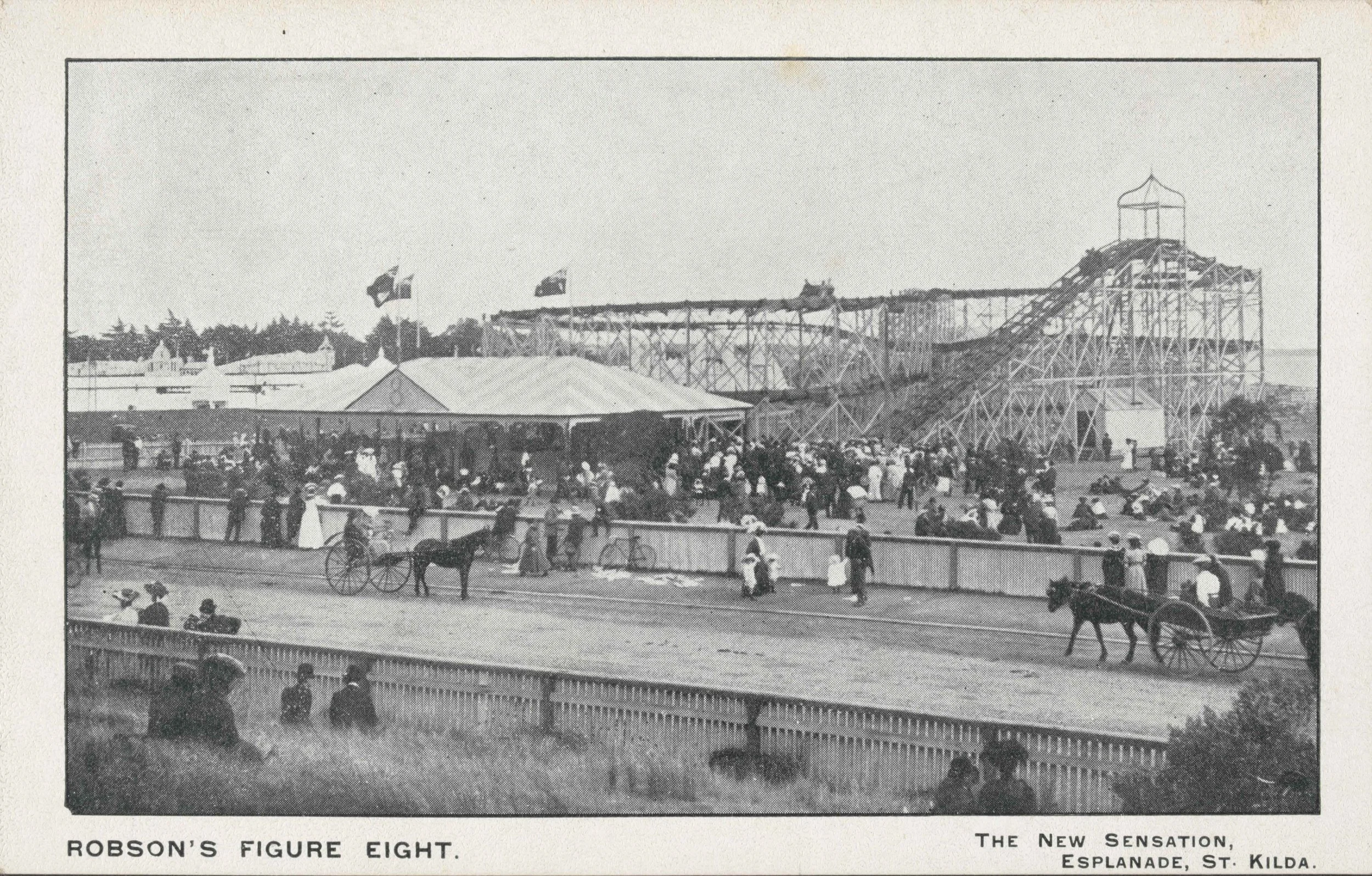
The Salambos debuted at Rickards’ Tivoli Theatre in Sydney in August 1904, with Elre performing under her new billing “Historicus” and described as 8 years old (3 years after the Salambos had first introduced her as a 7-year-old). Following the end of their contract with Rickards, the Salambos formed their own “Salambo and Olivette New Wonders Company” and toured Australia, New Zealand, and Tasmania. Erle Salambo also branched out into theme park management, serving as the general manager for the Wonderland City theme park in Sydney from 1906 until his departure from Australia in 1909, and attempting but failing to operate his own theme park, Dreamland, in Melbourne, from 1906 to 1907.[34]
The liquidation of the Dreamland theme park operating company at the end of 1907 was undoubtedly a blow to the Salambos. However, an even greater blow was to come in the summer of 1908 when Ollie sustained a fractured arm under circumstances that went unreported. This led to Ollie returning, alone, to the US in September 1908, ostensibly to receive treatment from specialist physicians unavailable in Australia. However, she would not return.[35]
Erle and Elre remained in Australia for another six months. With her mother back in the USA, Elre stepped in to perform her role in the fire-breathing and electrical display element of the Salambos’ performance; this apprenticeship would prove a harbinger of how she would spend her teenage years. Erle and Elre Salambo left Australia for the final time in March 1909. They did not, however, travel to the US to rejoin Ollie, at least, not immediately. Instead, they returned to the UK and began a new tour, culminating in appearing in Aladdin at Drury Lane—as prestigious an engagement as it was possible to find in English music hall in this period, and something the Salambos would reference in their billing for the rest of their showbusiness careers.[36]
Reappearance in America after five years abroad. THE SALAMBOS. Electrical Dynamitic Wonders.[37]
By March 1910, a year after they had left Australia, Erle and Elre Salambos had finally returned to the US and reunited with Ollie in New York. In their entry in the 1910 US Federal Census, presumably completed using information provided by Erle Salambo, Elre’s place of birth was given as England, while those of her parents were given as Illinois and California—clearly intended to imply that Erle and Ollie were her birth parents. The year of Elre’s immigration to the USA was given as 1902; this, as we have said, corresponds to the Salambos’ 1902 US tour. However, someone has crossed out the “England” entry on the census return and written above it a location that, alas, I cannot read (something City). However, they have neglected to cross out the “1902” in the column for year of immigration to the USA.[38]
Blowing fire from their mouths, apparently allowing an electrical current which would be fatal to an ordinary human being pass between them, lighting paper with their breath, and doing a lot of similar electrical stunts, the two women and one man who call themselves the Salambos and who form a feature at the Orpheum this week present an act which is startling.[39]
Although Elre’s globetrotting days were now over, this was the beginning of the most turbulent few years of her young life. With Ollie now back in the act, the Salambos, now billed as a trio, rejoined the US vaudeville circuit. Ollie would also return to performing her mind-reading routine as Mlle Olivette. However, this new status quo would last only until the spring of 1912, when Ollie retired from the act and showbusiness. Based on evidence presented below, it seems that at this time, Erle and Elre relocated back to Chicago, while Ollie remained in California in the home that Erle had bought there, perhaps expecting this separation to be temporary. This change to the act occasioned Erle commissioning a new set of publicity photographs. These show that, although Erle’s costume still had a Mephistophelian air, Elre’s was more like that of a nymph of Ancient Greek myth. This was presumably the costume she had worn when the act was still a trio.[40]
Within a year of Ollie retiring from the act, Elre had experienced an even greater change to her life, as, on 15 April 1913, she married a 21-year-old machinist-turned-actor named Clarence S. Bellor (1892–1916) in Chicago. She gave her age as 17 on the marriage licence; she may have been as many as two years younger. Under “father’s name”, she wrote Erle S. Salambo. Five months later, she gave birth to her first child, a daughter, Goldie Cecilia ‘Cecil’ Bellor.[41]
Alas, we know very little about Clarence Bellor. He was a native of Detroit and had lost his father at an early age. He would be dead of tuberculosis within 3 years of his marriage to Elre, by which time they seemed to have been estranged, although Detroit would be Elre’s home for the rest of her life. The fact that this marriage took place in Chicago, despite Detroit being the couple’s home, is the first piece of evidence we have that Elre and Erle had relocated to Chicago following the end of Ollie’s involvement in the act. There is tentative evidence that Clarence may have been added to the Salambos’ act for a time, with Erle gradually moving into a management role, primarily because Clarence was a machinist at the time of his marriage to Elre, but would, within a year, describe himself as an actor. However, it must be acknowledged that we can place Erle still with the act as late as May 1914, so the exact timing of the personnel change is uncertain.[42]
By the time of Clarence Bellor’s early death, Elre had already given birth to two children, both daughters, and was pregnant with a third. It is not clear if Bellor was the father of her third child, another daughter, or if she was the child of William Campbell (1887–1924), the man who, in 1917, would become Elre’s second husband. Elre would go on to have a fourth child, a son, with Campbell. However, this marriage would prove tempestuous and short-lived. In 1920, she divorced Campbell on the grounds of extreme cruelty. She also gave up the son she had with him, and placed her youngest daughter in the [temporary] care of friends. For reasons we will see later, these events may have taken on new significance given the real story of Elre’s own early life.[43]
One of the most remarkable things about this turbulent 7-year-period in Elre’s life is that, for the first 4 years of it, she continued to perform. Indeed, her third child was born on the Los Angeles Limited express train on the way to an engagement. When the famous singer, Sophie Tucker, who was on board the same train, heard about the birth, she gave up her state room to Elre and her newborn. In gratitude, Elre named her baby Sophie Tucker Campbell. (Sophie is the daughter Elre later fostered out, although she would reunite with Elre and her two sisters at some point, and, ultimately, take over the Campbell Lamp and Shade Company).[44]
By this time, the act was known as “The Three Salambos” and consisted of Elre, another woman, described in the press as her “sister”, and an unidentified man. The “sister” and the man were almost certainly actors hired by Erle Salambo to take the place of Ollie and himself, with the “sister” taking on Elre’s role whenever she was in confinement. We can be certain that the “sister” was not Ollie Salambo, as in January 1917, Ollie Salambo divorced Erle Salambo for desertion.
ROMANCE CRASHES. A stage romance was shattered today when Superior Judge Andrews granted Ellena C. Dessau an interlocutory divorce decree from Erle S. Dessau, on grounds of desertion. The divorce was granted by default, the defendant not appearing. The Dessaus were known better by their stage names, Mrs. Dessau as Ollie Salambo, and her husband as Erle S. Salambo.[45]
As we have already discussed, it seems that Elre had chosen to remain with her father back in 1913, and, by extension, become estranged from her mother. As to why Elre chose to go with her father, the reason is lost to the confusion over what and when Elre knew about her origins and what story Erle told her about those origins before the split with Ollie. There is tentative evidence that Elre may at one time have believed that her birth mother was someone with whom Erle had had a relationship in England. In this story, we see echoes of the paternity suit Erle faced in 1897 over Agnes O’Shea’s baby. On that basis, if it was something that Elre at one time believed, it may have been that, in 1913, Erle Salambo used the O’Shea episode to fashion a story that would keep Elre with him, and, by extension, the Salambos act. But so much about this, as we will see, is uncertain.
Erle Salambo Dessaux, white, 4625 Kenmore Avenue, is one man who proudly boasts of his black ancestry. Dessaux, who is a wealthy loop broker, was formerly an acrobat. Through his press agent, his name became juggled around considerably. He finally discovered that he owned various properties under the several different names he had used on the stage. Early this week he went into the Circuit Court and asked that his name be fixed as Erle Salambo Dessaux for the purpose of straightening out possible business tangles.[46]
The final dissolution of the Salambos’ act came shortly after America entered the First World War. By this time, Erle had reinvented himself as Erle Salambo Dessaux, Chicago banker and broker, and threw himself into offering Liberty Bonds through the Mortgage Trust and Security Company of Illinois, of which he was the president. He would later make this his legal name, claiming fancifully that ‘Salambo’ was a reference to his descent from the Carthaginian general, Hamilcar, the subject of the book and opera from which Erle obtained his stage name. In 1919, he remarried. By the following year, although still acknowledging his earlier career as a stage performer, he had written Ollie and Elre out of his life. Based on this, it seems likely that the dissolution of the Salambos act also marked the severing of his relationship with Elre, who had settled in Detroit and was trying, unsuccessfully, to make a go of her marriage to William Campbell.[47]
Erle Dessau/Livington/Salambo/Dessaux did not live to enjoy his newfound wealth; he died in Chicago in March 1923, aged just 52. His obituaries made no mention of Elre or Ollie.[48]
After a short business session, Pasadena Court, No. 40, Tribe of Ben Hur, held an enjoyable Halloween party last night at the Odd Fellows Temple[…]Among the features [was] a mental telepathy stunt by Mrs. Ollie Lauffenberger, who, blindfolded, worked with figures from 1–64 on the blackboard.[49]
Nineteen Nineteen was also the year that Ollie Salambo remarried. Her new husband was Pasadena resident and confectioner, Arthur Lauffenberger, who brought with him two sons from a previous relationship. The Lauffenbergers settled down to a life of suburban domesticity in Pasadena, becoming active members of local friendship societies and taking part in amateur dramatics and entertainments. They enjoyed 28 years together before Ollie’s death in August 1947, aged 73. Her obituary recorded that she was survived by her husband, two sons, and “…daughter, Mrs Elre Campbell of Detroit, Michigan”.[50]
Although Elre had chosen to go with her father, cutting off contact with Ollie in 1912 or 1913, she later reconciled with the woman she had grown up thinking was her mother. As events would show, she would continue to believe that her birth mother was someone else, but, clearly, she recognised and acknowledged the bond she had formed with Ollie Salambo in the years they were mother and daughter. Perhaps becoming a mother herself gave her a fresh perspective. Although this must remain speculation, it also seems likely that Erle writing Ollie and Elre out of his life at the time of his second marriage was some kind of wake-up call for Elre. However, this was not the end of the twists in her story.
Charging her husband had given her less than $50 in the past six months and had borrowed $200 from her, Mrs Elre C. Rutt, 999 Tuscola avenue, Tuesday, filed suit for divorce against Fred C. Rutt. They were married in 1923 and separated July 25 [1925]. Mrs Rutt says she is employed by a lamp company and her husband is in a similar business, and that his frequent disparagement of the products of her firm has damaged her business.[51]
Elre married her third husband, Frederick Earl Rutt (1883–1958), on 30 September 1923, five weeks after the death of Erle Salambo/Dessaux. The marriage would prove to be another disaster for Elre, ending within two years. However, its real importance to our story is the information that Elre supplied for the marriage registration. She gave her birthplace as England, her father’s name as John, and her mother’s name as Maria Preston.[52]
John and Maria Preston. Not Erle and Ollie Salambo. Before discussing this, it is worth going back a few years, to the 1920 US Federal Census—the first with a return filled out by Elre herself. Elre was, at this time, still married to her second husband, William Campbell. In her return, she gave her place of birth as England and stated that her father and her mother were both born in England, too.[53]
The evidence from the 1920 Census return and 1923 marriage registration taken together point to Elre becoming aware that she was adopted sometime before 1920. There is a potential objection to this interpretation arising from Elre’s fourth and final attempt at marriage; however, I think this can be explained—something I will do below. As to how early the Salambos told Elre she was adopted, I know of no evidence that answers that question. As we have seen from the 1910 US Census return, they maintained in official documents that they were her birth parents certainly up to that date. However, this, of course, does not mean that they had not told Elre the truth before this time. We might point to Elre stating on her 1913 marriage registration that Erle S. Salambo was her father, suggesting that she still believed him to be her father at this date. However, this may have simply been done to appease Erle Salambo, someone whom, at the time, she was still financially dependent. We can at least say, as we will see, that the only information Elre had about her birth parents came from Erle and Ollie Salambo, and this information was unreliable.
Elre entered into her fourth and final attempt at matrimony in December 1932. Her husband’s name was Roy C. Thomas. The marriage would, like the others, end within two years. After this, Elre, wisely, gave up on matrimony. On the registration form, Elre claimed that she had been married two times before, she was born in New York, her father’s name was Earl Dessau, and her mother’s name was Marie Preston.[54]
This document is the source for the possibility that, at one time, Elre believed that her birth mother was a woman with whom Erle Salambo had had a relationship. However, there is an alternative explanation that I believe to be the correct one, and that is connected to Elre giving New York as her place of birth. The latter was also a claim that Elre made in her 1930 Census return. On that same return, she gave her father’s birthplace as Illinois and her mother’s birthplace as California—clearly referencing Erle and Ollie Salambo and a marked departure from the information she gave in her 1920 Census return. However, she was, by 1930, a single mother. Without the claim to citizenship that having an American husband provided, claiming she was born in the USA was the simplest way to avoid any bureaucratic scrutiny—she made at least one trip to Canada at this time, for example, requiring a passport. It is possible that she claimed on her 1930 census return that her parents were born in the USA and on her 1932 marriage registration that Erle Dessau was her father, not because she believed it, but because this supported the erroneous claim that she too was born in the USA, with consequential birthright citizenship.[55]
As with many elements of this story, it is impossible at this remove to know the true reason for this shifting narrative.
Elre Campbell died of cancer in Detroit on 21 October 1949, aged, like Erle Dessau at the time of his death, 52. The official records have one more surprise. The information on her death certificate was provided by her eldest daughter, Cecil. Relying on information that her mother had given her, Cecil stated that Elre’s date of birth was recorded as 25 December 1894, her place of birth was England, the name of her father was Charles Preston, and the name of her mother was Clara.[56]
Memory fades. Whether this was a case of Elre forgetting what Erle Salambo told her about the names of her parents, or, perhaps, Ollie Salambo, after her reconciliation with Elre, innocently contradicting the story that Erle Salambo had told Elre sometime before 1920, I do not know. However, it is almost certain that, if there ever were any documents in connection with the adoption, these had long since been lost by the time one or both of the Salambos told Elre the truth. That neither Salambo could furnish Elre with a consistent story of her origins in their absence is a testament to how little contact the Salambos had had with her birth parents, if they had any direct contact with them at all. The only constants in all the many variations were that Elre was born in Wolverhampton on or near Christmas Day sometime around 1895, and that the family name of her birth parents was Preston.
AN ARTIST SENT TO PRISON At Wolverhampton Police Court, yesterday, John Hassall Preston, an artist, late of Liverpool, was brought up on remand charged with deserting his wife and six children, and leaving them chargeable to the Wolverhampton Union. There was another charge against him of owing £151 6s. to his wife under a maintenance order.—Mr. A. Turton, who appeared to prosecute, said prisoner was a man of great ability, but he had left his wife and children and formed an attachment for another woman, who had borne him two children. He went to Liverpool, where it was said he lived in a luxurious manner.[57]
John Hassall Preston (1863–1923) was a fine artist but a terrible human being. When his wife, Jane Preston née Wildman (1867–1941), dared to divorce him for starting a second family with another woman, he obtained his revenge by not only refusing to pay the court-ordered maintenance but also spending every penny he earned to prevent his assets from being seized to cover the accumulating debt. This latter tactic left not only Jane and her children but also Preston’s other partner, Marguerite, and her children in abject poverty. He was what we would call today a malignant narcissist, something that several spells in prison for non-payment of maintenance did nothing to cure.[58]
John and Jane Preston had at least nine children together, most of whom survived into adulthood. (John Preston would also have at least six children with Marguerite.) There is a mystery concerning the fate of one of John and Jane Preston’s children, however, a daughter, whose birth was recorded but who then disappeared from the records in connection with John and Jane Preston, despite there being no record of her death. Her name was Poppie Gertrude Preston, and she was born in Wolverhampton on 26 December 1895.[59]
Based on information posted to the Ancestry.com genealogy website by a member of the Campbell family, it seems that one or more of Elre’s descendants travelled to England in the late 1970s to solve the mystery of her origins.[60] There, they tracked down the birth certificate of Poppie Gertrude Preston. Alas, the account connected to that Ancestry.com entry is no longer active, so I have been unable to determine what led to this discovery, or what else was found. There are, of course, important questions left unanswered: how Jane Preston came to offer her child for adoption, and how Erle and Ollie Salambo came to adopt her; and why Erle Salambo, in his 1900 US passport renewal, in the closest to a true account he ever gave, reported her date of birth as 26 December 1897, not 26 December 1895.
To these questions, we should add the unknowables, such as why Erle and Ollie chose to adopt a child in the first place. It would be nice to believe that it was simply because they thought they could offer Poppie/Elre a better chance at life than Jane Preston could in the straitened circumstances in which John Hassall Preston had left her. However, it is inescapable that the Salambos expected Poppie/Elre to pay her way, adding her to their act as soon as she had mastered the script. Child performers, in general, and Elre, specifically, had hard lives, which included never being in one place long enough to receive a formal education. Against this, the photograph of Elre dating from her 1901 debut, in which she looks little more than a toddler, despite being nearly 6, and the reports of her examination by the Exeter magistrates, in which she showed no signs of any formal education, again, despite her age, speak volumes as to just how straitened were the circumstances of her early life as the youngest of eight children of a woman left in extreme poverty by a vindictive ex-husband. Can we really say that the Salambos, whatever their motives, did not give her a better chance at life?
Regardless, Erle and Ollie Salambo, in common with many stage performers, told so many lies and half-truths in the name of creating a colourful schtick that it is doubtful that even they knew where their invented stage personas ended, and their real lives began. In her early adulthood, Elre Campbell paid the price for that ambiguity. It is to her eternal credit that, in the face of this, she was able eventually to find her own identity, establish herself as an interior designer, and provide for her children.
Jamie Barras, February 2026.
Back to Staged Identities
Notes
[1] Story of the Campbell Lamp and Shade Company: ‘A Lampshade Dynasty is in Peril’, Detroit Free Press, 18 May 1952; advertisement copy, Campbell Light & Shade Company, Detroit Free Press, 14 November 1971. Company still in existence and still run by a Campbell, 1991: ‘Lighting’, Detroit Free Press, 9 November 1991. Death of Clarence Bellor, Elre’s first husband: entry for Clarence Bellor, 1916, Michigan, U.S., Death Records, 1897-1929. Divorce from William Campbell, 1921: entry for Elre C. Campbell, Michigan, U.S., Divorce Records, 1897-1952. Marriage Roy C. Thomas, 1932: entry for Elre C. Campbell, Michigan, U.S., Marriage Records, 1867-1952. Divorce, 1934: Michigan, U.S., Divorce Records, 1897-1952. Ancestry.co.uk, Ancestry.com Inc. (Operations), accessed 29 January 2026. Elre’s bumps along the way included bankruptcy in 1943: ‘Public Notices’, Monroe Evening News (Monroe, IL), 1 February 1943. Designing interiors for Ford cars: ‘Female Touch: 5 Women Employed as Ford Stylists’, Automotive News, 11 March 1946. “All-‘round genius”: first reference, this endnote. Growth of Detroit: ‘Detroit: A Planning History’, https://detroitplanninghistory.weebly.com/1900-1930.html, accessed 29 January 2026.
[2] ‘London Variety Stage’, Music Hall and Theatre Review, 29 August 1901.
[3] In 1889, the British Parliament passed the so-called “Children’s Charter”, granting new protections to children. Amongst other things, the law banned children under 10 from performing on stage except under special licence: https://www.nncee.org.uk/downloads/8/a-history-of-child-employment-law-to-2009, accessed 31 January 2026.
[4] Livingstone and Australia claim: ‘Amusements’, Philadelphia Times, 28 June 1891; also Note 2 above. Dessaux: Entry for Erle S Dessaux, in The National Cyclopaedia of American Biography, Volume 17 (New York: James T. White Company, 1920). Erle Dessau: "United States, Census, 1880", FamilySearch (https://www.familysearch.org/ark:/61903/1:1:MXV1-8KT), Entry for David S. Dessau and Emily R. Dessau, 1880. The connections that tie Erle Dessau to Erle Salambo are many and varied, but perhaps the most obvious is the report of his 1917 divorce, which names him as Erle S. Dessau, known professionally as Erle Salambo: ‘Romance Crashes’, San Diego Sun, 6 January 1917.
[5] Salambo/Dessau is described as a “co-religionist” in articles published in Jewish newspapers promoting his vaudeville act, for example: ‘The Salambos’, The Hebrew Standard of Australia, 16 December 1904. Marriage to Elena: California, County Marriages, 1849-1957", FamilySearch (https://www.familysearch .org/ark:/61903/1:1:XL84 3XY), Entry for Erle S Dessau and Elena C J Friis, 27 December 1888. Mortgage troubles: ‘In the Superior Court of Los Angeles…’, Los Angeles Evening Express, 25 August 1890.
[6] ‘Reyer’s New Opera’, Philadelphia Times, 11 February 1890.
[7] Olivette (strictly speaking, “Les Noces d’Olivette”) by Edmond Audran opened at the Gaiety in Philadelphia in February 1890, the same month that the Philadelphia Times reported on the debut of “Salambo” in Brussels: ‘Amusements: The Bijou’, Philadelphia Times, 2 February 1890. It is safe to assume, therefore, that this is when the Dessaus chose their stage names. Imre Kiralfy: ‘Imre Kiralfy Dies in London, Aged 74’, New York Herald, 29 April 1919.
[8] ‘Tricks of Fire Eaters’, Kansas City Journal, 26 October 1890.
[9] Mlle Olivette, mind reader: ‘News of the Theaters’, Democrat and Chronicle (Rochester, NY), 1 February 1894.
[10] Merton Clivette: Theodore P. Aiken, “Biographical Sketch of Merton Clivette (1868–1931)”, https://www.clivette.com/about, accessed 29 January 2026. Salambo and Clivette and Clivette in England: ‘Rich’s Theater’, Evening Herald (Fall River, MA), 30 December 1895. The Salambos' last engagement in the US, March 1896: ‘Poli’s Wonderland Theater’, Morning Journal-Courier (New Haven, CN), 23 March 1896.
[11] ‘Professional Cards’, Music Hall and Theatre Review, 26 June 1896.
[12] Entry record for Erle and Ollie Salambo, SS Germanic, arriving Liverpool, April 1896, UK and Ireland, Incoming Passenger Lists, 1878–1960; passport 9234, issued to Erle S. Salamboo, 11 April 1896, US Passport Applications, 1795–1925. Ancestry.co.uk, Ancestry.com Inc (Operations), accessed 28 January 2026.
[13] ‘Notices and Advertisements’, Era, 2 May 1896. ‘The Royal’, Era, 23 May 1896. ‘The People’s Palace’, Bradford Daily Telegraph, 8 September 1896. Technical difficulties: ‘Grand—Clapham Junction’, Era, 22 August 1896.
[14] ‘Salamanders Chez Eux’, The Sketch, 10 February 1897.
[15] ‘A Fulham Actress’s Baby’, Fulham and Hammersmith Chronicle, 26 March 1897.
[16] See Note 15 above. The baby’s name is given in the report as “Clarence John E. Cramer” [sic], and O’Shea stated that he was born after her return to England, but I have been unable to find a birth registration for him. “Spider and Fly”: ‘Fin de Siecle’, Streator Free Press (Streator, IL), 4 January 1894. Salambos with “Spider and Fly” company: “The Spider and Fly”, Baltimore Sun, 17 September 1895.
[17] Tour of Austria and Germany: ‘Music Hall Gossip’, Era, 24 November 1900 and 16 February 1901.
[18] ‘Dresses for the Pantomime’, Edinburgh Evening News, 8 December 1897; ‘The Sleeping Beauty at the Theatre Royal’, The Scotsman, 21 December 1897; ‘Amusements in Edinburgh’, Era, 15 January 1898.
[19] ‘London Variety Stage’, Music Hall and Theatre Review, 29 August 1901.
[20] https://www.nncee.org.uk/downloads/8/a-history-of-child-employment-law-to-2009, accessed 31 January 2026.
[21] ‘A Wonderful Child Historian’, Dundee Evening Telegraph, 23 January 1902; ‘Amusements’, Northern Whig, 22 February 1902.
[22] ‘Child Performer. Age Limit Under Act. Application Refused.’, Evening Herald (Dublin), 1 January 1904.
[23] ‘Child Historian’, Western Times, 21 October 1902.
[24] ‘A 5-Year-Old Prodigy’, Kansas City Star, 26 February 1903.
[25] ‘A Chat with a Little Wonder’, Era, 5 October 1901. US report: see Note 24 above.
[26] See Note 24 above.
[27] 1902 trip home: Entry for Mr E. Salambo, Mrs Salambo, and Miss C.E. Salambo, passenger list, SS Celtic, departed England, 19 March 1902, UK, Outward Passenger Lists, 1890–1960, ancestry.co.uk, Ancestry.com Inc (Operations), accessed 28 January 2026. 1902 date for immigration to US: 1910 US Federal Census: "United States, Census, 1910", FamilySearch (https://www.familysearch .org/ark:/61903/1:1:M5WP-2BQ), Entry for Erle S Livingston and Ollie Livingston, 1910.
[28] entry from Elre Livingston, London, England, School Admissions and Discharges, 1840–1911, ancestry.co.uk, Ancestry.com Inc (Operations), accessed 28 January 2026.
[29] Dublin licence refusal: Note 22 above.
[30] Harry Rickards: https://adb.anu.edu.au/biography/rickards-harry-8207, accessed 1 February 2026.
[31] 1905/06 trip to US via UK: entry for Mr Erle Salambo, Mrs Ollie C. Salambo, and Elre Salambo, passenger lists for SS Oroya, arriving England, 8 June 1905, UK and Ireland, Incoming Passenger Lists, 1878–1960; entry for Mr and Mrs E.S. Salambo and Elre Cecilia Salambo, passenger lists, SS Narrung, departing UK for Australia, 18 April 1906, UK and Ireland, Outward Passenger Lists, 1890–1960. ancestry.co.uk, Ancestry.com Inc (Operations), accessed 28 January 2026.
[32] See Note 9 above.
[33] ‘Amusements’, The Age (Melbourne, VIC), 24 August 1904.
[34] ‘Wonderland City: Big Improvements’, The Sun (Sydney, NSW), 20 September 1907; ‘Tenders: In the Matter of Salambo Dreamland Amusements Pty. Ltd., St Kilda (In Liquidation), The Age (Melbourne, VIC), 30 December 1907.
[35] Ollie Salambo’s fractured arm, return to US for treatment: ‘Local and General News’, Armidale Chronicle, 25 November 1908.
[36] Erle and Elre Salambo leaving Australia: ‘Somerset Sailing To-Night’, Sydney Morning Herald, 12 March 1909. In Pantomime at Drury Lane: ‘Pantomimic Interludes at Drury Lane’, Tatler, 29 December 1909; ‘The Pantomimes’, Daily Telegraph, 30 November 1909.
[37] Advertisement, Hudson Theatre, The Jersey Journal, 9 April 1910.
[38] 1902 trip and 1910 US Census: see Note 32 above.
[39] ‘About the Theaters’, The Grand Rapids Press, 6 May 1912.
[40] Last appearance of Ollie as Olivette: Advertisement for Murray’s Theater, Palladium-Item (Richmond, VA), April 1912. New publicity photographs showing the Salambos now a duo with Erle and Elre: ‘Amusements’, Charlotte News, 27 June 1913. In the San Diego City Directory of 1915, the entry reads “Salambo Earl S (Ollie C)”; while this might suggest the Salambos were still together at this time, the weight of evidence is that it simply shows that Ollie was still living in the home Erle had bought for the family, ancestry.co.uk, Ancestry.com Inc (Operations), accessed 28 January 2026.
[41] Entry for Elre C Salambo, Cook County, Illinois, U.S., Marriages Index, 1871–1920, ancestry.co.uk, Ancestry.com Inc (Operations), accessed 28 January 2026. Entry for Goldie Cecilia Bellor, 26 September 1913, Michigan, U.S., Birth Records, 1867–1914, ancestry.co.uk, Ancestry.com Inc (Operations), accessed 28 January 2026.
[42] Entry for Clarence Bellor, Detroit, Michigan, City Directory, 1915; ancestry.co.uk, Ancestry.com Inc (Operations), accessed 28 January 2026. "United States, Census, 1910", FamilySearch (https://www.familysearch.org/ark:/61903/1:1:MLT2-694), Entry for Anna Bellor and Clarence Bellor, 1910. "United States, GenealogyBank Historical Newspaper Obituaries, 1815-2013", FamilySearch (https://www.familysearch.org/ark:/61903/1:1:Q5MY-X1MM), Entry for Clarence S Bellor and Jack Diamond, 10 Mar 1916. The information on the date when Erle Salambo began to focus on his business career comes from the biography he himself wrote in 1920, not the most reliable of sources; however, it is consistent with subsequent events, e.g., the Bellor marriage in Chicago. See Note 4 above, second reference. Erle still with the Salambos, May 1914: ‘The Tongue of Fire Has its Good and Bad Features…’, Fort Wayne Journal-Gazette (Fort Wayne, IN), 9 May 1914. Clarence’s job is given as ‘machinist’ in the registration of Goldie’s birth, see Note 43 above, final reference.
[43] 1920 US Federal Census: return for William C. Campbell and Elre C. Campbell, Detroit Ward 8, 1920 US Federal Census, ancestry.co.uk, Ancestry.com Inc (Operations), accessed 28 January 2026. Divorce from Campbell for extreme cruelty: See Note 1 above, fifth reference. Elre and William Campbell’s son, William Jr, is not with Elre by the time of the 1930 census; he seems to have taken a new surname by this time. Return for Elre Campbell, Detroit Ward 2, 1930 US Federal Census, ancestry.co.uk, Ancestry.com Inc (Operations), accessed 28 January 2026.
[44] Sophie Tucker story: ‘New Sophie Tucker Arrives’, Oregon Daily Journal (Portland, OR), 16 January 1917. Elre still with the Salambo act in 1917: ‘Electrical Wonders Performed by Trio at Empress Theater’, Kansas City Post, 17 January 1917.
[45] Note 4 above, final reference.
[46] ‘Chicagoan Proudly Boasts His Black Ancestry’, Chicago Whip, 18 February 1922.
[47] Erle Dessaux marriage: ‘Weddings’, Chicago Tribune, 9 November 1919. "United States, Census, 1920", FamilySearch (https://www.familysearch .org/ark:/61903/1:1:MJ79 8TT), Entry for Erle Dessaux and Olga Dessaux, 1920.
[48] ‘Death Notices’, Chicago Tribune, 18 August 1923.
[49] ‘Tribe of Ben Hur Holds Fine Affair’, Pasadena Star-News, 28 October 1927.
[50] Ollie Salambo marriage to Arthur Lauffenberger: entry for Arthur E. and Ollie C. Lauffenberger, Pasadena, 1920 US Federal Census, ancestry.co.uk, Ancestry.com Inc (Operations), accessed 28 January 2026. Death: ‘Obituaries’, Pasadena Star-News, 28 August 1947.
[51] ‘Charging her husband…’, Detroit Free Press, 26 August 1925.
[52] Entry for Fred Rutt and Elre Campbell, 30 September 1923, Michigan, U.S., Marriage Records, 1867–1952, ancestry.co.uk, Ancestry.com Inc. (Operations), accessed 3 February 2026. It should be noted that it is the mother’s maiden name that the registration requires; however, it is clear that Elre did not know her birth mother’s maiden name; instead, “Preston” was the only name by which she knew her.
[53] 1920 US Federal Census: return for William C. Campbell and Elre C. Campbell, Detroit Ward 8, 1920 US Federal Census, ancestry.co.uk, Ancestry.com Inc (Operations), accessed 28 January 2026.
[54] Entry for Roy C. Thomas and Elre C. Campbell, 3 December 1932, Michigan, U.S., Marriage Records, 1867–1952, ancestry.co.uk, Ancestry.com Inc. (Operations), accessed 3 February 2026. Based on her reversion to her Campbell surname (which, it must be remembered, was the name of her business), it is likely that it was the Rutt marriage that she sought to erase from history.
[55] Return for Elre Campbell, Detroit Ward 2, 1930 US Federal Census; Elre Campbell, Canada, Border Crossings from U.S. to Canada, 1908–1935, ancestry.co.uk, Ancestry.com Inc. (Operations), accessed 3 February 2026.
[56] Death certificate for Elre Campbell, Michiganology, https://michigan.access.preservica.com/uncategorized/IO_100ef4bd-05a3-4ca2-a310-89f8cc13d5ac/, accessed 30 January 2026.
[57] ‘An Artist Sent to Prison’, Sheffield Evening Telegraph, 2 June 1899.
[58] An example of John Hassall Preston’s work: https://artuk.org/discover/artists/preston-john-hassall. The lives of John Hassall Preston and Jane Wildman Preston have been researched by their descendants: John Hassall Preston (1863–1923) • Person • Family Tree, Jane Wildman (1866–1941) • Person • Family Tree, accessed 4 February 2026. Preston’s other court cases: ‘Before the Magistrates’, Birmingham Weekly Post, 29 October 1910; ‘Artist and Wife’, Birmingham Daily Gazette, 14 August 1915.
[59] Record of Poppie Gertrude Preston’s baptism: "England, Staffordshire, Church Records, 1538-1944", FamilySearch (https://www.familysearch.org/ark:/61903/1:1:QL3T-HZKH), Entry for Poppie Gertrude Preston and John Hassall Preston, 31 Jan 1896, accessed 4 February 2026. Date of birth: birth certificate for Poppie Gertrude Preston, registered 6 February 1896, Wolverhampton, digital copy obtained from the General Register Office, February 2026. Poppie is not one of the children living with Jane Wildman Preston in 1901: "England and Wales, Census, 1901", FamilySearch (https://www.familysearch.org/ark:/61903/1:1:XSQ2-RQQ), Entry for Jane Preston and Florence J Preston, 31 Mar 1901, accessed 4 February 2026. A search of deaths in Staffordshire under the name Preston from 1895 until 1902 returns a record for Thomas Harold L. Preston, the Prestons’ youngest child, who died in Cannock in 1898, not long after his birth, but no equivalent record for Poppie.
[60] https://www.ancestry.co.uk/family-tree/person/tree/174317275/person/332263064886/facts, accessed 4 February 2026. I identify the date for the search as the 1970s because the copy of Poppie Gertrude Preston’s birth certificate that the Campbells obtained, an image of which was uploaded to Ancestry, is dated 27 April 1978.
Dreamland, Melbourne, Australia, 1906. Postcard. Image created by State Library Victoria. Public domain.
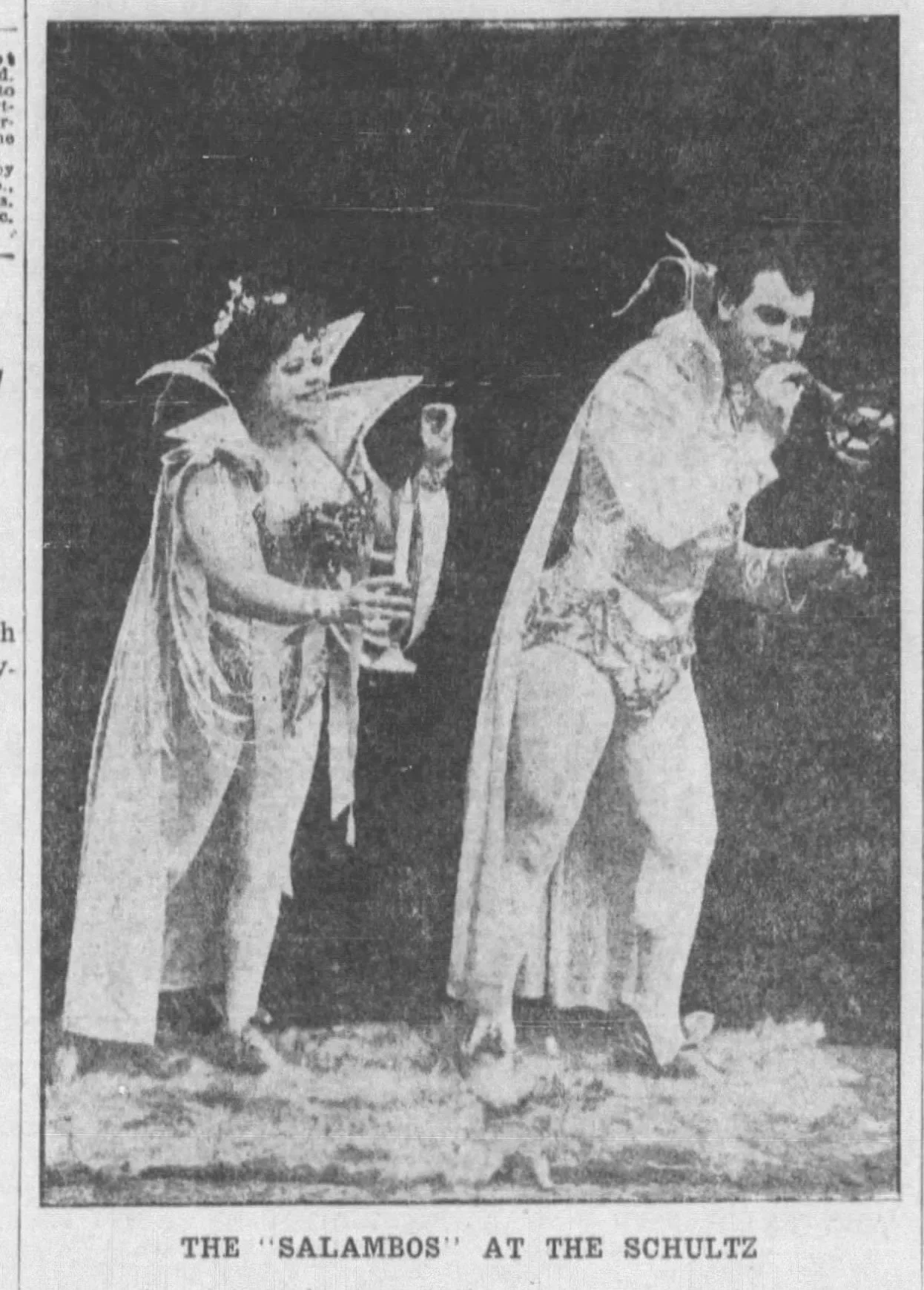
Elre and Ollie Salambo, Times Recorder, 16 May 1910. Image created by the Library of Congress. Public domain.
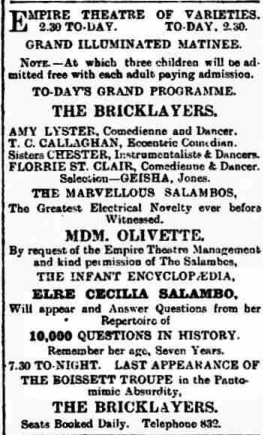
The Marvellous Salambos, Mdm. Olivette, and the Infant Encyclopaedia, Elre Cecilia Salambo, Northern Whig, 22 February 1902. Image created by the British Library Board. No known copyright holder.
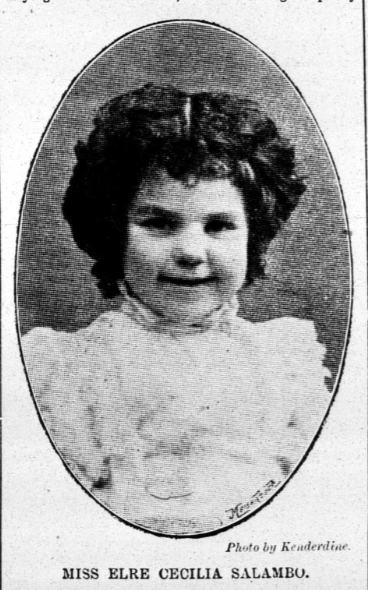
Elre as she was shown in publicity photographs released in 1901, the year she debuted. Era, 5 October 1910. Image created by archive.org. Public domain.
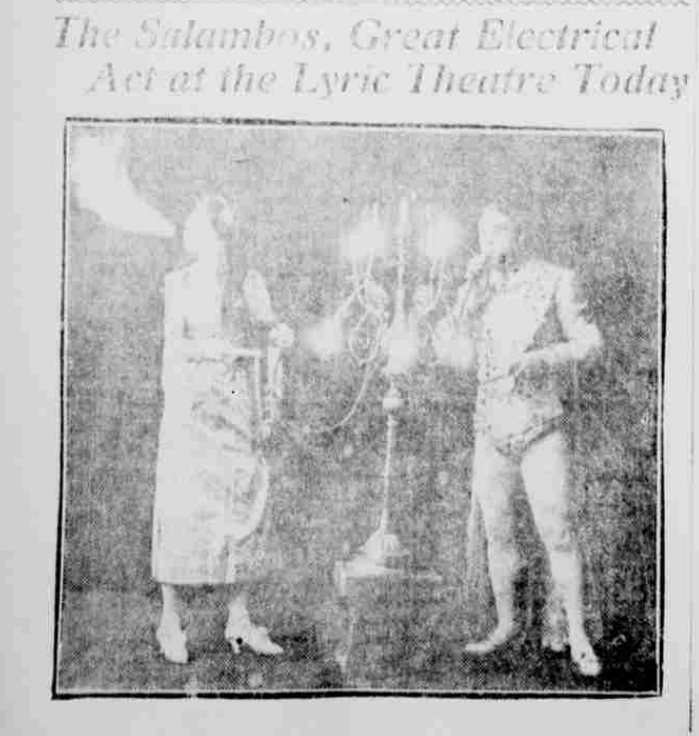
Elre and Erle Salambo, Tusla World, 16 March 1913. Image created by the Library of Congress. Public domain.