Limelight and Cornstalks
Part III: Roots.
Jamie Barras.
In Part II of this series, I described how comedian R.G. Knowles drew on the multinational, multiethnic, and egalitarian London entertainment scene to create a London baseball scene with universal appeal. In this third, and concluding part of this series, I want to show how that scene unravelled due to the inherent flaws in that model: it was broad in reach but lacked deep roots.
BASEBALL. On Saturday last the opening match of the season took place between the Dewars and the Remingtons. At the opening the game appeared to be a very one-sided affair, as the Remingtons went away with a strong lead. Later on, however, the Dewars, by some good play, put an entirely different complexion on affairs and finally won by one run.[1]
The 1895 season was to prove the high-water mark for R.G. Knowles’ no-collar London baseball scene. That season, it ran two tiers, senior and junior divisions, and for the first and probably last time, had more English-born than North American players. New to the Senior division was Fullers, a team sponsored by Vermont-born William Bruce Fuller (1857–1909), the confectioner. The team was led by Fuller’s employee, New Yorker John Henry Riley (1867–?). Another Fullers employee who would become a fixture on the London baseball scene, although as an umpire rather than a player, was Edward Siegfried “E.S.” Hengle (1855–1927). Hengle was born in Chicago to Dutch parents. In the 1880s, he officiated at baseball games all over the United States. He may have been a member of an amateur team, “The Crooks”, in Chicago in the late 1870s; however, that may have been one of his brothers. In 1891, he set off on a trip around the world, reaching London in 1892; there, he accepted a job at Fullers. London would remain his home for the rest of his life.[2]
Although conceived as a company team, Fullers would not long remain so; for most of the season, it fielded more music-hall performers, some veterans of the scene, some new to the game in London. Its stars were its battery, Chicagoan Howard Palmer Ruggles (1875–1959), an employee of the Werner Publishing Company, and, as we have already seen in Part II, player of colour [Charles Cornelius] Carey (1868–1901). Fullers was a replacement for a team previously announced as joining the Senior division, named “Johannis” (a brand of mineral water).[3]
The other “new” team in the Senior division was the Dewars. This was actually just the old J’s team, renamed after its new sponsor, whisky distiller Thomas R. Dewar (1864–1930). Dewar was also the new president of the LBA. The Thespians and Remingtons also returned.[4]
The situation with the second “Junior” tier was reminiscent of the changeover from the 1893 to the 1894 season. In the March 1895 announcement of the new season, eight clubs were named as planning to turn out for the Junior division that season: the Electrics, Crescents, Farringdons, Silverdales, Athletics, Balham Wanderers, Coldstream, and Anglo-Americans. However, in Knowles and Morton’s 1896 book, looking back at the 1895 season, only four teams are named: Woolwich Arsenal, White Horse, Civil Service, and St Jacob’s [Oil]. One of the Woolwich Arsenal players is pictured in Knowles’ earlier Windsor Magazine article: Woolwich Arsenal footballer Billy Stewart.[5]
In fact, the Civil Service team did not play its first game until 5 September 1895, when the Thespians defeated it in a trial game; only the Woolwich Arsenal, White Horses, and St. Jacob’s [Oil] teams competed for the 1895 amateur championship. Prominent among the Civil Service team’s players were three runners, James Oliver Bradfield (1857–1918), and the brothers George William Turk (1869–1943) and Arthur S. Turk(1881–1957). The Civil Service ran an extensive athletics programme, and this was a potentially very interesting development. Alas, although a Civil Service team was announced for the 1896 season, it does not seem to have materialised.[6]
The White Horse team was “a Brixton team” that gained the name “White Horse” because of the emblem on its uniforms. It struggled against teams with more backing, particularly St Jacob’s [Oil], which had the backing of the Vogeler Company, the manufacturers of St Jacob’s Oil (a patent medicine). Bostonian William Edwin Geddes (1846–1908), the London representative of the Vogeler Company, was on the LBA board.[7]
One player of note for the St Jacob’s team for the 1896 season was James Aloysius McWeeney (1869–1925). McWeeney was of Scots-Catholic heritage and had been destined for the priesthood before he discovered association football. He went on to become a prominent sports journalist and author. However, in 1896, he was a struggling songwriter. He also served as organising secretary of the LBA that year, taking over the role from Nelson Pingrey Cook (1864–1928) of Vermont. McWeeney and Cook would come back together in 1906 to form the British Baseball Association (BBA), the successor to the LBA in the capital. I tell that story elsewhere. We have already met other LBA regulars who became involved in the BBA in the previous part of this series; we will meet more later.[8]
St Jacob’s took on Woolwich Arsenal in the final of the Junior Division trophy, the Knowles Shield, on Saturday, 19 October 1895, and won the game 45–23. The following season, Vogeler’s would enter teams in both divisions.[9]
Outside of cup competitions, the games that caused the greatest stir in 1895 were those between the London Consolidated Club—an LBA All-Stars—and the visiting “Boston Amateurs”. Viewed as a stamp of approval for the English baseball scene, the visit of the “Boston Amateurs” was, in fact, an embarrassment, a piece of flim-flam perpetrated by minor league team manager and promoter Al Lawson (1869–1954). The “Amateurs” were supposedly players from Ivy League schools; this was true of Castle Douglas “Cass” Burt (1873—1948) and William Walter Clark (1870–1929), who had attended Princeton and Harvard, respectively, as they had claimed; however, the jury is out on the other Amateurs. The tour collapsed after just two weeks because Lawson did not realise that baseball clubs in England were funded through subscriptions, not gate receipts, so charged very little for tickets. Lawson abandoned the team and skipped the country.[10]
One player of note who turned out for the “London Consolidated” team in the games against the Boston Amateurs was the artist Ernest L. Blumenschein (1874–1960). A Pennsylvania native, Blumenschein was studying painting in Paris at the time. Meanwhile, the Boston Amateurs’ catcher, M. Maynard (?-?), would remain in London and become a regular in LBA games in future seasons.[11]
Inside cup competitions, the big news was the defeat of the Thespians by the Fullers team in the playoffs for the National Championship. There would be no hat-trick of championships for the Thespians. Nor, indeed, would there be any more wins for LBA teams in the National Championship. The Fullers were defeated by Derby in the 1895 final at Derby on Saturday, 17 August 1895. They started well, but their 20-year-old pitcher, Howard Ruggles, faded badly in the last few innings. The Remingtons would represent the LBA in the 1896 final but be defeated by Wallsend in questionable circumstances: the Remingtons had played a tough semi-final against Stockton immediately before the final, while Wallsend were rested. That was the last time that an LBA team would reach a National Championship final.[12]
From many points of view, this was a matter of congratulations, as the Midlanders are essentially an English team, and their capture of the bays from a purely American nine must give an impetus to the sport, and serves to show beginners what can be accomplished by pluck and perseverance.[13]
The defeat of the Fullers team by Derby in the 1895 National Championship final was seen, even by Knowles, as a watershed moment, a passing of the baton from teams of North American players to teams formed largely, if not solely, of British players, rapidly gaining in experience in the game. It was also a sign that the London scene had reached its high-water mark.
There was no more evidence of this than the demise of the Thespians team in the run-up to the 1896 season. This was a consequence of the need to furnish players for the teams with sponsorship, when those players were simply not available. The Thespians had to disband to provide them. So, when the season opened, the four teams in the Senior division were the returning Dewars and Remingtons and two new—on paper—teams, a second St Jacob’s Oil team to complement the junior division team, and the Crystal Palace team.[14]
In practice, the Senior St Jacob’s Oil team and the Crystal Palace teams were simply the old Thespians and Fuller’s teams remixed. The Crystal Palace team was associated with the London Pleasure Grounds of the same name, which furnished the team with a ground and £100 in sponsorship. Its arrival on the scene was the hidden sign that a schism was developing in the LBA. The point of contention was where games should be played.[15]
Baseball games at the Crystal Palace had been a feature of the LBA season since the previous year. This was a major vote of confidence in the ability of games to draw crowds. It also, for some in the LBA, threw light on a perennial problem for the scene: where it played its games. The Greyhound Inn cricket ground at Dulwich was no longer available (it was in the process of being turned into a housing estate), but games were still being played at Hyde Farm in Balham. This, in London terms, was the back of beyond. At least, that was the view of the faction within the LBA that backed the Crystal Palace as a venue.
This all came to a head at the 1897 LBA Annual General Meeting in March 1897. A row broke out between supporters of the Crystal Palace venue and the “old guard” of the LBA, who still favoured the old Hyde Farm, Balham ground out of nostalgia. The Crystal Palace’s supporters pointed to the difficulty both players and fans had getting to the Hyde Farm ground, something that was not an issue at the Crystal Palace, as it was a visitor attraction and was set up to receive large crowds. The old guard, however, dug in their heels and wrote off the partiality for the Crystal Palace shown by its supporters as financially motivated. They were not wrong about that, but it blinded them to the sense of the Crystal Palace argument. The row festered. The scene suffered. As we will see, this debate would be revisited a decade later.[16]
Alas, the 1897 season was to prove the final one for the Remingtons. One of the earliest and most important teams on the scene, the Remingtons had struggled to field a team for much of the 1896 and 1897 seasons because of a combination of illness and players associated with the Wyckoff, Seamans, and Benedict Company’s London offices returning to the US.[17]
One player to note who came to the fore in the 1897 season was the founder and captain of the Crystal Palace team, Dr William H. Wray (1854–1923). Wray was a veterinary inspector attached to the US Department of Agriculture stationed in London. Born in New Jersey, he had a long history of playing the game in the US before he was transferred to England.[18]
His introduction to the London baseball scene had come the previous year, when he had turned out for the Fuller’s team alongside his friend and fellow New Jerseyite, William Darcy Craven (1846–1940). Craven was the representative in England of American meat-packing concerns, a job he acquired following his father’s invention of a cold-storage method for maritime transportation. Craven had an even more storied history with baseball than Wray, After turning out for clubs like the Eureka in the New York area in the early 1860s, he went on to become a founder member of one of the first baseball clubs formed in the post-Civil War Southern United States, the Forest City Baseball Club of Savannah, Georgia. He had been playing in the LBA since 1894 and was its oldest (in age) playing member.[19]
The Wray–Craven connection would continue. In 1897, Craven would join Wray in the Crystal Palace team. Then, the next season, one of Craven’s sons, David S. Craven (1882–?), would replace him in the team—the first example of father and son players in baseball in Britain? The following year, after the final collapse of the LBA, Wray and Craven would form the London Baseball Club, an amateur team, with Craven as its chair and Wray as its honorary secretary. It is not clear if the London club was one of the teams in the game between “the Balham and Streatham teams” played at Balham in June 1899. Wray turned out for the Balham team.[20]
Wray himself would become involved in the next attempt to launch baseball in London, the British Baseball Association (BBA), in 1906. As stated above, this was the inspiration of the LBA’s two organising secretaries, J.A. McWeeney and Nelson Cook. The BBA’s Nondescript Baseball Club was a club of amateurs modelled on the London Baseball Club that Wray and Craven had launched in 1899. It was led by J.A. McWeeney and William Wray served on its board. This, as well as evidence I present below, places McWeeney and Cook on the same side of the venue argument as Wray, and it seems fair to describe the three men as leaders of the Crystal Palace faction. Wray also served as an umpire for the BBA, alongside other old LBA hands, Ed Hengle and Charles Petitjean.[21]
Wray was a keen cricketer, and he founded the Crystal Palace club alongside fellow cricketers Robert Henry Canham (1870–1949) and Ernest Herbert Canham (1876–1940). The Canham brothers, born in Norwood, in Surrey, were all-round athletes—Robert Canham was a professional cyclist. They got their start in the game in 1895 playing for the Junior division champions, St Jacob’s Oil.[22]
The team of the Australian baseball players who have been touring the States under the management of Mr. H. Musgrove, played their only game in England, against a London nine at the Crystal Palace this week. It was a pity that some of London's best players were not available, but that fact should not in any way detract from the grand performance of the visitors, who won by 21 runs to 8.[...]The sides were: The Australians.—C. Over, J. M'Kay, C. Kemp, W. G. Ingleton, H. S. Irwin, P. A. M'Allister, Rue Ewers, A. E. Wiseman, A. S. Carter, S. W. Smith, J. H. Stuckey, J. Wallis, and F. Laver. London. Armstrong, Kruger, Hunter, Slattery, Starkweather, Halter, La Martine, Achew, and Ashby.[23]
As was ever the way with the LBA, whatever the club’s origins, the bulk of Crystal Palace’s players for the bulk of its existence would be music-hall performers. It was the main source of players for the July 1897 game between Harry Musgrove’s Australian baseball tourists and the “London Consolidated” team. Its battery, “Bobbie” Armstrong, pitcher, and Kruger, catcher, were the battery in that latter game. Alas, to date, I have been unable to find out anything about these two players.[24]
Other players of note in the London team that day were Jack Ashby and Frank Halter, still there in the game five years after they helped launch the scene back in 1892. Also in the team were Walter Starkweather and another longtime stalwart of the scene, James La Martine, real name John Stewart Sherry (1858–1925). La Martine’s journey to the London baseball scene was an interesting one. He started his performing career as a member of the La Martine brothers of acrobats. Although the troupe began its career in the brothers’ native Philadelphia, they only found real success once they relocated to Cuba, where they remained for several years. La Martine then broke with his brothers and travelled to England with his wife, fellow performer Clara La Martine, and their young son, professional name Herbert La Martine. Within a few years of their arrival, John and Clara would give up the stage to manage their son’s burgeoning career. The Cuba connection is intriguing and worthy of more research.[25]
ED. LANG has organised a baseball team, which he calls the American Comedy Crazy Baseball Nine. Right fielder, Sparrow; short stop, C. M. Harris; second base, H. E. Fairbank; third base, Fred Brown; first base, William Manning; right fielder, Frank Parker; pitcher, W. Murphy; centre field, W. H. Fox; catcher, Patsy Gorman; extras, William Tucker, Jules Garrison, Mat Wills, Powers Brothers, and Reynolds. They are to play in costume; and the idea is they should encounter the American theatrical players now in London for the benefit of the Music Hall Benevolent Fund.[26]
SUNDRY variety and theatrical American citizens, now disporting in London, have resolved to challenge, at their national game of baseball, Mr. De Wolf Hopper and Company. Mr. Hopper, is a champion base-baller in his native land, and is to be met in this connection by such variety and theatrical experts as R. G. Knowles (just back from his native State), J. E. Sullivan (the Shaftesbury's Polite Lunatic), E. J. Conelly (of the same house), G. W. Barnum (the Strand's Polite Lunatic), Burr Mackintosh, Tom Oberle, and Clarence Handysides (all of the Duke of York's), and Eugene Stratton (of every variety theatre and hall worth mention in these dominions).[27]
The London Baseball Association ended not with a bang but with a whimper, the scene fizzling out across the 1898 season with only Dewars and the Crystal Palace still in the game. This coincided with the ebb of interest in the game nationally—it simply had not caught on. However, the failure of the London scene had its own flavour. J.A. McWeeney, the organising secretary of the LBA, writing in 1906 as he and former organising secretary Nelson Cook were about to relaunch a new attempt to popularise baseball in London, revisited the argument about suitable venues. He came down on the side of the supporters of the Crystal Palace, who said that it was the difficulty in reaching the Balham ground that had stifled the growth of the game. His partner, Nelson Cook, was even more direct, describing the LBA Annual General Meeting in the Spring of 1897 at which the venue argument was aired, as the funeral for a scene that had died across the 1896 season.[28]
With the benefit of history, we can see that the venue argument was just a symptom of the disease. Even at the Junior level, except for the Woolwich Arsenal team, none of the teams in the LBA had deep roots in any one piece of ground. All the teams played their games at Clapham Common, the Greyhound at Dulwich, Hyde Farm at Balham, or the Crystal Palace at Sydenham as circumstances demanded. Instead, they should have been assigned “home grounds” somewhere—and preferably had the locale in their team name, like the Woolwich Arsenal. The same issue was had with players. Knowles’ open-to-all philosophy meant that there would always be enough players for any scheduled game because any player who was free was free to play for any team at any time. In one game in 1896, a game was scheduled to include the Remingtons, but so many of the players that turned up on the day were regulars with the Dewars team that the result was given to them, not the Remingtons.[29] This approach meant that players and fans always got a game, but, just as with the rotating venues, it was an anathema to building fan loyalty for any one team.
But, then, it is too much to expect itinerant entertainers to see the importance of putting down roots.
The programme arranged for the East Melbourne Cricket Club night on Friday next, 11th December, by arrangement with Mr. Robert Brough, is advertised in our columns to-day and promises to provide a fund of entertainment[…]the latest additions to the list include[…]Mr. R.G. Knowles, by kind permission of Mr. P. Goatcher, in a baseball narrative scene.[30]
Our play had improved a good deal of late, due principally, I think, to the visit of Mr. R.G. Knowles. He gave us a whole afternoon of his time here, played a whole game, and taught us a good deal in a short time.[31]
From 1896 onwards, health problems meant that R.G. Knowles would spend less and less time involving himself in the scene he had created. At the close of the 1896 season, he and Winifred set sail for Australia for a much-needed break. It wasn’t to be, however, as the workaholic Knowles signed up to perform almost as soon as the Knowleses arrived in the country. I know of no evidence that Knowles played baseball on this visit. However, a feature of his act on this visit was a “baseball narrative scene”, which, we might speculate, may have involved a recitation of the famous “Casey at the Bat”. The Knowles would return to Australia in 1906, as part of a world tour. On that visit, Knowles played at least one game of baseball, at Townsville in Queensland.[32]
On both the 1896 tour and the 1906 tour, the bookings for R.G. Knowles, the founder and captain of the London Thespians Baseball Club, came courtesy of J.C. Williamson, theatrical producer, and the founder and captain of the Melbourne Thespians Baseball Club.[33]
Acknowledgements: I was first introduced to R.G. Knowles and the London Baseball Association via posts by Andrew Taylor at his Folkestone Baseball Chronicle Facebook page. Andrew was also a great help to me in my early research on the subject.
Jamie Barras, July 2026
Back to Limelight and Cornstalks
Notes
[1] ‘Baseball’, Derby Daily Telegraph, 10 May 1895.
[2] William Bruce Fuller: https://www.findagrave.com/memorial/159035067/william-bruce-fuller, accessed 14 July 2026. John H. Riley: entry for John H. Riley, Streatham district, 1901 England Census, ancestry.co.uk, Ancestry.com Inc. (Operations), accessed 10 July 2026. Edward Hengle’s biographical information and story can be assembled from the following: Edward S. Hengle (“Hengel”), US passport application, filed in London on 21 November 1924, and registration of his death, 1927, Births, Marriages, and Deaths: https://www.freebmd.org.uk/cgi/search.pl, accessed 14 July 2026. His career as an umpire in the US is mentioned in his passport application. He is presumably the “Ed Hengle”, umpire in a Memphis–Chattanooga game, mentioned here: ‘Pulled Out of the Fire’, Memphis Daily Appeal, 2 June 1886. ‘Crooks’: ‘Base-Ball’, Chicago Tribune, 24 March 1878.
[3] Johannis baseball team: ‘Baseball’, Music Hall and Theatre Review, 8 March 1895. Mineral water: https://www.gracesguide.co.uk/Johannis, accessed 13 July 2026. I tell the Ruggles story here: https://www.ishilearn.com/diamond-lives-the-mad-man-and-the-natural, accessed 12 July 2026. See also: ‘Baseball’, Akron Beacon Journal, 23 April 1897. This report, from a period when Ruggles was working at the Werner Company’s Akron, Ohio, office, is also direct evidence that Howard Palmer Ruggles and Ruggles, the Fuller’s pitcher, are one and the same. Annoyingly, in the report, his name is rendered as ‘H.G. Ruggles’; however, we can confirm this is Howard Palmer Ruggles, as this error was corrected in later reports, and his brother Oliver Ennis (O.E.) Ruggles was in Akron with him: ‘Beat Kent’, Akron Beacon Journal, 10 May 1897.
[4] Dewars = J’s: Note 3 above, first reference. Dewar elected LBA president: ‘Baseball’, Music Hall and Theatre Review, 1 March 1895.
[5] R.G. Knowles and Richard Morton, ‘Baseball’, (London: George Routledge and Sons, 1896), page 51, https://archive.org/download/baseball_202409/Baseball.pdf, accessed 9 January 2025; R.G. Knowles, ‘Baseball in England: Past, Present, and Future’, Windsor Magazine, November 1895, 516–520. Note 2 above, first reference.
[6] ‘Bustling Baseball Bristling’, Music Hall and Theatre Review, 6 September 1895. Bradfield and the Turks in Civil Service baseball team: ‘Sporting Intelligence’, South Wales Daily News, 30 August 1895. J.O. Bradfield: entry for James O. Bradfield, Lambeth district, 1901 England Census, ancestry.co.uk, Ancestry.com Inc. (Operations), accessed 10 July 2026; death registration for James. O. Bradfield, 1918, Births, Marriages, and Deaths: https://www.freebmd.org.uk/cgi/search.pl, accessed 14 July 2026. G.W. Turk: ‘Death of Major G.W. Turk’, Derbyshire Times, 29 January 1943. Arthur S. Turk: https://theathleticsmuseum.org.uk/a-s-turk-memorial-trophy-for-a-a-a-junior-long-jump-championship/, accessed 12 July 2026. Teams for 1896 season: ‘Baseball: The Growth of the Game’, Echo (London), 4 May 1896.
[7] White Horse/Brixton: Knowles, Note 5 above, final reference. Geddes: entry for William E. Geddes, Headingley district, 1891 England Census, ancestry.co.uk, Ancestry.com Inc. (Operations), accessed 10 July 2026; death registration for William Edwin Geddes, 1908, Births, Marriages, and Deaths: https://www.freebmd.org.uk/cgi/search.pl, accessed 14 July 2026. Knowles and Morton, Note 5 above, first reference, 67–68.
[8] McWeeney playing for St Jacob’s Oil: ‘Baseball’, Streatham News, 5 October 1895. Cook and McWeeney and the British Baseball Association: https://www.ishilearn.com/diamond-lives-health-friendship-and-baseball-part-I, accessed 12 July 2026.
[9] ‘Baseball at Sydenham’, Daily Telegraph & Courier (London), 21 October 1895.
[10]https://sabr.org/journal/article/george-h-lawson-the-rogue-who-tried-to-reform-baseball/, accessed 9 July 2026. The names and years and places of birth of five of the amateurs including Castle D. Burt and William W. Clark can be worked out from the record of their return to the USA: SS Georgian, sailed from London 17 September 1895, arrived Boston, Massachusetts, U.S., Arriving Passenger and Crew Lists, 1820-1963, ancestry.co.uk, Ancestry.com Inc. (Operations), accessed 10 July 2026. Cass Burt at Princeton: ‘Notes from “The Poly”’, Times-Union, 1 October 1892. Incredibly, Burt signed up with Lawson a second time in 1897: ‘First Player Signed’, North Adams Transcript (North Adams, Mass.), 23 February 1897. Burt’s name can be found in the 1911 Living Princeton Alumni Directory available here: https://babel.hathitrust.org/cgi/pt?id=mdp.39015075896061&seq=5, accessed 14 July 2026. Clark’s name can be found in the 1910 Harvard University Directory available here: https://babel.hathitrust.org/cgi/pt?id=mdp.39015035946626&seq=7, accessed 14 July 2026. That this is “our” Clark can be confirmed by the information in the arrival form that Clark is a 25-year-old lawyer from Ayer, Massachusetts, and his father’s given name starts with a “P”, cross-referenced with the following records: record of the birth of William Walter Clark, 10 March 1870, father Patrick, Massachusetts, State Vital Records, 1638-1927; entry for William W. Clark, Ayer district, 1880 US Federal Census, father’s name Patrick; and marriage certificate for William W. Clark, lawyer, father’s name Patrick, City of Boston, 7 February 1907, Massachusetts, State Vital Records, 1638-1927, familysearch.org, accessed 15 July 2026.
[11] ‘Baseball: Boston v. London’, London and Provincial Entr'acte, 7 September 1895. Knowles and Morton, Note 5 above, first reference, 31–42. Larson, Robert W.; Larson, Carole B., 'Ernest L. Blumenschein: The Life of an American Artist' (University of Oklahoma Press, 2013). Maynard in LBA: ‘Is Baseball to Boom?’, Morning Leader, 16 March 1896. ‘M. Maynard’: ‘Baseball’, Northern Echo, 18 August 1896.
[12] Fullers–Derby: Note 3 above, second reference. Remington in the 1896 final: ‘Baseball’, Pall Mall Gazette, 17 August 1896.
[13] Knowles and Morton, Note 5 above, first reference, 51–52.
[14] Demise of the Thespians: London Baseball Association, Colonies and India, 2 May 1896. Four teams: Note 10 above, final reference.
[15] This information came to light at the LBA Annual General Meeting of 1897: ‘Baseball’, Music Hall and Theatre Review, 02 April 1897.
[16] This came to a head at the LBA Annual General Meeting of 1897: Note 14 above.
[17] The Remingtons’ struggles in 1896: ‘Baseball’, Music Hall and Theatre Review, 24 July 1896; ‘Baseball’, Music Hall and Theatre Review, 31 July 1896. Will not be in 1898 season: ‘Sports and Pastimes’, Melton Mowbray Mercury and Oakham and Uppingham News, 19 May 1898.
[18] Wray: ‘Foot and Mouth Disease’, Toronto Daily Mail, 26 February 1892; https://www.familysearch.org/en/tree/person/details/LTSV-NX4, accessed 12 July 2026; entry for William H. Ray and Ida Ray, Penge district, 1891 England Census, ancestry.co.uk, Ancestry.com Inc. (Operations), accessed 10 July 2026. Wray and Crystal Palace team: ‘Baseball’, London Daily Chronicle, 5 February 1896. Wray and US baseball: Knowles and Morton, Note 5 above, first reference, pages 78–79.
[19] Wray and Craven in Fullers: ‘Music Hall and Baseball’, Morning Leader, 23 August 1895. William Darcy Craven: https://www.findagrave.com/memorial/92656850/william-darcy-craven, accessed 12 July 2026; Knowles and Morton, Note 5 above, first reference, page 79. For Forest City: ‘The Base Ball Match’, Charleston Daily News, 8 September 1868.
[20] Craven in the 1897 Crystal Palace team: ‘Baseball’, Derby and Chesterfield Reporter, 28 May 1897. “Dave Craven”, “newcomer” and a “chip off the old block” playing for Crystal Palace in 1898: ‘Baseball At Crystal Palace’, Greenwich and Deptford Observer, 12 August 1898. David Craven, William Darcy Craven’s son: entry for William D. Craven and family, Camberwell district, 1901 England Census, ancestry.co.uk, Ancestry.com Inc. (Operations), accessed 10 July 2026. Wray and Craven and London Baseball Club: ‘A Baseball Club for London’, Bell's Weekly Messenger, 22 April 1899. Balham and Streatham teams: News item, The Referee, 4 June 1899.
[21] See Note 7 above. Wray in the Nondescripts: ‘Nondescripts Baseball Club’, Daily News (London), 17 October 1906. Umpire in BBA with E.S. Hengle and Charles Petitjean: ‘British Baseball Association’, Sporting Life, 7 June 1906. Charles Petitjean in LBA: ‘London Baseball Association’, Sporting Life, 23 February 1894; ‘London Baseball Association’, Music Hall and Theatre Review, 23 February 1894; ‘The Baseball Associations’, Globe, 22 February 1894. Hengle: Knowles and Morton, Note 5 above, first reference, page 56.
[22] Knowles and Morton, Note 5 above, first reference, 70–71. Biographical information: entry for Robert H. Canham and Ernest H. Canham, Norwood subdistrict, 1901 England Census, ancestry.co.uk, Ancestry.com Inc. (Operations), accessed 10 July 2026; death registrations for Robert Henry Canham, 1949, and Ernest H. Canham, 1940, Births, Marriages, and Deaths, https://www.freebmd.org.uk/cgi/search.pl, accessed 13 July 2026.
[23] ‘Sporting Notes’, Music Hall and Theatre Review, 30 July 1897.
[24] “Bobbie” Armstrong for the Dewars in 1896: ‘Baseball’, Music Hall and Theatre Review, 31 July 1896. Armstrong and Kruger for Crystal Palace: ‘Baseball’, Greenwich and Deptford Observer, 11 June 1897.
[25] Note 20 above. La Martine/Sherry biographical information: https://www.quarlton.co.uk/tngds/getperson.php?personID=I4621&tree=tree1, accessed 13 July 2026. See also US passport application for “Thomas Herbert Sherry, known professionally as Herbert La Martine’, filed in Washington, DC, 10 June 1922, U.S., Passport Applications, 1795–1925, ancestry.co.uk, Ancestry.com Inc. (Operations), accessed 10 July 2026; Knowles and Morton, Note 5 above, first reference, page 74. La Martine Brothers return from Cuba: ‘Amusements: the Bijou’, Philadelphia Times, 14 April 1895. La Martines in Cuba (the article incorrectly claims Herbert La Martine was born in Cuba): ‘Master Herbert La Martine’, The Sketch, 10 October 1894.
[26] News item, Music Hall and Theatre Review, 28 July 1899.
[27] News item, Music Hall and Theatre Review, 14 July 1899.
[28] Note 15 above. J.A. McWeeney, ‘Baseball from an English Point of View’, 1906 special English edition of Spalding’s Official Base Ball Guide, ed. Henry Chadwick (London: British Sports Publishing Company, 1906), 51–59; ‘Yankee Fan Makes England Play Ball’, Sunday Star (Washington, DC), 12 April 1908.
[29] Note 17 above, first reference.
[30] News item, The Age (Melbourne, Vic.), 9 December 1896.
[31] ‘Victorian Notes’, Referee (Sydney, NSW), 29 August 1906.
[32] Notes 30 and 31 above.
[33] See, for example, News Item, The Leader (Melbourne, Vic.), 3 March 1906.
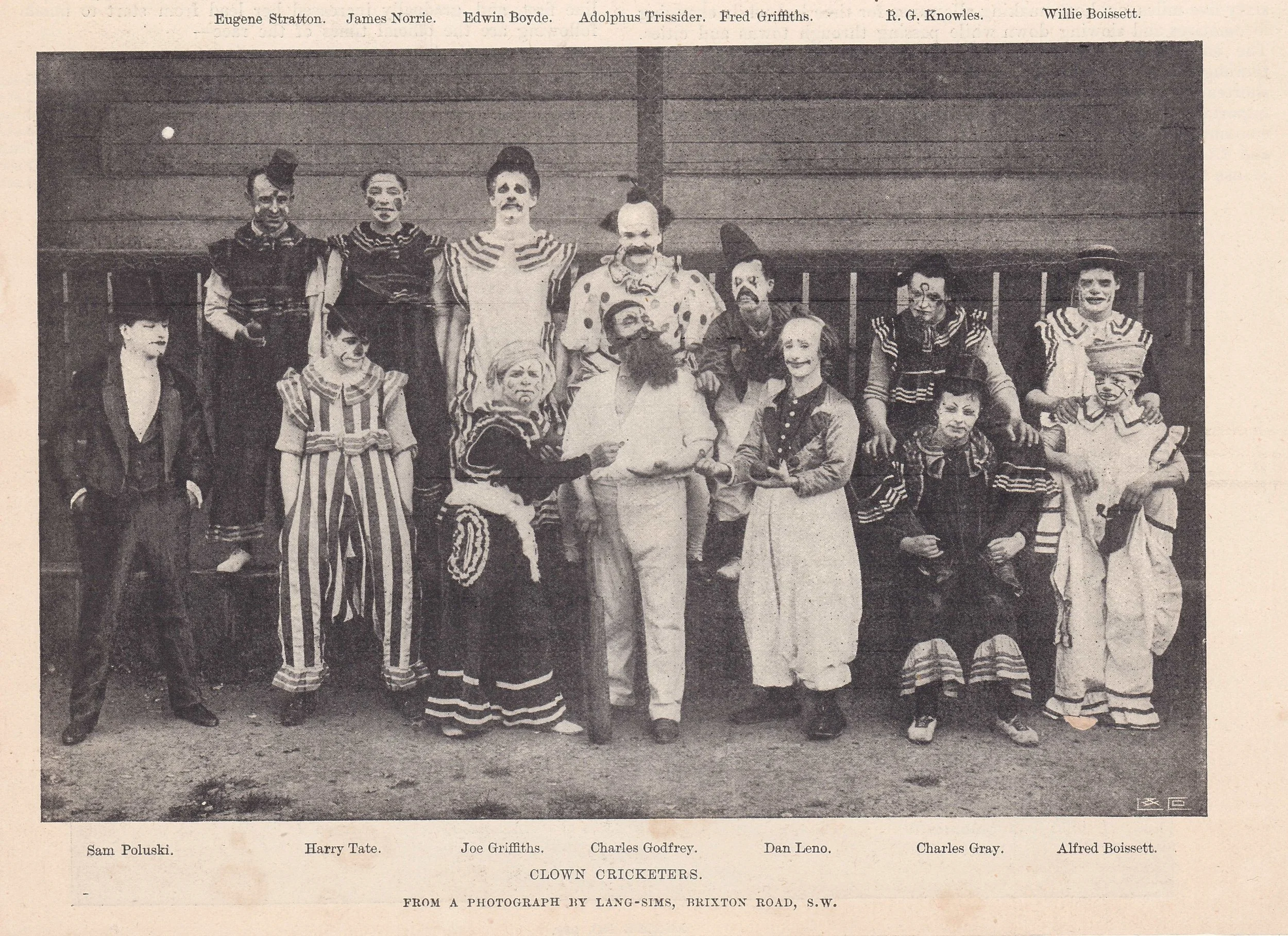
Clown Cricketers, Sketch Magazine, 9 October 1895. Author's own collection.
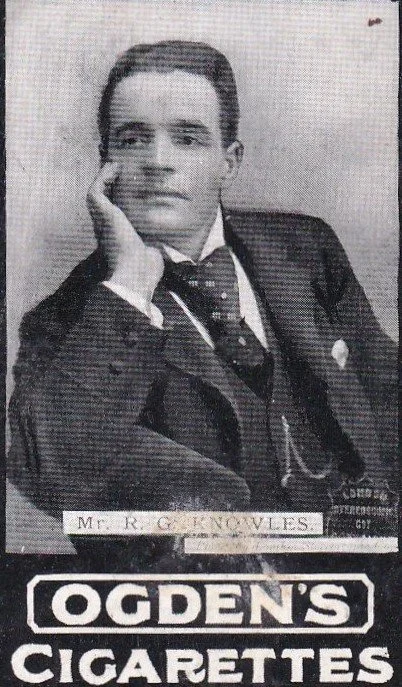
Richard George "R.G." Knowles (1858-1919). Ogden's Cigarette card. Author's own collection.

Base Ball and Mummers: the Thespians and the Buffalo Bills, Music Hall and Theatre Review, 22 July 1892. Image created by the British Library Board. No known copyright holder.
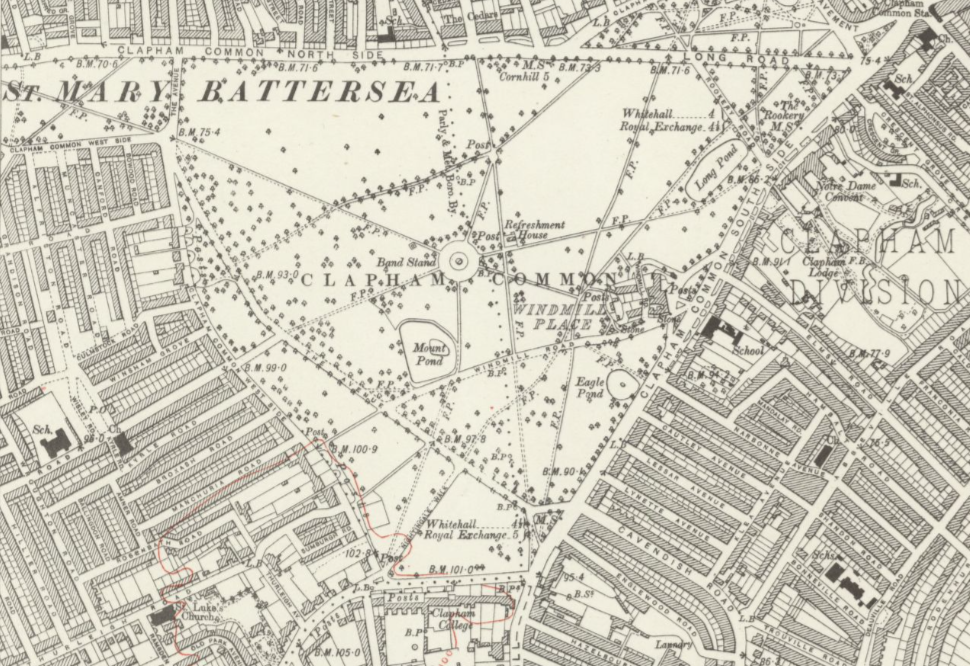
Clapham Common, 1896 Ordnance Survey Map. Library of Scotland. https://maps.nls.uk/os/. Public domain.
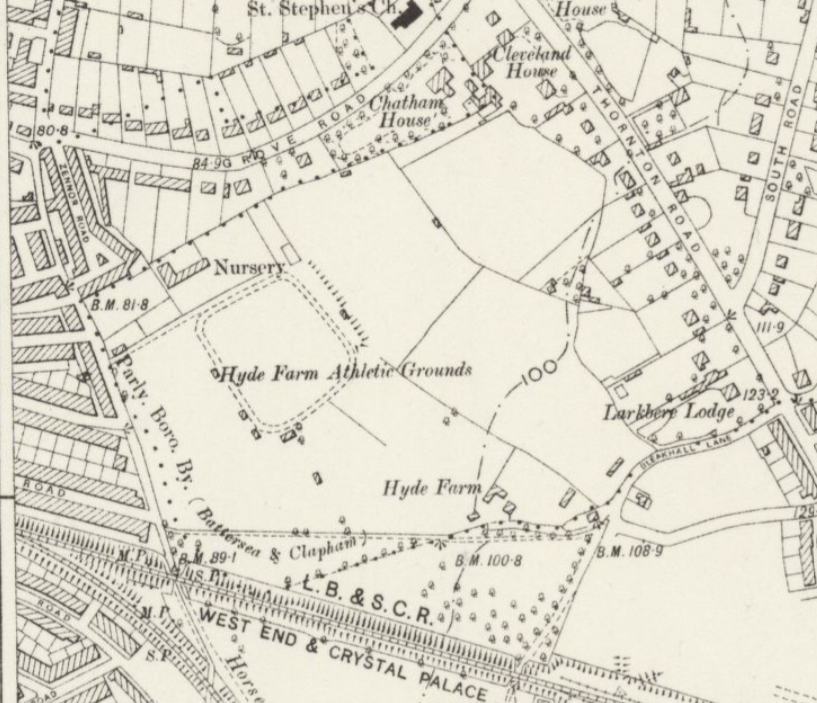
Hyde Farm, Balham, 1896 Ordnance Survey Map. Library of Scotland. https://maps.nls.uk/os/. Public domain.
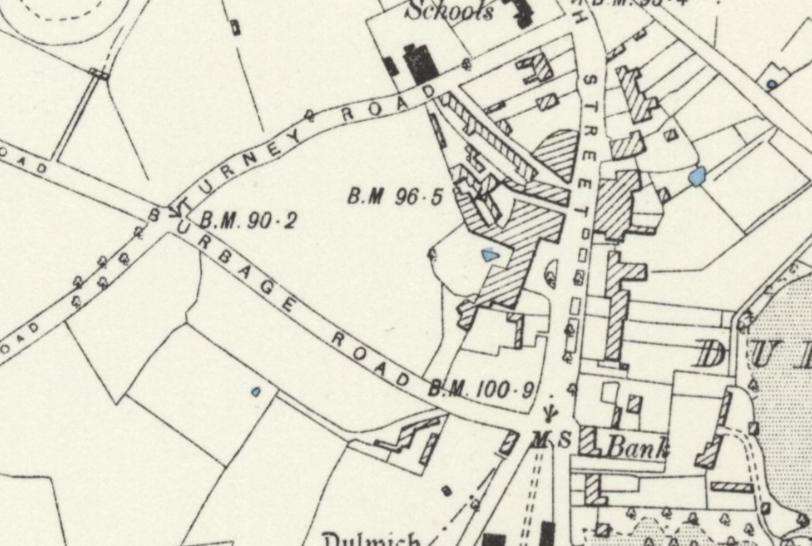
Greyhound Inn cricket ground, Dulwich, 1896 Ordnance Survey Map. Library of Scotland. https://maps.nls.uk/os/. Public domain.
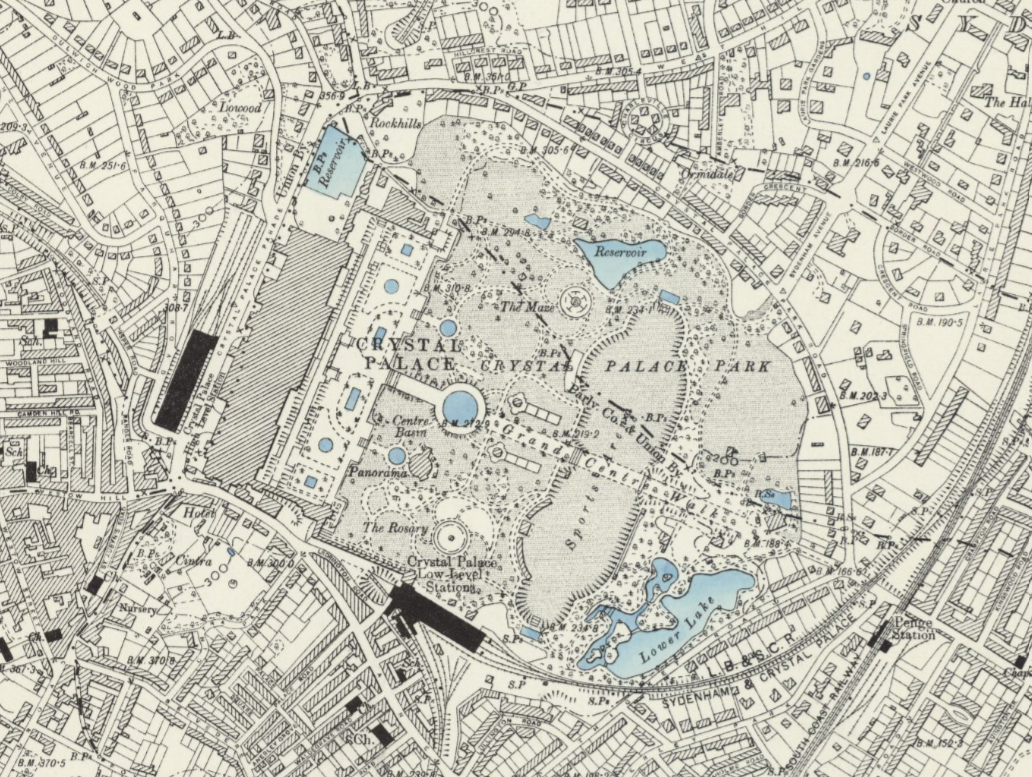
Crystal Palace Sports Arena, Sydenham, 1896 Ordnance Survey Map. Library of Scotland. https://maps.nls.uk/os/. Public domain.
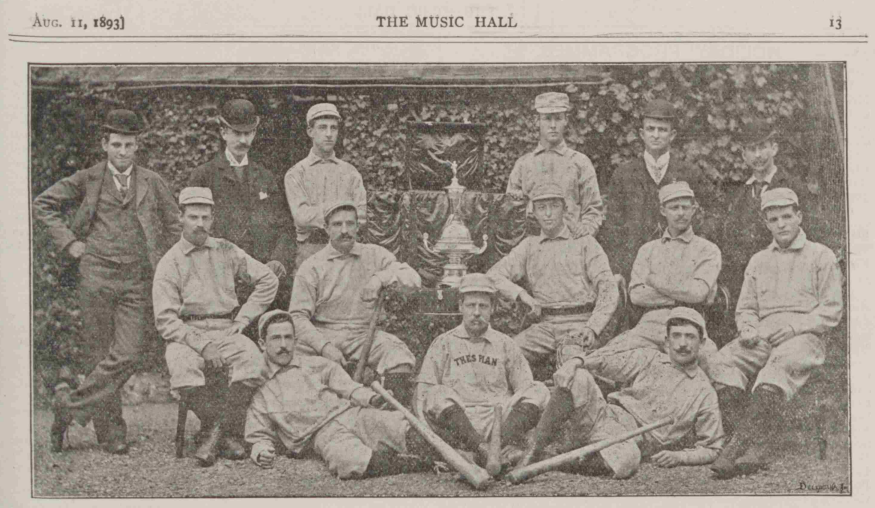
Thespians Baseball Club, Music Hall and Theatre Review, 11 August 1893. Image created by the British Library Board. No known copyright holder.
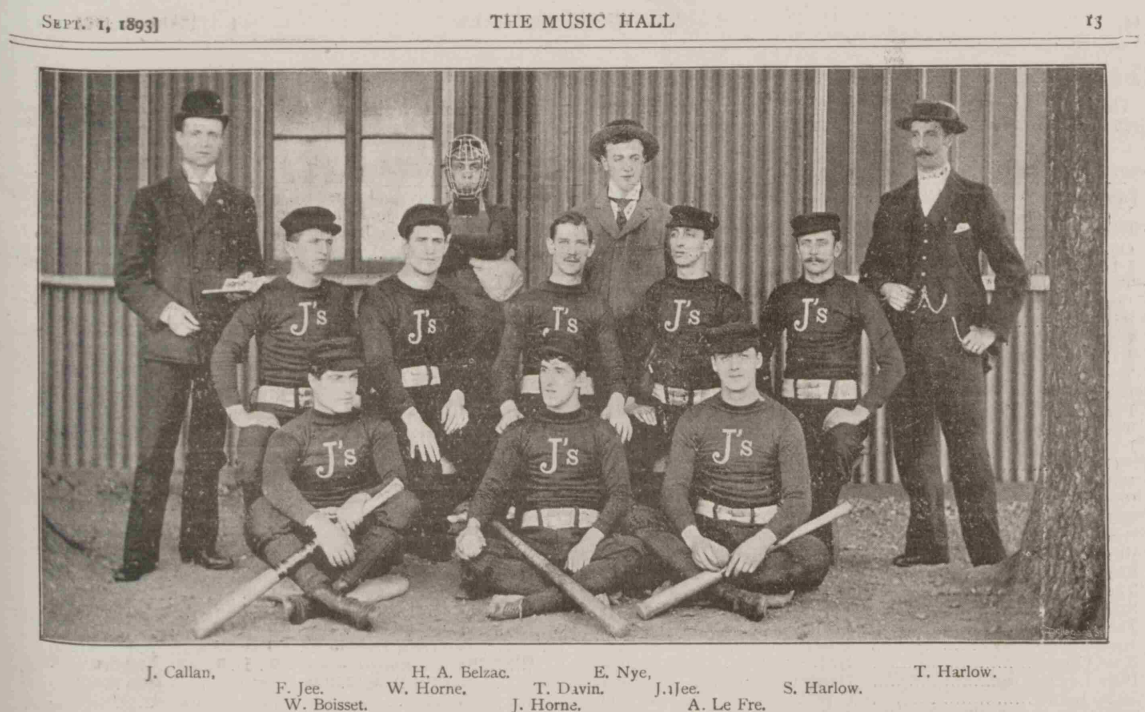
J's Baseball Club, Music Hall and Theatre Review, 1 September 1893. Image created by the British Library Board. No known copyright holder.
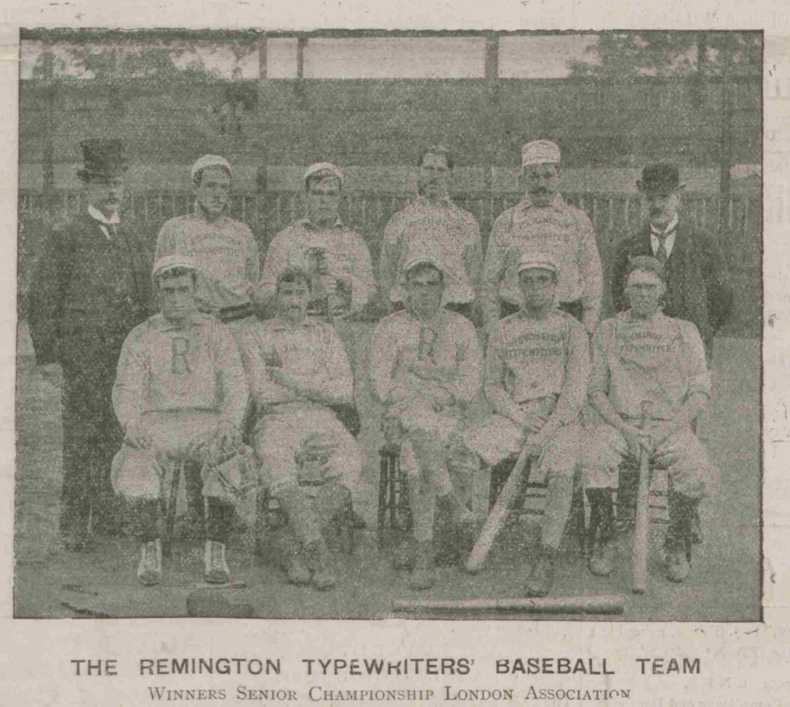
Remington Typewriters Baseball Club, Music Hall and Theatre Review, 27 December 1895. Image created by the British Library Board. No known copyright holder.
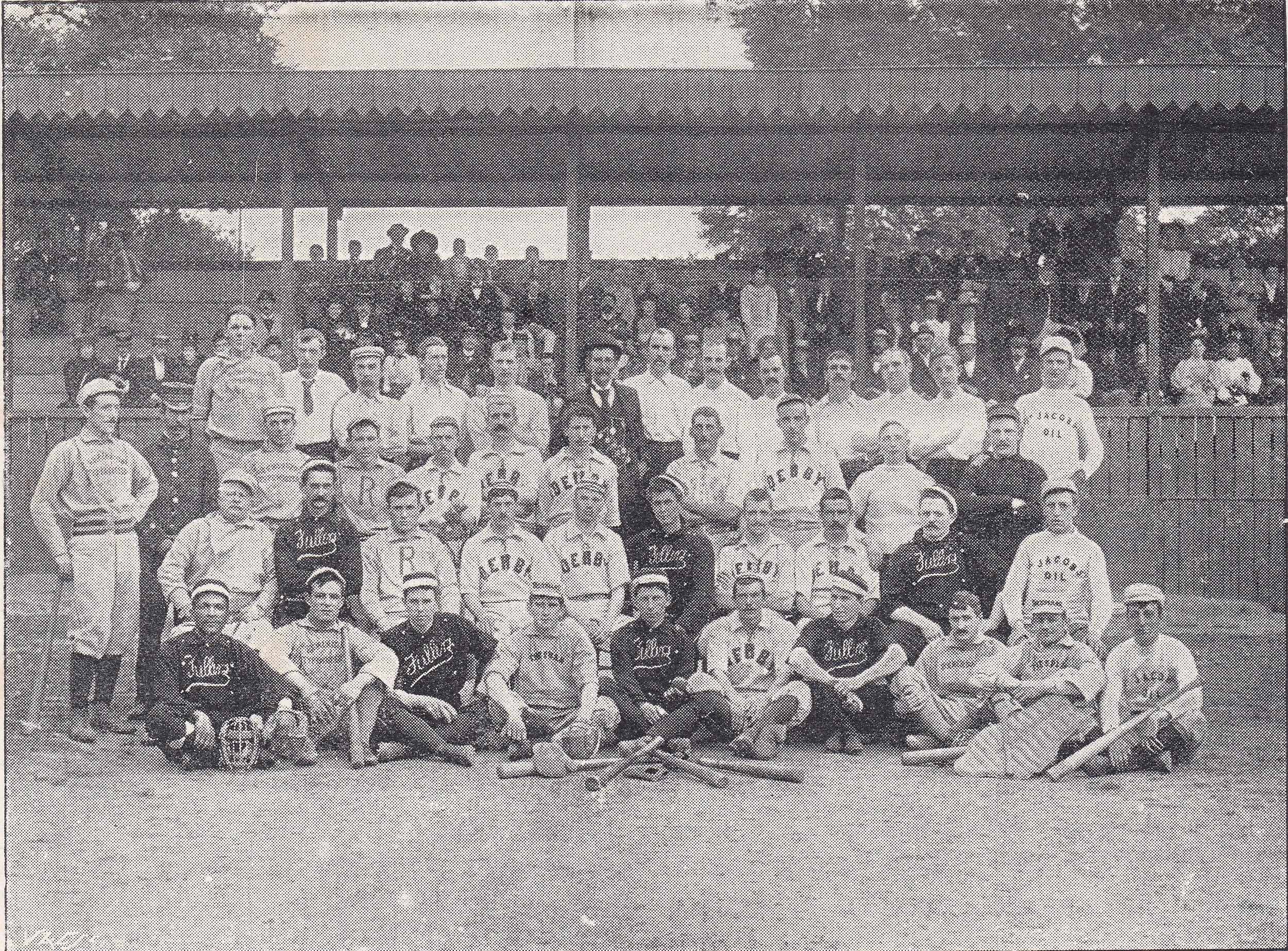
The teams of the 1895 London Baseball Association and the Derby Baseball Club, Windsor Magazine, November 1895. Author's own collection.

Base-Ball Matches at the Crystal Palace, 1895. Crystal Palace Programme. Author's own collection.
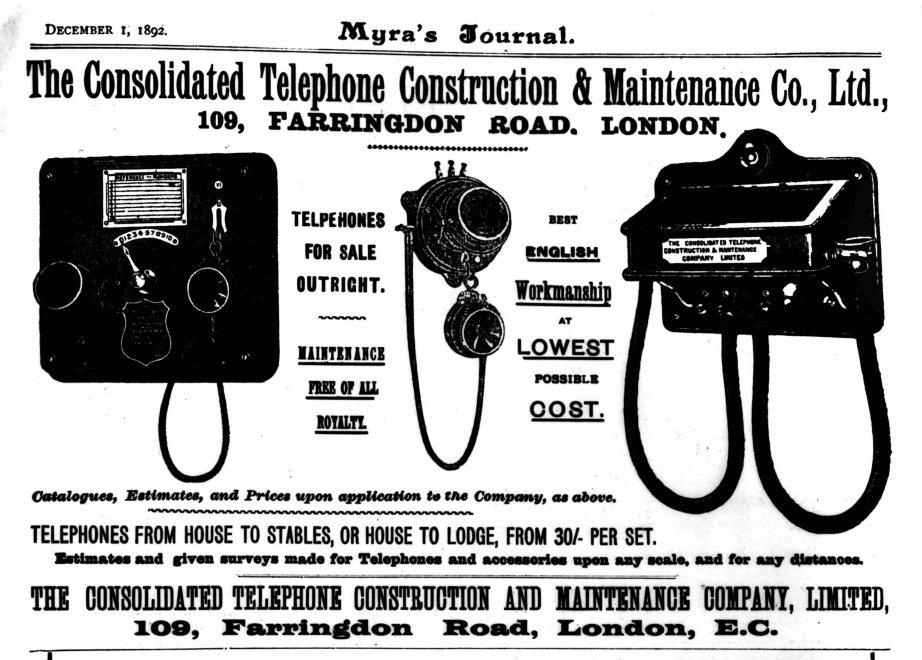
Consolidated Telephone Construction and Maintenance Company Limited, sponsors of the Electrics Baseball Club. Myra's Journal, 1 December 1892. Image created by the British Library Board. Public domain.
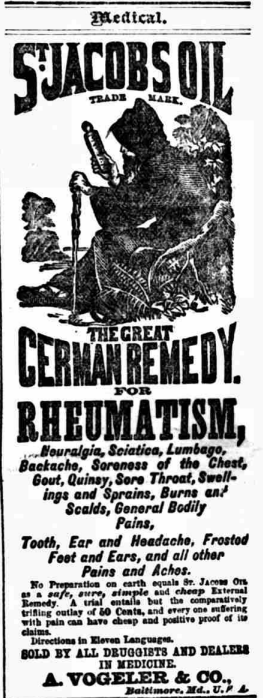
St Jacob's Oil, product of the Vogeler Company, and name it gave to the baseball clubs its sponsored. Toronto Daily Mail, 11 November 1881. Image created by the British Library Board. No known copyright holder.
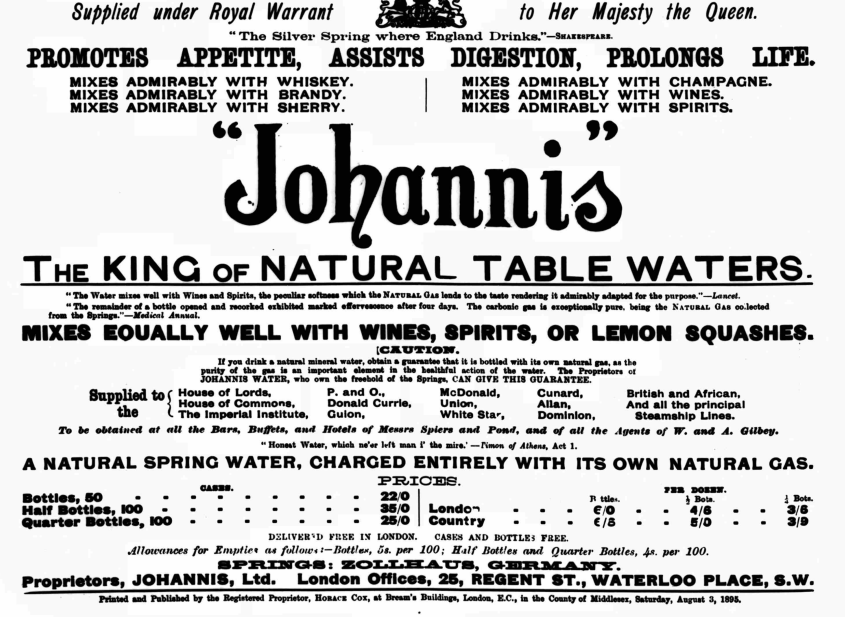
Johannis Mineral Water, proposed name for a team that did not emerge for the 1895 season. Queen Magazine, 3 August 1895. Image created by the British Library Board. No known copyright holder.
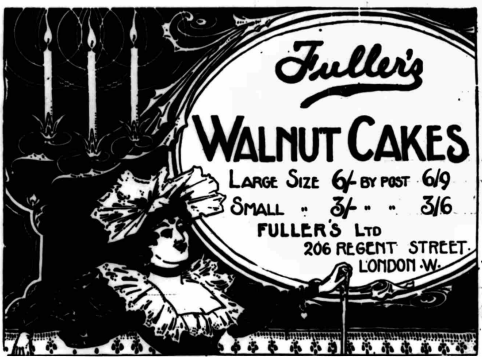
Fuller's, sponsors of the 1895 Fullers baseball team. Queen Magazine, 15 June 1895. Image created by the British Library Board. No known copyright holder.
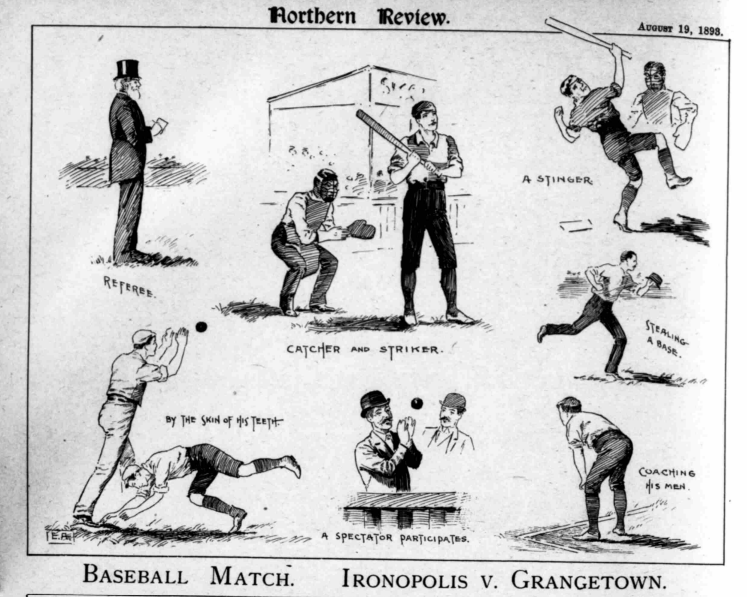
Baseball in England, 1893. Northern Review, 19 August 1893. Image created by the British Library Board. No known copyright holder.
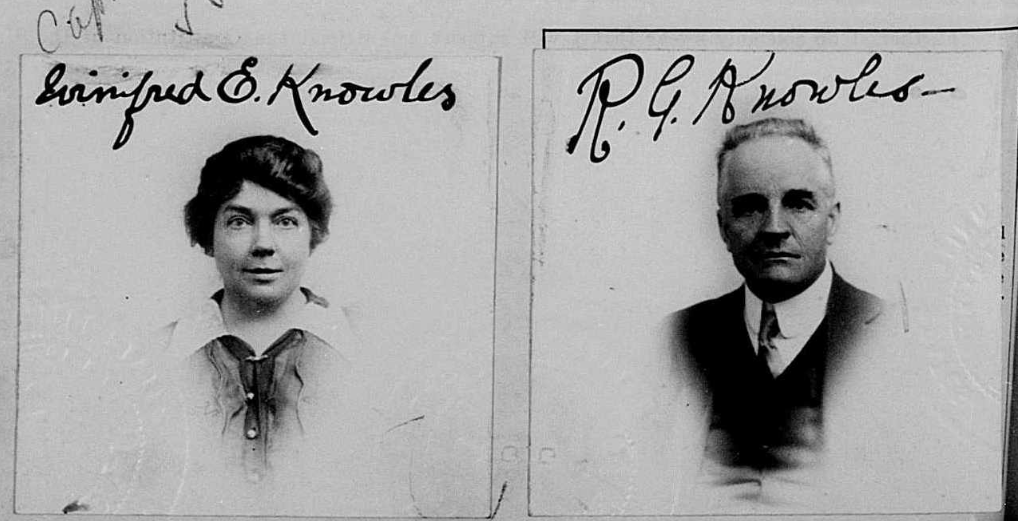
Winifred Johnson Knowles and R.G. Knowles in later life. US passport application. Public domain.