The Base Ballists: A Reverie
Jamie Barras
Our national game of Base Ball is to be introduced among the cricketers of Merry England early this spring[…]Early in April, they will play a picked nine of American base ballists in England, on Lord’s Cricket Grounds, London, by way of preliminary practice; and the probability is that the American party will be beaten, as they will consist mainly of amateurs out of practice.[1]
In the autumn of 1868, an All-England cricket team toured the Northeastern United States and Canada, playing matches against local teams. They also played at least three baseball games: an impromptu affair following a cricket match against the St. George Cricket Club of New York and organised games against a representative local nine in Boston and the Union Club of Morrisania in Hudson City, New Jersey. Back in 1859, an earlier All-England cricket team had played a practice game of baseball on a rest day during their own tour of North America.[2]
When it was announced in early 1870 that another All-England tour was planned and it would include some of the players who had turned out for the 1868 All-England baseball nine, a rumour went around that this third tour would again include baseball, and, in preparation for this, the All-England team was planning a series of practice games in England. Alas, this rumour was quickly declared “preposterous” by the All-England manager. The earliest recorded game of American baseball in England would instead be played in 1871 between two teams of US Navy sailors at Gravesend in Kent.[3]
At the heart of the 1870 rumour was the idea that the All-England nine would be able to find enough “American base ballists in England” to play against. In this piece, I want to step away from my usual practice of exploring the real history of American baseball in Britain to muse on a “what if”: What if the 1870 rumour had been true? What if the All-England nine had played a game of baseball at Lord’s against an American nine? Who might these “American base ballists” have been?
To answer these questions, I have assembled a fantasy American nine from amongst genuine Americans resident in Britain in the late 1860s who had the right skills and background to have played in this game. Although lighthearted in conception and execution, I hope that this exercise will, at the same time, open up new avenues for exploring the real history of American baseball in Britain in this early period.
This, then, is a reverie on what might have been and maybe was.
The American Association in London is a purely social and charitable body. It has no political objects in view. It especially desires peace and good-will between the two countries—many of its members being directly interested in transatlantic trade.[4]
The statement in the 1870 newspaper report that the “American base ballists” would be “mainly amateurs out of practice” points to residents of the UK, not visitors. For this reason, I have limited my picks to Americans living in England, and specifically Southeast England, i.e., men in easy travelling distance of Lord’s Cricket Ground. I have also biased it towards men born in the Northeastern United States. This is because, although by 1870, baseball had spread across North America and beyond, its heartland remained the place of its birth, New York and New England. It was also very much a white-collar game, as an ideal pastime for go-getting Yankee capitalists. I have also factored this into my picks.[5]
My picks have been governed by one further bias, though not one of my choosing: they had to be residents of England whose names and places of birth I could readily identify. The newspaper report quoted at the start of this piece may have had in mind a team drawn from the employees of the London offices of Yankee commercial enterprises—merchant banks and the like. The insurmountable challenge of assembling a fantasy nine from such a pool of players is that, if lists of American company employees exist, I do not have access to them. Similarly, the idea of trawling the 1871 England Census for men born in America, living in London, in their mid-20s to mid-30s, and having white-collar jobs is too daunting. For people interested in exploring the American community in London in this period, I have written a companion piece, The London Americans.[6]
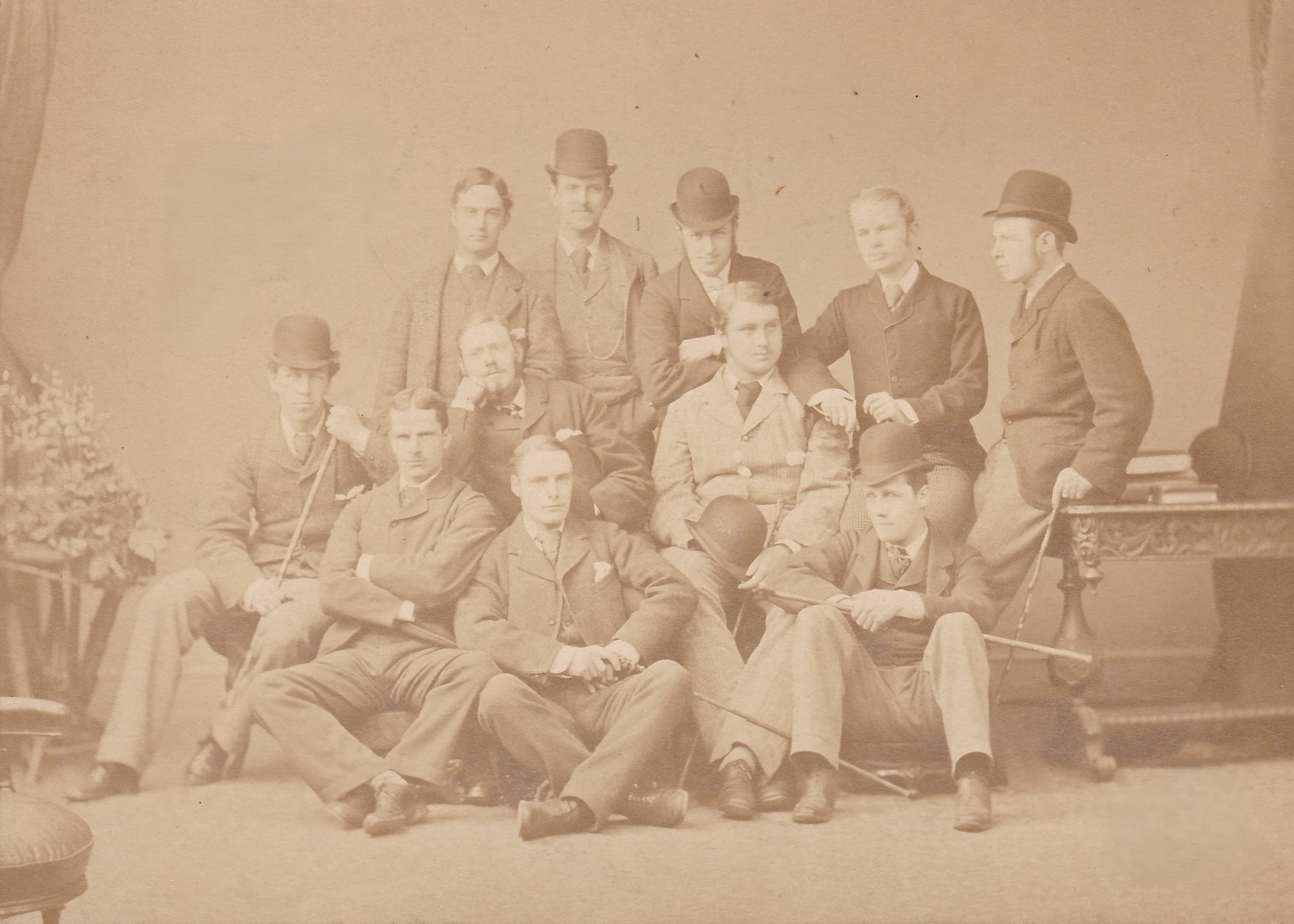
I have instead, with one exception, built my nine from the ranks of the best-documented body of Americans resident in England in this period: students at Oxford and Cambridge. Although a restriction forced by circumstances, it had the merit of pre-filtering for young, athletic men of the right social status. Added to this, we can say with certainty that Oxbridge scholars knew their way around Lord’s Cricket Ground.
CRICKET.— OXFORD v. CAMBRIDGE UNIVERSITIES. This match was concluded at Lord's Ground on Wednesday morning, Cambridge winning by 133 runs. The principal players were old Etonians. This victory is the third in succession obtained by Cambridge at Lord’s, and gives a majority of one in favour of Cambridge on the total series of annual matches played, Cambridge having fourteen matches, Oxford thirteen matches.[7]
This leads me neatly to the next element in my approach: as we have no written evidence of Americans playing baseball in England during this period, I have biased my search toward Americans at Oxbridge who turned out for cricket teams while they were there. It seems natural to me that “Americans base ballists” in England in search of a comparable bat-and-ball game would turn to cricket. Sī fuerīs Rōmae...At this early stage in its history, baseball was considered to have similar appeal and much the same player base as cricket; players moved easily between the two sports.[8]
There is no better proof of the relationship between cricket and baseball in this period than the career(s) of a giant of both sports, Harry Wright (1835–1895). The English-born Wright played his cricket for the afore-mentioned St George Cricket Club of New York. He played in the 1868 cricket match and baseball game against the All-England cricket team mentioned above, turning out for the All-England nine in the baseball game to lend the team some experience. Wright’s baseball career was long. As a player, he played for the Knickerbocker and Gotham Clubs of New York and the Cincinnati and Boston Red Stockings. In the Gotham and Cincinnati Red Stockings, he was joined by his brother George Wright (1847–1937), reckoned to be the best baseball player in the US at the time. As his time as a player wound down, Harry Wright took on managing roles, starting with the Cincinnati Red Stockings and moving to the Boston Red Stockings. In 1874, he brought the Boston Red Stockings and Philadelphia Athletics to Britain and Ireland. They played exhibition games against each other and cricket against the MCC and other teams. Harry Wright’s name will crop up again and again in my picks.[9]
To sum up: With one exception, the approach I have adopted in assembling my fantasy nine is, first, to identify American students at Oxford and Cambridge in the period 1865–1875 via alumni lists, specifically, the Alumni Oxonienses and the Cambridge Alumni Database (ACAD),[10] then to cross-reference these names with cricket team lists harvested from period newspaper reports. All with a bias towards men originating in the Northeastern United States.
Let’s start.
CRICKET. THE NEW YORK OPPONENTS OF THE AUSTRALIAN TEAM SELECTED—WHERE THEY COME FROM AND WHAT THEY ARE GOOD FOR[…]Mr J.T. Soutter, of this city, who heads the list, is one of the best all-round players in the country, being able to fill any position on the field credibly. He is a steady and capital bat and also a good round-arm bowler, being always on the wicket.[11]
The captain and lead pitcher of my fantasy nine is James Taylor Soutter (1844–1883). Soutter was the son of a New York banker and entered Corpus Christi, Oxford, in 1868, playing cricket for the college eleven. He was an all-rounder who, on his return to New York in the early 1870s, became a key member of the St George Cricket Club—Harry Wright’s old club—eventually captaining the side and becoming club president. He also captained New York teams against the Australian tourists in 1878 and the All-England and Gentlemen of Ireland teams in 1879. Although I know of no evidence that Soutter played baseball competitively, the men of the St George club were equally comfortable playing baseball. On at least one occasion, Soutter played alongside baseball great Joe Sprague (1843–1898), the star pitcher for the Eckford Base Ball Club of Brooklyn.[12]
Aged 26 in 1870, a good all-rounder and a wise head on his shoulders, Soutter had the right profile and was in the right place to lead my fantasy nine against an all-England nine at Lord’s
At Noon Young America sent in George Newhall and Johns to the bat, and for half-a-dozen overs some good play was shown at the bat, the good bowling of H. Wright and Tiffany—the latter a fine young American cricketer, recently from Cambridge, England—soon began to tell upon the wickets of the American youths, and when the third wicket fell it was found that only twelve runs has been obtained.[13]
My catcher did get to play alongside Harry Wright in at least two matches with the St. George Cricket Club. Louis McLane Tiffany (1844–1916) of Baltimore, Maryland, studied Medicine at Emmanuel College, Cambridge, from 1861 to 1866. He was from a wealthy family—his father, Henry Tiffany, owned a large country estate in Baltimore, “Rose Hill”, where Tiffany Street stands today, and was related to the Tiffanys of New York. Tiffany turned out for several cricket clubs during his time at Cambridge (his matches with St George were during a 1865 trip home). On his graduation, he returned to Baltimore to begin a long career as a distinguished surgeon and university teacher.[14]
There is tentative evidence for Tiffany playing baseball—a “Tiffany” played for the Pastime Base Ball Club of Baltimore in 1867, although this could have been a relative.[15] A further attraction of Tiffany in this respect is that Americans studying medicine in Britain would play a major role in attempts to popularise baseball in Britain in the 1890s and again in the 1930s.[16] Being a surgeon, it seems like Tiffany would be a safe pair of hands, regardless, which is why I have put him behind the plate. Admittedly, he left England in 1867, three years before our game, but this difficulty is easily met by having him return for a visit just in time to be picked. This is, after all, a fantasy nine.
Admiral Farragut, of the United States Navy, accompanied by his wife, Mrs. Pencock, Captain W. E. Leroy, Lieutenant S. N. Kane, and Lieutenant T. G. Willis, United States Navy, arrived on Saturday at the Royal Hotel, Edinburgh. The distinguished party are on a tour through Scotland.[17]
Staying at Cambridge, but breaking with convention, I will now name my basemen. Rhode Islander Samuel Nicholson Kane (1846–1906) was a US Navy officer who, following a visit to the UK in 1868, resigned his commission and entered Emmanuel College. He “migrated” to Magdalene the following year. It was for Magdalene that he played his cricket. We have already seen the role that the US Navy played in introducing American baseball to England in the real history, and I have written elsewhere about its role as an ambassador for the sport in other parts of the world. Baseball was first played at the US Naval Academy, Annapolis, in the 1860s, during Kane’s time there. Nicholson Kane would see Navy service a second time during the Spanish–American War. He is my first baseman and relief pitcher.[18]
Helpfully for us, two of Nicholson Kane’s brothers, De Lancey Astor Kane (1844–1942) and John Innes Kane (1851–1949), also studied at Cambridge in this period (Trinity and Trinity Hall, respectively, matriculating in 1862 and 1868). De Lancey acquired his middle name from the family connection to the Astors—John Jacob Astor was the Kane brothers’ great-grandfather. Like Nicholson, De Lancey and John Kane were keen sportsmen, although not, to the best of my knowledge, cricketers (yachting and anything to do with horses was more in their line); however, with similar upbringings to Nicholson Kane, they are a good fit for the team, filling out the other two bases.[19]
GREAT FOOTBALL MATCH FOR THE ASSOCIATION CHALLENGE CUP. WANDERERS V. OXFORD UNIVERSITY. On Saturday morning, this match, being the final tie for the Challenge Cup at the association games, was commenced at half-past 11 at the Lillie Bridge. Grounds, West Brompton[...]For Oxford, Kirke-Smith, Ottaway, and Maddison were conspicuous; whilst Sturgis, Howell, and Kinnaird were best for the victors, the goal-keeping on both sides being good.[20]
My next two players are another set of brothers. At short stop, I have Henry Parkman Sturgis (1847–1929). Sturgis entered Christ Church, Oxford, in 1865, and went on to become a member of the Surrey County Cricket Club. He may also have turned out for the Stock Exchange cricket team. Sturgis was born in Boston, Mass. His father was Russell Sturgis, a New England banker who was the senior partner in the Baring Brothers Bank in London. In time, Henry would become a partner at Barings Brothers, too. He connects my fantasy nine back to the Yankee commercial enterprises of London.[21]
In centre field, I have Henry’s younger brother, Julian Russell Sturgis (1848–1904), who entered Balliol in 1868. Born in Boston, Mass., like his big brother, Julian was the real sportsman of the Sturgis family, although, granted, his sports were rowing and Association Football. In 1873, he played for Wanderers FC in the second-ever FA Cup final, helping the Wanderers claim the cup for a second time. It would be over a hundred years before another American would lift the FA Cup. In later life, Julian became a barrister and poet and even wrote the libretto for the 1891 Arthur Sullivan opera Ivanhoe. Although I don’t know if he had any experience with bat and ball, his turn of speed makes him the perfect outfielder. His presence also serves to highlight the role that Association Footballers would have in attempts to popularise American baseball in Britain: the first professional baseball league in Britain, which ran for a single season in 1890, featured three teams affiliated with Association Football clubs.[22]
Manchester Free Grammar School.—Mr. F. Heard, of the sixth form, has been elected to an open scholarship at Lincoln College, Oxford. There were thirty candidates.[23]
In left field, I have Francis Edward “Frank” Heard (1845–?), who entered Lincoln College, Oxford, in 1864, and played cricket for the college eleven. Heard was the New York-born son of James Heard, a commission merchant of Scottish ancestry, and his American wife, Eliza. James Heard did business in New York and Liverpool. At this time, Liverpool—“the second city of Empire”—was the main entry point for American goods entering Britain. It had been a hotbed of secessionist activity during the recently concluded American Civil War due to the importance of cotton to the Lancashire economy.[24]
Heard is the “left field” choice, as he was a scholarship student, a grammar school boy made good, not part of the social elite. At the same time, in his origins and upbringing, he is representative of the go-getting Yankee capitalist of Scots–Irish ancestry, a class of people so important to the early history of American baseball. Alas, I know next to nothing about his life after Oxford, not even the year of his death.
CRICKET. THE DRAMATIC CLUB.—The formation of this club has proved a great success, although established but a few weeks, the number of members amounts to 180, chiefly composed of the theatrical profession. On Good Friday the club opened their season with a match at Highbury Barn. The game was intended to be played in a field adjoining, but it was found very heavy and wet. There was a feeling of disappointment expressed, and many there took themselves to a game of "rounders.”[25]
Before naming the final member of my fantasy nine, I want to mention several candidates who didn’t make the cut.
As of the time of writing (March 2026), the earliest report we have of a game of American baseball being played in Britain is of a game played in Dingwall, Scotland, in July 1870. A baseball club had been formed in the town two months earlier, a direct result of the return to the area of Andrew Keith Brotchie (1849–1926), a former resident who had emigrated to America as a child and grown up in Boston, Massachusetts.[26] I was tempted to bring Brotchie south to captain my nine; however, ultimately, I decided that he was needed in Dingwall to launch the real history of American baseball in Britain.
Dr George Bronson Farnam (1841–1886) was the son of the richest man in Connecticut, railway baron Henry Farnam (chief engineer and later president of the real “Rock Island Line”). After he graduated from Yale Medical School in 1869, George Farnam travelled to Britain to continue his medical studies in Edinburgh and London. The 1871 England Census found him, his wife Caroline, his mother Ann, and his young family living just two miles from Lord’s Cricket Ground. The attraction of Farnam as a potential member of my fantasy nine is akin to that of Louis Tiffany: Americans studying medicine in Britain, particularly Edinburgh, would play a major role in attempts to popularise baseball in Britain in the 1890s and again in the 1930s. However, not only is there no evidence of Farnam playing either cricket or baseball, but he was also a lifelong sufferer from heart disease and ended his short life as an invalid. So, ultimately, I had to reject him as a candidate.[27]
I also considered picking a non-American, celebrating the role that immigrants played in the early history of baseball in America—Harry and George Wright were both born in England. So, one of my early candidates was Irishman Edward H. Moeran (1848–1904). Moeran was the son of a university don and played cricket and association football for Marlborough College [school] and Trinity College Dublin. In 1870, he emigrated to the US, becoming a lawyer in New York. There, he became a mainstay of our old friend, the St George Cricket Club, serving under James T. Soutter. In at least one cricket match, he played alongside not only Harry Wright but also George Wright and another early baseball great, John Hatfield (1847–1909), of the Gotham and Mutual clubs of New York. This was a much storied match against a 1872 touring England team that included W.G. Grace.[28]
It is easy to imagine Moeran, passing through London on his way to a new life in America, taking the opportunity to make his way to Lord’s and play the national pastime of his future home. However, ultimately, I decided against picking him. I felt that I had mined the St George connection enough and instead saw a chance to throw the spotlight back onto attempts to popularise American baseball in Britain.
So, my final pick for my fantasy nine is an entertainer. American baseball and entertainment have gone hand in hand from baseball’s earliest days. This connection has proved particularly important in attempts to popularise American baseball in Britain, as American entertainers touring Britain represented a pool of players that baseball teams, particularly baseball teams in England, could draw on. The list of North American entertainers who played American baseball in Britain is a long one. We might cite two teams formed almost entirely of entertainers, the Thespians, founded in London in 1892, and the Regent Theatre team of Salford, Manchester, founded around 1897. The former, as the name suggests, was formed almost entirely of North American entertainers connected to the London stage. The latter was a team connected to a Salford theatre and run by the theatre’s lessee, Scots-American James Hardie. It played against touring troupes and featured a roster of players drawn from the turns appearing at the Regent, most notably African American and Native American stage performers—a far from unique example of an integrated team in the early game in Britain.[29]
I thought about exercising the fantasy element of my nine to the fullest extent and bringing two stalwarts of the 1890s Thespian team to England seven years early. Acrobat and strongman George A. Hall (1852–1928), known professionally as George Hall Dare, was a New Yorker who arrived in England in 1877 as one-third of the Brothers Dare. Hall played baseball in his youth in New York and New Orleans. That same year, Walter Darcy Craven (1846–1940), son of a New Jersey man who had invented a method of refrigerating meat for sea transport, arrived in England following a peripatetic career that included helping to revitalise baseball in Georgia following the end of the American Civil War. He would move between the US and UK on business for the next 15 years before finally settling in London around 1892.[30]
However, despite Hall and Craven’s unquestionable baseball credentials, bringing them to England so far in advance of their true arrival dates seemed a hand-wave too far. Instead, to honour the contribution to attempts to popularise American baseball in Britain of entertainers in general and African American entertainers in particular, the right fielder of my fantasy nine is Charles Barney “C.B.” Hicks (?–1902). C.B. Hicks was an early and rare example of a black performer of blackface minstrelsy who led his own entertainment troupes. In common with white entertainment troupe managers, black entertainment troupe managers like C.B. used baseball to pull in the punters, pitting members of their troupes against local teams to advertise their arrival in town. This made African American performers who made the trip to Britain a ready source of experienced players for the nascent American baseball scene in Britain.[31]
C.B. Hicks’ extended stay in England between the spring of 1870 and the autumn of 1871 was not of his choosing; in the spring of 1870, the troupe he had co-founded back in the States with fellow African American performer and manager Bob Height, the Hicks and Height Minstrels, went bust touring continental Europe. Hicks and Height had just enough money to make it to England, where they signed up to perform for English minstrel troupe leader Sam Hague to restore their fortunes. It would be another 15 months before they had made enough money to return to the United States. In Height’s case, this would only be a temporary return; he had seen enough that he liked during his time in England to make the country his permanent home in 1873.[32]
However, for C.B., this would be just one stop on a career that would take him—and African American baseball—around the world. In 1878, at the head of Hicks’ Georgia Minstrels, C.B. toured Australia. As part of the troupe’s promotional activities, the Georgias playing baseball against local teams, a major boost to the local scene. Hicks repeated this feat a decade later when he led the Hicks and Sawyer Minstrels to New Zealand and played teams in the Wellington area.[33]
Charlie Hicks, globe-trotting African American pioneer, is my final pick for my 1870 fantasy nine.
At the conclusion of the cricket match yesterday a scrub match of base ball was proposed and agreed amid the approbation of the spectators. The contest, of a very friendly character, was witnessed with the greatest interest, as many were anxious to see the Britishers play.[34]
With my fantasy nine complete, I can now assemble the All England nine. This is a much easier task. I will use the players who turned out in the game against the Union Club of Morrisania in October 1868, as the inclusion of these players in the proposed 1870 tour sparked the rumour that the tourists would play baseball.[35] See gallery below for the team lists.
The date for the game I have set as 1 April 1870—naturally. The All-England team has age, wisdom, and long experience with bat and ball on their side; however, America has the advantage of youth and far more accumulated experience of baseball, the game in contention. The newspapers were sure that the All-England team would win easily. I am not so sure.
Let’s play ball.
Jamie Barras, March 2026, revised June 2026.
Back to Diamond Lives
Notes
[1] ‘Base Ball In England’, Brooklyn Daily Times, 4 March 1870.
[2] St George game: ‘The National Game: The All England Eleven vs. St. George’s Cricket Club’, New York Daily Herald, 19 September 1868. Boston nine: ‘Bricks on Cricket, but Clay on Base Ball’, Cleveland Leader, 2 October 1868. Union Club: ‘Base Ball: The International Base Ball Match’, New York Herald, 21 October 1868. Practice game in October 1859: Frederick Lillywhite, 'The English cricketers' trip to Canada and the United States' (London: F. Lillywhite, 1860), 50; ‘All-England Eleven at Base Ball’, Bell’s Life in Victoria and Sporting Chronicle, 11 February 1860, reproducing the game report from Wilke’s Spirit of the Times.
[3] “Preposterous”: ‘Cricket’, New York Tribune, 24 February 1870. Earliest recorded game in England: ‘A Game of Base Ball’, Gravesend Reporter, 17 June 1871. Ultimately, the 1870 England tour of America did not go ahead.
[4] ‘The Fourth of July & the American Association in London’, The London American, 4 July 1860.
[5] White-collar baseball: S. M. Gelber, ‘“Their Hands Are All Out Playing:” Business and Amateur Baseball, 1845-1917’, Journal of Sport History, 1984, 11, 5–27. https://www.jstor.org/stable/43609288, accessed 8 June 2025.
[6]https://www.ishilearn.com/diamond-lives-london-americans, accessed 28 March 2026.
[7] ‘Cricket’, Windsor and Eton Express, 22 June 1861.
[8] See Note 5 above.
[9] Harry Wright: Christopher Devine, ‘Harry Wright’, https://sabr.org/bioproj/person/harry-wright/; George Wright: John Thorn, ‘George Wright’, https://sabr.org/bioproj/person/george-wright-2/; 1874 tour: John Bauer, ‘1874: New Game in the Old Country: US Teams Tour England’, https://sabr.org/gamesproj/game/summer-1874-new-game-in-the-old-country-u-s-teams-tour-england/, accessed 23 March 2026.
[10] ACAD: https://venn.lib.cam.ac.uk/, accessed 24 March 2026. Alumni Oxonienses: https://wellcomecollection.org/works/fc6xt2rx, accessed 24 March 2026.
[11] ‘Cricket’, New York Daily Herald, 24 September 1878.
[12] Soutter biography: https://www.familysearch.org/en/tree/person/details/K89Q-J5Q¸accessed 24 March 2026. Cricket at Corpus Christi: ‘Worcester v Corpus’, Oxford University and City Herald, 12 June 1869. Cricket for St. George of New York: as “J.T. Soutter’: ‘Cricket’, New York Herald, 23 June 1877; as “Soutter”: ‘Cricket’, New York Times, 14 June 1874. Against Australia: ‘The Australian Cricketers’, New York Tribune, 2 October 1878. Against Ireland alongside Joe Sprague: ‘International Cricket Matches’, Brooklyn Eagle, 14 September 1879. Against England: ‘The English Cricketers’, New York Herald, 3 October 1879. Joe Sprague: https://historicgreenpoint.wordpress.com/2015/04/11/jimmy-wood-beaseball-founder-recalls-the-eckford-club/, accessed 25 March 2026. Sprague’s years of birth and death are taken from his obituary: ‘Obituary: Joseph E. Sprague’, Brooklyn Eagle, 27 June 1898.
[13] ‘Cricket’, New York Daily Herald, 21 September 1865.
[14] Tiffany biography: https://www.familysearch.org/en/tree/person/details/LC7X-JNV, accessed 23 March 2026. As ‘L. Tiffany’ playing for University of Cambridge: ‘Cricket: Norfolk v. University of Cambridge’, Norfolk Chronicle, 13 May 1865. As ‘L.M. Tiffany’ playing for Emmanuel: ‘Cricket at Cambridge’, Bell's Life in London and Sporting Chronicle, 30 April 1864. After his return to the US as well as playing for the St. George club of New York, he also played for the Young America club of Philadelphia: ‘Cricket in Philadelphia’, Bell's Life in London and Sporting Chronicle, 6 July 1867. https://boltonhillmd.org/bulletin/recalling-rose-hill/, accessed 23 March 2026.
[15] ‘Base Ball Championship’, Baltimore Sun, 20 June 1867.
[16] American medical students helping to popularise baseball in Britain: 1) in the 1890s: https://www.ishilearn.com/diamond-lives-iron-and-ash; 2) in the 1930s: https://www.ishilearn.com/diamond-lives-washington-makes-his-bow. Accessed 26 March 2026.
[17] ‘Edinburgh’, London Scotsman, 4 July 1868.
[18] ‘Commodore Kane Dead’, New York Tribune, 16 November 1906; ‘Cricketers’ Chronicle: Trinity Hall v Magdalene College’, Cambridge Chronicle and Journal, 8 May 1869. US Navy and baseball around the world in the 1860s/1870s: https://www.ishilearn.com/diamond-lives-a-species-of-cricket, accessed 26 March 2026. Baseball at Annapolis: https://pugetsoundnavymuseum.org/when-baseball-went-to-war/, accessed 27 March 2026.
[19] Details of the Kane brothers from ACAD, Note 10 above, first reference.
[20] ‘Great Football Match for the Association Challenge Cup’, The Hour, 31 March 1873.
[21] Henry Sturgis Biography: https://www.familysearch.org/en/tree/person/details/K2MK-C8G, accessed 23 March 2026. “H. Sturgis” in the Stock Exchange cricket team: ‘Cricket’, Berkshire Chronicle, 27 June 1868. Russell Sturgis and Barings: ‘Mr Peabody and His Friends’, New York Times, 5 August 1868. Henry Sturgis and Surrey CCC: ‘Surrey County Club’, Bell's Life in London and Sporting Chronicle, 13 May 1865.
[22] Julian Sturgis and FA Cup: Pablo Maurer, https://www.nytimes.com/athletic/6360740/2025/05/16/fa-cup-titles-americans-tim-howard-julian-sturgis-crystal-palace/, accessed 23 March 2026. Ivanhoe: https://people.elmbridgehundred.org.uk/biographies/sturgis-brothers/, accessed 25 March 2026. The 1890 professional baseball league in England: Joe Grey, ‘What About the Villa?’ (Ross-on-Wye: Fineleaf Publications, 2010), 37–43; the book is available to download here: https://www.projectcobb.org.uk/ebooks/WatV.pdf, accessed 15 December 2025.
[23] ‘Manchester Free Grammar School’, Manchester Courier, 19 October 1864.
[24] ‘Cricket at Oxford’, Bell's Life in London and Sporting Chronicle, 16 June 1866. Biographical information from the entry for James Heard, Eliza Heard, Francis E. Heard, etc., in the 1861 England Census, Chorlton upon Medlock district, ancestry.co.uk, Ancestry.com Inc. (Operations), accessed 25 March 2026. Liverpool and the American Civil War: https://ldhi.library.cofc.edu/exhibits/show/liverpools-abercromby-square, accessed 26 March 2026.
[25] ‘Cricket’, Morning Advertiser, 2 April 1866.
[26] ‘Dingwall—Base Ball’, Inverness Advertiser and Ross-shire Chronicle, 19 July 1870. I tell the story here: https://www.ishilearn.com/diamond-lives-the-dingwall-game, accessed 28 March 2026.
[27] George Farnam biography: ‘Obituary: George B. Farnam’, Chicago Tribune, 30 December 1886. 1871 England Census, entry for George B. Farnam, Paddington, London, ancestry.co.uk, Ancestry.com Inc. (Operations), accessed 24 March 2026. Henry Farnam: https://blogs.davenportlibrary.com/sc/2019/03/28/henry-farnams-life-and-work-near-the-mississippi/, accessed 26 March 2026. Edinburgh University medical students and baseball in Britain: Note 16 above, second reference.
[28] Moeran biography: ‘Death of Edward H. Moeran’, New York Times, 6 December 1904. Playing for Marlborough College: ‘Marlborough College’, Bell's Life in London and Sporting Chronicle, 25 April 1868. In the 1872 New York v England cricket match: ‘Cricket’, New York Times, 19 September 1872. The 1872 1872 tour: ‘Cricket: The Gentlemen of England in America’, Saunders's News-Letter, 16 October 1872.
[29] Thespians: R.G. Knowles and Richard Morton, ‘Baseball’, (London: George Routledge & Sons, 1896). Comedian R.G. Knowles was one of the Thespians’ founders. Regent Theatre team: ‘Baseball: The Game in Manchester’, Sporting Life, 7 July 1898. I tell the story of the latter here: https://www.ishilearn.com/diamond-lives-behind-the-mask, accessed 26 March 2026. “Thespian Base Ball Club” was a popular name for clubs formed of actors; see, for example, ‘The Thespian Ball’, Democrat and Chronicle(Rochester, NY), 12 January 1886.
[30] R.G. Knowles gives potted biographies for Hall and Craven in his 1896 book ‘Baseball’, see Note 29 above, first reference, pages 75–76 and 79–80. George Hall was the brother of Thomas Hall, the first husband of acrobat Leona Dare, which was the origin of the “Brothers Dare” stage name; see: ‘Tribulations of an Acrobat’, Reynold’s Newspaper, 1 June 1879; ‘Amusements: Opera House’, Kentucky Gazette, 2 October 1875. Craven biography: https://www.findagrave.com/memorial/92656850/william-darcy-craven, accessed 27 March 2026. Craven and baseball in Georgia: ‘The Base Ball Match: Savannah Against Charleston’, Charleston Daily News, 8 September 1868.
[31] Charlie Hicks’ career: Robert C. Toll, Blacking up: the minstrel show in nineteenth-century America (New York: Oxford University Press, 1974),198–215; accessed at https://archive.org/details/blackingupminstr0000toll_a6k6/mode/2up, 30 June 2026. The importance of baseball to touring African American entertainment troupes: Abbott, Lynn, and Doug Seroff. Ragged but Right: Black Traveling Shows, “Coon Songs,” and the Dark Pathway to Blues and Jazz. Jackson: University Press of Mississippi, 2007. https://muse.jhu.edu/book/9959. It has to be acknowledged that this legacy is a contested one: Gary Ashwill, 'Underground Pastime: The Hidden History of the Negro Leagues', https://www.facingsouth.org/2002/10/underground-pastime-hidden-history-negro-leagues, accessed 26 March 2026.
[32] The Hicks–Height Minstrels in Europe: See Note 31 above, first reference, and Eileen Southern, ‘The Georgia Minstrels: The Early Years’, Inter-American Music Review, 2019, 10, 157–167. https://iamr.uchile.cl/index.php/IAMR/article/view/53523, accessed 26 March 2026. Sam Hague was less than happy when the troupe left to return to the US, as they took a number of his performers with them and adopted the “Georgia Minstrels” name that Hague regarded as belonging to him (it didn’t): ‘Mr Sam Hague…’, The Days' Doings, 25 November 1871. However, he did at least forgive Height, as Height rejoined the Hague troupe on his return to England: ‘Sam Hague’s Minstrels’, Birkenhead & Cheshire Advertiser, 8 November 1873.
[33] Hicks in Australia: ‘Baseball’, Herald (Melbourne, Vic.), 2 August 1878; ‘The Georgia Minstrels: Baseball Match’, Gippsland Mercury (Sale, Vic.), 2 August 1879. Hicks in New Zealand: ‘Baseball in Wellington’, Lyttleton Times, 6 March 1889..
[34] Note 2, first reference.
[35] Note 2, second reference.
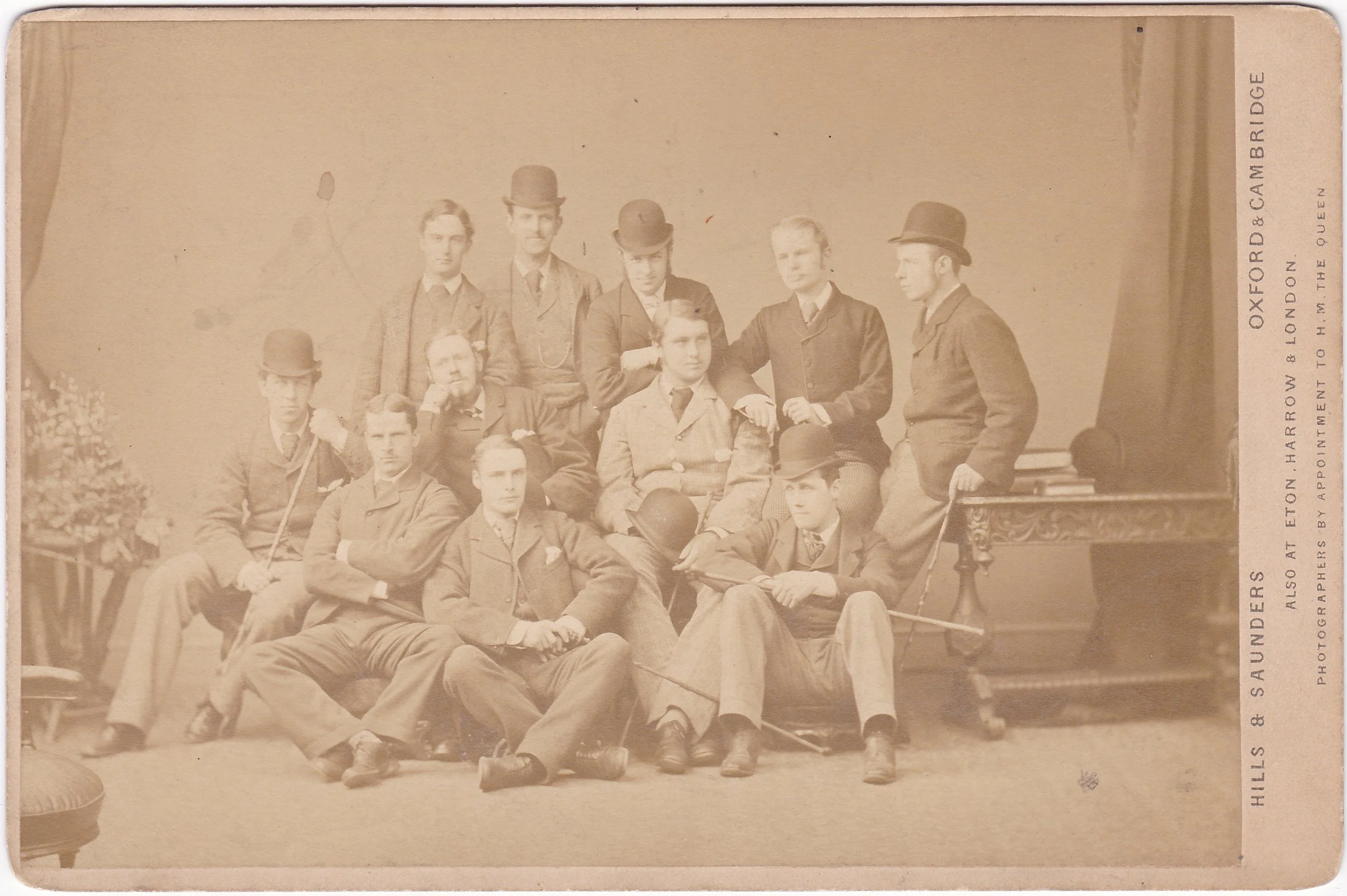
A studio portrait of an Oxbridge Eleven. Nineteenth-century cabinet card by Hills and Saunders of Oxford and Cambridge. Author's own collection.
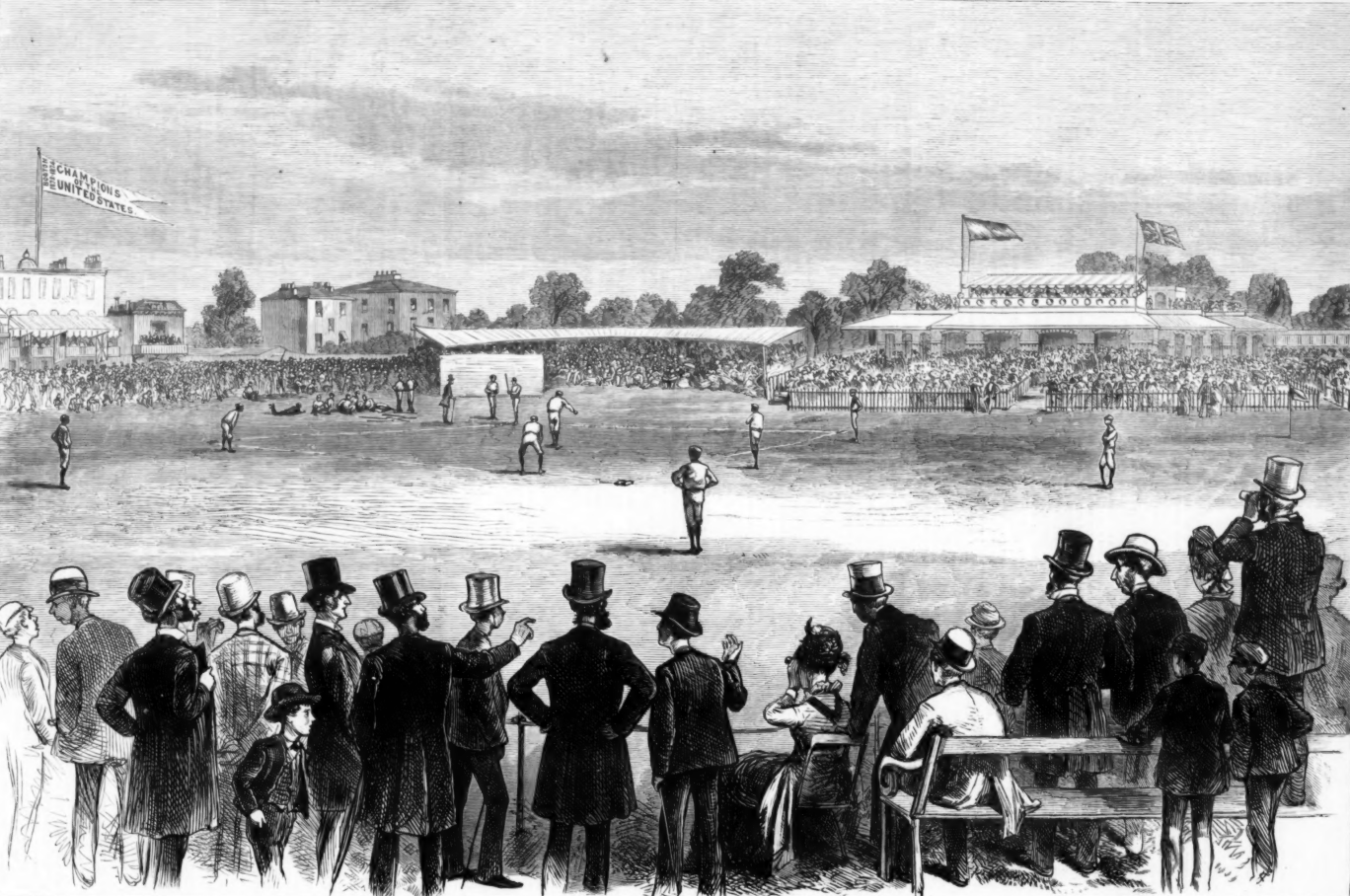
The American base ball players In England, Harper's Weekly, 5 September 1874. Image created by archive.org. Public domain.
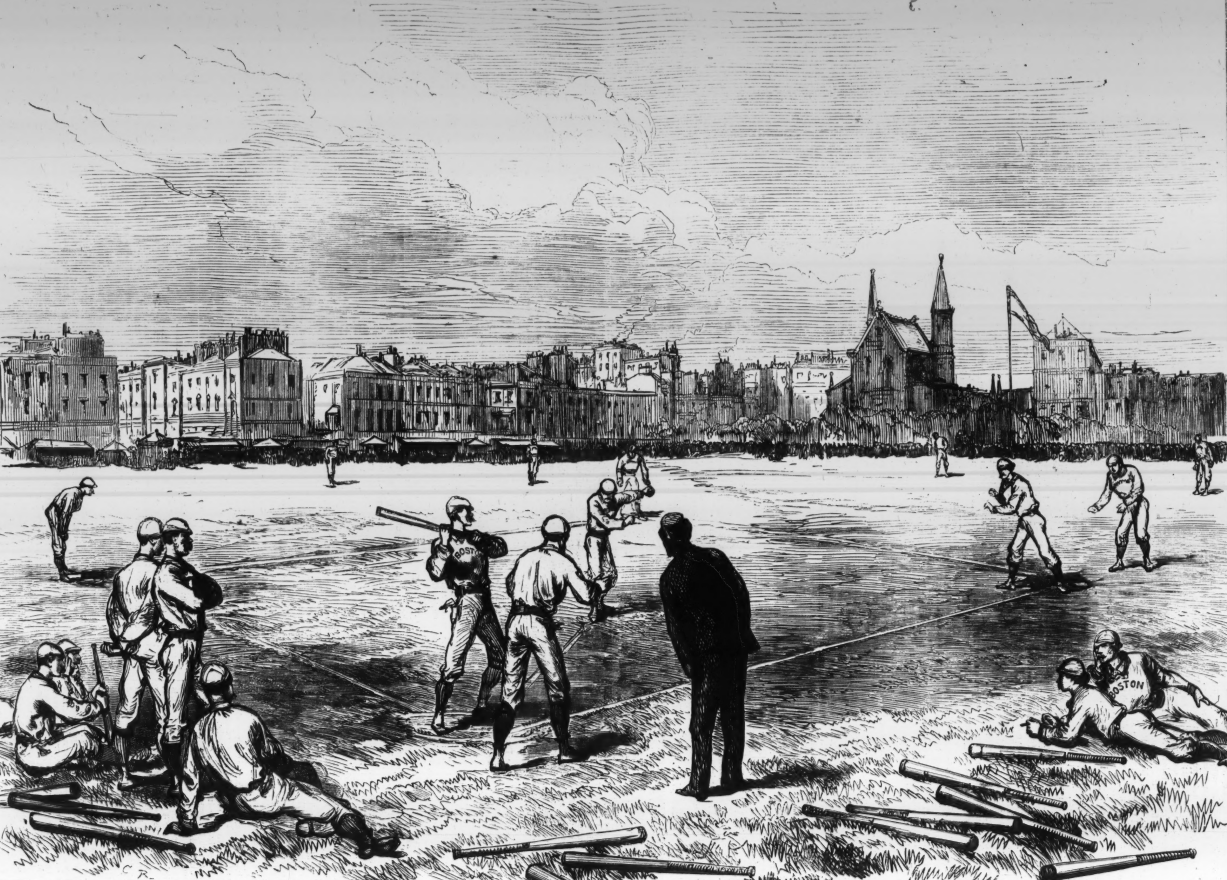
The American base ball players In England, Harper's Weekly, 12 September 1874. Image created by archive.org. Public domain.
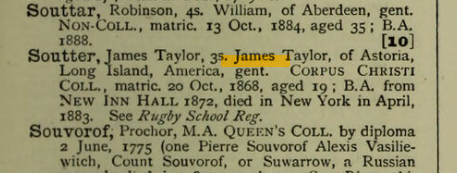
The entry for James Taylor Soutter, Alumni Oxonienses. Image created by Welcome Trust. Public domain.
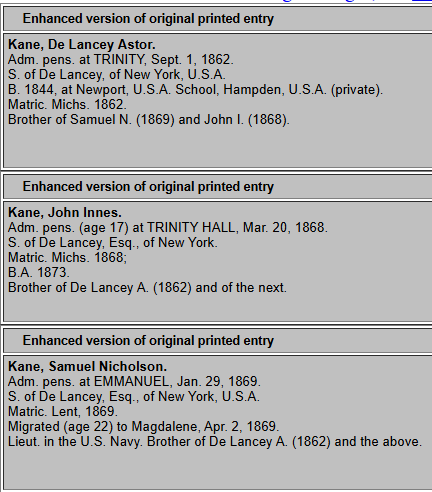
The entries for the Kane brothers, A Cambridge Alumni Database (ACAD). University of Cambridge Library.
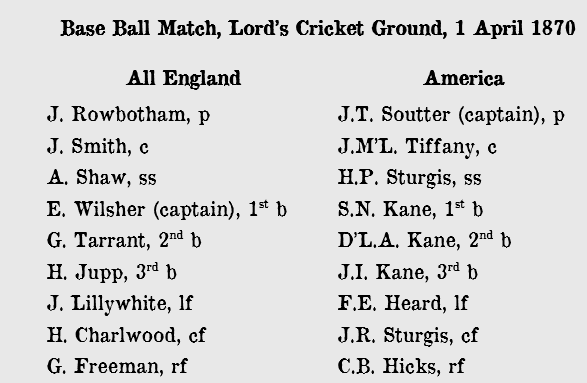
Base Base Match, Lord's Cricket Ground, 1 April 1870. A fantasy.