The London Americans
Jamie Barras
Our national game of Base Ball is to be introduced among the cricketers of Merry England early this spring[…]Early in April, they will play a picked nine of American base ballists in England, on Lord’s Cricket Grounds, London, by way of preliminary practice; and the probability is that the American party will be beaten, as they will consist mainly of amateurs out of practice.[1]
This is the second of two pieces in which I explore the 1870 rumour that English cricketers planning a tour of North America were also planning to play baseball while there and were practising baseball against “American base ballists in England” in preparation for it. In the first piece, I assembled a “fantasy nine” from genuine American residents of England with the necessary skills and background to have conceivably played against the English nine.[2]
Through necessity, I largely based my picks around American students at Oxford and Cambridge who knew their way around a cricket pitch. I did this because this is the largest body of Americans in England in this period for which we have easily searchable biographical data to cross-reference with period cricket reports. At the same time, I acknowledged that, although Oxbridge students were a very reasonable pick for our hypothetical American nine, it was likely that the newspaper reports had in mind American employees of Yankee commercial concerns in London. It was just that there is no ready way to identify good candidates for our nine from such a body of men in the absence of employee lists and better biographical data than that provided in the incomplete entries in the 1871 England Census.
In this piece, I want to tell the story of the first periodical published in England to cover baseball in America, the London American, which lasted from 1860 to 1863. The London American found its subscribers among the employees of the diplomatic missions, company offices, counting houses, art schools, theatres, and boxing rings of the metropolis. Its publisher considered baseball of interest to enough of its subscribers to justify including game coverage in its pages. That seems reason enough to me to suppose that we might find our “American base ballists” among the American’s subscribers, too.
THE LONDON AMERICAN.—This is the title of a new weekly newspaper, just started in London, England. It is a quarto sheet, and the size of the Tribune and Herald. This enterprise is commenced to meet the wants of the many Americans in England, and also to give information to those about to emigrate to the country.—We recognise in the publisher, a cousin of ours, who has the Yankee enterprise to push forward to success any legitimate enterprise, requiring talent and perseverance.[3]
The London American was the idea of two Yankee entrepreneurs, John Adams Knight (1824–1917) of Westbrook, Maine, who would be the American’s publisher for the whole of its short existence, and George Hazeltine (1829–1915) of Bradford, Massachusetts, the periodical’s first editor. Knight was a restless man who had tried and failed at several ventures before starting the American. He had come to England to work as a claim agent, acting on behalf of American clients to claim inheritances left to them by English relatives. He was also, and would remain for the rest of his life, an inveterate inventor. This appears to be how he met Hazeltine, as Hazeltine would, in time, become a patent lawyer. Hazeltine is likely to be the “George Haseltine” with whom, in 1860, Knight shared a patent for “improvements in spring bed bottoms”.[4]
Knight and Hazeltine aimed to provide readers in England with news on events in the United States, shipping intelligence, and information useful to those planning to emigrate to the US. They culled most of their US news items from New York newspapers delivered to their offices two weeks after their publication via the transatlantic mail steamer services.[5] Their focus was on political and commercial news, with, as might be expected given their shared background, a strong focus on patent news. However, they also found space for entertainment news and sports reports.
The latter showed a strong bias for horse racing news, including tips for English races from the periodical’s resident pundit, “the Clairvoyant”. However, there were also boxing, billiards, and, of great interest to us, cricket and, yes, baseball reports. Although the British press carried news of the American pastime from time to time, the American was unquestionably the first periodical published in Britain to cover baseball. Alas, its coverage would only last for a year, as the outbreak of the American Civil War swept all sports news from its pages. I have included the American’s 1860 baseball reports as an appendix to this piece.[6]
In trying to work out for whom this coverage was intended, we can point to the space the American devoted to covering the activities of the American Association in London.
AMERICAN INDEPENDENCE. The 84th anniversary of the declaration of American independence was celebrated on Wednesday night by a dinner in the London Tavern, The company consisted mainly of the members of the American association in London, General Campbell occupied the chair, and was supported, right and left, by Mr. Dallas, the American minister, Messrs. Dallas and Moran, secretaries of legation, Mr. Layard, Dr. Macgowan, Dr. Mackay, Mr. Croskey, and others.[7]
The American Association in London was a short-lived social and charitable body dedicated to promoting amity between Britain and America and caring for Americans living in England who were down on their luck. During its short life (1858–1861), its principal social events were the annual dinners it hosted to celebrate George Washington’s Birthday (22 February) and American Independence Day (4 July). These were lavish [men-only] affairs to which were invited the great and the good of the American community in London. New Englander, Russell Sturgis(1805–1887), of Boston, Mass., a senior partner of Baring Brothers merchant bank, was a regular invitee. (He was the father of two of my American nine picks in the first piece in this series.) So too was his fellow American-born partner of Baring Brothers, Joshua Bates (1788–1864). The two most prominent American bankers in London in this period, George Peabody (1795–1869) and Junius Spencer Morgan (1813–1890), were also on the invitation list.
Massachusetts-born Peabody lived most of his life in England and, after his retirement from business in 1864, devoted himself to philanthropy. His name lives on in Britain today in the form of the Peabody Housing Trust social housing body. J.S. Morgan was the father of J.P. Morgan of New York banking fame. J.S. became a junior partner in Peabody’s George Peabody and Company bank in 1854 and took over the firm on Peabody’s retirement, renaming it the J.S. Morgan and Company (not by choice—Peabody reneged on a deal that should have allowed Morgan to keep trading under the renowned Peabody name).[8]
Although the British press covered the American Association’s social events, it was the American, a periodical published by an American in London for Americans in London, that gave them the most attention.
EIGHTY-FOURTH ANNIVERSARY OF AMERICAN INDEPENDENCE. THE AMERICAN ASSOCIATION IN LONDON will celebrate the Eighty-fourth Anniversary of American Independence, by a DINNER at the London Tavern, at seven o’clock precisely.[9]
The Americanincluded a list of the committee members of the American Association in London in its 4 July 1860 issue. Examining the backgrounds and professions of the committee members gives us an insight into the makeup of the larger institutions of the American community in London in this period. It is amongst their junior staff that we might expect to find men of the right age, background, and spirit to have subscribed to the American—and to have played a practice game of baseball against an English nine.
The professions of the American members of the 1860 committee of the London Association embraced diplomacy, high finance, manufacturing, publishing, and the Arts. There were also a few Britons on the committee, most prominently Thornton Leigh Hunt (1810–1873). Hunt was, on paper, the publisher and owner of the Spectator magazine. In fact, he was a front man for two Americans, one of whom was fellow American Association committee member Benjamin Moran (1820–1886), assistant secretary to the American Legation.[10] Moran and his financial backer, businessman John McHenry, had bought the Spectator in 1858 to advance US government interests in England, requiring Hunt to parrot the message of the Buchanan administration on all matters of mutual interest to England and the US. This transparently partisan approach was disastrous to the Spectator’s reputation and finances. Moran and McHenry sold the magazine at a loss in 1861.[11]
George William MacArthur Reynolds (1814-1879) is another Englishman on the committee worth noting. A now-forgotten writer of popular fiction, a rival of Dickens in his day, his worth to the committee was that he was also the editor of two periodicals (Reynolds’s Weekly Newspaper, Reynolds’s Miscellany). His presence on the committee linked the American Association with the worlds of entertainment and sports.[12]
American actors and performers, male and female, were a significant presence in London. Although noticeable by their absence in the committee of the American Association, their activities did receive write-ups in the American. The same was true of the activities of American sportsmen, particularly boxers. The first issue of the American carried a report on the continuing fallout from the big sporting story of the year, the Sayers–Heenan fight. This unlicensed bare-knuckle fight for the championship of the world was fought over 42 bruising rounds in a field near Farnborough in April 1860. It ended in a draw and a near riot due to the two boxers, American John C. Heenan and Englishman Tom Sayers, having to flee the ring to avoid arrest. Supporters of the two boxers blamed each other for how the fight ended, each claiming that the other rioted to avoid their man’s defeat.[13]
Boxers, even more so than actors and entertainers, occupied a strange place in London society, often having the humblest of origins but mixing freely with the social elite. Men from all three professions would feature in attempts to popularise baseball in Britain, particularly in London. We can cite, for example, the 1896 Dewars Baseball Club of London, which was managed by comedian R.G. Knowles and featured African American acrobat Charles Carey and African American boxer Frank “the Harlem Coffee Cooler” Craig in its roster. Knowles had helped launch the baseball scene in London when he cofounded the Thespian Baseball Club in 1892.[14]
Meanwhile, many of the men who did make it onto the American Association committee had shared business interests. Kent-born Lazarus Simon Magnus (1826–1865), of Dutch Jewish ancestry, invested in South American railways with the committee chairman General Robert Blair Campbell (1792–1862), a former South Carolina congressman. Magnus was also a director of an undersea cable company alongside fellow committee member Philadelphian Joseph Rodney Croskey (1810–1886).[15] Railway investments were the major destination of British funds invested with Anglo-American banking concerns like George Peabody and Company and Baring Brothers. Meanwhile, schemes to lay undersea telegraph cables from Europe to North America consumed a lot of capital in the middle of the nineteenth century.
Massachusetts-born Nathaniel S. Dodge (1810–1874) and George P. Dodge (1838–1902) were father and son. They were in the vulcanised rubber goods business alongside fellow committee member Tyrolean Raffaello Louis Giandonati (1813–1874). The Dodges were scrappy Yankee capitalists of the old school—their business used a process patented by Charles Goodyear, a legal detail they chose to ignore.[16]
Miner Kilbourne Kellogg (1814–1889) was a Cincinnati-born artist and traveller. A portrait artist of some distinction, he was one of many American artists who found rich pickings painting the portraits of the old English aristocracy. His commissions financed a lifelong passion for collecting works by old Italian masters. His presence on the committee is a reminder that, before La Belle Époque Paris worked her magic, London’s art schools had large numbers of American students, all of whom were of the right age and social class to have enjoyed a game of baseball.[17]
Some members of the American Association’s committee defy categorisation. Alpheus Carpenter Billings (1795–1862) was a Rhode Islander who had arrived in England all but penniless. He owed his later considerable fortune to an inheritance from a timber merchant named Charles Cadman (1798–1852) with whom he shared a home. Billings was described, rather coyly, by the British press as Cadman’s “friend and companion”. Cadman was equally coy—on his 1851 England Census return, he described Billings as a “visitor” to the home they had, by this time, shared for 15 years. During their life together, Billings and Cadman built up a considerable art collection; Billings was later a patron of the Royal Dramatic College and the London Hospital.[18]
The final member of the 1860 committee of the American Association in London that I want to look at points to the reason why, within a year, the Association would be dissolved. Nathaniel Beverley Tucker (1820–1890) of Virginia was the US consul to Liverpool, “second city of empire”, and the port through which most American goods imported into England entered. As cotton was by far the most significant of these goods, destined for the Lancashire cotton mills, Liverpool would become a centre of support for the Southern states in the American Civil War. During the war, Tucker served as the Southern states’ representative in Europe. He was implicated in the assassination of Abraham Lincoln and, at the end of the war, fled to first Canada and then Mexico. However, he was eventually allowed to settle back in his native Virginia.[19]
Tucker’s presence in the 1860 committee was a foreshadowing of the conflict that would shortly divide the American community in England. It would also have a profound effect on the fortunes of the American, too, though the latter’s wounds would be largely self-inflicted. Launched with the lofty aim of urging “a closer alliance between England and America, believing that the advancement of liberal principles depends in a great measure on their united action”,[20] the American would spend the last two years of its short existence biting the hand that fed it.
Pandora’s box is open. The greatest physical and moral evil that can afflict humanity has dawned upon the people of the American Union. War has arrived, and it is utterly useless to say we cannot find where the responsibility rests. It is directly on the heads the leading Southern politicians, aided most persistently Mr. Buchanan and his Cabinet.[21]
There is no better illustration of the way in which the American was its own worst enemy during the American Civil War than its involvement with George Francis Train (1829–1904). The Boston-born Train was a true American eccentric (the New York Times called him a “crank”). A pioneer of railways and fast maritime transportation, in 1870, he circumnavigated the world in 67 days, becoming the inspiration for Phineas Fogg in the process. Train spent several years in England launching a succession of horse-drawn tramway companies, none of which lasted. He saw himself as a victim of a bigoted English establishment; his critics pointed out that, as his tramways used raised rails, they blocked all other traffic and were, therefore, wholly impractical. You say “to-may-to”, I say “to-mah-to”.[22]
Like fellow New-Englanders, Knight and Hazeltine, Train was an ardent supporter of the Union. After the outbreak of the war, he travelled the length and breadth of Great Britain, giving patriotic speeches, transcripts of which were published in full in the American. This included a speech he gave in London in July 1862 to members of the Irish nationalist organisation, the “National Brotherhood of St. Patrick” in which he asked his audience to “cheer for the Union of America and the disunion of Ireland from Great Britain”, foretold the downfall of England, and declared that “Liberty is a dwarf in England. In America a giant”.[23]
It is baffling that Knight and his editors—in 1862, Hazeltine was succeeded as editor by Andrew W. Bostwick (1832–1912), of Rochester, New York[24]—thought this was appropriate material for a periodical trying to win the hearts and minds of the British establishment. There is such a thing as too much Yankee pride. The British press’s response to this was contemptuous.
The London American is published in the same street as Punch, and at the same price; and although the fun is unintentional, it is nearly, if not quite, as good.[25]
Too much pride was not an issue that the American’s rival had.
The Index, founded in May 1862 by Swiss-American Henry Hotze (1834–1887), was like the American, a weekly periodical with an American focus. However, unlike the American, it was, from the outset, designed with the sole purpose of influencing British public opinion. Hotze was an agent of the Confederate States of America sent to England to achieve that purpose. Using Confederate government funds, he staffed the Index with English writers who knew how to play to the pretensions and prejudices of the periodical’s target readership. Its focus was on presenting the Confederate side of the war in terms with which a British readership would sympathise (the right of self-determination) and providing information that the Confederacy’s British supporters cared about: cotton prices and shipping news.[26]
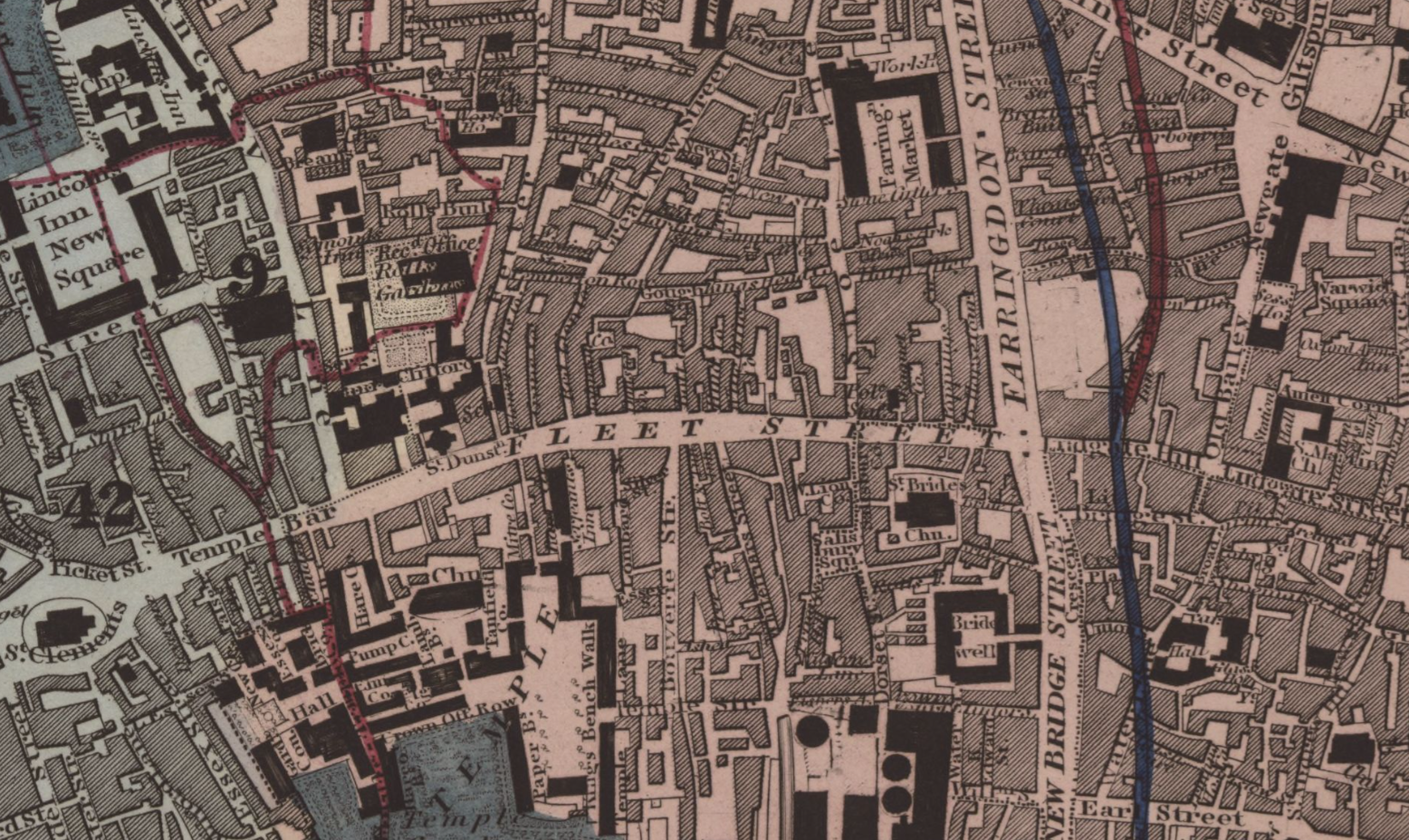
To the delight of the British press, Hotze set up shop two doors up from the American on Fleet Street (the American was at 100 Fleet Street, the Index at 102). The two offices, one with the “Stars and Stripes” and the other with the “Stars and Bars” mounted on flagpoles on their facades, became something of a tourist attraction, to the great financial benefit of the tobacconist that “like Virginia” occupied the territory/building between them.[27]
In truth, neither periodical had a large reach, selling at most 2000 copies a week each (c.f. the weekly Illustrated London News, which, by 1860, was selling 200,000 copies a week[28]). Of far greater reach and influence were the English newspapers and periodicals that took sides in the conflict, like the Manchester Guardian (Union) and the Liverpool Mercury (Confederate).[29] Arguably, the true importance of the American and the Index was that they gave their publishers access to the British establishment. This was particularly true of Hotze and the Index. Hotze was acutely aware that appealing to the British public at large was both futile, given its anti-slavery stance, and pointless, as decision-making power rested in the hands of the upper classes and wealthy merchants. He crafted the Index’s contents accordingly, which opened a lot of doors to him.
Far fewer important doors were open to the bellicose Knight. Subscriptions to the American plummeted. Knight’s response was to dig in his heels and increase the number of his targets. Not content with simply damning the Secessionists and prophesying the downfall of England, in December 1861, Knight decided to attack the very cause that the American was set up to support: Yankee commerce in London.
The trigger was the notorious Trent Affair, the seizure by the US Navy of two Confederate Envoys, Mason and Slidell, from a British ship, the RMS Trent. The incident brought Britain and the United States to the brink of war in December 1861. Wise heads called for calm. Knight damned Britain and said that, if she forced a quarrel “on the Free States in their hour of darkness”, she would go down in history as “the founder, supporter, and protector of American slavery.”[30]
War was averted by President Lincoln’s decision in January 1862 to release Mason and Slidell. In the pages of the American, Knight described this as a great victory, as America had put aside pride and the rightness of her actions in the name of peace. He and George Train then set about exposing the men they believed to be the real villains of the affair: American bankers in London who continued to stoke up war fever despite knowing that Lincoln had chosen the course of peace to profit from this inside knowledge. Train named names—Rothschilds, Barings, Peabodys—and Knight put the amount of money they had made as millions of dollars.[31]
These were the American’s subscribers that Knight and Train were damning. Its coverage of the Trent Affair and its aftermath was effectively the end of the American. It staggered on for a further year, but only through the charity of supporters in the US, most of whom knew nothing more about the periodical’s woes than what Knight told audiences at fundraising speeches he made on a trip to the US in autumn 1862: it was losing subscribers “through the influence of secessionists”.[32] Without government backing—the US Legation in London regarded Knight as more of a hindrance than a help—even this was not enough. The American published its final issue in the spring of 1863.
We had worked up a large subscription list and a profitable advertising patronage when the storm burst. There was no Atlantic cable at that time and the merchants had no way of getting quick information from America and this gave us a big start. We gave the news and the London Times was compelled to follow suit.[33]
After the demise of the American, John Adams Knight returned to his work as a claim agent. In 1865, he was declared bankrupt. According to his own later account, in an attempt to restore his fortunes, after the end of the war, allied with a Vermont lawyer attached to the American legation named Fisher, he travelled to Liverpool and applied himself to identifying British-built blockade-runners thought to be concealed in the port. Operating undercover as a Southern sympathiser, he identified seven such ships. The US Legation then applied to the English courts to have the ships seized. For this patriotic work, he expected to split the $750,000 paid by the courts to the American government in prize money 50–50 with Fisher. Again, according to his own account, this came to nothing when Fisher and his entire family died in a shipwreck on their way back to the US.[34]
The truth of this story is doubtful; the blockade runners that Knight claimed to have identified—Aerial, Penguin, Wasp, Owl, Lark, Badger, and Fox—were real enough; they were owned by the Fraser Trenholm Company, run by the most prominent supporter of the Confederacy in Liverpool, South Carolinian Charles Prioleau (1827–1887). However, there was no attempt to conceal this. In fact, brought low by the defeat of the South, Prioleau asked the British government for permission to sell the ships to pay off the company’s debts. The government refused and seized the ships on behalf of the US government.[35]
Knight returned to America in 1871 and resettled in Auburn, Maine, opening a grocery store and sharing a home with his sister, Ruth. He later worked as a carpenter. He continued inventing, patenting a number of “improvements” to domestic furniture. He died on 2 February 1918, aged 93. He never married.[36]
[The Anglo-American Times] does not believe that the “manifest destiny” of the United States is to swallow up the whole world, nor that the American people are the greatest people the sun ever shone upon. But it believes that they are an active, energetic, honest, and highly prosperous people—that they not only deserve but desire the good opinion of Europe[…][37]
Just over two years after the demise of the American, a second periodical dedicated to news of events in America launched in London. This was the Anglo-American Times, and its first editor was the husband of novelist Mary Andrews (1826–1911),the Reverend Charles Wheeler Denison (1812–1881), a Connecticut-born cleric, journalist, and abolitionist.[38]
Denison was many things, but he was not a sporting man; in his two years in charge of the Anglo-American, baseball featured only in news items; there was one game report, but this was of the annual Yale–Harvard game, so arguably also a news item.[39] Other sports received similarly short shrift. Denison’s successor in the editor’s seat introduced a dedicated “sports” column, but the Anglo-American would never cover sports to the extent that the American did. What it would do was survive.
From the outset, Denison struck a much more conciliatory tone in his editorial stance than Knight had—it is hard not to read in the language of his first editorial a direct riposte to the fiery rhetoric of the American. Denison even entertained a debate in the Anglo-American’s pages on whether Americans in England should avoid celebrating American Independence Day out of sensitivity for their hosts. Knight would have had a fit at the very idea. (Denison favoured prioritising celebrations of George Washington’s Birthday instead; a curious splitting of hairs.)[40]
The Anglo-American survived for over thirty years while the American disappeared after only three.
To the Editor of the Marylebone Mercury. Sir, —I do not know whether you are an admirer of the manly game of "Rounders,” as it is termed, I believe, but I should like you to hear my case, if you will kindly give it publicity. Paddington-green is a well-known spot, and, although its glories have faded in one sense, they flourish vigorously in another, for it is here that the game of "Rounders" is seen to the greatest perfection.[41]
To the best of my knowledge, we have no reports of American baseball being played in London, or indeed anywhere in England, before 1871.[42]
Cricket and American baseball’s English cousin, rounders, were the bat-and-ball games of choice in the capital. Yet, in 1870, people were of the view that there were sufficient “American base ballists in England” to support a rumour that an American nine would take on an English nine at Lord’s Cricket Ground. In the first piece in this series, I suggested that such men might have been found in the colleges of Oxford and Cambridge. The snapshot of the American community in London circa 1860 that I have provided here points to an alternative source, the diplomatic missions, company offices, counting houses, art schools, theatres, and boxing rings of the metropolis. As I said at the start of this piece, this is where the London American found its subscribers, and it considered baseball of interest to enough of them to justify including game coverage in its pages.
If the American Civil War had not intervened, if John Adams Knight had not been so proud of his Yankee roots, the London American might even have survived long enough to have given us our earliest reports of American baseball being played in London.
Jamie Barras, March 2026.
Appendix: The London American’s 1860 Coverage of Baseball in America
Base-ball certainly has been carried to a higher pitch of perfection in America than anywhere else within the last few years. Seven years ago, we believe, there were not two base ball clubs in the state of New York. In that kindly soil sports thrive apace, like Jonah’s gourd, or Jack’s fabled beanstalk.[43]
The first mention of baseball in the American came on 20 June 1860 in the form of a brief mention in an article on sports and recreations in America. Interestingly, there was no attempt to explain the game. Indeed, the American’s baseball coverage, aimed squarely at its American readers, made no concessions to anyone unfamiliar with the game. (It is worth noting here that, although the American’s cricket coverage would have been of interest to its British subscribers and included the results of matches played in Britain, given the popularity of the sport in this period in New York and New England, this was also almost certainly aimed at its American subscribers.[44])
Alas, events in America would mean that the American’s sports coverage would last only one year, crowded out of the periodical by reports of the outbreak and progress of the American Civil War. The upshot of this was that only five game reports made it into the periodical, all from the late summer/early autumn of 1860. By chance, these five reports covered the biggest baseball stories of that year. Three of the reports concerned the [in]famous contest between the Atlantics of Bedford, New York, and the Excelsiors of Brooklyn for the championship of the New York area played out across the late summer of 1860. The Atlantics had been all-conquering until this contest, but Joe Leggett of the Excelsiors had brought pitcher Jim Creighton into the team and then honed the team’s skills across a tour through the state. The first report in the American was published on 8 August 1860, detailing a game played in Brooklyn on Thursday, 19 July, that shocked the cognoscenti.[45]
BASE-BALL IN BROOKLYN.—The Atlantic Club, of Brooklyn, has hitherto been the champion base-ball club of the State of New York. The Excelsiors, a formidable, though, until this year, an unsuccessful competitor for the pride of place, have lately been on a tour through the state, and beaten the best clubs of Albany, Troy, Buffalo, Rochester, and Newburgh. On their return they challenged the champions to a new trial of skill. The match took place on the grounds of the Excelsior Club in South Brooklyn, in the presence of an immense assemblage of 10,000 lookers on. In nine innings, the Excelsiors made 23 runs, while the Atlantics only scored 4.[46]
The second report was published on 29 August.
BASE BALL.—On Thursday, the 9th inst., the Atlantic and Excelsior Clubs of Brooklyn, played the return match in their contest for the base-ball championship. The Atlantics have been champions hitherto, and have never been beaten until this year, in the first match by the Excelsiors. On this occasion, the Atlantics beat by one run, the score standing 15 to 14. The match was played on the grounds of the Atlantic club, in the presence of an immense number of spectators. The scene at the commencement of this game was picturesque in the extreme. The whole circle of the ground—and it is a pretty extensive one—was hedged in by a crowd of not less, at a moderate calculation, than twelve thousand people; and among these seated on the right of the players, were some three or four hundred ladies, and outside the circle vehicles of every description were loaded down with spectators, who never moved from their positions until the last hit in the last innings had ended the game.[47]
With honours even going into the final game, everything was to play for. The third and final report on the contest published by the American appeared in its 12 September 1860 edition.
BASE BALL.—The deciding contest for the championship of base ball between the Atlantic and Excelsior Clubs was played on the Putnam Ground, Brooklyn, on Thursday, August 23rd, in the presence of 20,000 spectators, many of them ladies. The Excelsior had scored 8 to the Atlantics’ 6, in five innings, when the crowd, who strongly favoured the Atlantics, so interrupted the game with their hootings and hissings of the Excelsiors, that the latter properly refused to continue the match, and it was agreed to draw the game.[48]
Alas, as this was its last report on the Atlantic–Excelsior battle, the American did not carry the story of the aftermath of this controversy: on refusing to continue the game, the captain of the Excelsiors, Joe Leggett, offered the Atlantic captain, Matty O’Brien, the ball, conceding the game. However, O’Brien refused to accept it, making the game and series a draw. A few days later, upon deliberation, the game umpire, Henry Thorne, decided that, as the game was not called off by mutual consent, Leggett was right, the Atlantics had won, and asked the Excelsiors to send the ball to the Atlantics, which they did.[49]
The next games covered in the American again featured the Excelsiors of Brooklyn, this time on tour, another major milestone in the history of the spread of the New York game across America.
BASE BALL.—The Base Ball match between the Excelsior Club of Brooklyn and the Excelsior Club of Baltimore came off on the 20th, and resulted in the victory of the former. The score stood at the close of the game—Excelsiors of Brooklyn, 51; Excelsiors of Baltimore, 6. The Excelsior Base Ball Club, on their return from Baltimore, played a match against a picked nine from all Philadelphia, yesterday afternoon, in presence of 1,500 spectators. The victory, as usual in all their excursion matches, was for the Excelsiors, who scored 15 to their opponents’ 4. The match occupied but two hours and five minutes, and the Philadelphians played well in the field—some of them being cricketers.[50]
These games were played on 22 September (Baltimore) and 24 September (Philadelphia) and reported in the 10 October 1860 edition of the American. Unreported in the American was the fact that the Excelsiors were greeted in Baltimore as “the champion club of the United States”, a compliment that the Excelsiors’ president, J.B. Jones, given the events of the previous month, was forced to decline.[51]
The final baseball report carried by the American was something of an outlier, both in terms of the American’s baseball coverage and baseball in general, as it concerned a game played under not the New York rules but the New England rules, was a prize contest, and, although a single game, was played across seven days.
BASE BALL.—The Medway and Upton clubs, the two crack clubs at the Massachusetts variation of base ball, have been playing a match at Worcester, Mass. Victory is to the club which first scores 100. After playing four days consecutively, the score stood—Upton, 38; and Medway, 25. The game was then adjourned for a week, as the grounds were required for the Worcester County Agricultural Exhibition.[52]
Ultimately, the game was abandoned with the score at 50 for Upton, 29 for Medway, the $1000 purse for which the teams were playing going to Upton. Games under New England rules were generally played based on the first team to score a certain number of runs/points, but 100 was clearly a tally too far. This game has gone down in history as the longest ever played.[53]
Notes
[1] ‘Base Ball In England’, Brooklyn Daily Times, 4 March 1870.
[2]https://www.ishilearn.com/diamond-lives-the-base-ballists-a-reverie, accessed 27 March 2026.
[3] ‘The London American’, Ellsworth American (Ellsworth, ME), 25 May 1860.
[4] Lives of John A. Knight and George Hazeltine assembled from: ‘John Adams Knight’, Lewiston Daily-Sun (Lewiston, ME), 2 February 1918; ‘Authority on Patent Laws’, Boston Evening Transcript, 10 September 1915; ‘Stuck to Yankee Doodle Flag’, Boston Globe, 14 October 1906; ‘Chapters from Busy Lives of Lewiston and Auburn Folk’, Lewiston Sun-Journal (Lewiston, ME), 4 June 1910; ‘New Patents’, Northern Daily Times, 5 October 1860; https://patents.google.com/patent/USRE5993E/, accessed 12 March 2026.
[5] ‘We arrived files of New York papers, by the Adventure, to 14 April’: ‘Latest American News’, The London American, 2 May 1860.
[6] Boxing: ‘The Championship’, The London American, 23 May 1860; Clairvoyant, see for example, ‘Sporting Items’, The London American, 15 May 1861; Billiards and trotting: ‘Sporting Items’, The London American, 10 October 1860. It should be noted here that, of course, anyone in London interested in baseball could read game reports to their heart's content in imported newspapers, particularly the New York papers, which, after all, were the source of the American’s coverage.
[7] ‘American Independence’, Sheffield Daily Telegraph, 6 July 1860.
[8] Daniel Dematos, ‘George Peabody’, https://tontinecoffeehouse.com/2022/06/06/george-peabody/, accessed 23 March 2026.
[9] ‘Notices’, The London American, 4 July 1860.
[10] The US diplomatic mission in England would not be upgraded to an embassy until 1893. https://uk.usembassy.gov/the-old-american-embassy-london-chancery-building/, accessed 23 March 2026.
[11] Richard Fulton, “The ‘Spectator’ in Alien Hands.” Victorian Periodicals Review, 1991, 24, 187–96. http://www.jstor.org/stable/20082560.
[12] Matthew Coyle, ‘George W.M. Reynolds: an Enigma in Print’, https://victorianweb.org/authors/reynolds/intro.html, accessed 27 March 2026. Buckley’s Serenaders are an example of an entertainment troupe of American origin in London who received frequent mentions in the pages of the American; for example, ‘Amusements’, The American, 26 December 1860. The Buckley family was English, but found fame in America and included Americans in the troupe it brought to England.
[13]https://www.theguardian.com/sport/blog/2010/apr/14/john-heenan-tom-sayers-boxing, accessed 27 March 2026. The American’s coverage: ‘The Championship’, London American, 2 May 1860.
[14] Thespians: R.G. Knowles and Richard Morton, ‘Baseball’, (London: George Routledge & Sons, 1896). Frank Craig and Charles Carey playing for the Dewars: https://www.ishilearn.com/diamond-lives-behind-the-mask, accessed 27 March 2026.
[15] Magnus biography: https://www.familysearch.org/en/tree/person/details/LRCN-P5Q, accessed 23 March 2026. Campbell biography: https://bioguide.congress.gov/search/bio/C000098, accessed 23 March 2026. Croskey biography and Croskey and Magnus: https://kelsall.one-name.net/population-studies/historical-population-growth-in-the-united-states/historical-records-from-before-1830/, accessed 23 March 2026. Magnus and Campbell: ‘The Buenos Ayres and San Fernando Railway Company Limited’, Morning Herald (London), 29 February 1860.
[16] Dodge biographies: https://www.familysearch.org/en/tree/person/details/KZ8Y-9P3, accessed 23 March 2026. Fighting against Goodyear: ‘The American Overshoe Protection Society’, Morning Advertiser, 15 October 1853. Giandonati biographical information: entry for “Raffallo Giandonati”, 1861 England Census, Paddington district, ancestry.co.uk, Ancestry.com Inc. (Operations), accessed 27 March 2036.
[17] Kellogg: ‘An Old Cincinnati Artist Gone’ Cincinnati Enquirer, 22 February 1889; ‘Art Notes’, New York Times, 3 March 1889.
[18] Billings biography: https://www.familysearch.org/en/tree/person/details/G36Q-Q2T, accessed 23 March 2026. Billings and Cadman: ‘Death of a Gentleman of Fortune’, Sun (London), 2 November 1852. ‘Royal Dramatic College’, Globe, 27 May 1863. Entry for Charles Cadman and “Alphens Bellings”, 1851 England Census, Saint Pancras district, ancestry.co.uk, Ancestry.com Inc. (Operations), accessed 28 March 2026.
[19]https://www.findagrave.com/memorial/5894395/nathaniel-beverley-tucker, accessed 23 March 2026.
[20] Editorial’, The London American, 2 May 1860.
[21] ‘War in America’, The London American, 1 May 1861.
[22] ‘Train to Lie in State’, New York Times, 20 January 1904.
[23] ‘Mr. Train on the Downfall of England’, The London American, 6 August 1862.
[24] ‘Andrew W. Bostwick’, Baltimore Sun, 10 October 1899; ‘A.W. Bostwick Dead’, Baltimore Sun, 9 February 1912; ‘Woodruff Family Reunion’, Democrat and Chronicle (Rochester, NY), 5 August 1912. Bostwick returned to the US in 1864, went into the oil business, and moved to Baltimore.
[25] ‘The American War in London’, Saturday Review of Politics, Literature, Science and Art, 2 August 1862.
[26] See Note 3 above for the story of the Index. Issues can be downloaded from archive.org; volume 1: https://archive.org/details/indexweeklyjourn01hotz, accessed 11 March 2026.
[27] Note 9 above; ‘Literary Gossip’, Western Daily Press, 5 May 1862. The buildings in question can be seen in John Tallis’ London Street Views, 1838, revised 1847: John Tallis's London street views, 1838-1840: together with the revised and enlarged views of 1847. 2nd rev. ed. London: London Topographical Society. Accessed at the University of Michigan.
[28] Adrian Bingham, ‘British Print Media, 1860s–1960s’, https://britishonlinearchives.com/posts/category/contextual-essays/480/british-print-media-1860s-1960s, accessed 12 March 2026.
[29] See Note 3 above and David Brown, Myth, Manchester, and the Battle of British Public Opinion during the American Civil War. The Historical Journal, 2023, 66, 818–841. https://doi.org/10.1017/
S0018246X23000237.
[30] Trent Affair: Donald Rakestraw, ‘The Trent Affair’, https://www.essentialcivilwarcurriculum.com/the-trent-affair.html, accessed 13 March 2026. “Hour of Darkness”: ‘England and the United States.—Some of the Causes of Distrust’, The London American, 1 January 1862.
[31] ‘The Release of Mason & Slidell—Settlement of the Trent Affair’, The London American, 15 January 1861. Train names names: ‘G.F. Train Again’, Birmingham Daily Post, 14 November 1862. ‘Millions of Dollars’: See Note 6 above, fourth reference.
[32] ‘Personal’, Chicago Tribune, 4 October 1862.
[33] See Note 2 above, fourth reference.
[34] See Note 2 above, third and fourth references. Bankruptcy: ‘Bankrupts’, Bell's Life in London and Sporting Chronicle, 28 January 1865.
[35] Names of the ships: See Note 2 above, third reference. List of Liverpool-built blockade runners: https://www.liverpool.ac.uk/~cmi/books/br.html; Charles Prioleau: https://ldhi.library.cofc.edu/exhibits/show/liverpools-abercromby-square, accessed 11 March 2026. The “Trenholm” in Fraser Trenholm was the company’s senior partner in the US, planter and politician George Trenholm (1807–1876). Like Prioleau, Trenholm was from South Carolina.
[36] See Note 2 above.
[37] ‘Salutatory’, Anglo-American Times, 23 October 1865.
[38] Denison biography: ‘Death of Rev. C.W. Denison’, Evening Star (Washington, DC), 15 November 1881. Connection to Anglo-American Times: ‘The Anglo-American Times’, Evening Telegraph (Philadelphia, PA), 17 July 1866. Mary Andrews Denison: Madeleine B. Stern, ‘Mary Andrews Denison’, James, Edward T., ed., Notable American Women, 1607-1950: A Biographical Dictionary, Volume 2 (Cambridge, Massachusetts: Harvard University Press, 1971), 462–463.
[39] ‘Personal’, Anglo-American Times, 3 August 1867.
[40] ‘The Approaching Fourth of July’, Anglo-American Times, 9 June 1866.
[41] Letter to the Editor, Marylebone Mercury, 13 April 1861.
[42] Earliest recorded game of American baseball in England: ‘A Game of Base Ball’, Gravesend Reporter, 17 June 1871. There was a baseball club active in Scotland a year earlier: ‘Dingwall—Base Ball’, Inverness Advertiser and Ross-shire Chronicle, 19 July 1870.
[43] ‘Base Ball’, The London American, 29 August 1860. For an American newspaper account of this game, see ‘Outdoor Sports: Base Ball’, New York Times, 10 August 1860.
[44] ‘Cricket: All-England Eleven versus Twenty-Two of Ireland’, The London American, 12 September 1860.
[45] ‘Outdoor Sports: Base Ball’, New York Times, 20 July 1860. For a modern view of this contest, see: Craig B. Waff, ‘August 23 1860: No Gentleman’s Game, Excelsior vs. Atlantic, https://sabr.org/gamesproj/game/august-23-1860-no-gentlemens-game-excelsior-vs-atlantic/, accessed 20 March 2026.
[46] ‘Base-Ball In Brooklyn’, The London American, 8 August 1860. For an American newspaper account of this game, see Note 9 above.
[47] ‘Base Ball’, The London American, 29 August 1860. For an American newspaper account of this game, see ‘Outdoor Sports: Base Ball’, New York Times, 10 August 1860.
[48] ‘Base Ball’, The London American, 12 September 1860. For an American newspaper account of this game, see ‘Grand Base Ball Match’, New York Times, 24 August 1860.
[49] ‘Out Door Sports: Base Ball’, Brooklyn Daily Times, 5 September 1860, and Note 10 above, final reference.
[50] ‘Base Ball’, The London American, 10 October 1860. For an American newspaper account of these games, see ‘The Base Ball Match’, Daily Exchange (Baltimore, MD), 24 September 1860; ‘The Excelsiors in Philadelphia’, New York Times, 26 September 1860.
[51] See Note 15 above, second reference.
[52] ‘Base Ball’, The London American, 24 October 1860. For an American newspaper account of this game, see ‘Base Ball Match’, Detroit Free Press, 13 October 1860.
[53] Philip J. Lowry, ‘I Don’t Care If I Ever Get Back: Marathons Lasting 20 or More Innings’, https://sabr.org/journal/article/i-dont-care-if-i-ever-get-back-marathons-lasting-20-or-more-innings/, accessed 19 September 2026.
Fleet Street, circa 1860. Smith and son, [London large scale plan], 1861. https://maps.nls.uk/joins/11932.html

Banner, London American. British Library.
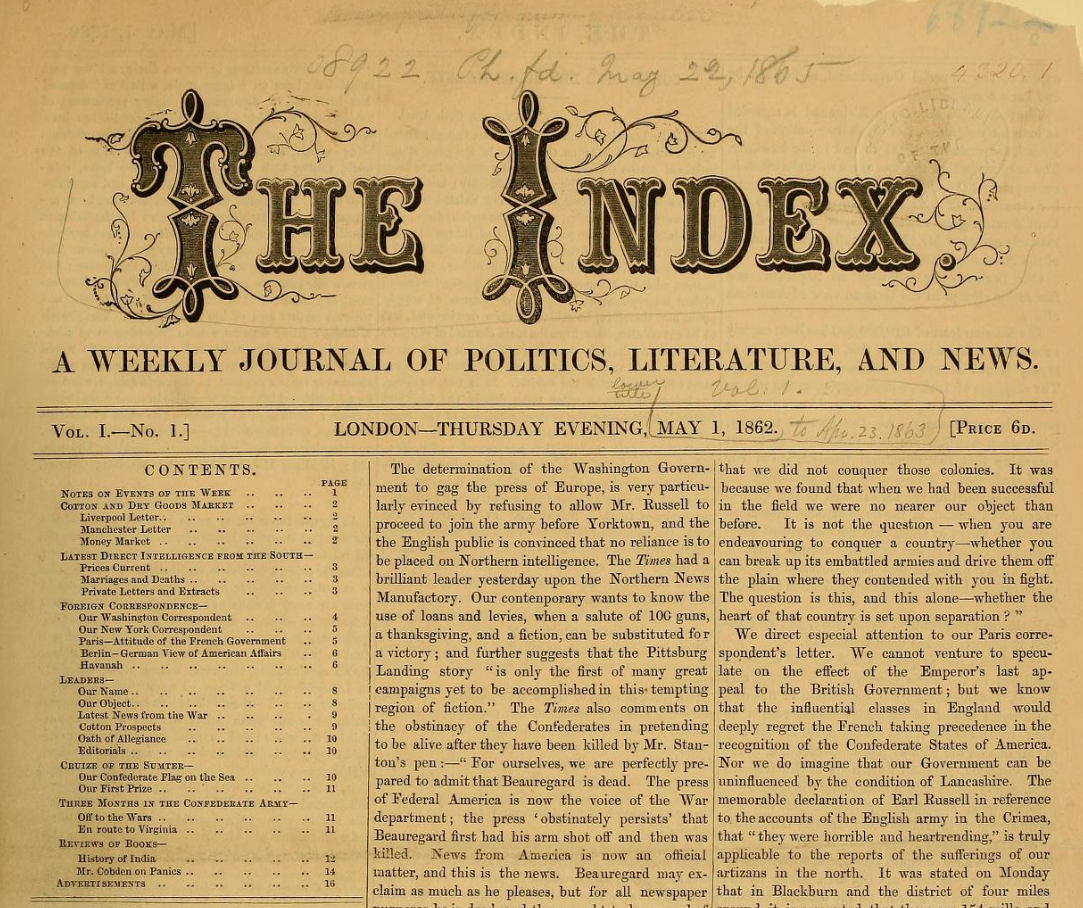
First edition of The Index, 1 May 1862, archive.org. Public domain.
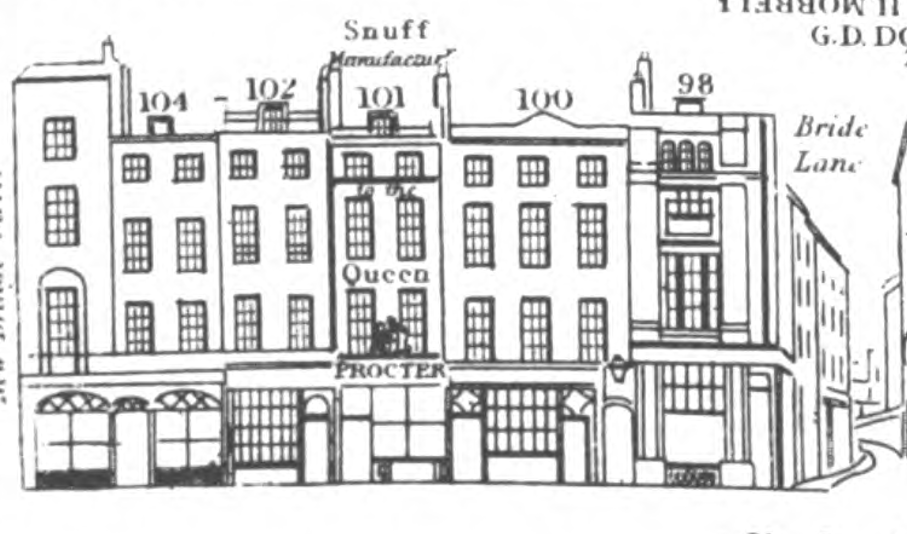
The offices of the London American (100 Fleet Street) and the Index (102 Fleet Street). John Tallis, London Street Views, 1838. Public domain.
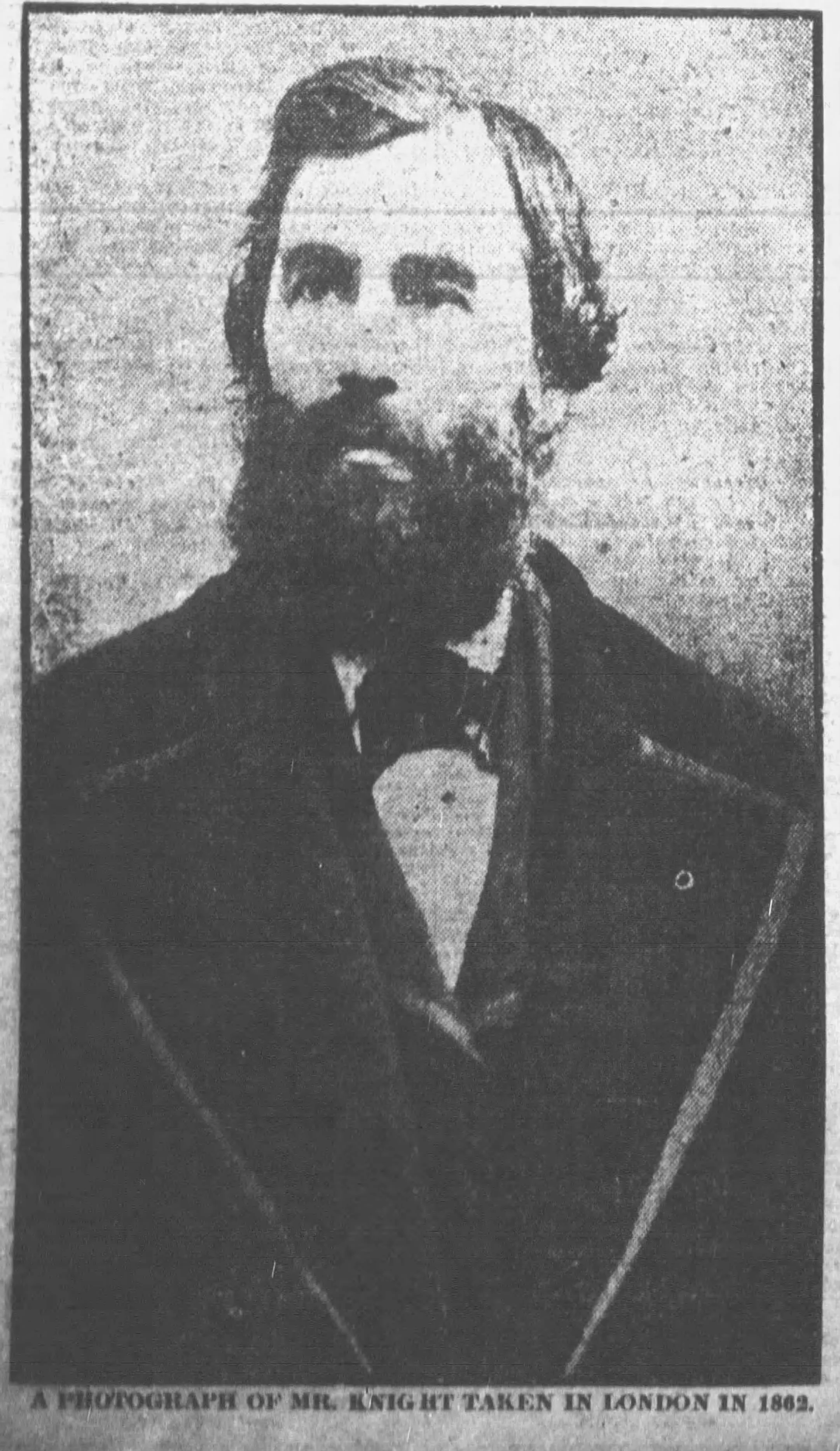
John Adams Knight, publisher of the London American, circa 1862. Lewiston Sun-Journal 29 September 1917. Image created by Library of Congress. Public domain.
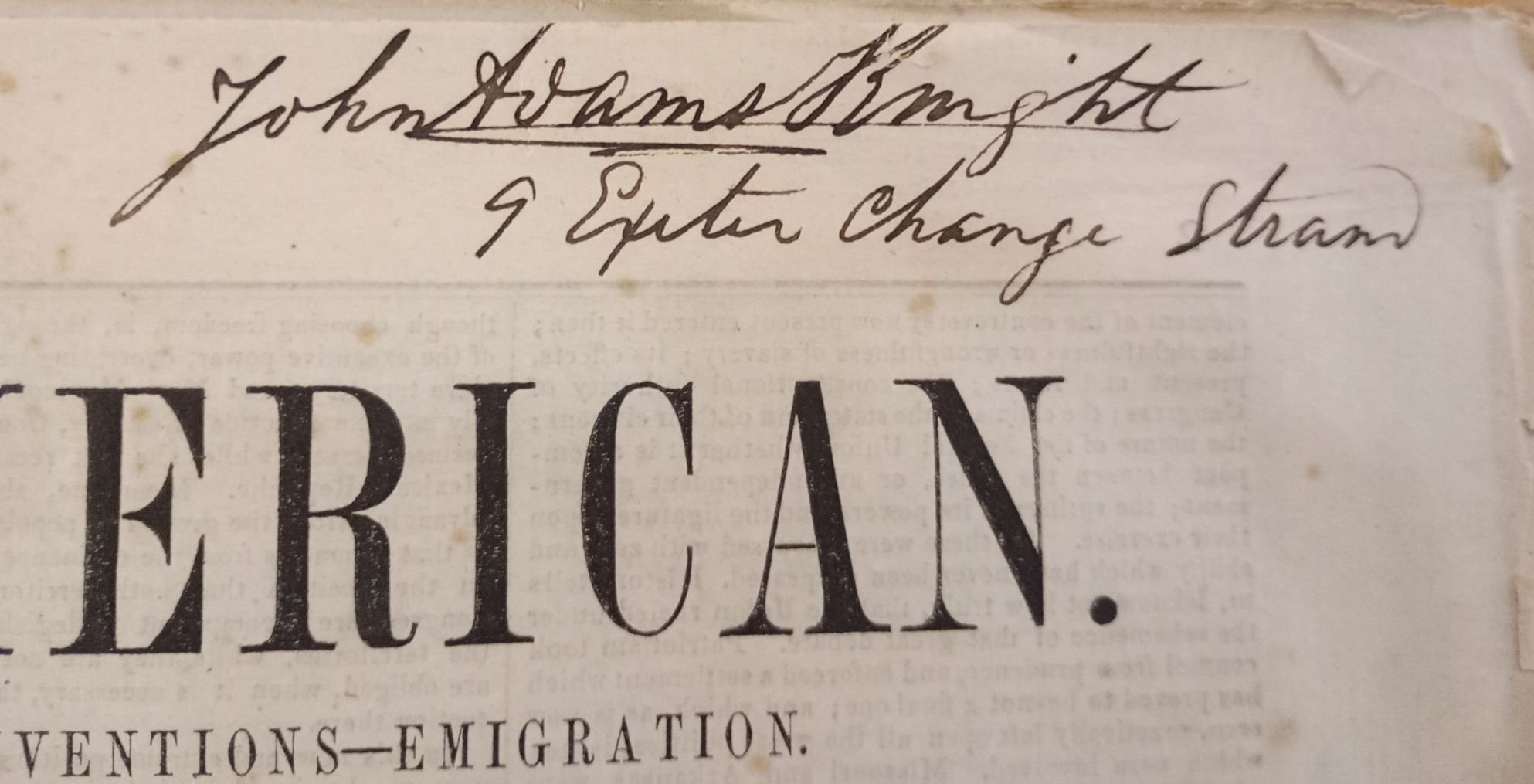
John Adams Knight's signature on the copy of the first issue of the London American held by the British Library.
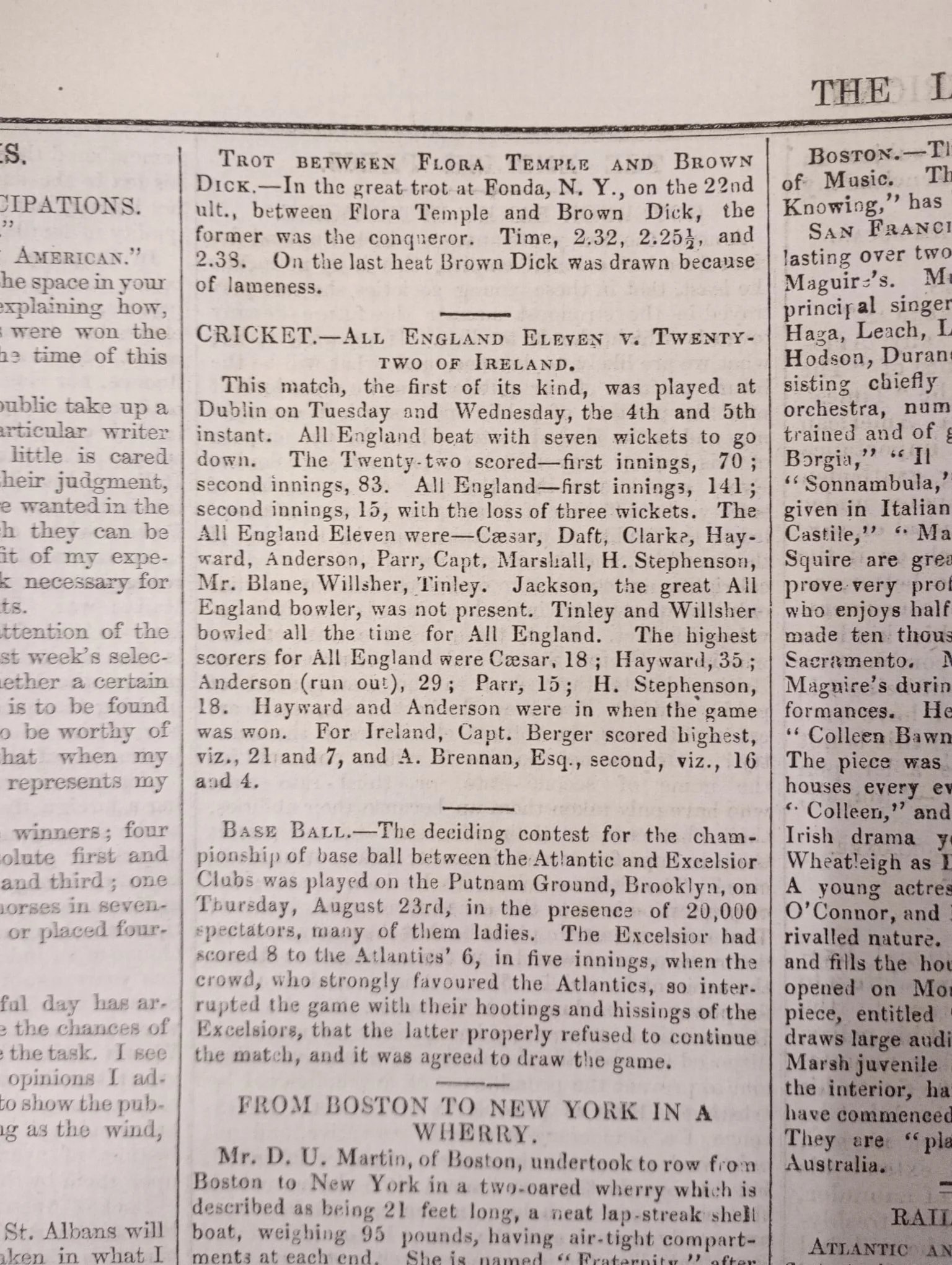
Cricket and baseball coverage, London American, 12 September 1860. Copy held by the British Library.
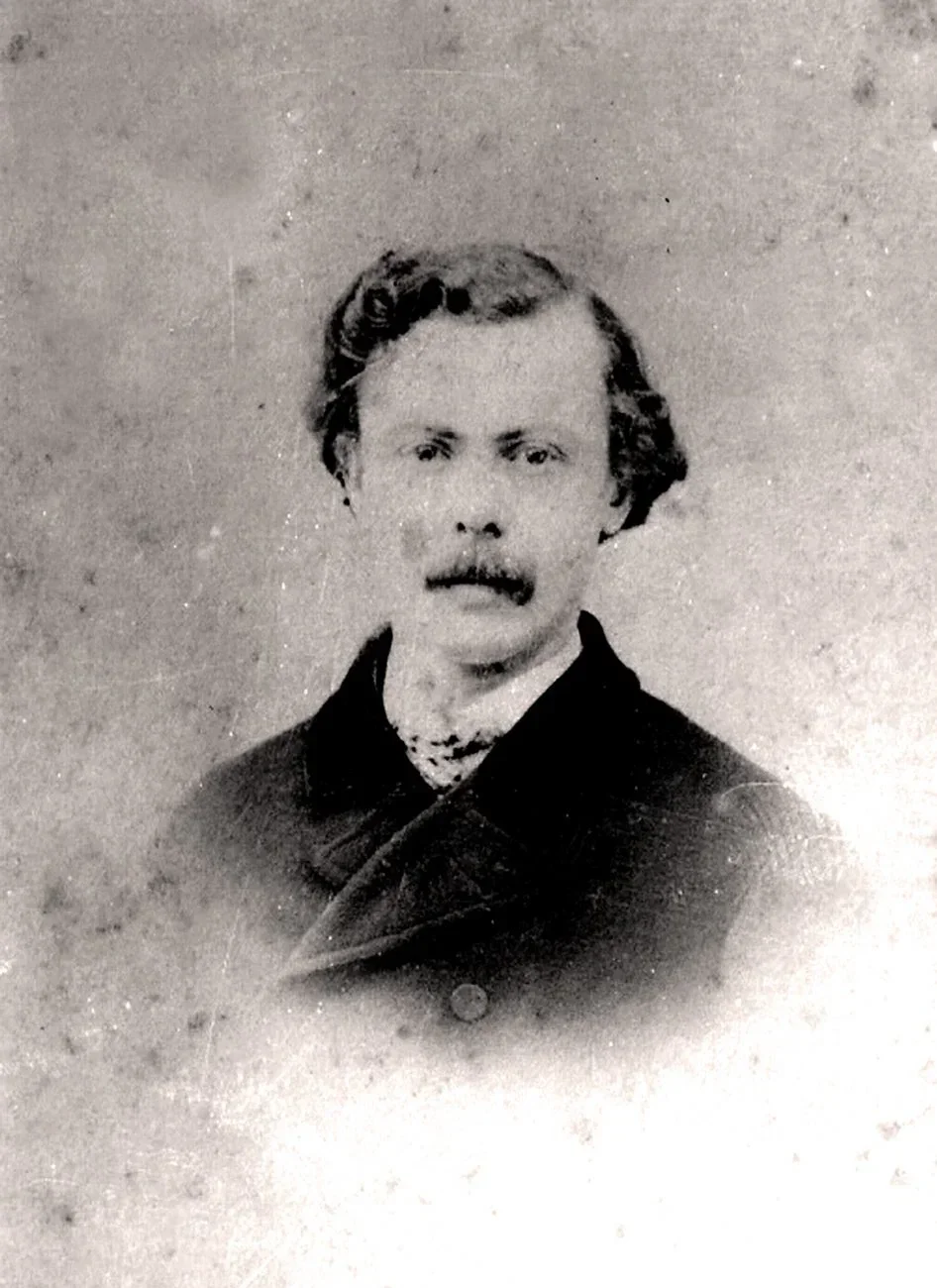
Henry Hotze, editor and publisher of the Index. Image created by University of Alabama. Public domain.
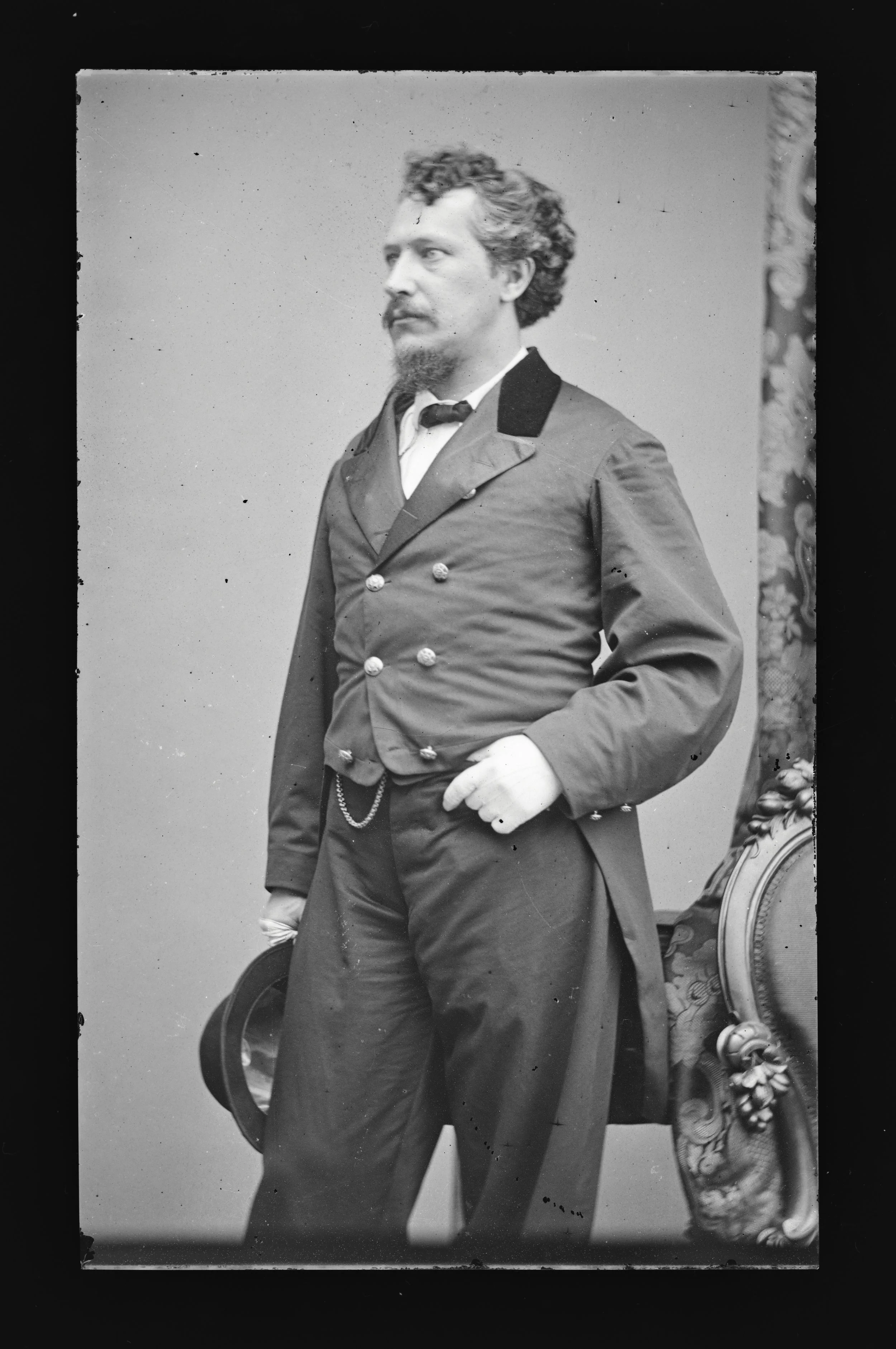
George Francis Train, American eccentric. National Portrait Gallery. Public domain.
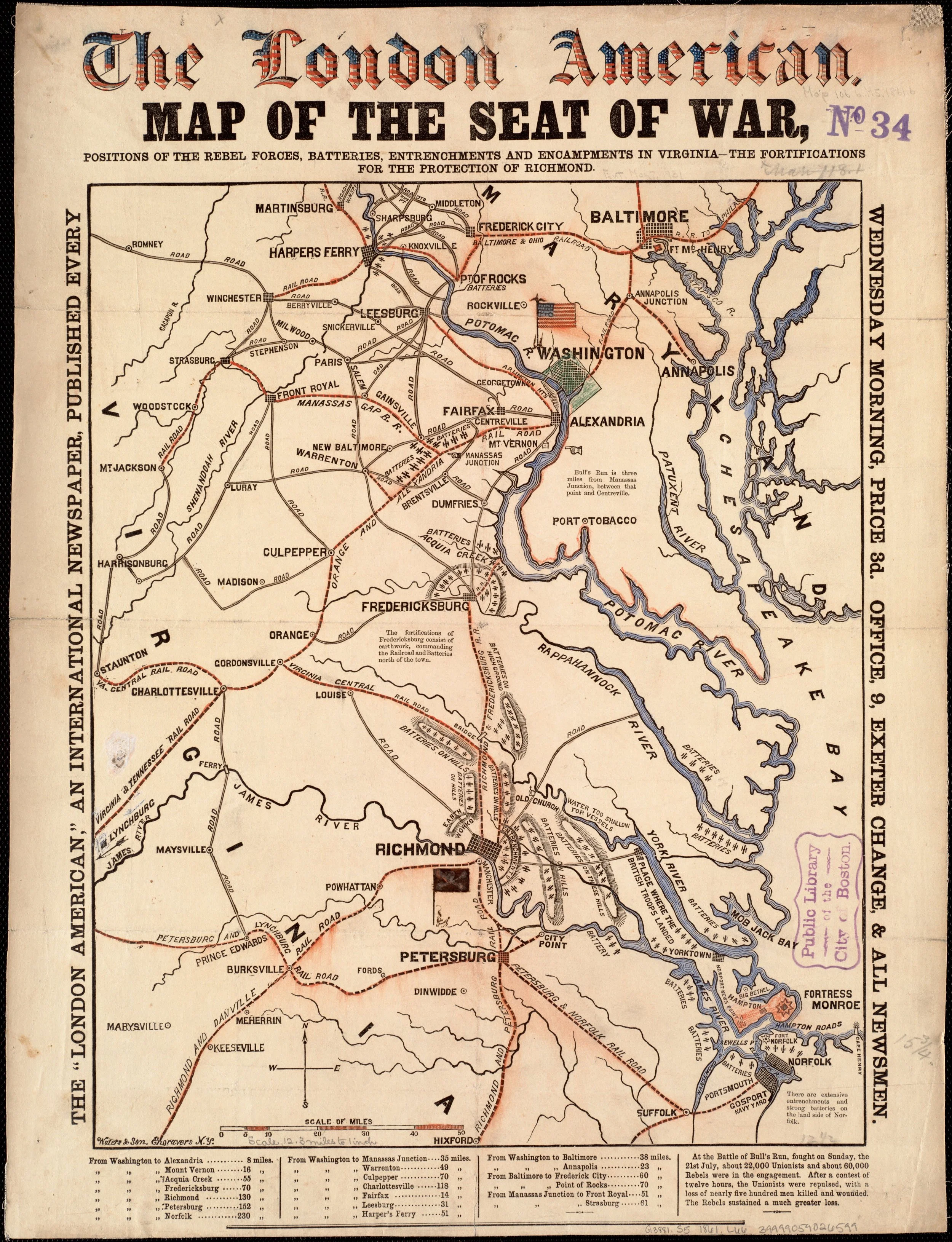
Map of the seat of the war, London American. Image created by the Library of Congress. Public domain.
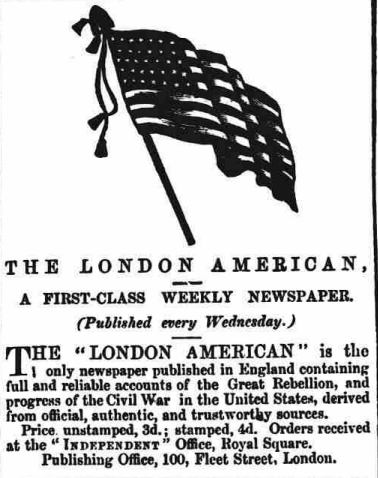
Stars and Stripes. Advertisement for the London American, Jersey Independent, 7 June 1862. Image created by the British Library Board. No known copyright holder.