Joe.
Part II: Native English Hurler (1938 & 1939)
Jamie Barras.
N.B.A. TAKES CONTROL. BASEBALL CLUB SECRETARIES BUT NO COMMITTEES. American baseball, struggling to assert itself in the forefront of British summer sports, lacks nothing in the courage of its administrators. This season they are making a bold move. They propose to augment their ordinary control as a governing body by extending it to direct control of the major clubs[...]This direct control of club affairs is a new departure in England, but that is no reason why it may not succeed. Each club will possess a paid coach, and amateurs will fill the remaining team places. The situation is a semi-reversion to amateur status, and a partial acknowledgment that the professional leagues were introduced much too soon.[1]
The London Major Baseball League, the only top-tier league in the south of the country, collapsed into insolvency at the end of the 1937 season, and early in 1938, the NBA took the difficult decision to merge its other two top-tier leagues (North of England and Yorkshire) into one. It also downgraded the merged league from “professional” to “semi-professional” by imposing a cap of at most two professional players per team.[2]
These changes were a recognition that the anticipated pushback by fans against the reliance of top-tier teams on imported talent had come about sooner than the NBA had hoped. The NBA had always known that it would have to develop native talent to keep the scene alive; however, it had hoped that it would give it time to do so. What it had not anticipated was that the scene would grow so quickly that the distribution of imported talent would quickly become uneven. This triggered the NBA’s worst-case scenario: teams stuffed with novice English players being decimated by opposition loaded with experienced North American players; an anathema to growing a loyal fanbase.
As evidence that this pushback against imported talent was the major factor in fan reluctance to engage with the game, we can look at how the NBA’s professionals reacted to this cap on numbers. The players, mostly North American, banded together and formed their own rebel league, the International Professional Baseball League (IPBL). Launched in a blaze of publicity and featuring teams that were stuffed with the country’s best players, the IPBL was a miserable failure, collapsing after only one month. It was on shaky ground financially right from the outset. However, the larger reason was that British sports fans had little interest in watching North Americans play other North Americans in a North American sport—a sport that many considered inferior to cricket.[3]
(How nuanced this situation was can be judged by the contrasting success of ice hockey in Britain in the 1930s: another imported sport played largely by imported players, ice hockey had the advantage of not having any equivalent competing sport, being a different take on an already popular sport, field hockey, and being almost entirely the domain of players from a British dominion, Canada, many of whom had roots in the UK, particularly Scotland.[4])
This cap on professional players was a boon for native amateur talent like Joe Dalton. The NBA assigned him to the Greenfield Giants, which was now Bradford’s only top-tier team.
BASEBALL IN RAIN. Greenfield Giants Win First Home Game.[...]Considering the conditions, Joe Dalton, the Bradford City half-back, pitched exceedingly well to score eight strikes-out for the Giants, going one better than Hanks, who retired at the end of the fifth frame after making seven strikes-out, to for Evans, whose three strikes-out did not fully represent his consistently accurate pitching.[5]
For a full account of the Lancashire–Yorkshire Baseball League’s two seasons of baseball, I refer readers to Harvey Sahker’s Blokes of Summer.[6] Here, I want to focus on the contrast between Joe Dalton’s background and that of the other pitchers in the league. I have included brief biographies of the other pitchers in the 1938 season as an appendix for comparison.
Although not the only British-born pitcher in the top tier of the game in 1938, Joe was the only pitcher in the top tier who had learned his baseball in Britain. All the other pitchers, including the two other British-born pitchers (Alan Forrest and Jack Wilding), had learned their baseball in the US or Canada. They had grown up with a game that Joe had encountered for the first time as an adult. They had a decade-plus of experience and muscle memory on him.
Joe’s recruitment by the Giants was touted as evidence that the game in Britain did not need American professionals to thrive. Alfred T. Grogan, head of the Yorkshire County Baseball Association, was fulsome in his praise for this homegrown product of the NBA system.
“Dalton has made the grade. He is going to be one of the best pitchers in Yorkshire. He can curve the ball and has a good change of pace. All the officials are highly delighted with his efforts. His training under Danny Wright’s coaching has worked wonders. A lot is going to be heard of Joe this season.”[7]
It is clear from Grogan’s tone that NBA officials saw Joe as the first of many players who would rise to the top tier via the NBA amateur leagues. “Danny Wright” was ace Canadian hurler William Daniel “Danny” Wright (1911–?). Wright had been the Greenfield Giants’ captain and starting pitcher in 1937 and had run a baseball training camp in the city in December of that year. However, for the 1938 season, the NBA assigned him to a team new to the game, Halifax.[8]
The Greenfield Giants’ 1938 season captain was one of their two allotted professionals, Scottish-born Canadian ice hockey star Ronald Scott “Scotty” Milne (1910–1984). Milne had played for Leeds Oaks in the 1937 season. He mostly played second base. The Giants' other professional was Leo “Doc” Holden (1909–1967), who had been an ace hurler back in British Columbia, but spent his baseball career in Britain mostly behind the plate.[9]
In Holden, Joe had a useful mentor. He needed one. Nineteen thirty-eight wasn’t just Joe’s rookie season; it was also a season of two halves. With pitchers of the calibre of Danny Wright and Bruce Hanks pitching for Halifax and Rochdale, respectively, the Greenfield Giants were always only going to be fighting for third place. This was an ideal introduction to the top tier for Joe, just the right balance between challenge and opportunity.
Joe pitched the Giants to three wins in his first five games, with an average of nine strikeouts a game.[10] But then the wheels came off the 1938 season. The collapse of the IPBL in mid-June brought all the players that had defected to it back into the NBA top tier. This threw all the NBA’s carefully crafted team rosters to the winds. In this, the league’s officials were giving way to pressure from teams that felt they were underperforming, which is to say, not as dominant as in previous years. An analysis of the opening weeks of the season shows that, in fact, honours were pretty much even across the board (the teams at the top had three wins, two losses, the teams at the bottom, two wins, three losses).[11]
This was how the NBA wanted it, a closely fought competition, but, of course, the teams saw things differently. Following the collapse of the IPBL, Hull acquired the services of Jerry Strong, the No.2 pitcher in the country, alongside Larry Marsh, another top player. Meanwhile, Oldham picked up Ross Kendrick, the best pitcher in the country. Kendrick was brought in to replace Oldham’s teen wunderkind, Alan Forrest, who had wrecked his arm trying to do too much, too soon. (See appendix for information on Strong, Kendrick, and Forrest.)
The Giants’ record for the rest of the season was one of being thrown off-balance by the sudden uptick in competition, followed by a slow return to an even keel: five straight losses followed by four wins, two losses, and a draw. Their final position in the table, 8th (third from bottom), did not do them justice, as they had only lost one more game than Hull, the team in 5th place. Joe had come through his baptism of fire.
U.S. Baseball Stars For England. America's Olympic Games baseball team is to visit England in August and in addition to playing clubs in Yorkshire. Lancashire and London will oppose England in a series of Test matches at Liverpool, Hull, Leeds, and Halifax.[12]
The biggest event in American baseball in Britain in 1938 was the five-game test series that Team England played in August against the team of amateurs that the USA planned to send to the 1940 Olympics. Now known as the first World Amateur Baseball Championship, at the time, it was billed as the International Amateur Baseball Cup. Team England won the series 4–1.[13]
Our interest in this series is that Joe Dalton was not included in the England squad. Instead, the team comprised the best Canadians playing baseball in Britain and Ulsterman Sam Hanna, who had grown up in New York. For a pure stats perspective, this was as it should have been: Joe, for all his talent and potential, was not yet among the pick of the eligible players. However, with the benefit of hindsight, it is clear that the NBA missed a trick by not including in the squad the only Englishman pitching in its top tier who had learned his baseball in England. Even if Joe warmed a bench the whole series, he would still have been an inspiration to aspiring players; the Bradford boy who earned his England cap after just three years in the game. A missed opportunity.
That the NBA still had confidence in Joe was made clear when the new team assignments for the 1939 season were released: Joe would be pitching for Halifax, the team that had topped the league in 1938.
I have no fears about the infield or the batting, and I am hoping that Joe Dalton will make still further progress this time. He is already the best native English hurler. Dalton, of course, is the former Bradford City outside left, and last season played for Shrewsbury.[14]
The above quote, with which I opened this piece, is from the pen of Thomas Teal “T.T.” Dickinson (1901–1982), senior sports reporter for the Halifax Evening Courier. By the start of the 1939 season, Dickinson had evolved into one of the most insightful, if partial, commentators on the game.[15]
His “Shay Baseball Chat” column is one of the richest sources for information on the game in England in 1938 and 1939. This was a trajectory as remarkable as that of Joe Dalton’s, given how much of a novice Dickinson was when he first started reporting on baseball; take this, from his report on Halifax’s first home game, published in the Courier’s 16 May 1938 edition: “The fact that the scoring was so low robbed the game of much of the excitement of the average baseball match.”[16]
Dickinson’s assessment that Joe was the “best native English hurler” in the game came in a column published on 13 May 1939 that was actually quite critical of his performance in the first two games of the season. Halifax had won the first game, played for the John Rigby Cup, against Leeds, but lost the second, a league game against Liverpool. In Dickinson’s judgment, Joe’s performance had been erratic—12 strikeouts in the Leeds game, but also six walks. His verdict? “It may be[..]that Halifax will need a more dangerous pitcher before the season is far advanced.”[17]
In this comment, Dickinson was almost certainly reporting the views of Halifax’s new captain, George “Chummy” McNeil (1914–1997). Nova Scotian McNeil had captained the England team that had beaten the American Olympic hopefuls the previous summer. He had also captained Leeds in the 1938 season. He was another of the ice-hockey-playing Canadians in the NBA top tier.[18]
In fact, by the time that Dickinson’s column went to press, McNeil had already identified the player he wanted to make the new starting pitcher for Halifax.
In view of the fact that it was his first essay in pitching this season, Dalton performed extremely well in striking out twelve Leeds batters, though he conceded six walks. Stover, a newcomer to English baseball, who has played semi-professional baseball in Canada and the States, made seven strike-outs for Leeds in the five innings he was on the mound.[19]
Ontarian John Francis “Jack” Stover (1916–1968) was a six-foot-two, 200-pound ice hockey player who, like McNeil, played in the Scottish leagues. In Ontario, he had played baseball for the Dominion Crystals Industrial team. His bio also claimed that he had “played for the Washington Senators”. The truth was that, in March 1938, a Senators affiliate, Orlando, had signed Stover out of the Orlando-based Joe Stripps Baseball School. Stover had then taken part in the Senators' spring training as a yannigan, but this had not led to any games with either the Senators or Orlando.[20]
Leeds had been giving Stover a tryout the day he played in the cup game against Halifax. However, it was Halifax that he signed for, less than a week after the game. Joe Dalton was bumped to reserve pitcher. However, if this bothered Joe, he didn’t let it show. It may even have fired him up. Stover pitched the next Halifax game, a Challenge Cup game against Hull, which Halifax won 14–3, but Dalton was back on the mound for a league match against Leeds, the team he had worked over in the John Rigby Cup in the first game of the season. This would turn out to be Joe’s first shutout game of his top-tier career, a 17–0 drubbing with 12 strikeouts along the way.[21]
Not to be outdone, in Halifax’s next game, against a Greenfield Giants’ team that now featured Ross Kendrick as pitcher, Stover produced his own shut-out game with 14 strikeouts. Kendrick struck out 14 Halifax players in turn, but was let down by the fielding of the rest of the Bradford players in a 13–0 win for Halifax.[22]
These two games set the tone for the rest of the season. With Stover as the starting pitcher and Dalton in reserve, Halifax was unstoppable. By the close of the season, Halifax was joint top of the league with Hull. The championship would be decided by a three-game playoff series. Meanwhile, Halifax had also made it to the final of the National Challenge Cup. All these games would be played over a single week in early August.
For the Cup, which was regarded as the ultimate prize, McNeil picked Stover to start. Halifax’s opponents were the Rochdale Greys, Cup winners the previous year. The game was played on Saturday, 5 August 1939, at Halifax’s ground. In a close-fought contest that went down to the final frames, Stover had 14 strikeouts on the way to a 9–5 victory. Halifax were the 1939 Challenge Cup champions.[23]
The first game in the playoff series was played two days before the Cup final, on Thursday, 3 August, at the Hull ground, Craven Park. With Stover resting up for the Cup final, Joe took pitching duties. Hull never got a look in. Joe struck out nine Hull players, but the victory really belonged to the Halifax batters, who scored 6 runs in the first two innings on the way to a 13–6 victory. The second game was played on Monday, 7 August, at Halifax. With Stover rested from his exertions in Saturday’s Cup final, McNeil could have picked him to start. Instead, he gave the honour to Joe, reserving the final frame for himself. It was the vote of confidence that Joe needed from his skipper. The game again belonged to the batters, with Halifax scoring five home runs, including two from Joe. However, Joe also had eight great innings on the mound, with only Hull professional George Etheze able to get a hit off him. Halifax won 11–3, taking the series and the league championship.[24]
Joe had proved beyond a doubt that he deserved the title “best native English hurler” in the game. Bring on the next season.
But it wasn’t to be.
Footballer's D.F.M. Warrant Officer Joe Dalton, RAF, formerly right half back for Shrewsbury Town, has been awarded the Distinguished Flying Medal. Dalton has seen service in Burma, Singapore, Gibraltar, India and Malta, returning to this country about three months ago.[25]
At the outbreak of the Second World War, Joe Dalton joined the RAF and trained as a wireless operator. In 1941, he saw service with 202 Squadron RAF, operating out of Gibraltar, taking part in operations including the attack that led to the scuttling of the German raider supply ship MV Alstertor. In December 1941, he was transferred to 205 Squadron, a seaplane squadron assigned to the Far East Air Force and based in Singapore. When the Empire of Japan launched its attacks, 205 Squadron suffered badly. Joe’s plane was attacked and sunk at its moorings. Though wounded, he helped a fellow crew member who was a poor swimmer to shore. The surviving men and planes of 205 Squadron relocated to what was then known as Ceylon and spent the rest of the war engaged in reconnaissance and sea rescue. For his service with 205, in March 1944, Joe, who had risen from Flight Sergeant to Flying Officer, was awarded a Distinguished Flying Medal. In recommending him for a medal, his commanding officer praised his “…keenness on his work, his qualities of leadership which make him an ideal crew member and his constant cheerfulness under sometimes trying conditions.”[26]
The war put an end to the NBA’s attempt to popularise American baseball in Britain. The game would continue to be played throughout the war and into peacetime, but in the form of amateur leagues organised at a local level. Some of those players who had remained in Britain during the war would continue playing it after the return to peace. However, this does not appear to be the case with Joe Dalton. At least, there is no evidence of it in newspaper accounts. Nor did he return to football, at least not as a professional. Instead, he put the skills he had learned in the RAF to good use, becoming an electronics engineer. In 1948, he married Pamela Swann Hadfield (1924–2020). The couple would go on to have a daughter together. Joe Dalton died at Steeton, West Yorkshire, on 2 January 1984.[27]
After Monday, assuming that no third play-off game is necessary, the team will break up for the winter, though several of the Halifax team will join other Lancashire and Yorkshire League players at the baseball festival at Butlin's Camp, Skegness, in the last week in August. Three of the Halifax players, Stover, McNeil, and Marsh, will go to Scotland for the ice hockey season, Joe Dalton reports for training with his Soccer club, Shrewsbury Town on August 14, and Sam Hanna may be given trials at the Shay. Well, here's to the next time![28]
The NBA dreamed of a self-sustaining American baseball scene in Britain with its own stars and rising talent. It was never going to be what its originators had hoped it would be, a reproduction of the scene in North America, but, by 1939, it had settled down to what it could be, a summer game enjoyed by thousands of fans and played by increasing numbers of amateur players, the best of whom could stand alongside the best of the Amateur players in the US and Canada. Joe Dalton had shown the way. His story is the story of what could have been if war had not intervened.
Jamie Barras, May 2026.
Back to Joe
Appendix: Pitchers in the 1938 Season of the Lancashire–Yorkshire Baseball League.
Newcomer to the league, Halifax, was led by ace Canadian hurler William Daniel “Danny” Wright (1911–?). Wright was born in St Thomas, Ontario, to recent immigrants from England. He played baseball for the St Thomas Tom Cats in the Inter-County League in 1934 and 1935 before moving north to Kirkland Lake and playing for Lake Shore in the Miners’ League. While at Kirkland Lake, he also turned out for the local softball team. Wright came to England in 1937 on a contract to join West Ham in the London Major League, but ended up with the Greenfield Giants instead. He moved to newcomer Halifax for the 1938 season. On 11 June 1938, Wright equalled the record for American baseball in Britain when he struck out 24 players of the Liverpool Giants. The Liverpool pitcher was Albert “Al” Haley (1909-?), who was born in Lancashire but grew up in Canada. A veteran of the Liverpool scene, like fellow Liverpool great, Jack Ritchie, Haley would make his home in the city and continue playing American baseball there after the war.[29]
The Rochdale Greys were yet another Mormon nine, the best of the bunch. The Greys’ pitcher was Mormon missionary S. Bruce Hanks (1915–1989). Hanks was a left-handed pitcher, which made him a tricky prospect for novice players. He had begun his baseball career in England the year before as a pitcher for the Mormon missionary team, the Catford Saints, in the London Major League. Early in the 1938 season, he shared pitching duties in the Greys with fellow missionary Edmund Miles Evans (1916–2003). Evans had caught for the Greys the previous season. He was brand new to pitching in 1938.[30]
In 1938, the Rochdale Greys would lift the National Baseball Challenge Cup thanks to Hanks’ pitching. Their opponents were the Oldham Greyhounds. In a game described as the ultimate pitchers’ duel, Hanks and the Oldham pitcher, Canadian Ross Kendrick (1909–1975), kept a clean sheet for 15 nerve-tingling innings. It was Kendrick who then faltered, fluffing a throw to first base in the 16th frame, allowing the Greys to score the only run of the game. This was a rare lapse for Kendrick, who was probably the best pitcher in England in 1938. Like Al Haley, he would make England his home, settling in Birmingham. He remained active on the American baseball scene in Britain for decades and was inducted into the British Baseball Hall of Fame in its inaugural year.[31]
Oldham had started the season with a different player on the mound. Alan Forrest (1921–1993) was born in Liverpool but grew up in New Jersey, USA. It was there that he learned his baseball. He returned to the UK with his family in early 1936 and was recruited into the Liverpool Giants. There were a good number of players in the league who were born in the UK but learned their baseball in North America, not least among the Canadian ice hockey players. What was remarkable about Forrest was his youth: he was just 15 when he joined the Giants, and just 17 when he turned out for Oldham in the 1938 season. Alas, he had an indifferent set of games before Oldham recruited Ross Kendrick in late June and replaced him on the mound. Kendrick had been one of the players who had quit the NBA to form the IPBL. After the IPBL collapsed, these players became available, and NBA teams gobbled them up. Forrest’s poor form seems to have been injury-related, and one might suspect that the teenage Forrest lacked the physical resilience to be pitching twice-weekly games. He returned to the amateur leagues in 1939, joining the St Helens U.G.B. (United Glass Bottles) works team. Postwar, he worked as a salesman before returning to the US in 1954. He died in Washington state in 1993.[32]
The story with Hull in the 1938 season was similar to that of Oldham: it started the season with one pitcher but replaced him when a better pitcher became available following the collapse of the IPBL. Johnny MacDonald (?–?) was yet another Canadian who had come to England to play ice hockey and then been recruited into the NBA leagues. He had played baseball in Montreal. In the 1937 season, he had pitched for Greenfield alongside Danny Wright. His replacement on the mound at Hull was his former teammate back in Montreal, Gerald Keith “Jerry” Strong (1913–1956). Second only to Ross Kendrick in the ranks of great pitchers in England in 1938, Strong had started his career in England at the West Ham club in the London Major Baseball League in 1936. He would quit baseball midway through the 1939 season in mysterious circumstances and return to Canada.[33]
Leeds’ pitcher was Saskatoon native Donald Desaulniers (1913–1950). One of a raft of Saskatoon ice hockey players recruited into English teams, Desaulniers was in England with his brother, Clare Desaulniers (1916–1989), who pitched for York in the 1938 season. Both brothers would move to Birmingham for the 1939 season. Don Desaulniers was sometimes referred to in the British press as “Lee Desaulnier”. This complicates the identification somewhat, as another of Don’s brothers was Lionel Desaulniers (1914–1991), who also played ball in Saskatoon. We can point to Don Desaulniers being in England in this period, and we can also say that, throughout the 1938 season, the Leeds pitcher was referred to as “Don Desaulnier”.[34]
Pitching duties for Sheffield for the 1938 season were shared between two players, both American: Lee Lamont Frodsham (1917–1999) and John William “Jack” Palmer (1917–1997). Frodsham and Palmer collectively represented an interesting case: a rare instance of Mormon missionaries playing for a non-Mormon team, albeit one that had a good number of Mormon players in the 1938 season. Both men would move to the Rochdale Greys (the lead Mormon team) in 1939 and return to the US at the outbreak of the war.[35]
The Bolton pitcher, John “Jack” Wilding (1912-1999), like Alan Forrest, was a British-born player who had learned his baseball in the US; in Wilding’s case, in Rhode Island. He had been with Bolton since the club was formed in 1936. By 1938, his brother, Tom, had joined him on the team. When the Bolton team was wound up at the end of the 1938 season, both Wilding brothers went back to playing amateur baseball in Liverpool, joining Alan Forrest in the St Helens U.G.B. team.[36]
[1] ‘N.B.A. Takes Control’, Liverpool Echo, 9 April 1938.
[2] These changes and the reasons behind them are discussed here: Daniel Bloyce, ‘John Moores and the ‘Professional’ Baseball Leagues in 1930s England’, Sport in History, 2007, 27:1, 64–87.
[3] Harvey Sahker is the best source for the story of the IPBL: Harvey Sahker, ‘The Blokes of Summer’, (Free Lance Writing Associates, Inc., 2011).
[4] I discuss the growth of ice hockey in Britain in the 1930s and its importance to the NBA here: https://www.ishilearn.com/diamond-lives-slugger, accessed 2 May 2026.
[5] ‘Baseball in Rain’, Bradford Observer, 16 May 1938.
[6] See Note 5 above.
[7] ‘Dalton Makes Good’, Bradford Observer, 14 May 1938.
[8] Dalton at baseball school: ‘Third Division Jottings’, Halifax Evening Courier, 18 December 1937. Wright’s involvement: ‘Baseball Classes’, Bradford Observer, 3 November 1937.
[9] Milne: https://internationalhockey.fandom.com/wiki/Scotty_Milne, accessed 2 May 2026. In Leeds Oaks: ‘Baseball Cup Final’, Yorkshire Evening Post, 16 June 1937. I tell Leo Holden’s story here: https://www.ishilearn.com/diamond-lives-doc, accessed 2 May 2026. In the Giants’ team: ‘Hull Team v Greenfield Giants’, Hull Daily Mail, 24 June 1938.
[10] See Note 5 above, and the following: ‘Giants Triumph’, Bradford Observer, 23 May 1938; ‘Leeds Beat Giants’, Bradford Observer, 6 June 1938; ‘Narrow Victories’, Bradford Observer, 13 May 1938.
[11] See Harrop for a detailed breakdown of results: https://projectcobb.org.uk/research.html#mhn, accessed 29 April 2026.
[12] ‘U.S. Baseball Stars For England’, Daily News (London), 2 July 1938.
[13] Ian Smyth, ‘Baseball Put to the Test And England Emerge Victorious’, Baseball Research Journal, 1995, 24, 131–133. Harvey Sahker, ‘The Blokes of Summer’, (Free Lance Writing Associates, Inc., 2011), 126–128.
[14] T.T. Dickinson, ‘Shay Baseball Chat’, Halifax Evening Courier, 13 May 1939.
[15] Dickinson: https://www.findagrave.com/memorial/248811126/thomas-teal-dickinson, accessed 3 May 2026. According to Halifax player Eric Webster, Dickinson helped to arrange games for the Halifax club: ‘Home Runs at the Shay’, Halifax Evening Courier, 28 May 1988. See also the entry on Eric Webster at Andrew Taylor’s Folkestone Baseball Chronicle Facebook page: https://www.facebook.com/FolkestoneBaseball, accessed 3 May 2026.
[16] ‘Sheffield’s Narrow Victory’, Halifax Evening Courier, 16 May 1938.
[17] T.T. Dickinson, ‘Shay Baseball Chat’, Halifax Evening Courier, 13 May 1939.
[18] I tell McNeil’s story here: https://www.ishilearn.com/george-mcneil, accessed 3 May 2026. See also, McNeil’s entry in the British Ice Hockey Hall of Fame: https://icehockeyuk.co.uk/hall-of-fames/george-mcneil/, accessed 3 May 2026.
[19] T.T. Dickinson, ‘Baseball: Halifax Open with Good Win’, Halifax Evening Courier, 12 May 1939.
[20] Stover: https://www.findagrave.com/memorial/140790962/john-f-stover, accessed 29 April 2026. Stover in Ontario baseball: ‘Signs Washington Contract’, Montreal Gazette, 28 February 1938. Stover and Orlando: ‘State League’, Daytona Beach Morning Journal, 12 April 1938. See also roster for Orlando for 1938 (Stover’s name is not on it): https://www.baseball-reference.com/register/team.cgi?id=289c4e5d&utm, accessed 29 April 2026.
[21] T.T. Dickinson, ‘Baseball: Halifax Sign New Pitcher’, Halifax Evening Courier, 17 May 1938; T.T. Dickinson, ‘Baseball: Remarkable Spell by Halifax’, Halifax Evening Courier, 19 May 1939; T.T. Dickinson, ‘Baseball: Stover Hits His First Home Run For Halifax’, Halifax Evening Courier, 20 May 1939.
[22] T.T. Dickinson, ‘Baseball: Great Display by Halifax’, Halifax Evening Courier, 29 May 1939.
[23] T.T. Dickinson, ‘Baseball: Halifax’s Cup Triumph’, Halifax Evening Courier, 7 August 1939.
[24] T.T. Dickinson, ‘Baseball: Smashing Win at Hull’, Halifax Evening Courier, 4 August 1939; T.T. Dickinson, ‘Baseball: Big Double for Halifax’, Halifax Evening Courier, 8 August 1939.
[25] ‘Footballer’s D.F.M.’, Shrewsbury Chronicle, 9 June 1944.
[26] 205 Squadron: https://rafweb.org/Squadrons/Sqn201-205.htm, accessed 3 May 2026. Dalton’s medal award was posted in the London Gazette, 36412, 3 March 1944. Details of his war service taken from his medal citation: entry for Joseph Dalton, Britain, Campaign, Gallantry & Long Service Medals & Awards, findmypast.co.uk, accessed 12 May 2026.
[27] Year of death, certified copy of death certificate, registered 3 January 1984, Keighley district, obtained from the General Register Office, cross-referenced with the date of birth given in Joe Dalton’s entry in the 1939 England Register (2 August 1915). Pamela Swann Hadfield: Pamela Swann Dalton registered her husband’s death; date of marriage and year of birth and maiden name of Pamela Swann Dalton, and birth of daughter, obtained from search of Births, Marriages, and Deaths, https://www.freebmd.org.uk/search, accessed 12 May 2026. Pamela Swann Dalton’s obituary: Craven Herald, 9 January 2020, https://www.cravenherald.co.uk/notice/18148703.pamela-swann-dalton/, accessed 12 May 2026.
[28] T.T. Dickinson, ‘Shay Baseball Chat’, Halifax Evening Courier, 5 August 1939.
[29] Biographical information for Danny Wright from 1931 Canada Census, St Thomas District, ancestry.co.uk, Ancestry.com Inc. Operations, accessed 1 August 2025. For St Thomas Tom Cats: ‘May Play in England’, Waterloo Region Record, 27 March 1937 and ‘Squeeze in Nineth Beats Panthers’, Waterloo Region Record (Kitchener ON), 3 July 1934; moves to Kirkland Lake and turns out for Lake Shore: ‘St Thomas Athlete is Moving North’, Niagara Falls Review, 8 May 1936. Softball for Kirkland Lake: ‘Harry Turner Leads Softballers South’, North Bay Nugget, 30 October 1935. Wright’s 24 strike outs: ‘Baseball Record’, Leeds Mercury, 13 June 1938. Haley year of birth, Entry for Albert Haley, 1931 Canada Census, Toronto district. Canadian: ‘Baseball: L’Pool Giants’ New Captures’, Liverpool Evening Express, 20 April 1937. Haley playing baseball in Liverpool postwar: ‘In Baseball Cup’, Hull Daily Mail, 30 July 1948.
[30] Hanks: https://www.familysearch.org/en/tree/person/details/KWCF-ZZC, accessed 26 April 2026. Evans: https://www.familysearch.org/en/tree/person/details/L28H-5QH, accessed 3 May 2026. Evans and Hanks, pitchers, Hanks left-handed, Evans a complete novice: ‘Amateur Baseball Personalities’, Halifax Evening Courier, 1 June 1938.
[31] The best account of the Rochdale Greys’ 1938 championship win is given here: Josh Chetwynd, ‘Ross Kendrick’, ed. Joe Grey, ‘Nine Aces and a Joker’ (Ross-on-Wye: Fineleaf Books, 2012), 27–36. This is also the best source of information on Kendrick.
[32] Forrest: entry for Alan Forest, 1930 US Federal Census, 1939 England Register, ancestry.co.uk, Ancestry.com Inc. (Operations), cross-referenced with Births, Marriages, and Deaths, https://www.freebmd.org.uk/cgi/search.pl, accessed 3 May 2026. “New Jersey League”: ‘Liverpool Giants’ New Player’, Liverpool Daily Post, 26 May 1936; for Oldham: ‘Big Duels in English Baseball Cup-Ties’, Liverpool Evening Express, 4 June 1938; injury: T.T. Dickinson, ‘Shay Baseball Chat’, Halifax Evening Chronicle, 25 June 1938; salesman: ‘Baseball Player is Now a Salesman’, Bury Free Press, 17 April 1953. Kendrick recruited by Oldham: ‘Baseball: New Players for Craven Park’, Hull Daily Mail, 27 June 1938. Forrest death: entry for Alan Forrest, U.S., Social Security Death Index, 1935—2014, ancestry.co.uk, Ancestry.com Inc. (Operations), accessed 5 May 2026. Cross-referenced with date of birth on 1939 England register entry.
[33] MacDonald for Hull: ‘Hull Baseball Team v. York’, Hull Daily Mail, 13 May 1938. For Greenfield in 1937: ‘Baseball Record’, Bradford Observer, 28 June 1937. With Strong in Montreal: see Note 32 above, last reference. I tell the story of Jerry Strong here: https://www.ishilearn.com/jerry-strong, accessed 3 May 2026.
[34] Donald Desaulniers: https://www.familysearch.org/en/tree/person/details/GZWG-J48; Clare Desaulniers: https://www.familysearch.org/en/tree/person/details/GBYN-55F; Lionel Desaulniers: https://www.familysearch.org/en/tree/person/details/PWCK-BRD, accessed 3 May 2026. Saskatoon players in Leeds Oaks team: Walt Riddell, ‘On The Sport Spot’, Star-phoenix(Saskatoon, Saskatchewan), 12 June 1937. Don Desaulniers pitching for Leeds in the 1938 season: ‘Leeds in Baseball Thriller’, Leeds Mercury, 16 May 1938. Clare Desaulniers pitching for York in the 1938 season: ‘Rochdale Swamped by the Greys’, Rochdale Observer, 20 July 1938. Don Desaulniers as “Lee Desaulniers”: ‘Leeds Baseball Tonight’, Leeds Mercury, 27 May 1937. Saskatoon players in Birmingham teams: ‘Baseball Season Opens’, Evening Dispatch (Birmingham), 28 April 1939. Donald Desaulniers in England: entry for Donald Desaulviers [sic], passenger list, 14 September 1939, UK and Ireland, Outward Passenger Lists, 1890-1960, ancestry.co.uk, Ancestry.com Inc. Operations, accessed 12 July 2025.
[35] Frodsham: https://www.familysearch.org/en/tree/person/details/KWCH-9V4, accessed 3 May 2026. Pitching for Sheffield: ‘Baseball: ‘Sheffield Dons Visit to Halifax’, Sheffield Independent, 13 May 1938. Palmer: https://www.familysearch.org/en/tree/person/details/KWCN-ZZ8, accessed 3 May 2026. We can identify this Palmer as the “Jack Palmer” who played for Sheffield and Rochdale from the record of his return to the US in 1939 on the same ship as Lee Frodsham, cross-referenced with the date of birth (14 July 1917): "New York, New York Passenger and Crew Lists, 1909, 1925-1958", FamilySearch (https://www.familysearch.org/ark:/61903/1:1:24LF-LLK : Sat Apr 12 17:59:00 UTC 2025), Entry for Lee Frodsham, 1939; "New York, New York Passenger and Crew Lists, 1909, 1925-1958", FamilySearch (https://www.familysearch.org/ark:/61903/1:1:24LF-LPG : Sat Apr 12 17:37:57 UTC 2025), Entry for John Palmer, 1939. Palmer pitching for Sheffield, 1938: ‘Baseball: Dons Visit Bradford’, Sheffield Independent, 15 July 1938. Frodsham and Palmer in Rochdale Greys, 1939: ‘Baseball’, Rochdale Observer, 10 June 1939.
[36] Wilding from the USA: ‘Baseball’, Liverpool Daily Post, 6 June 1936. Rhode Island: entry for John Wilding, Thomas Wilding, etc., Rhode Island, 1930 US Census, ancestry.co.uk, Ancestry.com Inc. (Operations), accessed 5 May 2026. Wilding pitching for Bolton, 1936: ‘Baseball’, Liverpool Daily Post, 8 June 1936. Wilding pitching for Bolton, 1938: ‘Baseball: Bolton at Church Road’, Liverpool Echo, 22 July 1938. Tom and John Wilding playing for Bolton: ‘Bolton’s Baseball Challenge’, Halifax Evening Courier, 6 July 1938. There was a “Joe” Wilding in the Bolton team, 1936; this appears to have been Tom, too, using another of his given names: ‘Baseball: Greys Make No Mistake At Bolton’, Rochdale Observer, 12 August 1936. Both brothers playing in St Helens, 1939: ‘England Baseballers Skittle Rootes’, Liverpool Evening Express, 15 May 1939. With Forrest in St Helens U.G.B. in 1939: ‘Amateurs v. Pros. In Baseball Cup-Ties’, Liverpool Evening Express, 9 June 1939.
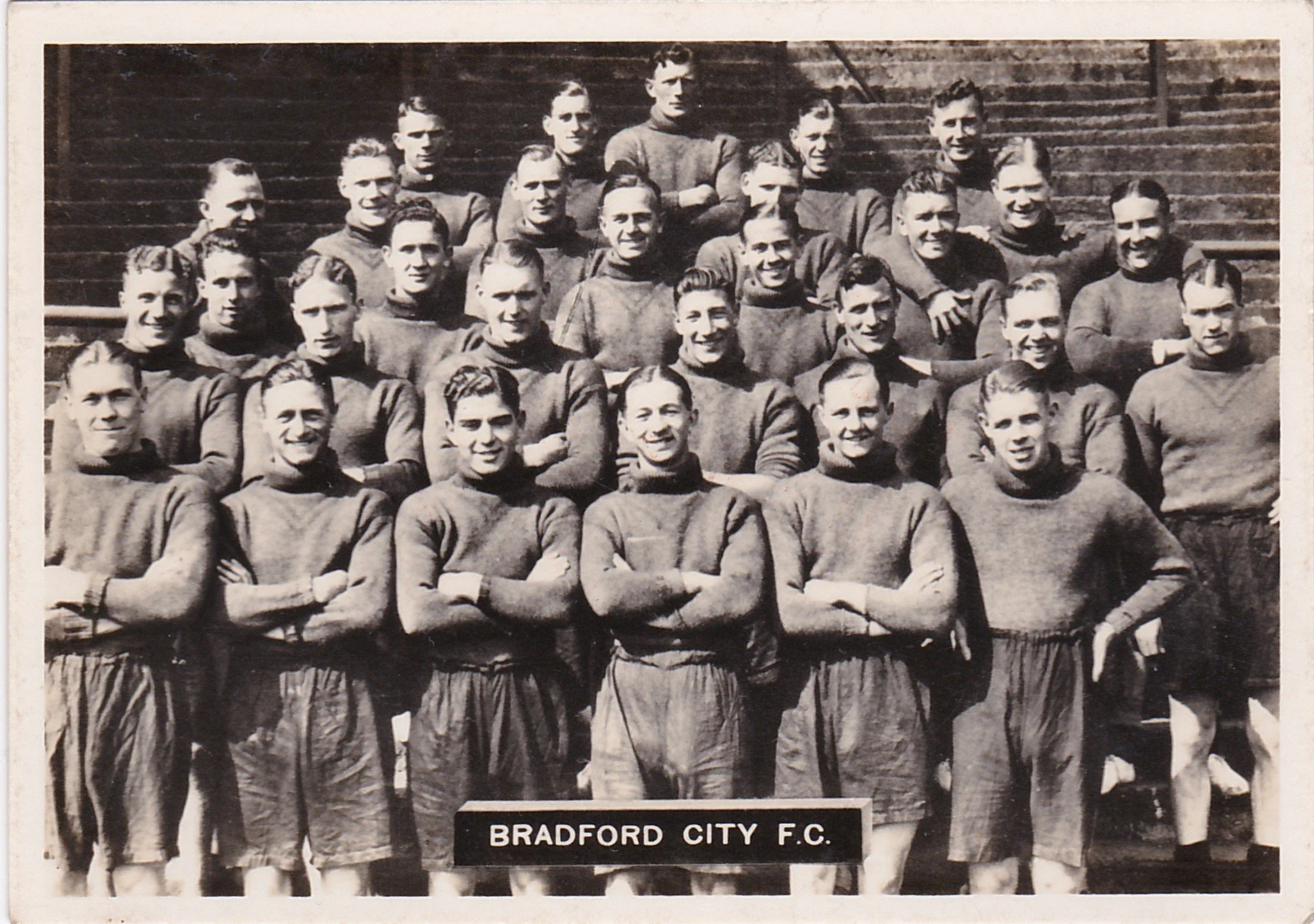
Joe Dalton (second row, fourth from left), Bradford City FC, 1936. Ardath Photo Card (Yorkshire teams series, No. 16). Author's own collection.
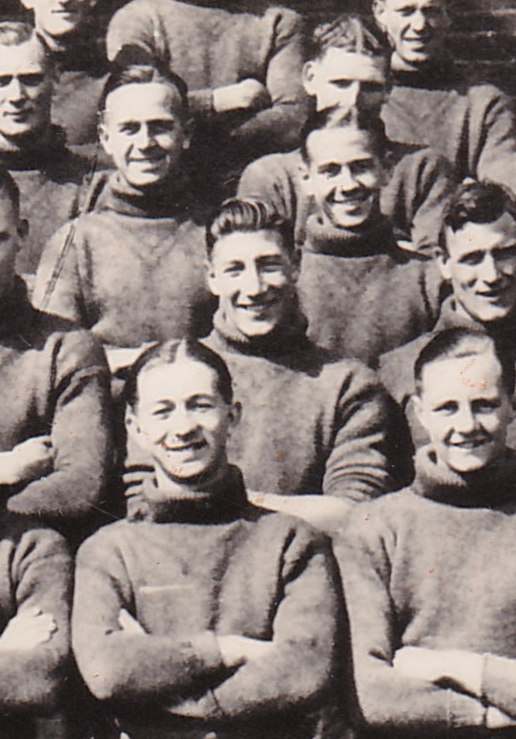
Joe Dalton (centre), Bradford City FC, 1936. Ardath Photo Card (Yorkshire teams series, No. 16). Author's own collection.
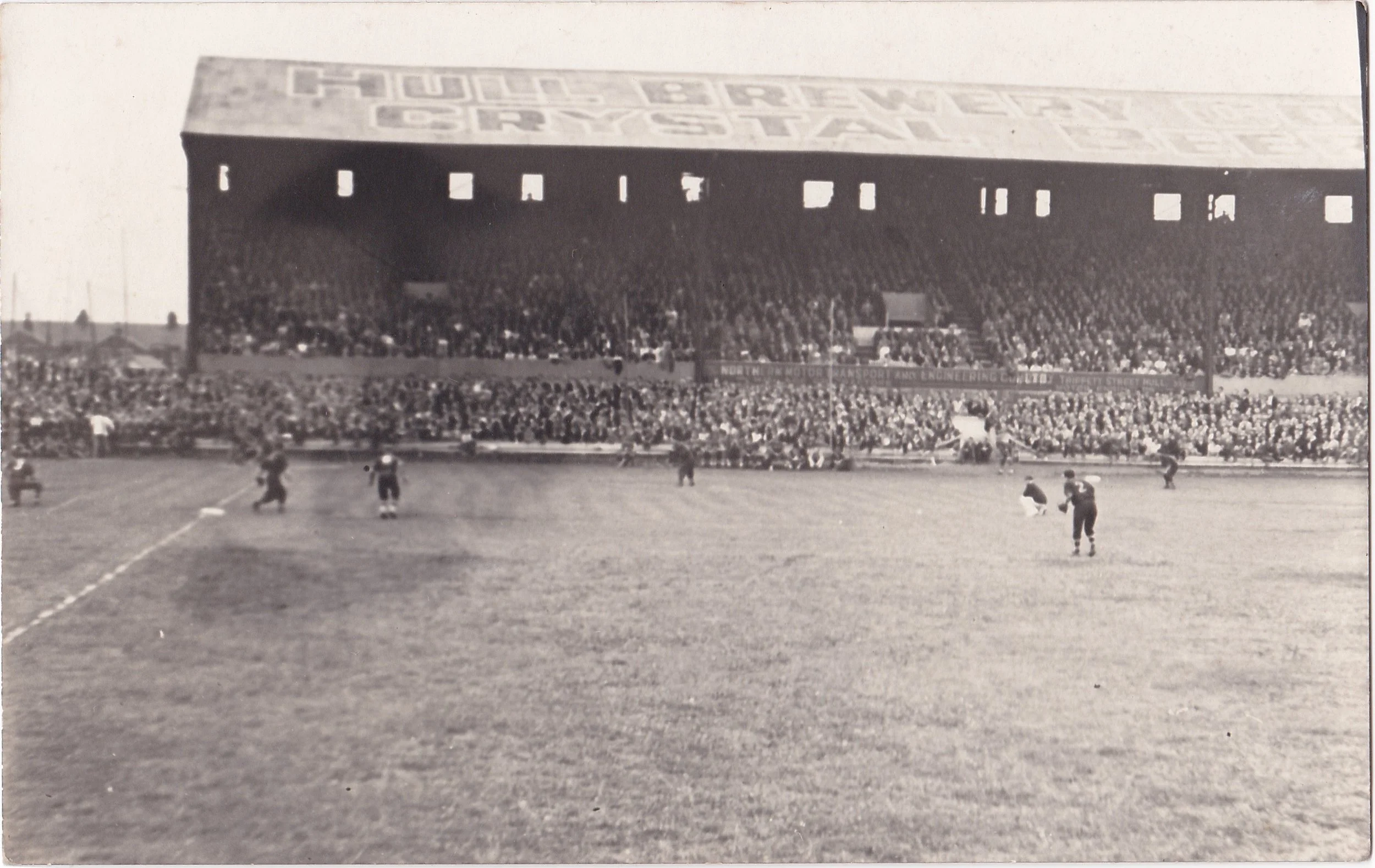
Hull v Romford, 1937 National Challenge Cup Final at Craven Park, Hull. Postcard. Author's own collection.
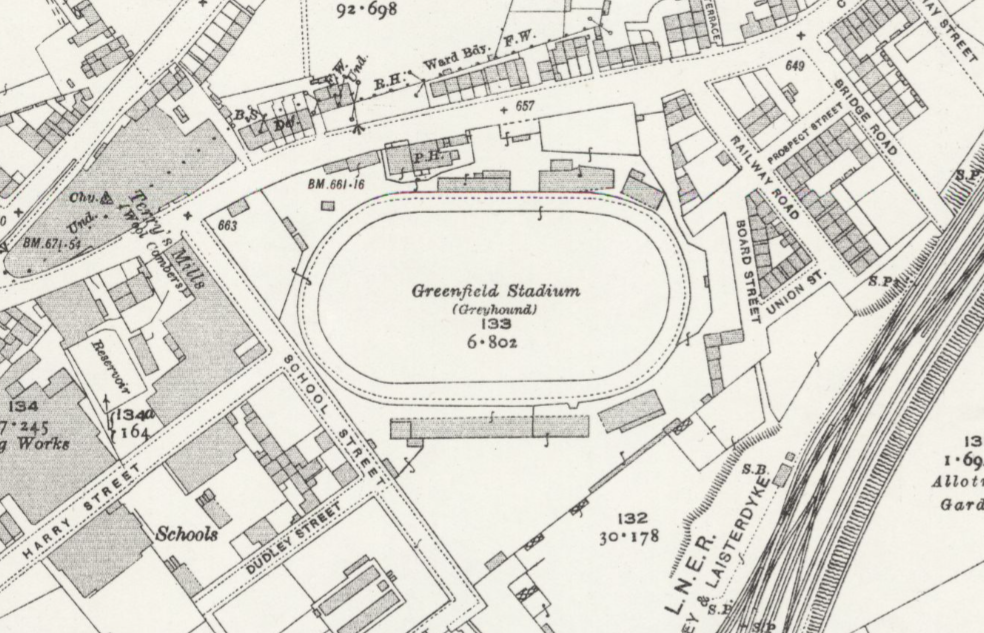
Greenfield Greyhound Stadium, Bradford. Ordnance Survey Map, 1934, accessed via National Library of Scotland: https://maps.nls.uk/os/.
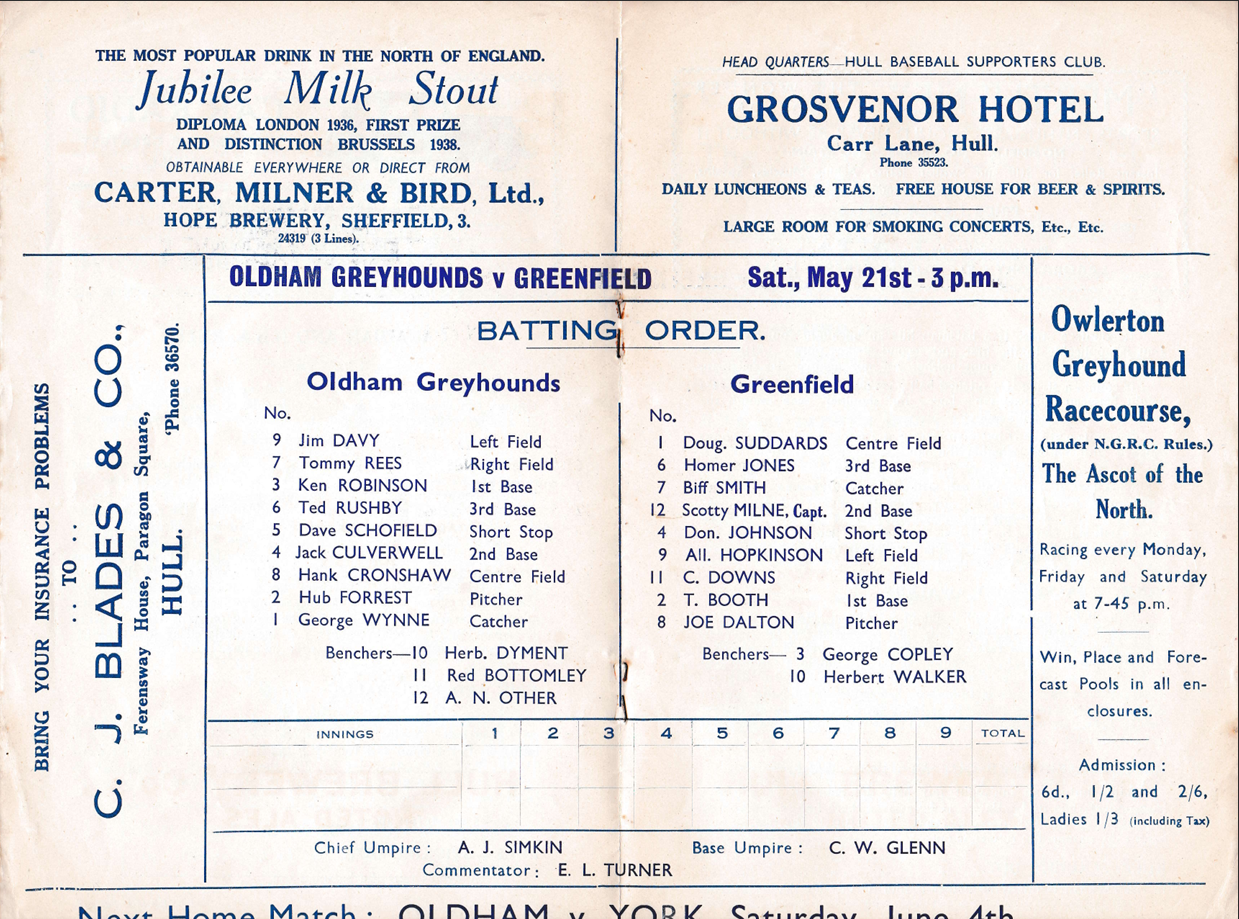
Joe Dalton in the 1938 Greenfield Giants (Bradford) team. Game programme 21 May 1938. Author's own collection.
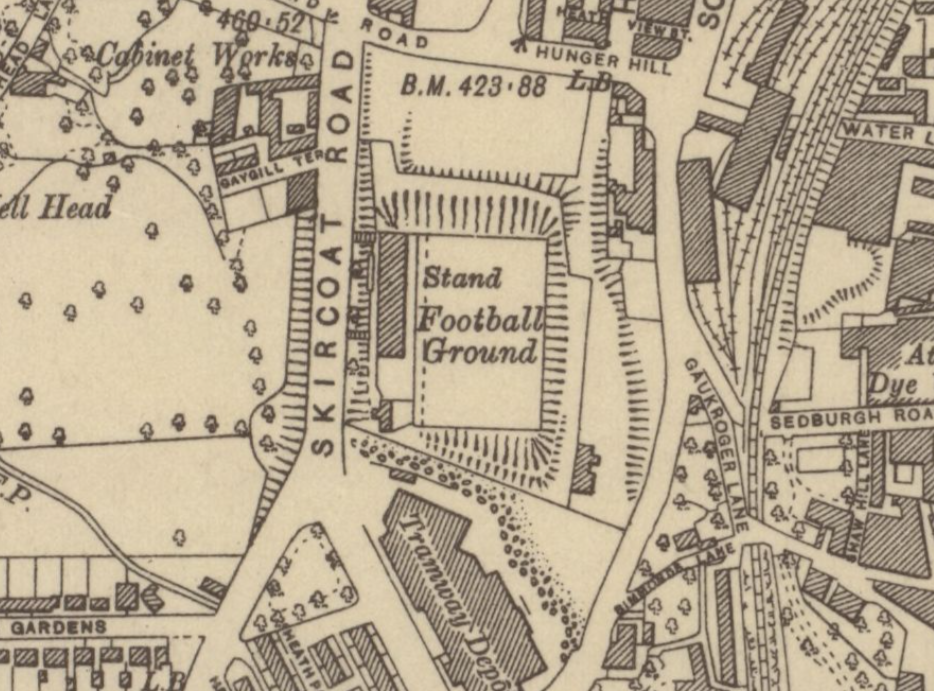
Shay Stadium, Halifax. Ordnance Survey Map, 1934, accessed via National Library of Scotland: https://maps.nls.uk/os/.
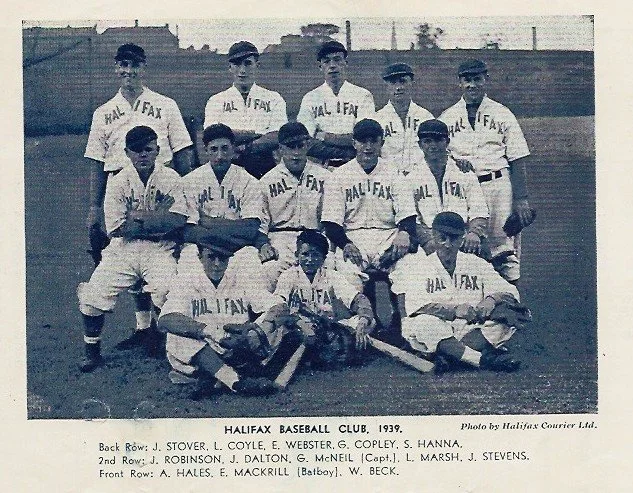
Joe Dalton in the 1939 Halifax team. Game programme, Project COBB.
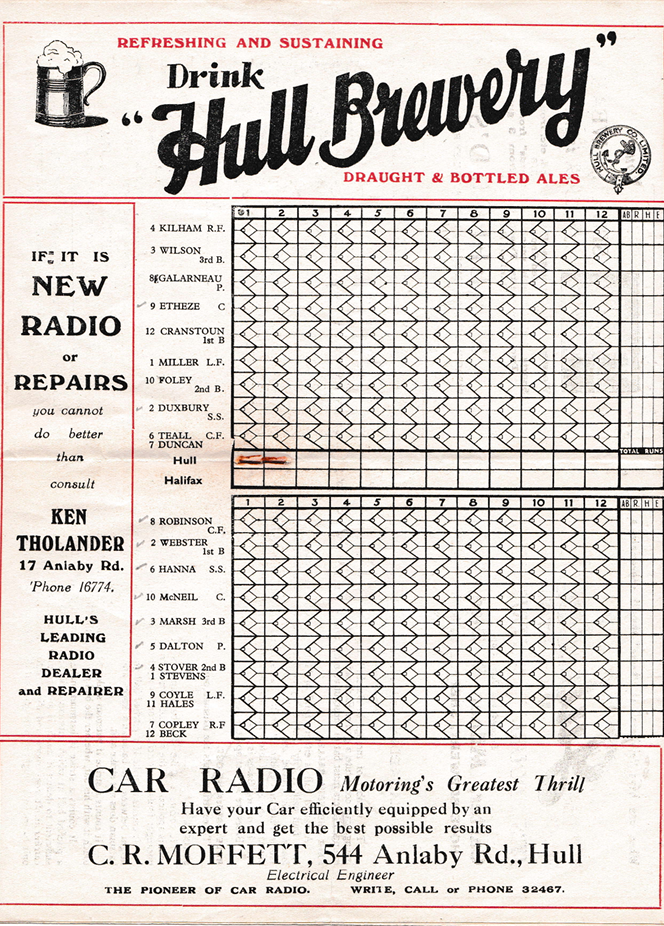
Joe Dalton in the 1939 Halifax team. Game programme, first playoff for 1939 League Championship, 3 August 1939. Author's own collection.
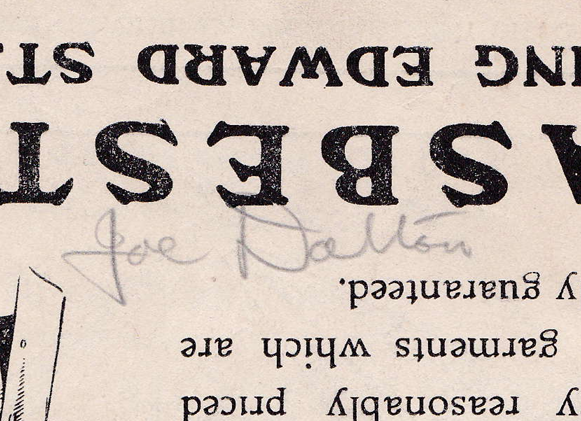
Joe Dalton's signature, game programme, first playoff for 1939 League Championship, 3 August 1939. Author's own collection.
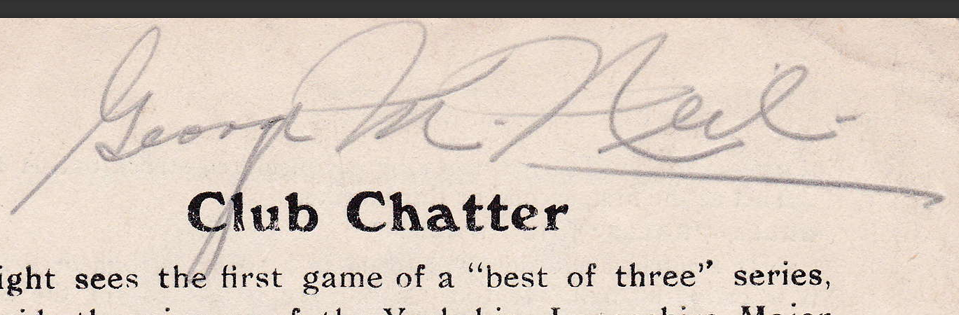
George "Chummy" McNeil's signature, game programme, first playoff for 1939 League Championship, 3 August 1939. Author's own collection.
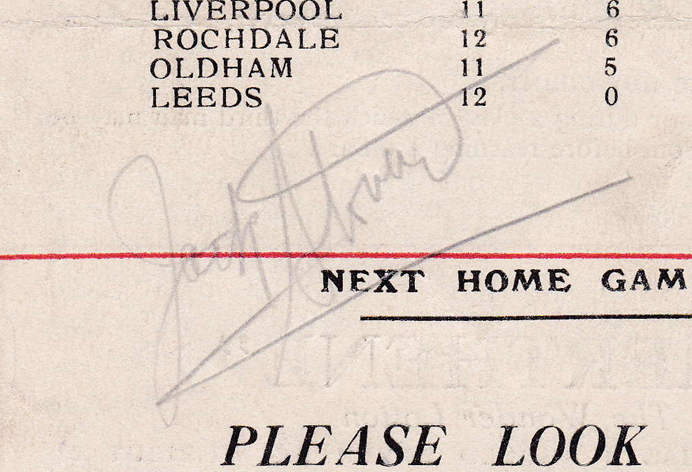
Jack Stover's signature, game programme, first playoff for 1939 League Championship, 3 August 1939. Author's own collection.
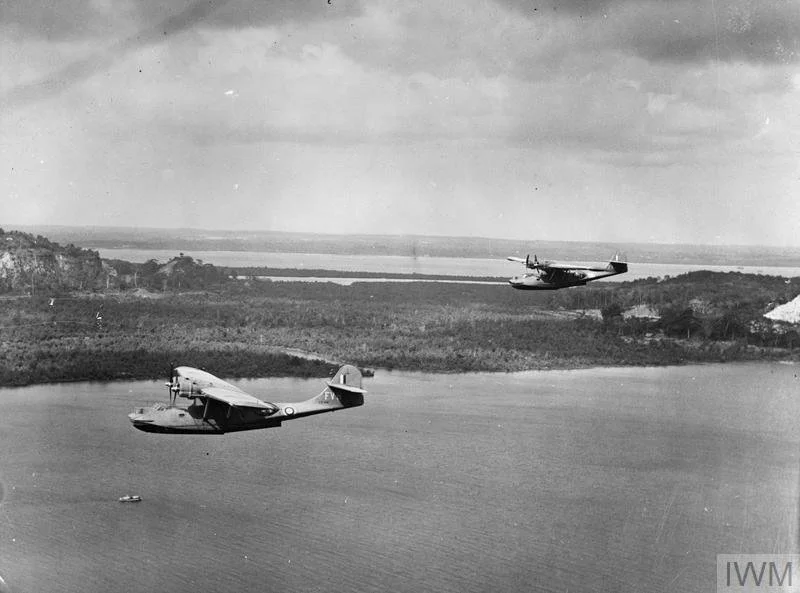
Catalinas of 205 Squadron RAF. Imperial War Museum. Public domain.