On the Etymology of Bat and Ball.
Jamie Barras.
Inverness was reached again close on six o’clock, the party driving through the town, in the course of which they were several times lustily cheered, and made direct for Kessock, where they were taken on board the Racoon, and sat down to a comfortable dinner in the state cabin. At eight o’clock in the evening, the Prince, along with the majority of the officers on board the vessel, manned a gig and crossed to the north side of the ferry, where they engaged in a game at bat and ball within a grass field at the side of Kessock Inn.[1]
Baseball historian David Block devotes a chapter of his 2019 book Pastime Lost to the question of whether “bat and ball”, a phrase that crops up in both British and North American sources in the late eighteenth century, going into the nineteenth century, was intended by those who used it as a synonym for cricket or a reference to a different game with that name. Block’s purpose was to determine if there was any evidence that the old English game of “base ball”, which was played without a bat, the ball being struck with the flat of the hand, at some point gained a bat and was thereafter referred to by some as “bat and ball” and others by the same old name of “base ball”.[2]
For Block, the most compelling evidence for the game-other-than-cricket hypothesis, at least as far as North American usage was concerned, was a reference in a 1778 court martial transcript to a disturbance at a prisoner-of-war camp in Cambridge, Massachusetts, during which British prisoners wielded “clubs designed to play at bat and ball”. As these clubs, as described, bore no resemblance to cricket bats, it seems that they were for a different game, a game that the American camp guards knew as “bat and ball”.
In light of such an analysis, to read in a July 1863 newspaper report of a British royal prince on a tour of Scotland engaging in a “game at bat and ball” is tantalising indeed, particularly as, in one version of the report, “game at bat and ball” was replaced with “game of bat and ball.[3] Even more tantalising is the fact that the prince’s fellow players were the officers of a Royal Navy ship newly returned from a visit to the Americas. Is this the smoking gun showing that American baseball arrived on British shores a good 7 years earlier than previously supposed?[4]
Alas, as I will show below, the evidence argues against it; however, ambiguities remain. And this event represents the first link in a chain of coincidences that connect this royal prince to the story of the involvement of Britain in general and the Royal Navy in particular in the spread of American baseball, something I first explored in The Transit of Venus.[5] I present the story of that July 1863 game at bat and ball here as a companion piece to that latter work and as an example of the challenges of interpreting the often scant accounts of men and women at play with which history has left us.
The Christening of "Prince Alfred." The baptism of his Royal Highness the infant Prince, second son of Her Most Excellent Majesty and his Royal Highness Prince Albert, took place on Friday, in the private chapel at Windsor Castle.[6]
Prince Alfred Ernest Albert (1844–1900), the second son of Queen Victoria and Prince Albert, as is still the way with second sons of British monarchs, was destined for a military career from birth. He duly entered service in the Royal Navy in 1858. Just four years later, it seemed as though his naval career would come to a premature end. In early 1862, the unpopular King Otto of Greece was deposed; in a plebiscite held the same year, Greek voters, keen to ally their nation with the might of the British Empire, chose Alfred to replace Otto over all other options, including becoming a republic. At this point, Great Power politics intervened, with France and Germany both making it known that they opposed the ascension of a British prince to the Greek throne. It is thought that Queen Victoria and Prince Albert were also against it, wishing Alfred to, in time, ascend to the throne of the Duchy of Saxe-Coburg and Gotha, Prince Albert’s familial seat. For appearance’s sake, Alfred was allowed to make a public show of declining the Greek offer. Timeō Danaōs et dōna ferentēs.[7]
Keen to draw a line under the affair, late in 1862, the British government announced that Prince Alfred had been appointed as junior lieutenant to the screw corvette H.M.S. Racoon, under the command of Count von Gleichen.[8] It was at this moment, while at Malta, that Prince Alfred fell ill. It was decided that the Racoon would travel to the Mediterranean to collect Alfred once he had recovered. However, the plan then changed, with Alfred instead making his way back to England in stages to join his new ship there. In the meantime, the Racoon was dispatched on special service to Bermuda.[9]
ANOTHER BLOCKADE RUNNER GOT IN “Charleston, April 13, “A steamship arrived this morning from Bermuda, with a cargo of army equipments, &c., for the government.”[10]
The steamers Cornubia and Beauregard, with 13,000 bales of cotton, arrived at Bermuda on the 23rd from Southern ports.[11]
The schooner Laura Ann, which arrived at Bermuda on the 24th ult., was boarded on the 21st ult. by the Florida, and received on board the crew of the ship Star of Peace, 980 tons, which vessel the Florida had recently captured and destroyed. The Star of Peace was on her way to Boston from Calcutta, laden with saltpetre, hides, and wool.[12]
As the above quotes show, by April 1863, the month that the Racoon was ordered to Bermuda, the island had become a major base for Confederate commerce raiders and blockade runners, second only to Nassau in the Bahamas. Although most blockade runners were British-built, had British crews, and were commanded by Royal Navy officers on half pay, Bermuda was awash with Americans from both sides of the conflict: freebooters, merchants, smugglers, spies, and sailors from Union vessels captured by Confederate raiders awaiting a berth on a ship to take them home.[13]
The Racoon’s time at Bermuda was brief; she arrived on 14 April 1863, left on 10 May, and by 29 May, was back in England, where she found Prince Alfred waiting for her.[14] However, this was time enough for members of her crew to have seen the island’s American residents at play. As we will see, in common with the officers of most ships of Her Britannic Majesty’s Navy, the Racoon’s officers had a keen interest in bat and ball games. Is it really so outrageous to suggest that they witnessed American baseball on Bermuda and were intrigued sufficiently to take the game back to Britain with them? As I detailed in The Transit of Venus and as we will see later in this piece, the idea of Royal Navy officers trying their hand at American baseball is not the least bit outrageous; it happened, and within a few years of Racoon’s Bermuda cruise. This, more than anything else, is what is so tantalising about that July 1863 game at bat and ball at Kessock Inn.
To this can be added that, as David Block points out in Pastime Lost, it is possible to find in this period instances of cricket and “bat and ball” being mentioned together as two separate sports.
BRITISH SCHOOL TREAT.—On Friday last, upwards of 80 of the boys of the British School went to Ashridge park, first proceeding by rail to Tring. During the day, which happy to say was a very favourable one as to the weather, the boys enjoyed themselves much, some at bat and ball, cricket, foot-ball and other games[…][15]
However, against this interpretation of the identity of the Kessock Inn “game at bat and ball” are two damning pieces of evidence. The first is the context in which the game was played. For all that cricket and “bat and ball” can be found together as separate sports, reading of a game “at bat and ball” in Britain in the mid-nineteenth century immediately puts one in mind of a poetical reference to a game of cricket, as testified by the number of public houses directly linked to the game that adopted the name “The Bat and Ball” in this period. One such pub, still in existence, is the Bat and Ball Tavern, Gravesend, Kent, which stands opposite the cricket ground from which it took its name.[16]
At first glance, the latter example would seem not to be the best one to use, as the Bat and Ball Cricket Ground at Gravesend was where the first game of American baseball known to have been played in England was played. However, I use it because that game, which was played on 12 June 1871, was between two teams formed of members of the Sheridan Base Ball Club of Ithaca, Michigan, then serving on the U.S.S. Franklin.[17] This allows me to make an observation that I will expand on later in this piece: in any port where the Royal Navy played cricket, there was an opportunity for the US Navy to play baseball, and by extension, for the two to play each other at both games.
But to return to the second and most damning piece of evidence against the idea that the “game at bat and ball” at Kessock Inn was not cricket, we can point to at least some of the officers of the Racoon playing cricket during their tour of Scotland. This was at Stromness on Orkney, just two weeks after the game at Kessock Inn.
In the morning the topgallant masts were again run up and the vessel put into ship-shape order, and the first motion which the inhabitants of Stromness looked for was to see the vessel steaming out of Hoy Sound towards the Atlantic. Symptoms of no immediate departure, however, began to appear by the boats being lowered and lying alongside and astern, and soon they were manned and in motion, conveying officers—some of them to the outer Holm, where they engaged themselves with a game at cricket—while others came into the town, and visited the Museum, and other objects of attraction.[18]
We would need a good reason to suppose that men who played a bat-and-ball game on one day played a different bat-and-ball game two weeks earlier, and the only reason we have for supposing that is that the word “cricket” was not used in the report on the earlier game. We can also point to at least one other instance of the officers of the Racoon dropping everything to play a game of cricket in an unlikely location. This was in Norway, a year after the Racoon’s Scottish cruise.
On the 15th the Racoon sailed from Alten, and the 16th and 17th were spent at Tromsø, where a ball was improvised on board the Racoon, which brought out an amount of beauty that few were prepared for, and left a lively remembrance on both sides. A cricket match was played in the Loffoden, at the foot of Vaagekaller, the highest mountain of that wild range, while the Prince was shooting at Steilo.[19]
We have, with reluctance, to conclude that, for all the ambiguities of phrasing and possibilities raised by the Racoon’s cruise to Bermuda, in all probability, that “game at bat and ball” at Kessock Inn was a game of cricket. The introduction of the American game of baseball to Britain would have to wait another 7 years—albeit moving just 10 miles to the north.[20]
However, this is just the first link in the chain of coincidences that connects Prince Alfred to the spread of American baseball. The second is on much firmer ground.
AN INTERNATIONAL MATCH.—A match played between an American and English nine, at Rio Janeiro, on the 30th of July, was witnessed by an immense concourse of spectators, including many distinguished personages; among others, Prince Alfred of England, and his suite; also, many richly attired ladies. The contest was a splendid yet stubborn one; it finally resulted in the success of the Yankees, in a score of 11 to 9. The utmost good feeling prevailed throughout; and in the evening, a grand ball and supper was participated in at the American Hotel, where both parties toasted, and were highly complimentary to each other. Mr. McGowan, formerly pitcher in the Athletic Club, of Harlem, played his old position in this international affair.[21]
A private letter from Mate G. Lewis McGowan, of the United States steamer Oneida, dated Rio Janeiro, July 31, gives an account of a base ball match between selected nines from the two nationalities, which came off on the 30th of July.[22]
In February 1867, the now Captain Prince Alfred, Duke of Edinburgh, took command of the H.M.S. Galatea and set off on what was intended to be a 2-year, round-the-world voyage. That voyage was to extend to 4 years after Alfred stepped in front of a would-be assassin’s bullet in Australia in March 1868, necessitating a temporary return to England for recuperation.[23]
The afternoon of 15 July 1867 saw the Galatea entering Rio de Janeiro harbour for what was to be eight busy days of receptions, balls, and naval salutes before her departure on 23 July. Already in harbour were a number of ships of the Royal Navy’s South America station and the US Navy’s South Atlantic Squadron. On 20 July, these vessels were joined by the U.S.S. Oneida, which was bound for the Pacific and service with the US Navy’s Asiatic Squadron.[24]
On board the Oneida was New Yorker G. Lewis McGowan, who, on the Oneida’s arrival in East Asia, would be transferred to the U.S.S. Maumee. This transfer likely saved his life. On 24 January 1870, as she left the port of Yokohama, the Oneida collided with the British passenger steamer, the Bombay. The Bombay sailed on in the mistaken belief that it had been a glancing blow, and the Oneida was as lightly damaged as the Bombay was. In fact, the American vessel had received a mortal wound and sank within 15 minutes, taking 115 members of her crew down with her. This now-forgotten tragedy caused a huge diplomatic row at the time, as rival British and American boards of enquiry arrived at opposite conclusions as to which ship’s officers were responsible for the disaster.[25]
If G. Lewis McGowan is to be believed, while at Rio, he pitched for an American nine against a British nine in a game watched by Prince Alfred. While the origins of the players of these two teams are not mentioned in newspaper accounts, we can suppose, given the presence of McGowan in the team, that the American nine was formed of US Navy sailors. We can reasonably assume that the British nine was, similarly, formed of Royal Navy sailors. As I detailed in The Transit of Venus, games of baseball between Royal Navy and US Navy teams were not unheard of in this period. We can also say in support of McGowan’s account that there was a Harlem Base Ball Club in existence in this period, albeit not formally known as the Athletic Club at the time,[26] and, so, it was possible that McGowan, as a New Yorker, was a member. However, beyond this, his account requires careful parsing.
Let us start with the date. This game reportedly took place on 30 July. However, as we have already seen, Prince Alfred and the Galatea left Rio on 23 July, a full week earlier. Thus, if this date is correct, then Prince Alfred could not have been one of the spectators. If we are to suppose the game took place at all, and 30 July is the correct date, then this latter detail must have been an embellishment added by McGowan, which must cast into doubt other elements of the account.
However, it is worth exploring an alternative explanation: that McGowan or the US newspapers got the date wrong. The Oneida arrived in Rio three days before the Galatea left, a narrow window of opportunity, but it is conceivable that the game actually took place on 21 or 22 July. Our accounts of the Prince’s visit to Rio, while rich in detail on how the Prince spent his mornings and evenings (paying courtesy calls and attending balls, respectively), do tend to skip how he spent his afternoons. We know from a subsequent account, detailed below, that Captain Creighton of the Oneida was one of the American officers who dined with Prince Alfred while at Rio. Tantalisingly, on 21 and 22 July, Prince Alfred stayed at the Palace of Princess Isabel, Countess d’Eu, heir to the Brazilian throne. This is of interest to us here, as the grounds of the Princess’s palace were where Rio’s British residents played their cricket.[27]
CRICKET. Rio British Cricket Club v. Eleven Men of H.M.S. Narcissus,— A cricket match was played between two elevens at Rio Janeiro on the 26th of June last, resulting in the victory of the landsmen by 30 runs.[28]
As we have already seen, cricket and the Royal Navy went hand-in-hand in this period. The role that the Royal Navy played in spreading cricket around the world is well known, with, for example, the first documented matches in countries such as Japan and Fiji being between Royal Navy teams and landsmen in 1863 and 1874, respectively. It should come as no surprise that it was a similar case with baseball, with, for example, the first recorded baseball game in Japan being between a US Navy team and a team of landsmen in 1871. The needs of baseball and cricket for a level playing field align; generally, where one can be played, so can the other (pace the size of the outfield). This has meant, as I observed above in reference to the 1871 Gravesend game, and previously documented in The Transit of Venus, that, where the British played cricket, opportunities arose for Americans to play baseball, and, by extension, for the two to play each other at both games.[29]
In short, whether the McGowan game happened on 30 July or a week earlier, in front of Prince Alfred or otherwise, the presence in Rio of both American and British ships and the existence of a cricket ground in the city presented all the elements needed for the two navies to be able to take to the playing field against each other. This supports the idea that McGowan was at least telling the truth about the game taking place. However, this does still leave us with one problem with McGowan’s account: why is there no mention of cricket?
When H.M.S. Scout took on the U.S.S. Pensacola and Omaha at Coquimbo, Chile, in 1873, and the U.S.S. Benicia at Honolulu, Hawaiʻi, in 1874, the contests comprised games of both baseball and cricket. When an “all-star” English cricket team toured the US and Canada in 1868, it also played baseball against local nines. On their tour of England 6 years later, the Boston Red Stockings and Philadelphia Athletics staged exhibition games of baseball and played cricket against the M.C.C. and other teams. There were also tours during which only one game was played—the 1872 M.C.C. tour of America, for example—and this would become the norm in later decades; but for much of this period, if only for reasons of national pride, when US teams met British teams on the playing field, both national pastimes were played. The result was usually a win at baseball for the American team, a win at cricket for the British. Not coincidentally, in this age of Great Power politics, this meant honours were even, and everyone went home happy.[30]
(As an aside: to return to an earlier question of mine: an American team meeting an English team is a good reason for a team to play one bat-and-ball game one day and another a few days, or weeks, later. Alas, these are not the circumstances that confronted the Racoon in 1863.)
It seems highly improbable that if American and English teams met each other on a playing field in Rio de Janeiro in July 1867, only the American game was played, especially as the most likely venue for such a contest would be a ground used by one of Rio’s British cricket teams. Where is the report of the cricket match to go alongside that of the baseball game? Would we be right in suspecting the whole of McGowan’s account because of the lack of any mention of cricket? Perhaps, but perhaps the real reason for this lack is to be found in the most likely result of such a match: a victory for the English eleven. McGowan was writing for a US readership, as were the newspapers that published his account. It is possible that a cricket match did take place, but either McGowan left that fact out of his letter, or the US newspapers chose not to include that part of his account in their reports because the English eleven team thrashed the American eleven.
For my part, I am inclined to believe that there was a game of baseball played between American and British sailors in Rio in late July 1867, and the two teams also played each other at cricket on the same day or the day preceding or following. The most likely venue for these games was one of Rio’s cricket grounds, possibly the grounds of Princess Isabel’s palace. It is possible that the game(s) took place while Prince Alfred was staying at the palace, and he was one of the spectators. However, I am inclined to believe that they took place on 30 July, as reported, after Alfred and the Galatea had left Rio, and his presence in the crowd was an embellishment by McGowan.
In short, we have in the events of July 1867, our second “near miss” between Prince Alfred and American baseball.
The final links in the chain of coincidences that connect the Prince to the sport take us back to England, but not before a diversion to first the Cape of Good Hope and then on to Australia.
In the bay float several British men-of-war, among which we recognise the Galatea, which acknowledges the command of Prince Alfred—otherwise known as Duke of Edinburgh. We met last at Rio, and he has preceded us in the voyage east.[31]
After she departed Rio de Janeiro in late July, the Galatea continued her leisurely journey toward Australia (and Alfred’s rendezvous with a would-be assassin). Arriving at the Cape of Good Hope via Tristan da Cunha on 15 August, Alfred found a familiar sight waiting for him in Simon’s Bay: his old ship, the Racoon. During his stay at the Cape, he took a break from shooting elephants long enough to go on a short cruise with his old shipmates.[32]
While Alfred was absent, the officers of the Galatea played at least one game of cricket against the Cape Town garrison. There was also a further arrival in the harbour, another ship familiar to Alfred, although this one was only of recent acquaintance: the Oneida, continuing on her way to East Asia. On his return to the Cape, Alfred visited the Oneida and twice dined with Captain Creighton. Alas, there is no indication that any sport was in the offing, although one of the Oneida’s officers remarked in a letter to the New York Times that on one excursion, he and his fellow officers “passed grove after grove where cricketers were displaying their skill”. Ah, what could have been! It would be another 16 years before the first recorded game of baseball would be played in Cape Town—inevitably between a US Navy team and landsmen.[33]
The Galatea set sail once more in mid-September and finally arrived at Adelaide on 31 October 1867. This was the start of five months of fetes, balls, salutes, and hunting trips up and down Australia’s east and southeast coasts. At Hobart, in January, the officers of the Galatea again found time to play cricket. More significantly for the history of the sport, at Sydney, a month later, in honour of the Prince’s visit, a combined team of Army and Navy officers took on the “Aboriginal Black Eleven”, a team of indigenous players assembled for what, later that same year, would become the first tour of England by an Australian national cricket team.[34]
It is, however, a more mundane bat-and-ball game that was a feature of the tour that is of greatest interest to us.
The Prince Alfred Reception Committee at Hobart Town have arranged for a day’s popular games in the Domain during the stay of the Prince. There will be six flat races, three hurdle races, two sack races, two wheelbarrow races, a blindfold race, a quoit match, a game of rounders[...][35]
‘Rounders’ was the name by which, by the 1860s, the game otherwise known as “bat and ball” or “base ball” was known in most parts of Britain and her Empire. As the name did not appear until 1828, long after “bat and ball”/“base ball” had migrated across the Atlantic, in the view of modern baseball historians like David Block, rounders did not beget American baseball; instead, the two games share the same immediate ancestor, old English “base ball”. However, as rounders was the name by which the base-running, bat-and-ball game prevalent in Britain was known when American baseball teams first toured Britain in 1874, many native observers dubbed American baseball simply a development of rounders. As this was also the view—minus the slights—of “the father of baseball”, Henry Chadwick, expressed in print as early as 1860, this was to lead to a patriotic push by American devotees of the game to find a native origin, to the detriment of baseball scholarship.[36]
It is not known if Prince Alfred got to see that game of rounders laid on in Hobart in 1868 in his honour—he never got to spend long in any one spot—however, his name would be forever associated with the sport after his return to England. The ground for this was laid the year before he set off on his round-the-world cruise in the Galatea.
VISIT OF PRINCE ALFRED TO LIVERPOOL.—His Royal Highness the Duke of Edinburgh arrived at Broad Green Station on Tuesday night about half-past six on a visit to Mr. S.R. Graves, M.P. of Wavertree Grange. Triumphal arches and other signs of welcome greeted the royal guest on his way from the station through Wavertree to the Grange.[37]
Wavertree Grange stood on the grounds of a 104-acre green space that is now officially known as Wavertree Sports Park but informally as “The Mystery”. It acquired the latter name due to the identity of the benefactor who donated the space to the community being unknown for many years afterwards. Following Alfred’s visit, the road that ran along the eastern edge of the Mystery was renamed “Prince Alfred Road” in his honour (as its previous name was “Cow Lane”, we can see why Mr. Graves, M.P., was keen to encourage the change).[38] We will return to the Mystery later.
Alfred’s 1866 visit to Liverpool, his third in 15 years, was to form a lasting kinship between the city and the monarch’s second son, strengthened by Alfred’s career as a naval officer, which resonated with the people of this port city. Thus, it was no surprise that, when a club formed in the city to promote the playing of the games of rounders and quoits as competitive sports for adults in 1873, the year that Alfred married, it took the name The Duke of Edinburgh Rounder and Quoit Club.[39]
Attempts to turn rounders into a competitive sport for adults in England dated back to 1864, with the founding of the City of Bristol Rounder Club.[40] It is no coincidence that Liverpool and Bristol are both port cities on the west coast of Great Britain—as was the third city in which rounders was played competitively in this period, Cardiff. We can see in moves to elevate rounders to a competitive sport attempts to emulate the success of American baseball, accounts of which would have been plentiful in the ports of Britain’s west coast, the bulk of whose trade was with the Americas. (For better or ill: Bristol and Liverpool both grew rich on the transatlantic slave trade; they are today wrestling with this legacy.[41])
This link with baseball was made explicit when the Liverpool Rounders Association (LRA), founded on the back of the spread of the sport across the city, codified its first set of rules in 1883. In communicating these rules to the press, the LRA stated that they were “mainly founded on a very popular American game called Base Ball”.[42]
Although this is not the place to detail the growth and development of rounders as a competitive sport in the 1880s, or the differences between its code and that of American baseball, something I have done elsewhere,[43] of interest to us here is the clashes between the sport and proponents of American baseball in Britain in the early 1890s. These clashes grew out of the first serious attempt to establish American baseball as a professional sport in Britain, which itself was a development of the Spalding 1888–1889 world baseball tour, which reached the British Isles and Ireland in the spring of 1889. During the visit, the American tourists played a Liverpool rounders team at rounders and baseball. Although this has obvious echoes of the cricket and baseball pairing of earlier decades, these games had a very different purpose: to demonstrate the superiority of one code over the other with the aim of eliminating the “losing” code from the “competition”. As ever, each side won its own game, although, in this case, this made no one happy.
Events came to a head three years later, when, to the shock of the American baseball proponents, the National Rounders Association (NRA) renamed itself the “English Baseball Association” (EBA), laying claim to the name “baseball” on the grounds that their sport was the original “base ball”. This was a defensive move on the part of the NRA, as the name “rounders” carried with it the dual connotation of being a children’s pastime and the “crude” progenitor of the more “scientific” American baseball, something that the NRA felt impeded the spread of the sport (i.e., no-one took the idea of grown men playing rounders seriously).[44]
Alas for the EBA, it was never able to grow beyond the three original centres of attempts to turn rounders into a competitive sport, Liverpool/Lancashire, Cardiff/South Wales, and Bristol/Gloucestershire. However, it was to take deep root in the first two, far deeper than American baseball was able to manage anywhere in the British Isles and Ireland. This was to have a profound effect on the most serious attempt to establish American baseball in England, the 1930s attempt mounted by John Moores.
John Moores was a Liverpool businessman. He was not only familiar with English baseball, thanks to Liverpool being one of its two heartlands, he was also an ambassador for the game. In 1933, he travelled to America on business and carried with him a letter from English Baseball proponents in Liverpool addressed to heads of the American professional baseball leagues and proposing an international test series between English, American, and Irish teams. In the event, Moores was so dazzled by what he saw of American baseball in its home country that he returned to Liverpool convinced that this was the version of the game that should be played in Britain, too.[45]
Moores was unable to convince Liverpool’s English Baseball fraternity as a whole to switch codes; however, he was able to win enough clubs and individual players to his side to form the first of what would go on to become a nationwide association of amateur and professional/semi-professional American baseball leagues. Liverpool would be a stronghold of the American game in England from this point forward. As a marker of this, in 1937, Moores’ National Baseball Association (NBA) created the North of England’s first stadium with a skimmed diamond in the city.[46] The location for that stadium? The Mystery in Wavertree, the green space in whose grounds once stood the house where Prince Alfred stayed on his 1866 visit to the city.
At eight o’clock in the evening, the Prince, along with the majority of the officers on board the vessel, manned a gig and crossed to the north side of the ferry, where they engaged in a game at bat and ball within a grass field at the side of Kessock Inn.[47]
Alfred, Duke of Saxe-Coburg and Gotha, died at his ducal seat on 30 July 1900, aged just 55. As a sportsman and officer in the Royal Navy active in the mid-nineteenth century, it is no surprise that his story intersects with that of the spread of American baseball across the world. As I hope I have shown, where the Royal Navy went, cricket went, and this set up conditions that eased the adoption of American baseball in the far-flung places of the earth. However, as I hope I have also shown, it is remarkable just how many links there are in the chains of coincidence that link Alfred to the spread of American baseball, albeit fueled, in part, by the ambiguities of the scant references to men and women at play with which history has left us.
I, for one, am convinced that the exploration of the careers of Royal Navy officers like Prince Alfred will throw up more instances of British involvement in the spread of American baseball. It may perhaps even one day lead us to establish an earlier date for the introduction of the American game into Britain than the current one of 1870. Alfred has, I believe, shown us the way.
Jamie Barras, March 2026.
Back to Diamond Lives
Notes
[1] ‘Prince Alfred on his Cruise’, Aberdeen People’s Journal, 11 July 1863. Kessock Inn and North Kessock: https://www.undiscoveredscotland.co.uk/northkessock/northkessock/index.html, accessed 1 March 2026.
[2] David Block, “Chapter 6: Bat, Ball, and Beyond” in “Pastime Lost: a” (Lincoln: University of Nebraska Press, 2019).
[3] ‘Prince Alfred’s Visit’, Fifeshire Journal, 9 July 1863.
[4] At the time of writing (March 2026), the earliest known game of American baseball, which is to say the game played under rules written down in New York in the 1840s, played in Britain was that played at Dingwall, Ross-shire, in July 1870: ‘Dingwall—Base Ball’, Inverness Advertiser and Ross-shire Chronicle, 19 July 1870. I tell the story of that game here: https://www.ishilearn.com/diamond-lives-the-dingwall-game, accessed 1 March 2026. The credit for the discovery is shared by Bruce Allardice of the Protoball Project and a team of UK researchers led by Joe Grey. Coincidentally, Dingwall is just 10 miles from North Kessock, the location of the Prince’s July 1863 “game at bat and ball”.
[5] https://www.ishilearn.com/diamond-lives-the-transit-of-venus, accessed 1 March 2026.
[6] ‘The Christening of Prince Alfred’, Weekly Chronicle (London), 8 September 1844.
[7] Entry for Prince Alfred Ernest Albert, Encyclopædia Britannica, 11th Edition (Cambridge: Cambridge University Press, 1911).
[8] Von Gleichen, more properly Prince Victor Ferdinand Franz Eugen Gustaf Adolf Constantin Friedrich of Hohenlohe-Langenburg, was a close relative of the royal family, being the son of Queen Victoria’s half-sister: https://www.pdavis.nl/ShowBiog.php?id=1417, accessed 1 March 2026.
[9] ‘Racoon’, Naval & Military Gazette and Weekly Chronicle of the United Service, 18 April 1863. There was a suggestion that this late-stage change in mission was some kind of “punishment” handed out to Count Von Gleichen for some offence: ‘The Racoon’, Portsmouth Times and Naval Gazette, 4 April 1863. However, it is hard to see how Alfred would be entrusted into the care of an officer out of favour with the Lords of the Admiralty.
[10] ‘America’, London Evening Standard, 30 April 1863.
[11] ‘America’, Leeds Mercury, 16 April 1863.
[12] ‘America: The Civil War’, Manchester Courier, 18 April 1863.
[13] https://web.archive.org/web/20150330233650/http://www.nps.gov/history/CRMJournal/Summer2007/reviewbook4.html, https://www.usni.org/magazines/naval-history/2024/october/business-blockade-running, accessed 1 March 2026. One such Royal Navy officer on half pay commanding a British-built blockade runner was Ralph Peter Cator, future captain of the H.M.S. Scout: see Note 5 above.
[14] ‘The West India Squadron’, Hampshire Telegraph and Naval Chronicle, 16 May 1863; ‘Naval and Military’, Western Daily Gazette, 28 May 1863; ‘Portsmouth’, Portsmouth Times and Naval Gazette, 30 May 1863; ‘Prince Alfred—Portsmouth—May 11’, Reading Mercury, 16 May 1863.
[15] ‘British School Treat’, Leighton Buzzard Observer and Linslade Gazette, 22 September 1863.
[16] http://www.dover-kent.com/2014-project-c/Bat-and-Ball-Gravesend.html, accessed 1 March 2026.
[17] ‘A Game of Base Ball’, Gravesend Reporter, 17 June 1871. The report describes baseball as “merely an elaboration of the well-known game of “rounders””.
[18] ‘Prince Alfred at Stromness’, Orcadian, 21 July 1863.
[19] ‘Prince Alfred in Norway’, York Herald, 10 September 1864.
[20] See Note 4 above. North Kessock is just 10 miles from Dingwall; history is, of course, full of remarkable coincidences like this.
[21] ‘An International Match’, New York Sunday Mercury, 15 September 1867. Quoted here: https://protoball.org/In_Rio_de_Janeiro_on_30_June_1867, accessed 1 March 2026. “30 June 1867” appears to be a typo.
[22] ‘A private letter…’, Philadelphia Enquirer, 14 September 1867.
[23] https://www.pdavis.nl/ShowShip.php?id=85, https://dictionaryofsydney.org/entry/assassination_attempt_on_prince_alfred_1868, accessed 1 March 2026. Henry O’Farrell, the would-be assassin, who may not have been in his right mind, was swiftly tried and, controversially, just as swiftly executed.
[24] The account of Galatea’s visit to Rio is taken from: ‘His Royal Highness the Duke of Edinburgh at Rio Janeiro’, The Times, 23 August 1867; ‘Reception of Prince Alfred at Rio Janeiro’, Washington Chronicle, 4 September 1867. Oneida at Rio: ‘Naval’, New York Tribune, 4 September 1867; ‘Naval Intelligence’, New York Times, 2 September 1867.
[25] McGowan joins the Oneida: ‘Navy Bulletin’, Philadelphia Enquirer, 10 May 1867. McGowan, New Yorker, and assigned to Maumee (name recorded as “G.L. McGowan”): Register of the Commissioned, Warrant, and Volunteer Officers of the Navy of the United States, 1869 Edition. USS Maumee: https://www.civilwar.com/history/order-of-battle/union-forces-31893/union-navy/146910-maumee-1864-1869.html, accessed 1 March 2026. Online resources that I have consulted put the end of the Maumee’s service at 1865, and record her as then being sold in Hong Kong in 1869 without comment. We can point to the reference above and news reports to show that, in fact, she was part of the Asiatic Squadron up until the end of 1869, which is how she came to be sold in Hong Kong: ‘Naval Matters’, New York Tribune, 23 December 1869.
[26] ‘Mutual v Harlem’, New York Herald, 27 August 1866. This game took place on the Harlem Club grounds at Mount Morris Square.
[27] Alfred’s movements: Note 24 above. Princess Isabel and cricket in Rio: https://cricketbrasil.org/en/our-history/, accessed 1 March 2026.
[28] ‘Sporting Intelligence’, Western Morning News, 6 August 1867.
[29] Mike Galbraith, https://galbraith.press/death-threats-sparked-japans-first-cricket-game-the-japan-times/, https://randomthoughtsoncricket.home.blog/, Mike Galbraith, https://galbraith.press/legendary-1896-ycac-vs-ichiko-baseball-games/, accessed 2 March 2026.
[30] Note 5 above, and: John Thorn, https://ourgame.mlblogs.com/american-cricket-in-the-1860s-decade-of-decline-or-new-start-3d4dd866e467, John Bauer, https://sabr.org/gamesproj/game/summer-1874-new-game-in-the-old-country-u-s-teams-tour-england/, R.A. Fitzgerald, https://archive.org/details/wicketsinwestort00fitz, accessed 1 March 2026.
[31] ‘Prince Alfred’s Visit from an American Point of View’, Cape and Natal News, 23 December 1867.
[32] ‘Cape of Good Hope: Arrival of H.R.H. the Duke of Edinburgh’, Paisley Herald and Renfrewshire Advertiser, 28 September 1867; ‘The Morning Herald has the following…’, The Daily Southern Cross (NZ), 24 October 1867.
[33] ‘Cricket at the Cape’, Bell's Life in London and Sporting Chronicle, 9 November 1867. Oneida at the Cape: See Note 31 above. The latter is an account written by one of the Oneida’s officers, reprinted from the New York Times. It is very much of its time. Cape Town baseball, 1883: https://protoball.org/Cape_Town_club_v_USS_Enterprise_club_on_14_April_1883, accessed 2 March 2026.
[34] Prince Alfred’s tour: https://www.australiangeographic.com.au/history-culture/2024/10/australias-first-royal-visit/, accessed 1 March 2026. Galatea’s cricket match in Hobart: ‘Tasmania’, Australian and New Zealand Gazette, 24 March 1868. Army and Navy versus the “Aboriginal Black Eleven’, ‘Cricketers’, Bristol Times and Mirror, 7 May 1868. Olly Rickets, ‘Aboriginal cricket: The first Australian tour of England, 1868’, https://www.bbc.co.uk/news/magazine-23225434.
[35] ‘Reception of Prince Alfred’, Launceston Examiner (Tas.), 12 December 1867.
[36] Daniel Bloyce, ‘“That's your way of playing rounders isn't it”? The response of the English press to American baseball tours to England, 1874–1924’, Sporting Traditions, 2005, 22, 81–98. David Block, “Chapter 2: Rounders, Schmounders” in “Baseball Before We Knew It” (Lincoln: University of Nebraska Press, Second Edition, 2025).
[37] ‘Visit of Prince Alfred to Liverpool’, Stockport Advertiser and Guardian, 22 June 1866.
[38] https://historic-liverpool.co.uk/historic-townships/wavertree/, accessed 2 March 2026.
[39] This 1873 date for the founding of the club is based on a history of the club written after it changed its name: ‘Liverpool Rounders Club’, Liverpool Mercury, 4 December 1877. The name “Duke of Edinburgh Rounder and Quoit Club” would not appear in print until 1875, see below.
[40] Founding of The City of Bristol Rounder Club: ‘Rounders v. Cricket’, Bristol Daily Post, 4 August 1864.
[41] https://theblackcurriculum.com/blog/liverpool-historic-links-to-slavery, https://collections.bristolmuseums.org.uk/stories/transatlantic-traffic-enslaved-africans/, accessed 2 March 2026.
[42] W.H. Hivey, Hon. Sec. Rounders’ Association, letter to the Manchester Courier, 6 June 1883. W.H. Hivey was a Liverpool businessman whose firm sold mats, bags, and dunnage (package material); see, for example, advert, Sporting Gazette, 13 August 1887.
[43] https://www.ishilearn.com/diamond-lives-intolerance, accessed 2 March 2026.
[44] See Note 43 above.
[45] I tell that story here: https://www.ishilearn.com/diamond-lives-versions, accessed 2 March 2026.
[46] First skimmed diamond in North of England: ‘“Giants” Record Bid’ Liverpool Evening Express, 31 March 1937.
[47] See Note 1 above.
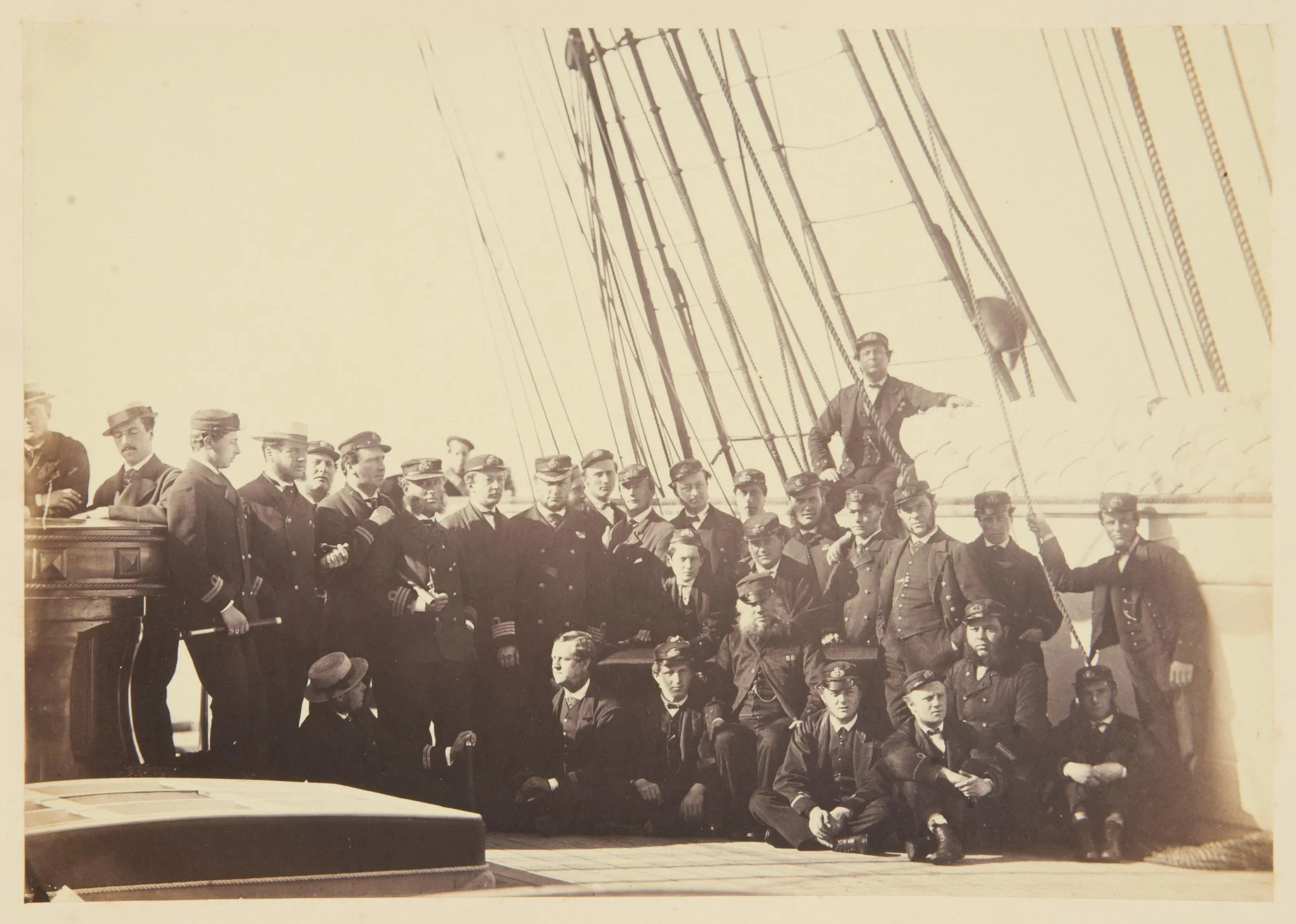
Prince Alfred (third left) and the officers of HMS Racoon. Copyright: the Royal Collection.
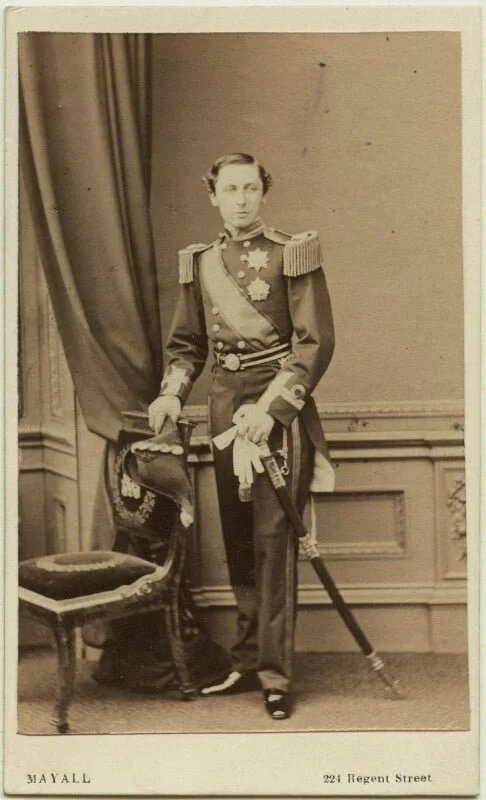
Prince Alfred, Duke of Edinburgh, 1867. National Portrait Gallery. Creative Commons.
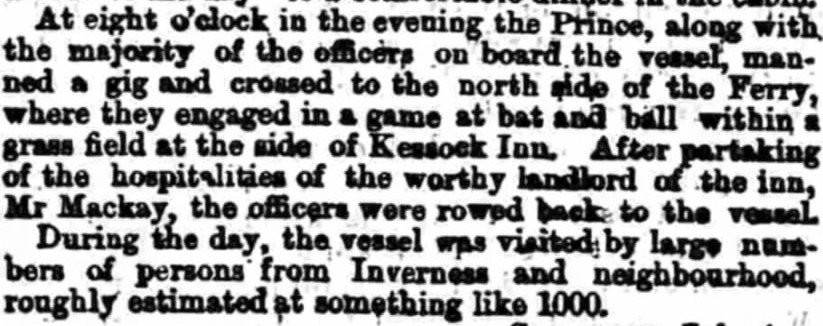
"a game at bat and ball". Courier and Argus, 8 July 1863. Image created by the British Library Board. No known copyright holder.
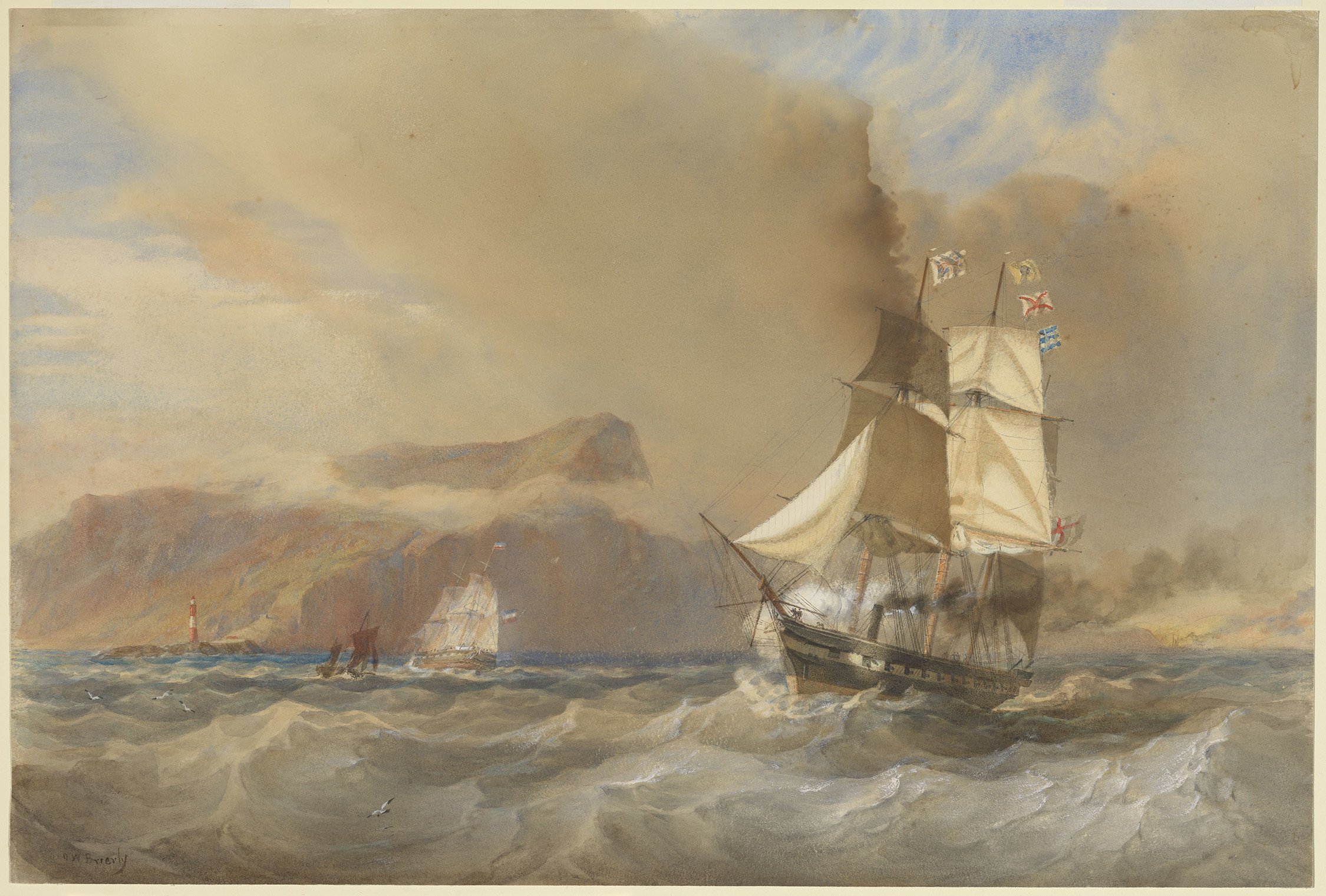
HMS Racoon. Copyright: the Royal Collection.
![HMS "Galatea" in Farm Cove; Government House to the left, c. 1870, [attributed Charles Pickering], from albumen print published in "A collection of photographs of buildings and views in New South Wales," Thomas Richards, Government Printer, 1873, Sta](https://images.squarespace-cdn.com/content/v1/674e1985476d7307b8b5f633/95caca4f-76ab-463c-acb9-0574b32dc480/SLNSW_479645_142_HMS_Galatea_in_Farm_Cove.jpg)
HMS "Galatea" in Farm Cove; Government House to the left, c. 1870, [attributed Charles Pickering], from albumen print published in "A collection of photographs of buildings and views in New South Wales," Thomas Richards, Government Printer, 1873, State Library of New South Wales, PXD 557/vol. 3, 55.
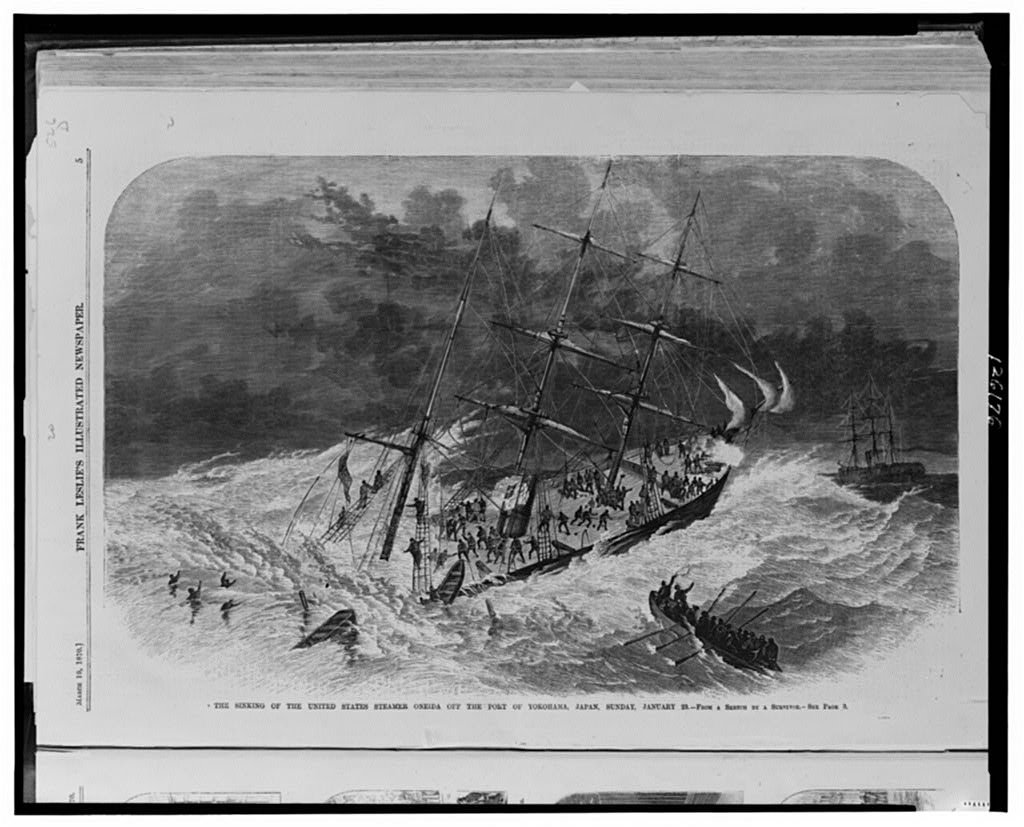
The Oneida Disaster, 1870. Image created by the Library of Congress. Public domain.
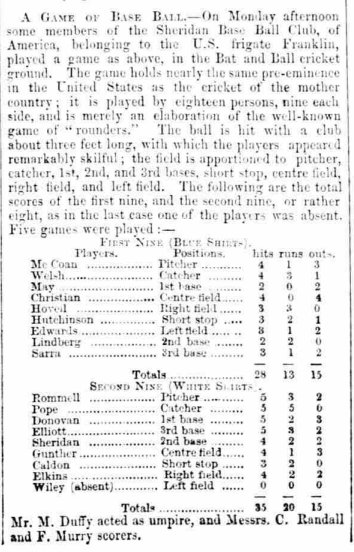
A Game of Base Ball, Gravesend Reporter, 17 June 1871. Image created by the British Library Board. No known copyright holder.
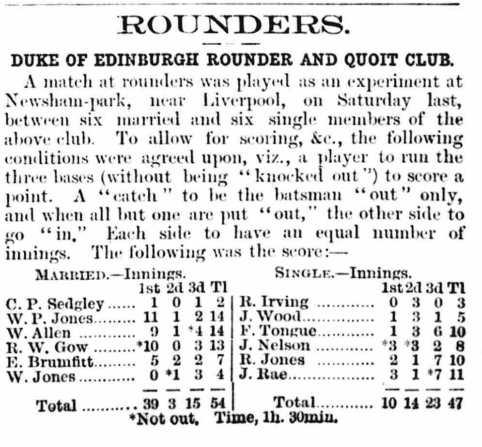
The Duke of Edinburgh Rounder and Quoit Club. Athletic News, 12 June 1875. Image created by the British Library Board. No known copyright holder.