The Rounder Years.
1849—1892
Jamie Barras.
FROM A SOLDIER IN THE 21ST TO HIS BROTHER IN GLASGOW. Camp before Sebastopol, 9th May, 1855[...]We have all kinds of games here, such as cricket, foot-ball, rounders, horse and foot racing, &c.; and amongst all our troubles we get an extra drink occasionally.[1]
American baseball grew from a regional to a national pastime thanks to its adoption by soldiers of the Union Army during the American Civil War. It required little beyond a bat, a ball, and a more or less flat piece of ground; the perfect game for armies on the march and in temporary camps.[2]
Rounders offered the same advantages, so it is no surprise that we see sailors and soldiers of the Royal Navy and British Army playing it at landing places and in camp, with documented instances from across the globe dating back to at least 1849. However, unlike baseball, rounders had to contend with the British sportsman’s determination to play cricket regardless of conditions. Alas, ultimately, this proved too strong a competition. Still, in the casual games of Britain’s sailors and soldiers, we see the first dawning of the idea that rounders could be more than a children’s game. References showing adults, including sailors and soldiers, playing rounders are included as an appendix.[3]
It would be reasonable to ask, of course, why anyone in Britain would try to turn rounders into a sport when the country already had a strike-and-run-based sport in cricket? In my ruminations on the origins of rounders, I described the game as played by boys and youths as a game that was not as technical as cricket but was more vigorous than the strike-and-run games that preceded it. The adult supporters of the idea of playing rounders as a sport viewed the sport in much the same way, in that a player required “a fair amount of skill to be really proficient all round, and, at the same time, not as much science as in cricket”. It was a simpler pleasure. It was also faster-paced, as, as we will see, in borrowing from the rules of the children’s game, its adult supporters retained the idea of a batter having only a few chances to strike the ball before they have either to run or be put out. This was already, of course, a feature of the American game.[4]
Efforts to turn rounders into a sport for adults began just two years after the end of the Crimean War, when a “civil Crimean hero” joined in an attempt in Cardiff, South Wales. Meetings were held (to discuss the rules?), and games were played; however, alas, the time was not yet ripe: that attempt failed.[5]
It would take the success of the American experiment with baseball to give rounders the boost it needed.
The Old Game of Rounders.—A few young men of our city are about to revive the now almost forgotten game of rounders, by forming themselves into a club, to be named "The City of Bristol Rounder Club," and all necessary arrangements are being made, with a view to its immediate starting.[6]
The City of Bristol Rounder Club was formed in August 1864, in Bristol, South Gloucestershire. Bristol, like Cardiff, was a port city with deep connections to North America. It was a transatlantic trade hub; ships, having unloaded their cargoes there, would travel on to Cardiff to load coal or iron for the return trip.[7]
A year earlier, a print that showed Union prisoners playing baseball at the Salisbury Confederate Prison became a surprise best-seller in Europe. Although intended by its promoters as propaganda for the Confederate cause, painting a rosy picture of life in a Confederate prison, the print also served as an advertisement for baseball, which had seen an explosive growth in popularity due to the Civil War. The good people of Bristol would have been among the first to know of this development. As the game of rounders probably acquired that name in Bristol sometime in the eighteenth century, it is no surprise that they turned to their homegrown variant.[8]
Mr Elliott then proposed. "Success to the Bristol Rounder Club." He hoped it would go on and prosper and that by the end of next year it would be in a still better position than it was at present. (Hear, hear.) Mr W.P. Morgan, secretary to the club, in responding, observed that the club was in very flourishing condition. They were rapidly increasing in numbers, their numbers being at present between 40 and 50, exclusive of honorary members, and he hoped that by the end of the next year they would have doubled their numbers. (Hear, hear.)[9]
In some important respects, the Bristol effort would prove to be an outlier. In future years, the development of rounders into a competitive sport would be viewed through a lens of British ideas of class and social status, with rounders dubbed a game played by men of “a certain class[…]who could not afford to subscribe to a cricket club”. It would be embraced by employers and faith-based organisations seeking to provide physical recreation for the working man and woman; a game of the “masses” not the “classes”, of the city, not the country.[10]
The City of Bristol Rounder Club was different. First, there was the city itself. A major port, yes, but one sat in a region with the lowest population density in England; towns of any size were few and far between; Bristol’s hinterland was rural. Then, there were the club’s members. Its organising secretary was William Prosser Morgan (1837–1901), a solicitor’s clerk. Other key members included three more solicitors’ clerks, Samuel Henry Ablett (1845–1897), Henry William Povey (1849–1874), and Stephen Edwin Bryant (1839–1884). These were white-collar workers in white-collar firms—just as the originators of the American game of baseball were. We can suppose that they were motivated to develop rounders into a competitive sport by a desire for a novel form of recreation that, as we have said, was a simpler pleasure than cricket. It is also clear from the records that the social aspect—dinners, annual outings—was an important dimension of the club. They leaned toward the classes more than the masses.[11]
Similarly, later developments would suggest that they did not take up the game because they lacked the social standing to play cricket: despite initial optimism, the rounders scene grew very slowly; by the summer of 1867, the City of Bristol Rounder Club had become the City of Bristol Rounder and Cricket Club in recognition that there were too few opportunities to play the former game. If Morgan, Ablett, Povey, Bryant et al. had wanted to play cricket in 1864, they could have joined a cricket club or started one of their own; there was no social or economic barrier in their way. Instead, they chose to form a rounder club. Indeed, one report of the founding of the rounder club explicitly stated that it was the work of men who “did not indulge in or appreciate the all-prevailing game of cricket”.[12]
Playing rounders was a choice. But what of the game itself?
ROUNDERS—On Saturday last a numerous assemblage attended to witness a friendly game between some of the members of the City of Bristol Rounder Club and some gentlemen connected with one of the cricket clubs at Bedminster. It lasted three hours, and was well contested on both sides.[13]
The few accounts that we have of games played by the City of Bristol Rounder Club show a game in a state of development:
—On 20 May 1865, the club played a local cricket team in a single innings game, winning by 19 runs to 18. The club was at bat for 90 minutes, their opponents for 81 minutes. No other information is provided, but from the length of the innings combined with the low run rate, we can suppose that there was a) no three outs/all out, and b) no three strikes and you're out.[14]
—On 22 August 1867, the club played the Horsfield Cricket Club in a game of two innings, with six players a side in the first innings, and eight in the second. Methods of dismissal were caught out, run out, and “struck” out. Later evidence shows that “struck” referred to a runner being hit by a ball thrown by a fielder, aka being “soaked”, “plugged”, or “burned”, not dismissed for failing to strike the ball while at bat. This was a feature of both the children’s game of rounders and the “Massachusetts game” of baseball. The low number of players per side shows that the posts/bases were not manned—something that soaking as a means of dismissal made unnecessary. All players had a turn at bat, and the innings ended when a team ran out of players who had not been dismissed. As there could still be players on the bases/posts when this happened, these players were marked as “missed” in the scorecard, i.e., not out. We are not told the duration of the game; however, the increase in the number of innings suggests that something approaching a three-strike rule had been introduced—in later incarnations of the game, batters would have to run after receiving a maximum of two or three “good balls”.[15]
—On 5 September 1869, the club played the Knowle cricket club in a two-innings game with six players per side. Evidently, the club had decided this was the ideal combination of player numbers and innings.[16]
What we don’t have is any information on the equipment used or the layout of the playing field—was a bat or stick used? What size was the ball? Was the home post/base the batter’s box or an additional base/post set off to the side, as in later versions of the game? We can attribute this lack of information to the absence, as far as we can tell, of any attempt to establish a governing body or codify the rules.
Nailsea: Rounders Club. The following match was played at Nailsea on Saturday last, and after a very exciting game ended in favour of the B.R.R.C. [Bedminster Rangers’ Rounders Club].[17]
By the early 1870s, rounders as a sport had grown beyond its Bristol roots and was being played across South Gloucestershire, Somerset, and even into Devon, still without any governing body. One reason for this lack of greater organisation was that the region was too sparsely populated to develop a large integrated scene. This was a function of its largely rural character outside of the major population centres of Bristol and Gloucester. This stood in major contrast to the situation with the other centres of rounders in this period, as we will see. From what little evidence we have, the game was the game the City of Bristol club had developed, with six players a side, two innings, etc. Although women playing the game would become one of its defining features, there is no evidence of this at this early stage. Similarly, it would be widely adopted by schools, but this appears to be a development of future decades.[18]
AN OLD GAME REVIVED.—On Saturday evening, a match of the old game of “rounders” was played at the Fort Barrack-field, between seven artisans of this dockyard and seven artisans from Deptford and Woolwich (recently transferred to this yard) for £5 a side.[19]
ROUNDER MATCH.—The return rounder match between the Tubal Cain and Bute Engineers against Messrs. Hill's Shipwright's Apprentices, was played on Saturday evening, in the field adjoining the Sophia Gardens, in the presence of a number of spectators. The game resulted in the victory of the former by 13 runs. Each side played out two innings, the engineers scoring 45, and the shipwrights 32.[20]
The next place that rounders as a competitive sport made an appearance was Cardiff. This was a renewal of attempts to launch the sport in the city after the earlier abortive effort in 1858. This second effort, commencing around 1870, is of particular interest as the teams were formed of blue-collar workers—dockyard workers, engineering firm employees, and shipwright apprentices—in contrast to the white-collar Bristol scene.
This is the first time that we see something that would be a defining characteristic of not only rounders as a competitive sport in Britain but American baseball in the country too: the game as an urban, blue-collar alternative to cricket as a means of enriching the spiritual and physical wellbeing of the working man and woman. Just as in Bristol, there seems to have been no attempt to codify the rules. However, the report of the first game in this revival did provide a degree of detail on how that game was played.
The stipulations were that from the goal to the first mark the distance should be 25 yards, the same distance between the other marks, the entire circuit being 100 yards. This distance having to be run to score a point; the ball to be struck out between the right and left marks, or not less than 20 yards.[21]
This is clearly a diamond arrangement with the final base/mark being the batting crease. The reference to the ball having to be “struck out between the right and left marks, or not less than 20 yards” suggests the existence of a foul line modified by the distance the ball was struck. This is something that might be adopted if all the fielders were in the outfield. Indeed, seven players a-side suggests that, as in Bristol, the bases/marks were not manned. (Did Bristol have a similar rule? Alas, accounts of games are silent on this point.) The score, 114–40, indicates that all seven players had to be dismissed for the single innings to end. Later games in Cardiff were played across two innings, suggesting that, just as in the mature version of the Bristol game, there was no three out/all out rule, but the batter had to run after facing a maximum number of good balls.[22]
Little more is known about the Cardiff game. It would be left to the third West Coast port city to attempt to turn rounders into a sport to move that game forward by putting its rules into print.
ROUNDER MATCH. TO THE EDITOR OF THE DAILY POST. Sir,—Will you please insert in an early issue of your valuable paper what probably will be the first reported match at rounders. It was played as an experiment, at Newsham Park, on Saturday last, between six married and six single members of the Duke of Edinburgh Rounder and Quoit Club.[23]
The Duke of Edinburgh Rounder and Quoit Club was founded in Liverpool in 1873. Although the city shared Bristol and Cardiff’s strong links with the United States, it differed from those cities in one important respect: scale. Liverpool and the adjacent county of Lancashire were, by the middle of the nineteenth century, second only to London in terms of population and population density. The region was also one of the most heavily industrialised in England, famous for its port and the Lancashire cotton mills. It was first in the country in terms of trade with the US.[24]
The president and vice president of the Duke of Edinburgh club, John Griffith Howe (1849–1902) and William Cowell Kidd (1850–1899), both worked for the Mersey Dock and Harbour Board as warehouse examiners. One of the club members, Henry Edward Maddrell (1853–1893), was another Dock and Harbour Board employee, working as a Master Porter. The club’s deputy captain, Peter Croft Asbury (1856–1902), and his brother, fellow club member John Asbury (1858–?), were both clerks for a corn merchant. These were white-collar jobs in blue-collar organisations orientated towards the port of Liverpool. Their involvement pointed to the future of the scene in the city: skewed towards the working man and woman, but organised by men who had risen to management roles.[25]
Although founded in 1873, it was not until 1875 that the Duke of Edinburgh club announced to the press that it had taken up rounders, suggesting that the addition of “Rounder” to its name may have been a recent innovation. Although there is no definite evidence, we might suspect that this change was prompted by the arrival in Liverpool in the summer of 1874 of the Harry Wright baseball tourists.
The 1874 tour of England by the Boston Red Stockings and Philadelphia Athletics, proposed by Harry Wright and organised by the pitcher for the Red Stockings and future baseball magnate, Albert Spalding, was an attempt to interest the Old Country in America’s pastime. In that, it failed. British sports fans were, on the whole, bemused by the game. The first two games of the tour, played in Liverpool on 30 and 31 July 1874, were met with particular disinterest, only 500 turning up to watch the first game, and significantly fewer the rematch. And yet, we might suspect that at least some members of the Duke of Edinburgh club were in the crowd for at least one of the games and liked what they saw enough to try to create their own version of the game.[26]
In communicating their first attempt at an organised “match” of rounders in June 1875, the Duke of Edinburgh club signalled that it intended to go beyond the attempts in Bristol and Cardiff by presenting the rules by which it played the match to encourage others to take it up.
To allow for scoring, &c., the following conditions were agreed to:—A player to run the three “bases” (without being “knocked out”) to score a point. A “catch” to be the batsman’s “out” only, and when all but one are put out, the other side to go “in”. Each side to have an equal number of innings.[27]
The club also sent the newspapers a score card. This shows that the teams each had six players—echoes of the Bristol scene, although, critically, the Liverpool rounder enthusiasts soon moved away from this—and there were three innings. The match lasted 1 hour and 30 minutes. We also have a reference to “three bases”, an indication that the home base was the batter’s crease, as in the early Cardiff game. Also of note is that each player continued to have turns at bat until either they were put out or the inning ended—the latter implying that the player was at one of the bases when their last teammate was put out. Again, this is reminiscent of the Bristol and Cardiff scenes.
We also have evidence to support the contention that the Harry Wright tourists’ visit of the previous year was somewhere in the thoughts of the match’s organisers: the reference to “bases” (this would soon be dropped in favour of “posts”, as in the children’s game) and the fact that a full circuit of all bases scored a single “point” (this would be dropped in favour of a batter scoring as many runs as bases/points they rounded after a hit).
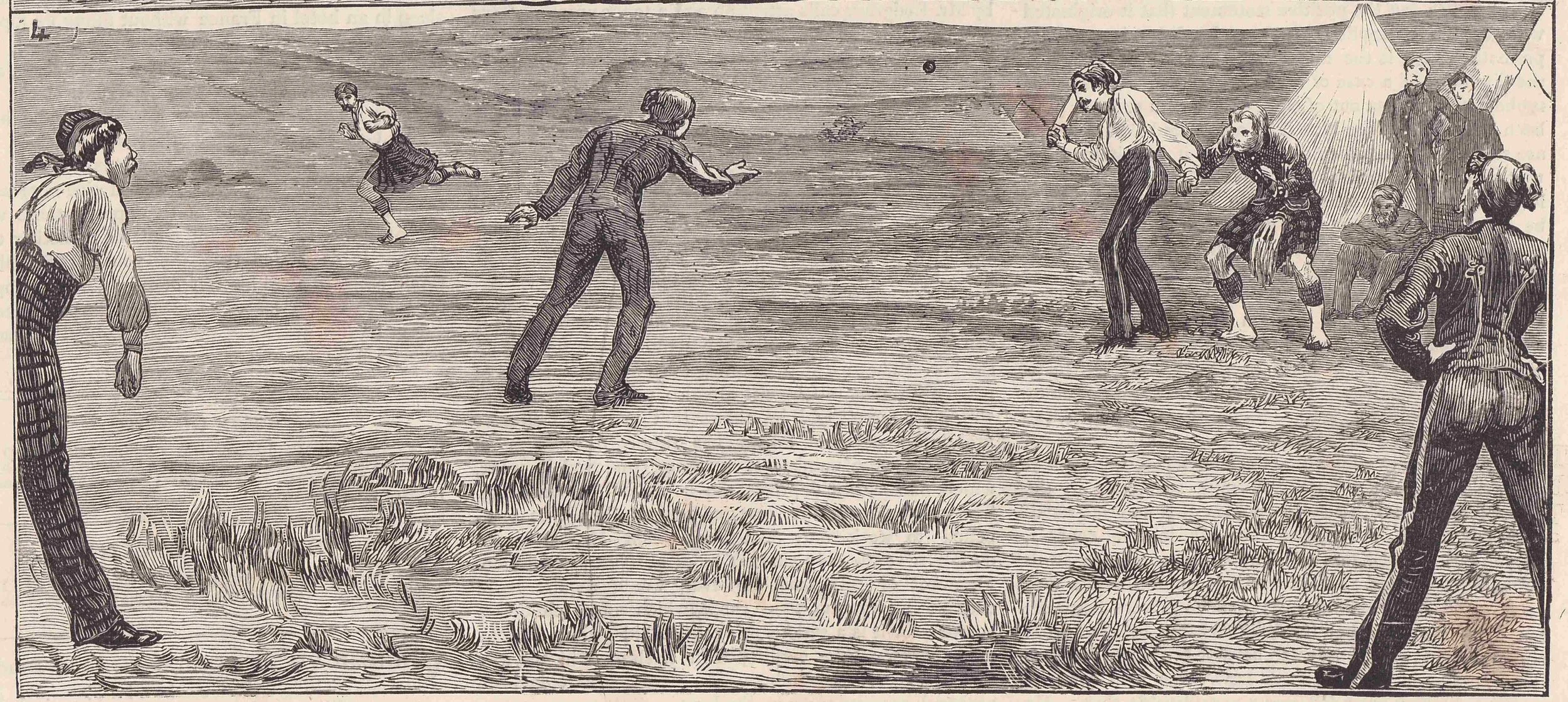
One thing the letter does not mention, but we know from later events, is that in the match, the Duke of Edinburgh club used a flat bat, not a round stick. Although this was as in cricket, it likely reflected how rounders was played in the North West of England, not something imported from the former game. Historically, rounders and the games that preceded it could be played either with a flat “bat” or a round “stick” (or the flat of the hand). The earliest illustration of a bat for “Englische base-ball”—rounders by another name—published in Germany in 1796, shows a bat with a flat striking surface and a knife-like shape. In 1841, a description of rounders in The Every Boy’s Book stated that some players preferred a stick over a bat. In 1873, contemporary with the Duke of Edinburgh club’s move into rounders, soldiers of a Highland regiment were sketched playing rounders on Dartmoor using a short round stick as a bat, which would become the norm outside North-West England.[28]
The question of stick or bat aside, there is enough here to suggest that the Duke of Edinburgh club was aware of the Bristol or Cardiff scenes, and yet, we have the statements in its letter to the press that it was reporting what it believed to be the “first match of rounders”, which had been played as “an experiment”. It seems then that, rather than being informed by the Bristol and Cardiff scenes, the Duke of Edinburgh club had arrived at a proto-rounders competitive game by the same process of trial and error that the other scenes had adopted.
SAINT DOMINGO ROUNDER CLUB. This match was played at Stanley Park on Wednesday last, and resulted in a victory for the Captain’s side.[29]
A month after the Liverpool Daily Post published the letter from the Duke of Edinburgh club reporting its first rounder match, it carried a report of another rounder match, this time played by the Saint Domingo club. This was a single-inning match with seven players on one side and eight on the other. The local scene was on its way.
By the summer of 1876, the Duke of Edinburgh club had dropped “quoits” from its name. By the following summer, it had made an even bolder change, adopting the name “The Liverpool Rounders Club”, placing itself at the head of the growing scene that now included a club that would become a stalwart of the game, the White Star Rounder and Athletic Club, founded by employees of the famous shipping line of the same name. It had also made a significant change to how it played the game: teams now had 11 players a-side, as in cricket, and the so-called Massachusetts game of baseball/town ball. This allowed the bases/posts to be manned and marked the first step away from “soaking” runners to put them out and toward touching them out.[30]
Sir,—May I trespass on your space to bring under the notice of your very numerous readers a revival of an old school game, viz., Rounders, under a new form, governed and ruled by laws as to bowling, batting, &c., as in cricket, these laws being mainly founded on a very popular American game called Base Ball?[31]
The rounders scene in Liverpool continued to grow across the late 1870s and early 1880s. Critical to understanding subsequent developments is appreciating that this was a grassroots movement. Clubs were formed, which led to the formation of more clubs. Word spread, interest grew, and then, and only then, was a governing body formed. Here, we see a pattern of evolution that mirrors that of other sports in the UK in the late Nineteenth Century.
The Liverpool Rounder Association (LRA) was formed no later than February 1882. Its first president was William Henry Hope (1849–1914), a wholesale greengrocer and prominent nonconformist Christian philanthropist. However, its driving force for the whole of its existence was its honorary secretary, William Henry Hivey (1852–1950). Hivey owned a dunnage business—a company that supplied packing material to shipping companies. Thus, Hope and Hivey continued the tradition of the officers of rounders organisations in Liverpool having connections to the port.[32]
The LRA’s Big Bang moment, just like that of Association Football, was its creation of a standardised set of rules that would allow the spread of the game without the need for new teams to play established teams to learn the game. The LRA announced this development in letters written by W.H. Hivey and sent to the local press in the summer of 1883. Arguably, the most significant aspect of these letters, and indeed, the whole development, was that, in discussing the origin of the new rules, the LRA acknowledged in writing the role of American baseball in the growth of rounders as a sport. However, the letter also provided us with our first information on the particulars of the bat that the LRA favoured and the size and layout of the playing field, including the information that there were now four bases and rather than scoring a “point” for rounding all the bases, runners now scored four “runs” if they rounded all the bases off a hit (i.e., scored a “home run”).
A team consists of 11 players, and each has his appointed place on the field, such as first base, first cover point, &c. The bat used measures 2ft. 6in. long, blade 3½in., double-handed batting being prohibited. After striking a ball the batsman runs to his first base (distant 22 yards), which scores one run, and so on for every base (22 yards between each) he succeeds in touching, without stopping, scores a run. There being four bases altogether, the maximum number of runs off a single hit is, therefore, four.[33]
I have included the full letter as an appendix. Jumping ahead two years, a letter writer to the North British Daily Mail provides us with more information on the layout of the field and rules of play, quoting from the rules presented in the LRA Rounders Handbook.
The ground is laid out in a rhomboid square, each side measuring 22 yards, the extreme length being 33 yards and the breadth 29 yards. There are a bowling, a batting, and four running bases. The batter takes his place at the batting crease, and must strike at one out of four good balls, a good ball being one which passes the batsman over the crease—three feet wide—not higher than the head nor lower than the knee, and each ball being declared good or bad by the umpire as delivered[…]The bowler stands at a distance of 15 yards from the batter, in the centre of the square, and with a run of two yards delivers the ball as fast as he can over the crease above mentioned.[34]
I have included the full description as an appendix. It is worth noting that 22 yards is a shorter distance between bases than in the New York game (30 yards) but only slightly greater than that found in the Massachusetts game (20 yards). In the modern game of rounders, which is played by both children and adults, the distance is around 13 yards.[35]
In his 1883 letter, Hivey also reported that in Liverpool there were 26 teams and 1000 players. He also announced the inauguration of a Challenge Cup competition open to all. By 1885, the number of clubs competing for the Challenge Cup had increased to 50, and the number of teams in the LRA to 80. That same year, the writer to the North British Daily Mail boasted that ‘rounders was the only game played in Liverpool during the summer months, while in Manchester, Birkenhead, Bootle, Widnes, &c., &c., it is highly popular’. He went on to describe a game in June of 1884 that attracted ‘between 5000 and 6000’ spectators. His principal reason for writing was to report the establishment of the first clubs in Scotland. By 1886, a Scottish Rounders Association had been formed.[36]
In a separate development, in 1884, rounders was one of the four sports adopted by the Gaelic Athletic Association (GAA) of Ireland in its founding charter. However, there are no records of the game being organised at this time. The first rules for “Irish Rounders” were put in print as late as 1958.[37]
This planting of the game in other parts of the country was the major feature of the final years of the 1880s. It did not thrive in Scotland, but it did take root in Gloucestershire (in 1887). This was almost certainly the small local rounders scene, kicked off by the City of Bristol Rounder Club in 1864, adopting the Liverpool rules. More significantly for future developments, it also took root in South Wales (in 1890). Again, this is likely a case of the small local rounder scene active since 1869 adopting the Liverpool rules. By this time, the original LRA had, in light of its aspirations, renamed itself the National Rounders Association (NRA). The adoption by areas outside North-West England of the Liverpool rules fixed the use of a flat bat, a defining characteristic of the sport going forward even while the pastime of rounders was going in the other direction toward the use of a round stick.[38]
ROUNDERS. A handsome bronze challenge shield has been obtained for the working men of Gloucester, and will be competed for on Wednesday next, in the Park, under the rules of the National Rounders' Association, between the Wagon Works Rounders' Club and the Atlas Rounders' Club.[39]
The first games played in Gloucestershire under the NRA (Liverpool) rules were played in July 1887 by two works teams. By the following season, the Gloucestershire Rounders Association (GRA) had been formed under the presidency of Gloucester corn merchant and Liberal MP, Thomas Robinson (1827–1897). The organising secretary was cabinet maker Frederick Mansfield (1839–1915), another Liberal. The GRA’s clubs were a mix of works teams and teams associated with religious institutions; these included two teams from the Gloucester Wagon Works (Smith’s Shop and Turners and Fitters) and a team from the Fielding and Platt Company’s Atlas Works, alongside the Ryecroft Wesleyans, Gloucester Rangers, Beaufort Rovers, Harlequins, and X.L.C.R. (Excelsior).
This placed the development firmly in line with ideas current at the time about the importance of physical recreation for working men and women—a happy worker was a productive worker. In 1886, the National Physical Recreation Society recognised the value of rounders as a sport for the working man by donating a shield to be competed for by rounders clubs across Britain.[40]
Arguably, however, the most significant event in the sport’s future development was the 1889 return of the Americans.
Sir,—I noticed T. Bradshaw’s letter in your valuable paper last night about giving the American baseball team a good reception on their visit to Liverpool, which I hear will be about the middle of this month. The game of baseball is little different to rounders, so what is there to hinder a scratch team of rounders players being formed and a challenge being sent to the baseballers. […] LOVER OF ROUNDERS.[41]
The 1889 baseball tour of England was the brainchild of Albert Spalding, player and promoter of the 1874 Wright tour, now enjoying his self-appointed role as baseball’s chief booster, manufacturer of sports equipment, and publisher of sports books, including Spalding’s Official Base Ball Guide.[42]
The games in Liverpool took place on Saturday 23 March 1889 at the Police Athletic Ground on Spiel Road, in front of a crowd of 6000–8000 (the largest of the tour). The two touring American teams, the Chicago White Stockings (owned by Spalding) and ‘All-America’, opened the action by playing a five-inning baseball game against each other that ended 2–2. Next, a scratch team of 11 Americans (including Spalding as pitcher[43]) played a scratch team from the LRA at rounders. The LRA team scored 18 runs in its first innings. In reply, the American team made 8 runs in its first innings, forcing the follow-on, and made 6 runs in its second, giving the game to the LRA players by an inning and 2 runs. Finally, in a game of baseball, the LRA players failed to score across three innings, while the Americans scored 16 runs in their first innings and 1 in their second before the result was called due to rain. The pitcher for the LRA team was local cricketer and Association Footballer Frank Sugg. Sugg would go on to become a sporting goods manufacturer in the Albert Spalding mold based in Liverpool.[44]
Although the performance by the LRA players in the game of baseball was described in the press as a ‘poor show’ and there is little doubt that the Americans were the more skilled players, there is equally little doubt that what the—admittedly partisan—crowd took away from this was the advantage that the American rules gave to the defending side and how this advantage was nullified by the rules under which rounders was played.
That the Americans did not deploy their best battery in the rounders game—Spalding himself serving as bowler—may go some way to explaining their failure to achieve the shut-out in the rounders game that they achieved in the baseball game (in which the pitcher was the Chicago White Stockings pitcher Baldwin). However, against this, the American view of the rounders game was that the Americans’ defeat was entirely due to their unfamiliarity with the rules, and if a second game had been played, the Americans would have won.[45]
This supports the argument that the impact of the pitcher/bowler on the game was dulled by the rules of rounders: the Americans needed time to come up with a different approach.
Regardless of the true level of impact of the American choice of pitcher/bowler on the result, the spectators, ignorant of the relative skills of the American players, would not have appreciated this. So, ultimately, all that Spalding achieved by agreeing to play the LRA at its own game and then deciding not to use his best pitcher was to convince the crowd of how much more to their taste the rules of rounders made the gameplay.
This is not to say that the games did not influence how rounders would be played going forward: Up to this point, the sport had been played with a one-handed bat and a soft ball, in common with the children’s pastime that had inspired it. Going forward, it would be played with a longer two-handed bat and a hard ball equivalent to a junior baseball. This latter development also marked the final end to the inclusion of “soaking”—hitting the runner with a thrown ball as a means of putting him out. The complete 1889 NRA rules were published in an 1892 guide to Rounders, Quoits, Bowls, Skittles, and Curling, in a chapter titled “Modern Rounders”. This account included a diagram of the playing layout and is the best description of the game in its mature form that we have. I have included the 1889 NRA rules as an appendix.[46]
The 1889 tourists left without having put in place anything that might grow the game of American baseball in England. However, in the summer of 1889, Spalding Bros. arranged for players from Yale, Harvard, Dartmouth, and Princeton Universities to travel to the UK specifically to teach the game to local sportsmen. This was the prelude to launching a national professional league in England the following year. The effort was organised in England by a man who will play a significant role in the next chapter of the Rounder story, the former American consul in Manchester, newspaperman and lawyer, R. Newton Crane (1848–1927).[47]
On Tuesday evening, the members of the Bristol Rounders’ Club celebrated their anniversary at the Three Compasses Inn, Jacob-street, Mr. J. Davies, occupied the chair; and a pleasant evening was spent.[48]
Informed and shaped by the development in America of baseball as a competitive sport, attempts in England and Wales to move rounders in the same direction were on the rise by the end of the 1880s. While there was some justification to claims by critics that the game was cricket for the masses, it is also undeniable that its earliest proponents saw it simply as a viable alternative to the latter as a matter of taste. This mirrored the choice made by baseball’s proponents in the US between that game and cricket, without the influence of national pride. At the same time, there was also an element of national pride in choosing to develop a base-running bat-and-ball game indigenous to England over adopting the American game. The latter emotion will come completely to the fore in the next chapter of the rounder story.
Jamie Barras, August 2026.
Back to The Rounders
Appendix A: the 1883 Hivey Letter, Manchester Courier, 6 June 1883, 2.
ROUNDERS. To the Editor of the Manchester Courier. Sir, —May I trespass on your space to bring under the notice of your very numerous readers a revival of an old school game, viz., Rounders, under a form, governed and ruled by laws as to bowling, batting, &c, as in cricket, these laws being mainly founded on a very popular American game called Base Ball? In this city the game has made great headway during the last five years, there being an association (consisting of 26 clubs and upwards I, 000 players) formed specially for the extension and improvement of the game. A moderate expense (35s. to 45s.) is sufficient to fully equip a club, all that is required being base poles and flags, bats, and balk. Further, the game is a healthy and enjoyable one, and a player requires a fair amount of skill to be really proficient all round, and, at the same time, not as much science as in cricket. A team consists of 11 players, and each has his appointed place on the field, such as first base, first cover point, &c. The bat used measures 2ft. 6in. long, blade 3½in., double-handed batting being prohibited. After striking a ball the batsman runs to his first base (distant 22 yards), which scores one run, and so on for every base (22 yards between each) he succeeds in touching, without stopping, scores a run. There being four bases altogether, the maximum number of runs off one hit is, therefore, four. Should the batsman, however, struck by the ball, whilst running between the bases, thrown from a fielder's hands is "out," or if the ball be caught off the bat. There are other rules, &c, to bowling and other points too numerous to mention within the space of this letter. The Rounders Association are anxious to promote the extension of the game generally, especially in the neighbouring towns of Lancashire, and with this view am instructed to write that we shall be glad to furnish all information, laws of game, &c, free to anyone who writes to the address given at foot of this letter. Further, we will, on the invitation of any parties providing a piece of ground suitable (in a public park where the general public could be admitted would be preferred), send representative teams, at our own expense entirely, any Saturday afternoon, to give an illustration of the game. —Trusting soon to hear the formation of Manchester Rounders Club, I am, &c, W. H. HIVEY, Hon. Sec. Rounders' Association. 13, Strand-street, Liverpool, May 31st, 1883. P.S. Our local clubs are this year competing for a silver challenge cup. I have little doubt that if a good club were formed in your town they would be allowed to enter for this.
Appendix B: Description of Rounders, North British Daily Mail, 31 March 1885, 6.
I will now give a brief description of the game:—The players are eleven a side, the innings three each. The ground is laid out in a rhomboid square, each side measuring 22 yards, the extreme length being 33 yards, and the breadth 29 yards. There are a bowling, a batting, and four running bases. The batter takes his place at the batting crease, and must strike at one out of four good balls, a good ball being one which the batsman over the crease— three feet wide —not higher than the head nor lower than the knee, each ball being declared good or bad by the umpire as delivered. For every three bad balls one point is scored. Should the batsman attempt to strike the ball and fail, he must run or be declared out. Behind the batsman stands the backstop (synonymous with wicket-keeper in cricket) whose duty it is to stop every ball delivered by the bowler, and either return to him or pitch it to the man at the first base to intercept the batter, in order to prevent him from scoring a point. There can also be a longstop if the bowler is swift at bowling. ‘The bowler stands at a distance of 15 yards from the batter, in the centre of the square, and with a run of two yards delivers the ball as fast as he can over the crease abovementioned. He can, of course, deliver fast or slow, as he thinks proper, to the batsman he has to deal with. The ball should be quickly passed to the bowler or the base men — there is a man stationed at each base—by the fielders. A great deal depends on the quickness with which the ball is passed from one to the other in order to prevent the batsman from going the rounds, The method of scoring is as follows:—If he succeeds in reaching No. 1 base without stopping, he scores one point; if he reaches No, 2 or No, 3 base, he secures two or three points respectively; while if he goes the “ rounds,” he scores four points. The bat used must not exceed 30 inches in length nor 3½ in breadth. No double-handed batting is allowed. The ball weighs 1½ to two ounces, and measures about seven inches in circumference. All matches must be with association balls (so stamped), and a new ball used for each innings played. To distinguish the bases, four base poles, each six inches above the ground, are to be used, and the batter must touch these bases as he goes round.
Appendix C: National Rounders Association 1883 Rules, published in Lawn Tennis: Its Laws, Rules, Regulations, Definitions, Plans, &c. The Game of Rounders, Containing Laws and Plans of the Game and the Rules of the Rounders Association (Manchester: John Heywood, 1887), 15–20.
THE GAME OF ROUNDERS.
RULES.
1. The name of the Association shall be ”The Rounders Association.”
2. The object is the development and spread of the Game of Rounders.
3. The Association shall consist of the Founders Clubs subscribing to its funds and adopting its rules. Each Club in the Association is entitled to send one Representative to the General Meetings (see Rules 8, 9, and 10). Proxies may attend in case the accredited Representative cannot do so, but they can only vote and speak by permission of the Chairman. In all cases the name of a proxy attending a meeting must be handed up to the Chairman immediately after entering the room. The Ticket of Membership will be issued to all Clubs in the Association, and said Ticket must be produced at all meetings of the Association.
4. The Representatives have power to elect to their body not more than five gentlemen (to be elected annually), who have served the cause of Rounders, or who are at present in connection therewith.
5. All Officers of the Association to be duly appointed Representatives from their respective Clubs, with the exception of the President, Treasurer, and Secretary.
6. Any gentleman who has held the Office of President shall be ex-officio a member of the Representative Body, unless decided otherwise by a vote of the Representatives at the Annual Meeting.
7. The Executive Committee of the Association shall consist of President, Chairman, Treasure›-, Secretary, and 14 Members, elected at the Annual Meeting. At Committee Meetings six to form a quorum.
8. The Subscription to the Association shall be 5s. per Club, to be paid annually, not later than 1st May. No Club shall be allowed to send a Representative to the meetings unless their first subscription is paid. Non-local Clubs may become members of the Association on payment of a Registration Fee of 2s. 6d.; they to be entitled to all privileges except representation at meetings
9. In order to secure the Association against the difficulty created by new Representatives being appointed in the middle of a year, no club will be allowed to change their Representative between 1st March and 31st December unless the one appointed should cease to be a member of the Club. All changes in the appointment of Representatives to be notified to the Association Secretary, in writing, by the Secretaries of the various Clubs. A Representative must be a member of the Club he represents, and a bona-fide resident in the town or place where the Club plays.
10. Local Clubs will not be allowed to play Matches with Clubs outside the Association, under a penalty of 2s. 6d. for a first, 5s. for a second, and expulsion from the Association for a third offence. All Clubs within a radius of 15 miles from the Liverpool Exchange to be considered Local Clubs.
11. The Representatives meet Quarterly for the transaction of business on the first Wednesday in March, June, September, and December.
12. All applications for membership in the Association to come before the Committee, who have power to admit or reject, subject to the revision of the Representatives.
13. All disputes as to ground or any other matter between Clubs must be referred to the Committee of the Association for settlement, their decision in all cases to be final. The parties interested shall be summoned by the Secretary to attend the meeting of the Committee.
14. All expenditure of the Association Funds to be sanctioned by the Committee.
15. All Meetings of either Representatives or Committee to be conducted according to the established rules of debate.
16. No motion having for its object alteration of any “Law of the Game” will be discussed (except at the Annual Meeting), unless notice thereof has been given at the previous General Meeting.
17. On receipt of a letter signed by not less than 10 Representatives, the Secretary shall call an “extraordinary meeting” to discuss the particular matter named therein—such meeting to be summoned by circular, and the Secretary shall inform the Representatives in the Circular why the meeting is called.
18. Aggregate meetings of the whole body of Rounders players may be called from time to time by the Representatives, such meetings, however, to be “consultative” only, all resolutions passed thereat to be considered as recommendations to the Representatives.
19. The Annual Meeting for the election of Officers, &c., to be held in December each year. At said meetings the Treasurer shall submit statements of his Accounts and Balance Sheet (which must have been previously audited by four Auditors appointed by the Representatives), and the Committee shall submit their Annual Report; the Annual Meeting to be called together by circular.
20. The Representatives in meeting assembled may make bye-laws from time to time, which shall be as binding as these rules.
AUTHORISED LAWS OF THE GAME
I.—LAYING OF THE GROUND.
That the Ground be laid out in the form of a Rhomboid, each side to measure 22 yards, the extreme length to be 33 yards, and the breadth to be 29 yards.
The first point to be called the “Striking Base."
That on the right „ „ “First Base.”
The central point „ „ “Second Base.”
That on the left „ „ “Third Base”
The “Fourth Base ” to be midway between the “ Third ” and the “ Striking Bases.”
To distinguish these Bases, four Base Poles, each 3 feet 6 inches above the ground, are to be used
II.—NUMBER OF PLAYERS AND POSITIONS.
That in a Match the number of Players on each side do not exceed eleven.
That the positions of the eleven fielders be named as follows, viz:—
No. 1. Longstop. No. 2. Backstop. No. 3. Bowler.
„ 4. 1st Base. „ 5. 2nd Base. „ 6. 3rd Base.
„ 7. 1st Cover. „ 8. 2nd Cover. „ 9. Centre Point.
„ 10. 3rd Cover. „ 1I. 4th Cover.
III.—THE BALL.
That all Matches be played with the Association Ball, so stamped. In all Matches a new Ball must be used for each innings played.
[Note.—The Association Ball weighs 1¾ to 2¼ ounces, and measures 6¾ to 7¼ inches in circumference.]
IV.—THE BAT.
That the Bat to be used must not exceed 30 inches in length, nor 3 ½ inches in breadth.
That “Double-Handed Batting” be prohibited.
V.—BOWLER’S POSITION.
That the distance between the Striking and Bowling Bases be 15 yards, and in delivering the Ball the Bowler may take a run of not more than 2 yards, but must always have one foot within the limits of the space, as defined in Rule 7, at the time of such delivery. The Bowler to have the same privileges as any other fielder.
VI.—STRIKING BACK.
The Striking Base to be defined by a mark one yard long, drawn across the first point of the figure defined in Rule No. 1. The Batsman can stand anywhere in a direct line with the said mark.
The “Touching Base ” to be defined by a space 1 foot square, to be marked at the centre of the Striking Base.
VII.—BOWLING BASE.
The Bowling Base to be defined by an oblong space 2 yards long, by 24 inches wide, the top end of which space must be 15 yards from and in a direct line with the Batting Base and No. 2 Base.
VIII.—METHOD OF SCORING.
That a Batsman must strike at one of 4 good balls, or failing to do so shall be declared “out;" but on a Batsman striking he scores 1 point for each Base he succeeds in touching without stopping—i.e., should he run to No. 2 Base, he scores 2 points; but should he stop at No. 1, he only scores 1 point, and so on; though in every case he must run the whole of the Bases consecutively before he is “Home.”
That on a Batsman failing to strike the Ball, but succeed in touching a Base or Bases, the runs to score to his credit the same as if he had struck the Ball.
IX. —DEFINITION OF “GOOD” AND “BAD” BALLS.
Every Ball delivered over the Striking Base, not higher than the head nor lower than the knee of the Batsman, shall be recognised as a “Good Ball,“ and every ball outside these limits, shall be declared as a “Bad Ball"
The Umpire shall declare every Ball whether “Good” or “Bad,” as delivered; and for every 3 Bad Balls delivered to each Batsman, 1 extra is to be scored by the Batting Teams.
DEFINITION OF BOWLING.
That the Ball must be bowled underhand, and if jelted or jerked the Umpire shall declare it a “Bad Ball.”
That if a Batsman strike at a Ball he is understood to accept it as a “Good Ball,” and take the consequences.
X.—BATSMAN WHEN “OUT”.
That a Batsman be “out” if whilst running the Bases he be struck with the Ball (which must leave the fielder's hands) before touching the Base; or if the Ball be caught off the Bat; but in every case the Batsman scores the number of points per Base he succeeds in touching before being put out. That in the event of there being two players at one Base, the first occupant is the one to be put out.
That in the event of a Batsman stepping out over the Striking Base to strike at the Ball, and so interfering with its free passage from Bowler to Backstop, he shall be declared "out,” if the Ball strike him from the Bowler's hands.
If a Batsman in running the Bases accidentally misses touching a base, the Umpire shall bring him back, and no runs be scored past the base missed; and the Batsman cannot be put “out” whilst coming back to the Base missed.
That if, whilst running the Bases, a Bateman be so obstructed as to cause him to be thrown out, he shall be ruled “not out;” but if a batsman wilfully obstructs, by kicking, carrying, or delaying the Ball, or if he hits the ball twice consecutively, or if he interferes with a Fielder whilst in the discharge of his duty, such player shall be declared “out”
No Batsman shall be declared "out” who is prevented or baulked from reaching the Bases by the action of any fielder.
XII.—NUMBER OF INNINGS.
That the number of innings and time for draw be arranged by the respective Captains before commencing a match, and that when a team is 30 runs behind, it be compulsory for it to “follow on.”
XIII.—TERMINATION OF THE GAME.
That when there is but one Batsman at the Striking Base he must strike at one of six good balls or be “out” and the innings shall only be terminated by the Batsman being caught out or the “Touching Base” being struck with the Ball by a Fielder whilst the Batsman is running the Bases. When there is only one man left on the Batting side, he shall be entitled to claim a rest of 5 minutes after running the Bases, before being called upon to take his place at the Striking Base.
That when a Club has made a winning score, it shall have the option of terminating the game.
XIV.—UMPIRES.
That an Umpire be appointed by the competing Clubs, and should there be two decided upon, they shall act together, one giving his attention entirely to the Bases, whilst the other attends solely to the Bowling. The Umpires shall be the sole judges of fair or unfair play, the weather and the light for play, their decision in all cases to be final. They shall see that the ground is laid out correctly.
No Umpire shall be changed during a Match, unless with the consent of both sides.
The ”Bowling Umpire” shall take especial care to call Balls “good " or “bad ” distinctly as delivered.
Appendix D: 1889 National Rounders Association Rules, published in Rounders, Quoits, Bowls, Skittles & Curling, 1892
National Rounders Association’s Revised Laws of the Game of Rounders.
LAYING OUT THE GROUND.
1. The ground shall be laid out in the form of a diamond, as per diagram herewith, each side to measure 22 yards, the extreme length to be 33 yards, and the breadth to be 29 yards. The first point shall be called the “Batting Base;” that on the right, “First Base;” the centre point, “Second Base;” that on the left, “Third Base.” The “Fourth Base” shall be placed 17 yards beyond “Third Base,” in a direct line with “Striking Base.” To distinguish these bases, four base poles, each 3 ft. 6in. above the ground, made of wood or iron, and free from projecting points liable to injure the player, shall be used.
NUMBER OF PLAYERS AND POSITIONS.
2. In a match the number of players on each side shall not exceed eleven; their names and positions on the field shall be as per diagram.
THE BALL
3. All matches shall be played with the Association Ball as stamped, and sold only by the appointed agents of the N.R.A. whose names can be obtained from the Association Secretary. The said ball shall weigh from 3 ¼ to 3 ¾ ounces, and shall not exceed from 8 ¼ to 8 ¾-inches in circumference.
THE BAT.
4. The bat must not exceed 35in. in length, nor 3 3/4in. in breadth. Double or single handed batting shall be permitted at the option of the batsman.
BOWLER’S POSITION.
5. The distance between the striking crease and bowler’s crease shall be 50 feet, as per diagram, The bowler may take a run of three yards, but at time of commencing his run, and when actually delivering the ball, he must always have both his feet within the limits of the “Bowler’s Crease,” as defined in Rule 7.
The umpire shall call “No ball,” and it shall count one to the batting team, for every ball not bowled in strict accordance with this rule.
STRIKING BASE.
6. The striking crease shall be defined by a crease three feet wide, in the centre of which there shall be a diamond 18 inches wide, thus—[diagram of plate]—the diamond in the centre thereof being the “Touching Plate” to be used for touching the side out when there are no batsmen ready to take their place at the crease.
BOWLER’S CREASE.
7. The bowler’s crease shall be an oblong space 3 yards long by 24 inches wide, the top end of which must be 50 feet in a direct line from the striking crease and the second base, as per diagram.
METHOD OF SCORING.
8. A batsman must aim at one of three good balls, or failing to do so, shall be declared “out;” but on a batsman striking, he scores one point for each base he succeeds in touching without stopping—i.e., should he run to second base, he scores 2 points; but should he stop at first base, he only scores 1 point, and so on; though in every case he must run the whole of the bases consecutively before he is “Home.”
If a batsman aims at a ball and fails to hit it, but succeeds in “setting away” to a base or bases without being “put out,” such runs shall not score to the batsman’s credit, but be entered in the score book as “Byes,” said byes being included in the grand total of runs made by the team.
DEFINITION OF “GOOD” AND “BAD” BALLS.
9. Every ball delivered over the striking base, not higher than the head nor lower than the knee of the batsman, shall be declared by the Umpire a good ball, and every ball delivered outside these limits shall be declared a bad ball. The bowling umpire shall declare audibly, so as to be distinctly heard by bowler and batsmen, each ball as delivered, whether “good” or “bad,” and for every two bad balls delivered to any batsman, one extra shall be scored to the batting team.
DEFINITION OF BOWLING.
The ball must be bowled with a clear fair underhand delivery, free from jelt or jerk; every ball jelted or jerked (in the opinion of the Umpire, who shall be the sole judge, and his decision in all cases to be final) to be declared a “No ball,” and same shall count one to the batting team.
If a batsman strike at a ball, whether good or bad, he shall be understood to accept it as good, and take the consequences, except “No balls,” as defined in rules 5 and 9.
BATSMAN, WHEN “OUT.”
10. A batsman shall be declared “out”—
1st. If the ball be clean caught and held by any of the fielding team off the bat, without first touching the ground.
2nd. If the first base or batsman be touched by any fielder with the ball (which MUST NOT leave the fielder’s hands), or with the fielder’s hand holding the ball, before the said batsman succeeds in touching the base—provided always that the ball is not diverted in its flight from the bat by striking against any obstacle or bystander (other than the ground), in which case the batsman shall not be out.
3rd. If the batsman is touched with the ball, which must not leave the fielder’s hands, before he has touched second, third or fourth bases.
4th. If the batsman, when striking at the ball, misses it, and the ball afterwards hit him on any part of his body or legs, before touching the ground from the bowler’s hand.
In every case the batsman shall score the number of points per base he succeeds in touching before being put out.
The batsman, whilst running, shall not deviate from a straight line drawn from base to base, and if he deliberately deviates therefrom to avoid any baseman, he shall be declared “out.”
A batsman may “over run” any of his bases when running, but must come back to the base again before starting for the next base.
In every case where a batsman claims to have “over run” his base, he must turn to the right when returning to the base. If he turns to the left, he may be touched out by any fielder on the ground that he is about to try and steal to the next base.
At every base, the batsman must always keep his hand on the base; otherwise he may be put out by being touched with the ball the moment his hand is removed therefrom.
If in the opinion of the umpire the ball be accidentally or wilfully knocked out of the hand of a fielder seeking to touch out a base runner, the umpire shall declare such base runner out.
If a batsman in running the bases accidentally misses touching a base, the umpire shall bring him back, and no runs be scored past the base missed; the batsman cannot be put “out”. Whilst coming back to the base missed.
BATSMAN AND FIELDERS OBSTRUCTED.
11. If, whilst running the bases, a batsman be so obstructed as to cause him to be thrown out, he shall be ruled “not out;” but if a batsman wilfully obstruct by kicking, carrying, or delaying the ball, or if he hit the ball twice consecutively, or if he interferes with a fielder in any way whilst in the discharge of his duty, such player shall be declared “out.”
No batsman shall be declared “out” who is prevented or baulked from reaching the bases by the action of any fielder.
NUMBER OF INNINGS.
12. Three innings shall be considered the number to be played to decide a match, unless otherwise arranged by the respective captains before commencing a match.
When a team is 30 runs behind, it shall be compulsory for it to “follow on.”
If from any circumstances whatever, it is found impossible to play the three innings, a match shall be decided by the result of the completed two innings played.
TERMINATION OF THE GAME.
13. When there is but one batsman at the striking crease, he must strike at one of four good balls or be “out,” and the innings shall only be terminated by the last batsman being caught out, or the “Touching Base” being struck with the ball by a fielder whilst the batsman is running the bases. When there is only one man left on the batting side, he shall be entitled to claim a rest of three minutes after running the bases before being called upon to take his place again at the striking base.
When a club has made a winning score, it shall have the option of terminating the game.
UMPIRES.
14. Two umpires shall be appointed by the competing clubs, who shall act together, one giving his attention entirely to the bases, whilst the other attends solely to the bowling throughout the match. On points of fact connected with the play going on, the umpires’ decision shall be final. On questions of interpretation of Rules or Laws of the Game, an appeal may be made to the Executive, but the umpires’ decision must be acted upon in the field.
It shall be the umpires’ duty to see that the ground is laid out correctly.
No umpire shall be changed during a match, unless with the consent of both sides.
Appendix E: Adults Playing at Rounders, 1819–1864
(1819; Bristol) "The Brandon Hill Meeting[...]"the greater part with hobble-dee-hoy boys, who were amusing themselves by throwing tufts or grass at each other, to the greater danger of lookers-on; and females of the lowest description"; and "that even close to the scaffold there were fellows forming parties for rounders, girls making assignations &c." (“The Brandon Hill Meeting”, Felix Farley's Bristol Journal, 16 October 1819, 3 (Quoting the Bristol Observer).)
(1822; Bristol) "Tuesday.---Took a walk over Brandon Hill; saw two or three parties of sailors and some other young vagabonds playing trap, foot ball, rounders, pelting each other, &c. &c. close by, and in some instances, on the main foot-path; saw a lady struck in the head with a stone; I thought a few red waistcoats may be well employed there, as turning people into the gutter in front of the council house[…]Friday.---Walked about until I was quite tired, without seeing any nuisance! (N.B. There was a dense fog this day.) Now and then indeed a boy's hoop would come into contact with my legs; or a ball strike me in the face from some of the rounder party; but being a father myself, I thought innocent recreation of this kind should be overlooked, particularly as the worst that could happen would be a broken shin, or an eye knocked out! (“First Weekly Report of the Inspector of Nuisances”, Felix Farley's Bristol Journal, 16 November 1822, 3.)
(1842; Hofwyl, Switzerland) When looking on, during a general game, in which some of the masters join (rounders I think the English boys call it), I have observed that while there is perfect freedom, there is none of the licence which would characterise the sport of boys happy to escape unjust or injudicious restraint; (Letters from Hofwyl (London: Longman, Brown, Green, and Longmans, 1842), 90.)
(1845; London) I am passionately fond of skating. I can cut likenesses, dance the Polka, play at football, hockey, or rounders, on the ice better than on terra firma, and I once challenged all England to pick up sixpences with me or any frozen river in the universe. (Horace Mayhew, “A Scamper over the Serpentine,” in George Cruikshank’s Table Book (London: Punch, 1845), 57.)
(1849; Mozambique (Madamede Island, Nampula Province)) After dinner the party left the tents to witness a game of rounders played by the boats’ crew, and then adjourned to the beach[…] (Capt. G.L. Sullivan, Dhow Chasing in Zanzibar Waters (London: Sampson Low, Marston, Low & Searle, 1873), 41–42.)
(1849; Isle of Wight) Yes, we have been sufficiently rollicking since I finished the ‘number; and have had great games of rounders every afternoon, with all Bonchurch looking on; (Charles Dickens to John Forster, quoted in John Forster, The Life of Charles Dickens, vol. 2: 1842–1852 (London: Chapman and Hall, 1872), 404–405.)
(1850; off Greenland) Thus were we impeded by the mighty ice, now tracking along the edge of the floes, or pressing into narrow lanes of water, sometimes stopped altogether and nipped by two fields of ice,—playing rounders, cashing bears, shooting thousands of rotches,—with lovely weather, continual daylight, and strange fairy-like scenery (Clements Robert Markham, Franklin’s Footsteps: A Sketch of Greenland along the Shores of Which His Expedition Passed, and of the Parry Isles, Where the Last Traces of It Were Found (London: Chapman and Hall, 1853), 58.)
(1851; off Greenland) Outdoor sports now commenced; and to see the heavy falls the men experienced in their thick winter clothing and cloth snow-boots, whilst playing rounders upon the ice, an observer might have wondered how they escaped fractured bones and broken heads. (Sherard Osborn, ed., The Discovery of the North-west Passage by H.M.S. Investigator, Capt. R. McClure (London: Longman, Brown, Green, Longmans, and Roberts, 1856), 160.)
(1852; London) By eleven or twelve in the morning the men have found their way to Highbury, and, all in their neatest trim, begin to saunter in by twos and threes to amuse themselves in the garden, skittle-grounds and paddock. Bowls, rounders, trap and leap-frog are played con spirito; (“The Working-Man’s Way in the World”, Tait’s Edinburgh Magazine, March 1852, 167.)
(1854; Boulogne, France) My Dear Collins,—Bobbing up, corkwise, from a sea of “Hard Times”, I beg to report this tenement—AMAZING!!! Range of view and air, most free and delightful; hill-side garden, delicious; field, stupendous; speculations in haycocks already effected by the undersigned, with the view to the keeping up of a “home” at rounders. Charles Dickens to Wilkie Collins, in The Letters of Charles Dickens, vol. 1, 1833–1856 (New York: Charles Scribner’s Sons, 1879), 419.)
(1855; Crimea) FROM A SOLDIER IN THE 21ST TO HIS BROTHER IN GLASGOW. Camp before Sebastopol, 9th May, 1855[...]We have all kinds of games here, such as cricket, foot-ball, rounders, horse and foot racing, &c.; and amongst all our troubles we get an extra drink occasionally (“From a Soldier of the 21st to His Brother in Glasgow”, Glasgow Herald, 1 June 1855, 5.)
(1855; Crimea) In the way of games, skittles, quoits, and rounders were “got up” and “nine holes” were played with shot large and small (James Edward Alexander, Passages in the Life of a Soldier: Or, Military Service in the East and West, vol. 2 (London: Hurst and Blackett, 1857), 115)
(1856; Crimea) In camp, quoits, cricket, skittles, rounders, &c., have become quite the rage with the soldiers. Bats are made out of ration and deal wood; and good balls of wood and leather. (“The British Army”, Liverpool Shipping Telegraph and Daily Commercial Advertiser, 31 May 1856, 1.)
(1856; Dorset) On Saturday last, a game of rounders was played between eight of the parish of Rimpton, and eight of the parish of Trent. The weather was very unpropitious. The game was carried on with much spirit by both parties, and terminated in favour of the Trent players by a long run. The return match will shortly come off. (“Trent”, Sherborne Mercury, 20 May 1856, 3.)
(1856; Glasgow, Scotland) At the same time, there has been “ample scope and verge enough” left for all kinds of recreative amusements. Cricket, rounder, and football, the sports most popular here, are now practised as extensively as at any former period. On Saturday afternoon, when the mills and public works are stopped, King’s Park presents a most cheerful and animating spectacle, with its numerous groups of youthful operatives, after the toils of the week, all earnestly engaged in these healthy and exciting games. (Hugh Macdonald, Rambles Round Glasgow (Glasgow: John Cameron, 1856), 28)
(1857; off Greenland) 19th. Early this morning two bears were seen, but they did not approach sufficiently near the ship to give one a chance of hitting them[…]In the evening the men turned out for a game of rounders—the exertion kept us warm, although the air was cold. We are all very anxious to get out of Melville Bay, as the season is getting pretty far advanced. 20th. Still fast in the ice, and no appearance of a lead, although a constant look-out is kept[...]The men had another game of rounders this evening. (Diary of Mr. David Walker, Surgeon and Naturalist to the “Fox” Arctic Expedition, The Natural History Review and Quarterly Journal of Science (London: Williams & Norgate, 1858.), 175)
(1858; England) If he is in a country barrack, indeed, he may get some amusement. He will probably play at cricket, quoits, or “rounders” and draw in health from the fresh air and vigorous exercise. But these are exceptional cases. (“The Soldier—His Occupation”, The Spectator, quoted here: Aberdeen Herald, 3 April 1858, 6)
(1858; Gloucestershire) The Rounder Match at Leckhampton, which Bell's Life announced to take place on Monday (yesterday), for £20 side, has been, in consequence of the unfavorable state of the weather, postponed until Whit-Monday—a much more suitable time, as will give our holiday pleasure seekers an opportunity of witnessing the sport, which has been aptly described as "Cricket without wickets.". (“The Rounder Match at Leckhampton”, Cheltenham Chronicle, 18 May 1858, 6)
(1858; Cardiff, South Wales) Every schoolboy, whether he has struggled over pons asinorum or not, knows perfectly well what rounders mean. So do some of the children of a larger growth in Cardiff, though they may not win a gold medal in a contest, and accordingly last Monday a select number commenced a series of meetings, having for their object a repetition of the healthful games of their juvenility. The company consisted of some who were enabled to proclaim the dawn of manhood by infantile hirsute appearances; of some who had long since declared "the middle age" as past recall; and of others, with specs on nose," indicative of their existence in the "progressive age of receding vision"[...]There was a civil Crimean hero, and numerous others of as varied occupations, with an excellent commandant of the commissariat department, in the presence of Mr. Crocker, of St. Mary-street.. (“Rounders”, Cardiff & Merthyr Guardian, 3 July 1858, 5.)
(1858; New South Wales [Australia]) Sixty or seventy persons, varying in age from twenty to fifty, took part in athletic sports, and for the time, at least, thought themselves boys again. On this occasion “quoits, cricket, and rounders” enlisted without exception the sympathies of the assembly. (“The Herald’s “Wayze-Goose” to Manly Beach”, Australian and New Zealand Gazette, 9 October 1858, 4)
(1859; Kent) WORKMEN'S FESTIVAL.—The whole of the workmen in the employ of Messrs. Foord and Sons, builders and contractors, Rochester, celebrated their festival on Saturday last, when about 200 of the workmen dined together, a large portion at the Hook and Hatchet, and the remainder at other houses. During the afternoon and evening the workmen amused themselves at cricket, rounders, and other manly games. (“Workmen’s Festival”, Chatham News, 16 July 1859, 4.)
(1860; Somerset) Combe St. Nicholas—A number of our leading farmers, who met at the George Inn on Thursday week to pay their tithes, made up a match to play a game of "rounders" (six aside) on the Wednesday following, at three o'clock in the afternoon. At the appointed time about half the number were present, but their places were filled by some that were there to witness the sport. The rules of the game were, the side that got the most runs in three innings was to be the winner. The game was played with great skill, and was not concluded until 8 o’clock. (“Combe St. Nicholas”, Nowlen's Weekly Chronicle, 12 May 1860, 4.)
(1861; London) My Dear Wilkie, I have got the Copperfield reading ready for delivery, and am now going to blaze away at Nickleby, which I don’t like half as well. Every morning I “go in” at these marks for two or three hours, and then collapse and do nothing whatever (counting as nothing cricket and rounders). (Charles Dickens to Wilkie Collins, in The Letters of Charles Dickens, vol. 2, 1857–1870 (New York: Charles Scribner’s Sons, 1879), 172.)
(1863; Kessock Inn, Scotland) The party were loudly cheered on returning to Inverness in the evening. They proceeded at once to the "Racoon" and dined on board. Afterwards the officers had a game at what is called "rounders," a species of cricket, in a field in north side of Kessock Ferry. The Prince was the most active and energetic of the party. There was an immense concourse of spectators, among whom the Prince moved in the most easy and affable manner. (“Prince Alfred in the Highlands”, Inverness Courier, 9 July 1863, 5.)
Notes
[1] “From a Soldier of the 21st to His Brother in Glasgow”, Glasgow Herald, 1 June 1855, 5.
[2] Debbie Schaefer‑Jacobs, “Civil War Baseball,” National Museum of American History, https://americanhistory.si.edu/explore/stories/civil-war-baseball. Accessed August 2, 2026.
[3] Note 1 above; Capt. G.L. Sullivan, Dhow Chasing in Zanzibar Waters (London: Sampson Low, Marston, Low & Searle, 1873), 41–42; “The British Army”, Liverpool Shipping Telegraph and Daily Commercial Advertiser, 31 May 1856, 1; Sherard Osborn, ed., The Discovery of the North-west Passage by H.M.S. Investigator, Capt. R. McClure (London: Longman, Brown, Green, Longmans, and Roberts, 1856), 160; Diary of Mr. David Walker, Surgeon and Naturalist to the “Fox” Arctic Expedition, The Natural History Review and Quarterly Journal of Science (London: Williams & Norgate, 1858), 175.
[4] “Rounders”, Manchester Courier, 6 June 1883, 2. The maximum number of “good balls” that a batter can face before having to run or be put out is mentioned in the first account of the rules of rounders published in English: William Clarke, The Boy’s Own Book (London: Vizetelly, Branston and Co., 1829 Edition), 20.
[5] “Rounders”, Cardiff & Merthyr Guardian, 3 July 1858, 5; “Losses in Cardiff”, Cardiff & Merthyr Guardian, 7 August 1858, 5.
[6] “The Old Game of Rounders”, Western Daily Press, 3 August 1864, 2.
[7] Martin J. Daunton, Coal Metropolis, Cardiff 1871–1914 (Leicester: Leicester University Press, 1977), 39–42.
[8] Note 2 above; Otto Boetticher, Union Prisoners at Salisbury, North Carolina. Lithograph. New York: Sarony, Major & Knapp, 1863. Prints and Photographs Division, Library of Congress (013.00.00); Michael Aubrecht, “Baseball and the Blue and the Gray,” Baseball Almanac, https://www.baseball-almanac.com/articles/aubrecht2004b.shtml. Accessed August 16, 2026. “The Brandon Hill Meeting”, Felix Farley's Bristol Journal, 16 October 1819, 3; “First Weekly Report of the Inspector of Nuisances”, Felix Farley's Bristol Journal, 16 November 1822, 3.
[9] “Bristol Rounder Club Dinner and Presentation”, Western Daily Press, 6 December 1866, 3.
[10] “Rounders”, Globe, 20 July 1886, 1; Martin Johnes, “‘Poor Man’s Cricket’: Baseball, Class and Community in South Wales c.1880–1950,” The International Journal of the History of Sport 17, no. 4 (2000): 153–66, doi:10.1080/09523360008714152.
[11] Names of members of City of Bristol Rounder Club: Note 6 above; “The City of Bristol Rounder and Cricket Club”, Bristol Times and Mirror, 11 December 1868, 2; “Bristol Rounders Club”, Bristol Times and Mirror, 8 December 1870, 2. Biographical information assembled from census records, newspaper obituaries, and registrations of Births, Marriages, and Deaths. For example, William P. Morgan, 1881 England Census, Bristol District; Stephen E. Bryant, 1881 England Census, Bristol District, Henry W. Povey, 1871 England Census, Bristol District, ancestry.co.uk, Ancestry.com Inc. (Operations), accessed 17 August 2026; “Deaths”, Bristol Mercury, 2 January 1875, 8; https://www.findagrave.com/memorial/252900038/william-prosser-morgan, accessed 16 August 2026.
[12] “Rounders vs Cricket”, Bristol Daily Post, 4 August 1864, 2; “The City of Bristol Rounder Club having added cricket to their list of sports…”, news item, Western Daily Press, 22 June 1867, 2; “City of Bristol Rounder and Cricket Club”, Bristol Times and Mirror, 6 July 1867, 5.
[13] “Rounders”, Western Daily Press, 24 May 1865, 3.
[14] See Note 13 above.
[15] “Rounders”, Western Daily Press, 24 August 1867, 3; “The Knickerbocker Rules and When Baseball Started Looking Modern,” Baseball History, https://baseballhistory.org/articles/knickerbocker-rules-1845, accessed August 16, 2026.
[16] “Rounders Match”, Bristol Times and Mirror, 6 September 1869, 2.
[17] “Nailsea: Rounders Club”, Bristol Mercury, 31 May 1873, 6.
[18] https://www.populationspast.org/resources/rsd/pop_dens_1871.pdf, accessed 25 May 2026.
[19] “An Old Game Revived”, Western Mail, 7 July 1869, 4.
[20] “Rounder Match”, Cardiff Times, 7 May 1870, 8.
[21] See Note 19 above.
[22] Note 20 above, and “Cardiff”, Western Mail, 18 April 1870, 4.
[23] “Rounder Match”, Liverpool Daily Post, 8 June 1875, 6.
[24] “The Liverpool (late Duke of Edinburgh) Rounders Club has been in existence four years”: “Liverpool Rounders Club”, Liverpool Mercury, 4 December 1877, 6; https://www.populationspast.org/resources/rsd/pop_dens_1871.pdf, accessed 25 May 2026.
[25] Note 23 above; “Rounders”, Athletic News, 28 April 1877, 3. Entry for John G. Howe, 1881 Census, Liverpool district, ancestry.co.uk, Ancestry.com Inc. (Operations), accessed 17 August 2026; “Dock Board”, Liverpool Daily Post, 25 February 1876, 6; “Deaths”, Liverpool Weekly Courier, 13 December 1902, 6. Entry for John Griffith Howe, Births, Marriages, Deaths, December 1902, registered at W. Derby, https://www.freebmd.org.uk/cgi/search.pl, accessed 16 August 2026. “Deaths”, Liverpool Weekly Courier, 24 June 1899, 6; Entry for William Cowell Kidd, Births, Marriages, Deaths, June 1899, registered at Fylde, https://www.freebmd.org.uk/cgi/search.pl, accessed 16 August 2026. Entry for Henry E Maddrell, 1881 England Census, Toxteth Park, ancestry.co.uk, Ancestry.com Inc. (Operations), accessed 17 August 2026; Entry for Henry Edward Maddrell, Births, Marriages, Deaths, December 1893, registered at Toxteth Park, https://www.freebmd.org.uk/cgi/search.pl, accessed 16 August 2026. Entries for Peter C. Asbury and John Asbury, 1881 England Census, West Derby District, ancestry.co.uk, Ancestry.com Inc. (Operations), accessed 17 August 2026; Entry for Peter Croft Asbury, Births, Marriages, Deaths, December 1902, registered at West Derby, https://www.freebmd.org.uk/cgi/search.pl, accessed 16 August 2026
[26] John Bauer, “Summer 1874: New Game in the Old Country: U.S. Teams Tour England,” SABR Games Project, https://sabr.org/gamesproj/game/summer-1874-new-game-in-the-old-country-u-s-teams-tour-england/, accessed August 16, 2026.
[27] Note 23 above.
[28] Gutsmuths, Spiele zur Uebung und Erholung des Körpers und Geistes: für die Jugend, ihre Erzieher und alle Freunde unschuldiger Jugendfreuden, gesammelt und praktisch bearbeitet von Gutsmuths, Mitarbeiter zu Schnepfenthal (Schnepfenthal: Buchhandlung der Erziehungsanstalt, 1796); Every Boy’s Book: A Complete Encyclopedia of Sports and Amusements, ed. Edmund Routledge (London: George Routledge and Sons, 1841); Cassell’s Complete Book of Sports and Pastimes: Being a Compendium of Out‑Door and In‑Door Amusements (London: Cassell, 1887), 222; “The Autumn Manoeuvres at Dartmoor”, The Graphic, August 16, 1873, 1.
[29] “Rounders”, Liverpool Daily Post, 8 July 1875, 8.
[30] “Rounders”, Liverpool Daily Post, 27 June 1876, 7; Note 19 above; Note 20 above, second reference; John Thorn, “The Game That Got Away,” Our Game, accessed August 17, 2026, https://ourgame.mlblogs.com/the-game-that-got-away-a385699cd936.
[31] Note 4 above, first reference.
[32] “Newsham Rounders Club”, Liverpool Mercury, 10 February 1882, 6; “Mr. W.H. Hope”, Liverpool Echo, 19 January 1914, 5; “Advert: W.H. Hivey & Co.”, Liverpool Journal of Commerce, 30 May 1889, 7; “98 And Still Going Strong”, Liverpool Mercury, 28 February 1950, 5.
[33] See Note 4 above, first reference.
[34] “Rounders”, North British Daily Mail, 31 March 1885, 6.
[35] Note 30 above, final reference; https://www.roundersengland.co.uk/rounders-near-me/rounders-pitch/, accessed 17 August 2026.
[36] Note 34 above; “Rounders: Scottish Rounders Association”, North British Daily Mail, 27 January 1886, 7.
[37] Gaelic Athletic Association, Chapter One: “Aims and Ethos” (Dublin: Gaelic Athletic Association, 2022); Howard Burman, “Irish Rounders,” Protoball, accessed August 17, 2026, https://protoball.org/Irish_Rounders_(Burman's_Report).
[38] “Gloucestershire Rounders Association”, Gloucester Citizen, 17 May 1888, 4; the early history of the South Wales Rounders Association is described in: “South Wales Rounders Association”, South Wales Echo, 5 May 1892, 3. The first mention of the National Rounders Association is made in 1886: “Athletic Notes”, Athletic News, 20 April 1886, 5.
[39] ‘Rounders’, Gloucestershire Chronicle, 23 July 1887.
[40] ‘Gloucestershire Rounders Association’, Gloucester Citizen, 30 May 1888, 4; “The Naval and Military Tournament”, Liverpool Daily Post, 19 December 1887, 7. Thomas Robinson: https://www.familysearch.org/en/tree/person/details/GZKX-DYC; Frederick Mansfield: https://www.familysearch.org/en/tree/person/details/GXYK-Y1N, accessed 25 May 2026. Year of death for Mansfield, from a search of Births, Marriages, and Deaths for Gloucester: https://www.freebmd.org.uk/cgi/search.pl, accessed 25 May 2026.
[41] ‘Rounders and Baseball’, Liverpool Mercury, 1 March 1889, 4.
[42] https://chicagology.com/baseball/1888worldtour/, accessed 17 August 2026.
[43] The players involved in the game of rounders are listed here: “Rounders and Baseball at Liverpool”, Cricket and Football Field, 23 March 1889, 5.
[44] News item, Illustrated Sporting and Dramatic News, 30 March 1889, 7.
[45] “Baseball”, New York Herald Bureau, published in the Toronto Daily Mail, 25 March 1889.
[46] James Manders Walker, “Modern Rounders,” in Rounders, Quoits, Bowls, Skittles and Curling (London: George Bell and Sons, 1892), 7–17.
[47] “Proposed Baseball League in England”, Birmingham Daily Gazette, 30 August 1889, 4. “Baseball”, Western Daily Press, 17 July 1889, 7.
[48] “Bristol”, Bristol Times and Mirror, 10 December 1864, 8.
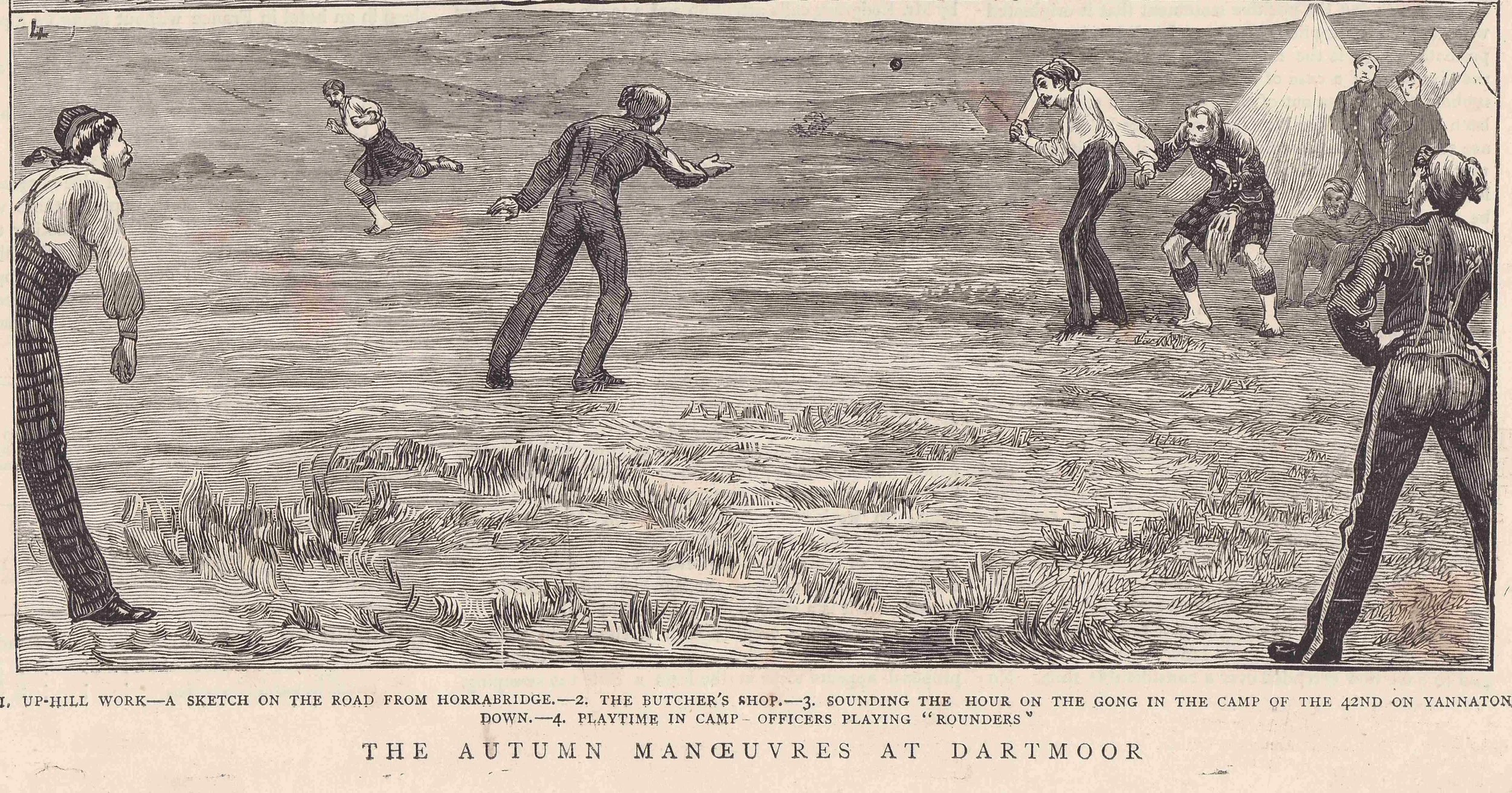
Rounders on Dartmoor, Graphic, 16 August 1873, 1. Author's own collection.
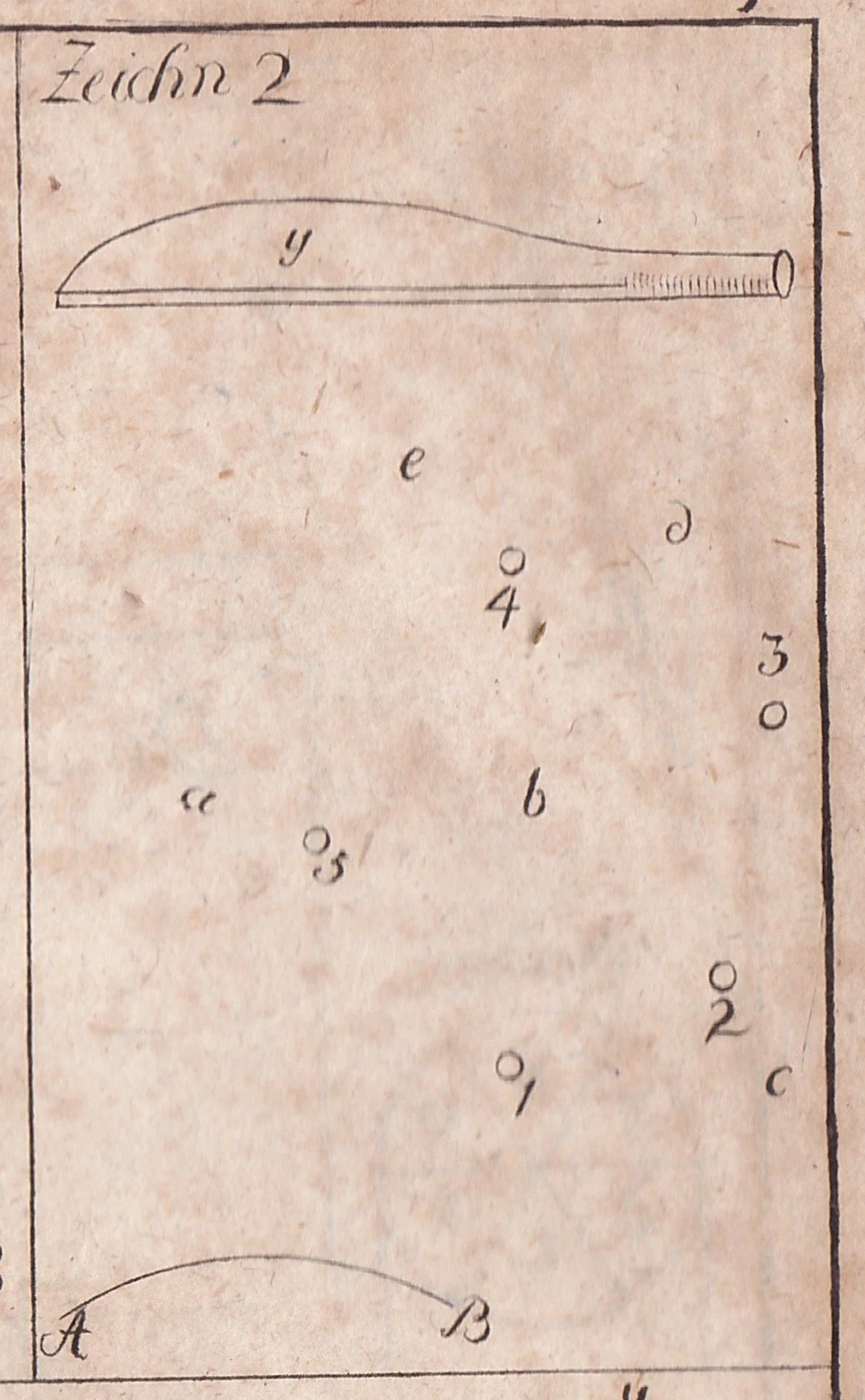
"Englische Base-Ball", GutsMuths, 1802 edition. Author's own collection.
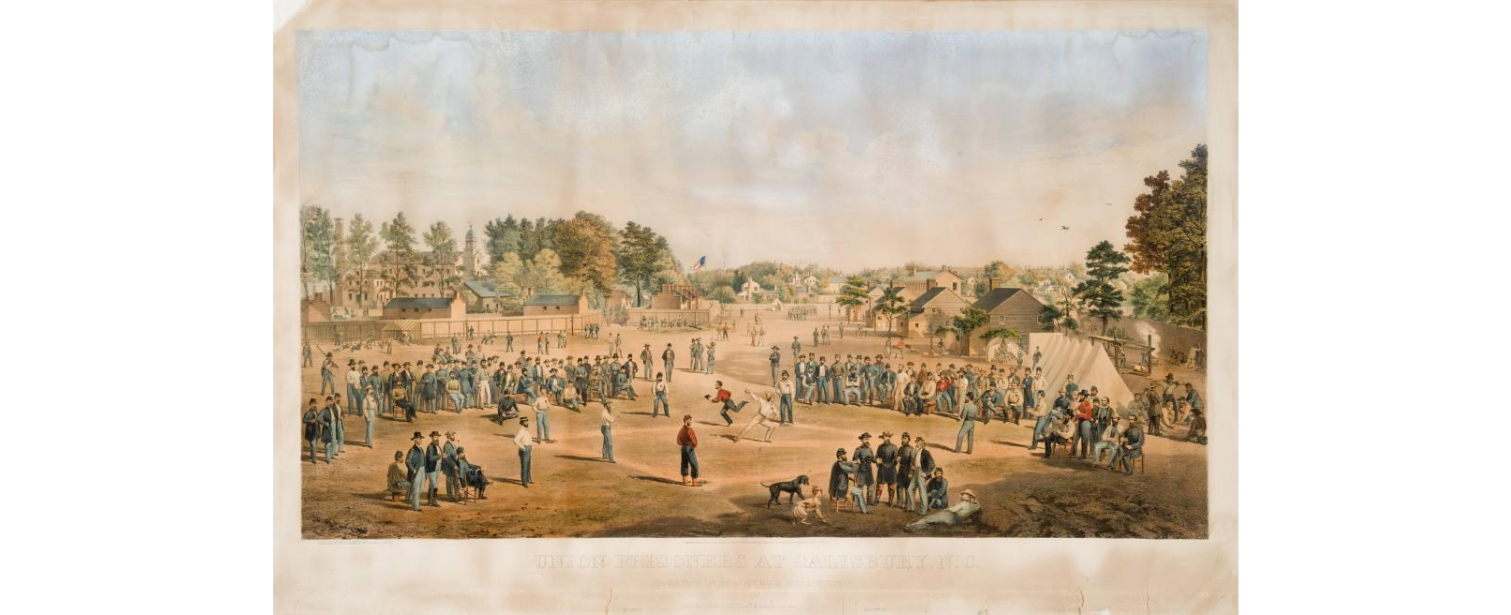
Otto Boetticher, Union Prisoners at Salisbury, North Carolina. Lithograph. New York: Sarony, Major & Knapp, 1863. Image created by the Library of Congress. Public domain.
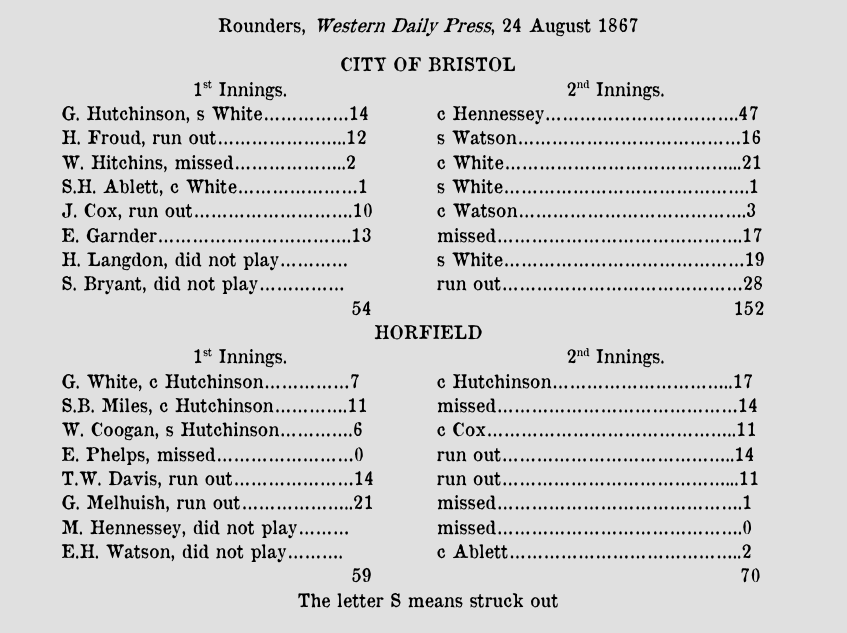
The Bristol game, Western Daily Press, 24 August 1867, 3. Author's own transcription.

The earliest iteration of the Liverpool game, Liverpool Daily Post, 8 June 1875, 6. Author's own transcription.
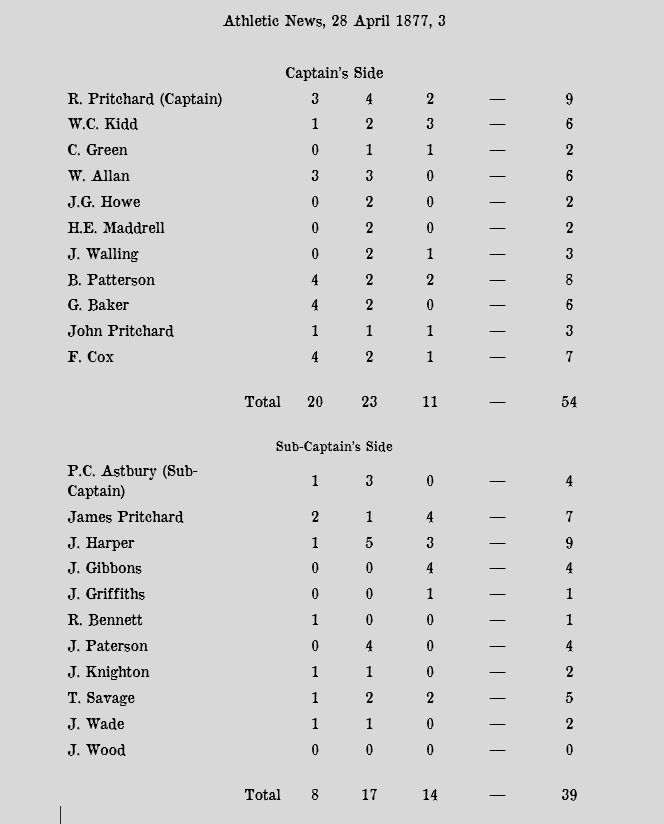
The mature Liverpool game, Liverpool Rounders Club. Athletic News, 28 April 1877, 3. Author's own transcription.
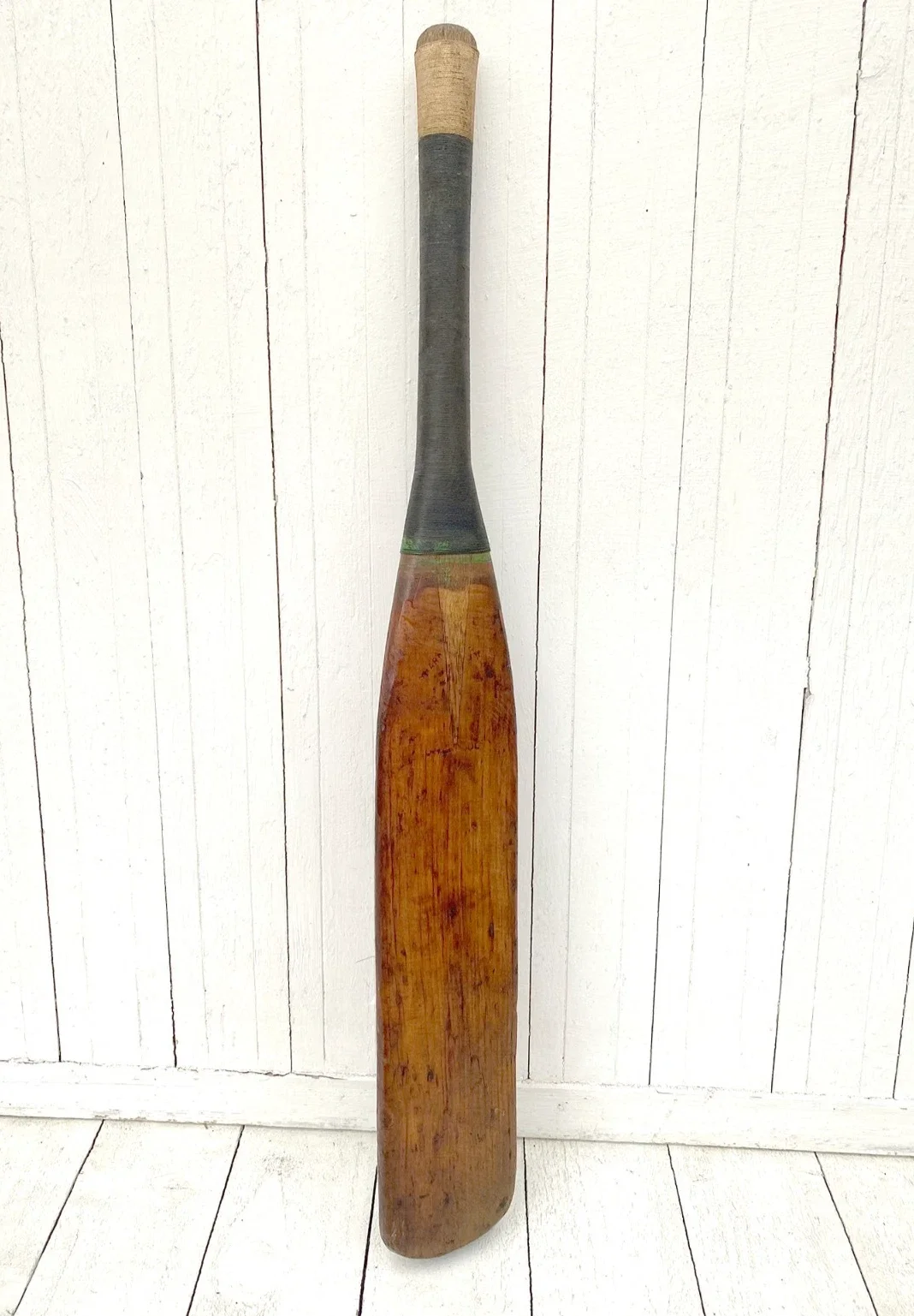
A bat for the Liverpool game made by Jack Sharp, sports goods manufacturer of Liverpool. eBay listing, 2026. Copyright not determined.
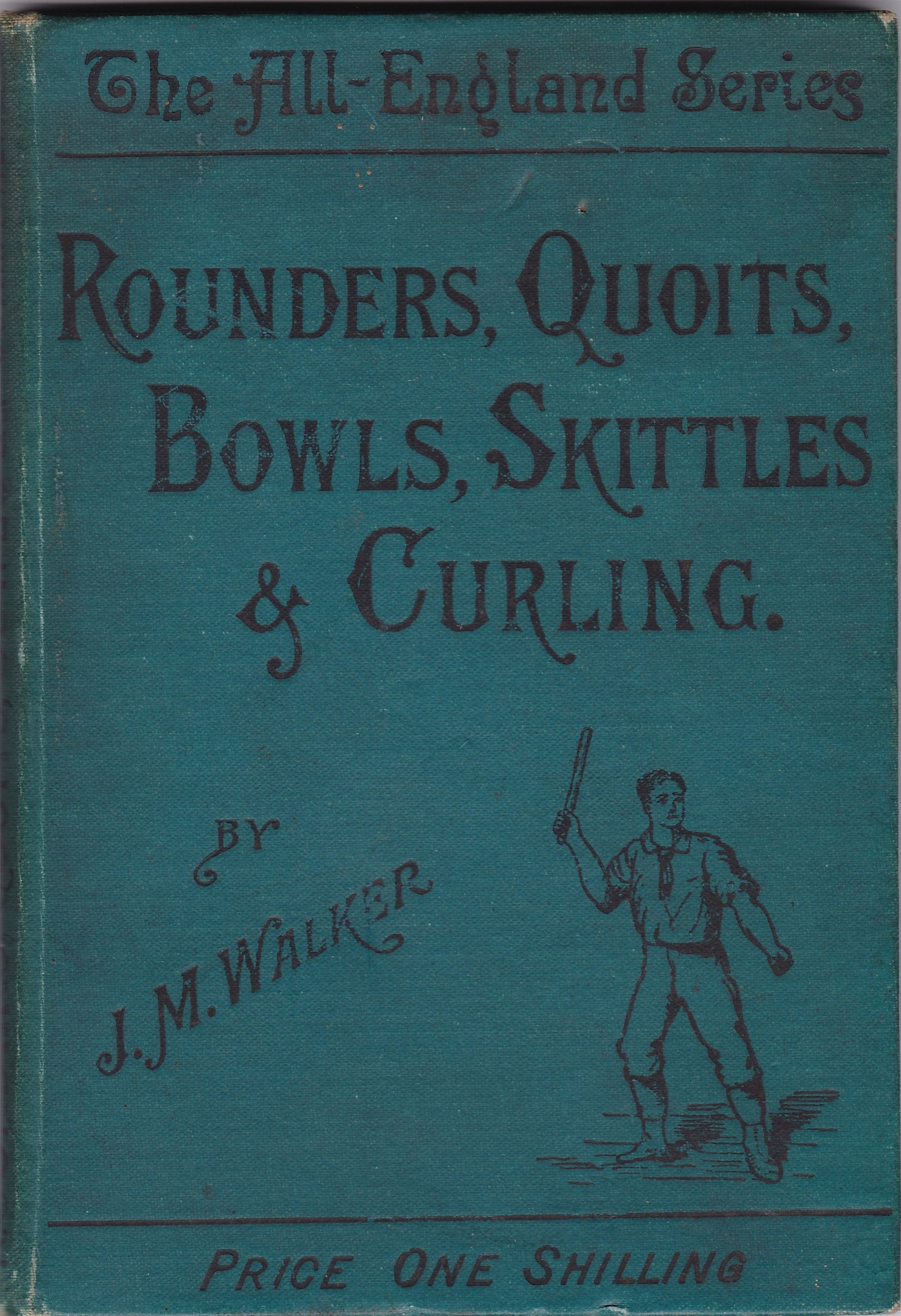
James Walker, Rounders, Quoits, Bowls, Skittles, and Curling, 1892. Author's own collection.
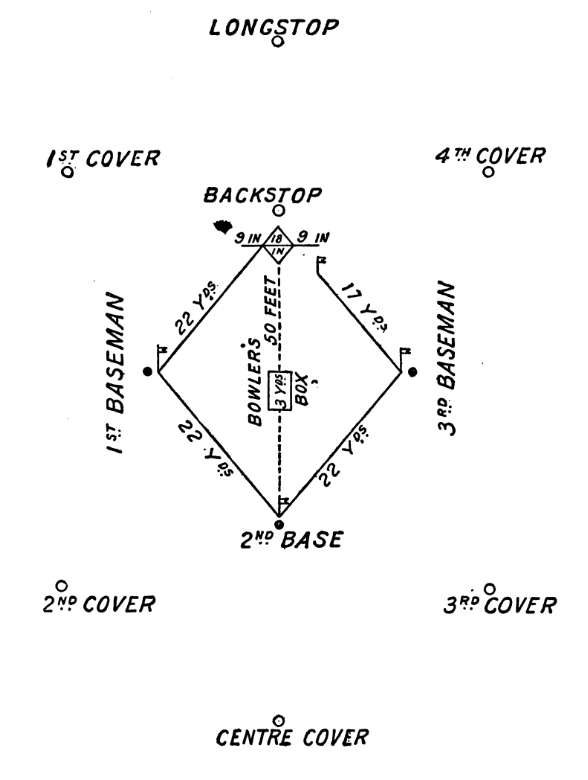
diagram of the layout for rounders under the 1889 National Rounders Association rules. Published in Walker, 1892. Author's own collection.