Shadowplay.
Jamie Barras.
Mr. BREAREY, in support of the charge, stated that the adjournment had enabled him to ascertain that the word "child" was now applicable to both illegitimate and legitimate offspring. In 1844, an act was passed apparently with the view of remedying a previous defect in the law, by which the word "child" had been decided to mean only the offspring of married parents, but now it was made an offence for a mother to desert her bastard children, whereby they became chargeable to the parish.[1]
On 5 September 1893, a court in Sheffield, Yorkshire, sentenced 21-year-old Ellen Linglook to 21 days in prison for what, for Victorian England, was an all-too-ordinary crime: “deserting” her “bastard children”. Behind this tragedy—and injustice—there was an all-too-ordinary story of a young woman whose common-law partner had died or deserted her, leaving her unable to provide for their children.[2]
From the registration of the birth of one of those children—Millicent, born in Wigan, Lancashire, on 7 September 1891—we have the additional information that Ellen’s real surname was “Moore” and that her partner’s—assumed—name was “Louis Linglook”, and he was an “artist (painter)”. It seems likely, but not certain, that these were the “Lyng Look” and “Ellen Look” who, a few months before Millicent was born, were living with their two-year-old daughter, Louisa, in West Leigh, just a few miles southeast of Wigan. In their census return, the couple gave their respective ages as 60 and 20, and places of birth as “South America” and “Lancashire Liverpool”. Lyng Look gave his profession as “cabinet polisher” (aka, French polisher)—a different kind of job using a brush to “artist”—and Ellen’s age is a couple of years off, so we cannot be completely certain; however, that coincidence in names—Ellen, Ling/Lyng, Look, and Louis(a)—in two families six miles and five months apart, makes it likely.[3]
This all-too-ordinary tragedy is made extraordinary by that choice of pseudonym: “Louis Linglook”. Treated separately, those two names share an unusual history. That history may point to Louis Linglook’s real identity. At the very least, exploring that history will allow us to once again pick at one of the threads of the Staged Identities series: adopting a stage name and identity was an easy way to disappear.
THE MISFORTUNE TO LING LOOK.—Ling Look, a Chinese sword-swallower, was exhibiting recently in Marseilles. Having swallowed the sword as far as the handle, Ling fastened to the guard a rifle, pulled the trigger and discharged the piece. Having failed to size the sword between his teeth, to guard against the recoil of the rifle, the latter kicked and forced the sword of his convenient stomach.[4]
In a sense, there was never such a thing as the “real” Ling Look; however, as much as that term can be applied, it can be applied to the stage performer who first came to public attention in France in 1868. Presenting himself as Chinese, this Ling Look performed feats of sword swallowing that included swallowing a raw egg alongside a sword and then producing the egg, intact. The act’s finale centred on Ling Look firing a rifle resting against the hilt of a sword he had “half-swallowed” such that the recoil propelled the rest of the sword rapidly down his throat—a stunt that, even though it was a stunt, was as dangerous as it sounded. I say “first Ling Look”, but it must be acknowledged that it is possible that this Ling Look took his name and further inspiration from Ling Ah Look, one of the attendants of Chang Woo Gow (詹世釵, Chang Yoo Sing, 1841–1893), the 7-foot-9-inch Fuzhou-born polymath who, in the second half of the nineteenth century, made a small fortune touring the world as “the Chinese Giant”. Ling Ah Look was a member of Chang’s retinue during his first tour of Europe in 1866–1867; it is easy to believe that “our” Ling Look saw one of those performances. Coincidentally, in later years, Ling Look met Chang Woo Gow while the former was performing in Shanghai.[5]
Ling Look, the sword swallower, was not Chinese. His real name was Ferdinand Guder (Ferdinand Güder, 1842–1878), and he was born in Moravia in what is now Czechia. Czechia was then part of the Austro-Hungarian Empire, and the press variably described Guder as Austrian or Hungarian. The revelation of Ling Look’s true identity would come nearly a decade after he first stepped onto the stage in France. By then, he was performing alongside a contortionist billed as “Yamadeva”/“Yamadiva”, the “great man serpent”. This was revealed to be Ferdinand’s younger brother, Louis Guder (Lois Güder, 1852–1877). These are the “Louis” and “Ling Look” whose names, nearly two decades later, someone would combine to create “Louis Linglook”.[6]
The Guder brothers seem to have begun touring together in 1872. At least, the anglophone press contains no account of him between Ling Look’s injury while performing in France in 1868 and the first mentions of his partnership with Yamadeva in 1872. While this does not preclude performances in Europe during this period, it is also possible that this reflects a long convalescence following his injury. There is a third possibility that we will return to: that the Ling Look who partnered with Yamadeva was not the Ling Look who performed in France in 1868, but a protégé, trained by the injured original Ling Look to take over his act. That it was indeed the same act—with additions—can be judged from the fact that it still included both the swallowing of a raw egg alongside a sword and the dramatic finale with the recoil of a discharged firearm propelling a sword down Ling Look’s throat. If this was not the original Ling Look, it was someone intimately familiar with his act, and, critically, the trick to how it was performed.[7]
The Guder brothers travelled—under their own names—from Europe to the USA in March 1872. They then embarked on a nationwide tour. America evidently impressed them, because, in February 1873, they became American citizens. However, the honeymoon was short, as, by August of that year, they were reduced to performing in a “small wagon show in Pennsylvania village”. Ling Look was also, by this time, being referred to in the press as a “Teutonic Chinaman”—he was no longer fooling anyone.[8]
Undaunted, the pair applied for US passports so they could take their act to the wider world. On their applications, they listed their place of birth as “Brünn”—the town more commonly known as Brno—in Moravia. They spent much of the next two years touring the Caribbean and South and Central America. May 1875 found them in Puerto Rico, where a report of Ling Look’s appearance at a local theatre published in the Boletin Mercantil de Puerto Rico was accompanied in the same edition by the appearance of the names “F. Guder” and “L. Guder” on a list of people leaving from the port of San Juan; useful independent evidence for the identification of the Guder brothers as Ling Look and Yamadeva.[9]
Eighteen Seventy-Five was a year of particular significance in the careers of the Guder brothers: that year, they partnered with two other performers, Kellar and Cunard, to form the Royal Illusionists.
Well, then, my master’s name, that is the name by which he is known to all, even to good people down here (or up here) is Harry Kellar, who is known wherever the English language is spoken, and in a great many places where it is not.[10]
Harry Kellar (Heinrich Keller, 1849–1922) emerged from the nineteenth century as one of the giants of American stage magic, a performer with worldwide fame. However, in 1875, he was just establishing himself as a performer in his own right after long years of apprenticeship under first the “Fakir of Ava” (Isaiah Harris Hughes, 1813–1891), then the “spiritualists”, the Davenport Brothers, and, finally, in partnership with one of the “mediums” from the Davenport Brothers’ show, William Marion Fay. He formed the Kellar and Cunard double-act in early 1875. “Cunard” was a stage name used by several partners employed by Kellar as assistants. It is possible that the original Cunard was a Frenchman of that name, as Kellar claimed; however, later Cunards included American David Hayman, brother to Kellar’s business manager, Al Hayman, and Briton Archimedes Socrates Cicero Litherland (yes, that was his real name). Sources disagree on who was performing as Cunard while Kellar and Cunard partnered with Ling Look and Yamadeva; however, it is likely it was David Hayman, as this was when Al Hayman was serving as Kellar’s business manager.[11]
Kellar was an intelligent and literate man. He shared with his later friend Harry Houdini an interest in the history and evolution of stage magic in America, and his account of the early decades of his career remains one of our best sources for the story of how stage magic in America evolved from the presentation of parlour tricks to grand illusions.[12]
According to Kellar’s later account, he, Cunard, and the Guder brothers ran into each other in Panama sometime in late 1875/early 1876, and returned to New York in March 1876 to begin their new careers as the Royal Illusionists. The name was a steal from the billing of the famous English illusionists Maskelyne and Cooke. John Neville Maskelyne (1839–1917) and George Alfred Cooke (1825–1905) had got their start in stage magic by exposing the tricks of the Davenport Brothers, Kellar’s former employers. (The Davenports presented themselves as real mediums; their act was, of course, staged, as Maskelyne and Cooke demonstrated.) In the early part of his career, Kellar would derive much of his material from Maskelyne and Cooke, sometimes openly, in the form of buying apparatus from them, and sometimes covertly, in the form of bribing members of Maskelyne and Cooke’s stage crew to furnish the necessary details for Kellar to copy the apparatus. Kellar was not technically adept; his skill as a stage magician was in recognising what would work with an audience; allegations of stealing bits from other stage magicians would dog him for much of his career.[13]
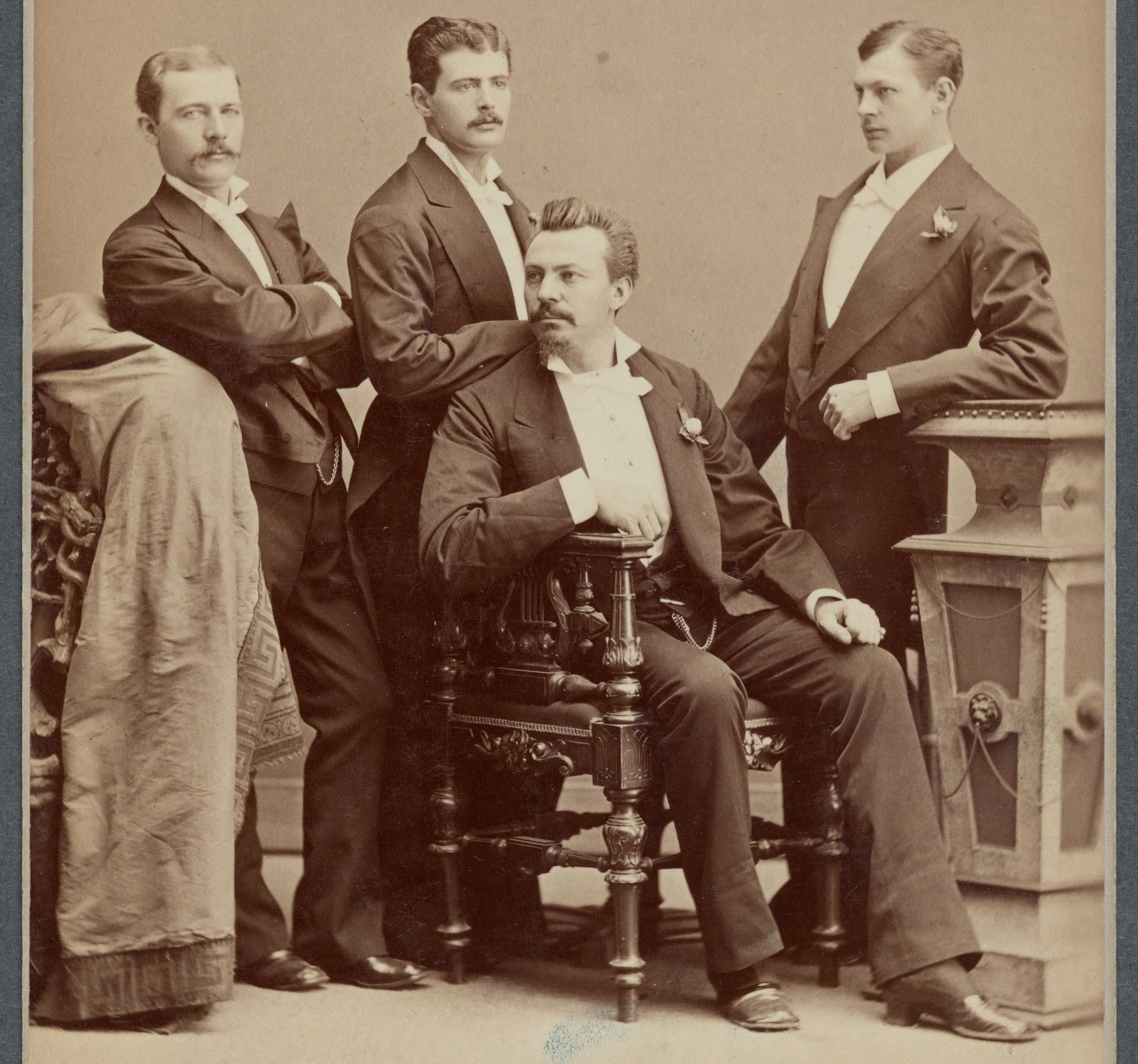
Despite returning to America via New York in March 1876, the Royal Illusionists did not debut until May 1876 on the other side of the country, in San Francisco, California. They followed this engagement with a brief tour of the American West, before, on 4 July 1876, sailing for Australia. Thanks to Kellar’s gift for showmanship, this would be where Ling Look and Yamadeva achieved their greatest success. Their acts remained the same, but Kellar provided new staging and scene setting. Notably, Ling Look performed part of his act in evening clothes, not “yellowface”, and cabinet photographs of the Kellar, Cunard, Ling Look, and Yamadeva Royal Illusionists from this tour show all four men in evening clothes without stage make-up, making plain that they were all of European extraction, and, in the case of Ling Look, that the “Chinese necromancer” was just a stage persona.[14]
This is not to say that the Australian tour was an unqualified success. Houses were not always full, and the tour came to an ignominious end in Adelaide, South Australia, in May 1877. Unhappy with the arrangements made by their Australian booking agent, the Royal Illusionists disappeared on the way to a performance at Port Adelaide. It was later discovered that they had boarded a boat for Melbourne and, from there, departed for Southeast Asia for the next leg of their tour. They left their inept Australian booking agent to cover the costs of their cancelled bookings.[15]
The Royal Illusionists’ tour of Southeast Asia took in Singapore, Java, and Siam (Thailand). They then made for China. In Shanghai, tragedy struck.
This roused Yamadeva, and he also attempted to throw the large ball, but in doing so fell back and complained of a pain in the right chest. We drove him back to the city and summoned an English physician[…][16]
According to Kellar’s later account, one afternoon, the Illusionists visited the Hermitage summer garden outside Shanghai in the company of Chang Woo Gow and “several ship’s captains”. There, Yamadeva challenged one of the ship captains to a game of bowls, only to suffer an internal injury, diagnosed as ruptured muscles. He was confined to bed for four days, but was then judged fit enough for the Royal Illusionists to set off for their next engagement in Hong Kong on board the steamship Khiva. Alas, Yamadeva suffered a sudden relapse and died of a burst blood vessel on their first night at sea. This account is corroborated by the UK Register of Deaths at Sea, which records Yamadeva’s name as “Lois Gudir”, and his date and place of death as 7 October 1877 on board the steamship Khiva.[17]
Lois Guder/Yamadeva’s body was carried to Hong Kong, and he was laid to rest in Happy Valley Cemetery. Reports of his death were the first to identify Ling Look and Yamadeva as “Austrian” brothers named Guder. Meanwhile, the Royal Illusionists began a series of performances in Hong Kong. However, it is not certain if Ferdinand Guder/Ling Look took part. What is certain is that, while the Royal Illusionists were in Hong Kong, Ferdinand Guder fell ill and was admitted to hospital for an operation on his liver. Kellar and Cunard departed from Hong Kong for the next stop of their tour without him. They returned to Hong Kong later that spring to be met with the news that Ferdinand Guder had died during surgery and had been buried alongside his brother. Kellar and Cunard paid their respects to the brothers’ graves and then returned to their touring.[18]
So ended the story of the first Ling Look. But not the story of Ling Look.
W.S. BOOTH begs to return his sincere thanks to Mr. D. Saunders, the Sisters Taylor, Mr. E.C. Dunbar, Herr Ling-Look, Mr. Harry Castor, &c., for kindly assisting on his Inaugural night and rendering it such a complete success.[19]
Within nine months of the death of Ferdinand Guder/Ling Look in Hong Kong, a second Ling Look had appeared in England. He debuted in Manchester and was billed as “Herr Ling-Look”, an early indication of a connection to the original. He was said to be newly arrived in England and unable to speak English. In his first few months in the country, his business dealings were handled by fellow illusionist Henri Herrmann, who had been performing in England since at least 1863, and whose billing as the “Great German Wizard” hints at why the newly arrived, non-English-speaking “Herr Ling-Look” found him useful.[20]
LING LOOK’S Original and World-Renowned Performance of Eating Fire, Biting Off Red-Hot Iron, Drinking Boiling Oil, including Sword and Egg Swallowing, eclipses anything ever seen.[21]
The real evidence for the connection between this Ling Look and the original was in his act; it was the familiar combination of fire-breathing and egg and sword swallowing, culminating in a spectacular finale where he used the recoil of a discharged firearm to propel a sword down his throat.[22]
It is also clear, as the use of the phrase “world-renowned” in the quote above shows, that this Ling Look presented himself as the Ling Look, the performer who had found fame in Australia the previous summer. This pretence would lead to a confrontation with Harry Kellar in late 1879/early 1880. Kellar and Cunard had, in fact, passed through England on the way back to the US the previous summer, within a few months of the death of the Guder brothers. Kellar had taken the opportunity to observe Maskelyne and Cooke at work at the Egyptian Hall in London. On their return to America, he added to the act his take on the Maskelyne and Cooke automaton “Psycho” (actually, a mechanism controlled by a human operator secreted inside). With typical gall, he claimed that his Psycho was the original.[23]
Kellar and Cunard returned to the UK in December 1879 for a brief engagement at the Waverley Hall in Edinburgh. At some point, Kellar entered into a correspondence with the “new” Ling Look (probably via the letter-holding service offered by the variety trade paper The Era). According to Kellar’s later account, this Ling Look knew things about his (Kellar’s) involvement with Ling Look and Yamadeva that only someone in contact with Ling Look and/or Yamadeva at the time could have known. However, when Kellar travelled from Edinburgh to Liverpool to meet him and introduced himself as a “friend of Harry Kellar”, this Ling Look had no idea that it was really Harry Kellar he was talking to, revealing himself to be an imposter. At different times, Kellar gave two accounts of what happened next. In the first, an account sent to the US press soon after the encounter, when Kellar revealed his true identity, the false Ling Look simply took up his hat and left without a word. In the second, a story Kellar told to his friend Harry Houdini decades later, the false Ling Look stayed long enough to tell Kellar that he was, in fact, the “true” Ling Look’s younger brother.[24]
Was the new Ling Look Ferdinand Guder’s younger brother? Like many others before me, I have endeavoured to try to find the answer to that question in official records and come up empty. Based on his notices, it seems that Ling Look was in Africa for at least part of 1881. This may explain why he cannot be found in the 1881 England Census. However, it doesn’t help that “Güder” can be anglicised in any number of ways (Guder, Gueder, Guter, Geuter, Guerther, etc.). We can at least say that he did not submit a return under his stage name, as some performing artists did.[25]
Instead, we are left with examining what little biographical information we have for this second Ling Look to see if the story holds up. This information entered the public record as a result of yet another tragic death associated with the Ling Look act.
A shocking accident occurred at the Oxford Theatre of Varieties, New-road, Brighton, last evening, a boy’s head being completely shattered by a cannon during the performance. Ling Look, a Chinaman, who describes himself as the “Lord of Fire, Cannon, and Sword”, who commenced an engagement at the Music Hall the previous evening, was just completing his entertainment when the fatality resulted.[26]
On 27 December 1881, during a performance at a small music hall in Brighton, an accident during the climax of Ling Look’s act took the life of 15-year-old George Smythe in the bloodiest way possible. One change this second (or third) Ling Look had made to the act was to replace or supplement the rifle used in the finale with a specially made “cannon”, a 3 ½-feet long, 2½ -inch diameter wooden tube encased in tin. As with the rifle, the end of the cannon was placed against the hilt of a sword halfway down Ling Look’s throat; then, the cannon was fired, and the recoil drove the sword the rest of the way down Ling Look’s throat. This, to the untrained eye, made the stunt even more hazardous for Ling Look. Most members of the audience would not have appreciated that the force of the recoil would depend on the size of the gunpowder charge and pellet loaded into the cannon; with careful choice of both, the “cannon” delivered no more recoil than a rifle, but provided much more dramatic visuals. The pellet in question was a wad of paper, and, in the normal run of the routine, Ling Look would aim the cannon such that the wad of paper would be fired up into the air over the heads of the audience. However, the Oxford was a very small performing space—the front of the upper gallery was only 22 feet from the stage. There was little to no margin for error. Ling Look carried off the trick successfully on the first night of the run, but the next night, despite calls from the music hall commissioner for people in the gallery to sit back, George Smythe rose in his seat for a better view. When the “cannon” was fired, the paper pellet, propelled at great speed, struck young George in the head and smashed his skull to smithereens.[27]
Ling Look, his wife, Caroline, who was his assistant, and Mrs Ellen Botham, the proprietress of the Oxford, were all arrested and charged with manslaughter. Ling Look’s wife’s name was given in the press as Caroline, and she was described as English and 23 years old. It was also revealed that the couple had “a young family”—this led to Caroline being released on bail while Ling Look was remanded. Ling Look himself was described in some reports as 34 years old and in others, and in the court records, as 43 years old. This discrepancy is unhelpful. However, we will explore this later.[28]
Remarkably, despite being described in the press as having a “physiognomy” that was “not at all Chinese”, and at least one newspaper as far away as Boston, Massachusetts, reporting that he was in fact “German”, Ling Look was charged and tried under that name (more precisely as “Ali Ling Look”).[29]
He remained largely silent throughout the whole process, Caroline doing the talking for him. Ling Look communicated to the authorities only by writing notes. At the trial, Caroline claimed that he could not hear. Had years of performing an act that involved discharging a firearm made him deaf? It is certainly possible. However, another possibility is that, along with not providing his real name, he stayed silent to avoid revealing that he was not Chinese. It is easy to imagine his reasoning: if by some miracle he escaped conviction, if the only name by which the killer of George Smythe was known was the “Chinaman Ling Look”, the man behind the Ling Look persona could simply abandon it and start again under his own name.
In the event, the precaution, if that’s what it was, proved unnecessary.
CANTERBURY.—LING LOOK.—Special Engagement.—LING LOOK, the great Chinese Conjuror, will make his First Appearance here TO-NIGHT. To illustrate the perfect safety of his tricks, the cannon will be examined nightly on the stage, prior to his performance, in the presence of competent authorities.[30]
“Ali” Ling Look and Caroline Ling Look stood trial at Lewes Assizes on 12 January 1882. (Ellen Botham, the proprietress of the Oxford, although arrested and arraigned, was not committed to trial.) The facts of the case were presented, and evidence was heard from, amongst others, George Smythe’s grieving father and several of the other artists who had performed at the Oxford that dreadful night. In making his plea to the jury, the Ling Looks’ barrister intimated that Ling Look’s career was ruined and the performance was discredited, and “no doubt, would not be repeated again.”[31]
The Judge gave a summing-up sympathetic to the Ling Looks and the jury deliberated for only a short while before returning “not guilty” verdicts on all charges.
Four days later, Ling Look performed his whole act, cannon finale included, to a packed house at the Canterbury Music Hall in London in what would prove to be the start of a sell-out run.
There is no such thing as bad publicity.
So what can we learn about this Ling Look from this incident? If the court records and some newspaper reports are to be believed, his age at the time of his arrest was 43, giving him a year of birth of 1839. As Ferdinand Guder was born in 1842, if this is the case, then the “new” Ling Look could not be Ferdinand’s younger brother as Harry Kellar claimed he said he was. Of course, other newspaper reports gave his age as 34, giving him a year of birth of 1848, which would make that relationship possible. We also know that he had a [common-law?] wife named Caroline and at least one child. Alas, once more, a search using variants of Guder does not turn up any marriage or birth that might be confidently assigned to this relationship.
I think this Ling Look was born in 1839 and was not Ferdinand Guder’s younger brother, but rather his older brother. Returning to the question of the “missing” years from the injury in France in 1868 to Ling Look and Yamadeva beginning their partnership in 1872, I think the most likely chain of events is that the first Ling Look was Ferdinand Guder’s older brother. Following his injury, and believing, perhaps, that he would never perform again, he trained Ferdinand as his replacement, the second Ling Look. Ferdinand and Louis toured North and South America, and then Asia, for five successful years, but then tragedy struck, and they both died in East Asia in 1877/78 at the height of their fame and success. I think this spurred the elder Guder brother, perhaps in tribute to his brothers, perhaps simply because he did not want to see the opportunity go to waste, to return to performing the Ling Look act that he originated over a decade earlier.
I find this a much more compelling chain of events than the alternative: Ferdinand Guder was the original Link Look. Following his injury in France in 1868, he trained his younger brother to replace him, only to then return to performing as Ling Look instead. This left his supposed successor with no outlet for his newfound skills until he, Ferdinand, died in 1878, leaving the way clear for his younger brother to take up the role he had trained him for a decade earlier.
Alas, it is only a theory.
A most extraordinary entertainment is given by Ling Look, who is a perfect wonder. He swallows swords and bayonets, rubs his body with red-hot iron just that he possesses no natural feeling and having forced a bayonet down his throat allows a gun to which it is affixed to be fired.[32]
For months after his acquittal, Ling Look traded on his infamy, his billing even directly referencing the tragedy: “LING LOOK, the Chinaman, of Brighton notoriety, in his marvellous performance”. However, even infamy was fleeting in the Victorian music hall, and, in time, he simply settled back into the same routine, touring the same act around Great Britain and Ireland and appearing in pantomime at Christmas. As to Caroline and their child or children: they were never mentioned again after the acquittals. However, it should also be stated that they were never mentioned before the incident at Brighton either, even though Caroline was working as Ling Look’s assistant for some time before the tragedy. This absence from the press may simply have reflected the press’s general lack of interest in performers’ assistants and families.[33]
In late 1886, a “Professor Ling Look”, whose act comprised “sword swallowing, gun exhibition, and fire eating”, the signature Ling Look routine, appeared in Australia. At first glance, this might seem to be Ling Look embarking on a second foreign tour (following his first, to Africa, in 1881). However, we find this Professor Ling Look performing in Melbourne, Victoria, on 16 November 1886, and then “Ling Look, fire and sword performer” appearing in Manchester, England, on 1 January 1887. It would not have been possible in this period for someone to travel from Australia to England in only six weeks. So, one of these men is yet another “fake” Ling Look. It seems likely that it was the Australian “Professor Ling Look”—a billing that the Ling Look touring England never used—who was the [new] fake. It is worth noting in this regard that his appearances in Australia were restricted to a single month, while we can trace the continuing career of the Ling Look in England across the rest of 1887 and beyond.[34]
“Professor Ling Look” shared the bill with Charles Sylvester, the son of Alfred Sylvester, “the Fakir of Oolu”, a British-born illusionist who had settled in Australia. At least two of Alfred Sylvester’s sons followed him on to the stage. We might reasonably suspect that “Professor Ling Look” was Charles Sylvester or one of his assistants.[35]
The Sylvester family had a history of stealing from the Royal Illusionists. It will be remembered that the first (second?) Ling Look toured Australia with Harry Kellar and the other Royal Illusionists back in 1876–1877. A controversial highlight of Harry Kellar’s act in this period was a trick that involved making a caged bird disappear. There was a suspicion that the trick employed a spring-loaded trapdoor that crushed the bird beneath it when it was triggered. Kellar mounted a live demonstration to show that this wasn’t the case (which of course only proved that the trick could be performed without killing the bird, not that it was). After the Royal Illusionists left Australia, Alfred Sylvester Jr, Alfred Senior’s son and Charles’ brother, added the disappearing bird trick to his own act. Then, in 1879, Alfred Sylvester Senior allied with William Marion Fay, Harry Kellar’s erstwhile partner, to mount a tour of Asia, following the route taken by the Royal Illusionists two years earlier to reap the goodwill that they had sown. It is also worth noting that at least one of the artists who performed as “Cunard”, Harry Kellar’s partner and assistant, the Englishman Archimedes Socrates Cicero Litherland, had by this time settled in Australia and gone into artist management.[36]
VICTORIA VARIETIES.—General Manager, Mr. Tom Melbourne.—A strong company is provided here this week, the bill being headed by the Louisiana troubadour quartet, who received great approbation. The Three Macks are especially worthy of mention; as are the Lindsays, musical eccentrics. Ling Look’s assault-at-arms, and Bunth and Bond, tumblers, &c., are very successful. Miss Daisy May, serio-comic, and Hal Croueste, vocal comedian, assist greatly in the success.[37]
Ling Look made his final appearance in the English variety press in November 1890. He was, by this time, well down the bill. His sword swallowing and fire breathing days were behind him. Instead, his performance consisted of an “assault-at-arms”—a martial arts display—with fire and sword, something that had been a feature of his act since at least 1887. This speaks of a performer reaching the end of their performing life. If, as I have speculated, this Ling Look was the “original” Ling Look of 1868, this is not a surprise: 20 years is a long time to spend swallowing foreign objects and working with hot irons, burning coals, and discharging firearms. We can well imagine the damage he had done to his body.
Five months after Ling Look’s last recorded appearance on an English stage, in Bolton, Lancashire, “Lyng Look” filled out a census return ten miles away in West Leigh for himself, his “wife”, Ellen, and their two-year-old daughter, Louisa. And five months after that, and another six miles away in Wigan, Ellen Linglook gave birth to a baby girl that she and her “husband”, Louis Linglook, named Millicent.[38]
Were Ling Look, Lyng Look, and Louis Linglook the same man? Alas, we cannot know. All three were too good at covering their tracks. Lyng Look and Louis Linglook were probably the same man, based on the coincidence of names on the two records we have for them, the Lyng Look census entry and the birth registration for Louis Linglook’s daughter; however, whether he was also Ling Look, the sword swallower, is much less certain. There is the issue of how Lyng Look described himself in his census return, namely aged 60 and a cabinet/French polisher, neither of which can be made to fit Ling Look. If you are going to lie about your age and profession, why use your “real” stage name? We might suspect that Lyng Look, whoever he really was, in grasping for a fake name to use in his census return, latched onto the name of an artist he had seen perform a few months earlier. But against that, what are we to make of the “Louis Linglook” identity—was it just a coincidence that Louis was also the name of the brother of one of the men who performed as Ling Look?
We also cannot know what this meant for the women in the lives/life of these men/this man and the children they had together. What became of Caroline, the “wife” of Ling Look, and their child or children? We know that by 1893, Ellen Linglook, the partner of Louis Linglook, who was probably also Ellen Look, the partner of Lyng Look, had been left to provide for their children alone, something she proved unable to do. However, what happened to her and the children after that is another mystery.
Ling Look was a mask worn by several men. With its aid, from out of the shadows, these men appeared, and then back into the shadows, they went. And when they went, they took the truth about the lives of so many with them.
Jamie Barras, October 2026.
Back to Staged Identities
Notes
[1] “The Case of Children Desertion”, York Herald, 16 May 1857, 11.
[2] Entry for Ellen Linglook, West Yorkshire Archive Service; Wakefield, West Yorkshire, England; Register 8 of Female Prisoners; Year Range: 1893 Jun–1895 Jan, Reference Number: C118/234; entry for Ellen Linglook, Yorkshire, Sheffield Crime Courts and Convicts 1737-1938, findmypast.co.uk, accessed 25 October 2026.
[3] Birth registration for Millicent Linglook, Wigan district, born 7 September 1891, registered 28 September 1891, digital copy obtained from the General Registry Office, October 2026; census return for Lyng Look, Ellen Look, and Louisa Look, West Leigh District, 1891 England Census, ancestry.co.uk, Ancestry.com Inc. (Operations), accessed 25 October 2026.
[4] “The Misfortune to Ling Look”, Lansing State Republican, 14 April 1868, 3.
[5] Egg as well as sword swallowing: “An Expert Chinese Juggle”, Dodge County Republican (Kasson, Minn.), 31 October 1868, 2. Chang Woo Gow: http://npg.org.uk/collections/search/person/mp83366/chang-woo-gow-chang-yu-sing, accessed 27 October 2026. Chang Woo Gow and Ling Ah Look: “Great Attraction at the Yorkshire Fine Art & Industrial Exhibition”, York Herald, 15 September 1866, 7. Ling Look and Chang meet supposedly meet in Shanghai: Harry Kellar, A Magician's Tour, Up and Down and Round About the Earth: Being the Life and Adventures of the American Nostradamus, Harry Kellar (Chicago: Donohue, Henneberry, 1890), 84–85.
[6] See endnotes below for the evidence that Ling Look and Yamadeva were Ferdinand and Louis/Lois Guder, alongside: “A Strange Juggler”, Philadelphia Times, 16 February 1879, 3; “Notes of Interest”, Buffalo Daily Dispatch and Evening Post, 15 December 1877, 2.
[7] Compare the accounts in Note 4 and Note 5, first references, above, to those in “A Chinese Juggler”, Sydney Morning Herald, 22 October 1872, 3, and “American Theatricals”, Era, 11 August 1872, 10.
[8] Entries for Ferdinand Guder and Louis Guder, passenger list of the Ville de Paris, arrived New York, 15 March 1872, New York, U.S., Arriving passenger and Crew Lists (including Castle Garden and Ellis Island), 1820-1957; naturalisation papers for Ferdinand Guder and Louis Guder, 18 February 1873, New York, U.S., Index to petitions for naturalisation filed in New York 1792–1989, ancestry.co.uk, Ancestry.com Inc. (Operations), accessed 25 October 2026. “Varieties Theater”, St. Louis Globe-Democrat, 26 May 1872, 2; “Varieties”, Sunday Mercury (New York, NY), 10 August 1873, 6.
[9] US passport applications for Ferdinand Guder and Lois Guder, 30 October 1873, U.S., Passport Applications, 1795–1925, ancestry.co.uk, Ancestry.com Inc. (Operations), accessed 25 October 2026. “Teatro”, Boletin Mercantil de Puerto Rico, 14 May 1875, 3; “Movimiento Maritimo: Salidas”, Boletin Mercantil de Puerto Rico, 14 May 1875, 3.
[10] Kellar autobiography: Note 5 above, final reference, 10.
[11] Notables of the West: Being the Portraits and Biographies of the Progressive Men of the West Who Have Helped in the Development and History Making of This Wonderful Country (New York: International News Service, 1913), 457, s.v. “Harry Kellar”; Kent Blackmore, Alfred Sylvester: The Fakir of Oolu and His Family of Magic, chap. 4, accessed 28 October 2026, Sydney Magic; “A. Litherland Cunard”, Lorgnette, 30 August 1890, 5. Billy Rose Theatre Division, The New York Public Library. "Kellar: Levitation" New York Public Library Digital Collections. Accessed 28 October 2026. https://digitalcollections.nypl.org/items/1cc969d0-4845-0139-fe58-0242ac110004
[12] Kellar autobiography: Note 5 above, final reference.
[13] https://www.encyclopedia.com/science/encyclopedias-almanacs-transcripts-and-maps/davenport-brothers-ira-erastus1839-1911-and-william-henry-1841-1877, accessed 28 October 2026. It should be noted here that Maskelyne and Cooke exposed the tricks behind the Davenport Brothers’ fake spiritualism in 1865, a full four years before Harry Kellar joined the act, which was still going strong despite the efforts of Maskelyne and Cooke.
[14] Kellar autobiography, Note 5 above, final reference, 58–59; “Theatricals in California”, Utah Evening Mail, 24 May 1876, 4; “Royal Illusionists at St. George’s Hall”, Weekly Times (Melbourne, Vic), 30 December 1876, 14. Billy Rose Theatre Division, The New York Public Library. "The Royal Illusionists" New York Public Library Digital Collections. Accessed 28 October 2026. https://digitalcollections.nypl.org/items/244f1430-ff8c-012f-a4f7-58d385a7bc34.
[15] “New Trick by the Royal Illusionists”, Register News-Pictorial (Adelaide, SA), 9 May 1877, 5.
[16] “Kellar’s Ghost Story”, St. Louis Republic, 23 March 1890, 22.
[17] Note 16 above; entry for Lois Gudir, UK, Registers of Births, Marriages and Deaths at Sea, 1844–1890, ancestry.co.uk, Ancestry.com Inc. (Operations), accessed 25 October 2026.
[18] Kellar autobiography, Note 5 above, final reference, 88, 186–187; Harry Houdini, Miracle Mongers and Their Methods (New York: E. P. Dutton and Company, 1920), 86-87;
https://www.findagrave.com/memorial/93715358/louis-guder, https://www.findagrave.com/memorial/93715373/frederick-guder, accessed 28 October 2026. “Notes of Interest”, Buffalo Daily Dispatch and Evening Post, 15 December 1877, 2.
[19] “Manchester—Alexandra Hall”, Era, 2 February 1879, 18.
[20] “Manchester—Alexandra Hall”, Era, 16 February 1879, 9; “Ling Look”, Era, 9 March 1879, 17; “Day’s Crystal Palace Concert Hall”, Birmingham Daily Post, 22 January 1864, 1.
[21] “Ling Look”, Era, 23 February 1879, 17.
[22] Note 21 above; “The London Music Halls—South London Palace”, Era, 29 February 1880, 4.
[23] “Philharmonic Hall”, Hampshire Advertiser, 20 July 1878, 5; “A Peer of the Chinee”, Portland Press Herald, 4 March 1879, 1.
[24] “Edinburgh—Waverley Hall”, Era, 6 December 1879, 8; The letter is reproduced in Kellar’s autobiography, Note 5 above, final reference, 186–187. Account to Houdini: Note 18 above, second reference.
[25] “Mandarin Ling-Look, the Chinese Salamander and Sword Swallower, just returned from Africa”, Era, 17 December 1881, 21.
[26] “A Shocking Accident…”, London Evening Standard, 28 December 1881, 5.
[27] “Winter Assizes—South-East Circuit: Lewes”, Times, 13 January 1882, 11; “Fatal Accident at a Music Hall”, Era, 7 January 1882, 9. Age of George Smythe at death: entry for George Smythe, Brighton District, First Quarter of 1882, Births, Marriages, and Deaths, https://www.freebmd.org.uk/cgi/search.pl, accessed 30 October 2026.
[28] Note 26 above; entries for Ali Ling Look and Caroline Ling Look, Lewes Prison, date of warrant 6 January 1882, UK, Calendar of Prisoners, 1868–1929, ancestry.co.uk, Ancestry.com Inc. (Operations), accessed 25 October 2026.
[29] “Personal”, Boston Evening Transcript (Boston, MA), 19 January 1882, 8.
[30] “Canterbury—Ling Look”, London Evening Standard, 16 January 1882, 1.
[31] Note 26 above, first reference.
[32] “Birmingham Concert Hall”, Birmingham Daily Post, 26 December 1885, 5.
[33] “Gaiety Theatre of Varieties”, Preston Chronicle and Lancashire Advertiser, 15 April 1882, 1.
[34] Professor Ling Look: “Exhibition Building”, The Age (Melbourne, Vic.), 19 November 1886. The Ling Look of England: “Manchester: Star Theatre of Varieties”, Era, 1 January 1887, 18.
[35] Charles Sylvester: Kent Blackmore, Alfred Sylvester: The Fakir of Oolu and His Family of Magic, chap. 8, accessed 28 October 2026, Sydney Magic; Note 11 above, third reference.
[36] Kent Blackmore, Alfred Sylvester: The Fakir of Oolu and His Family of Magic, chap. 4, accessed 28 October 2026, Sydney Magic.
[37] “Bolton: Victoria Varieties”, Era, 8 November 1890, 18.
[38] Notes 2 and 3 above.
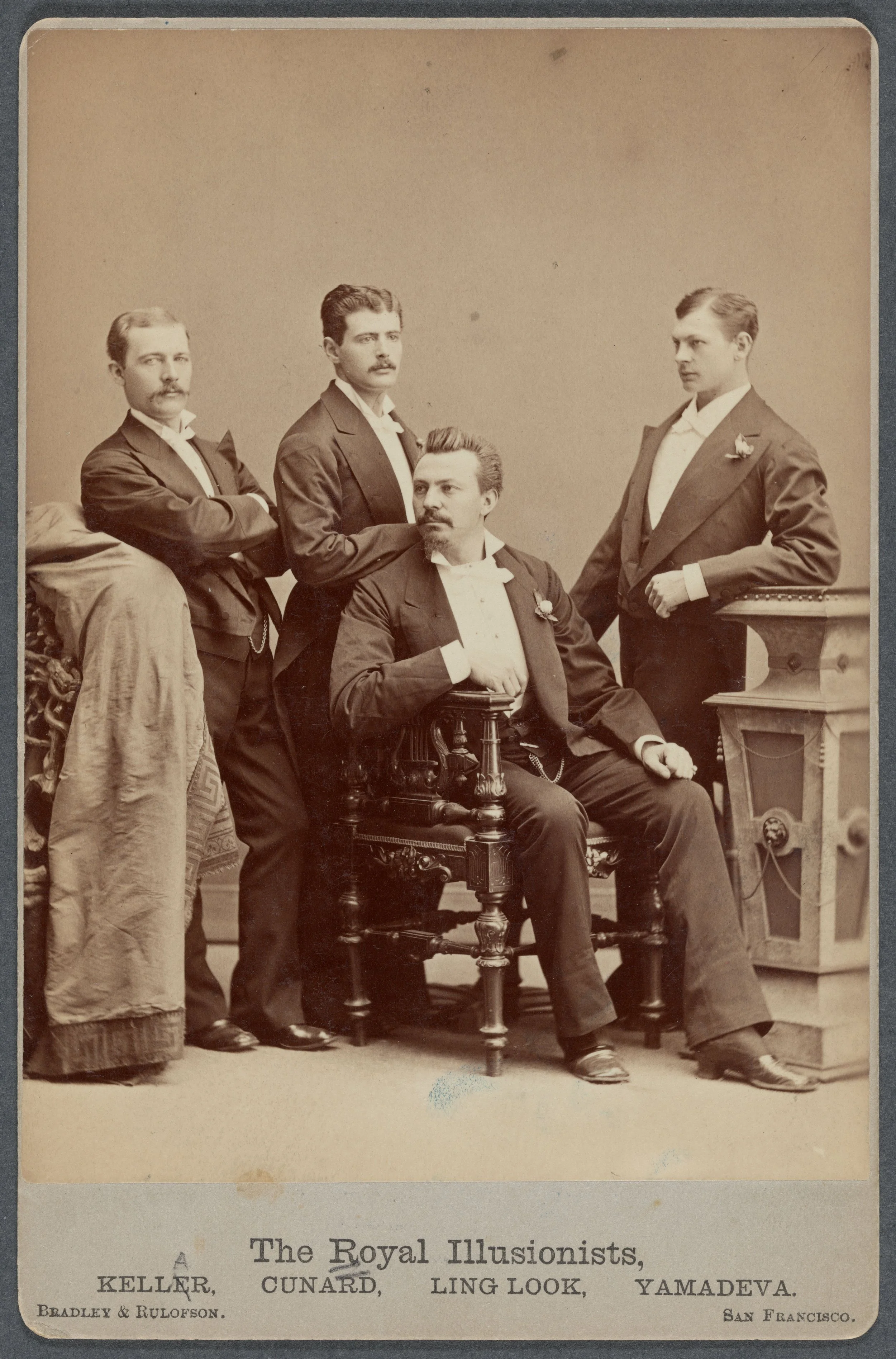
Billy Rose Theatre Division, The New York Public Library. "The Royal Illusionists" New York Public Library Digital Collections. Accessed 28 October 2026. Public domain.
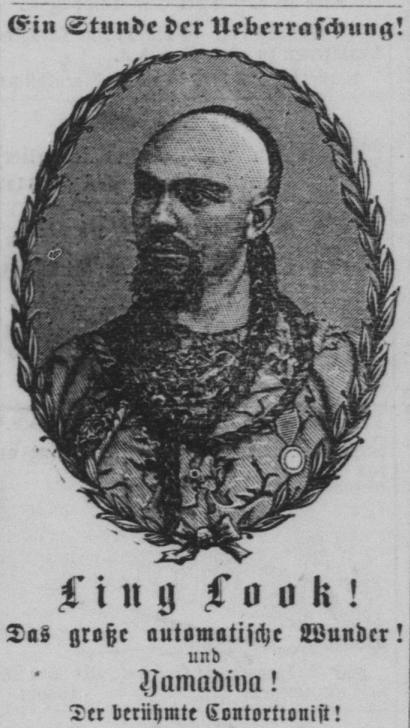
Ling Look, Washingtoner Journal, 1 January 1874, 3. Image created by the Library of Congress. Public domain.
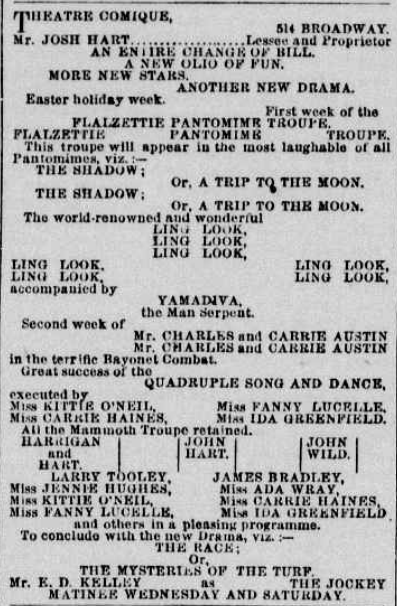
Ling Look and Yamadiva. New York Herald, 14 April 1873, 9. Image created by the Library of Congress. Public domain.
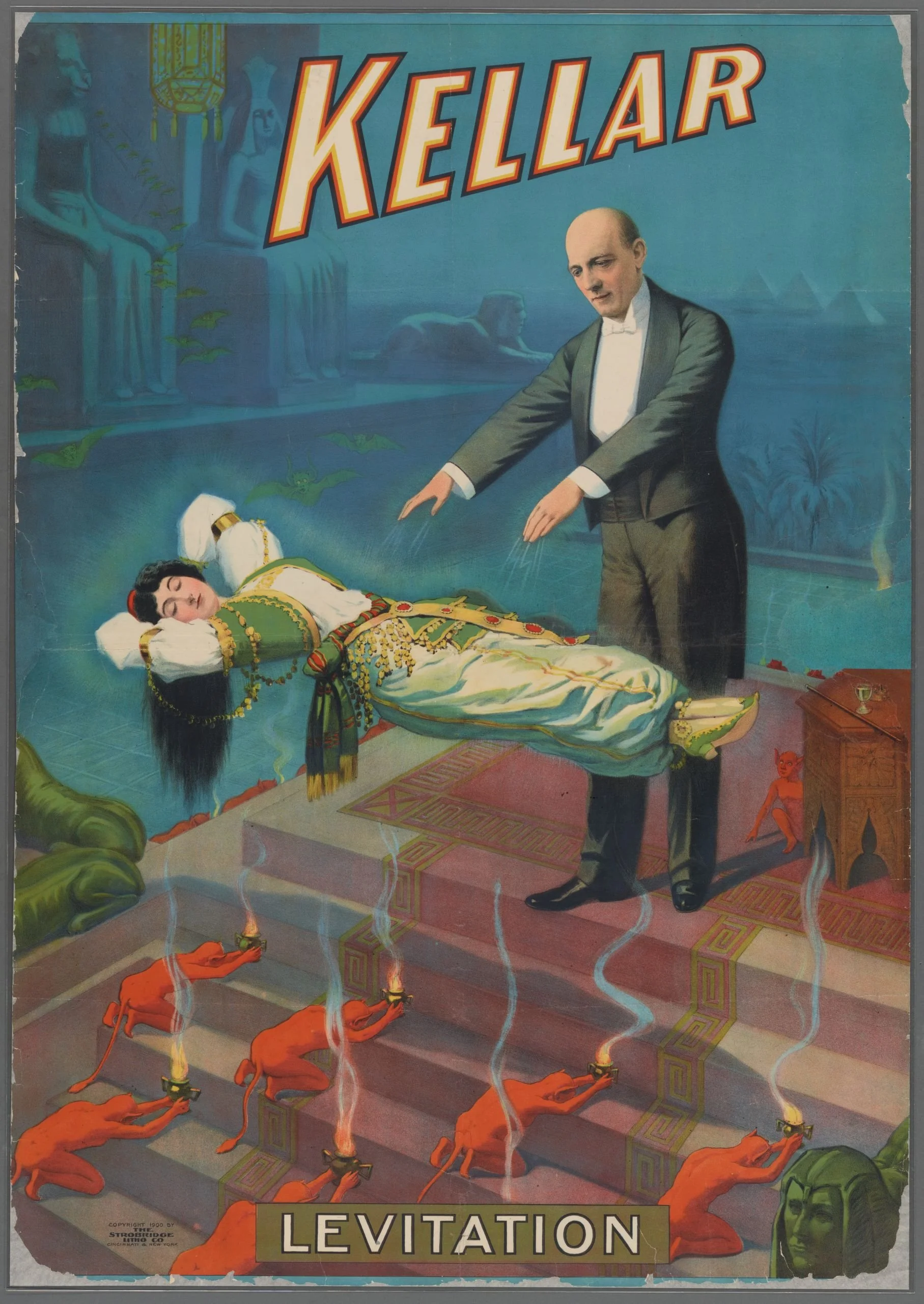
Billy Rose Theatre Division, The New York Public Library. "Kellar: Levitation" New York Public Library Digital Collections. Accessed 28 October 2026. Public domain.