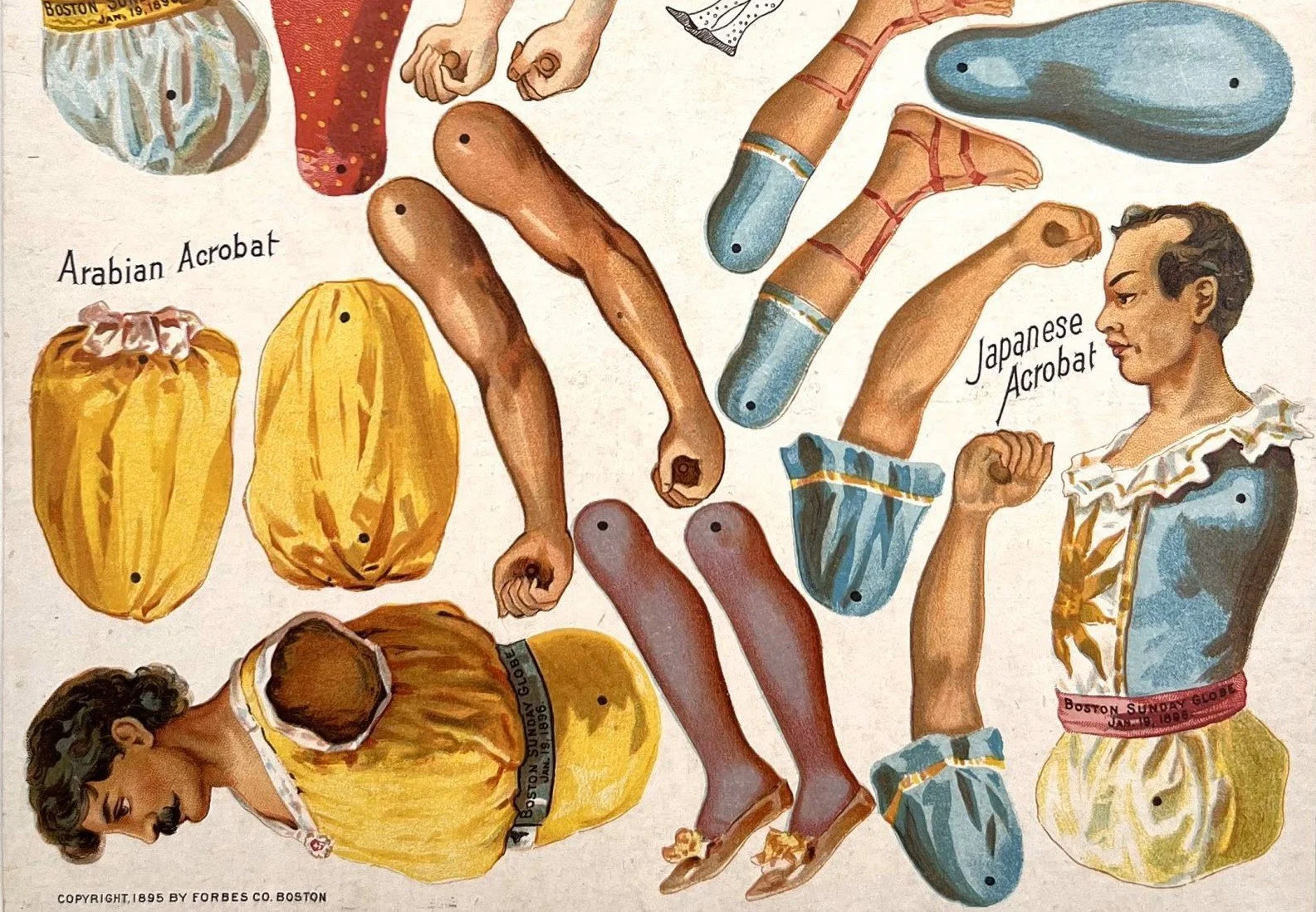
Japananza.
Jamie Barras.
Notice.—The theatre will be closed on Wednesday next, to allow for the preparation of the New and Original Japananza, written by Arthur Law, called THE GREAT TAY-KIN, a Japanese Mystery, Music by George Grossmith—Scene, the Japanese Village.[1]
Eighteen Eighty-Five was the year England’s fascination with Japanese culture and manners burst into full bloom. In January of that year, a “Japanese Village” opened inside Humphrey’s Hall in Knightsbridge, West London, populated with Japanese craftspeople and entertainers brought to England for the purpose. This was followed in March by the debut of what would become the most popular of all the Savoy Operas, The Mikado. In later years, people would conflate these two events, with the story circulating that Gilbert had been inspired to write The Mikado by a visit to the Knightsbridge Japanese Village. In fact, although Gilbert did make use of residents of the Village as advisors for the production, he had been working on The Mikado since May of the previous year. The timing was simply a coincidence born of the zeitgeist.[2]
The Japanese Village and, especially, The Mikado, inspired dozens of plays, skits, ballets, and variety performances in that momentous year of 1885, providing work for dozens of English actors and entertainers. Many simply rode the wave of the fad for all things Japanese and then moved on when it broke. Others built careers providing “Japanese” entertainment to English audiences. The best of the productions told the English something about themselves. The rest presented a vision of Japan that was at best distorted and at worst a dangerous libel; however, in that, they merely reflected their audiences’ prejudices back at them. Collectively, they were a barometer of English attitudes towards themselves and the Other. This is their story.
The Great Tay-kin[…]is a Japanese conjurer, or rather a certain Josiah Gandy, otherwise Mr. Toole, who is driven to assume the disguise of the conjurer in order to escape detection. The scene of the piece is a Japanese village, but it is soon apparent that the inhabitants are not from Japan. The painter of fans has been accustomed to practise his art on the pavements of the Metropolis, and, in fact, all are frauds.[…]The Great Tay-kin is a very merry and successful skit, partly on Knightsbridge (though it will not, of course, be supposed that any suspicion is directed against the genuineness of the Knightsbridge Japanese) and partly on The Mikado.[3]
The Mikado and the Knightsbridge Japanese Village came together in the most successful of the works directly inspired by the two entertainments, J.L. Toole’s The Great Tay-kin. John Lawrence “J.L.” Toole (1830–1906) was a comic actor and theatre manager in the High Victorian tradition. He conceived The Great Tay-kin as a satire of London society’s sudden and overwhelming love of all things Japanese. The setting was a Japanese village in London, like the Knightsbridge Japanese Village, but one populated with Londoners pretending to be Japanese and making such a bad job of it that only the truly infatuated would fall for the act. To realise the work, Toole hired playwright Arthur Law (1844–1913) and actor–composer George Grossmith (1847–1912). The same George Grossmith had created the role of Ko-Ko in The Mikado and was performing it every night at the Savoy Theatre while The Great Tay-kin played at Toole’s, just 500 yards away. One has to wonder what his employers thought of him writing the music for a piece that poked fun at one of their own productions while he was receiving standing ovations for his role in it.[4]
On 2 May 1885, the day after The Great Tay-kin opened, Humphrey’s Hall, the building that contained the real Knightsbridge Japanese Village, burned down. A young Japanese wood carver perished in the blaze. The Village would not reopen for another six months. Alas, as is the nature of such things, the publicity this tragedy generated probably helped The Great Tay-kin’s box office.[5]
One virtue of The Great Tay-kin was that, like The Mikado, it poked fun at the English, not the Japanese. At the same time, one of its star turns was an Englishwoman who affected a Japanese persona. Her name was Julia Ferrett (1852–1916), the daughter of a Dorset schoolmaster, but English audiences came to know her as Okita.
[…]and not least in the favour of the house was Miss Okita as the Queen of Mystery. This lady has a very prepossessing appearance, and her performance of the various conjuring tricks she introduced skill of no common order.[6]
By the time Julia Ferrett debuted in The Great Tay-kin, she had over a decade’s experience as a stage magician. She first stepped onto the stage in Paris in 1873 as an assistant to her [common-law] husband, the magician and magic-shop owner Charles de Vere (Herbert Gardiner Shakespeare Williams, 1843–1931). Thanks in no small part to the later fame of several of the de Vere children, we know a great deal about Ferrett/Okita’s career. Readers interested in the full story are invited to seek out the works of Charles Greene III.[7]
For the first 12 years of her career, Julia Ferrett was billed as “Lily Edith”. Although some have supposed that she took the name “Okita” (sometimes written O’Kita) from the name of the character that she was hired to play in The Great Tay-kin, a survey of the theatrical press shows that Ferrett debuted her Okita act nearly two months before she joined the cast of The Great Tay-kin. It is also noticeable that the other female roles in The Great Tay-kin had names that played heavily into a skit of The Mikado: “Imy Imy”, “Kissi Missi”, “Rosee Posee”, etc. It seems likely, then, that the de Veres conceived the new billing for Ferrett’s return to the English music halls before she was cast in The Great Tay-kin.[8]
The act itself, Ferrett had been performing on the continent for several years under her “Lily Edith” billing, playing “une enchantresse à Nagasaki”. It was originally called “la séance Japonaise”, but by the time the de Veres brought it to England, it had acquired the name “Recreation(s) Japonaises”. Rather than being a character in The Great Tay-kin, Okita was a speciality act brought in to lend the production some extra sparkle; something that would have been familiar to English audiences used to the ensemble approach to pantomime. Shortly after Okita left the production, she performed the same service for a patriotic entertainment about Gordon of Khartoum in which she was cast somewhat improbably as a Japanese entertainer in the Mahdi’s camp.[9]
Okita used Japanese costumes—allegedly from Japan—and staging, and, in her early billing in England, was presented as “a Japanese lady”. However, it is not clear to what degree she was trying to “fool” her audiences into thinking she was Japanese, as opposed to simply asking them to suspend their disbelief long enough to enjoy the performance. It is clear that the trade press, at least, was not fooled. However, it also did not care that it was all a performance (“the nationality of Miss Okita matters not”).[10]
This was a period when Western stage magicians increasingly adopted personas centred on “Oriental” archetypes, Indian fakirs, Chinese Mandarins, and the like. By doing this, they intended to evoke in the minds of their audiences visions of the “Mystic East”, to sell the idea that maybe, just maybe, what they were witnessing was real. Okita, whom some credit with being the first non-Asian magician to perform as Asian, was a pioneer of that approach.[11]
Within a year of her debut as Okita, Ferrett was joined on stage by two of her daughters. These were Carrie de Vere (1875–1901) and Constance de Vere (1879–1966). Carrie would die young; however, Constance, under her middle name Elise, would achieve lasting fame as an actress on the Parisian stage and Broadway. She would go on to marry a rogue who ended up running a Hollywood film studio. Second only to Elise in fame was Carrie and Constance’s younger sister, Clemmie de Vere (1888–1973) (all eight of the de Vere children had names beginning with “C”, which speaks to the ego of their father, Charles de Vere). As an animal trainer under the name “Madame Zera” and a stage magician under the name “Ionia”, Clemmie led a life of adventure that culminated in a marriage (her second) to a Russian prince in the midst of the Russian Revolution, followed by a long life mixed up in exile politics in Paris.[12]
Ferrett enjoyed a long career as Okita. She and de Vere eventually separated, and de Vere went on to marry a third (second?) time. Ferrett died in Paris in 1916 and was buried in the family plot in Cimetière des Batignolles. History remembers her as a pioneering female magician and seems willing to forgive her for her Japanese masquerade because of it.[13]
THE FOUR Marvellous DERKAROS. The Only (English) Japanese Performers now performing in the Provinces, Return to London, December 6th, 1875. Mons. DERKARO, the Only Balancer of the Japanese Ladders and Bamboos; Madame DERKARO, the Only Lady that ever Balanced the High Japanese Perch; YOUNG HARA, the Little (English) All-Right; and JOHNNIKITCHIE, the Japanese Wonder, now at the Alexandra, Manchester. Immense Success. Always Re-engaged everywhere.[14]
The Knightsbridge Japanese Village was the brainchild of a man who called himself Tannaker Buhicrosan. Despite the Japanese-sounding name, he was a Westerner. Opinion is divided about his real identity. The most compelling case seems to be that made by Paul Budden, who identified Tannaker as an Englishman named William Bellingham Neville (1840–1894). According to Budden’s research, Neville travelled to Japan in 1864, by which time he was an army deserter and convicted bigamist. By 1867, he had assembled a troupe of Japanese acrobats and embarked on a tour that took in Australia and New Zealand, and, eventually, England, arriving in 1868. Tannaker remained in England for the rest of his life, managing various Japanese entertainment troupes and attempting various business ventures like the Japanese Village.[15]
As ever, I am indebted to Pernille Rudlin of the Ninjin: Japanese Acrobats Abroad website for information concerning Japanese entertainment troupes in England in the late nineteenth and early twentieth centuries. The information below on genuine Japanese entertainers is drawn largely from Rudlin’s research.[16]
From 1868 until his death, Tannaker operated a shifting roster of Japanese performers, under the banner “Tannaker’s Japanese”. Although he wasn’t above stealing the advertising copy and performers of other Japanese troupes, it greatly vexed him when English entertainers passed themselves off as Japanese in imitation of his own troupe, and he often took out ads in the trade press threatening legal retaliation against copyists.[17]
The most persistent—and blatant—copyist of Tannaker’s Japanese was a figure as shadowy as Tannaker himself. Professionally, he went by the name “Alfred Derkaro”, and his various combinations were known as the “Derkaro Family”, the “Derkaro Troupe”, the “Der Karos”, and the “Der-Karos”. Towards the end of his life, he gave his name to an English census taker as “Alfred Carrier”, and his place of birth as London, in 1832. There is nothing beyond his statement to support this. We might suspect that his real surname was “Caro” and he was of German, perhaps German–Jewish, descent. There were several German–Jewish families in England in this period called “Caro”. It is a short distance from “Caro” to “[Der] Karo” and on to “Carrier”. However, this must remain speculation.[18]
The beginning of 1885 saw Alfred Derkaro working the English halls as a double act under the billing “Mons. and Madame Der Karo”. However, he had been performing under the Derkaro name since at least 1873, and, through the years, the troupe had gone through a number of iterations. It began as “The Marvellous Oriental Wonders, The Derkaro Family, Male and Female Artists (three in number)” comprising “Mons. and Madame Derkaro” and “Young Hara” (a little boy) in an “Egyptian screen performance”. Clearly, at this time, Derkaro/Carrier was interpreting “oriental” quite broadly. Indeed, his own on-stage character then and later was based on an Indian “fakir”. However, within two years of their debut, the three Derkaros had become four, with the addition of “Johnnikitchie”—a direct steal from the name (“Kitchie”) of several Japanese acrobats active in England in this period, and Derkaro was advertising the act as a Japanese ladder act and “the only opponents of the real Japanese”.[19]
Across the next two years, Derkaro doubled down on this curious double standard of simultaneously stealing from Japanese performance troupes while claiming to be their only English rivals. First, he modified Hara’s billing to read “Little (English) All-Right”, and then he rebranded (replaced?) “Johnnikitchie” with “Tommy the Wolf”. “Little All-Right” and “Tommy the Wolf” were two of the young performers in Tannaker’s troupe. Tannaker, understandably, fumed:[20]
Managers are cautioned against persons using the above titles, and after this notice proceedings will be taken against persons infringing the same in any form. What a pity (would-be talented) people can’t obtain Engagements without pirating.[21]
The threat had the desired effect: Derkaro quickly dropped the “Little All-Right” and “Tommy the Wolf” billing. He even dropped “Japanese” from the description of the act for a period, although it continued to feature Japanese-style ladder balancing.
“Johnnikitchie” was added to the act after Derkaro had advertised for “two or three respectable boys, aged 6 to 9 years, for the musical and gymnastic profession”. At its largest, the Derkaro combination consisted of nine performers: Derkaro, a female partner (possibly his wife, possibly not), and seven child performers. For a time, Derkaro even offered two acts for a single booking, “Madame Derkaro and her Troupe” and the “Little Raphaels”, the latter a trapeze act featuring “three wonders of grace, beauty, and strength”. As the promotion of “Madame Derkaro” to top billing suggests, by this stage, Derkaro had stepped away from the limelight to focus on building his budding acrobatic empire.[22]
Whatever Derkaro’s plans were, they all came crashing down in the Spring of 1880. In February and March of that year, an eight-strong Derkaro troupe “lately returned from the continent” toured the English halls. However, following a performance in London in late March, the Derkaros then disappeared for six months. When they finally reappeared, in late September, their billing read “Mons. and Madame Derkaro (Japanese Balancers)”. The troupe, evidently, was no more.[23]
We can reasonably suppose that the troupe had become too costly to keep up for the few bookings it was generating, and Derkaro had released his young performers from whatever contracts he had with them. He then continued with “Madame Derkaro” alone. I use quotes here because, as I discuss below, this may not have been the “Madame Derkaro” who had performed with Alfred Derkaro before the summer of 1880. Similarly, what became of “Hara”, the member of the original trio whom Derkaro presented as his son, I have been unable to determine. As late as January 1885, Derkaro was advertising for “a boy and girl, or two boys” to join the act.[24]
Derkaro kept the “Mons. and Madame Derkaro” billing from late 1881 until the summer of 1886. (“Derkaro” was sometimes rendered “Der Karo” in this period, and Madame was sometimes replaced with “Mdlle.”; however, a check of dates and bookings shows that these were all the same act.) However, after June 1886, Derkaro shifted to solo billing as “Mons. Derkaro” and began describing his act as a “single-handed performance”.[25]
There is something else of interest to note: by 1885, the Derkaros were billed as “balancers, jugglers, top-spinners à la Japanese” and Madame/Mdlle. Derkaro as a “lady gun equilibrist, lady cannon balancer”. Meanwhile, in Spring 1886, shortly before Derkaro switched to solo billing, a new act with no connection to Derkaro, “Naadine” [sic], appeared on the halls, billed as “the only lady Japanese top spinner à la Japonaise” and “only lady gun and cannon equilibrist”. Naadine remained active under that billing until January 1888. Is this evidence that, for at least the latter part of the Derkaro act’s lifetime, rather than being Mrs Derkaro/Carrier, “Madame/Mdlle. Derkaro” was simply a stage name used by several performers hired by Alfred Derkaro, at least one of whom subsequently went solo? Was the break-up of the troupe in the summer of 1880 also the end of Derkaro/Carrier’s romantic relationship?[26]
Whatever the true identity of “Madame/Mdlle. Derkaro” in the act’s later years, Alfred Derkaro would not share billing with anyone again after the summer of 1886. He continued to perform as a solo act for at least another decade, and, as we have seen, ended his days as a resident of the Music Hall [Retirement] Home in Camberwell sometime after the summer of 1914.[27]
As I have often said in this series, many middle-of-the-bill music hall acts were essentially tribute acts “playing the hits” of more successful acts higher up the bill. However, Alfred Derkaro/Carrier was something else. He copied not just elements of the act and staging of Tannaker’s Japanese, but also the names of some of its performers. This, in theatrical terms, was outright theft—or piracy, as Tannaker had it. To add insult to injury, Dekaro did all this while proclaiming that his act was superior and implying that this was because his act was English and Tannaker’s was foreign. He acted on his own worst instincts and then appealed to the worst instincts of his audiences to make it pay. He, more than any other performer in this survey, knew there was money to be made by holding up a mirror and reflecting his audiences’ prejudices back at them.
As has already been stated in The Era, the piece is founded on a Japanese basis. It has no resemblance to The Mikado, and was indeed planned, I am told, before Messrs. Gilbert and Sullivan’s comic opera was announced. It was only to be expected, when all London was seized with a sort of Japanese craze, that many caterers for the public entertainment would take advantage of the public fancy.[28]
I will end this piece with the story of a man who succeeded where Alfred Derkaro failed, building a performing dynasty out of a Japanese masquerade. However, before telling that story, I want to briefly cover some of the productions and acts that rode the wave of the popularity for all things Japanese in 1885.
The Japs, or the Doomed Daimio was a burlesque written as a vehicle for comic actors Willie Edoiun (William Frederick Byer (1846–1908)) and Lionel Brough (1836–1909). After a short try-out in Bristol in September 1885, it transferred to Edouin’s Novelty Theatre in London for a successful autumn run. The Doomed Daimio was set in Japan, and, like The Mikado and The Great Tay-kin, poked fun at the English, not the Japanese. In The Doomed Daimio’s case, this was in the form of Edouin’s character, “Sanzuki Jappa”, a daimyo (warlord) whose love of all things English had led him to furnish not just his castle but also the town surrounding it in English trappings; he had even gone as far as to hire an English maid—an obvious satire on the English craze for Japanese furnishings and servants.[29]
Other theatrical productions with a Japanese theme of note in 1885 were ballets such as the Dolph Rowella Company’s “A Japanese Village: a comic ballet”, which had a successful Spring run at the Gaiety on the Strand—yards from where The Mikado was playing—and “Old China, New Japan”, which played at the Oxford Music Hall (London) in April, and was the work of choreographer and ballet master Paul Valentine (1839–1924).[30]
The number of music hall acts who rode the wave is too great to count. Some simply had fun with the craze, like the “Mick R Dos”, a clown act whose routine “Jap on Knees” featured “Fan Foo”, reputed—not at all seriously—to be the “only Japanese clown ever allowed to leave his native country”.[31] Others simply adapted their existing acts to suit the current public taste: in one half-column of one edition of The Era, the music hall trade paper, in August 1885, there were ads for John Le Clair, purveyor of “Japanese juggling entertainment”; Adele Libra, “whose performances on the slack wire certainly vie with anything offered us by the famous Japanese artists”; Avrigny, “equilibrist jongleur Japanois”, Neno, “trapezist and Japanese perch performer”, Mr. and Miss Bellac, “Japanese equilibrists”, and, inevitably, the Der Karos “Japanese Top Spinners”.[32]
Perhaps the most representative of the latter class of performers were Val Simpson and Miss Minnie Russell.
VAL SIMPSON AND MISS MINNIE RUSSELL, just concluded Nine Weeks successful Engagement at Theatre Royal, Portsmouth, Pantomime. ROYAL AQUARIUM, BRIGHTON, Second Week. Great success of our Japanese Juggling Act; also of Skating Entertainment. Day’s, Birmingham, and other Halls to follow.[33]
Val Simpson and Miss Minnie Russell were the husband-and-wife team of John Henry Simpson (1858–1923) and Alice Louisa Simpson née Wyatt (1864–?), of Hull and London, respectively.[34] They began performing together shortly before their marriage, debuting as the “Royal Western Skaters” in August 1877, with Simpson using his own name (“J.H. Simpson”). This was in the midst of England’s first roller skating boom, triggered when British manufacturers decided to bring out unauthorised, lower-priced copies of the quad roller skates patented by American James L. Plimpton. The timing of the future Mr. and Mrs. Simpson could have been better, as back in April 1877, Plimpton had won the court action that saw the sale or rental of all unauthorised copies of his skates banned; the majority of England’s roller skating rinks would be shuttered by year’s end.[35]
The Royal Western Skaters soldiered on. On 31 August 1879, Alice gave birth to their only child, John Roy Simpson (1879–1969). She had continued performing with the act up until just a few weeks earlier, a not-uncommon occurrence with female music hall artists in this period. By the autumn of 1882, the pair had dropped the “Royal Western Skaters” billing and were advertised as “J.H. Simpson and Miss Minnie Russell”. An even greater change came a few months later, when the act morphed into “Mons. Vals, Equilibrist and Juggler, and Miss Minnie Russell”, before finally, in December 1883, settling on “Val Simpson and Miss Minnie Russell, skaters, equilibrists, and vocalists”. With the skating craze well and truly over, they were casting their net wider.[36]
Still, juggling on roller skates remained the Simpson’s main draw. For the 1884/85 Christmas and New Year Pantomime season, they rebranded this as Japanese juggling on roller skates. In April 1885, they even shared the bill with Okita. They continued advertising themselves as “Japanese jugglers” across 1885 and into the first two months of 1886, at which point they announced they were leaving for America and a seven-month engagement with P.T. Barnum’s Circus. Seven months turned into over a year. By the time they returned, in the summer of 1887, the craze in England for all things Japanese had died down, and so “Japanese” disappeared from their billing.[37]
The Simpsons would continue to perform together for the next few years. Val Simpson would then go into theatrical, circus, and skating rink management in England and South Africa, albeit, with limited success and at least one brush with the law. Although he and Alice were still together at the time of the 1891 England Census, within a few years, all mention of their names together would end. There is no record of a death for “Alice Louisa Simpson” in England; she may have died in South Africa. However, it seems more likely that Alice and Simpson separated and Alice subsequently remarried. She may have been the “Miss Minnie Simpson, serio-comic and vocalist”, who toured independent of Simpson in the mid-1890s. Simpson, meanwhile, eventually revived the Simpson–Russell skating act with his son, who used the professional name, John Ray Simpson. The pair toured as “the Vals” for several years towards the end of the 1890s. John Henry “Val” Simpson died in 1923.[38]
Val Simpson and Minnie Russell rode the wave of the popularity of all things Japanese in 1885 and 1886; however, this was a brief episode in their 20+ year career. They used it to their advantage and then jettisoned it when it ceased to be a selling point. This was much more representative of the response of English music hall artists to the Japanese craze than the career-long exploration (or exploitation) of Japanese masquerade by artistes like Okita and Albert Derkaro. However, I want to end this piece by returning to a performer who not only made a career out of Japanese masquerade but spawned a dynasty of like-minded performers.
His name was Edwin Bale.
Terrific success in London of EDWIN BALE’S ROYAL YOKOHAMA TROUPE (Male and Female). Can give the following Acts.—Bicycle Riding, Juggling Entertainment, Performing Pigeons by Mdlle. YOKOHAMA, Wire Walking, Double Trapeze, and Bar Act. At Liberty for Pantomime and Galas.[39]
The Royal Yokohama Troupe literally almost missed the boat when it came to exploiting the 1885 craze in England for all things Japanese: they did not arrive in the country until the summer and did not take the stage until the year was almost over. Their billing stated they were newly arrived from Brazil. This was broadly speaking true, but what the billing left out was that the troupe was, like the Derkaros, another English combination masquerading as Japanese—although, as we will see, the Yokohamas took that masquerade much farther than Alfred Derkaro ever did. The troupe was the brainchild of Edwin Bale (1849–1912), a member of a large Hampshire-born family, four of whom went on to the stage, and two of whom—Edwin and his older brother, William—spawned generations of performers. The story of later generations of the family is told by some of their descendants on the “Royal Zanettos” website.[40]
The Bale family’s journey in stage entertainment began in 1865 when Edwin, William, and another brother, Frank, formed the “Brothers Bale” juggling act. For the next two years, the three brothers toured up and down Great Britain, honing their act and their on-stage personas. They were first billed as “German Jugglers”, then “Chinese Jugglers”, and eventually, in March of 1867, as “Japanese Jugglers”, a label that stuck. By 1867, William was married. It is not clear if his wife, Sarah, was a part of the act; however, in May of that year, an irate audience member wrote to the trade paper The Era to complain that he had watched a performance by an act called the “Dusoni Family” one night and the next turned up at another hall to watch the Brothers Bale perform, only to discover that this was simply the Dusonis under a different name. If the Bale brothers were put off by this criticism, they didn’t show it: the Dusoni Family and Brothers Bale appeared on listings for at least another year, even at times appearing on the same bill.[41]
The first major change to the act was the departure of William in the late 1860s. He settled in London to take care of his growing family. We will meet several of his sons below. Edwin and Frank soldiered on as a double act for around a year before teaming up with “Professor Brown”, a trick cyclist. Brown passed his skills on to the brothers, and bicycle tricks would be a feature of their act going forward. The Brown and Bale combination lasted around a year, then the brothers went it alone again. By this time, they had been joined by someone identified as a third, younger Bale brother. It is not clear who this was. He did not stay with the act long, at least according to the billing.[42]
Instead, the next big development in the act—outside of its acquisition of a monkey and a performing pigeon—was the arrival of Emma Bulley/Bewley (1853–1897). Bulley, whose stage name was “Mdlle. Otto”, would, by 1875, be married to Edwin. (It is worth noting here that it is possible that this was Edwin Bale’s second marriage, as according to the 1891 Census, he had a son, James, born in 1869/69, long before Emma was in the picture.[43]) Emma, Edwin, and Frank Bale continued touring together for a further two years, billed as “The Brothers Bale and Madame Otto”. Then, Frank, too, departed the act to start family life.[44]
From 1877 until 1885, Edwin and Emma Bale would tour the world as the “Edwin Bale Troupe” and “Edwin Bale’s Original Combination”, performing alongside a mix of hired child performers, their sons, and other junior members of the wider Bale family. The Bale Combination’s notice from 1879 serves as a guide to the type of act they offered (a little of everything).
Fifty-second Week of Brilliant London Season. EDWIN BALE’S ORIGINAL COMBINATION COMPANY (Six in Number), Male and Female Bicycle Riders, Jugglers, Troupe of Monkey Bicycle Riders, Troupe of trained Pigeons, and including LA PETITE FRANCES, the marvellous Miniature Bicyclist (only Four Years Old).[45]
After a years-long tour of South America, the troupe returned to England in August 1885. Bale took out notices in the trade press announcing their return.
Notice. Notice, To Proprietors and Managers of First-Class Theatres and Music Halls. MDLLE. IONA, ALBERTO, ELO, MERT CLARK, and EDWIN BALE have arrived, after Six Years’ absence from England. They have been giving their Entertainment all through Cuba, Mexico, Central Mexico, Peru, Chili, Buenos Ayres, and the Brazils. The Acts consist of Pigeons, Juggling, Bending, Velocipedes, Japanese Wire, Double Trapeze, Horizontal Bar, Strength of Teeth, Jumping Dog, Performing Monkey, the American Salamander, Chinese Shadows, Acrobating, &c. Proprietors and Managers wishing to engage the above Novelties communicate, 33, St. Mary’s-square, Kennington-road, London.[46]
What is interesting is that, in later years, Edwin Bale would claim that he came up with the idea of the Royal Yokohama Troupe while he was still in South America and “on his way home was able to get the exact make-up”. However, in the above notice, published in August 1885, there is no hint that the troupe had any plans to launch a Japanese masquerade. Having been out of England for so long, Edwin Bale would have been unaware of just how big the craze for all things Japanese had become. He soon caught up.[47]
The Great Yokohama Troupe of “Ladies and Gentlemen Jugglers (six in number) “straight from Rio de Janeiro” debuted in London in late October 1885. (Through the years, the troupe would be described as both the “The Great” and “The Royal” Yokohama Troupe.) As the reference to the “exact make-up” above hints at, with the Yokohamas, Bale went beyond simply adopting Japanese costuming and staging; the Yokohamas were a yellowface troupe, made up to appear Japanese—to the untutored or distant eye, at least. We don’t know how many were fooled by the masquerade, but the intent was to fool.[48]
One of Bale’s favourite stories in later years was that, while appearing in Leipzig, Germany, in 1886, the troupe was visited by some “well-to-do Japanese” then staying in the city. Eager to meet what they thought were fellow countrymen, these Japanese visitors bribed a waiter to lead them to Bale’s dressing room. They arrived just as Bale and the rest of the troupe were taking off their make-up. Confronted with the truth of the deception, the Japanese visitors were understandably outraged at this “insult to their nation”. Bale defused the confrontation by pretending to be from South America, speaking to the visitors in Spanish, a language they did not understand.[49]
To Bale, this story was an amusing anecdote. To him, pretending to be Japanese was simply part of the Yokohamas’ schtick, their gimmick, and no more objectionable than blackface minstrelsy, which, at the time, was at the peak of its popularity, and regarded by English audiences as harmless fun. These were different days.
As ever, it is hard to know how many of the people watching the Yokohamas were actually fooled by their pretence. As with Okita, reporters from the trade press certainly weren’t (“The Yokohama Troupe look exceedingly to us like a combination which was once called “The Bale Troupe”). By February 1886, Bale had effectively dropped all pretence, at least as far as the trade press was concerned, advertising “The Bale Troupe (six in number)” alongside The Yokohamas, offering two acts for a single booking, much as the Brothers Bale did with their alter egos, the Dusoni Family, back in the 1860s.[50]
Two interviews with Edwin Bale survive: the one in which he recounts the story of the Leipzig encounter, given in 1895, and an earlier interview from 1891, given to the Strand Magazine for an article on “Child Workers in London”. In this interview, Bale scoffs at the commonly held belief that the bones of child acrobats were deliberately broken and reset to make the children more flexible (the mind boggles). We also hear from two of his young charges, a “Master Harris”, who tells the Strand writer that he eats meat twice a day, has a bath every evening, and receives 3 shillings a week in pocket money, and an unnamed second child who informs the writer he has £9 in the bank. The interview, which is accompanied by sketches of the young acrobats practising, goes very gently on its subject. To put the 3 shillings a week “pocket money” in perspective: a troupe like the Yokohamas could expect to earn between £20 and £50 a week and as much as £60 for a one-off gala appearance. There was a reason acts like Bale’s favoured child performers.[51]
In 1897, Emma Bale died, aged just 43. Two years later, Edwin Bale retired the Yokohama Troupe act; however, he continued with the Bale Troupe of trick cyclists for at least another decade. He died at home in Lambeth, London, in 1912, aged 63.[52]
By the time of Edwin’s death, a whole new generation of Bales had become entertainers. His son, Edwin, took over the bicycle troupe and used it as a springboard to running his own circus. One of Edwin Jr.’s sons, Edwin Trevor “Tommy” Bale (1913–1994), became a renowned animal trainer with the Ringling Brothers and Barnum and Bailey Circuses. Tommy’s son, Elvin Bale (b. 1949), followed his father and grandfather into the circus ring, becoming one of the world’s best trapeze artists.[53]
However, it is four of Edwin’s nephews, his brother William’s sons, George, Frank, William Jr. (known in the family as “Pip”), and Albert, who have the most relevance to our story. Their act, “The Zanetto Troupe”, was a copy of the Yokohama Troupe, and carried the Bale tradition of Japanese masquerade into the 20th Century. Untangling its origins is no easy feat.
The Only act of its kind. THE ZANETTO TROUPE, Imperial Japanese Variety Artists, &c. Greatest success possible at the THEATRE ROYAL, PORTSMOUTH. Evening News, 27th December 1890. The Zanetto Troupe of jugglers, &c., come upon the scene and manipulate various articles with a skill and dash that we have never seen equalled.[54]
The Zanettos were the brainchild of William Bale’s oldest son and Edwin’s nephew, George Bale (1867–1949). At least, this seems to be the case. The Zanetto Troupe first appeared, fully formed, in late 1888, not in England but in America, albeit with the claim that they had lately appeared at the Alhambra, London. They were three in number, “two ladies and a gentleman”, and their names were given as “Alfred, Marie, and Louise”. They returned (travelled?) to England in the Spring of 1889, where their notices listed their agents as “Macdermott and Holmes”.[55]
Noting the names of the agents of this 1888–1889 Zanetto Troupe is important. We first see George Bale named in the press as a member of the Zanetto Troupe in 1891, on the announcement of his marriage to Jessica Prosser, a slack-wire artist (the marriage would not end well). The agent for the 1891 George Bale Zanetto Troupe was Macdermott, the Macdermott and Holmes partnership having dissolved the previous year. Following the end of the partnership, Macdermott moved to new offices at “7, York-road, S.E.”, London. This was right next door to the office of Hugh Didcott, the agent for Edwin Bale’s Yokohama Troupe, at 6 York Road. From mid-1890 onwards, ads for the two troupes usually appeared next to each other in the trade press.[56]
We know that Edwin Bale had “close relatives” in his troupe as well as his son(s), wife, and hired child performers.[57] Given how closely the Zanetto Troupe copied the staging, costumes, and, critically, the yellowface makeup of the Yokohama Troupe, it seems reasonable to suppose that George Bale, at least, and possibly William (Pip), Albert, and Frank Bale, too, learnt their trade in their uncle’s troupe and transferred this knowledge into the Zanetto Troupe. The question is: was this in 1888 or in 1890/1?
The last time the Zanettos were described as “two ladies and one gentleman” was in September 1889, a few months after their return to/arrival in the UK. At first glance, it seems a given that the four Bale brothers could not have been the “Alfred, Marie, and Louise” of the 1888–1889 Zanettos. This lends itself to a scenario whereby, in mid-1890, on the dissolution of the Macdermott and Holmes Agency and Macdermott moving to York Road, Macdermott created a new Zanetto Troupe using artists signed to Hugh Didcott, his new neighbour, namely the Bale brothers.[58]
However, an alternative scenario suggests itself: that the Bale brothers split from their uncle in 1888 and travelled to America to replicate the Yokohamas’ success with their own Zanetto Troupe. One feature of the Zanetto Troupe act after 1890 was one of the Bale brothers cross-dressing as a “female” juggler.[59] In later years, this was Pip Bale; he may well have also fulfilled that role earlier, alongside his brother Albert. Were Pip and Albert the “two ladies” of the 1888–1889 Zanetto Troupe and George the “one gentleman”? But, in that case, why did George use the “Alfred” alias? Why not his own name?
Added to all this, there is the curious case of “George Zaroni, Japanese Juggler”, active in the US in 1885–1888 whose real name was said to have been George Bale or Beale. As this Zaroni/Bale/Beale may not be related to our story, I have reserved his story for the appendix.
The whole affair is very murky.
The Zanetto Troupe, comprising George, Pip, and Albert Bale in its early years, and then George, Pip, and Frank in its later years, continued to perform well into the twentieth century. As the Bale brothers grew older, it became harder to maintain the pretence that they were Japanese, so in time, they dropped it. They continued to perform in yellowface, however, simply changing their billing from “Japanese” to “Japanese impersonators”. In time, George and Jessica’s daughter, Jessie Bale, would replace Frank Bale in the act. Jessie would go on to marry another performer, Carmelo Palomar, and the pair would give birth to another generation of Bale family entertainers.[60]
George Bale spent his last years in the Variety Artists’ Retirement Home in Twickenham—the successor to the Music Hall Home in which Alfred Derkaro spent his last years. He died in 1949.
As has already been stated in The Era, the piece is founded on a Japanese basis. It has no resemblance to The Mikado, and was indeed planned, I am told, before Messrs. Gilbert and Sullivan’s comic opera was announced. It was only to be expected, when all London was seized with a sort of Japanese craze, that many caterers for the public entertainment would take advantage of the public fancy.[61]
The Mikado continues to be performed to this day; however, most of the acts and productions that rode the wave of the Japanese craze in Britain in 1885 have long since been forgotten. For many acts playing the halls that year, “Japanese” was just a label they slapped on to their existing routines to keep up with the trend. Others, like Okita, the Derkaros, and especially the Bale/Yokohamas, went much further.
Any type of racial masquerade is now frowned on—even The Mikado has not escaped criticism, despite modifications to casting and makeup in modern productions.[62] However, in an age when it was common, people like Julia Ferrett, Alfred Derkaro/Carrier, and Edwin and George Bale would have seen anything they saw on stage as fair game, ripe to be repurposed or copied, irrespective of origins—provided the source material did not threaten legal action. They were a mirror of the times.
Jamie Barras, November 2026.
Back to Staged Identities
Appendix: The Curious Case of George Zaroni, “Japanese Juggler”.
In February 1886, a San Francisco newspaper reported that a juggler named George Zaroni, “whose real name is supposed to be George Bale”, had been attacked and injured by a man named Gordon. Gordon was either upset that Zaroni/Bale had “enticed” his sister to leave the family home to live with him or trying to retrieve a diamond pin that Zaroni had stolen, depending on whose account you believe. A subsequent account rendered Zaroni’s real name as “Beale”, not “Bale”. Although Gordon was charged with assault, those charges were subsequently dropped.[63]
Zaroni had been active in the US since the previous summer. He was described as a “Japanese juggler” and, while using the “El Zaroni” billing, as “an Australian Jap”. He was active throughout 1886 and 1887. On 31 October 1888, “George Zaroni, of Australia” married a woman named Stella Zeiser in Sacramento, California. This was two weeks before the Zanetto Troupe (two ladies, one gentleman) made its debut in Philadelphia. In the marriage registration, Zaroni gave his age as 24. Zaroni’s marriage was the last time his name would appear in the US press for over a decade.[64]
Zaroni began his career in the US in association with a “child mesmerist” called Leonard Goheen. They were described as a pair of confidence men in the press, leaving a trail of unpaid bills behind them. A year later, Goheen, working alone, was exposed as a grifter. Then, in April 1887, he was arrested and jailed in Springfield, Missouri, for sexual assault of a child. After a failed bid to escape county jail in January 1888, he finally succeeded in escaping along with seven other prisoners in May of that year. In October 1891, a “Leonard Goheen” attended the execution for murder of his brother, Adelbart Goheen, in Fergus Falls, Minnesota; that Leonard Goheen was said to be 18 years old and had been living apart from the family for “several years”.[65]
Earlier that year, a “Sats Zaroni, Champion Juggler of the World” had debuted in Ogden, Utah. This Zaroni was said to have gained his title in a competition with 11 other jugglers at the Theatre Royal Drury Lane on 4 May 1887. He toured the US successfully for the next decade. In an advertisement for his appearance at a Fourth of July Event in 1900, he was billed as “Sats Zaroni, the World Renowned Australian Jap Juggler”—the billing that George Zaroni had used back in 1886 and 1887 while appearing as “El Zaroni”. That year was also the year that “George Zaroni, the famous Japanese Juggler” returned to the news, reporting performances in Astoria, Oregon, in November and December 1900. There were more performances credited to George Zaroni in July of the following year; in reports, he was described as being “late of Hinglers [sic] English Circus” (Hengler’s). Sats Zaroni’s name, meanwhile, was absent from the press in this period. He was back in the news at the end of the year, however.[66]
There would be no further mentions of George Zaroni, juggler, after the summer of 1901. Sats Zaroni’s name continued to feature, however. In later years, he would be billed as a “Hindoo” juggler. His life came to a tragic end: in December 1910, he was booed off stage in Chicago following a poor performance. His powers as a juggler failing him, and having no other means of supporting himself, he took his own life in his hotel room on 9 December 1910.[67]
Towards the end of his life, Sats Zaroni used the billing that George Zaroni had used back in 1886/87; he was clearly at least aware of this Zaroni. The most obvious and most likely conclusion is that this was because he was the George Zaroni of 1885–1888, and that he was an Australian whose real name was George Beale. There was no “juggling championship” fought on stage at the Theatre Royal Drury Lane on 4 May 1887—the theatre was the home of opera, not variety, and on 4 May 1887, it hosted a performance of Frederick Corder’s “Nordisa”. We have no reason, therefore, to suppose that Sats Zaroni was in England while George Zaroni was touring America.[68]
It is also—just—possible that Sats Zaroni was not the George Zaroni of 1885–1888, but was instead someone who knew that George Zaroni and assumed the name when that George Zaroni had no further use of it. The most obvious candidate for the author of this deception is his former associate, the escaped convict Leonard Goheen. In this scenario, it is, therefore, possible that the George Zaroni of 1885–1888 was, as the San Francisco newspaper had it in its first report, George Bale, and Bale abandoned the Zaroni identity to launch the Zanetto Troupe in Philadelphia in November 1888. However, this must be regarded as the least likely explanation for these curious events. For that reason, I have relegated the Zaroni story to this appendix.
Notes
[1] “Toole’s Theatre”, Era, 25 April 1885, 12.
[2] Wendy S. Williams, “Free and Easy, Japaneasy: British Perceptions and the 1885 Japanese Village,” Brewminate, 2020, https://brewminate.com/free-and-easy-japaneasy-british-perceptions-and-the-1885-japanese-village/. “The New Opera at the Savoy”, Era, 14 March 1885, 8; “The Evolution of “The Mikado””, Era, 5 September 1885, 15.
[3] “Toole’s Theatre”, London Evening Standard, 1 May 1885, 3.
[4] William John Lawrence, “Toole, John Lawrence (1830-1906),” in The Dictionary of National Biography, 1912 Supplement, ed. Sidney Lee (London: Smith, Elder & Co., 1912); Arthur Law, “Who Was Who in the D'Oyly Carte Opera Company,” The Gilbert and Sullivan Archive, accessed 19 November 2026, https://www.gsarchive.net/whowaswho/L/LawArthur.htm; George Grossmith, “George Grossmith,” in Who Was Who in the D'Oyly Carte Opera Company, The Gilbert and Sullivan Archive, accessed 19 November 2026, https://www.gsarchive.net/whowaswho/G/GrossmithGeorge.htm.
[5] “The Japanese Village Destroyed”, Era, 9 May 1885, 7; “Japan in London”, Lloyd’s Weekly Newspaper, 29 November 1885, 6.
[6] ““The Great Tay-kin” at Toole’s”, Era, 2 May 1885, 8.
[7] Charles Greene III, “Ionia: Secrets of the Princess Unlocked,” Genii 85, no. 8 (August 2022): 16-35. This article is excerpted from a self-published book of the same title.
[8] “Brighton: Aquarium”, Era, 21 March 1885, 16; “Covent Garden Theatre”, Reynold’s Newspaper, 12 April 1885, 4; “Royal Aquarium”, Daily News (London), 20 April 1885, 4.
[9] “Théâtre de Mirecourt”, La Presse Vosgienne, 5 November 1882, 1; “Théâtres & Concerts”, Le Petit Nord, 20 August 1883; “Sanger’s Amphitheatre”, London Evening Standard, 4 July 1885, 3.
[10] Japanese lady: Note 7 above, first reference; Japanese costumes: “The Unique and Original Okita”, Era 30 July, 1887, 19; “matters not”: “Reopening of Holborn Theatre”, Era, 1 May 1886, 9.
[11] Christopher Goto-Jones, “Magic, Modernity, and Orientalism: Conjuring Representations of Asia,” Modern Asian Studies 48, no. 6 (November 2014): 1451-1476; “De Vere.” Girls Love Magic. Accessed 19 November 2026. https://girlslovemagic.com/history/de-vere/.
[12] Note 6 above.
[13] “Julia ‘Okita’ Ferrett De Vere (1852–1916),” Find a Grave Memorial, memorial no. 185681487, accessed 19 November 2026, https://fr.findagrave.com/memorial/185681487/julia-de_vere.
[14] “The Four Marvellous Derkaros”, Era, 11 July 1875, 13.
[15] Paul Budden, Paper Butterflies: Unravelling the Mystery of Tannaker Buhicrosan (Gatekeeper Press, 2020). The Budden timeline is summarised here: “Tannaker Buhicrosan,” Ninjin, accessed November 20, 2026, https://ninjin.co.uk/tannaker-buhicrosan/.
[16] Ninjin: Japanese Acrobats Abroad, accessed November 20, 2026, Ninjin homepage.
[17] “Japanese!”, North-Eastern Daily Gazette, 16 March 1872, 1.
[18] Alfred Derkaro: “A Juggler and His Dress”, Era, 16 February 1884, 7. Alfred Carrier: by 1911, Alfred Derkaro was a resident of the “Music Hall Home” for distressed older artistes, which was based at 31 Wilson Road, Camberwell: “Mr Wilton Friend”, Era, 21 October 1911, 31. In the 1911 Census return for the Music Hall Home, we find an “Alfred Carrier”, “retired juggler”, age 79, place of birth, St James, London: entry for Alfred Carrier, Camberwell District, 1911 England Census, ancestry.co.uk, Ancestry.com Inc. (Operations), accessed 18 November 2026. As an example of a German–Jewish Caro family in England in this period, see entries for [Rabbi] Simon David Caro, England, Alien Arrivals, 1810-1811, 1826-1869, and Simon Caro, Norwich district, 1861 England Census, ancestry.co.uk, Ancestry.com Inc. (Operations), accessed 18 November 2026.
[19] “The Marvellous Oriental Wonders”, Era, 11 May 1873, 14; “The Four Marvellous Derkaros”, Era, 25 April 1875, 13. Derkaro Indian fakir character: Note 18 above, first reference.
[20] “Madame Derkaro and her Marvellous Troupe”, Era, 24 September 1876, 13; “Tannaker’s Japanese New Entertainment (1873),” Ninjin: The Art of Victorian Japonisme, accessed 21 November 2026, https://ninjin.co.uk/tannakers-japanese-new-entertainment-1873/; “Little Allright,” Ninjin, accessed November 20, 2026, https://ninjin.co.uk/little-alright/.
[21] “Tannaker’s Japanese”, Era, 24 September 1876, 13
[22] “Wanted Immediately”, Sunderland Echo, 6 February 1874, 2: “Madame Derkaro and her Marvellous Troupe”, Era, 2 July 1876, 13; “Derkaros! Derkaros” Derkaros!”, Era, 22 February 1880, 19.
[23] Note 21 above, final reference; “Margate: The Ball By-the Sea”, Era, 26 September 1880, 9.
[24] “Mons. and Madame Derkaro”, Era, 10 January 1885, 20.
[25] “Oldham Gaiety Theatre”, Era, 12 June 1886, 22; “The Original World-Renowned Derkaro”, Era, 22 January 1887, 21.
[26] “The Der Karos”, Era, 29 August 1885, 2; “Naadine, the Miraculeux”, Era, 10 April 1886, 22; “Naadine, M.M.H.A.A.”, Era, 17 July 1886, 19; “Brighton: Oxford Theatre of Varieties”, Era, 7 January 1888, 15.
[27] “Variety Artists’ Fete”, Richmond Herald, 1 August 1914, 7.
[28] ““The Japs” at Bristol”, Era, 5 September 1885, 15.
[29] “Novelty Theatre”, Era, 28 November 1885, 12.
[30] “The Gaiety”, Era, 7 February 1885, 14; “Oxford”, Era, 4 April 1885, 12.
[31] “Mick R. Dos”, Era, 9 May 1885, 23; “Jap on Knees”, Era, 13 June 1885, 22.
[32] Era, 29 August 1885, 22.
[33] “Val Simpson and Miss Minnie Russell”, Era, 28 February 1885, 22.
[34] Entry for John H. Simpson, Alice Simpson, John R. Simpson, Portsea District, 1891 England Census, ancestry.co.uk, Ancestry.com Inc. (Operations), accessed 18 November 2026; marriage registration for John H. Simpson and Alice Louisa Wyatt, Pancras District, 1877, search of Births, Marriages, and Deaths, https://www.freebmd.org.uk/cgi/search.pl, accessed 20 November 2026; “The Death of Val Simpson”, The Stage, 14 June 1923, 11.
[35] Jack Rundell, “The Chaplin Craze: Charlie Chaplin and the Emergence of Mass-Amusement Culture” (PhD diss., University of York, 2014), 44–62; “The Royal Western Skaters”, Era, 19 August 1877, 13; “The Plimpton Roller Skate”, Leeds Mercury, 20 April 1877, 3.
[36] Birth registration of John Roy Simpson, born 31 August 1879, birth registered at Marylebone, 2 October 1879, digital copy obtained from the General Register Office, November 2026; “Royal Western Skaters”, Era, 6 July 1879, 15; “J.H. Simpson and Miss Minnie Russell”, Era, 14 October 1882, 20; “Mons. Vals”, Era, 14 April 1883, 20; “Val Simpson and Miss Minnie Russell”, Era, 8 December 1883, 20.
[37] Note 34 above; “Covent Garden Theatre”, Era, 11 April 1885, 12; “Val Simpson and Miss Minnie Russell”, Era, 27 February 1886, 21; “Gloucester: Albert Music Hall”, Era, 27 August 1887, 14.
[38] “Circus Lotteries”, Era, 8 November 1890, 11; “Parthenon Theatre of Varieties”, Blackheath Gazette, 14 June 1895, 4; “Wrongful Dismissal of Music Hall Artists”, London Evening Standard, 27 June 1898, 3. Note 35 above.
[39] “Edwin Bale’s Royal Yokohama Troupe”, Era, 19 May 1888, 22.
[40] Edwin Bale’s years of birth and death assembled from: entries for Edwin Bale, “Theatrical Artist”, Lambeth, 1891 England Census, and Edwin Bale, “Music Hall Artiste”, Lambeth District, 1901 Census, ancestry.co.uk, Ancestry.com Inc. (Operations), accessed 18 November 2026; death, Edwin Bale, born 1849, 1912, Lambeth, search of Births, Marriages, and Deaths, https://www.freebmd.org.uk/cgi/search.pl, accessed 20 November 2026. “The Royal Zanettos, “The Royal Zanettos,” accessed November 22, 2026, https://www.theroyalzanettos.com/.
[41] “Dundee”, Era, 12 February 1856, 12; “Liverpool: Parthenon Concert Hall”, Era, 15 October 1865, 13; “Leeds: Thornton’s Music Hall”, Era, 8 July 1866, 13; “London Music Halls: The Oxford”, Era, 3 March 1867, 11; Letter, Era, 31 May 1867, 11; “Dover: Theatre Royal”, Era, 31 May 1868, 12.
[42] “Brothers Bale”, Era, 19 June 1870, 15; “London: Oriental Theatre”, Era, 15 October 1871, 8. Photographic History Sussex, “The Bognor Clown,” Photographic History Sussex, accessed 22 November 2026, https://www.photohistory-sussex.co.uk/BognorClown.htm.
[43] Note 41 above, first reference.
[44] “Wakefield: Theatre Royal”, Era, 16 May 1875, 8. Marriage of Emma Bewley and Edwin Bale, Liverpool, 1875, search of Births, Marriages, and Deaths, https://www.freebmd.org.uk/cgi/search.pl, accessed 22 November 2026. “Bewley” is, in some accounts, spelled “Bulley”. Year of birth of Emma Bewley: 1891 England Census, Note 41 above, first reference, cross-referenced with search of search of Births, Marriages, and Deaths, https://www.freebmd.org.uk/cgi/search.pl, accessed 22 November 2026. Year of death of Emma Bale: Emma Bale, born 1854, died Lambeth, 1897, search of Births, Marriages, and Deaths, https://www.freebmd.org.uk/cgi/search.pl, accessed 22 November 2026.
[45] “Edwin Bale’s Original Combination Company”, Era, 20 April 1879, 16.
[46] “Notice”, Era, 1 August 1885, 22.
[47] “A Chat with Edwin Bale”, Era, 31 August 1895, 16.
[48] “The Great Yokohama Troupe”, Era, 10 October 1885, 22.
[49] Note 48 above.
[50] “Music Halls: Star”, London and Provincial Entr’acte, 9 January 1886, 11; “The Yokohama Troupe”, Era, 13 February 1886, 21.
[51] “Child Workers in London”, Strand Magazine, May 1891, 501–511.
[52] Note 40 and 44 above. “Peel Park Galas”, Bradford Weekly Telegraph, 8 June 1906, 6.
[53] Find a Grave, memorial no. 280390445, “Edwin Trevor Bale,” accessed 22 November 2026, https://fr.findagrave.com/memorial/280390445/edwin_trevor-bale; “Elvin Bale,” Circuses and Sideshows, accessed 22 November 2026, https://www.m.circusesandsideshows.com/performers/elvin_bale.html.
[54] “The Zanetto Troupe”, Era, 10 January 1891, 25.
[55] Note 40, final reference; “Central Theatre”, Philadelphia Times, 11 November 1888, 9; “The Zenetto Troupe”, San Francisco Call-Bulletin, 23 December 1888, 7; “Now at Tony Pastor’s New York, the Zenetto Troupe”, Era, 4 May 1889, 21.
[56] “The Zanetto Troupe”, Era, 24 January 1891, 24; “Music Hall Gossip”, Era, 19 July 1890, 15; “Royal Yokohama Troupe”, Era, 14 September 1889, 22; “Married”, Era, 25 July 1891, 16; “Music Hall Divorce Case”, Newcastle Weekly Chronicle, 1 March 1897, 8.
[57] Note 47 above.
[58] “Zanetto Troupe”, Era, 14 September 1889, 22.
[59] This can be seen in photographs at the Royal Zanettos website: Note 40 above, last reference.
[60] “The Zanettos”, Music Hall and Theatre Review, 25 May 1911, 3; Note 40 above, last reference. In 1893, the Zanettos travelled/returned to the US; the party consisted of George, his wife, Jessica, William (Pip), Albert, and “Polly” (William’s girlfriend Mary Fleming; he left his wife at home): entry for George, William, Albert, Polly, and Jessica Zanetto, passenger list of the Gallia, arrived New York, 31 August 1893, New York, U.S., Arriving Passenger and Crew Lists (including Castle Garden and Ellis Island), 1820-1957, ancestry.co.uk, Ancestry.com Inc. (Operations), accessed 23 November 2026.
[61] ““The Japs” at Bristol”, Era, 5 September 1885, 15.
[62] Desdemona Chiang, “Why The Mikado Is Still Problematic,” HowlRound Theatre Commons, October 8, 2015, https://howlround.com/why-mikado-still-problematic.
[63] “After his Sister”, San Francisco Examiner, 22 February 1886, 3; “After a Diamond Pin”, San Francisco Examiner, 23 February 1886, 2; “Gordon and Zaroni”, San Francisco Call-Bulletin, 6 March 1886, 2.
[64] “Married”, San Francisco Call-Bulletin, 11 January 1889, 8. "California, County Marriages, 1849-1957", FamilySearch (https://www.familysearch.org/ark:/61903/1), George Zaroni and Stella M Zeiser, 31 October 1888. “Williams Hall”, Pasadena Union, 5 June 1885, 2; “Robinson’s Circus”, Expositor (Fresno, CA), 8 June 1886, 3; “New Theatre Comique”, Butte Miner (Butte, MT), 17 December 1887, 3.
[65] “Goheen, Zaroni Combination”, Pasadena Union, 19 June 1885, 2; “Master Goheen’s “Fake””, Butte Miner (Butte, MT), 1 April 1886, 1; “A Horrible Outrage”, Wichita Star, 30 April 1887, 4; “A Break for Liberty”, Commercial Events (Springfield, MO), 6 January 1888, 2; “Broke Jail”, Commercial Events (Springfield, MO), 4 May 1888, 3; “Goheen Goes Hence”, Minneapolis Daily Times, 23 October 1891, 1.
[66] “Novelty Theatre”, Ogden Daily Commercial (Ogden, UT), 11 January 1891, 12; “Great Fourth of July Celebration at Lincoln Park”, Lincoln Evening News (Lincoln, NE), 2 July 1900, 4; “Business Locals”, Astoria Evening Budget (Astoria, OR), 3 December 1900, 3; “Dog and Pony Show Ready”, Spokesman Review (Spokane, WA), 21 May 1901, 2; “The Trocadero”, New Orleans States-Item, 28 December 1901, 8. University of Sheffield, Archives and Special Collections, “Hengler Grand Cirque (1844–1924),” Discover Our Archives, accessed 24 November 2026, https://archives.shef.ac.uk/agents/corporate_entities/104.
[67] “Hindoo Jugglery”, News-Democrat (Padukah, KT), 1 August 1909, 3; “Juggler Kills Self When Power is Gone”, Omaha Daily News (Omaha, NE), 9 December 1910, 9.
[68] “Theatre Royal Drury Lane”, Morning Post (London), 4 May 1887, 6; Roger Witts, “Nordisa by Frederick Corder,” OperaStory, 13 July 2021, https://operastory.co.uk/nordisa-by-frederick-corder/.
Boston Globe, 1900. Public Domain.
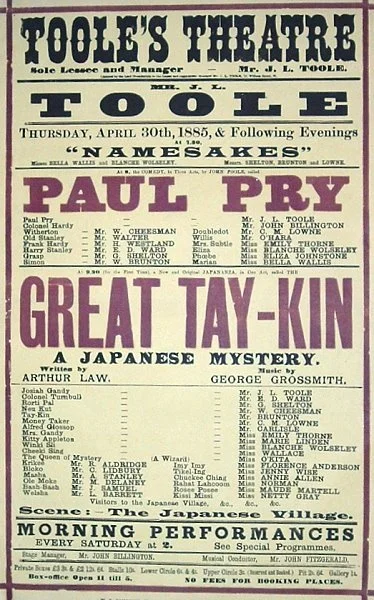
The Great Tay-kin, Toole's Theatre, May 1885. Public Domain.
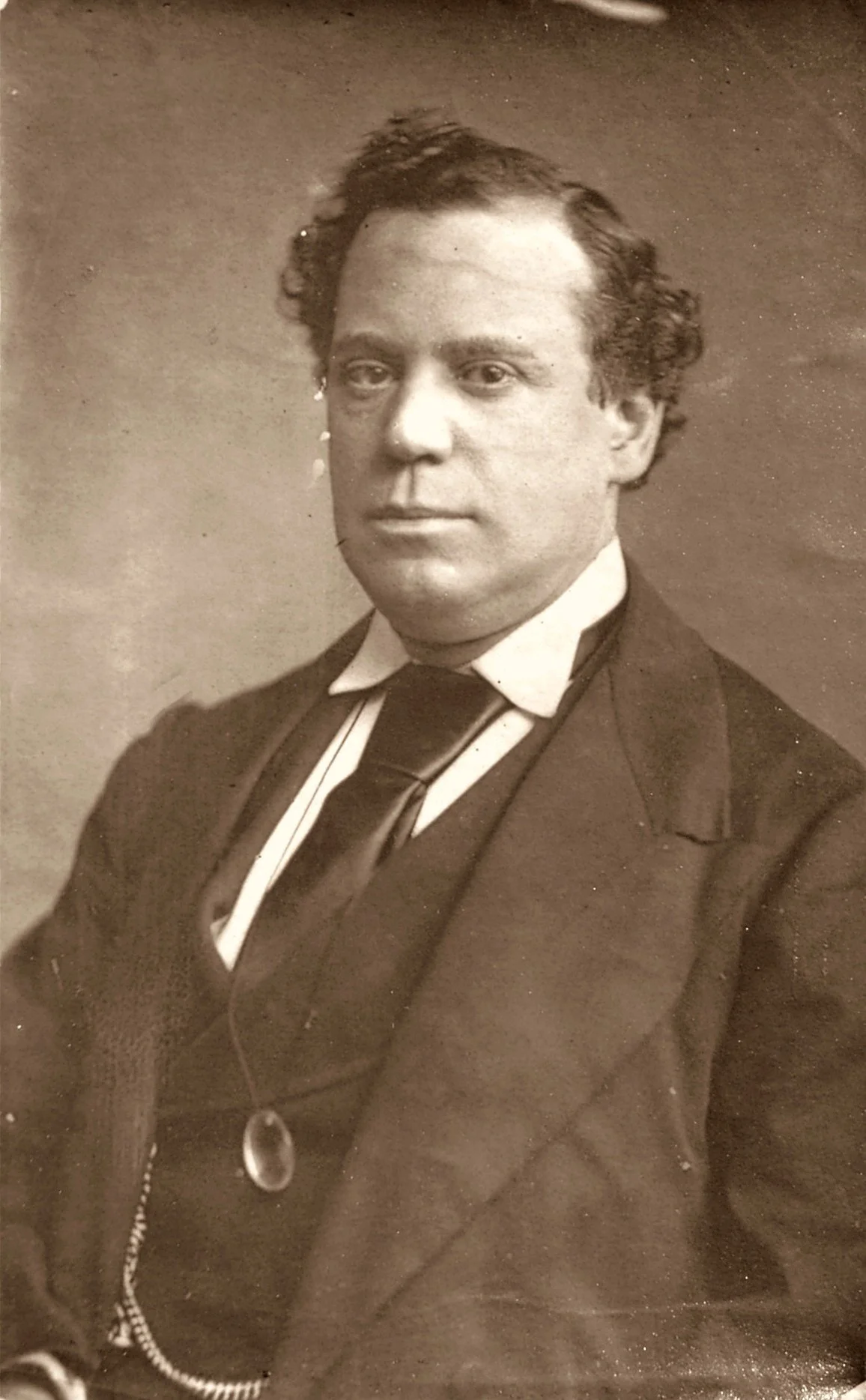
J.L. Toole. National Portrait Gallery. Creative Commons.
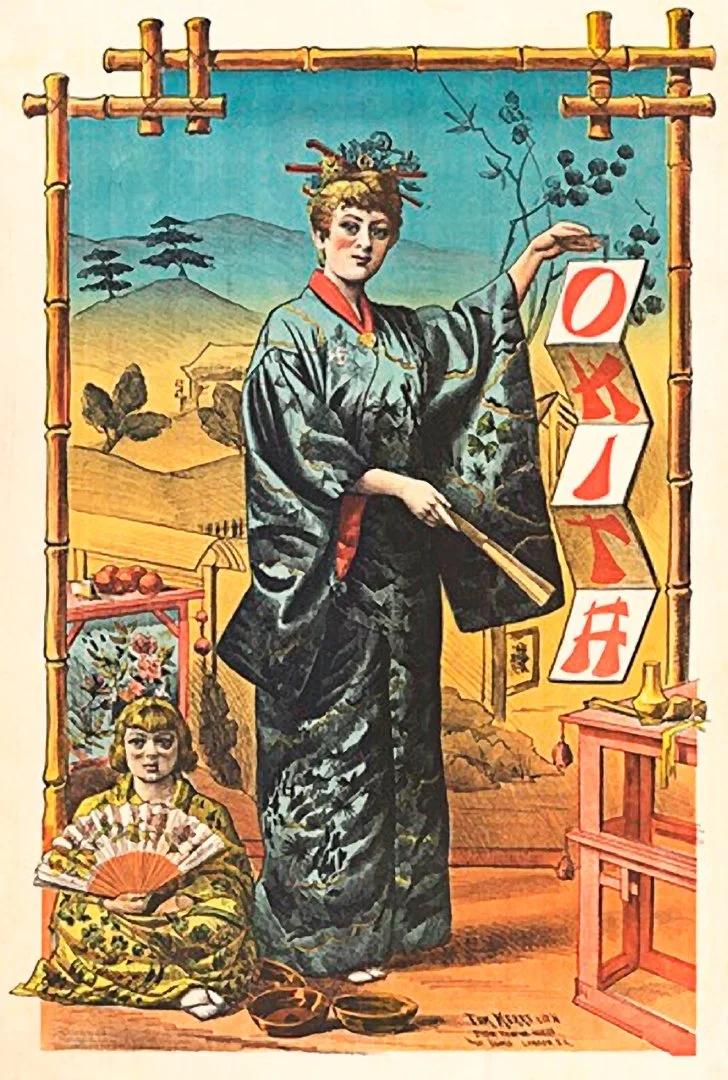
Okita circa 1890. Public domain.
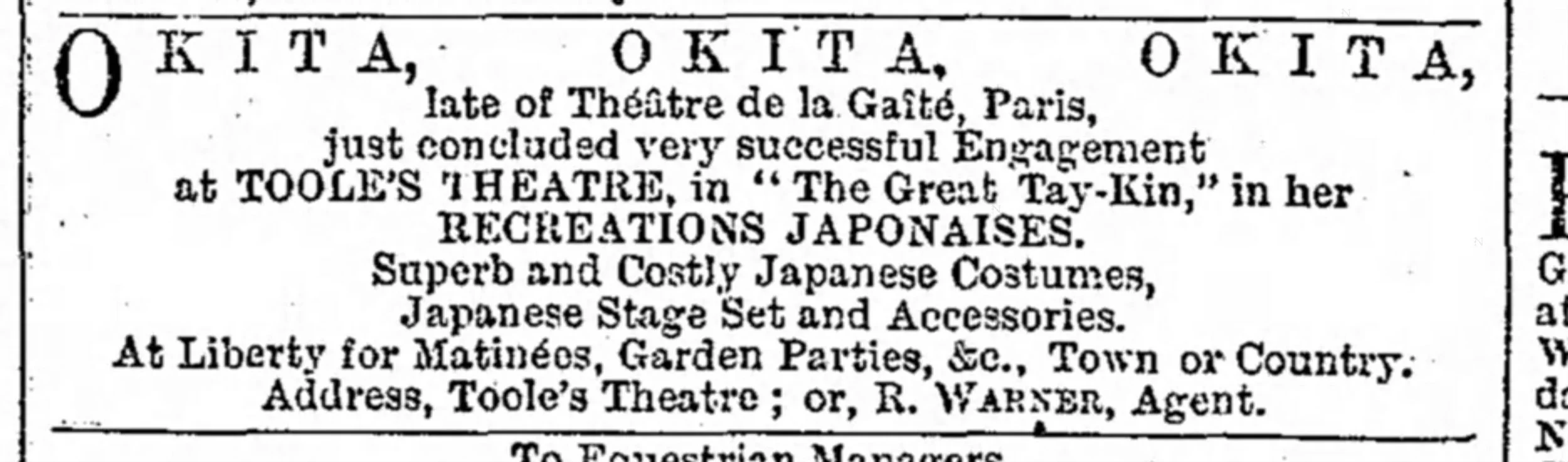
Okita, Okita, Okita, Era, 22 June 1885, 22. Image created by the British Library Board. No known copyright holder.
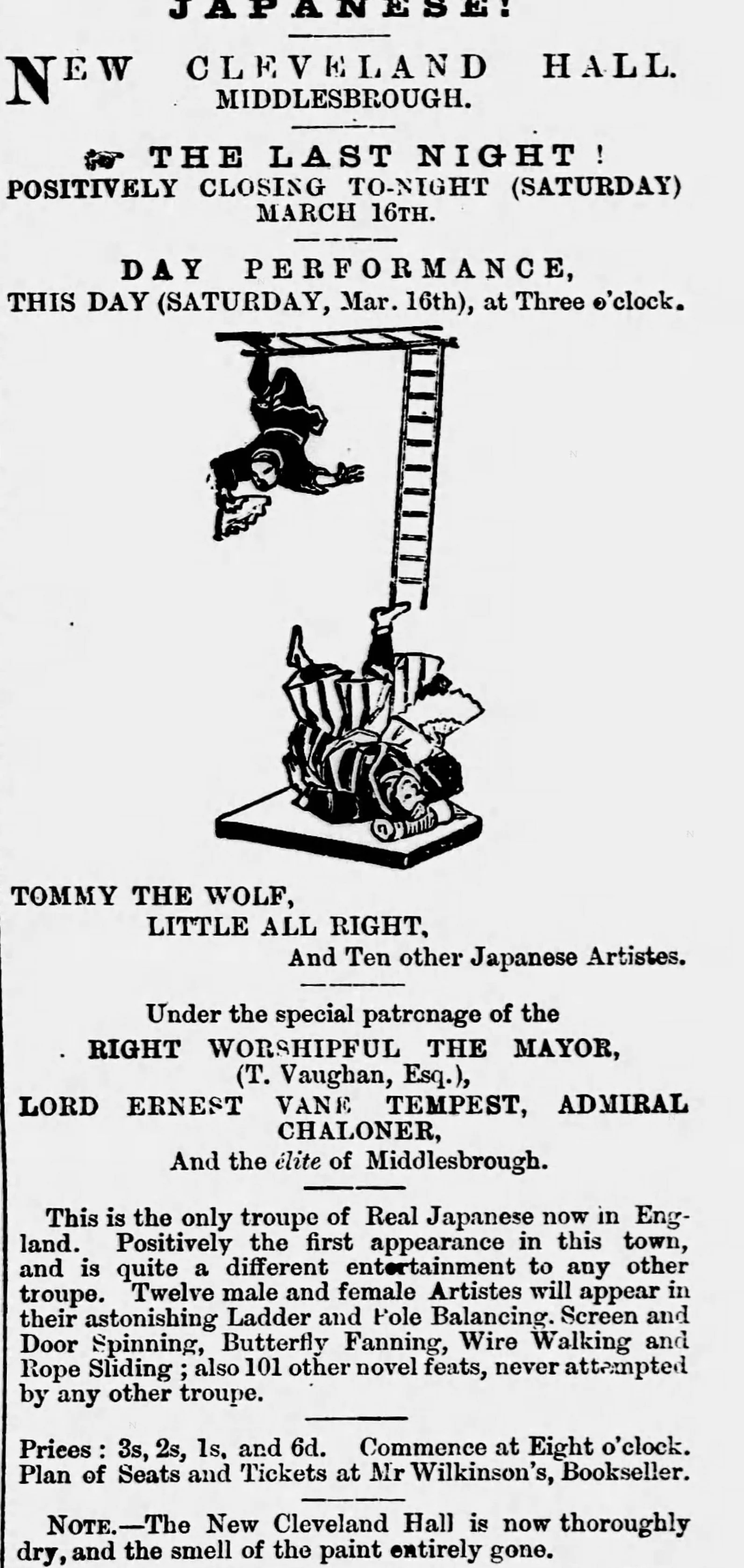
Tannaker's Japanese, with Little All-Right and Tommy the Wolf. North-Eastern Daily Gazette, 16 March 1872, 1. Image created by the British Library Board. No known copyright holder.
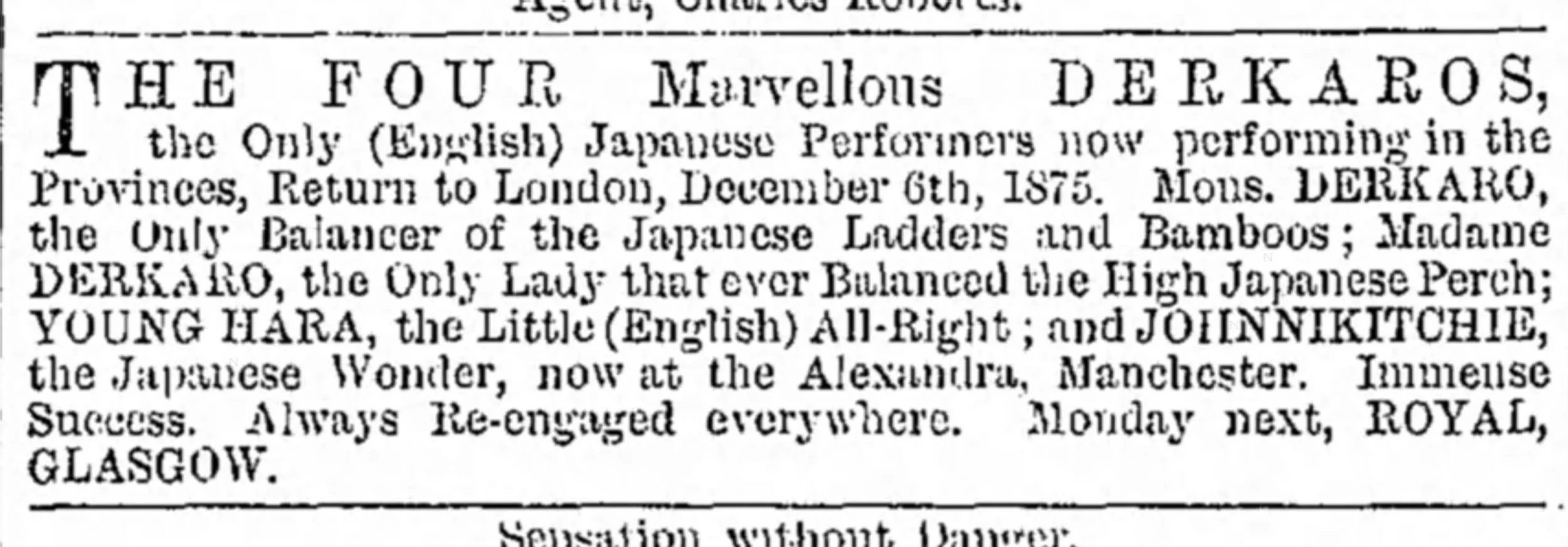
The Derkaros, with the Little (English) All-Right. Era, 11 July 1875, 13. Image created by the British Library Board. No known copyright holder.
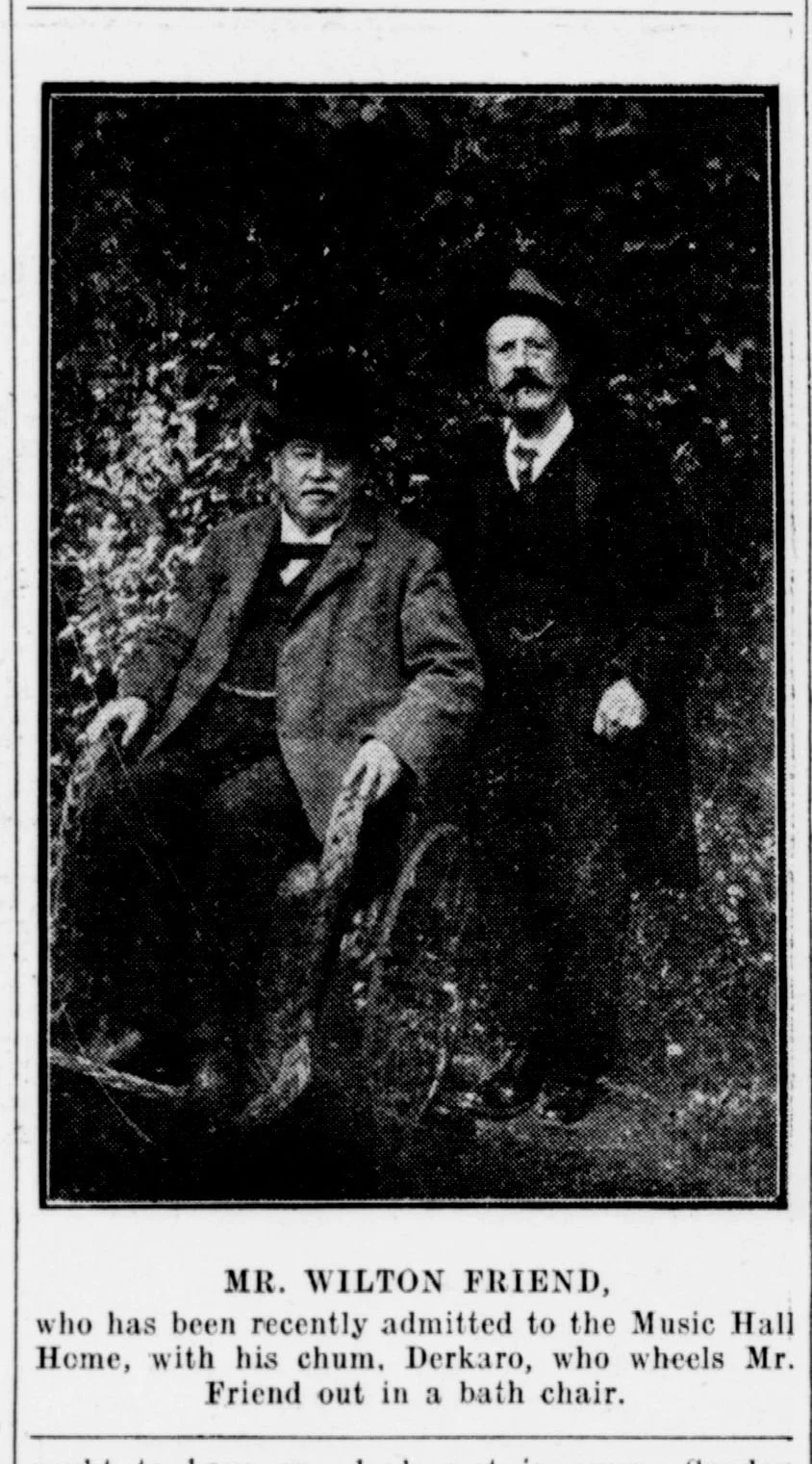
Alfred Derkaro/Carrier (standing) in later life. Era, 21 October 1911, 31. Image created by the British Library Board. No known copyright holder.
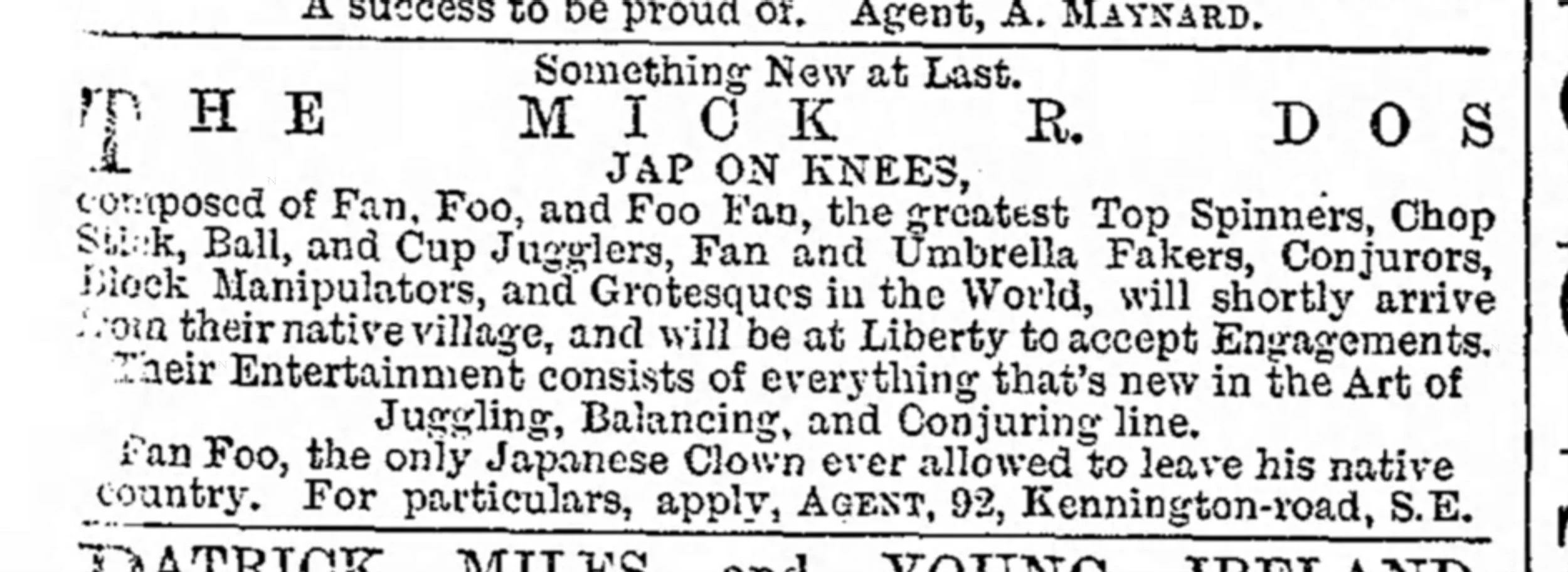
The Mick R. Dos. Era, 9 May 1885, 23. Image created by the British Library Board. No known copyright holder.
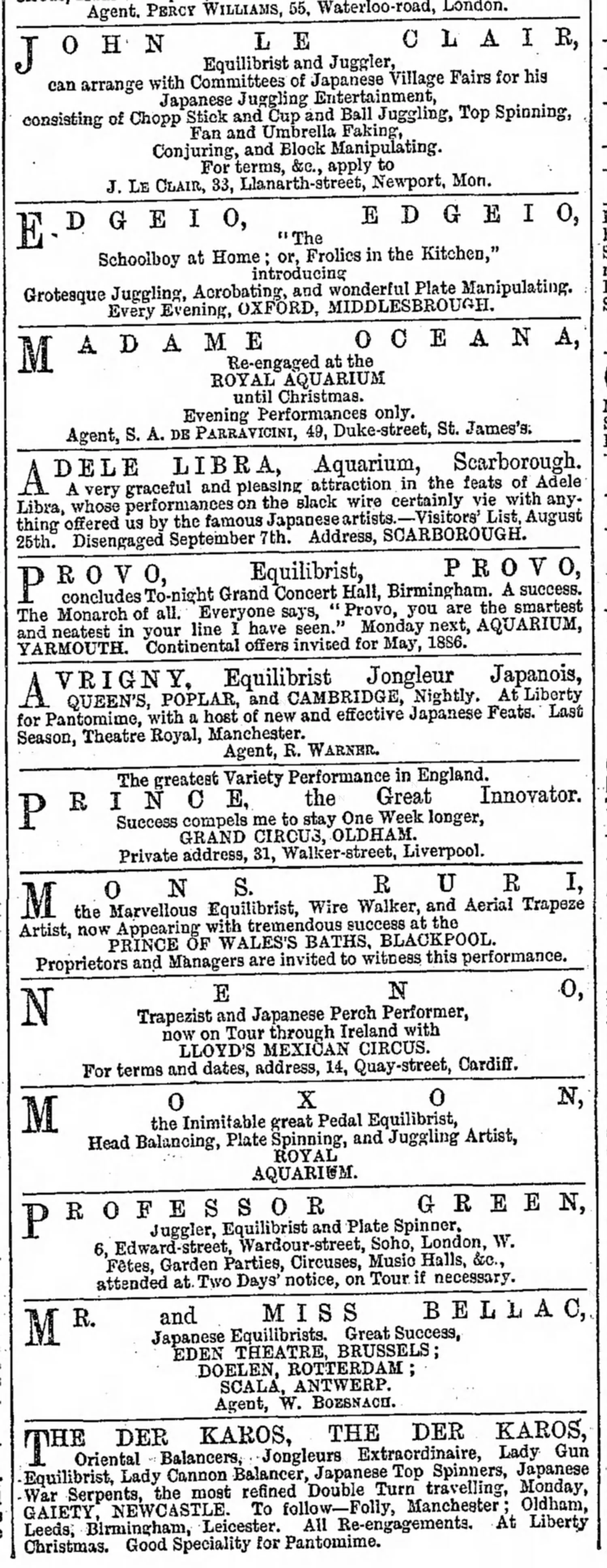
Satisfying the craze for all things Japanese. Era, 29 August 1885, 22. Image created by the British Library Board. No known copyright holder.
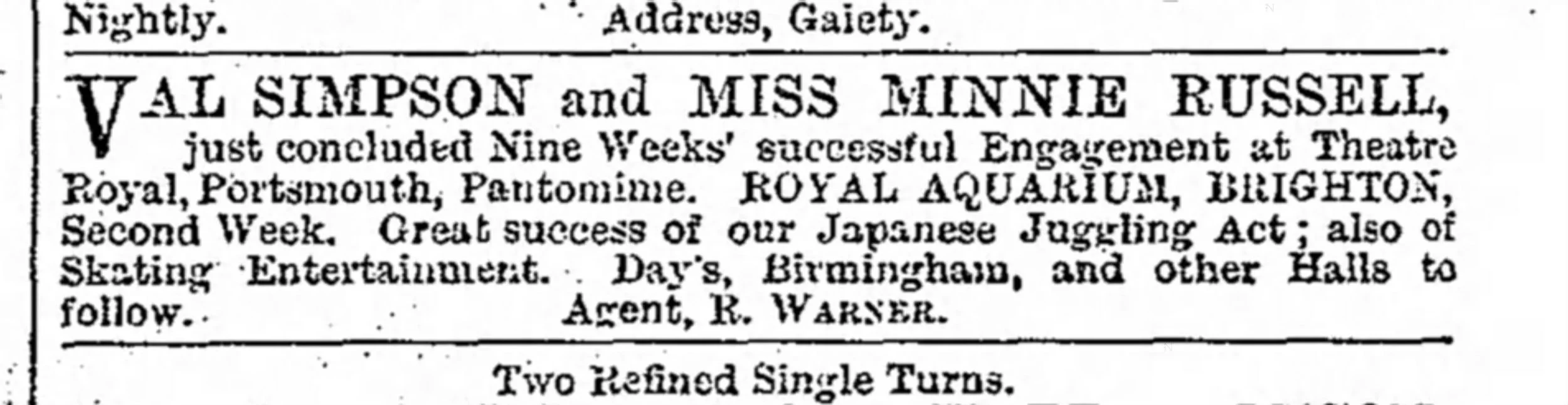
Val Simpson and Miss Minnie Russell. Era, 28 February 1885, 22. Image created by the British Library Board. No known copyright holder.
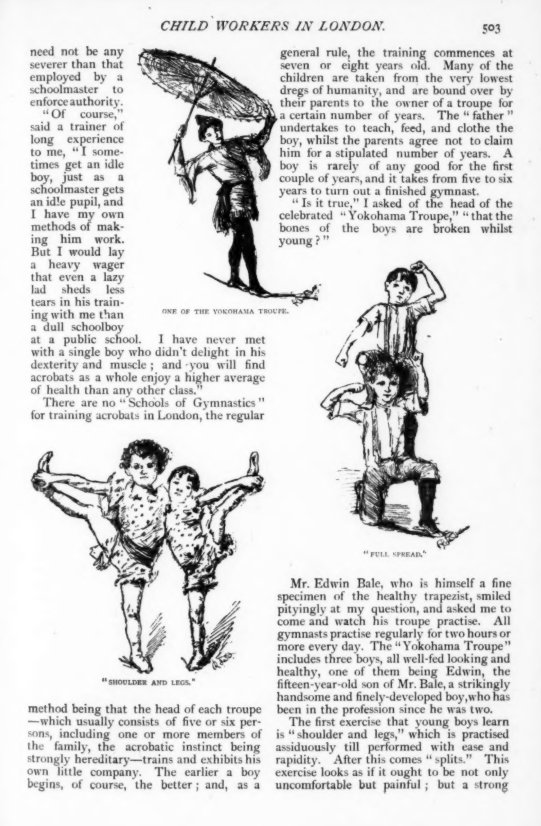
"Child Workers of London", excerpt of interview with Edwin Bale, Strand Magazine, May 1891. Public domain.
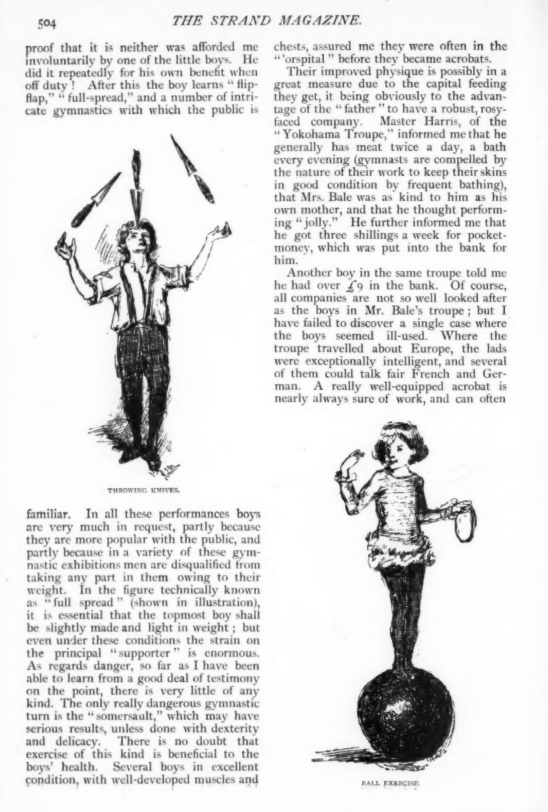
"Child Workers of London", excerpt of interview with Edwin Bale, Strand Magazine, May 1891. Public domain.
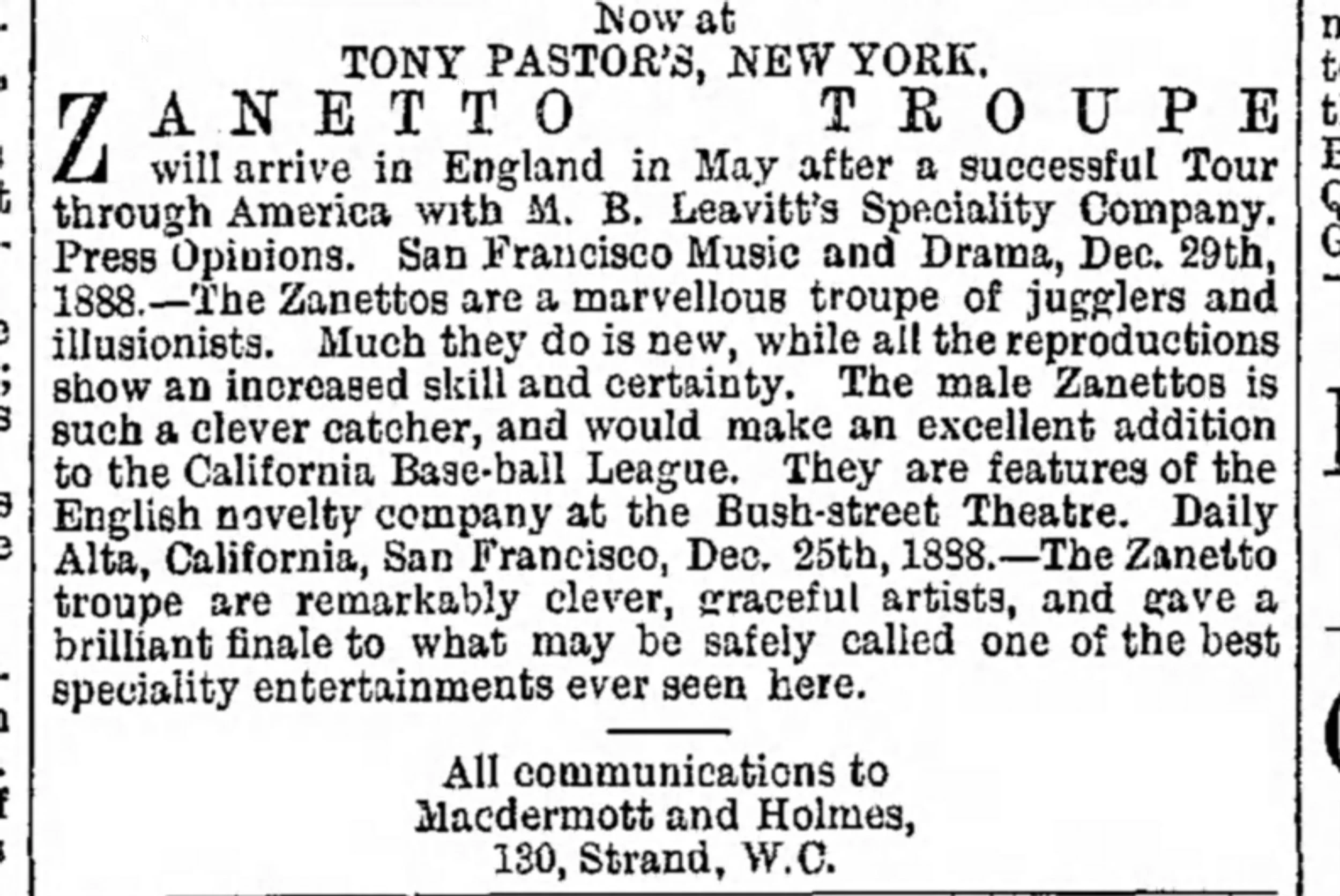
The 1888-1889 Zanetto Troupe arrive in England. Era, 4 May 1889, 21. Image created by the British Library Board. No known copyright holder.
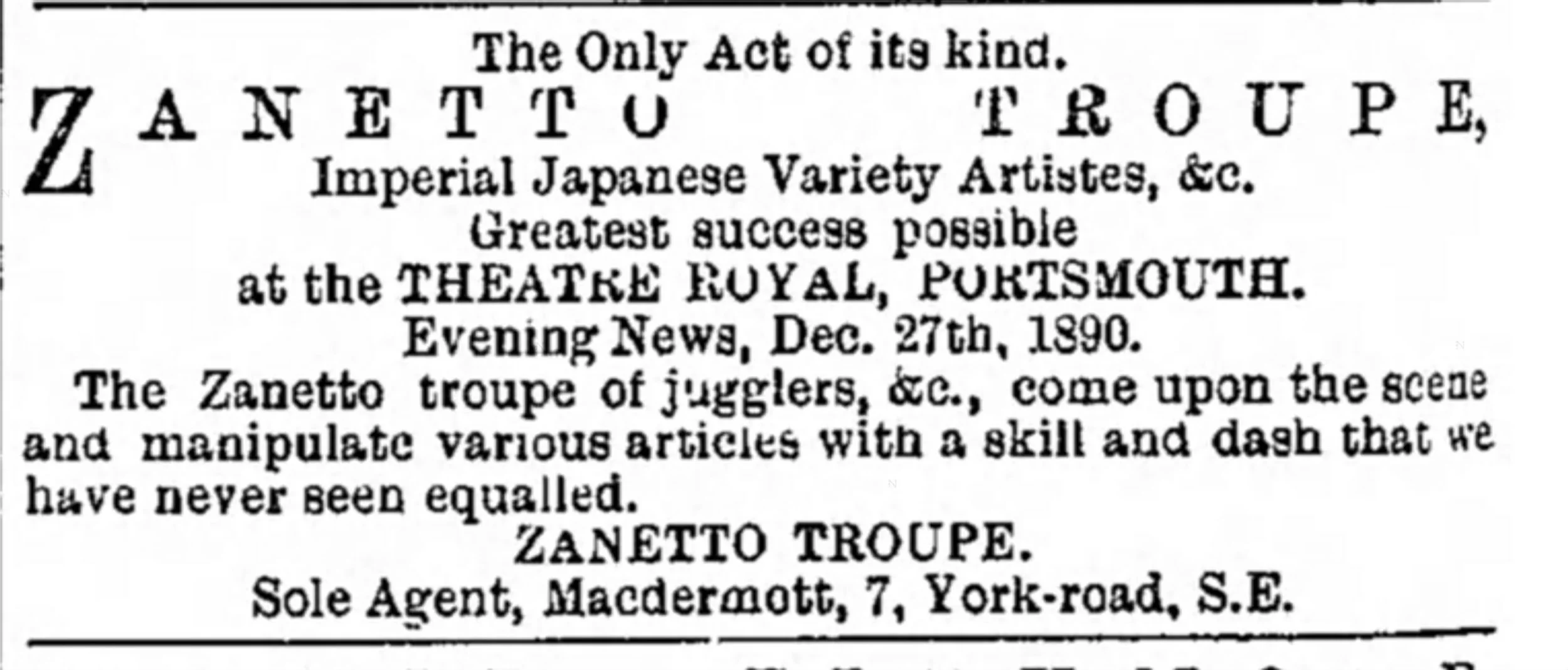
The 1890-onwards Zanetto Troupe. Era, 24 January 1891, 24. Image created by the British Library Board. No known copyright holder.