The Pêl Fas Years.
1904—1918.
Jamie Barras.
Many of Cardiff’s pubs and clubs hold regular quiz sessions and one regular question invariably stumps many participants. It is: “Splott US were a famous Cardiff baseball team, but what was the meaning of US in the title?” The answer is that the US stood for University Settlement, not United States or United Services, as many people think. The Settlement was founded at the turn of the century by people with University connections such as Professor Burrows.[1]
The “University Settlements” were institutions set up in Britain’s inner cities by academics and alumni of Britain’s universities for the betterment of the lives of working men and women. They were staffed by volunteers drawn from students of those same universities, men and women who saw themselves as secular missionaries (it was no coincidence that many were divinity students) preaching something akin to Chadwick’s maxim of ‘discipline, order, and fair play’.[2]
Splott University Settlement was founded in 1901 and was the last of the settlements. It was an initiative of staff and alumni of University College Cardiff (UCC, now part of Cardiff University).[3]
One key difference between the Splott settlement and settlements elsewhere in the country was that it did not offer accommodation. This was of critical importance to its future development, as this accommodation, when available, was only for men, and thus, many other settlements were focused heavily on the health and welfare of the working man. Splott, in contrast, from its earliest days, also provided support to women, particularly working women, thanks to the active participation in its administration by women like Una Burrows, wife of the settlement’s first warden, and Lillan Howell, of the famous Cardiff Howell family, founders of the city’s leading department stores. This aligned it with the Chapel Sport movement and would eventually lead to the involvement of the settlement in the promotion of women’s sports, including baseball.[4]
Splott University Settlement v. Channel Mills. At Splott Park. Splott took first innings, and thanks to fine “off” driving by Messrs A. and T. Mitchell, J.K. Merritt, who made respectively 25, 22, and 19, the innings realised 97. Channel Mills feebly responded with 15 and 19.[5]
Splott University Settlement makes its first appearance under that name as a team in a June 1907 report in the South Wales Daily News detailing a match against the Channel Mills team (Cardiff and Channel Mills was a local flour mill, a subsidiary of the famous Spillers Flour Mills Company[6]).[7] However, we can be sure that the team had been in existence since 1904, playing under the name ‘Splott’, based on the officers (e.g., Ted Diment (Henry Edwin Diment (1878–1927)) and players, notably the team captain, W.H. Williams, that the teams had in common. Diment, who was works manager for Messrs Tuck and Co., a rubber goods manufacturer with premises in Bute Docks, would eventually rise to become chairman of the sports governing body.[8]
The settlement founded the team to keep the players in its football team together in the summer. Contemporary minutes show that the settlement administration originally wanted to form a cricket team for this purpose; however, the members voted to form a baseball team instead. The minutes rather sniffingly state, ‘We are surprised by the local support for the American sport of baseball, but having viewed the local converted cabbage patch called Splott Park, we can understand that cricket would be difficult to play there’.[9]
By 1907, the league, operating under the auspices of the newly renamed Welsh Baseball Association (WBA), had no less than four divisions containing at least 36 teams. This was up from three divisions and 30 teams the previous year, and just 10 teams and a single division the year before that—although it should be noted that these numbers represent only the teams entered in the league, not the sum of teams playing in South Wales.[10]
The explosion in growth between 1905 and 1906 under what was at the time known as the South Wales and Monmouthshire Baseball Association was accompanied by the offering of a new trophy for the winner of the first division championship, the Dewar Shield. This was the gift of distiller Sir Thomas Dewar, the sponsor of many such trophies in many sports, and represents a connection between the ‘English’ game in Wales and the American game in London, as Dewar was a prominent supporter of the London Baseball Association (LBA) of the 1890s, which played under the American code.[11]
The teams taking part in the 1907 season ranged from the settlement teams (Splott US, University Settlement) and company teams (Channel Mills, Cardiff Rope Works, Post Office), through political clubs (Roath Conservatives, Grange Liberal Institute) and church teams (Caerphilly English Congregationalist (E.C.), St Peter’s RC Church, Roath, St Saviour’s Anglican Church, Splott, St German’s Anglican Church, Roath) to pub teams (London Style). Many of the teams not associated with a specific institution were connected to local sports clubs already fielding, for example, rugby and association football teams. (It is worth stating here that many of the South Wales baseballers were men known locally primarily for their careers in other sports, most notably rugby football, with their participation—see, for example, the case of Jack Wetter, below.)[12]
The list represents the full breadth of organisations involved in the period in the promotion of physical recreation amongst working men, faith-based and secular. The former is strongly represented, and not coincidentally, faith-based organisations would be a feature of baseball played under the English code in both its centres, South Wales and Liverpool—Liverpool even had a Church baseball league in this period (The Liverpool and District Church Baseball League[13]). This reflects both the sheer number of faith-based organisations in the working class areas of Britain’s cities—and it is noticeable in this respect that both Liverpool and Cardiff were port cities—and the extent to which, in the wake of the rise of ‘Muscular Christianity’, sport was adopted by these faith-based organisations as a means to further their mission, something that is discussed in detail below.
New to the league in the 1907 season was Penylan, a club that had been in existence since at least 1905; Penylan would go on to be one of the dominant teams in the league and remain in existence for over 70 years.[14] The 1907 season also marked the first appearance of another of the league’s dominant teams, Grange Albion(s), which survived all the way up to 2018 and was revived again in 2021. Of interest to us here, the Albion was formed from members of the Penarth-Road Methodist team of the previous season.[15]
To the latter and the aforementioned Caerphilly English Congregationalist teams, we can add Splott Wesleyans and Roath Wesleyans as early baseball teams in Cardiff that grew out of the Chapel Sport movement. The Baptists would become involved within a few years, too. It is also worth mentioning in this context that many of the working men who were members of the Splott University Settlement were ‘Nonconformists and Liberals’. This description can unquestionably be extended to cover the members of the many local sports clubs that fielded baseball teams.[16]
Chapel Sport was an offshoot of ‘Muscular Christianity’, but one that placed much less emphasis on the promotion of ‘masculinity’ than the Anglican original, focusing instead on the promotion of health and fellowship, something that, for example, would prove more amenable to the development of women sports (which is not to say that all chapelgoers gave women’s sports an easy ride, of course). Hugh McLeod, who coined the term, described its development as passing through five stages: 1) The spontaneous founding of sports teams for the purposes of fellowship; 2) a recognition that these teams represented a way to keep teenagers too old for bible class within the chapel community; 3) the further exploitation of these team as a way to increase chapel membership and promote healthy living; 4) the extension of the latter idea to a doctrine that playing sports was vital to leading a good life; and finally, 5) a view that sports provision was an essential part of a chapel’s activities.[17]
What is interesting about this progression is the extent to which it mirrors the development of rounders, the sport that would become English Baseball, in Liverpool in the 1870s and 1880s, with a period of spontaneous adoption and growth (McLeod Step 1), followed by regulation and promotion of the sport as a form of physical recreation ideal for the working man (McLeod Steps 3 & 4). The parallels are even stronger when we consider the origin and spread of the role of sport within faith-based organisations like the University Settlements, and, most especially, the Y.M.C.A. In the case of the latter, famously, in the USA, the ‘Y’ became synonymous with gym culture (McLeod Step 5), to the point that, as McLeod puts it, ‘a Y without a gym seemed a contradiction in terms’.[18]
Even in the UK, Y.M.C.A. branches made much of the provision of a gym when trying to attract new members: in 1898, the Leicester Y.M.C.A. boasted that its new gymnasium was ‘…one of the best in the provinces. A competent instructor is engaged, and nightly many young men participate in the pleasures of organised muscular exercise.’[19] This argument can also be extended to the Y.W.C.A.; however, as McLeod points out, the involvement of the Y.W.C.A. branches in sport was historically under-reported.[20]
It should come as no surprise that by 1911, Y.M.C.A.-based teams were also a feature of the WBA.[21] However, before discussing the further development of the WBA, we need first to return to the 1907 season.
BASEBALL CHAMPIONS. GRANGE TEAM’S VICTORY OVER NEWPORT. The famous Grangetown baseball team again won the Welsh championship on Saturday by defeating Newport. No one can deny that the win was not thoroughly deserved, for in every phase of the game the Usksiders were outclassed.[22]
The 1907 WBA season ended in victory for Grange (aka Grangetown) in the first division. The team received their prize, the Dewar Shield, in a ceremony in November.[23] In a sign of things to come, Penylan and Grange Albion were tied for first place in the second division (the championship was decided in a playoff match the following May; Grange Albion won, the first of many championship victories for them[24]). Both Penylan and the Albion were promoted to the first division for the following season.
However, the most remarkable incident of the 1907 WBA season was outside of its regular competition. It came in the form of a brief renewal of the conflict between the English and American codes in South Wales.
Mr Nelson P. Cook’s visit to Morriston has resulted in success, for it has been decided to form a team to play the American game […] It is also likely that a baseball team will be formed at Llanelly. Mr Cook is at Neath to-day, and is confident that in a few weeks there will be many teams in this part of Wales. He is certain also that the American game will be played.[25]
Nelson Pingrey Cook (1864–1928) was a co-founder of the British Baseball Association (BBA), which, since 1906, had been operating two leagues playing under the American code in London. A Vermont native long resident in Britain, Cook had been the first organising secretary of the LBA in London back in the 1890s.[26]
As part of his role as the organising secretary of the BBA, Cook undertook tours of Britain promoting the American code. In the summer of 1906, his destination had been Scotland, in the winter, Birmingham; now, in the summer of 1907 (early June), he was in South Wales. Here, as in Scotland and Birmingham (and indeed, London), his focus was on interesting local Association Football clubs in adopting baseball under the American code as a close-season complement to football.[27]
Cook was greatly aided in his efforts by the May 1907 decision by the Danygraig Football Club of Swansea to form a baseball team to play the game under the American code. This would be the first baseball club in Swansea under either code, so this was both a coup and a unique opportunity for Cook, as, unlike elsewhere in South Wales, here, the thirst for the game was not already being met by teams playing under the English code. However, the WBA was not going to give up without a fight, and arranged to play an exhibition game under the English code at the Danygraig ground, scheduled for late June, to convince baseball enthusiasts in Swansea of the superiority of the local game. Initially, it was hoped that this would be between picked Cardiff and Swansea teams. However, due to the lack of suitable players in Swansea, it was ultimately decided to send picked Newport and Cardiff teams (playing under the names ‘East’ and ‘West’, respectively).[28]
Cook moved quickly to raise the stakes: offering to run a weeklong training camp at Swansea in early July for anyone interested in the American game, with himself as the [star] instructor. Local newspaper headlines asked ‘WELSH OR AMERICAN? WHICH STYLE OF BASEBALL WILL SWANSEA ADOPT?’ The competition was on.
The WBA teams played their exhibition game on Saturday, 29 June, before an interested (if unknowledgeable) crowd, with the West team (Cardiff) winning by four runs.[29] Preparations were then made to welcome back Cook the following week for the start of his training camp.
But Cook never showed. Interested players gathered at the Danygraig ground on Monday, 8 July 1907, and waited…and waited…but nothing, no Cook, no telegram to explain his absence; nothing. Danygraig’s enthusiasm for the American game evaporated in the face of the humiliation heaped upon it by Cook’s failure to appear. In a newspaper report that did little to disguise the hurt this slight had caused, it was said that ‘The absence of Mr Cook had altered things considerably, and now it is extremely doubtful if baseball will “go” at all this summer.’ And the Danygraig team was now ‘…thinking more of football than anything else’.[30]
It was an extraordinary own goal from Cook (with apologies for the mixed metaphor); with this one act, Cook had set back the cause of the American game not just in Swansea but in the whole of South Wales, ultimately, by decades. In December, it was announced that he would return to South Wales (Cardiff, not Swansea) in the New Year. However, there is no reference to the Swansea incident in reports of this planned visit, and it seems ultimately not to have taken place. Truth be told, by January 1908, the BBA had more pressing problems: the 1907 season in London had been a financial failure, exacerbated by bad press at home and abroad, and the major Association Football clubs that had backed the BBA at launch were on the brink of withdrawing, as was Cook’s partner in the founding of the BBA, John A McWeeney. The chance to plant the American game in South Wales had passed.[31]
What was behind this affair—a lapse of memory, a loss of interest? With Cook, it is impossible to tell. He was a complicated character; on the one hand, he put in the years—and the miles—as organising secretary for first the LBA and then the BBA, but, on the other, he was a flim-flam man, a failed journalist turned travelling salesman with a tendency to spin tall tales to passing journalists. After his falling out with the co-founder of the BBA, McWeeney (himself a journalist), he gave an interview to an American newspaper in which he wrote McWeeney out of the story completely, an extraordinary slight that demonstrates that it would not have been out of character for him to consciously fail to honour his agreement with the Danygraig club. At the end of the 1909 season, it was his turn to exit the BBA (he returned to America with his British wife and children). On balance, whatever he contributed to the game in earlier years, by 1909, the American game in Britain was better off without him.
INTERNATIONAL BASEBALL. England and Wales met for the first time in an international encounter at Cardiff yesterday. The English team was composed practically of Liverpool players, while that of Wales was drawn from the Cardiff and Newport clubs. Wales batted first, and mainly owing to fine scores by Lewis and Wreford, who each made 18, they scored 102. England responded with 56, Williams, Barron, and Ramsay (10) being the highest scores. Following on with a deficit of 47, England scored 61, leaving Wales 17 to get to win, which they did for the loss of four men. Wales winning by seven men to bat.[32]
The highlight of the 1908 WBA season was undoubtedly the match between picked Liverpool and South Wales teams, billed as the England vs. Wales Baseball International, which, as the quote above from the Edinburgh Evening News demonstrates, made national news. This was the first of what, by the start of the Second World War, would be 22 such encounters, Wales winning 14 (9 home, 5 away) and England 8 (6 home, 2 away). However, of more interest to us here is the churn of teams in the WBA league, with as many old teams leaving/folding as new teams joining, something that would be a feature of the league for the whole of its existence.[33]
Joining the newly promoted Penylan and Grange Albion in the first division would be returning teams Splott US, Grange Barbarians, Roath Conservatives, Newport, the champions Grange, and new teams Grange Temperance Institute and Barry Conservatives.[34]
The Channel Mills team dropped to the second division and Caerphilly to the third. The second division also included a team new to the league, but not a new team, the Pill Harriers. The Pill Harriers were a Newport-based team that grew out of the provision of sporting facilities for dockworkers and coaltrimmers in the Pill district of the city. They had been playing baseball since at least 1899, and would go on to become another stalwart of the game in South Wales.[35]
The 1908 season would also include a team from the Cardiff Gas Works, who played in the third division. At season’s end, Grange were once again the winners of the Dewar Shield.[36]
Having heard a rousing speech from Captain Masterman, the following signified their intention of joining the Sports' Company for active service:—Messrs. W. Jenkins, Gus Lewis, Dan Callan, Mike Honrhan, Dick Williams, J.S. Carter, A. Hodinott, E. Brooke, Rhys Davies, and A. Hales. Mr T. Martin, a baseball player, also joined. Mr. R. W. John announced that no less than 89 players from eleven clubs in the Cardiff District [Rugby] League had enlisted.[37]
Splott US won their first ever league championship in the 1911 season, which, as stated above, was also the season that saw Y.M.C.A. teams play in the league for the first time. Splott would go on to win the Dewar Shield a further five times, placing it in the top 5 of teams with the most wins, albeit far behind the team at number one, Grange Albions, with 25 wins by 1984.[38]
However, this period of the game in South Wales would be dominated by the effects of the outbreak of the First World War. This resulted in the suspension of regular league games. This is not to say that there was no baseball played in South Wales between September 1914 and November 1918, however, far from it; as we will see, players from the WBA would mount charity matches and, more than this, the American code would finally establish a substantial presence in the area thanks to the arrival of US Armed Forces in the form of the US Navy and American Expeditionary Force (AEF).
I hope you and all the baseball boys are all right, as it leaves me at present. I am at our base for the time being, as I have just come out of hospital. I have been ‘gassed.’ My word, it is terrible. No doubt you have heard of our regiment being cut up. We had an awful time of it, and we had to leave a lot of our wounded in the trenches.[39]
The story of Welsh baseballers in the First World War deserves a work of its own. Here, I will focus on a single episode. The 1stBattalion of the Monmouthshire Regiment, a territorial force raised in Newport, set sail for France in February 1915. By May of that year, it had been decimated, suffering horrendous losses at the Second Battle of Ypres.[40] As the account above, from a letter written by Private Frank Halford to the secretary of the Newport Baseball Club (Halford had played for the Newport second team before joining up), makes clear, a number of its men were taken prisoner as allied units retreated. Halford’s letter reached the club in mid-June. In response, the club decided to stage a charity game to raise funds to send relief parcels to the men of the Monmouthshire Regiment taken prisoner.
That match took place in July 1915 between a scratch team put together by 23-year-old Newport captain Edmund Wetter (1892–1983) and a team formed of soldiers of the Monmouthshire Regiment.[41] Edmund’s older brother, and fellow Newport player, Jack (John James Wetter (1888–1967), was himself serving in the South Wales Borderers by this time, which would have given the game added poinancy for the Newport captain. Jack Wetter was a Welsh military rugby international and would go on to win a DCM in 1917. In November 1916, his family received word via a letter from a comrade that he had been killed at Salonika. This fortunately proved incorrect, but this must have been a hard time for the family.[42]
One of the Monmouthshire Regiment players, Rifleman William J. Coombes, may have had even more cause to reflect, as one of the Monmouthshire Regiment soldiers killed at the Second Battle of Ypres was a relative, Arthur James Coombes (died 8 May 1915).[43]
One outcome of note of the charity match was the decision by the Newport club to donate some of its baseball kit to the Monmouthshire Regiment. The gift was acknowledged in a letter to the newspapers sent by Cpl. Lamprey of the 3/1st Monmouthshire Regiment. At the same time, but separately, a local manufacturer sent a Welsh Brigade Royal Field Artillery Unit some baseball equipment in response to a request made through the newspapers back in May. The playing of baseball under the English code in the British Army in this period is a story still waiting to be told.[44]
Another outcome was the playing of a second game for the same cause between Newport and Pill Harrier players in late August. One thing to note about the latter game is that, in the long list of Monmouthshire baseball players who had joined up published in the South Wales Weekly Argus and Monmouthshire Advertiser on 22 May, it was reported that one of the Pill Harriers’ club’s officials, A. Woods, was also killed at the Second Battle of Ypres while serving in the South Wales Borderers. (Later in the war, the Pill Harriers’ former captain and Welsh International (1914), W. Prosser, would die of wounds sustained in battle.)[45]
This episode set the precedent, and further games for charity, usually in aid of local hospitals or prisoner relief packages, would be played by scratch teams for the rest of the war. Notably, in this regard, in July 1916, the Caerphilly Military Hospital Baseball Team was established to raise funds for the local Red Cross Hospital; and that same month, two teams formed mostly of munitions workers played a baseball game at Cardiff Arms Park in aid of ‘starving British prisoners’.[46]
And then, the Americans arrived.
BASEBALL AT NEWPORT. A large number of spectators assembled at Pill Harriers’ Grounds, Newport, Saturday, to witness an exhibition baseball match played by teams of Americans in aid of funds for war invalids.[47]
The baseball games played under the American code by US military teams in South Wales is of interest to us because of their intersection with the local game. We know that some of the games had local involvement; more than this, they were watched by knowledgeable local baseball fans and, critically, players and officials. As I will later show, seeing the game played under the American code would impact how the latter would play the game under the English code in the post-war period.
The first thing to acknowledge is that, in terms of games recorded, we are talking about only a handful compared to the hundreds of games played across the South-East of England. This is, as might be surmised, because there were many fewer AEF units stationed in Wales, and, as far as I am aware, the only CEF units stationed in Wales were those unlucky enough to be assigned to the infamous Kimmel Camp at the war’s end as a prelude to being shipped home.[48] The second thing to acknowledge, which is connected to the first, is that local observers saw too little of AEF units to grow familiar with AEF unit designations, resulting in reports such as that quoted above, from September 1917, where the players were simply referred to as ‘Americans’.
The biggest American baseball game in Wales was played in Cardiff on 4 July 1918, at Cardiff Arms Park in the presence of the Lord Mayor of Cardiff and other local dignitaries. The visitors were represented by the US Consul in Cardiff, Lorin Lathrop, and Commander Jeffers, USN. The teams were described as ‘crews of American vessels’, but no other information was given. We can suppose, however, that these were colliers assigned to carry coal from the South Wales coalfields to US troops in France, as these constituted the majority of US-flagged vessels operating out of South Wales ports during the war.[49]
A Glamorgan team meeting Uncle Sam's bluejackets in a baseball match at Cardiff Arms Park on Saturday were defeated by 19 to 4.[50]
Two days after the 4 July game between two American teams at Cardiff Arms Park, a game took place between a US Navy team and a local team. Based on the score (19–4), we can safely assume that it was played under the American code. This is the only instance I can find of a report of a game between a local and an American team. The proximity to the 4 July game strongly suggests the ‘bluejackets’ were one of the teams that played on 4 July, and, by extension, likely a team from one of the colliers. We can add to this short series of American games at Cardiff Arms Park the 1 June 1918 game in which Splott US played a charity game against a team drawn from the rest of the South Wales league at Cardiff Arms Park. Before the game, “two teams of American seamen delighted the audience with an exhibition of the game as they play it.”[51]
BASEBALL AT CARDIFF. In aid of the Prisoners of War Fund two baseball matches were played at the Cardiff Arms Park on Saturday afternoon, illustrating the differences in style between the American and Welsh games.[52]
We are on much safer ground with the games played at Cardiff Arms Park on 18 May 1918 thanks to a rare surviving artefact from this period, a ticket to the games that reveals that the teams were from the USS Beaufort and USS Jupiter. A check of US registers shows that these were both colliers, giving us our best evidence that the bluejackets at the other games were similarly engaged. These games are of additional note, as one of them was played under the Welsh code. As far as I have been able to determine, this is the first instance of American baseballers playing the “English” game since the Spalding tourists took on a Liverpool team at rounders in 1889.[53]
CARDIFF WORKERS’ SPORTS CLUB. It has been decided at a meeting of Spillers and Bakers (Limited) workers, Cardiff, presided over by Mr. S. Potter, to resuscitate the athletic club, which was closed for the duration of the war […] It was decided to hold another meeting this summer and to re-instate the various sections of sport, including cricket, Rugby and Association football, baseball, and swimming.[54]
With the end of the First World War, US forces began to leave South Wales. The last game between US teams in Cardiff reported in the newspapers took place in March 1919, at Cardiff Arms Park, between US Navy ‘Headquarters’ and ‘Crew’ teams; the Crew team won 9–4.[55]
By then, moves were already afoot to, in the words of the local newspapers, ‘resuscitate’ the game under the English code in South Wales. The WBA held its first post-war meeting on 14 May 1919; 40 clubs had already indicated that they would take part in the revived league. We will pick up that story in a future episode of this series.[56]
Insulated from the encroachment of other summer sports by distance, the South Wales scene would ultimately overtake the Liverpool scene in importance. The revival of English Baseball in South Wales in the first decade of the twentieth century, and the success the game had in negotiating the disruption caused by the First World War, set it on course for its golden period, 1919–1939.
Jamie Barras, August 2026.
Back to The Rounders
Notes
[1] ‘How Well Do You Know the City of Cardiff?’, Cardiff Post, 18 April 1996.
[2] Lionel F. Ellis, “Toynbee Hall and the University Settlements,” Journal of the Royal Society of Arts 96, no. 4762 (1948): 167–78, http://www.jstor.org/stable/41363547.
[3]https://www.cardiff.ac.uk/about/our-profile/history, accessed 16 July 2025. Assessment for Listing, Old College Building, Courtney Road, Splott, Cardiff, https://www.gov.wales/sites/default/files/publications/2019-01/160307atisn10172doc1.pdf, accessed 16 July 2025.
[4] Lucinda Matthew‑Jones, “How Women from All Classes Came Together in the Splott Settlement,” WalesOnline, accessed 15 July 2025, https://www.walesonline.co.uk/lifestyle/nostalgia/how-women-classes-came-together-12596684.
[5] ‘Splott University Settlement v. Channel Mills.’, South Wales Daily News, 26 June 1907.
[6]https://canfod.glamarchives.gov.uk/en/records/D684, accessed 16 July 2025.
[7] ‘Baseball’, South Wales Daily News, 26 August 1907.
[8] Splott baseball team of 1904: ‘Baseball’, Western Mail, 8 August 1904; roster for Splott 1905 with W.H. Williams, etc. ‘Baseball’, South Wales Daily News, 7 August 1905; Splott US listed as Splott, based on roster: ‘Baseball’, South Wales Weekly Argus and Monmouthshire Advertiser, 7 September 1907. H.E Diment, treasurer of Splott Baseball Club: ‘Splott Baseball Club’, South Wales Daily News, 24 March 1904. His later career and biographical details: Cardiff Baseball Pioneer’, Western Mail, 8 June 1927. Messrs Tuck and Co.: http://messybeast.com/1892-bristol-channel/1892-bristol-channel.htm, accessed 16 July 2025.
[9] ‘A Splott on the Landscape’, South Wales Echo, 7 May 1986; ‘Work Schemes of the Past Nurtured Sporting Greats’, Cardiff Post, 12 June 1997.
[10] Number of teams in 1907 league: ‘Baseball: Allocation of Teams’, Western Mail, 9 April 1907. 1906 South Wales season with three divisions and 30 teams: ‘Baseball’, Western Mail, 19 March 1906. 10 teams in competition in 1905: ‘Baseball’, South Wales Daily News, 28 April 1905.
[11] Dewar Shield offered as a prize: Western Mail, 6 March 1906; Thomas Dewar and the LBA: R. G. Knowles and Richard Morton, Baseball (London: George Routledge and Sons, 1896), 64–65. The shield can be seen in the photo here: http://www.grangetowncardiff.co.uk/grangesport.htm, accessed 16 July 2025. See also: William Morgan, ‘Welsh Trophies’, Baseball Mercury, Issue 34, November 1983.
[12] London Style Pub: Brian Lee, Cardiff Memories: Grangetown’, https://www.walesonline.co.uk/news/local-news/brian-lee-cardiff-memories-grangetowns-2016592, accessed 17 July 2025.
[13] ‘Liverpool and District Church Baseball League’, Liverpool Evening Express, 10 June 1905.
[14] Penylan is described as a ‘new addition’ to the league here: ‘Baseball in South Wales’, South Wales Daily News, 4 May 1907. Mention in 1905: ‘Baseball: Penylan v. Scratch Team’, South Wales Daily News, 2 August 1905. William Morgan credits 1903 as the year of the team’s founding: William Morgan, ‘A Visit to Cardiff’, Baseball Mercury, Issue 33, July 1983.
[15] ‘Welsh Baseball Association’, South Wales Daily News, 26 April 1907. Elizabeth Thomas, “When Baseball Was One of the Biggest Sports in Cardiff and the Fight to Keep It Going,” WalesOnline, accessed 17 July 2025, https://www.walesonline.co.uk/lifestyle/nostalgia/cardiff-baseball-league-teams-grangetown-23250070. Demise of Grange Albion in 2018: http://www.grangetowncardiff.co.uk/grangesport.htm, accessed 21 July 2025. Revival: Elizabeth Muratore, “The Remarkable and Rich History of Welsh Baseball,” MLB.com, accessed 22 August 2026, https://www.mlb.com/news/featured/welsh-baseball-remarkable-history.
[16] Caerphilly Congregational Institute: ‘Baseballer’s Funeral’, South Wales Daily News, 12 July 1906; Splott Wesleyans: ‘Baseball’, South Wales Daily News, 8 June 1905. Roath Wesleyans: ‘Baseball’, Western Mail, 22 August 1907. Splott US ‘Nonconformists and Liberals’: ‘Splott Election and the University Settlement’, South Wales Daily News, 3 November 1904.
[17] Hugh McLeod, “‘Thews and Sinews’: Nonconformity and Sport,” in Modern Christianity and Cultural Aspirations, ed. David Bebbington and Timothy Larsen (London: Sheffield Academic Press, 2003), 28–32.
[18] Hugh McLeod, “The YMCA and the Rise of Modern Sport,” 6. Accessed 16 July 2025, https://ymcaheritage.com/wp-content/uploads/2020/04/The-Rise-of-Modern-Sport-YMCA-Oral-Histories-and-Stories-v.2.pdf.
[19] Quoted by McLeod, Sport and the Y.M.C.A., Note 18 above, 6.
[20] McLeod, Sport and the Y.M.C.A., Note 18 above, 7.
[21] ‘Baseball’, South Wales Daily News, 22 May 1911.
[22] ‘Baseball Champions’, Western Mail, 9 September 1907.
[23] Grange awarded Dewar Shield: ‘Baseball in South Wales’, Western Mail, 8 November 1907.
[24] ‘Baseball’, Western Mail, 4 May 1908.
[25] ‘Baseball Champions’, Western Mail, 9 September 1907.
[26] Knowles and Morton, Note 11 above, second reference, 80–81; Ernest L. Heitkamp, ‘Yankee Fan Makes England “Play Ball”’, Sunday Star (Washington, D.C.), 12 April 1908.
[27] Cook in Scotland: ‘Baseball In Scotland’, Dundee Evening Telegraph, 13 July 1906; in Birmingham: ‘Football and Baseball’, Northern Daily Telegraph, 8 November 1906.
[28] Danygraig FC adopting American code for its baseball team: ‘First Swansea Baseball Team’, South Wales Daily Post, 15 May 1907; WBA opts to send team to play Swansea team: ‘Baseball: Welsh Association’, South Wales Daily Post, 15 May 1907; Ultimately, it is picked Cardiff and Newport teams: ‘Exhibition Game at Swansea’, South Wales Daily News, 15 June 1907.
[29] Cook’s offer to coach players for one week: ‘Baseball Begins at Swansea’, South Wales Daily Post, 29 June 1907; headlines: ‘Welsh or American?’, South Wales Daily Post, 18 June 1907; East vs West game: ‘Baseball: East v. West’, South Wales Daily News, 1 July 1907; ‘Baseball: East v. West Match Played at Swansea’, Western Mail, 1 July 1907.
[30] ‘Sports & Pastimes’, South Wales Daily Post, 10 July 1907.
[31] Cook returning to South Wales: ‘Yankee Baseball For Cardiff’, Western Mail, 27 December 1907; the story of the 1907 BBA season and its aftermath: Note 1, above.
[32] ‘International Baseball’, Edinburgh Evening News, 4 August 1908.
[33] Martin Johnes, “‘Poor Man’s Cricket’: Baseball, Class and Community in South Wales c.1880–1950,” The International Journal of the History of Sport 17, no. 4 (2000): 153–66.
[34] ‘Baseball’, Western Mail, 4 May 1908; ‘Baseball’, Western Mail, 10 August 1908; ‘Baseball’, Western Mail, 24 August 1908.
[35] ‘Pill Harriers Baseball Club’, South Wales Weekly Argus and Monmouthshire Advertiser, 2 May 1908; ‘Pill Harriers Football Club’, Star of Gwent, 18 May 1900.
[36] Gasworks team: ‘Baseball’, Western Mail, 31 August 1908; Grange win Dewar Shield: ‘Baseball’, South Wales Daily News, 7 September 1908.
[37] ‘Names of Athletes for Active Service’, Western Mail, 5 September 1914.
[38] Splott win 1911 championship: Sporting Life, 6 November 1911; Top 5 teams: Note 10 above, final reference.
[39] ‘Names of Athletes for Active Service’, Western Mail, 5 September 1914.
[40]https://www.longlongtrail.co.uk/army/regiments-and-corps/the-british-infantry-regiments-of-1914-1918/monmouthshire-regiment/, accessed 17 July 2025.
[41] ‘Baseball for Charity’, South Wales Weekly Argus and Monmouthshire Advertiser, 3 July 1915.
[42] Jack Wetter Military Rugby international: ‘Example to the Onlookers’, Western Mail, 17 April 1915; Winning DCM: ‘Newport D.C.M.’, Western Mail, 20 June 1917. Incorrect report of death: ‘Rank & File: Killed’, Western Mail, 27 November 1916.
[43] William J Coombes’ service: https://livesofthefirstworldwar.iwm.org.uk/lifestory/943624; Death of Arthur James Coombes: https://livesofthefirstworldwar.iwm.org.uk/lifestory/942488, accessed 17 July 1915. Alas, the Coombes family were so numerous in the area that it has to date proved impossible to determine how closely related William and Arthur Coombes were.
[44] Equipment for Soldiers: ‘Baseball for Soldiers: Gift of the Newport Club’, South Wales Weekly Argus and Monmouthshire Advertiser, 10 July 1915; Gift acknowledged: ‘Baseball for Soldiers’, South Wales Weekly Argus and Monmouthshire Advertiser, 10 July 1915. Request for equipment from RFA: ‘Dromio’, ‘Baseball for Soldiers: Appeal for Equipment’, South Wales Weekly Argus and Monmouthshire Advertiser, 8 May 1915.
[45] Second game: ‘Dromio’, ‘Exciting Baseball: Sport that Helps Soldiers’, South Wales Weekly Argus and Monmouthshire Advertiser, 28 August 1915. List of baseball players who have volunteered: ‘Baseball Soldiers’, South Wales Weekly Argus and Monmouthshire Advertiser, 10 July 1915. Death of W. Prosser: ‘Died of Wounds’, Western Mail, 24 July 1917.
[46] ‘Caerphilly Notes’, Caerphilly Journal, 24 August 1916. ‘For Starving British Prisoners’, Western Mail, 31 July 1916.
[47] ‘Baseball at Newport’, Western Mail, 24 September 1917.
[48] Edward Butts and Tabitha de Bruin, “Kimmel Park Riot,” The Canadian Encyclopedia, accessed 17 July 2025, https://www.thecanadianencyclopedia.ca/en/article/kinmel-park-riot.
[49] ‘Crews of American vessels: ‘Public Notices’ Western Mail, 4 July 1918; Commander Jeffers and Lorin Lathrop, American Consul: ‘Celebration in Wales’, Western Mail, 5 July 1918. Jeffers and the colliers: https://www.history.navy.mil/content/history/nhhc/research/publications/documentary-histories/wwi/august-1918/vice-admiral-william-2.html, accessed 22 August 2026.
[50] ‘District News’, Western Mail, 8 August 1918.
[51] ‘Baseball at Cardiff’, South Wales Argus, 3 June 1918; May Newport game: ‘Baseball at Newport’, South Wales Argus, 17 May 1918; Brynmawr: ‘Public Notices’, South Wales Gazette, 2 August 1918.
[52] ‘Baseball At Cardiff’, South Wales Daily News, 20 May 1918, 4.
[53] See Note 52 above.
[54] ‘Cardiff Workers’ Sports Club’, Western Mail, 5 April 1919.
[55] Headquarters versus Crew: ‘U.S. Baseball at Cardiff’, Western Mail, 15 March 1919.
[56] ‘Welsh Baseball Association’, Western Mail, 15 May 1919.
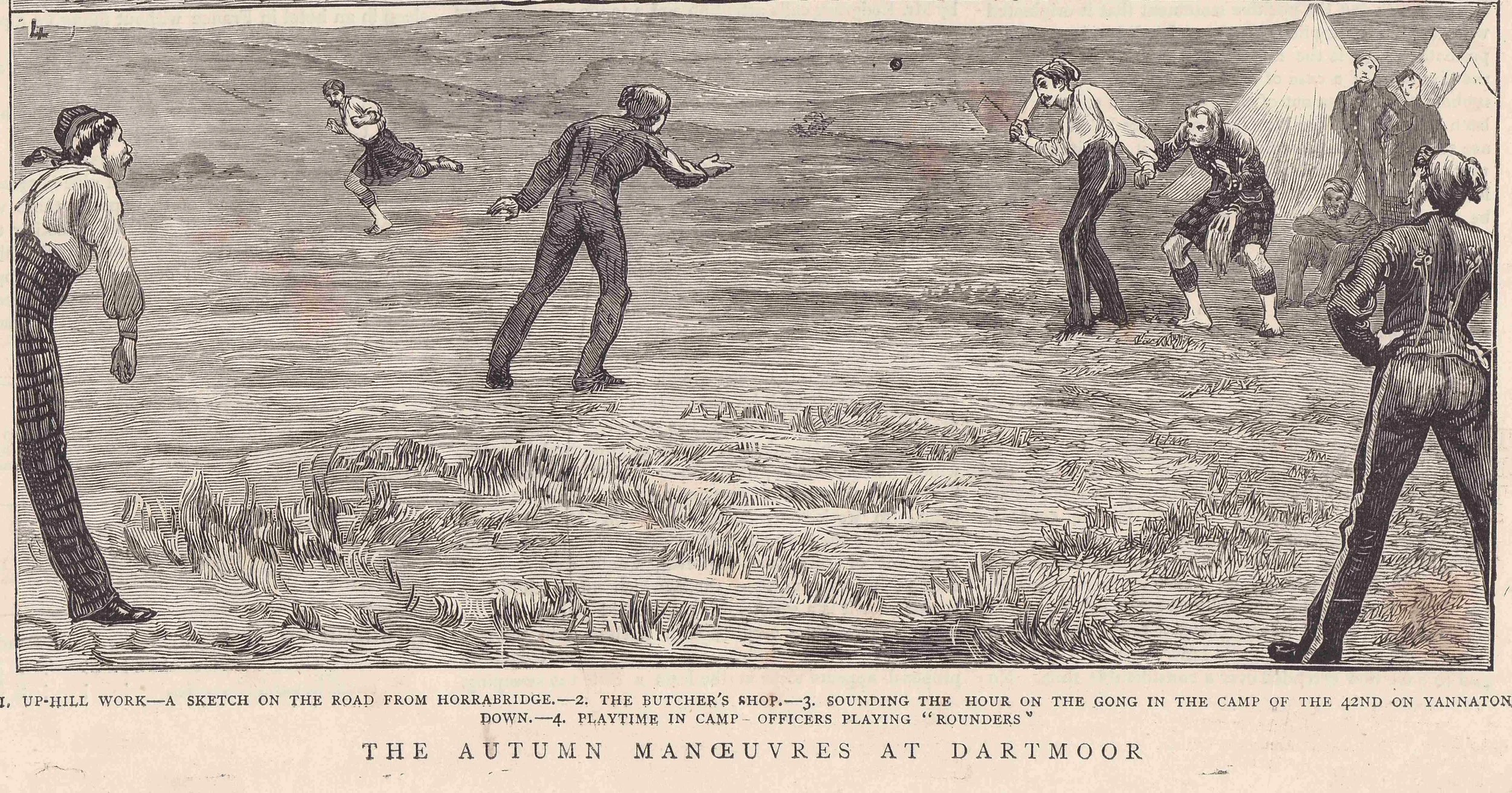
The Autumn Manoeuvres on Dartmoor, The Graphic, 16 August 1873, 1. Author's own collection.
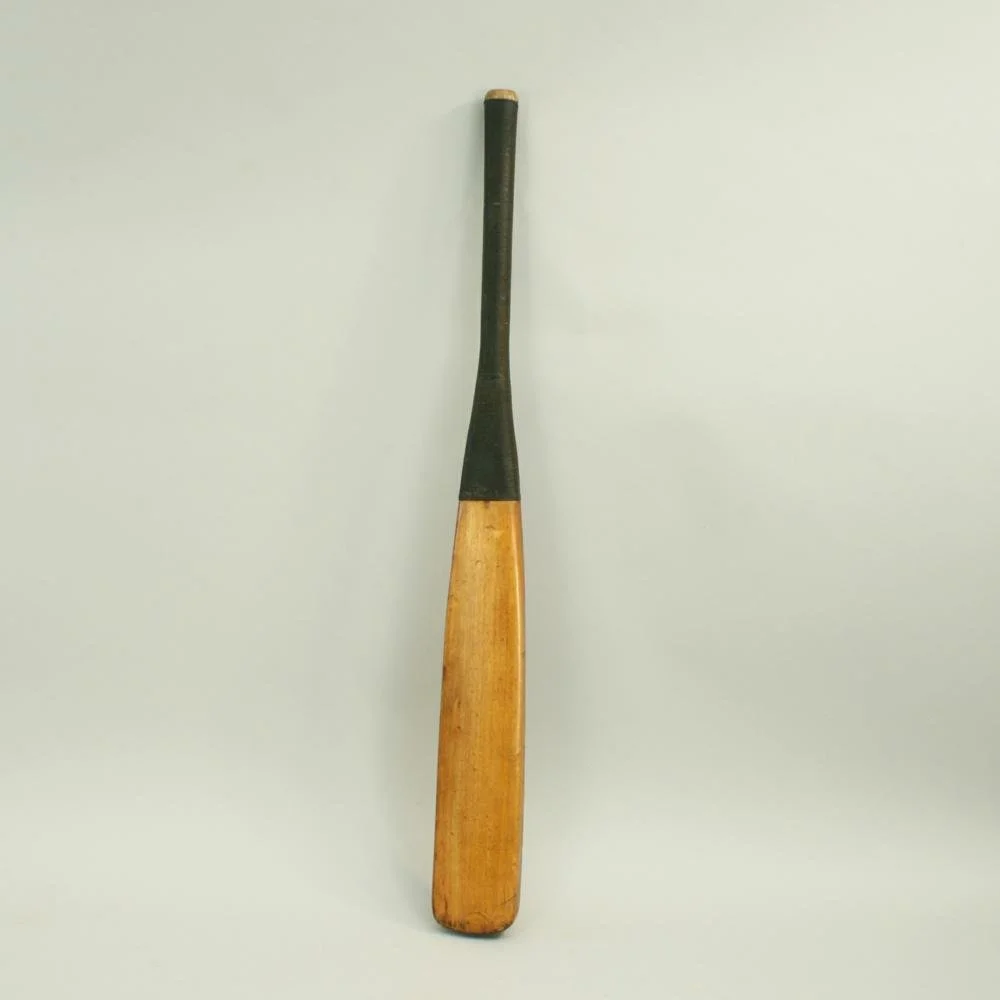
Bat for Welsh Baseball. Sports Antiques listing. Copyright undetermined.
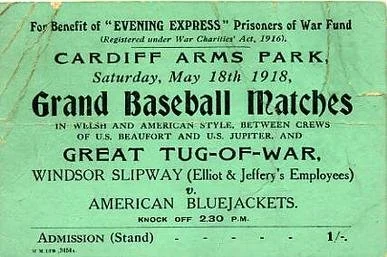
Ticket for games at Cardiff Arms Park 18 May 1918 under both the American and Welsh codes. Source: Wikipedia; copyright undetermined.