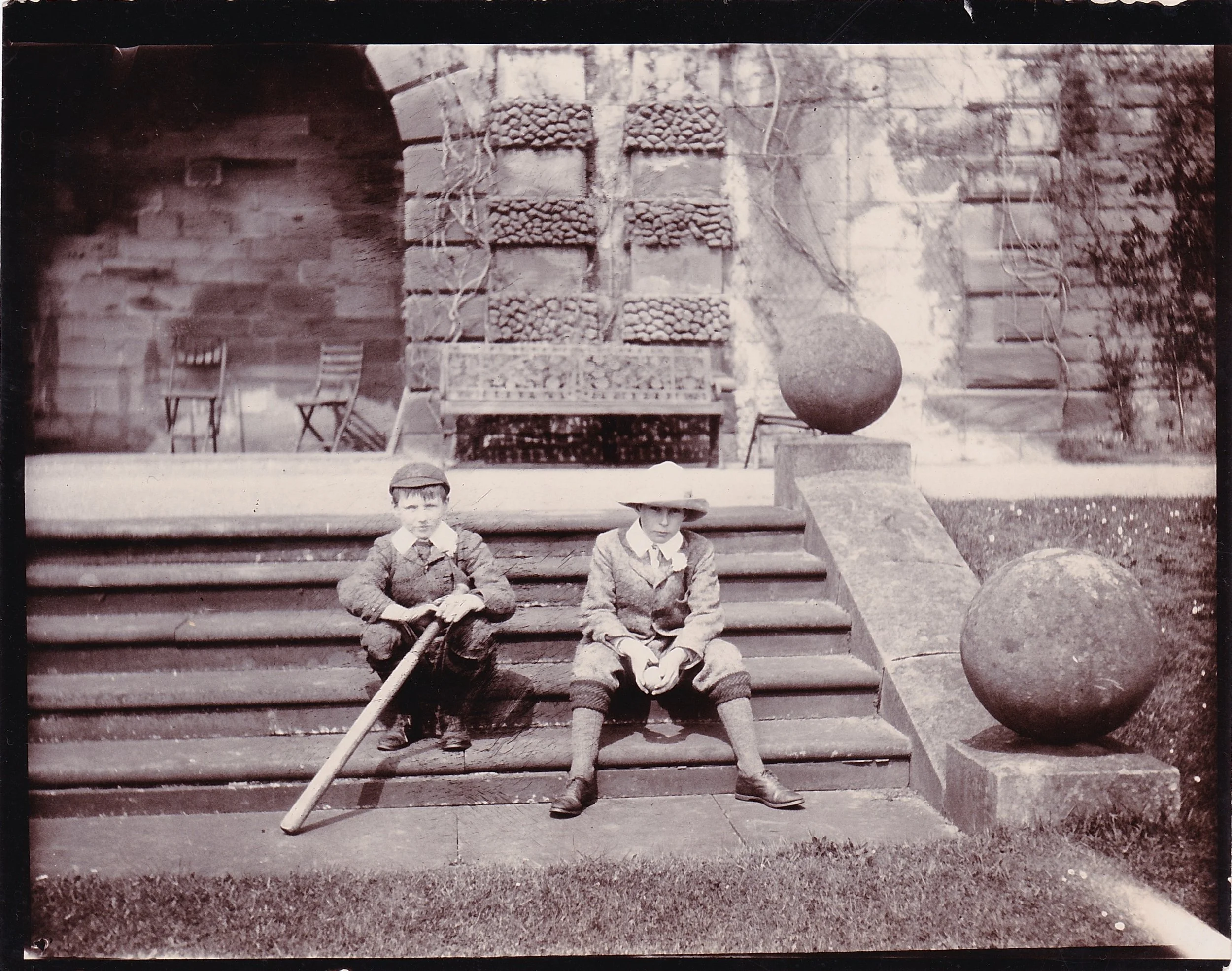
The Dartmouth Boys Play Ball.
Jamie Barras.
Angleterre, Patshull park, jeunes enfants avec une batte de baseball.[1]
In a departure from my usual work, in this piece, I speculate on the possible identities of two sitters in a photograph I recently added to my collection. The photograph was taken at Patshull Hall, the country seat of the Earls of Dartmouth, circa 1900. It shows two young boys posing with a baseball bat and a ball. As I will show, the Sixth Earl of Dartmouth had at least two encounters with American baseball players, the first in England in 1889 and the second in America in 1904. The evidence favours a date for “our” photograph towards the first of those two dates, although this is not certain. We can at least say that this photograph is an early example of boys in England taking an interest in American baseball.
The photograph: 10 x 12 cm, silver albumin print, crisp image and edge effects characteristic of a direct transfer from a glass plate negative. This and the outdoor setting suggest a handheld quarter-plate field camera such as the Lancaster family of hand cameras, popular from the 1880s to the 1910s, after which film cameras became the norm.[2] The same seller has (as of September 2026) more photographs from the same series showing a man, a woman, an older boy, two girls of around the same age as our sitters, and a younger girl, plus dogs. The fact that there are only two adults suggests that this is a single family.[3]
These people are well-to-do, well-dressed, but at the same time very comfortable with their surroundings, suggesting residents, not visitors. There is further evidence of this in the fact that the series includes photographs taken at different times of the year, and, possibly, across a number of years.
Location: A quick visual comparison with images online shows that, yes, the photograph was taken in the grounds of Patshull House, Staffordshire, the country seat of the Earls of Dartmouth. To be precise: the two boys are sitting in front of an ornamental arch set into the south-facing terrace of Patshull House, at the top of an Italianate staircase. The other photos in the series were taken elsewhere in the grounds of Patshull Hall.[4]
Sitters: Patshull House was the country seat of the Earls of Dartmouth. Circa 1900 was the era of the Sixth Earl, William Heneage Legge (1851–1936). He and his wife, Mary, had six children who survived to adulthood: William Legge (1881–1958), Gerald Legge (1882–1915), Dorothy Legge (1883–1974), Joan Margaret Legge (1885–1939), Humphrey Legge (1888–1962), and Celia Mary Legge (1892–1970).[5]
This large family maps to the people in the series of Patshull photographs, with the caveat that we could be looking at the same sitters at different times in their lives. It is worth noting that nobody in the Earl’s or his wife’s immediate family had as many children as they did. It is also worth noting that the older boy in one of the other photographs in this series and one of the boys in “our” photograph have the same distinctive set of lips; they may be brothers, or the same boy at different ages. A comparison with a later photograph of William Legge, Seventh Earl of Dartmouth—the eldest son of the Sixth Earl—shows that William Legge has the same distinctive set of lips, suggesting the sitter is either William Legge or this is a Legge family trait.
Date: Two dates suggest themselves based on visual and historical evidence: early 1890s and between 1905 and 1910. To understand why, we need to look at the connections between the Sixth Earl of Dartmouth and baseball.
Baseball Connections I: The Sixth Earl was a noted cricketer; he played for the MCC in the 1870s and served as its president in 1893. His father, the Fifth Earl, hosted cricket matches at Patshull, between the MCC and Staffordshire teams, in the mid-1870s. Of more note for our purposes, before he assumed the earldom, the Sixth Earl was known as Viscount Lewisham, and, while still Viscount Lewisham, he served as president of Kent County Cricket Club. In this capacity, on Tuesday, 12 March 1889, he attended a reception and luncheon held in honour of the visiting Spalding Baseball tourists. The reception was held at Kennington Oval, home to the Surrey County Cricket Club, before the American baseball players’ first game in England. Viscount Lewisham gave one of the speeches.[6]
Baseball Connections II: The Sixth Earl also had an interest in Association Football. If we are looking for a connection between baseball, an event in Staffordshire in the 1890s, and two boys with a father connected to Association Football, this immediately brings to mind Stoke City FC and the 1890 National Baseball League. The Sixth Earl was Lord Lieutenant of Staffordshire, a role he assumed in 1891. This often took him to Stoke.[7] While I can find no direct connection between him and Stoke City FC, it would not be surprising if he involved himself in the club’s baseball endeavours.
Baseball Connections III: The Second Earl of Dartmouth was the government minister in charge of the American colonies at the time of the Revolution; he took a keen interest in Native American education, and Dartmouth College is named after him. The Sixth Earl—“our” earl—and family visited Dartmouth College in 1904. The Earl laid the foundation stone for a new Dartmouth Hall and took part in the annual bonfire celebrations, which were begun by the Dartmouth Baseball Club.[8]
Suggested Scenarios:
1) The photograph dates to Spring 1889 and shows the two eldest sons of the Sixth Earl of Dartmouth, William and Gerald Legge, with a baseball bat and ball gifted by Albert Spalding on the occasion of Viscount Lewisham/Future Sixth Earl of Dartmouth’s speech to welcome the American baseball tourists to England.
2) The photograph dates to the early 1890s and shows William and Gerald Legge with a baseball bat and ball, possibly gifted by Albert Spalding in 1889, possibly gifted by Stoke City FC’s baseball club in 1890.
3) The photograph dates to sometime after the Dartmouth family’s visit to Dartmouth College in 1904 and shows one or more grandsons of the Sixth Earl of Dartmouth with a baseball bat and ball gifted by the Dartmouth College Baseball Club.
Best Guess: I lean towards favouring Scenario 2. I base this on the age of the boys in the photograph and where it might sit among the other photographs in the series. William and Gerald Legge were only 8 and 7 years old in 1889; this seems too young to be the boys in “our” photograph, discounting Scenario 1. At the same time, we cannot dismiss Scenario 3, as one of the challenges with dating photographs of the British aristocracy is that they clung to fashions long after they were abandoned by others. Against Scenario 3, the other photographs in the series suggest we are looking at one family, not cousins, etc.—there are, for example, only two adults, a man and a woman, in the other photographs. In addition, the ages of the Sixth Earl’s grandchildren cannot be made to align for these two boys to be cousins.
Caveat: One possibility that has to be discussed is that this image does not show a baseball bat at all, but rather a cricket bat photographed from an angle. In my view, this can be discounted. Whatever the angle of the bat relative to the camera, if it were a cricket bat, we would be able to see either a pronounced shoulder on the bat or a broad shadow on the ground corresponding to the blade. We see neither. In addition, the proportions of the bat to the handle are wrong for a cricket bat of this period—the bat is far too long for the handle. Finally, there is the ball; even accounting for glare, it is the wrong colour to be a cricket ball but the right colour to be a ball for baseball.
Conclusions: The direct involvement of Viscount Lewisham/the Sixth Earl in the Spalding Tour’s visit to England in March 1889 points strongly to this being the date at which the Legge/Dartmouth family acquired its interest in baseball. It seems very likely that this is also the date that it acquired its baseball equipment. However, at the same time, it is also possible that it acquired the equipment sometime in the years immediately following the Spalding Tour, when supporters of American baseball were making their first attempt to popularise the game in England. It is even possible that this did not happen until the family’s trip to America in 1904. Regardless of the exact date and the sitters, this photograph is an early example of English boys showing an interest in American baseball.
Jamie Barras, October 2026.
Back to Diamond Lives
[1] Listing Description, Photograph, Abebooks.co.uk, accessed 7 September 2026.
[2] http://redbellows.co.uk/CameraCollection/Lancaster/StandardInstantograph_gen.htm, accessed 8 September 2026.
[3] https://www.abebooks.co.uk/servlet/SearchResults?ds=30&kn=patshull&vci=63736497, accessed 8 September 2026. The seller was photovintagefrance, Arneville, France.
[4] https://patshullhall.co.uk/patshull-hall/, accessed 8 September 2026.
[5] https://www.thepeerage.com/p1361.htm#i13605, https://www.chch.ox.ac.uk/cathedral/war-memorials/captain-hon-gerald-legge, accessed 8 September 2026.
[6] “The Cricket Week at Patshull”, Midland Counties Express, 14 August 1875, 7; “Cricket”, Morning Post, 4 May 1893, 5; “Baseball at the Oval”, Morning Post, 13 March 1889, 7; “The Looker On”, The Sportsman, 13 March 1889, 8; “The American Baseball Teams”, Illustrated Sports and Dramatic News, 16 March 1889, 6; Harry Clay Palmer, Athletic Sports in America, England and Australia … Also Including the Famous “Around the World” Tour of American Baseball Teams (Philadelphia: Hubbard, 1889), 406–12.
[7] “The New Lord Lieutenant”, Staffordshire Advertiser, 3 October 1891, 4.
[8] Edward Connery Lathem and David M. Shribman, “Miraculously Builded in Our Hearts: A Dartmouth Reader” (Dartmouth Legacy, 2016), 8, 37–44.
"Angleterre, Patshull park, jeunes enfants avec une batte de baseball." Author's own collection.
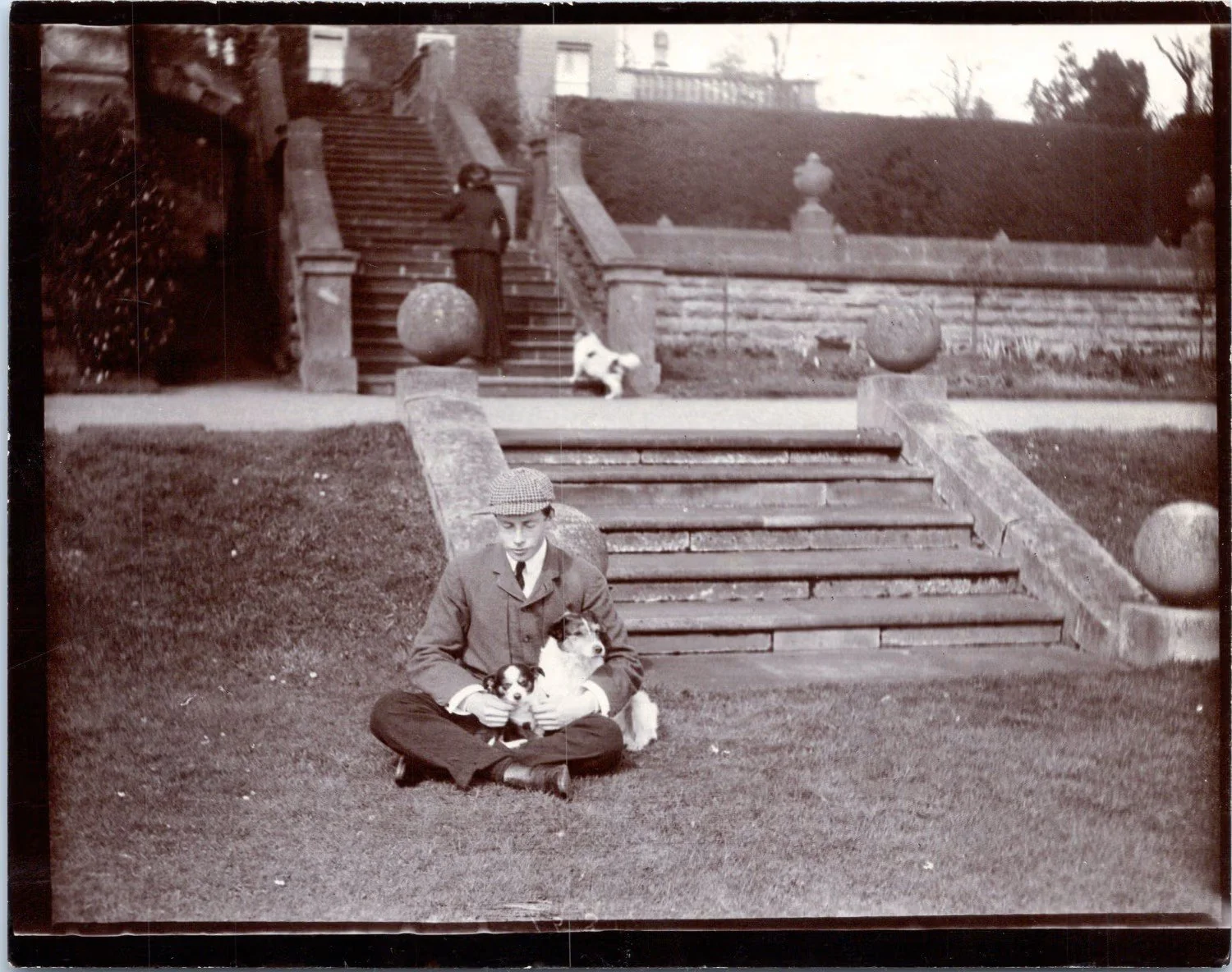
Another photograph in the Patshull series. Copyright undetermined.
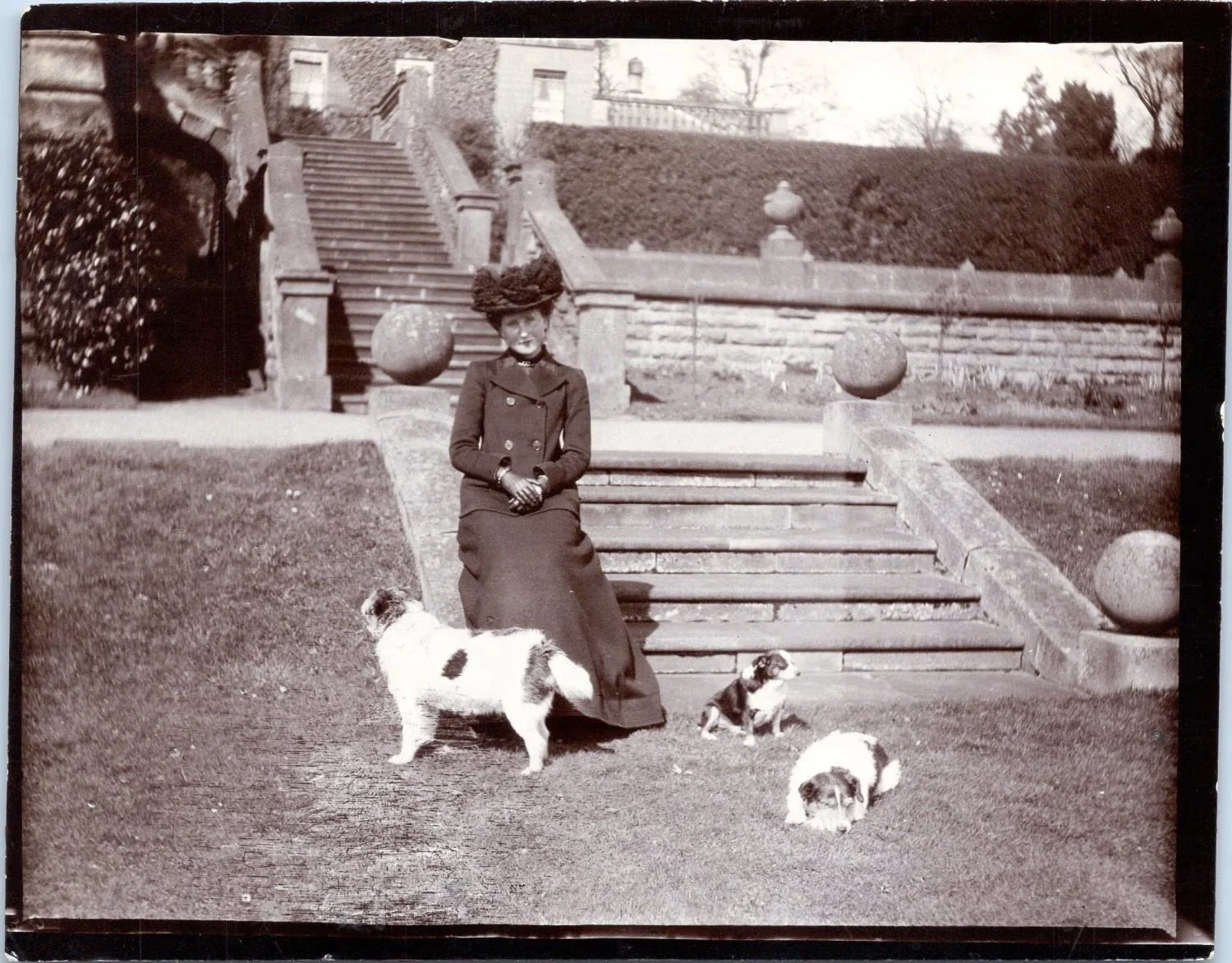
Another photograph in the Patshull series. Copyright undetermined.
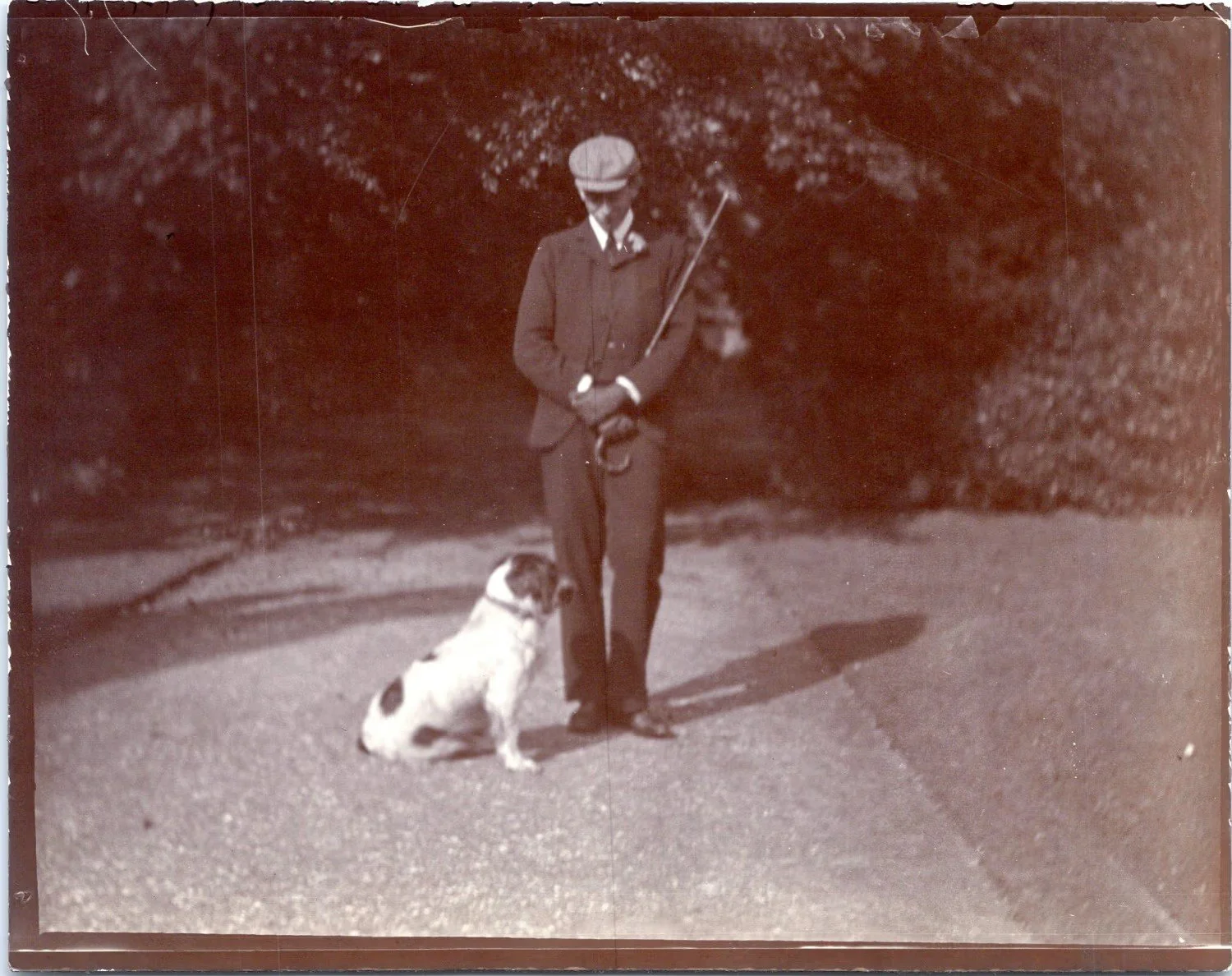
Another photograph in the Patshull series. Copyright undetermined.
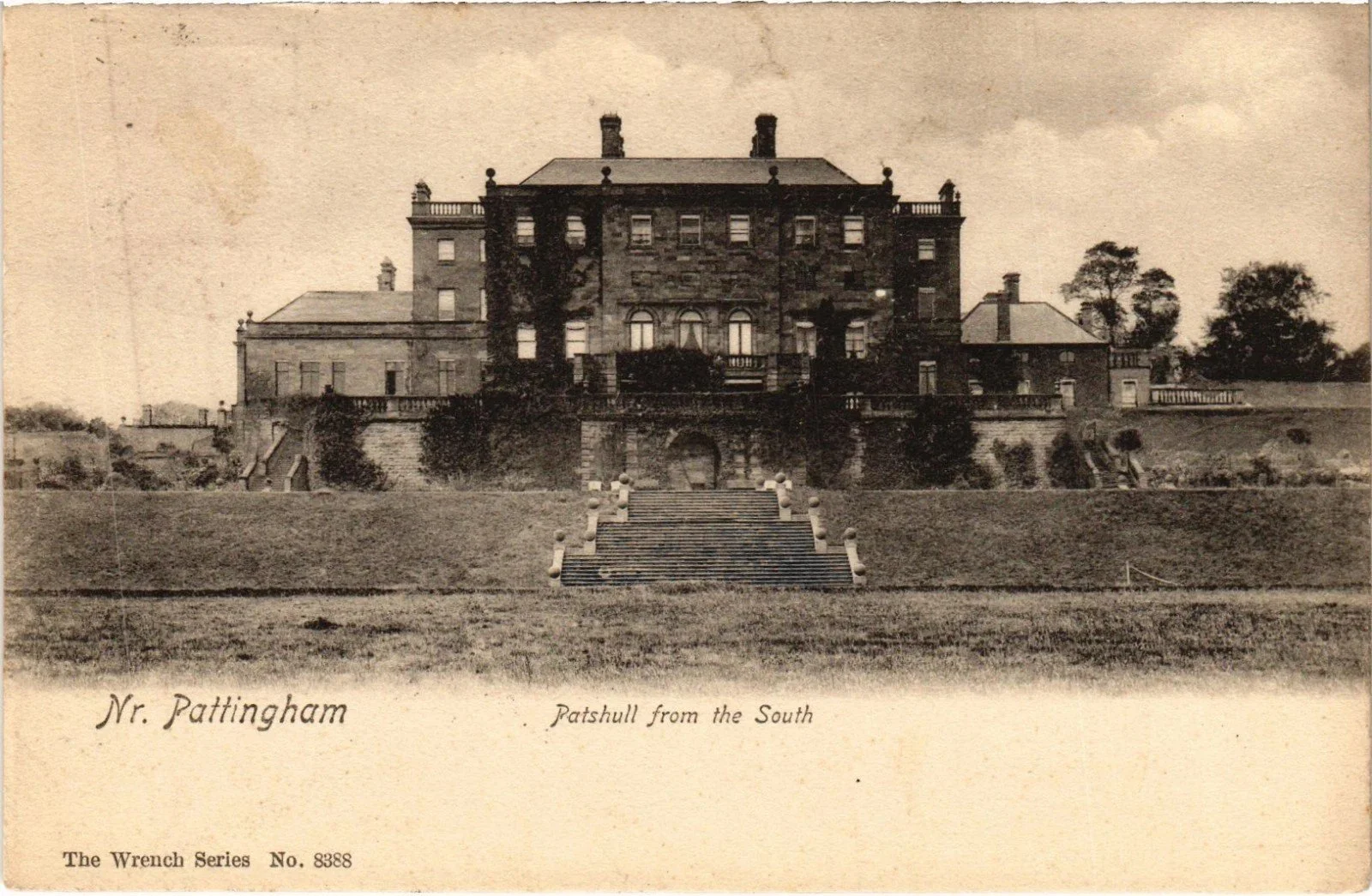
Patshull Hall, viewed from the south, showing the recessed arch and Italianate staircase featured in the Patshull photographs. Postcard. Author's own collection.
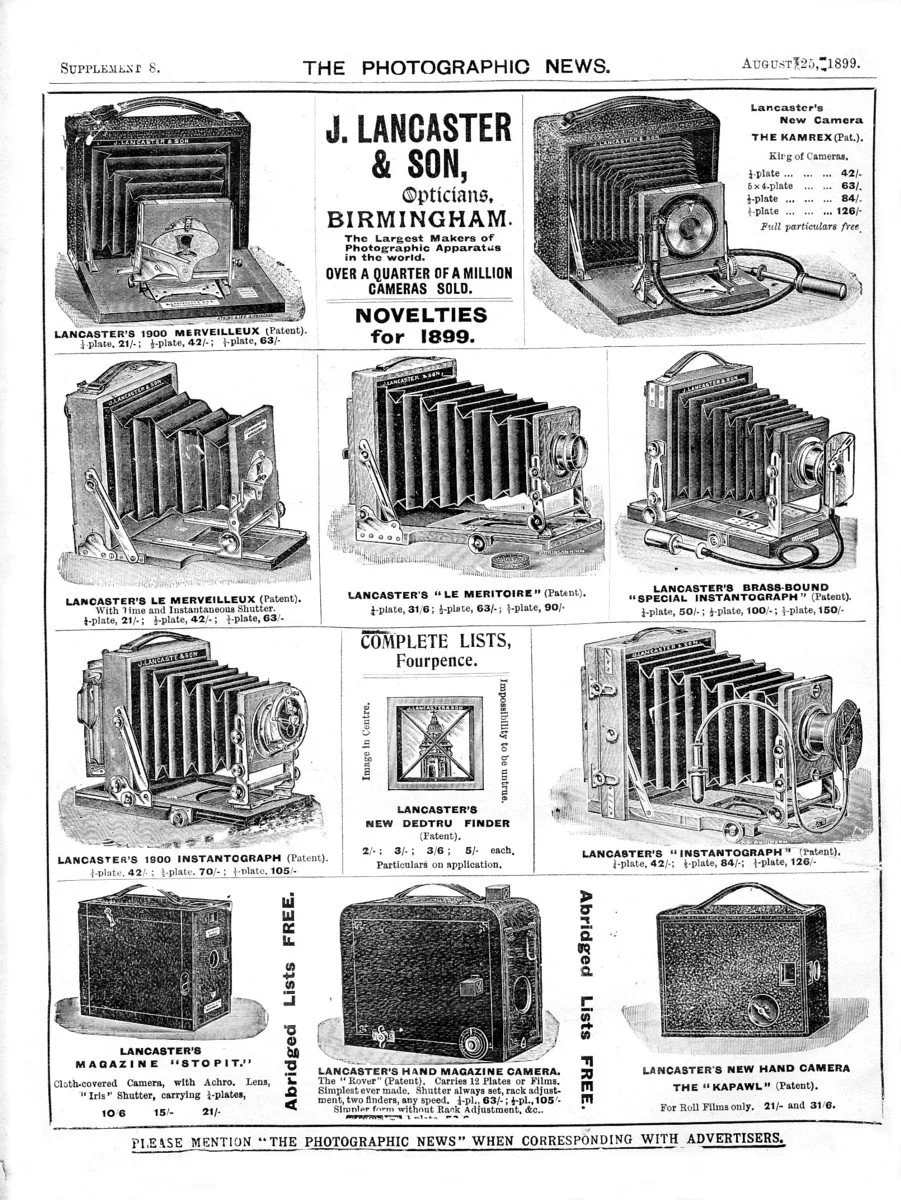
Lancaster field cameras, circa 1899. Catalogue. Public domain.
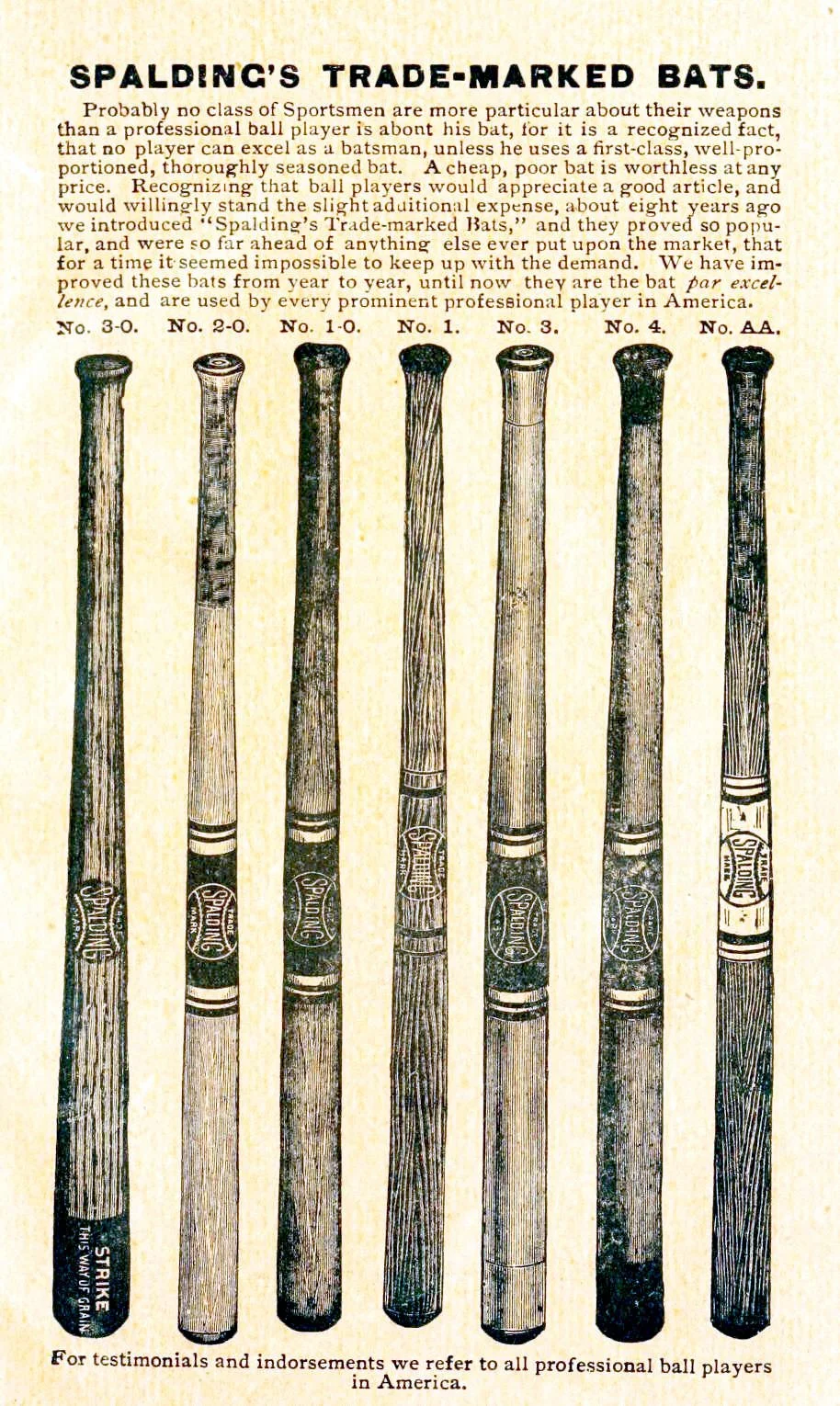
Advertisement for Spalding baseball bats, circa 1889. Public domain.
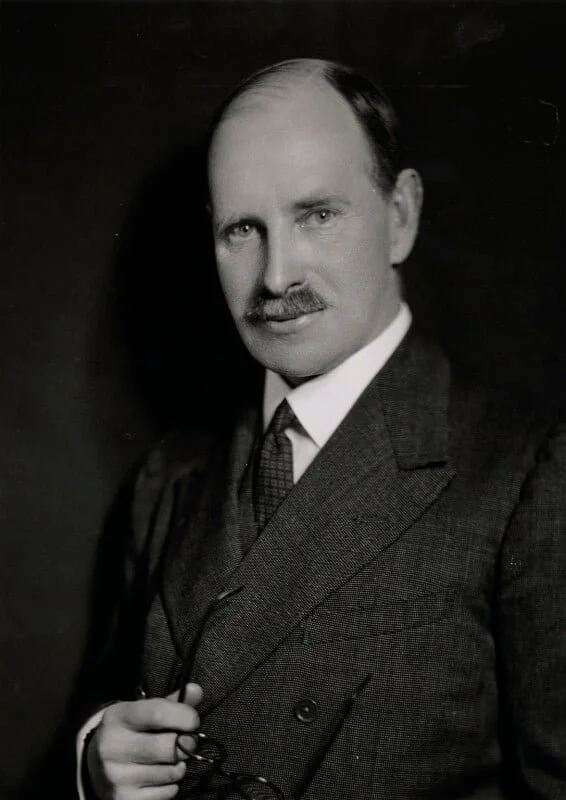
William Legge, Seventh Earl of Dartmouth, in the 1930s. Image provided by the National Portrait Gallery under creative commons licence.