The Baseball—Rounder War.
1889—1895.
Jamie Barras.
Since the challenge was originally given the National Rounders Association has changed its name to “The English Baseball Association”, although still playing the old game of rounders. I am glad to state, however, that the matches referred to will be played according to the genuine or regular baseball rules.[1]
Within two years of its foundation in 1887, the National Rounders Association (NRA) faced an existential threat in the reappearance of American baseball in England. At the end of part one of this series, I detailed how it met that threat head-on by challenging the Spalding baseball tourists to games of baseball and rounders in Liverpool in the spring of 1889. The next six years represented something close to a civil war between the two base-running, bat-and-ball games. Throughout, American baseball remained unmoved; however, it failed to overcome its opponent. Meanwhile, rounders made changes to the way it was played and even changed the name of its sport. It emerged from the conflict transformed but the stronger for it. It proved a foundational conflict.
The commanding general of the Rounder forces was W.H. Hivey, the Liverpool businessman and NRA secretary we met in part one of this series. His opposite number and nemesis was the president of the National Baseball Association (NBA), an American newspaperman and lawyer named Newton Crane.
It has been urged against baseball that it is simply an improved form of rounders. It undoubtedly owes its origins to rounders, but it bears less resemblance to that game than modern cricket does to the ancient sport of the village-green, where an inverted milking stool and wooden balls were the rude implements of play. The modern game of baseball has been developed from its crude origin in rounders within the memory of those still able to play it.[2]
Robert Newton Crane (1848–1927), newspaperman, government envoy, baseball booster, and lawyer, was born in New Jersey in 1848, the son of a Wesleyan minister. His chief claim to fame during his lifetime was that he was the first American appointed King’s Counsel (KC)—the highest ‘rank’ of trial lawyer in the English legal system. Perhaps to modern eyes, of greater significance was that he was a prominent eugenicist. In one tract, he evoked the spectre of what Theodore Roosevelt called “race suicide” to support the need to prevent “procreation by undesirable spouses”. Of course, Crane and Roosevelt were far from being alone in holding such views in this period and should be viewed as products of their time.[3]
Crane arrived in England in 1874—the same year as the Wright tour—and served as American consul in Manchester until moving to London in 1880 to practice as a lawyer. In October 1889, Crane chaired a meeting in London that resulted in the formation of the National League of Baseball of Great Britain (NLBGB), with Crane as its provisional chairman. The other attendees elected to the provisional council alongside Crane represented mostly a mix of association football and cricket interests—reflecting the mission of the new league to supplement the winter game (association football) and appeal to those sections of British society that the summer game (cricket) had been largely unable to reach (working men). The odd men out, and of particular interest to us here, were Derby industrialist Francis Ley, of whom more below, and W.H. Hivey.[4]
The presence of the latter makes plain that Crane intended to bring the rounders association ‘into the fold’. By the summer of 1890, the Baseball Association of Great Britain had been formed to govern the national professional league and amateur associations, a relationship designed to mirror that between the Football Association (FA) and its leagues. Its chairman was Rev. F. Marshall, chairman of the Yorkshire Rugby Union. Somewhat bizarrely, when asked his views on baseball shortly after his appointment, Marshall replied, “As a game I think it distinctly inferior to both football and cricket, and presenting little of the scientific features of the latter game.”[5]
This did not bode well. Similarly, despite its aspirations to be a national league, the four teams that made up the professional National Baseball League in its first—and only—year of operation were all from the Midlands: Aston Villa, Preston North End, Stoke, and Derby. Not coincidentally, this encompassed an area that was a heartland of Association Football, and the heartland of rounders. This again reflected the aspirations of the game to become the summer sport for football players and fans; a position occupied at the time in Liverpool by rounders. A clash was inevitable.
WITHDRAWAL OF THE DERBY CLUB. In consequence of a letter received from Mr. Ley that a rupture had occurred in the National Baseball League and the Derby team were about to retire from the League, our representative saw Mr. Ley and got further particulars about the affair.[6]
The NLBGB was not a success. It folded after a single season, having failed to achieve the expected attendance levels. Its most accomplished team was also its most controversial, the Derby team, masterminded by industrialist Francis Ley (1846–1916).Ley was an iron foundry owner who had become interested in baseball as a means of physical recreation for his workforce during an 1888 tour of ironworks in America; on his return, he added a baseball section to his existing works recreation club. To raise the game of its players, he brought over two iron foundry workers from Cleveland, Ohio, who, it just so happened, were crack baseball players, John Reidenbach and Sim Bullas. With Reidenbach and Bullas as its battery, the Derby team laid waste to its competition in the NLBGB. Under pressure from the other team owners, Ley agreed to have only one of the two Americans on the field at a time. He reneged on that promise, triggering an argument that led to Derby’s withdrawal from the league.[7]
Ley’s commitment to the game’s success was far greater than that of the owners of the other teams in the NLBGB: they were just giving the new venture a go. Thus, when the league collapsed after only one year, Ley not only kept the Derby club going but he also continued to invest in keeping it the best baseball club in Great Britain. The club would win three national championships across the ten years of its existence: 1895, 1897, and 1899.[8]
When Hivey offered to play an NBA team under American rules in the Spring of 1892, it was the Derby team that stepped forward to accept the challenge. To explain the background to this challenge, we need first to look at how the NRA responded to the creation of the NLBGB.
No one can deny, after the splendid exposition made by the Union on the last two Saturdays, that they are the finest combination extant. Last Saturday’s gate-money, taken at their match with Kensington, ought to be a solacium to the National Rounders Association for their unrequited efforts for some time past to replenish their exchequer.[9]
The logic of the NRA forming rounders leagues was that of the Football Association by way of the NLBGB: the best way to build fan numbers and fan loyalty was to offer supporters a chance to follow a team week-by-week as it progresses through a league rather than watching it stake everything on a single roll of the dice in a Challenge Cup. Not coincidentally, this was also the best way to retain player loyalty in the face of the lure of American dollars urging defection to the NLBGB. Thus, the same year the American code launched the NLBGB, the NRA launched two leagues in Liverpool: a senior league and a junior league, each with eight teams. The teams in the senior league during its first two years of operation (1890 and 1891) were Union, White Star, Kensington, Mossley, Keystone, Chesterfield, Waterloo, and Newnham.[10]
Given the defensive nature of this move, and given that the NLBGB collapsed within a year, it is with some irony that it can be reported that, within two years of their formation, the NRA leagues were experiencing some of the same problems as the NLBGB: the disparity in skills between the best-performing and worst-performing teams in the senior league was so great that it was losing teams who saw no hope of ever winning. The senior NRA league even had its own Derby in the all-conquering Union team and its bowler, John Lamont. In the 1892 season, the Union won every game it played. And in September 1891, Lamont achieved the incredibly rare feat of shutting out the batsmen of the second-best team in the league, the White Star, in one inning of a two-inning game. Needless to say, the rounders press, while praising Lamont for his achievement, were less than complimentary about the quality of the spectacle it presented to the fans.[11]
There was a second and larger reason that the NRA was struggling to retain the services of its best players: the image of the sport itself.
It ought, however, to be said that no one knowing anything of [Base Ball or Rounders] would presume to place the extremely simple Rounders on the same footing as the more inspiring and intricate Base Ball.[12]
By the time the National League of Baseball of Great Britain launched in the summer of 1890, the British press had become so used to calling the sport a form of advanced or scientific rounders that it had become almost a reflex action. The flipside of this was the solidifying perception that rounders, by extension, was simply a crude progenitor of a superior American offspring. Publications like Cassell’s Book of Sports and Pastimes, from which the above quote is taken, only reinforced this view. ‘Base Ball’ was included in the section on ‘Manly Games and Exercises‘, while rounders was relegated to the section on ‘Minor Out-Door Sports’. In early editions, the entry on rounders (page 225) stated that in parts of the country it was played under ‘strict rules’ but went no further.
Sometime before 1896, Hivey persuaded the editors to change this to read ‘The more elaborate [version of the] game, which is identical in all essentials to Base Ball, is governed by strict laws’ (emphasis as in the original) and add his contact details for further information. He could not, however, persuade them to remove the negative description of rounders appended to the section on Base Ball. Whatever the NRA’s view of the game as they played it, to the British people at large, since the [re-]arrival of American baseball in the country in 1889, the rounders were seen as adults playing at a child’s sport.
The great prejudice against it being its name—people when they heard that men were going to play a game of “Rounders” thought of the schoolboy game, and had no idea how that had been improved, and that it was now played on scientific principles.[13]
This perception was also blamed for the inability of the sport to grow beyond its established roots in Lancashire, Gloucestershire, and South Wales, something that weighed heavily on the minds of the members of the NRA council. As we will see, in the next decade, the successor to the NRA would show a determination to differentiate the game that it played from that played by women. This may have also played a role in its thinking. However, it should be noted that, even among the NRA’s critics, as can be seen below, the view was that rounders was a “childish game”; so, we can take the NRA’s explanation for its unease at face value. It is against this backdrop that, in March 1892, W.H. Hivey attended a meeting in Manchester of American baseball’s backers. The main order of business was to reconstitute the former Baseball Association of Great Britain as the National Baseball Association (NBA) with Newton Crane as its president; however, also on the agenda was a proposed merger between the NRA and the new NBA.
MR HIVEY, of Liverpool, of the National Rounders Association, addressed the meeting on the proposed amalgamation of the Rounders Association and the Baseball Association. He said the question had been discussed in Liverpool, but they had not taken a vote on the matter.[14]
At the March 1892 meeting, Hivey made clear that a merger could happen only if certain conditions were met. Hivey presented the NRA’s red line—the three elements of the American code that, as far as the NRA was concerned, had to be removed for there to be a merger. It will come as no surprise that they were the elements that restricted high scores and variety in stroke play:
1. The way the ball was delivered.
2. The three-out-all-out system.
3. The restrictions placed on the batters by the foul line.
A baseball player and journalist at this meeting, Will C. Bryan, provided the American sporting journal Sporting Life with an account of the proceedings. Bryan’s dispatch included a less-than-flattering description of Hivey.
AN ADVERSE INFLUENCE. Mr. Crane places great store on the hold base ball has taken on the Liverpool rounders people. I know that for two or three years he has been trying to bring these players to see the advantage of giving up their childish game for base ball. He attempted to work through Mr. Hivey, the secretary of the National Rounders Association, and just there is where he made his great mistake. I think he has now discovered that Hivey has from the outset been the real impediment to the amalgamation of the Rounders Association with the Base Ball Association, and although professing great friendship has, for motives of his own, held his men back from either adopting such changes in the Rounders’ game as would make it conform to base ball, or affiliating with the Base Ball Association. While an invited guest at the Manchester meeting of the Association last spring, he was made vice president, those present believing his professions of a desire to promote our game in England. He had, however, n sooner been elected than he took the floor and made an angry, bitter speech, in which he sneered at base ball and claimed that rounders was an infinitely better game.[15]
In response to Hivey’s objections, Newton Crane offered a remarkable ‘one-association, two-code’ solution, where the NRA would become part of the NBA but continue to enjoy a high degree of autonomy, its teams continuing to play rounders against each other but baseball against other teams in the NBA. Hivey responded in turn by bullishly promising to form a baseball team from NRA players to be called the ‘National Rounders Baseball Club’ that would “guarantee to beat any baseball players if a fair notice of a match were given them”.[16]
Before that encounter could be arranged, the NRA had its own annual general meeting. There, it not only voted against merging with the NBA but also voted to change its name to the “English Baseball Association” (EBA). The Gloucestershire Rounders Association followed suit at the end of May. By this time, the South Wales Rounders Association had already changed its own name to the South Wales English Baseball Association—making plain that the intended name for this sport was “English Baseball”, i.e., the “English Baseball Association” was the Association of English Baseball, not the Baseball Association of England. (The South Wales body soon dropped “English” from its name, and, in practice, players and officials would refer to the game as simply “baseball”, only adding “English” or “Welsh” when there was a need to differentiate it from the American game.)[17]
This bolt from the blue shook the NBA to its core. Newton Crane sharpened his quill and made ready to steward the resulting contest.
On Saturday, the Liverpool representatives played in much improved form, and with steady practice should make one of the finest teams in England, but at present they have yet something to learn before they can hope to beat the Derby team.[18]
To what we can be sure was Newton Crane’s satisfaction, the first game between Derby and Liverpool under American rules, which took place in Liverpool on Saturday, 25 June 1892—and which Crane himself umpired—resulted in a convincing win for Derby, 27–6. The return match at Derby played the following week was again a victory for Derby, but by a much narrower margin, 18–10. This was viewed by both the Liverpool and the Derby papers as a credible result for a team inexperienced in the rules of the game playing one tutored by an American professional.[19]
Although the rounders baseball team did not live up to Hivey’s boast, the encounters did at least reinforce for the newly christened EBA the correctness of its decision to continue to go it alone: its team had suffered at the hands of the Derby pitcher, failing to score in any of its first three innings; this was exactly the “lack of onfield action” that the rules of rounders were designed to prevent. If, however, the NRA thought that this was the end of the matter, it was mistaken. To understand what happened next, we need first to consider the NBA’s position at this moment in its history.
To move the game of baseball forward in Britain, the NBA needed everyone involved in baseball in Britain to pull in the same direction. While the Liverpool group called its game ‘rounders’, its existence outside the NBA meant little beyond the competition for players in areas where rounders was strong. However, once the Liverpool group changed the name of its game to ‘baseball’, it became a matter of vital importance to the NBA that the Liverpool group was brought into the fold, if for no other reason than to stop the press from getting the two organisations confused, diluting if not outright corrupting the NBA’s message. It is no surprise that Crane felt he had to act.[20]
At the end of July 1892, the amateur teams that played as ‘Liverpool’ and ‘Manchester’ under the American code played in a tie in the NBA’s English Challenge Cup. In its report on the 1892 season under the American code presented a few weeks later, the NBA stated that four Liverpool EBA teams would be taking part in the Cup the following season.[21]
The language suggested this would be a permanent switch of codes—a victory for the NBA; in fact, it was the workable version of the Crane two-code system (two associations, two codes, not one association, two codes) proving itself: EBA teams trying their chances in the NBA Challenge Cup under the American code while continuing to participate separately in the EBA league and Challenge Cup competitions under the English code.[22]
This event should have represented the inauguration of a workable compromise that both associations could get behind, a stable two-association, two-code system, with players moving between the two codes, and teams from one code playing friendlies and challenge-cup games under the other code. Instead, in the Spring of 1893, the NBA renewed its assault on the EBA by mounting a lightning campaign to persuade the South Wales Baseball Association to make a permanent switch from the English to the American code.
Rounders is played in two cities out of Wales and is going back every year. Baseball is played in almost every town in the North of England and Midlands Counties, and is going forward ten times faster than any other field sport ever did.[23]
The 1893 NBA South Wales campaign was led by John Frederick “J.F.” Appleton (1854—1936), a member of the NBA council and leading light of the American baseball scene in first Lancashire and then the North-East of England, here recast as the secretary of the National Baseball Association of South Wales. Appleton was a Nottinghamshire-born commercial traveller with the gift of the gab and the ability to relocate at short notice, making him the perfect point man for the NBA. He later settled in South Wales with his family and became a seller of patent medicines.[24]
The campaign had several fronts: 1) arranging for an exhibition game to be played between an Appleton-led team and a local SWBA team (Grangetown) under the American code; 2) stump speeches by Appleton to local bigwigs extolling the virtues of American baseball; and 3) the co-opting of the ‘Local Sport’ column of the Western Mail to push the NBA narrative—a deal sealed by a personal letter from Newton Crane to the column’s editor.[25]
Letters duly began to appear in the Local Sport column: How can the rounders crowd call their game ‘baseball’ when a sport by that name already exists? Asked one supposedly neutral correspondent. I have played and enjoyed both rounders and baseball, swore another, and that has shown me the superiority of the latter as a senior game; rounders is best left to the juniors. Appleton also contributed, in the form of an appeal to reason: Couldn’t the rounders crowd see that their game was dying? They should surrender to the inevitable and join the winning side.[26]
All of this was directed towards the prospective attendees of a meeting organised by the SWBA to discuss whether to stick to the English code or switch to the American one (the calling of this meeting may also have been part of the NBA campaign). In its 10 April announcement of the meeting, the SWBA laid out what we can now recognise as Appleton’s case: The change in name from rounders to baseball was done in the belief that it was the name only that was holding the game back; however, the game still had not grown beyond its heartlands. The only way for the SWBA to grow was to recognise that it was the game itself, as the SWBA and EBA played it, that was the problem, and so, switch to the American code.[27]
The meeting took place in Newport on 2 May 1893, and Appleton was present to argue the NBA’s case. However, the result was defeat; the SWBA opted to continue to play under the English Baseball Association code[28] Their view was no different to that of the erstwhile NRA in March of the previous year: they had their red line when it came to adopting elements of the American code that, in their view, broke up play, restricted scoring, and limited the variety of strokes available to the batter.
For its part, the NBA viewed this rejection as the ultimate in truculent nativism, rejecting a lifeline simply because it had a foreign source. Appleton returned to the North-East of England, and the NBA set about developing a new approach. This latter exercise culminated in the NBA gathering together its supporters in North-West England in 1894 to propose the establishment of the Liverpool and District Baseball Association.
The Liverpool meeting was an even greater success than was anticipated. A large attendance gratified the promoters, and among those who were present were Mr. George Mahon, the well-known and capable president of the famous Everton Football Club, who occupied the chair, while Mr J. Houlding, president of the Liverpool Football Club, was represented by his manager, Mr. Houlding being out of town. Dr Sterne, an enthusiast and skillful player, was present from Manchester. A decision was made to form an association, the Liverpool and District Baseball Association.[29]
This is not the place to go over the well-trodden ground of the 1892 dispute between Everton FC board members, led by George Mahon, and their president, John Houlding, that led to Houlding leaving the club and founding Liverpool FC. It is, however, interesting to note that by no later than 1895, both the Anfield football ground, owned by Houlding and at the heart of the dispute, and Goodison Park, Everton FC’s new home, were hosting games of baseball. Specifically, that year, EBA Globe Cup games were played at both grounds, culminating in Everton FC offering the use of Goodison Park free of charge for the final, between the Union and the Everton Baseball Club (not affiliated with the football club). That game took place on 31 August 1895 and was won by the Union 67–48.[30]
(As an aside: the ‘Globe Cup’ was the EBA’s own World Series, which is to say, it was named after its sponsor, Globe Furnishings Limited.[31])
These games and the fact that Mahon and Houlding were willing to put their names to the effort to expand the NBA presence in Liverpool speak to the degree to which the Association Football clubs saw baseball—under either code—as a summer sport to complement the winter game. As we will see below, this included allowing their players to play baseball in the off-season. With the benefit of hindsight, this was an unworkable proposition for anything other than the occasional cup game, as football grounds needed to be “rested” in the close season to restore the turf. This would become an issue in later attempts to use football grounds to host baseball leagues in Britain.[32]
However, the most remarkable thing about the July 1894 meeting and its outcome is that, other than an American dental surgeon living in Manchester, Lincoln Sterne, the team that emerged from it was made up entirely of EBA stalwarts.
Derby Baseball Club being anxious to meet a nine of Liverpool, the following were selected as representatives, subject, of course, to the players’ approval:–W M'Gaw (pitcher), R Burrows (catcher), J Coke (No. 1), J Ingoldsby (No. 2), T Williams (short stop), DE Connor (third base), CH Gill (long field), W Smith (centre field), and Dr Sterne (right field). Reserves: J Ryder and J Fitzsimmons. As several gentlemen of influence have promised the undertaking their support, success seems almost assured.[33]
McGaw, Burrows, and Ingoldsby were Everton players. Coke was the captain of the Union. Connor, who would become secretary of the Liverpool and District Baseball Association, was another Union player, as were Gill and Smith. Williams played for Seafield. Five of the men— McGaw, Burrows, Connor, Coke, and Gill—were veterans of the 1892 Liverpool EBA games against Derby under American rules.[34]
It must be emphasised that all of these players would continue to play for their respective sides in the EBA, even Connor, despite the latter enjoying an official capacity in the NBA as secretary of the American Baseball Association in the city.
To me, the meaning of this is clear: the NBA, as its actions the previous year in South Wales show, was intent on replacing the game that the EBA played, which the NBA refused to call ‘baseball’, with the ‘genuine’ article. The EBA, clearly recognising that it could never accomplish the reverse, was instead content to let its players and teams move backwards and forwards between the two codes—again, in something akin to the workable version of the Crane two-code solution. On a national scale, the EBA’s position was clearly the weaker of the two, as its reluctance to insist on its players and teams playing only by the English code shows: it was scared that its players would defect permanently to the NBA. However, at a local level, the NBA, by simply offering EBA players an opportunity to play games under the American code as opportunities arose, while otherwise continuing to play their regular games under English rules, was admitting its own lack of support in the Liverpool area.
This was a ‘two-association, two-code’ solution applied on a micro-level. Of course, we can speculate that Newton Crane was hoping that, in time, the EBA players would opt to play more and more of their games under the NBA code, causing the EBA to wither and die; but for that to happen, the NBA would have to furnish the EBA players with enough opportunities to do so. As we will see, they could not do that. So, in Liverpool, at least, the two codes had to learn to live with one another.
Unfortunately, nothing seems to have come of the proposal for a game against Derby. Instead, local players, again, mostly from the EBA, met for a practice match under the American code in late July. Lincoln Sterne was not present for this game, but there was one significant attendee from outside the EBA’s ranks: William ‘Billy’ Stewart, wing half for Everton FC (recorded in a press account of the game as ‘W. Stewart (Everton FC)’).[35]
Some of the players of the Everton and Liverpool football clubs are anxious that baseball nines should be established in Liverpool, which they would enthusiastically support.[36]
The presence of footballers in the line-up of clubs under the American code was a feature of the 1890 NBL, and designedly so, in keeping with the idea of the sport being the summer complement to Association Football. It is thought that the ‘Stewart’ who played for Preston North End Baseball Club in the 1890 NBL is the same Billy Stewart, who was on the books of Preston North End Football Club at the time. I do not know how strong an attribution this is;[37] however, the recorded presence of Billy Stewart playing American baseball in Liverpool while on the Everton FC books is strong support for it.
In early in August 1894, it was suggested that a game be arranged between the Liverpool American baseball enthusiasts and the current Preston North End team.[38] However, the same report noted that the new football season was only 3 weeks away, so the baseball season would soon be ending. In the event, again, it seems nothing came of that proposal for that reason.
Great disappointment is evinced by those interested in the American game that Liverpool baseballers are unable to place a team in the field to oppose the Boston amateur champions, who arrive in Liverpool about the 20th inst. A meeting was called by Mr D.E. Connor, secretary of the Liverpool (American) Baseball Association, to consider the matter, when it was deemed inadvisable, owing to the shortness of time for practice and advertising, to entertain the challenge.[39]
The failure of Liverpool’s American baseball enthusiasts to put together a team (from EBA players) to play against the touring ‘Boston Amateurs Club’ (of dubious origin[40]) in the late summer of 1895 was again indicative of the problems that the NBA had in trying to provide players in the city with opportunities to play under the American code. Liverpool was too far from the centres of the American game in England (by this time, the North-East of England and London) for the NBA to provide teams for them to play against. This was itself a sign of the malaise that had fallen upon the NBA due to its failure to grow the game beyond its early adopters—a topic beyond the scope of this article.
When the ship carrying the American team docked in Liverpool in late August 1895, D.E. Connor, who pulled double duties as EBA star player and standard-bearer of the American code in the city, was reduced to simply acting as the American team’s guide in getting from the port to the railway station for the train that would take it to Derby for its first game. A few years later, Connor would attribute the failure of American baseball to catch on in Liverpool to the lack of support from the city’s sizeable American community.[41]
Eighteen Ninety-Five was also the year that Newton Crane stepped down as president of the NBA; the role passed to Francis Ley. However, although there would be a new “National League” in the late 1890s, the organisation would have little real relevance beyond running the Challenge Cup; it would cease to be active by 1901. Crane would, however, continue to advocate for the sport in England and lend his name to organisations attempting to revive the game until the 1920s. He died in London in 1927.[42]
W.H. Hivey, the guiding light of the NRA/EBA and Crane’s nemesis, stepped down as EBA secretary in 1894.[43] Although the EBA still had its best years ahead of it, without his force of personality, it lost its way towards the end of the Nineteenth Century. There was even a brief period at the dawn of the new century when it could not put together enough teams to run a senior league. However, after that brief interregnum, the sport in Liverpool would revive. That will form a future chapter in the story of the Rounders.
Jamie Barras, August 2026.
Back to The Rounders
Notes
[1] “Baseball v Rounders”, Liverpool Mercury, 23 June 1892, 7.
[2] Newton Crane, Baseball (London: George Bell & Sons, 1891), 2.
[3] “Robert Newton Crane is Dead in London”, Ashbury Park Press (Ashbury Park, NJ), 6 May 1927, 1; Robert Newton Crane, Marriage Laws and Statutory Experiments in Eugenics in the United States (London: Eugenics Education Society, 1910), 3, 7.
[4] “A Baseball Association”, Derby Daily Telegraph, 10 October 1889, 3.
[5] “The Rev. F. Marshall on Baseball”, Batley Reporter and Guardian, 19 July 1890, 11; quoting an interview in the Umpire.
[6] “Baseball: Withdrawal of the Derby Club”, Derby Mercury, 6 August 1890, 2.
[7] Joe Gray, What About the Villa? (Ross‑on‑Wye: Fineleaf, 2010).
[8]https://www.projectcobb.org.uk/national_champions.html, accessed 19 May 2025.
[9] “Rounders Notes”, Liverpool Echo, 2 August 1890, 3.
[10] See Note 10 above.
[11] “Team of All the Talents”, Liverpool Echo, 24 August 1929, 3; “Rounder Notes”, Liverpool Evening Express, 5 September 1891, 3.
[12] “The American Game of Base Ball,” Cassell’s Book of Sports and Pastimes (London: Cassell and Company, Limited, 1896), 141.
[13] ‘Baseball’, South Wales Echo, 10 April 1893, 2.
[14] “Sports and Pastimes: Revival of Baseball”, Lancashire Evening Post, 8 March 1892, 4.
[15] Will C. Bryan, “Baseball: From Over the Sea”, Sporting Life (Philadelphia, PA), 22 October 1892, 3.
[16] See Note 15 above.
[17] “English Baseball”, Liverpool Mercury, 25 April 1892, 7; “Gloucester Baseball”, Gloucester Citizen, 30 May 1892, 4; “Rounders”, South Wales Echo, 25 May 1892, 3.
[18] “Notes on Out-Door Sports”, Derby Daily Telegraph, 6 July 1892, 2.
[19] “Baseball”, Liverpool Mercury, 27 June 1892, 7; “Baseball”, Liverpool Daily Post, 4 July 1892, 3; Note 20 above.
[20] “English Baseball Association”, Nottingham Journal, 15 September 1890, 7.
[21] “Baseball”, Evening News (London), 19 September 1892, 1. In the event, one team, the Union, the pick of the Liverpool English Baseball teams, did enter the competition but its planned semi-final against a team from London was cancelled when a suitable date could not be found. Or at least, that was the reason given: “Baseball Notes”, Liverpool Echo, 15 July 1893, 3.
[22] “Baseball Notes”, Liverpool Echo, 1 July 1893, 3.
[23] “Local Sport”, Western Mail, 20 April 1893, 7.
[24] “Baseball”, Newcastle Daily Chronicle, 28 July 1894, 7; “Baseball”, Newcastle Daily Chronicle, 25 August 1893, 7; ‘Local Sports’, Western Mail, 25 March 1893, 7. Appleton’s biographical details: https://www.familysearch.org/en/tree/person/sources/KCG1-51N, accessed 19 September 2026. That this was “our” J.F. Appleton can be confirmed from the birthplaces of several of his children (Newcastle, Manchester, and South Wales) and his job as a commercial traveller, which is confirmed by the reference to “our” Appleton here: “There to Stay! Base Ball Has Become a Fixture in England”, Sporting Life (Philadelphia, PA), 20 May 1893, 1.
[25] “Gymnastics at Cardiff”, South Wales Echo, 8 March 1893, 3; “Baseball”, South Wales Daily News, 17 April 1893, 6.
[26] “Local Sport”, Western Mail, 26 April 1893, 7; “Local Sport”, Western Mail, 29 April 1893, 3.
[27] “Baseball”, South Wales Echo, 10 April 1893, 2.
[28] “Athletic Notes”, South Wales Argus, 2 May 1893, 4.
[29] “Baseball”, Music Hall and Theatre Review, 20 July 1894, 13.
[30] “English Baseball”, Liverpool Mercury, 29 July 1895, 7; “English Baseball”, Liverpool Mercury, 19 August 1895, 7; “English Baseball”, Liverpool Mercury, 2 September 1895, 7. Everton had won the Cup the previous year, at a game played at Kirkdale Football Ground: “Outdoor Sports”, Liverpool Mercury, 25 August 1894, 7. The 1895 Globe Cup final was watched by a crowd of 3000—one tenth of the regular Everton FC gate.
[31] See Note 30 above, third reference.
[32] “No Baseball at Odsal”, Yorkshire Post and Leeds Intelligencer, 17 April 1936, 17.
[33] “American Baseball”, Liverpool Mercury, 16 July 1894, 7.
[34] “Baseball”, Derby Daily Telegraph, 29 June 1892, 4; “Baseball Notes”, Liverpool Echo, 21 July 1894, 3.
[35] “American Baseball”, Liverpool Mercury, 30 July 1894, 7.
[36] “Baseball Notes”, Liverpool Echo, 4 August 1894, 3.
[37] Gray, Note 7 above, 45.
[38] “Baseball Notes”, Liverpool Echo, 11 August 1894, 3.
[39] “American Baseball”, Liverpool Mercury, 19 August 1895, 7.
[40] Jerry Kuntz, “George H. Lawson: The Rogue Who Tried to Reform Baseball,” Society for American Baseball Research, https://sabr.org/journal/article/george-h-lawson-the-rogue-who-tried-to-reform-baseball/. Accessed May 21, 2025.
[41] “Arrival of the American Baseball Players”, Liverpool Daily Post, 22 August 1895, 4; “Another Plea for Baseball”, Liverpool Echo, 21 September 1912, 7.
[42] “Baseball”, Western Mail, 28 July 1914, 8; “Baseball Matches for London”, Weekly Dispatch (London), 12 May 1918, 3; Note 3, first reference.
[43] “English Baseball”, Liverpool Mercury, 30 April 1894, 6.
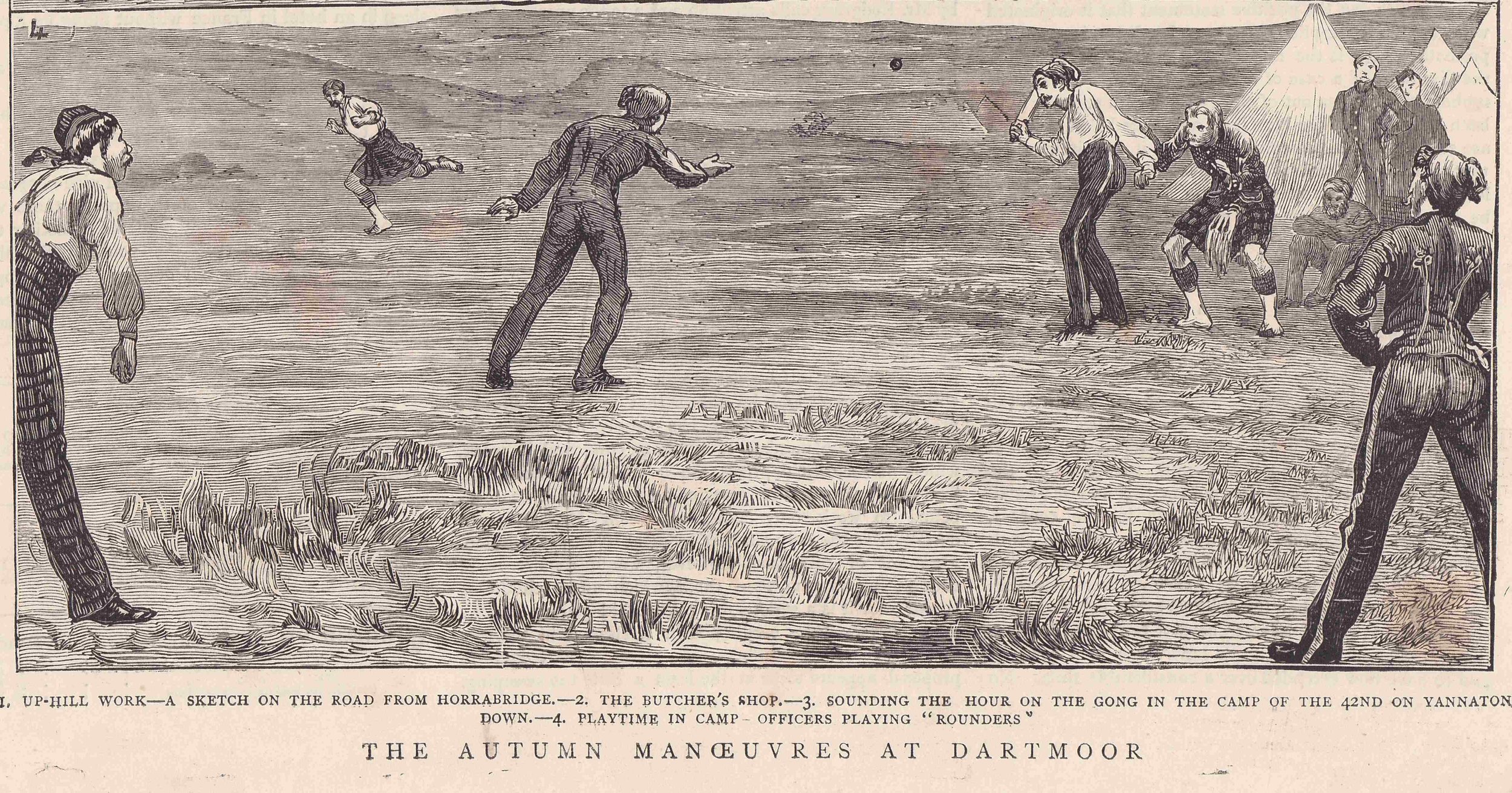
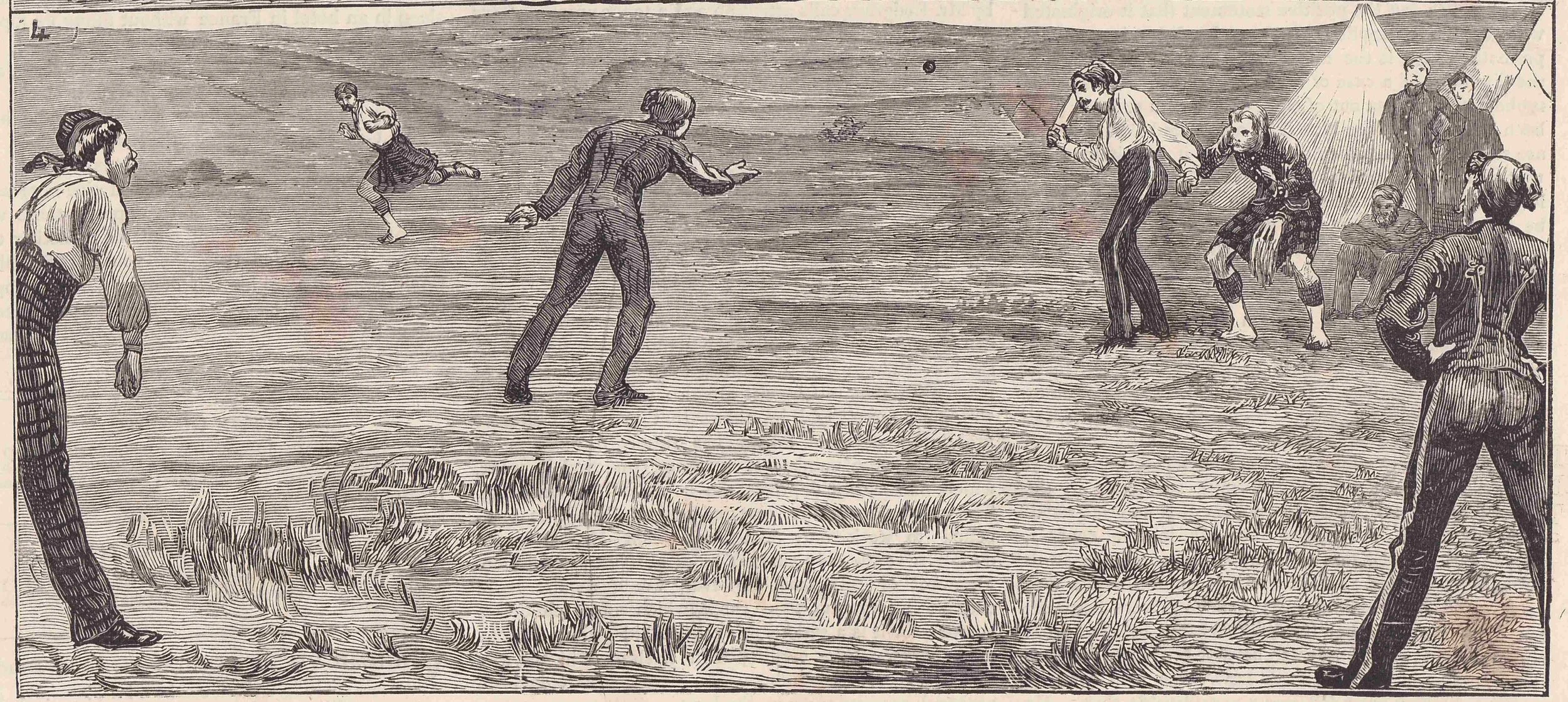
The Autumn Manoeuvres at Dartmoor, The Graphic, 16 August 1873, 1. Author's own collection.
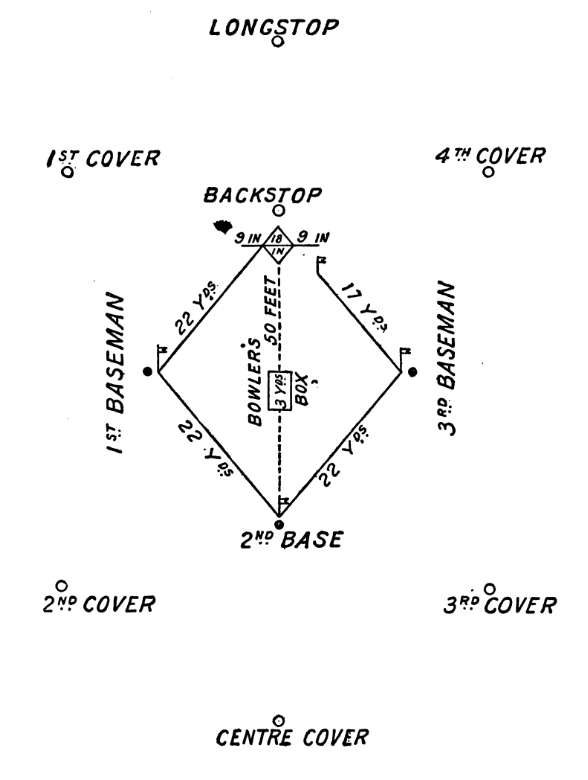
Layout of the playing field, Rounders/English Baseball. From Rounders, Bowls, Quoits, Skittles, and Curling, 1892. Author's own collection.
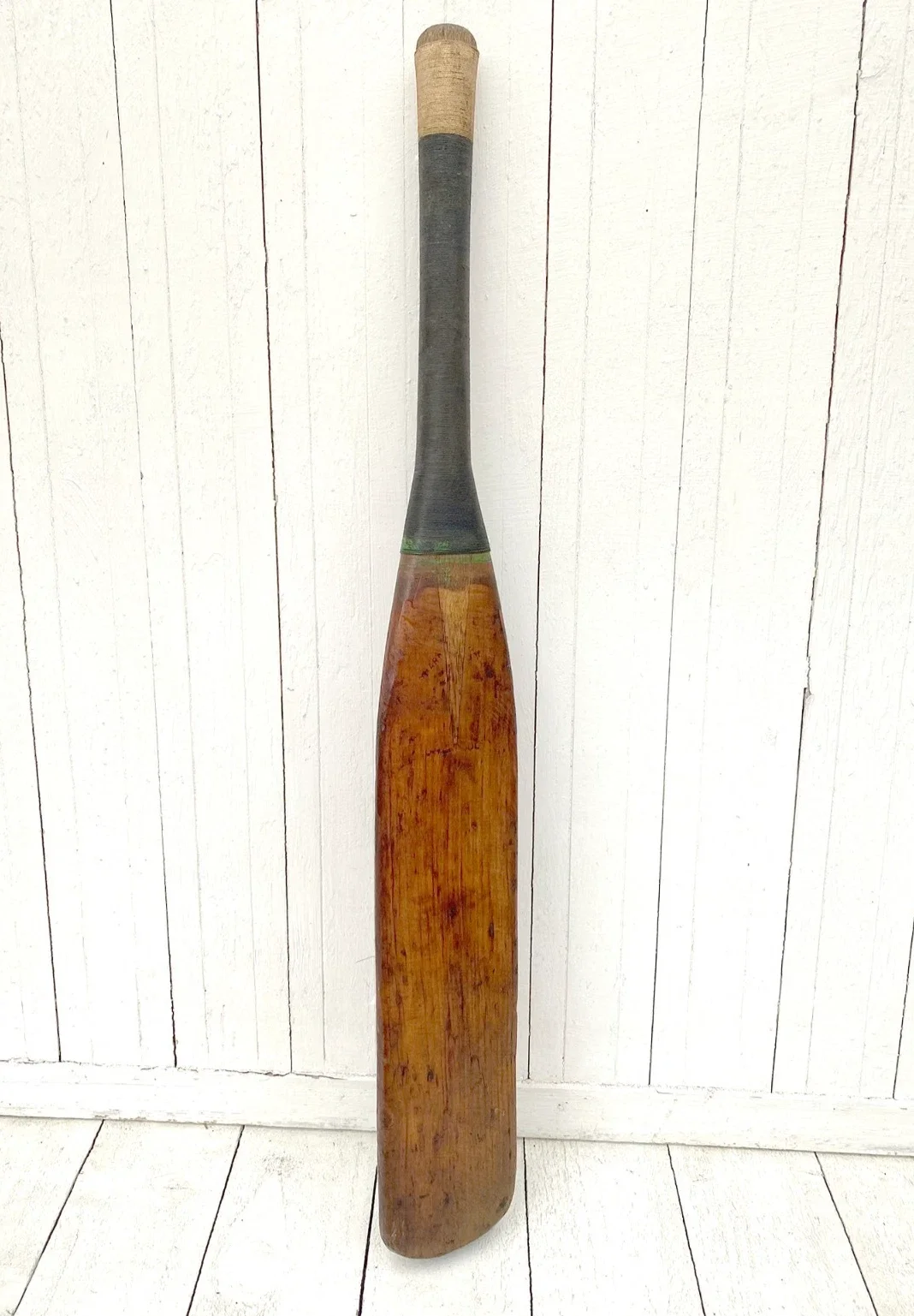
A bat for Rounders/English Baseball. eBay listing. Copyright undetermined.
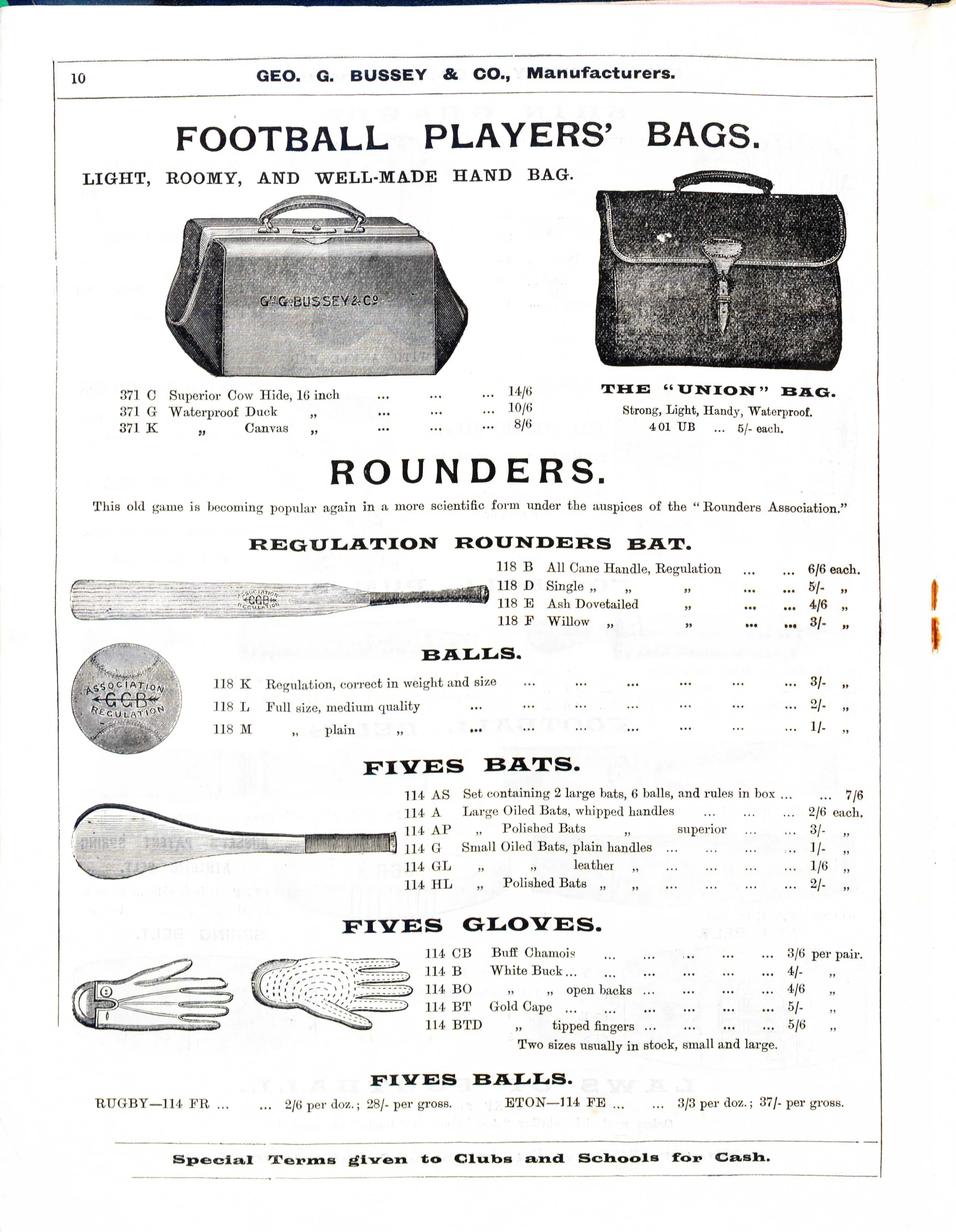
Listing for Rounder bats and balls, Geo G. Bussey Co, 1894/95 Winter Sports Catalogue. British Library. Author's own scan.