Anglo—Welsh Baseball.
1919—1939
Jamie Barras.
CARDIFF WORKERS’ SPORTS CLUB. It has been decided at a meeting of Spillers and Bakers (Limited) workers, Cardiff, presided over by Mr. S. Potter, to resuscitate the athletic club, which was closed for the duration of the war […] It was decided to hold another meeting this summer and to re-instate the various sections of sport, including cricket, Rugby and Association football, baseball, and swimming.[1]
The Welsh Baseball Association held its first post-war meeting on 14 May 1919; 40 clubs had already indicated that they would take part in the revived league.[2] Meanwhile, the Newport Baseball Club held its first post-war meeting on 10 May 1919 and played its first game, against Splott US, on 17 May. Jack Wetter was back from the war, his brother Edmond was confirmed as team captain, and another brother, Frank, was also in the team. Newport would prove dominant in the 1919 season, winning the championship.[3]
The 1919 season was populated with many of the clubs that had played in the last season before the war, including Splott US, Penylan, Grange Albion, Pill Harriers, the Gasworks, and Grange YMCA. A notable addition (for one season only) was the ‘14th Cardiff Old Comrades’, a team formed of Cardiff-based veterans of the 14th (Service) Battalion of the Welsh Regiment, which was known as the ‘Swansea Pals’ as many of its early volunteers were from Swansea. Noticeable by its absence was Grange, the team that had dominated the pre-war game (it would, however, return for the 1920 season).[4]
The above should not be taken to mean that it was business as usual. The opposite was very much true. This period in the history of the game in South Wales was one of change. The first change concerned styles of play.
For the benefit of the uninitiated, it may be explained that “dolly” bowling is slow, lob bowling. All baseball bowling is underhand […] and the ball must pass over the batsman’s crease above the level of his knee, below the top of his head. Most bowlers send the ball down fast, with a low trajectory […] but the “dolly” bowler pitches the ball up in the air. It travels slowly, and comes down steeply like a ball dropping from the roof of a house.[5]
In its 10 May 1919 meeting, the Newport club voted to ban ‘dolly’ bowling (lobbing the ball in the air such that it arrived at the batter falling almost vertically downwards). Although not a rule change per se, it did reflect the sense post-war that the game needed to change. Banning ‘dolly’ bowling, like most of the changes across the next ten or so years, was aimed at making the umpire’s life easier (in this case, to make it easier to see if the ball reached the crease below head height). Controversies arising from contested decisions were a perennial problem in games under the English code, exacerbated by the amateur status and nature of both players and umpires. Thus, in 1927, a rule was introduced that gave the batter no runs if they were caught out. Under the English code, a batter/runner scored a run every time they rounded a base (called ‘posts’ under the English code); before the 1927 rule change, umpires had to award a number of runs equal to the number of bases the runner had rounded before the catch was made. However, they could not look in two directions at once (the locations of the fielder and the runner), and errors were made. A further rule change, introduced in the EBA in 1920, reduced the number of runs that a runner scored by rounding all four bases (a ‘home run’ under the American code; a ‘four’ under the English code) from four to two. In a game that favoured high scores, the latter rule did not last long.[6]
The solutions chosen brought the game under the English code closer to that under the American code. In this, we can see the influence of players and officials in both Liverpool and South Wales witnessing games played under the American code by American teams during the war years.
Wrapped up in these changes in the style of play were changes in governance, particularly in South Wales.
WELSH BASEBALL. ARRANGEMENTS FOR THIS SEASON. […] The organisation of the Welsh Baseball Association has been re-modelled on the soundest possible lines, with a view to increasing interest in the game, particularly in districts which have not, as yet, come within the scope of the Association. One of the changes was the creation of a Welsh Baseball Union—a central authority organised on similar lines to the Welsh Rugby Union. This is a new departure, which, it is believed, will be good for the game in Wales.[7]
Modelling itself on the Welsh Rugby Union (WRU), the Welsh Baseball Union (WBU) came into being in April 1921 to take charge of the game at all levels, from the newly envisaged ‘schoolboy league’ (to ‘grow’ new players) up to the England vs Wales Baseball Internationals. Under this umbrella sat the Glamorganshire (Cardiff) Baseball Association and Monmouthshire (Newport) Baseball Association, with both associations running their own district leagues in addition to their top teams playing in the renamed Welsh League. Ted Diment, the long-time official with the Splott US club, was the WBU’s first vice-chair. One of the new Union’s stated aims was to strengthen links with the EBA in Liverpool with a view to reforming and standardising the code and improving the training of umpires, etc.[8]
By August of 1921, the Liverpool newspapers were reporting that the EBA and WBU had entered ‘upon a kind of amalgamation’ to be called the ‘British Baseball Union’. However, this announcement proved premature. In fact, it would be another 7 years before the two associations would, rather than merge, create a body through which they could work together on shared priorities, the International Baseball Board. Although this may have been with the intention of unifying the code in the two countries, ultimately, it would only coordinate the rules and procedures of the playing of the England vs Wales Baseball Internationals.[9]
Still, in terms of both participation and spectatorship, the game was in a period of growth. The next significant development would be the emergence of the women’s game.
Mr Emlyn Jones, general secretary, reported that when he took office thirty years ago, there were only 22 teams attached to the organisation, whereas now there were 91, excluding boys’ and ladies’.[10]
Within two years of its founding, the WBU had organised its first women’s league, the ‘Cardiff Ladies’ League’, which commenced in May of 1923. It also initiated a challenge cup, the ‘Cardiff and District Ladies’ Challenge Bowl’, with the first round being played in July of 1923. Splott University Settlement was one of the founding teams. The other teams were also a host of familiar names: Grange Albion, Channel Mills, Gripoly Mills, Docks, Grange, Grange Baptists, Grange Wesleyans, and Newport. Grange Wesleyans won the league, and Grange the Challenge Bowl.[11] It is worth noting here that in 1927, the ‘Cardiff Ladies’ Baseball Union’, the body that ran the league, held what was described on one newspaper report as its ‘sixth annual meeting’; however, this may have been an error on the journalists’ certainly, no mentions in the press of a league can be found before 1923 (although ladies’ teams unquestionably existed before that date).[12]
As with the men’s game in South Wales and the earlier Ladies’ Rounders League in Liverpool, the teams in the Cardiff women’s league ran the gamut of institutions that promoted physical recreation amongst their workers and members. Chapel Sport played a strong role, as the presence of the Nonconformists and the Splott US teams shows—with the Splott US team benefiting from the added boost of the settlement having, from its earliest days, a women’s section (led by Una Burrows). However, running in parallel with this was the strong association between women in the workplace and sports.
Several accounts state that the first women’s baseball international [between Wales and England] was played in 1926; however, I can find no mention of this in newspapers of the time.[13] As ever, the absence of evidence is not evidence of absence; however, this shows there is a need for more research on this topic.
We do at least have two rosters from a game played during the Cardiff women’s league’s second season (1924).
“A” and "B" teams in the exhibition game of the Cardiff and District Ladies' Baseball League at Splott Park this evening:-
“A” Team: G. Sinith (Wesleyans, capt.), T. Martin (Gripoly), G. Miller (Baptists), H. Royle (Baptists). F. Coles (Gripoly), N. Galpin (Grange). F. Curthoys (Wesleyans), O. Smith (Baptists), O. Parsons (Baptists), I. Royle (Baptists), and A. Stevens (Albions). Reserves: O. Jones (Albions) and R. Maylard (Gripoly).
“B” team: A. John (Baptists, capt.). H. F Pugsley (Gripoly), D. Blackler (Grange), O. Evans (Albions), H. Davies (Baptists), R. Martin (Albions), G. Horwood (Grange), M. Marshall (Albions), M. James (Wesleyans, M. Escott (Gripoly), and E. King (Gripoly). Reserves: D. Foulkes (Wesleyans) and E. Peterson (Albions).[14]
Of note here is ‘H. Royle’. This is almost certainly a 19-year-old Hilda Royle (1905–1993), described in later years as a pioneer of the women’s game.[15] That makes ‘I. Royle’, Irene Royle (1909–1994), Hilda’s sister, who was just 14 years old at the time of this game. The Royle family lived in Grangetown, which supports the identification—‘H Royle’ and ‘I Royle’ both played for the Grange[town] Baptists women’s baseball team. In 1921, Hilda was working as a typist; we can suppose that this was still her job in 1924. Thanks to a contribution made by one of her descendants to the Ancestry.com platform, we can enjoy a remarkable photograph of early women’s baseball in South Wales in the form of a photograph of Hilda Royle, circa 1926, caught mid-pitch, wearing a pinafore dress and a tennis player’s sun visor and hairnet combination; the epitome of the Chapel Sport devotee.[16]
Following the same logic, we can also suppose that the other women in the rosters would have been Grangetown residents. Armed with this information and the 1921 Wales Census, we can tentatively identify Nelly Galpin (1908–?). Nelly’s two older sisters were working as rope spinners in 1921; we can suppose that this was the job that Nelly was doing here in 1924. It will be remembered that the local ropeworks contributed a men’s team to the pre-World War One league. Two more possible identifications are Florence Curthoys (1905-1980), a draper’s assistant, and May Escott (1906–?), a domestic servant.
We can immediately see that many of these women were young, and most were in paid employment.
LADIES’ BASEBALL SECTION. A further meeting in connection with the above section will be held on April 9, at 81 Everton-road, Everton, when the matter of forming the ladies’ section will be definitely settled. At the present moment, four clubs have definitely decided to participate, and if it is possible to obtain one or two more clubs it will make a very interesting competition.[17]
Unlike in South Wales, women’s baseball under the English code failed to make much impact in Liverpool. This was due to the continued success of women’s rounder leagues across Lancashire. It was not until 1931 that plans for a women’s baseball section were finalised. The “Liverpool Ladies’ Baseball League” duly launched in May of 1931 with six teams: Guard of Honour Athletic Club, Clarence, Crystal, Bootle Olympic, Cowley, and Evans. However, although the teams played a full season in 1931, the league did not return the following year. The scene paid a heavy price for the split along gender lines between rounders and baseball that had long been in place in Lancashire. At the same time, it has to be acknowledged that this may have been how many women in the Liverpool rounders community wanted it. By the 1920s, the rounders scene in Liverpool was organised by the Liverpool Union of Girls’ Clubs (LUGC), which had as its primary aim the support and welfare of the city’s working women (which, given the employment practices of the time, included girls as young as 13). Having rounders as a separate sport allowed clubs in the Union to run the game the way they wanted, free from interference from men’s organisations, placing an emphasis on providing safe spaces for women and low barriers to participation. [18]
The American Legion has invited the English and Welsh baseball teams, who are playing at Stratford on Saturday, out to see the game at Stamford Bridge, when American baseball will be shown at its best and can be compared with the Welsh game.[19]
The 1920s and 1930s represented a golden period in baseball under the English code in South Wales and Liverpool in terms of participation from players and spectators. In August 1926, 12,000 fans turned out at Cardiff Arms Park to watch Wales beat England by an innings in that year’s Baseball International. A week earlier, listeners to BBC Local Radio could have heard former international and organising secretary of the WBA, William H. Boon, preview the match on his regular Saturday night ‘Baseball Prospects’ show.[20]
One survivor from this period is a photograph of the Splott University Settlement Baseball Club from 1928, showing the men’s and women’s teams sitting together.[21] By this date, the settlement itself had closed its doors for good (the settlement buildings had been taken over for use as a hospital during the war and were sold to the RC Archdiocese of Cardiff in 1923[22]). However, the members of the settlement had by this time internalised its ideals, and the baseball club had become the embodiment of the ideals of health and fellowship that the settlement had been set up to foster. In effect, the settlement had served its purpose.
Meanwhile, both the WBU and EBA still hoped to popularise the game beyond its two centres of Liverpool and South Wales. They even staged two exhibition games in London, arguably the home of the game played under the American code (the first, on 9 June 1924, at Stratford, East London, was won by Wales, the second, the following day at Tufnell Park, North London, by England).[23]
The American Legion Post in London, North American army veterans who staged weekly games under the American code in West London in this period, extended a rather back-handed invitation to the Liverpool and South Wales teams to come and watch one of their regular games. The description of the game that the England and Wales teams played in the report about the invitation from the American Legion—‘the Welsh game’—was incorrect, as the game began in Liverpool; however, this reflected the perception of the game to outsiders and the fact that the game was much bigger in South Wales during this period than in its birthplace.
The venue for the annual baseball internationals alternated between Cardiff and Liverpool; the year before, 12,000 people watched the 1926 game at Cardiff Arms Park, just 5000 watched the 1925 game at Fairfield in Liverpool. For the 1924 game in Cardiff and the 1923 game in Liverpool, the attendances were 10,000 and 6000, respectively. It is not too much to say, based on this, that the game in South Wales enjoyed roughly twice the support of that in Liverpool, despite Liverpool having nearly three times the population of Cardiff and Newport combined at this time (1921 Census: Cardiff, population, 200,000; Newport, 92,000; Liverpool, 802,000). (It is worth noting that England regularly won at home in this period, as it did in 1923, so it was not a matter of no one wanting to watch their home side lose.)[24]
This, of course, reflects the diversity of the population of Liverpool, a city of many peoples and faiths, and the integration of the wider Liverpool sport scene with that of the rest of England; the conditions simply didn’t exist there, as they did in South Wales, with its much more homogeneous population (largely Welsh, largely Nonconformist) and strong national identity, for a single sport to corner the market.
One consequence of baseball under the English code being such a niche sport in Liverpool was that, even in the heady days of the 1920s and 1930s, when it was enjoying its greatest period of success, the EBA subjected itself to much more introspection as it searched for a way to put itself on a firmer footing. This was a recipe for internal conflict arising from competing visions for the way forward, and this would, in turn, lead to the next challenge faced by the game in South Wales: the return to the national stage, at a scale not previously seen, of the American game.
As if major league baseball wasn't having a tough enough time nowadays, what with so many domestic problems to solve, it seems that John Moores, "patron" of the English Baseball Union, is about to interview the leaders of the American organized game with a view to promoting international relations, good-will and, most fearsome item of all, competition.[25]
As I have detailed elsewhere in this series, John Moores was a Liverpool-based businessman and head of the Littlewoods Group who had made his fortune in sports betting and then diversified into mail order shopping.[26] The ‘English Baseball Union’ (EBU) was a breakaway organisation created in Liverpool in January 1932 following turmoil within the EBA over the previous few months.
I tell the full story elsewhere in this series, but, briefly, the division was principally on whether to continue efforts to expand the game beyond its Merseyside heartland or concentrate on shoring up support locally. The losing side of the argument, men who supported expansion, resigned from the EBA and, in the New Year, launched a competing association, the EBU. Some of the strongest teams in the EBA leagues defected to the EBU.[27]
Moores became a patron of the EBU, sponsoring one of its cup competitions. When, in March 1933, he travelled to America, most likely on business connected to the mail order catalogue business he launched in 1932, he carried with him a letter from the EBU to the heads of the National and American Leagues (John Heydler and John Harridge, respectively) proposing ‘international games with England, Ireland, and America’. However, in the event, he was won over by the American version of the game, and returned to Liverpool intent to convert the EBA and EBU en masse to his new cause. In that, he failed. However, the further rupture in the ranks of the English Baseball supporters proved a heavy blow to the scene.[28]
The effects were eventually felt in South Wales, too.
If everything works out according to plan an American baseball test match between England and America will be staged in Cardiff this year. Already eight teams have signified their intention of joining the league to be formed under the auspices of the National Baseball Association, and now the inauguration of a second division is being contemplated.[29]
What would become known as the ‘Cardiff American Baseball League’ (or simply ‘Cardiff American League’) began to take shape in March 1939 under the watchful gaze of Andrew McGraw, a veteran NBA organiser, sent to Wales for the purpose. Former Welsh international (under the English code) Freddie Fish, at the time, the holder of the record for the most successive home runs in a game, was trumpeted as having joined in the effort (under the rather nebulous title of honorary ‘assistant coach for the South Wales area’).[30]
When it finally launched in May, two of its seven (not eight) teams were from RAF formations: RAF St Althan and the County of Glamorgan Barrage Balloon Squadron (which, strictly speaking, was part of the Royal Auxiliary Air Force). The other teams were the Central Y.M.C.A., Penylan, the Lumberjacks (timber merchant employees), St David’s, and the Mail & Echo (employees of the Western Mail and South Wales Echo newspapers). The RAF St Athan team topped the league at the end of the season.[31]
How much of a threat this new incursion would have proved if it were not for the start of the Second World War, we will never know. The war brought an end to John Moores’ attempts to popularise American baseball in England. The game continued through the war and into the peace at an amateur level, albeit in a few regional centres rather than as a national scene—mirroring English Baseball, the game it sought to replace.
“I think one of the main things that has led to the decline of baseball is the length of the football season. When the soccer fixtures used to finish in the old days, then the teams would take up their bats and play baseball. Now the season is longer and there are more high-profile football tournaments to watch in the summer like the European Cup and World Cup. Liverpool has also lost a lot of factories who used to have teams and the schools have also stopped playing.”[32]
Anglo–Welsh Baseball experienced a brief resurgence in the immediate postwar period, with the England–Wales Baseball Internationals recording some of their best attendances in the late 1940s. Fans of the sport consider the 1950s as a second golden period for gameplay. However, after this, the game went into rapid decline in both Liverpool and South Wales. The rise of television and youth culture, the globalisation (and monetisation) of Association football, the decline of British industry, the nationalisation of school sports curricula, and fall in church attendances all played their parts. The Liverpool scene soldiered on until the early 2000s, by which time the number of active clubs had dropped from its pre-war peak of 200 to 6. The last England–Wales Baseball International was played in 2014. In South Wales, the last surviving men’s league was wound up in 2017. However, the women’s scene, independent since the early 2000s, continued. A six-club men’s game was revived in 2021, and a bid was made to reintroduce Welsh Baseball into South Wales schools. At the time of writing (August 2026), the women’s game was enjoying the twentieth season of its independent era, and the revived men’s game its fifth season. Meanwhile, Bolton Rounders, inheritor of the women’s competitive rounders scene in Liverpool, continues to this day, albeit mostly as a traditional sport in Bolton schools.[33]
The codification of rounders in the late nineteenth century was inspired by, but also a reaction to, the introduction of the American game of baseball into Britain, just as the codification of baseball was inspired by, but also a reaction to, the introduction of the English game of cricket into America. There were other forces at work in both cases, not least the love their supporters had for the games. Nevertheless, the modern discourse on baseball, cricket, and Empire can be extended to rounders, baseball, and Empire. Countries, on the whole, like sports they can call their own, and when one is not available, they import a sport and make it their own, even to the point of forgetting that it ever had a foreign origin. Rounders was original to England, but at the same time owed much to American baseball.[34]
Modern rounders is a mid-twentieth-century development of the original children’s game. It is doubtful that the schoolteachers who codified its rules knew or cared much about American baseball beyond what they saw in the newspapers. The modern game owes nothing to the game that was known historically as Rounders or English Baseball and is now known as Welsh Baseball. The exception is the rounder variant played in Bolton, Lancashire. There, spectators can still see a game with the flavour of the Cardiff, Bristol, and Liverpool games in their original form. It is vintage rounders.
Jamie Barras, August 2026.
Back to The Rounders
Notes
[1] ‘Cardiff Workers’ Sports Club’, Western Mail, 5 April 1919.
[2] ‘Welsh Baseball Association’, Western Mail, 15 May 1919.
[3] Newport Club first post-war meeting and ban on ‘dolly’ bowling: ‘Baseball’, ‘Baseball’, South Wales Weekly Argus and Monmouthshire Advertiser, 10 May 1919; match against Splott: ‘Baseball’, South Wales Argus, 13 May 1919; Wetter Brothers in the team: ‘Baseball: Newport Club Averages’, South Wales Argus, 4 October 1919.
[4] See list of match results: ‘Baseball’, Western Mail, 30 June 1919. Grange’s return: ‘Baseball: Welsh Association’s Annual Meeting’, Western Mail, 18 March 1920.
[5] ‘Baseball Notes’, South Wales Argus, 17 June 1913.
[6] A summary of these rules changes is contained in: ‘Game All Set for Its 96th Birthday’, South Wales Echo, 15 January 1988. In the latter article, the four runs down to two rule it attributed to 1931, however, the rule is discussed in 1921, here (as a shortlived EBA innovation): ‘Baseball In Wales’, South Wales Argus, 16 July 1921.
[7] ‘Welsh Baseball: Arrangements for this Season’, Football-Argus, 23 April 1921.
[8] ‘Schoolboys League’ and Glamorganshire and Monmuthshire Associations: see Note 8 above; strenthening ties with EBA: ‘Baseball in Wales’, Western Mail, 22 March 1922.
[9] ‘British Baseball Union’, Liverpool Echo, 6 August 1921; ‘Baseball Budget’, Liverpool Echo, 13 August 1921. There is a single mention of the Union the following year, but this may simply reflect a meeting between the EBA and WBU in advance of that year’s International: ‘Baseball Memoranda’, Liverpool Echo, 6 May 1922. The International Baseball Board was founded in the summer of 1928: ‘Baseball Budget’, Liverpool Echo, 30 June 1928.
[10] ‘Baseball Notes’, South Wales Argus, 17 June 1913.
[11] List of teams, dates, and results assembled from: ‘Baseball’, Western Mail, 14 May 1923; ‘Baseball’, Western Mail, 23 July 1923; ‘Baseball: Cardiff Ladies’ League Trophies Presented’, Western Mail, 2 October 1923.
[12] ‘Ladies’ Baseball’, Western Mail, 26 February 1927.
[13] Martin Johnes, “‘Poor Man’s Cricket’: Baseball, Class and Community in South Wales c.1880–1950,” The International Journal of the History of Sport 17, no. 4 (2000): 153–66, doi:10.1080/09523360008714152.
[14] ‘To-Day’s Exhibition Game’, Western Mail, 30 June 1924.
[15] Letter, ‘Elaine’s Feat’, South Wales Echo, 10 June 1986.
[16] Information comes from the entry for ‘Hilda Royle’ and ‘Irene Royle’ in the 1921 Wales Survey, Grangetown (West Cardiff) district, ancestry.co.uk, Ancestry.com Inc. Operations, accessed 19 July 2025. The photograph in question is attached to the entry for Hilda Royle (1908-1993) in the Pill Family Tree (Pill was Hilda’s married name).
[17] “Ladies’ Baseball Section”, Liverpool Echo, 4 April 1931, 6.
[18] “Ladies’ Baseball League”, Liverpool Echo, 12 May 1931, 10; “Baseball Cup-Ties”, Liverpool Daily Post, 11 June 1931, 11; “Union of Girls’ Clubs”, Liverpool Echo, 30 May 1930, 14.
[19] ‘American Baseball’, Evening News (London), 5 June 1924.
[20] ‘International Baseball’, Western Mail, 3 August 1926. Match on Radio: ‘Wireless Notes’, Western Mail, 24 July, 1926. Baseball Prospects: ‘Broadcasting the Programmes’, South Wales Argus, 1 May 1926.
[21] ‘Splott University Settlement Baseball Club’, Western Mail, 11 May 1928.
[22]Assessment for Listing, Old College Building, Courtney Road, Splott, Cardiff, https://www.gov.wales/sites/default/files/publications/2019-01/160307atisn10172doc1.pdf. Accessed 16 July 2025.
[23] Stratford game: ‘Baseball: Wales Beat England’, Western Mail, 9 June 1924; Tufnell Park game: ‘Baseball: England Turns the Table on Wales’, Liverpool Daily Post,10 June 1924.
[24] 1923 international: ‘Baseball: England’s Easy Victory Over Wales’, Liverpool Daily Post, 23 July 1923 1924 international: ‘International Baseball’, Western Mail, 28 July 1924; 1925 international: ‘Bee’s Notes on Sports: Arise, Sir Baseball’, Liverpool Echo, 27 July 1925. Population data: https://web.archive.org/web/20240704043924/https://www.visionofbritain.org.uk/census/table/EW1921GEN_M13, accessed 19 July 2025.
[25] ‘Harridge and Heydler Have Enough Worries’, Springfield Evening Union, 17 April 1933.
[26] Barbara Clegg, “Moores, Sir John (1896–1993), Businessman and Philanthropist,” Oxford Dictionary of National Biography, published 23 September 2004, accessed 20 July 2025, https://www.oxforddnb.com/view/10.1093/ref:odnb/9780198614128.001.0001/odnb-9780198614128-e-40918.
[27] Reduction in number of officers: ‘Baseball Changed’, Liverpool Echo, 24 October 1931; Bailey and Deakin ousted: ‘Baseball: New Men at the Helm’, Liverpool Evening Express, 19 November 1931; Kennard and Cannell ousted in turn: ‘Baseball Officials’, Liverpool Evening Express, 27 November 1931; EBU formed: ‘New Baseball Union’, Liverpool Echo, 30 January 1932; Kennard and Cannell in new Union: ‘English Baseball Union’, Liverpool Echo, 16 February 1932.
[28] Moores sponsoring EBU trophy: ‘Bee’s Notes on Sports: New Baseball Trophies’, Liverpool Echo, 9 December 1932; Moores as patron of the EBU and travelling to America to promote England, Ireland, America internationals: ‘Bee’s Notes on Sports: Ambassador to America’, Liverpool Echo, 28 March 1933.
[29] ‘Introducing American Baseball to Wales’, Western Mail, 1 March 1939.
[30] McGraw as organiser of American game in Cardiff: ‘Baseball’, Western Mail, 25 January 1939; Freddie Fish and Cardiff American Baseball League: see Note 40 above; Freddie Fish’s record: ‘Not Seven or Even Nine—It Was Eleven!’, South Wales Echo, 6 January 1986.
[31] ‘Cardiff American League’, Western Mail, 22 May 1939; ‘Cardiff American League’, Western Mail, 29 May 1939. The Balloon Squadron played as the ‘Balloon Barrage’ team; the name of the unit is given here: ‘Baseball: Aberdare Valley Exhibition Game’, Western Mail, 25 May 1939.
[32] John Jervis, chairman of the English Baseball Association, speaking in 1998: Roger Bryson, “A Last hurrah for baseball’s home base?”, Liverpool Daily Post, 25 May 1998, 3.
[33] Note 32 above; Elizabeth Muratore, “The Remarkable and Rich History of Welsh Baseball,” MLB.com, accessed August 24, 2026, https://www.mlb.com/news/featured/welsh-baseball-remarkable-history; “Baseball: Bid to Revive Sport That Was Once Popular in South-East Wales,” BBC Sport, https://www.bbc.co.uk/sport/baseball/62296800, accessed 23 August, 2026; https://x.com/baseballwales; https://www.instagram.com/welshbaseballunion/; https://www.facebook.com/p/Welsh-Ladies-Baseball-Union-100042887265665/.
[34] Boria Majumdar and Sean Brown, “Why Baseball, Why Cricket? Differing Nationalisms, Differing Challenges,” The International Journal of the History of Sport 24, no. 2 (2007): 139–56, https://doi.org/10.1080/09523360601045732.
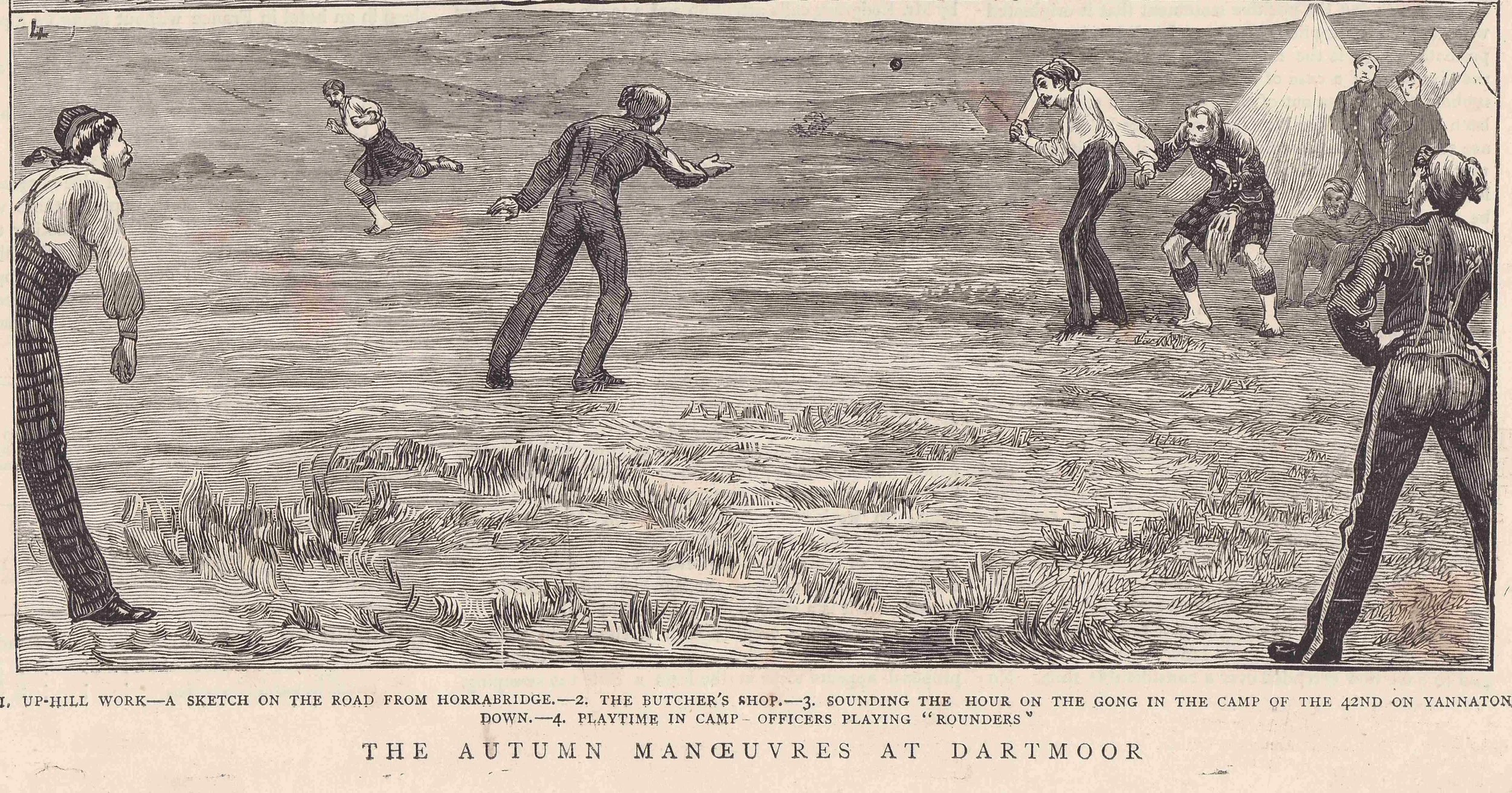
The Autumn Manoeuvres at Dartmoor, The Graphic, 16 August 1873, 1. Author's own collection.
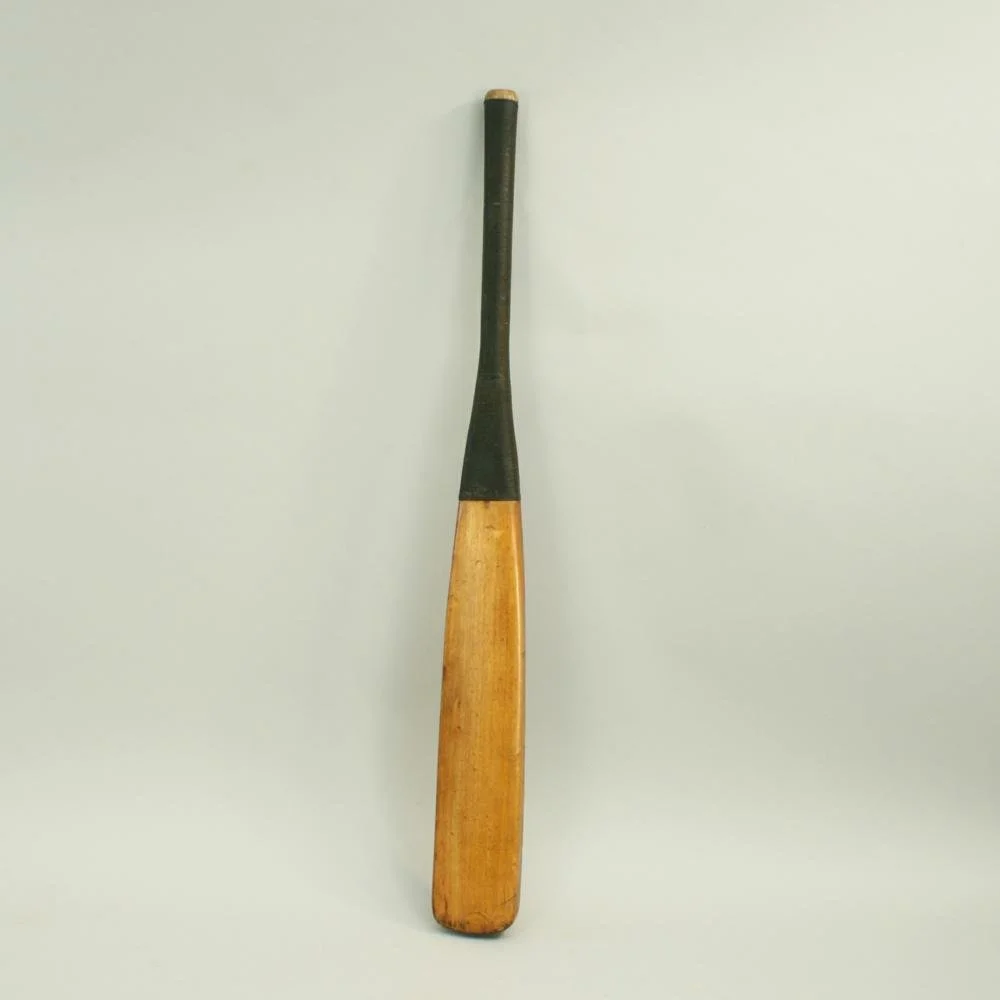
A bat for Welsh Baseball. Sports Antiques listing. Copyright undetermined.