A Game Without A History.
Jamie Barras.
"[…]even close to the scaffold there were fellows forming parties for rounders, girls making assignations &c.[1]
Tuesday.—Took a walk over Brandon Hill; saw two or three parties of sailors and some other young vagabonds playing trap, foot ball, rounders, pelting each other, &c. &c.[2]
Rounders is a game without a history. It has no scholarly work devoted to its origins, and, until recently, it was thought that there was no convincing evidence for its existence before it sprang, fully formed, from the pages of the 1828 edition of William Clarke’s Boy’s Own Book. The latest scholarship shows that references to the game date back at least another decade, but that is still relatively recent. Meanwhile, claims of a Tudor origin seem to be based on a misreading of a quote from Shakespeare and the—highly contested—theory that it was the name given in the nineteenth century to a game previously known as “baseball” (“base ball”, “bass ball”, “baste ball”, “ball base”, etc.).[3]
The uncontested fact that it had acquired the name “rounders” by the time that the modern game of baseball appeared in the North-eastern United States led some early historians of the latter to posit that the former was its progenitor. This vexed patriotic partisans of the American game no end and led to the promotion of what is now dubbed the “Doubleday Myth”: the idea that the American game was summoned from the aether in 1839, in Cooperstown, New York, by future US Army general and theosophist Abner Doubleday.[4]
Modern baseball historians, who have long since dismissed the Doubleday Myth, are equally contemptuous of the idea that the American game descended from rounders. Their case is built on the fact that references to baseball in both England and the [future] United States predate those to rounders by nearly a century. They further contend that rounders is not simply this earlier baseball renamed, but a development of the latter game in much the same way that the American game is. This, as I will show, is likely to be closer to the truth than any claim to ancient origins.[5]
The cap was what he usually wore in the stable, but as he was going on a visit he put on his Sunday hat and his cap and handkerchief inside of it. The stick, he said, was one that he and his brother had been playing at ball with, at a game called “rounder”, but in their retreat they dropped these things.[6]
According to Encyclopaedia Britannica, rounders is an “old English game that never became a seriously competitive sport, although it is probably an ancestor of baseball. The earliest reference to rounders was made in A Little Pretty Pocket-Book (1744), in which a woodcut also showed the children’s sport of baseball”. This convoluted phrasing is evidently designed to reconcile the fact that the description and illustration of a rounders-like game in A Little Pretty Pocket-Book appears under the title “Base-Ball”. It typifies the oft-expressed view that rounders is simply this old “base-ball” renamed, and, as such, all references to baseball in records that predate mentions of rounders are of rounders simply under an earlier name. This, this view contends, includes a reference to the game of “base” in Shakespeare; ergo, rounders is of at least Tudor origin.[7]
In this formula, “modern” baseball is a successor to rounders that split from the original while it was still known by its earlier name. For this to be the case, rounders, as we know it, would have to conform to descriptions of “old” baseball. If the two games differ, rounders is instead, like “modern” baseball, a successor to that original game, not the same game renamed.
American baseball historian David Block contends that the latter is the case. Block’s theory, based on the best available evidence, much of which Block himself has brought to public attention, is that rounders is a relatively recent (eighteenth-century?) base-running bat-and-ball offshoot of “old” baseball. The latter, Block contends, was mostly a base-running hand-and-ball game. In some parts of the country, this bat-and-ball variant kept its original name, but in others it was renamed “rounders”. Block bases his theory on two foundations: differences in descriptions of how the two games were played, and proof that “old” baseball continued to be known by that name long after “rounders” appeared.[8]
The evidence for Block’s theory is presented below. My own theory, the evidence for which I also present below, borrows from Block’s. It is, in essence, a reframing: I believe rounders is an amalgam of older strike-and-run games like “old” baseball played with new vigour: a mid-to-late eighteenth-century development that came about because of the rise of cricket. In this, I refer to the historiography of the development of modern sport, most obviously the work of Eric Dunning.[9]
In the early eighteenth century, cricket started its journey towards becoming the sport we know today, gaining in vigour and technique to the point that it came to be seen as a game only for older youths and men. A gap opened between it and other “strike-and-run” games. By the mid-to-late eighteenth century, games less technical than cricket, but more vigorous than the strike-and-run games that preceded them, had appeared to fill this gap. I believe that rounders—an amalgam of strike-and-run games like “old” baseball played with new vigour—was one of these games. This property of being vigorous without being too technical made it particularly attractive to older boys and anyone else looking for a pastime as energetic as cricket but less constrained by rules. As boys switched to rounders, and youths and men switched to cricket, the remaining strike-and-run games, particularly “old” baseball and stool ball, came to be seen as games for younger children, girls, and women.
We see in this the beginnings of what would become a defining characteristic of the development of modern sports: whereas in earlier times, folk games were enjoyed by people of all ages and genders, by the end of the eighteenth century, they had begun their journey towards becoming sports with exclusions defined by age and gender, exclusions justified by references to the vigour and technique with which the new sports were played.[10]
The relationship between strike-and-run games like cricket, rounders, and old baseball would change as they continued to evolve. Eventually, rounders would be tamed and, in most parts of the country, old baseball and the related games stool ball and cat would be forgotten. They became indistinguishable in people’s memories from the milder form of rounders that they now enjoyed. This would have consequences when, in 1874, a game still calling itself “baseball” reappeared in England after becoming popular in the United States.
Separately, in the 1840s, fond memories of the uncouth, vigorous game of their youth led some sportsmen to relaunch “old” rounders as a sport for adults. Associated with this was the adoption of the game as a recreation by sailors and soldiers of the Royal Navy and the British Army. Those efforts would bear fruit in the following decades, albeit not without experiencing their own problems due to the American adoption and adaptation of baseball.[11]
ROUNDERS. In the west of England this is one of the most favourite sports with the bat and ball. In the metropolis, boys play a game very similar to it, called Feeder.[12]
As there appears to be no dispute that “rounders” as a name is of relatively recent origin, our focus needs to be on whether it is “old” baseball renamed or a different/evolved game. It is worth taking a moment to consider the name itself. What sets “rounders” as a name apart from those of the other games we have already encountered is that, as commonly understood, it describes an action, not an implement of the game—c.f. “baseball”, a game played with a ball in which players round bases (which were/are physical objects). This can be extended to other games in this family (stool ball, tut ball, burney ball, dully, cat, etc.).
In fact, although a “rounder” came to mean a complete circuit of the bases/posts, it is likely that the word “rounders” was originally applied to the players. “Rounders” as a name given to watchmen who circulated an area can be found in English sources at least as far back as the late seventeenth century, such as in the 1596 “Poem of Poems or Syon’s Muse” by Gervase Markham: “The Citties rounders, watchmen of our town,/They found me how I sought him up, and down/And finding me, with weapons of their scorn,/They smote, and wounded me”. We might therefore hypothesise that the name came after the method of playing was established, and was based on observation of how the game was played, which would support the theory that the game was an earlier strike-and-run game known by a new name. This would also, of course, apply to a development of an existing game or games. Critically, it is a name independent of the implements with which the game is played, and, therefore, could be applied to any number of games. I view this fact to be significant, as I will show.[13]
Next, I want to go into the Block theory in more detail and set out the evidence in support of its reframing. In the process, I will also present evidence that goes against the idea that rounders is simply “old” baseball renamed.
Base-Ball. The Ball once struck off,/Away flies the Boy/To the next destin'd post/And then home with Joy.[14]
References to “baseball” (“base ball”, “bass ball”, baste ball”, etc.) in English sources date back at least as far as the early eighteenth century. That the game was played at least sometimes without a bat, the ball instead being struck with the flat of the hand, can be inferred from the famous woodcut that accompanies its description in John Newbery’s A Little Pretty Pocket Book of 1744. However, it must also be stated that the earliest full description of the game, contained in a book published in 1796 in what is now Germany, shows a game played with a bat.[15]
Baseball is, itself, thought to be an offshoot of the much older game stool ball. In his 1801 book “The Sports and Pastimes of England”, Joseph Strutt described stool ball as a game that, when involving more than two players, included runners moving between stools placed in a circle. He also describes a related (derivative?) game, a version of “tip-cat”, in which there are multiple batters placed in a circle at a number of points (“holes”). A bowler placed in the centre of the circle throws a “cat”—a short length of stick— at one of the batters; if the batter manages to hit the cat, all the batters run from one hole to another until the cat is retrieved. Notably, Strutt does not describe baseball or rounders in his book. However, this may have been because, in Strutt’s classification system, they were simply variants of stool ball. The games he describes were played by people of all ages: folk games.[16]
That rounders is an offshoot of baseball rather than that game renamed, David Block deduces from the fact that the two games appear together in some nineteenth-century accounts, as in the following:
After tea there was a resumption of sports—cricket, quoits, croquet, base ball, rounders, and other pastimes being vigorously pursued until eight o’clock when the time of departure arrived, and the company left the grounds well satisfied with their afternoon’s recreations[...][17]
Block writes that, “[…] my research shows that while English baseball was played predominantly without the use of a bat (players using their bare hands to strike the ball), every published description of rounders from 1828 onward stipulated that bat usage was fundamental to its play.”[18]
By “published description”, Block seems to be referring to descriptions of how the game should be played, such as in books devoted to games and pastimes like Strutt or Clarke. I make this assumption because we see at least one account in a newspaper of rounders being played without a bat. This was published in 1860 and appears to describe a game peculiar to Cowes, on the Isle of Wight—where the royal family had a summer home.
In another [place] a number of Eve's fair daughters were deeply immersed in the arts of the fashionable, elegant, and highly-accomplished diversion—"Rounders." This feminine enterprise will be deemed vulgar by the fastidious, but had they seen their Amazonian spirit and exertion, the graceful movements of their arms, for a time converted into bats, the contemptuous heel-kicking their garments received in racing after the ball, the unmodulated shouts of "Bring her yer"-—meaning the ball—and the total absence of diffidence in meeting the gaze of the numerous spectators, they would have—no cause alter that opinion.[19]
It is also worth noting that we have at least one example of a description in a book of games and pastimes of the game “Feeder”—the game that, in 1828, Clarke described as a metropolitan variant of rounders—in which we find the following:
A round stick or a small bat may be used by the players for striking, but this is not necessary, the open hand being a more ready and a sufficiently serviceable weapon.[20]
More particularly, we have descriptions of rounders that clearly owe little to “old” baseball, but are, instead, related to other games in the strike-and-run family, most noticeably, the tip-cat of Strutt’s 1801 work. This is illustrated by the account of F.C. Husenbeth in his 1856 work “The History of Sedgley Park School, Staffordshire”.
A favourite game was "cat," but played with a ball, which was struck with a stick, thicker at each end than at the middle, and called a "cat-stick." This was usually played at the lower end of the " Bounds" near the chapel, for the convenience of sending the ball to a great distance. Mr. Birch often joined the boys at this game, and they used to contrive purposely to let him get the "striking hole," to witness his extraordinary power of sending the ball a long distance, oftentimes even into the " Long Meadow. " The similar game of "rounders" was much played later on, as also "cricket."[21]
Elsewhere in the book, Husenbeth tells us that “Mr. Birch” arrived at the school in 1801 and died in 1821, placing the arrival of rounders at the school no earlier than 1801 and likely much later.[22]
In 1860, Husenbeth elaborated on both cat and rounders as played at Sedgley Park in a letter to Notes and Queries.
But the game was always called “cat” and carefully distinguished from a somewhat similar game called “rounders”. In “cat” one boy was “in” and had to run round the holes in time to prevent anyone putting the ball into the striking hole; but in “rounders” each hole had its boy standing at it, and, when the ball was struck, all kept running round till the ball was returned; when he who got the striking hole, of course struck the ball next.[23]
“Hole” variants of cat and rounders are described in books of games and pastimes from this period; however, Husenbeth’s description of “rounders”, with batters at each hole, is closer to what Strutt in his 1801 book described as a version of “tip-cat”, albeit, in Husenbeth’s game, the “cat” is replaced with a ball. When played with a ball, the game came to be known in America as “two-old-cat”, “three-old-cat”, or “four-old-cat” depending on the number of players. This was viewed by some as an American innovation and progenitor of the equally American baseball.[24]
Sedgely Park was a Catholic Boys’ School, and, from 1808, it served as a preparatory school for Ushaw College Catholic seminary in the North East of England. A seven-hole/batter version of cat was played at Ushaw from its founding right up until the 1970s. The seminary, which closed in 2011 and is now a tourist destination, was founded by refugees from the English College, Douai, expelled from France during the French Revolution. Cat was said to have been played by the students at Douai since at least 1760. (It is worth noting here that, as the name suggests, the English College’s students and staff were English, not French; the college existed because it was for many centuries illegal to train as a priest in the Catholic faith in England; thus, we cannot suppose that this version of cat was of French origin.) The long, thin stick that broadens suddenly at the striking end used in the Ushaw game is reminiscent of the stick used in another variant of cat played elsewhere in England called “Knurr and Spell”. This example further illustrates the cross-pollination between bat-and-ball games in this period. The playing of cat at Ushaw died out in the 1970s, but the “cat rings” on which the game was played can still be seen at the site today, as can surviving examples of sticks and balls. The college’s archives also hold copies of the rules of the game and accounts of it being played dating back to the 1830s. Meanwhile, the earliest evidence of the Douai game in England pre-date the founding of Ushaw College: in their early years in England, the Douai refugees rented Crook Hall, a few miles from the site of the future college; the lease included a field where cat and cricket could be played.[25]
Finally, it should also be noted that there appear in the records references to rounders as a game involving the players simply standing in a circle and throwing a ball at each other.
George Hume, twelve years of age, was sent to gaol for five days for playing at what the commitment called “rounders”, which consisted of a number of children standing in a ring and throwing a ball at one another.[26]
The stout fellows of the naval brigade beside us would play “rounders” in a ring with a ball, with many a rough joke and a loud laugh[...][27]
What is clear is that it was not, as the conventional story has it, simply “old” baseball renamed, as there are descriptions of the game that differ from descriptions of old baseball. However, at the same time, it is too reductive to describe it as simply a development of old baseball for much the same reason. The name “rounders” was a term applied in the mid-to-late eighteenth century to a number of ball games involving a circle, most of which involved one or more “strikers” running in a circle as opposed to a point and back as in cricket. The version of these games that came to dominate—the one that was committed to print—was the one that resembled stool ball/“old” baseball in its use of a single “striker” and multiple bases and runners. However, this was a later reduction.
Critically, I believe these games came to the fore and acquired the class name “rounders” because they evolved to fill the gap created by cricket’s own evolution towards being a more vigorous, more technical game aimed at older youths and men.
Thus, a more cautious interpretation of the relationship between old baseball, tip-cat, stool ball, and a half-dozen other strike-and-run games, on the one hand, and rounders, on the other, is that when we see these other games and rounders presented together, this represents a division of base-running strike-and-run games into less vigorous and more vigorous categories. See the appendix for relevant examples of this juxtapositioning.
There is a considerable, but not total, overlap between the categories of less vigorous and more vigorous and the categories of less technical and more technical. Playing with a bat or stick (more vigorous) or without one (less) would represent such a division, as would playing with a bat (less technical) versus a stick (more). This latter division exists in modern rounders, where, with one important regional exception, “flat bats” are reserved for novices, while the competitive game uses a truncheon-like stick. There is also an example from cricket in which players wishing to improve their batting technique can train with a bat with a narrow striking surface (a “technique bat”).[28]
Critically, I think that whether the game was played with or without a stick, or with a bat versus a stick, is important only insofar as it is an indication of the degree of vigour with which the game could be played. In this regard, we can look to nineteenth-century examples of cricket and baseball being played together:
The young men played at cricket, while the boys played base ball and other games.[29]
Whether this version of baseball was played with or without a bat or stick is irrelevant; it is being positioned as less technical/vigorous than cricket and therefore more suitable for younger boys.
In general, all forms of physical recreation can be thought of as residing somewhere on the spectrum from sedate to vigorous. However, historically, one consequence of differentiating games by their degree of vigour was the rise of exclusions based on gender. This was, for example, the principal objection raised to women playing Association Football and related sports (this, of course, is not to say that this was the real reason for men objecting to women taking up these games, as Dunning and others make clear).[30]
In the present context, it is most obvious in the way in which, in the early twentieth century, in schools in England, boys were directed towards cricket and girls towards rounders. Similarly, in the early twentieth century, in those parts of the country where a version of baseball was played as a sport, it was reserved for boys/men, while girls/women were pushed toward rounders—though not without pushback. However, discussion of this latter phenomenon belongs to a history of nineteenth-century attempts to turn rounders into a competitive sport.[31]
Much more recently, we can point to the controversy over the 2015 decision to disqualify rounders as a sport for assessment under the physical education (PE) element of the English school curriculum. The reason given was that the Department of Education was standardising assessment criteria towards sports played by both boys and girls, to make assessment fairer—i.e., comparing like with like. Rounders lost out because it was seen as a sport played only by girls, c.f. cricket, which, by 2015, was played by both girls and boys. Critics of the decision suspected that the real reason rounders lost out to cricket was that, as a sport enjoyed primarily by girls, it was viewed as somehow “inferior” to the latter game. It unquestionably suffered from not having a professional league associated with it, with some people dubbing it a “leisure activity” rather than a sport on these grounds.[32]
The irony of this is that, as period sources show, the evidence from 150 years earlier is that rounders was considered a game for boys because it was regarded as lying at the more vigorous end of the spectrum. This stands in contrast to old baseball, which, lying somewhere in the middle, if not towards the sedate end of the spectrum, oscillated between being considered suitable for both girls and younger boys and for girls only. Here, again, we see the influence of the arrival on these shores of the American take on old baseball and its claims to be the manliest of games.
It is here also that class enters the picture. It would be tempting to be reductive and say that rounders was “the working-class version” of old baseball and associated games. However, although there is evidence that in its most unfettered form it was favoured by working/labouring-class boys and youths, it is also clear that, when under adult supervision, children of all classes played both rounders and these other strike-and-run games, with the latter retaining their position as the less vigorous of the two, but the former being a tamer version of rounders than that played by boys out of sight of adults. Eventually, the overlap would be so great that rounders would replace these other games in people’s memories. The effect of this would be to obscure the history of all these games.
Jamie Barras, September 2026.
Acknowledgments: I would like to thank David Block for useful discussions. All views expressed in this piece are my own.
Back to The Rounders
Appendix: Running Strike-and-Run Games in Nineteenth-Century England, their Degree of Vigour, and Who Played Them
Examples abound from the nineteenth century of the positioning of strike-and-run games somewhere on a sedate-to-vigorous spectrum. Many of these also include the gendering of such games on this basis. Overlaying this is a near-equivalent spectrum that considers the degree of technique. Below, I present in chronological order a selection of quotes from period sources. These feature references to rounders and old baseball, often in relation to cricket, sometimes singly, and sometimes in relation to each other. Some of the passages illustrate how rambunctious rounders was considered in the nineteenth century. Most references to rounders involve boys/men playing the game; however, I have also included references to girls playing the game in this period. I have also included instances where rounders appears alongside “burney-ball” and “tutball”, two games historically described as regional variants of baseball/rounders. There is also one instance of rounders appearing alongside “stool ball”, said to be the earliest of all these running strike-a-ball games.
It should be noted that this is not intended to be an exhaustive list but rather an attempt to reflect the variety and proportion of period sources covering these games in relation to each other.
(1819; Bristol) "The Brandon Hill Meeting[...]"the greater part with hobble-dee-hoy boys, who were amusing themselves by throwing tufts or grass at each other, to the greater danger of lookers-on; and females of the lowest description"; and "that even close to the scaffold there were fellows forming parties for rounders, girls making assignations &c."[33]
(1822; Bristol) "Tuesday.---Took a walk over Brandon Hill; saw two or three parties of sailors and some other young vagabonds playing trap, foot ball, rounders, pelting each other, &c. &c. close by, and in some instances, on the main foot-path; saw a lady struck in the head with a stone; I thought a few red waistcoats may be well employed there, as turning people into the gutter in front of the council house[…]Friday.---Walked about until I was quite tired, without seeing any nuisance! (N.B. There was a dense fog this day.) Now and then indeed a boy's hoop would come into contact with my legs; or a ball strike me in the face from some of the rounder party; but being a father myself, I thought innocent recreation of this kind should be overlooked, particularly as the worst that could happen would be a broken shin, or an eye knocked out![34]
(1825; Berkshire) Then comes a sun-burnt gipsy of six, beginning to grow tall and thin, and to find the cares of the world gathering about her; with a pitcher in one hand, a mop in the other, an old straw bonnet of ambiguous shape, half hiding her tangled hair; a tattered stuff petticoat, once green, hanging below an equally tattered cotton frock, once purple; her longing eyes fixed on a game of baseball at the corner of the green, till she readies the cottage door, flings down the mop and pitcher, and darts to her comrades.[35]
(1832; London) FATAL ACCIDENT. Saturday afternoon an Inquest was held at the Grapes public-house on the body of Jacob Smith, a fine boy aged about eight years, son of Mr. Smith, tobacconist, Whitechapel-road. It appeared that on Thursday afternoon last, the deceased and some other children were playing a game called “Rounders”, in Whitechapel-road, when a waggon which was about to pass that way obliged them for a while to desist.[36]
(1833; Berkshire) Then again, this very afternoon, the squabbles of these ragged urchins at cricket on the common—a disputed point of out or not out?[...]What can be prettier than this, unless it be the fellow group of girls, sisters, I presume, to the boys, who are laughing and screaming around the great oak, then darting to and fro, in a game compounded of hide and seek and base ball.[37]
(1834; London) THE LORD CHANCELLOR'S PROTEST AGAINST WYNFORD'S BILL FOR THE BETTER OBSERVANCE OF THE SABBATH. DISSENTIENT 11. Because it will breed much bitter feeling between the productive and the consuming classes, since I apprehend the games of cricket, trapball, rounders, and fly the garter, which will be prohibited, not much more unholy than the games of rouge et noir, billiards, and hazard, which will be as usual allowed.[38]
(1836; Devon) Mr. Wm. Holmes of Pilton, complained of three boys, Thomas Miller, George Bennett, and George Newcome of Rawleigh, for trespassing over a close of land in his occupation called Duck Pond Meadow, on Sunday the ultimo. The complainant stated, that the close and others near it being much trespassed over by boys, he set a person to watch on the day before named, who, on coming up to the gate, saw a number of stout boys, playing at "rounders," amongst whom was the defendant Miller. Bennett and Newcome did not appear to be at play, but were mere lookers-on.[39]
(1837; London) The prisoners said they were playing at a game called "rounder," knocking a ball with a stick, when the ball went over the railings, and Osborne went into the area to get it, when he found the property. Waddington, the gaoler, said that the prisoners were connected with a gang of "rounder" players on the Calthorpe estate, and were well known.[40]
(1837; Cowes, Isle of Wight) On Monday and Tuesday according to ancient custom, the young men, as well also the young women, of these towns assembled together, and played the games of cricket, trap, rounders, &c. This is not the custom in any other part of the island.[41]
(1838; Gloucestershire) Fred. and Edward Stamp and R. Mayo, were fined 3s. 4d. each and costs, for playing at rounders, &c. on the Pittville walks.[42]
(1842; London) The cap was what he usually wore in the stable, but as he was going on a visit he put on his Sunday hat and his cap and handkerchief inside of it. The stick, he said, was one that he and his brother had been playing at ball with, at a game called “rounder”, but in their retreat they dropped these things.[43]
(1843; Berkshire) The children, above 200 in number, assembled in a meadow adjoining the Forbury, where they amused themselves with cricket, base ball, and other recreations during the afternoon, and were afterwards assembled at the school room in the churchyard and regaled with buns and tea.[44]
(1844; Lancashire) CAUTION TO Boys.—Two boys were brought up at the Town Hall, on Monday last, for playing at rounders on Sunday, and being rather riotous and obstreperous over their sport. They were dismissed with a caution and reprimand.[45]
(1846; Buckinghamshire) The villagers had a general holiday; several parties were stripped for cricket on the hill, and the lasses of the neighbourhood, at bass-ball and other rustic games, made the welkin ring again with mirth and laughter.[46]
(1847; Cowes, Isle of Wight) At three o'clock, about three hundred persons sat down to a substantial dinner of roast beef, plum pudding, &c., after doing ample justice to which, Mr. Toward, the Queen's Bailiff, proposed, in succession, the healths of her Majesty, his Royal Highness the Prince Albert, Prince Alfred, and the rest of the Royal Family, which toasts, we need hardly say, were drank with the greatest enthusiasm. The sports of the evening then commenced in the following order:— Dancing, cricket, quoits, trap-bat and ball, rounders, whipping a ball out of a hole (six persons hooded), foot-ball, foot-race, donkey-races[...][47]
(1848; Suffolk) After the repast the party engaged in various sports, consisting of cricket, baste ball, dancing, &c. The scene, which was of a most gratifying and delightful character, was generally participated in by the company until evening, when all sang " God save the Queen" and three-times-three hearty cheers concluded the festivities.[48]
(1850; Berkshire) After tea, the boys amused themselves by playing at cricket and other games, and the girls by playing at base ball, &c.[49]
(1850; London) My Sundays were spent playing at "rounders," and gambling. I used to play with thieves. I have seen them thieve when I was with them. I went with them on purpose to thieve myself; that was before I came to the ragged school.[50]
(1852; Pembrokeshire) After dinner the company adjourned to the adjoining field to enjoy themselves in singing rounds, glees, &c., cricket, prisoner's base, rounder, and corresponding female pastimes.[51]
(1853; London) Mr. Wilson found that the majority of the boys and of the parents attended no place of worship whatever, dawdled about the streets, went up the river, had their games of ‘rounders’ in Battersea-fields, or listened to some Infidel ‘spouter’ on Kennington Common.[52]
(1853; Cheshire) The principal of the new clubs is the Deva Cricket Club, which has already begun operations. Those youngsters who are not ambitious of cricketing, content themselves with a game of rounders, and many happy groups may every evening be seen on our ancient city playground.[53]
(1855; Buckinghamshire) The children, after amusing themselves for several hours, the boys with foot ball, cricket &c., the girls with base ball, trap bat, and swings, returned at 9 o’clock[...][54]
(1855; Yorkshire) Service ended, the boys for an hour or more amused themselves with cricket, whilst "tirzee," "burney ball," and other kindred games divided the attention of the girls.[55]
(1855; Crimea) FROM A SOLDIER IN THE 21ST TO HIS BROTHER IN GLASGOW. Camp before Sebastopol, 9th May, 1855[...]We have all kinds of games here, such as cricket, foot-ball, rounders, horse and foot racing, &c.; and amongst all our troubles we get an extra drink occasionally.[56]
(1856; Crimea) In camp, quoits, cricket, skittles, rounders, &c., have become quite the rage with the soldiers. Bats are made out of ration and deal wood; and good balls of wood and leather.[57]
(1857; London) A number of youths and lads were brought to this court charged by the park constables with playing at a game called “rounders”. The constable described the game as being of a dangerous character, from the force with which a piece of wood was struck by one player to another.[58]
(1858; Berkshire) A cricket-match was played between the boys of the Holyport National-school and those of the Follyhill-school, in which the latter were victorious. Other portions of the assemblage were scattered over various parts of the ground, engaged with games such as base-ball, trap-ball, foot-ball, swings, kiss-in-the-ring, &c., &c.[59]
(1858; Dorset) After walking round the garden to the front of the Rectory and there singing the hymn "Children of Jerusalem," they separated to their respective places for amusement, &c., till tea time—the girls to one part prepared for them, and the boys in an adjoining field for cricket, rounders and other games.[60]
(1859; Kent) WORKMEN'S FESTIVAL.—The whole of the workmen in the employ of Messrs. Foord and Sons, builders and contractors, Rochester, celebrated their festival on Saturday last, when about 200 of the workmen dined together, a large portion at the Hook and Hatchet, and the remainder at other houses. During the afternoon and evening the workmen amused themselves at cricket, rounders, and other manly games.[61]
(1859; Sussex) On Friday last, the children of our National School, numbering 290, passed a very pleasant afternoon in Kidbrook Park, when cricket, rounders, stool ball, together with scrambling for sweetmeats, &c., running for cheeses, &c., gave ample employment to the young people till about six o'clock.[62]
(1860; Norfolk) The young men had a game of cricket, the boys played at base ball and other games. Kissing the ring appeared to be the favorite sport of the girls and children, while the men smoked their pipes and watched the games in calm enjoyment.[63]
(1860; Herefordshire) No time was lost before old and young entered the amusements of the afternoon—the boys at cricket, rounders, and leap-frog, and the girls at forfeits and other games.[64]
(1860; Cowes, Isle of Wight) In another [place] a number of Eve's fair daughters were deeply immersed in the arts of the fashionable, elegant, and highly-accomplished diversion—"Rounders." This feminine enterprise will be deemed vulgar by the fastidious, but had they seen their Amazonian spirit and exertion, the graceful movements of their arms, for a time converted into bats, the contemptuous heel-kicking their garments received in racing after the ball, the unmodulated shouts of "Bring her yer"-—meaning the ball—and the total absence of diffidence in meeting the gaze of the numerous spectators, they would have—no cause alter that opinion.[65]
(1861; London) Now, I have no objection to the game of Rounders” as a theory, which, indeed, traces from the earliest antiquity, and is a healthy and invigorating pastime, but I have a most decided objection to the practice when it is played on the middle of a cross path crowded with passers-by, who have as much right to be there the players themselves, and who, as the tip-cats fly about, and the balls shoot over their heads, are in momentary fear ot having a black eye or swelled face from one of the missiles. And I can assure you it is very poor consolation, after being struck on the head with a tough India-rubber ball, to be asked by one of the players, What the——do you mean by spoiling our——game?”[66]
(1862; London) Living in wide, open streets, perhaps in squares, with time for going to the parks, or often to places especially adapted for playgrounds, the boys of the middle and upper classes know not the discomforts of narrow dirty courts, foul atmosphere, and want of space. But the lower half cannot easily transmute their tastes and forget the pleasures of ” rounders,” trap-hat and ball” (or they designate it ‘‘strike up and lay down,”) “foot it,” and the rest; and they have, moreover, very considerable temptation to incorporate with their sports sundry habits, quite the reverse of sportive. “Bill” offends “Jem’s” dignity, and the argumentum ad rem frequently assumes the shape of a stone.[67]
(1862; Norfolk) If they were playing a game of cricket or base-ball, they would not say "thank-you" for a fellow who did not play in earnest, but laid down and took no part in the game; in their studies, let them take care that whatever they took in hand they did it fairly and earnestly. He had watched boys growing up into men and had found that he who played and worked well was the one to get on in life.[68]
(1864; Dorset) In the Park the following amusements have been provided—Archery, Cricket, Croquet, Quoits, Football, Football, High Jumping, Merry-go-round, Gymnasium, Swings, See-saw, Rounders or Base-ball, Skittles, Aunt Sally, &c.[69]
(1866; Shropshire) After the repast, the girls formed several of those "select circles" which are always to be seen at similar gatherings as the present; while the boys betook themselves to cricket, rounders, tut-ball, blind-man’s buff, &c.[70]
(1870; Yorkshire) A suitable time having been allowed to elapse after dinner, all—by the permission of the Rev. R. Elmhurst—adjourned to a field close by, where the gentlemen played a cricket match amongst themselves, whilst the ladies and junior portion of the company amused themselves by playing at burney-ball or rounders.[71]
(1875; Hampshire) After tea there was a resumption of sports—cricket, quoits, croquet, base ball, rounders, and other pastimes being vigorously pursued until eight o’clock when the time of departure arrived, and the company left the grounds well satisfied with their afternoon’s recreations[...][72]
Notes
[1] “The Brandon Hill Meeting”, Felix Farley's Bristol Journal, 16 October 1819, 3 (Quoting the Bristol Observer).
[2] “First Weekly Report of the Inspector of Nuisances”, Felix Farley's Bristol Journal, 16 November 1822, 3.
[3] David Block, “Rounders—A Game that ‘Gets No Respect’,” SABR Origins Committee Newsletter 1, no. 2 (May 2021): 2–6; William Clarke, The Boy’s Own Book (London: Vizetelly, Branston and Co., 1829 Edition), 20; Notes 1 and 2 above; “Rounders”, Encyclopedia Britannica, https://www.britannica.com/sports/rounders, accessed 15 August 2026. The Shakespeare quote is from Cymbeline, Act V, Scene 3: “two striplings-lads more like to run the country base”. The scholarly consensus is that this refers to a safe-haven tag game called base/prisoner’s base rather than a ball game such as baseball or rounders by an earlier name.
[4] John Thorn, Baseball in the Garden of Eden: The Secret History of the Early Game (New York: Simon & Schuster, 2011).
[5] Patrick Carroll, “The Chicken or the Egg?” The SABR(UK) Examiner, January 1995, 4–5; David Block, “Chapter 2: Rounders Schmounders,” in Baseball Before We Knew It: A Search for the Roots of the Game (Lincoln: University of Nebraska Press, 2005), 32–40.
[6] “Worship-street”, Morning Herald (London), 22 January 1842, 7.
[7] https://www.britannica.com/sports/rounders, accessed 17 September 2026.
[8] David Block, Baseball Before We Knew It, in Note 5 above, second reference, chap. 11, 150–59.
[9] Norbert Elias and Eric Dunning, Quest for Excitement: Sport and Leisure in the Civilising Process, vol. 7 of The Collected Works of Norbert Elias (Dublin: University College Dublin Press, 2008).
[10] Eric Dunning, “Sport as a Male Preserve: Notes on the Social Sources of Masculine Identity and Its Transformations,” in Quest for Excitement: Sport and Leisure in the Civilising Process, Note 8 above, 222–242.
[11] “From a Soldier of the 21st to His Brother in Glasgow”, Glasgow Herald, 1 June 1855, 5; Capt. G.L. Sullivan, Dhow Chasing in Zanzibar Waters (London: Sampson Low, Marston, Low & Searle, 1873), 41–42; “The Old Game of Rounders”, Western Daily Press, 3 August 1864, 2.
[12] Note 3 above, second reference.
[13] Gervase Markham, The Poem of Poems, or Syon’s Muse (London: James Roberts, 1596).
[14] John Newbery, A Little Pretty Pocket-Book: Intended for the Instruction and Amusement of Little Master Tommy, and Pretty Miss Polly (Worcester, Mass.: Isaiah Thomas, 1787), 43.
[15] Johann Christoph Friedrich GutsMuths, Spiele zur Uebung und Erholung des Körpers und Geistes: für die Jugend, ihre Erzieher und alle Freunde unschuldiger Jugendfreuden, gesammelt und praktisch bearbeitet von GutsMuths, Mitarbeiter zu Schnepfenthal (Schnepfenthal: Buchhandlung der Erziehungsanstalt, 1796). “Pastimes: Stool Ball”, The Queen, 9 April 1864, 3–4.
[16] Joseph Strutt, ed. William Hone, The Sports and Pastimes of the People of England: Including the Rural and Domestic Recreations, May Games, Mummeries, Shows, Processions, Pageants, and Pompous Spectacles from the Earliest Period to the Present Time (London: Thomas Tegg, 1849).
[17] “Southampton: Excursion to Broadlands”, Wiltshire County Mirror, 17 August 1875, 6.
[18] David Block, “Rounders: A Game That ‘Gets No Respect’,” Protoball, https://protoball.org/Rounders:A_Game_That%22Gets_No_Respect%22, accessed 17 August 2026.
[19] “Brading: Good Friday”, Isle of Wight Observer, 14 April 1860, 3.
[20] “Feeder,” Cassell’s Book of Sports and Pastimes (London: Cassell, 1882), 222.
[21] F. C. Husenbeth, The History of Sedgley Park School, Staffordshire (London: Richardson and Son, 1856), 104–105.
[22] Husenbeth, Note 21 above, 86, 201.
[23] Letter by F.C. Husenbeth, Notes and Queries (London: Bell & Daldy, 1860), 206.
[24] Every Boy’s Book of Games, Sports, and Diversions, or the School-Boy’s Manual of Amusement, Instruction, and Health (London: John Kendrick, 1852), 63; Albert G. Spalding, America’s National Game, chap. 3 (New York: American Sports Publishing Co., 1911), 29–46.
[25] David Milburn, A History of Ushaw College (Gateshead: Northumberland Press, 1964), 59; Treasures of Ushaw College: Durham's Hidden Gem (London: Scala Arts and Heritage, 2015), 130–31. https://ushaw.org/, accessed 30 September 2026.
[26] “Lady Murdoch’s Soirees,” Tait’s Edinburgh Magazine, vol. 27, May 1860, 271.
[27] James Edward Alexander, Passages in the Life of a Soldier: Or, Military Service in the East and West, vol. 2 (London: Hurst and Blackett, 1857), 115–116.
[28] https://www.sportsdirectoryuk.co.uk/products/slazenger-flat-rounders-bat, https://www.ramcricket.co.uk/products/technique-cricket-bat, accessed 17 August 2026. The regional exception is Bolton Rounders (Lancashire), which is played with a bat, not a stick: “Origins of Bolton rounders game sought by university”, https://www.bbc.co.uk/news/uk-england-manchester-13977360, https://www.westhoughton-high.org/wp-content/uploads/Rounders-KO.pdf, accessed 10 August 2026.
[29] “J.J. Colman, Esq. of Carrow”, Norfolk News, 2 June 1860, 5.
[30] June Arianna Kennard, Woman, Sport and Society in Victorian England (EdD diss., University of North Carolina at Greensboro, 1974), https://libres.uncg.edu/ir/uncg/f/Kennard_uncg_7422020.PDF, accessed 24 August 2025; Dunning, Note 9 above.
[31] “Baseball and Rounders”, ‘Baseball and Rounders’, Liverpool Echo, 30 July 1910, 8.
[32] “Rounders Chief Executive Criticises Department of Education Decision,” Sky Sports, January 22, 2015, https://www.skysports.com/more-sports/news/12040/9699631/rounders-chief-executive-criticises-department-of-education-decision; Camilla Turner, “Rounders Is Being Replaced by Cricket at Girls’ Schools as It Is Seen as a ‘Leisure Activity’ Rather than a Sport, Leading Head Says,” The Telegraph, December 22, 2017, https://www.telegraph.co.uk/education/2017/12/22/rounders-replaced-cricket-girls-schools-seen-leisure-activity/, accessed 17 September 2026.
[33] “The Brandon Hill Meeting”, Felix Farley's Bristol Journal, 16 October 1819, 3 (Quoting the Bristol Observer).
[34] “First Weekly Report of the Inspector of Nuisances”, Felix Farley's Bristol Journal, 16 November 1822, 3.
[35] “A Village Sketch”, Evans and Ruffy's Farmer's Journal, 7 November 1825, 3. From Mary Russell Mitford’s “Our Village” series.
[36] “Fatal Accident”, Weekly Dispatch (London), 8 October 1832, 3.
[37] “Children Out of Doors”, Liverpool Albion, 25 November 1833, 6. From Mary Russell Mitford’s “Our Village” series.
[38] “The Lord Chancellor’s Protest Against Wynford’s Bill…”, Satirist; or, the Censor of the Times, 25 May 1834, 6.
[39] “Petty Sessions, Barnstaple, 9 April 1836”, North Devon Journal, 14 April 1836, 4.
[40] “Hatton-Garden”, Morning Post, 20 April 1838, 4.
[41] “Public Office”, Cheltenham Chronicle, 15 November 1838, 3.
[42] “Cowes, April 1”, Hampshire Advertiser, 1 April 1837, 3.
[43] “Worship-street”, Morning Herald (London), 22 January 1842, 7.
[44] “Public Building”, Berkshire Chronicle, 30 September 1843, 3.
[45] “Caution to Boys”, Preston Chronicle, 4 May 1844, 2.
[46] "West Wycombe", Bucks Advertiser & Aylesbury News, 22 August 1846, 6.
[47] "The Court, &c.", Morning Post, 9 August 1847, 5.
[48] “Boxford National School Fete”, Ipswich Journal, 2 September 1848, 3.
[49] “Andover”, Reading Mercury, 3 August 1850, 2.
[50] “Visits to the London Ragged Schools”, Express (London), 23 May 1850, 2.
[51] “Tenby”, Welshman, 28 May 1852, 3.
[52] “The Vauxhall Factory Schools”, The Record, 23 January 1853, 6.
[53] “Cestrian Cricket Club”, Chester Chronicle, 4 June 1853, 5.
[54] “Taplow”, Reading Mercury, 14 July 1855, 5.
[55] “Farnham (near Knaresborough): Church School Feast”, Leeds Intelligencer, 16 June 1855, 6.
[56] “From a Soldier of the 21st to His Brother in Glasgow”, Glasgow Herald, 1 June 1855, 5.
[57] “The British Army”, Liverpool Shipping Telegraph and Daily Commercial Advertiser, 31 May 1856, 1.
[58] “Rounders”, Morning Chronicle, 17 March 1857, 7.
[59] “Maidenhead: The Braywick Rural Fete”, Windsor and Eton Express, 11 September 1858, 3.
[60] “Annual Tea Feast”, Poole & Dorset Herald, 5 August 1858, 5.
[61] “Workmen’s Festival”, Chatham News, 16 July 1859, 4.
[62] “Forest Row: School Treat”, Sussex Advertiser, 9 August 1859, 5.
[63] “J.J. Colman, Esq. of Carrow”, Norfolk News, 2 June 1860, 5.
[64] “Sabbath-School Festival”, Hereford Times, 6 August 1860, 7.
[65] “Brading: Good Friday”, Isle of Wight Observer, 14 April 1860, 3.
[66] “To the Editor of the Marylebone Mercury”, Marylebone Mercury, 13 April 1861, 2.
[67] “Paddington Green”, Marylebone Mercury, 22 February 1862, 2.
[68] “Competitive Examination of Voluntary Schools”, Norfolk News, 15 November 1862, 2.
[69] “Grand Rural Fete at Winkton House”, Christchurch Times, 25 June 1864, 1.
[70] “Chetwynd: Annual School Festival”, Newport & Market Drayton Advertiser, 21 July 1866, 4.
[71] “Farnham: Easter Festivities”, Pateley Bridge & Nidderdale Herald, 23 April 1870, 5.
[72] “Southampton: Excursion to Broadlands”, Wiltshire County Mirror, 17 August 1875, 6.
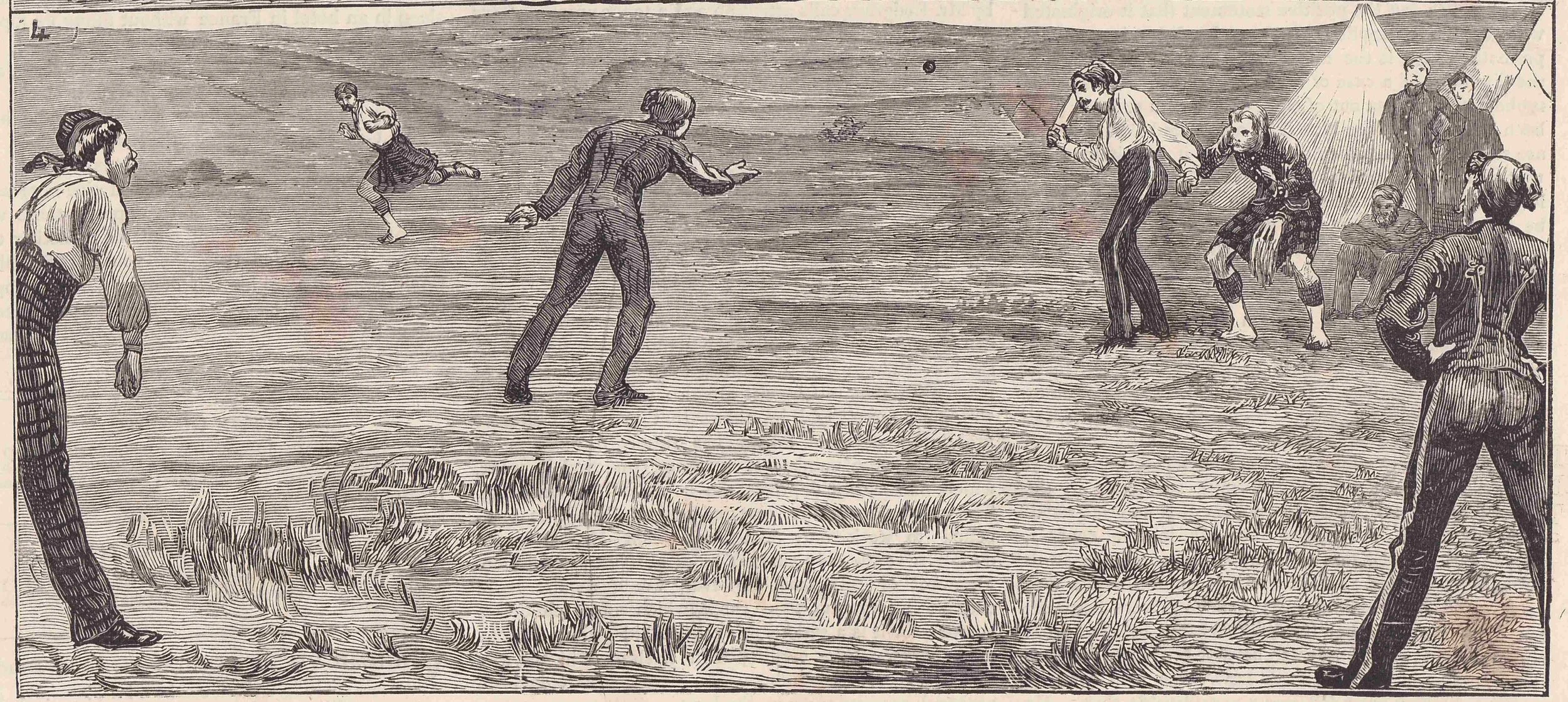
The Autumn Manoeuvres at Dartmoor, Graphic, 16 August 1873, 1. Author's own collection.
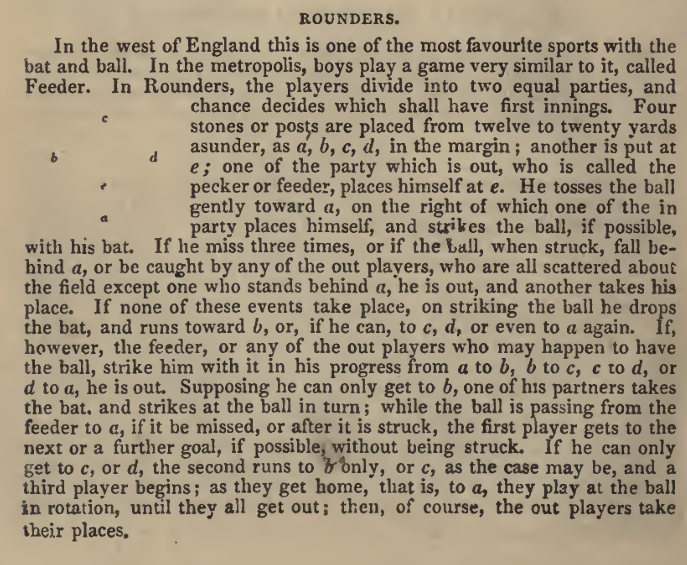
Earliest known full description of Rounders in English, William Clarke, The Boy’s Own Book (London: Vizetelly, Branston and Co., 1829 Edition), 20. Public domain.
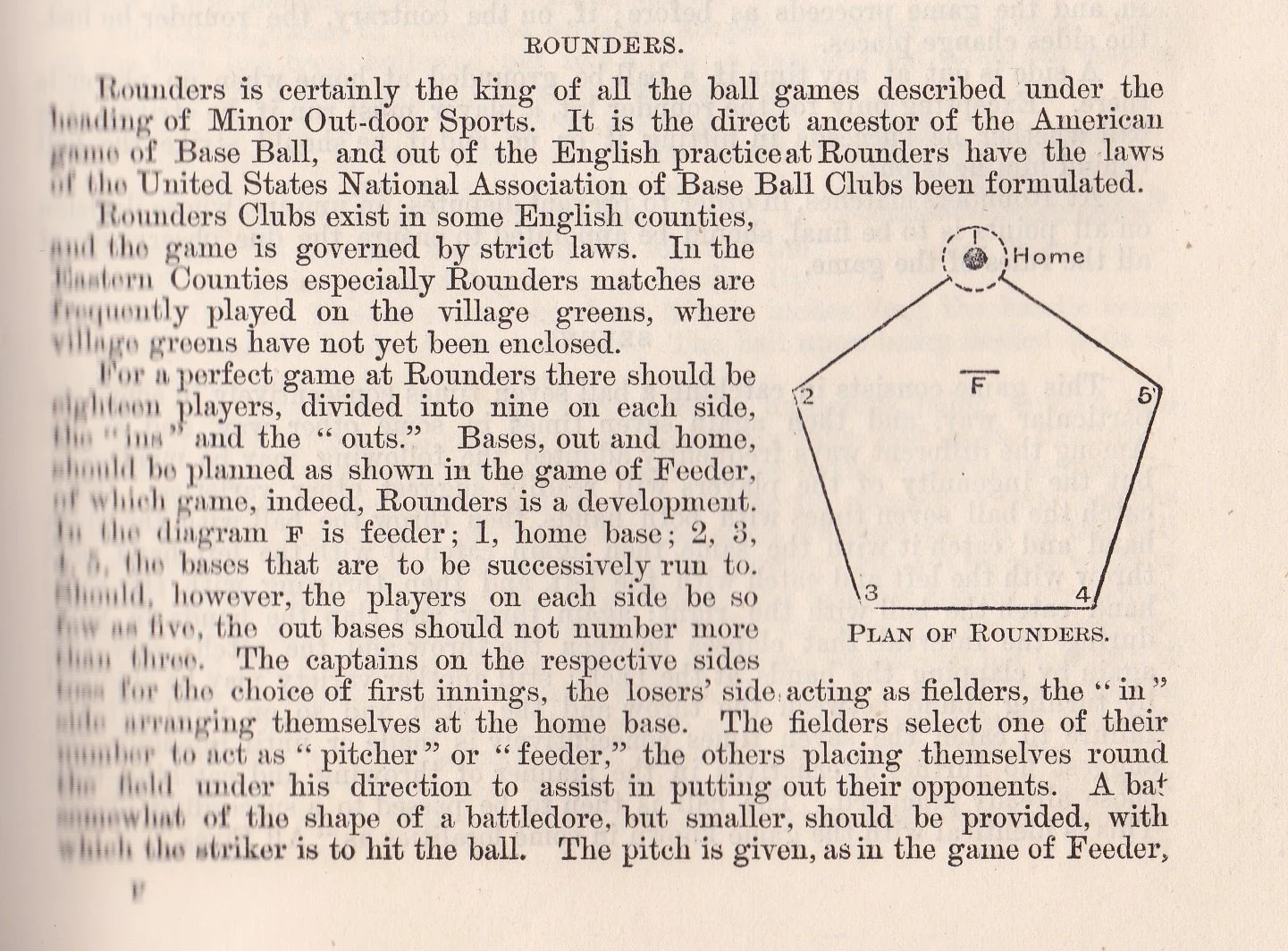
Description of Rounders, late nineteenth century. Cassell’s Complete Book of Sports and Pastimes: Being a Compendium of Out Door and In Door Amusements (London: Cassell, 1887), 222. Author's own collection.
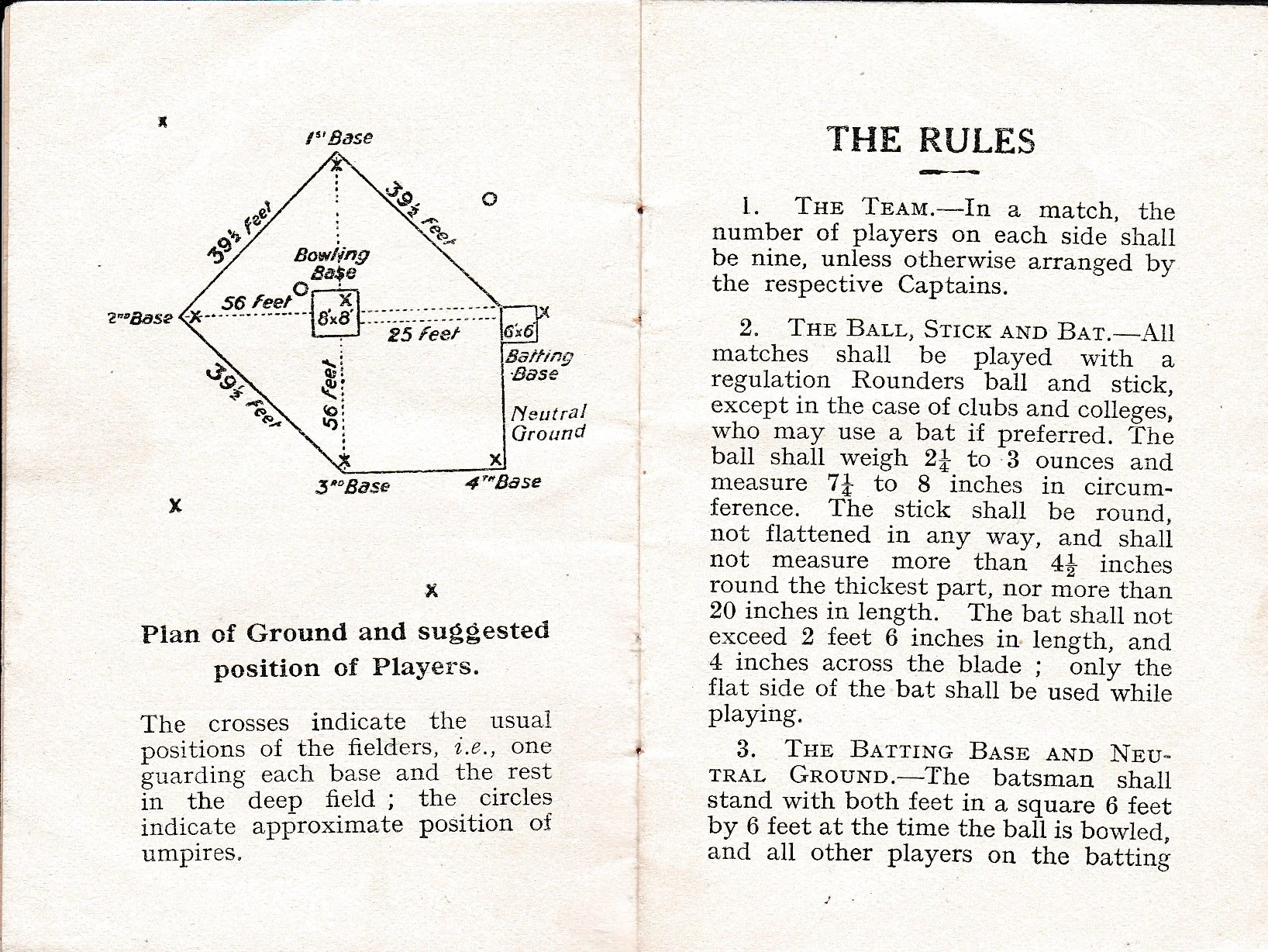
Layout and early rules for the modern game of rounders, aimed at school-age girls. The Ling Rules of the Game of Rounders, 1930 edition. Author's own collection.
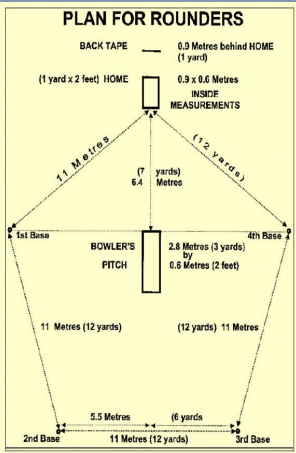
Layout of the playing field for Bolton Rounders, a modern version of the more traditional game. https://www.westhoughton-high.org/wp-content/uploads/Rounders-KO.pdf Copyright undetermined.